




Abstract
We explore the open innovation research model in order to remove barriers in service organizations, where lack of knowledge is the main barrier to innovation. The purpose of this paper is to propose a research model exploring the relationship between open innovation, organizational learning ability, absorptive capacity, and strategic innovation. In this study, we collected data from 330 pharmaceutical companies in Lahore and Karachi (Pakistan). The Structural equation model analysis was used through analysis of moment structures and statistical package for the social sciences to check the relationship between the variables. The results reveal that hypotheses related to innovation have been accepted. The findings of this study are evidence that various types of open innovation have different effects on strategic innovation. The inbound and outbound open innovation directly affects strategic innovation; the mutual effect of exploitative learning ability and explorative learning ability between open innovation and strategic innovation have indirect effects. Similarly, the empirical findings of absorptive capacity also significantly impact open innovation and organizational learning ability. This study contributes to the theory by introducing exploitative and explorative learning abilities as mediators between open innovation and strategic innovation. Moreover, it analyzes how absorptive capacity may enhance learning abilities through the open innovation phenomenon. Practically, this study would help the managers understand and improve organizational productivity and gain competitive advantage by creating, sharing, and utilizing knowledge through internal and external avenues.
Keywords
Introduction
Open innovation is an essential component of business models and pharmaceuticals. 1 Bogers, Chesbrough 1 stated the first proposal, that is, “Open Innovation” break the boundaries of the organization, have access to innovation processes; inside and outside enterprises that execute outside organization. Companies and organizations are more fundamental to manage the expert knowledge and technological skills of growth. 2 Many processes are still under study regarding open innovation management. 3 Insecurities are prevailing and external resources for innovative ideas are misused. 4 Opening up the open innovation requires new management styles and systems, adaptation to exploit open innovation potentials and reduce the induced risks. 5 The results of open innovative improvements and developments for the institution are the latest ideas and related employee’s expertise Chang, Gong. 6 A firm can adopt new technology and ideas to use information techniques efficiently to leverage them. 7 In addition, many academics regard the particular phase of learning as a “black box” in the organization, and its essential elements receive little attention. 8 Knowledge is used to innovate, exploit existing knowledge (a process of exploitation), and explore new knowledge (a process of explorations). It is all about the learning perspective and technology adoption in the firms. 9 Exploration and exploitation have different characteristics and impacts on the performance and development of products. 10
Levinthal and March 11 outline exploration as the pursuit of new knowledge of things that might come to be known, while exploitative defines the use and development of something already known. In this study, the relations of exploitative learning ability and exploration learning ability have been measured as coherent. Both innovation processes engage with the same outcome because of discrepancies between the resources to seek after this innovation processes. 12 The theory of organizational learning delineates the dual kinds of explorative learning and exploitative learning. 11 The purpose of organizational learning processes is to explore and exploit utilizing absorptive capacity. 13 Many internal factors such as management, human resources management, technical expertise, internal skills, and innovation are at the center of research. 14 This is because innovation is seen to be an event under the direction or execution of an organization. The external factors are incomprehensible, while external factors such as consumer expectations, rivalry, or undeniably management efficiency in companies such as the management operations are entirely invisible or, in some cases, controlled. 15
In addition to concentrating on external acquisition and adaptation, the role of absorptive capability (AC) is to keep information within limits. Dual dimensions can be integrated into internal procedural knowledge, and firms can also explore and evaluate external knowledge. 16 Cohen and Levinthal 17 describe the theory of absorptive capacity that illuminates the critical values, which allow companies to recognize external knowledge and adaptive innovation. The capacity to absorb organizational skills such as assurance, assimilation, revolutions, and externally exploited knowledge is anticipated to have innovative capabilities. 18 AC encourages companies that excel in external knowledge. 19 The development of service innovations, methods, products, plans, and markets are part of organizational learning processes. 20 Exploitable progress needs to improve the systematic approach for the development of internal procedures. 21 Because of diverse problems and issues, we need to establish an absorptive capacity perspective for exploratory learning. 22 The effect has been established between organizational learning ability (OL) and open innovation (OI) (both inbound and outbound), but still, there has been no study carried out concerning absorptive capacity. Thus, absorptive capacity must be examined in detail to look at both the development and technology sectors. 23 Open innovation is being reviewed in modern research as a unique and fascinating method for creating strategic innovation. The strategic effect of innovation by competitive environmental elements need to be investigated. 24 Besides its indisputable role in drug innovation, an important documentary has shown that internal science-based knowledge is an essential predictor of firms' ability to innovate even when companies cooperate with external partners. 23
Reviewing these arguments, it has been found that no study has been carried out involving absorptive capacity between open innovation and organizational learning. Moreover, some studies have shown that exploitative learning has little impact on innovation. Excessive focus on exploitative learning decreases companies' ability to innovate existing knowledge or change new product direction.12,14,15 Therefore, organizations need to use and keep the right balance between these two learning abilities. 19 The past studies show some matching relation between inbound and outbound open innovation but failed to explain the relationship between strategic innovation and organizational learning abilities. Most importantly, a research question arises: how can an organization’s strategic innovation be enhanced through learning capabilities? Similarly, in absorptive capacity, there is a complete lack of maintaining and renewal of knowledge. It faces a problem when the trend moves the absorptive capacity toward open innovation. The major obstacles in innovation are lack of knowledge, the difficulty of maintaining exploitative and explorative learning abilities and a high failure rate of strategic innovation. 22
In this context, this paper proposes a research model that examines the links between open innovation, organizational learning skills, absorption ability, and strategic innovation. Hence, the first objective of the present study is to extend the connection between open innovation (inbound open innovation and outbound open innovation) and Strategic innovation. The second objective is to examine the mediation role of organizational learning ability (exploitation learning ability and exploration learning ability) between dependent and independent variables. The third objective is to analyze the moderation impact of absorptive capacity between open innovation and organizational learning ability. Practically, this research study would help managers, entrepreneurs, innovation adopters, and technology suppliers better understand these dynamic capabilities of open innovation and strategic innovation, which can be transformed into competitive advantages and help face global challenges.
The subsequent sections of the paper have been organized as follows: In the “Literature Review,” theories related to open innovation and literature are presented that define our topic. Next is the section for hypotheses development. After that, “Research Methodology” has been elaborated. Then “Analysis and Result” section empirically supports the test by accepting or rejecting the devised hypotheses. Finally, in the “Discussion and Conclusion,” the conclusion is presented by summarizing the results of the empirical analysis showing the managerial implications and future directions.
Literature review and hypotheses development
Open innovation, exploitative learning ability, explorative learning ability and strategic innovation
Inbound and outbound open innovations play a vital role in acquiring new knowledge and developments, specifically developing strategic innovation (SI). The current studies define that open innovation has to pay ever-increasing attention to the research of strategic innovation. Open innovation uses purposive inflows and outflows of knowledge to accelerate internal innovation and expand markets for external use of innovation. The managing board of open innovation (inbound or outbound) significantly incorporates strategies, and many scholars can find out that the OI is the crucial component in the achievements of the organization’s SI. 25
Extensive discussion on empirical studies has been found on inbound and outbound open innovation because they had a substantial strategic interest in its competitive advantages. The SI is supposed to create strategic innovation and develop unique products or services and new processes to improve growth to change the game and produce new values for corporations. 26 Originally the strategic innovation was introduced between 1980 and early 1990. 27 Strategic innovation has a big impact on both corporate-level input and outcome. 28 It has been observed that the globalization of big firms was successful only when they developed strategic innovation by fronting various shortcoming resources.
Bertrand, Mullainathan 29 defines that strategic innovation could make profitable growth even during shrinking or mature markets for corporations preparing to take the risk and questioning the status quo. SI points out to the corporation to follow the methods that change the inward environment of competitors and grab the different strategic benefits from the competitors. Many firms have to exploit their performance with leading OI. Earlier research noted some complementary relationships of inbound and outbound open innovation; however, they were unsuccessful in discovering the open innovation impacts of SI. These unreliable findings indicate that combining a couple of other elements for attention-seeking when studying relationships of OI and SI is necessary. Few scholars emphasize presentation of worth, knowledge of inward and outward management, and other factors influencing firm innovation performance to execute the research. The view of this study presents that OI’s notion has explained the link among inbound OI and outbound OI and SI. Both aspects of open innovation (open inbound innovation, outbound open innovation) have been determined as an innovation. 30
Basically, inbound open innovation is stated as inner knowledge that allocates further knowledgeable fields, companies, and firms. Such standards define the practices as enhancing ways from other findings, but most firms do not depend on individual research and development. Knowledge advancement through those accomplishments did not drive internal investigations, even so, beneficial about business. These examples explain open inbound innovation; licenses, outsourced and sub-contracting. 30 Moreover, the study is expanded using a system based on supportive networks between companies, inlet and an outlet relationship, professionals, and economic system. 31 On the other hand, a shortage of research in active explicit inquiry exists that is directly capable of recognizing the paradigm of open innovation. Instead of consuming factual and concrete kind of open innovation (open inbound innovation) in past researches, the scholars also focused on patent analysis that was emerging latest classification of individual outcome. 32 Similarly, limited research has been carried out to choose realistic and rivals associates by open innovation, deprived of concern about diverse open innovation. 33
In recent times, the most significant way to emphasize open inbound innovation and vigorous deviations is by anticipating forms of cooperation and relationship. 31 Therefore, this study intends to activate functions and roles, classifying the vibrant revolution of the open innovation system and imposing different technological techniques in open innovation. This research emphasizes vibrant “metaphor” in lieu of the open innovation types—inbound and outbound. Basically, innovation is a multifaceted and complicated task. It must be recognized that innovation plays a dynamic role in commercial evolution by developing enduring firms, companies, and confronting communal trials. Moreover, it enhances the knowledge for the elements (industrial rank, district, and province), emphasizing more study, strategy, proposal, and preparation. Based on the relationships between a firm`s challenges and the impact of inclination of innovation, we propose:
Inbound open innovation has a significant association with strategic innovation.
Inbound open innovation has a significant association with exploitative learning ability.
Mediating role of organizational learning ability between open innovation and strategic innovation
Open innovation is an escalating concept in the modern era that was first declared by the book of Henry Chesbrough. 34 The organizational learning literature, also reported by March, 12 states exploitation as “the refinement and extension of existing competencies technologies and paradigm” and exploration as “experimentation with new alternatives that have a return that is uncertain, distant and often negative”. 11 In this way, organizational learning (exploitative learning, exploration learning) has a distinctive influence on open innovation (inbound and outbound). The exploratory concept is primarily perceived in high tech industries, and plays a vital part in innovation processes and open innovations that have supported more empirical demonstration. 35 This organizational learning method is absolutely dependent even though the firms produce and grow conjunctional competencies for the corporation in connections of boundaries span. 36 The firms encourage through the circulation of the knowledge and open innovation processes over the innovation system. Knowledge used for innovation exploits existing knowledge (a process of exploitation) and explores new knowledge (a process of exploration); it is all about learning perspective in the firms. 9 The perception of strategic innovation has grown to achieve prominence between management and academia. It still needs to be enhanced in the modern years.
On the other hand, it has to raise new technological inward ways to make potential working and forming techniques in the industrial side. Strategic innovation leads to the incredible perception that changes the value of customers. Wuyts and Dutta 37 concluded that the productive firms had not added value by setting roles for performing artists of start groups and customers. By putting the example of IKEA Ingvar Kamprad, Elmtaryd, Agunnaryd, it has to expand the innovative product for the customer making alliance, and require delivering and exchange of down price, best qualities and Swedish design furniture.
The scholars and practitioners have increased their interests in competitive advantages dependent on inside knowledge, and absorb outward knowledge. That is only about the existence of learning processes of exploitation and exploitation to convert the external knowledge into the innovation processes. 38
According to this, this study proposes the following hypotheses:
Exploitative learning ability has significant mediating associations between inbound open innovation and strategic innovation.
Explorative learning ability has a significant mediating association between inbound open innovation and strategic innovation.
Explorative learning ability has a significant mediating association between outbound open innovation and strategic innovation.
Exploitative learning ability has a significant mediating association between outbound open innovation and strategic innovation.
Exploitative has a significant association with strategic innovation.
Exploration has a significant association with strategic innovation.
Moderating role of absorptive capacity between open innovation and organizational learning ability
In past studies, exploitation learning and exploration learning have been explained. 39 Although, both exploitation-exploitation persuade unique goals, the actual measure of absorptive capacity (AC) in the perspective of exploration is distinctive compared to exploitation. Cohen and Levinthal 17 defined AC as “the firm`s ability to value, assimilate, and apply new knowledge.” The role of AC is not just to focus on outside gaining and adaptations for the outside information but also to embrace inward information. As per dual aspects has an ability to put force among inward information for the preceding capacities, and the organizations also have an ability to exploit and explore the outward information. The AC links to OL to encourage information to backup innovation and make changes to update goods and provisions of services. 16 In the rocket-shooting stage for business enterprises, profiteer organizations, SMEs, big companies, and so forth, the requirements of culture for open-labeled innovation dynamics may motivate open inventiveness and decrease the cost of open-label innovations (also known as innovation complexity), or open innovation paradox. 40
Raisch, Birkinshaw 41 have also used the concept of AC to explore and exploit learning. 42 Hence, OL promotes learning of inbound OI. Therefore, OI literature has been highly noted in recent years. 43 Thus, the nature of learning achievements is processed by encouraging competencies of exploitation and exploration for the latest outward information. Therefore, adaptations, exploitations and market-driven innovation for the given capacities of organizations are called AC. 18
The AC plays a dynamic role in OI after obtaining resources and securing the information. 44 In the current research, AC underlined OI’s best succession and looked for the experimental study on AC connected to OL with an OI appraisal. Research carried out in many EN (European Nations) and the United States of America indicates the link between exploitation on OI with the collaborations of AC. 45 Similarly, the information of AC leads to be well-known vital importance of OI. 46 The investigation reveals individual’s relevance for the absorption of the structure, and its preceding thoughts that it is a firm-level function of learning in assuring a company’s success. 47 The following hypotheses describe the links among the variables:
Absorptive Capacity has a significant moderating association between exploitative learning ability and inbound open innovation; Greater the impact of Absorptive Capacity has a more effective relationship.
Absorptive Capacity has significant moderating associations between Explorative learning ability and outbound open innovation; greater the impact of Absorptive Capacity has a more effective relationship. OL (inbound and outbound) relates to both the learning ability of exploration and exploitation together. As a result, the linkage between AC (Absorptive Capacity) and (Organizational Learning) OL has a more positive impact on acquiring information about both inbound and outbound. Figure 1 delineates the research framework based on the hypotheses.

Research model.
Research methodology
This research focuses on a deductive approach for testing the relationship between open innovation (inbound, outbound), organizational learning ability (exploitative learning ability, explorative learning ability), absorptive capacity, and strategic innovation. These variables are related to each other, that is, OL mediates the relationship between OI and SI and the AC plays moderating association among OI and OL. Several hypotheses have been derived to check the significant Variables. In this regard, a quantitative approach and cross-sectional strategy have been used.
A sample of 330 has been collected from the pharmaceutical companies of Pakistan through a questionnaire. The Ethical Research Committee approved this research, and informed consent was taken from the respondents. The respondents showed the extent of their agreement with each item on a 5-point Likert scale, ranging from “1 = Strongly Disagree” to “5 = Strongly Agree.” The scales adopted from previous studies consisted of items of Open Innovation (9 items), Organizational Learning Ability (7 items), Absorptive Capacity (6 items), and Strategic Innovation (3 items). In this study, the unit of analysis was pharmaceutical companies established and working in Pakistan
Analysis and results
Descriptive statistics
Demographics of respondents.

Table 1 divides into male and female responses with a frequency of 106 and 224, respectively. Therefore, the results show that the response of females is higher than the male response. In the age column, the frequency of respondents aged 21–30 years is 194, the frequency of respondents of the age group 31–40 years is 98, the frequency of respondents lying 41–50 years is 26, while the frequency that is ranging in 51 and above is 12. The table also shows that the middle-level managers were 291, while the top-level managers were 39.
Descriptive statistics.

Initially, the table shows the 330 cases represented by the letter N. Second, the mean represents the average. This study indicates that the mean response for inbound open innovation value is 3.950, with a minimum value of 1.25 and the maximum value of 5, while the standard deviation is 0.653. Similarly, the mean for outbound open innovation is 3.890, with a minimum value of 1 and the maximum value of 5, while the standard deviation is 0.653. Absorptive capacity has a mean value of 4.056 with a minimum value of 1.40 and the maximum value of 5, while the standard deviation is 0.653. Exploitative learning ability shows a mean of 3.852, with a range of 2.33–5, and the standard deviation is 0.653. Likewise, the mean value of explorative learning ability is 3.771 with a minimum value of 1 and the maximum value of 5, while the standard deviation is 0.653. The Strategic Innovation value is 3.870, ranging from 2 to 5, while the standard deviation is 0.653. Additionally, the data are generally within the normal range of Skewness and Kurtosis (i.e., from −1.0 to +1.0, and −3 to +3.49, respectively). In this table, the skewness values range from −1.225 to −0.577, and the Kurtosis values from −0.307 to 2.805.
Correlations between the variables.

**Correlation is significant at the 0.01 level (2-tailed).
*Correlation is significant at the 0.05 level (2-tailed).
The outbound open innovation is positive and shows a positive relationship with inbound open innovation with a value of 0.260 and an absorptive capacity (0.115). This is also correlated with exploitative learning ability that has a value of 0.403, and in correlation with explorative learning ability (0.298). Strategic Innovation also correlates with a value of 0.405. This table also shows that inbound open innovation has a positive relationship with absorptive capacity and exploitative learning ability (r = 0.196: 0.371, p < .05), and a negative correlation with absorptive capacity (r = −0.011, p < .05) with strategic innovation is (r = 0.436, p < .001). Absorptive capacity has a correlation value of 0.208** with exploitative learning ability and 0.336** with explorative learning. It also correlates with explorative learning ability having the value of 0.286** and strategic innovation with a correlation of 0.477**.
Structural equation model
The great advantage of Structural equation model (SEM) is that it helps refine and adjust the findings leading to a good study design. In comparison with other statistical strategies, SEM should handle multiplex circumstances well. 48 In addition, SEM is composed of two components: measurement model (cfa) and structural model. 49 IBM statistical package for the social sciences (SPSS) analysis of moment structures (AMOS), a global data analysis framework, has been used in this study. 50
Measurement model (CFA)
Essentially, confirmatory factor analysis (CFA) used in the research indicates that factors require good data health: reliability and validity.51,52 The CFA’s graphical demonstration has been displayed in Figure 2, with heading arrows showing the covenant, with variation values (distribution of data around a mean or known R square), arrows heading values (arrows from variable to element) representing the intercept values. Confirmatory factor analysis.
Model fit measure.

Average variance extracted and discriminant validity.

Note. AVE = average variance extracted; IOI = Inbound open innovation; OOI = Outbound Open Innovation; Exe_L = Exploitative Learning ability; Exv_L = Explorative Learning Ability; St_In = Strategic Innovation. The bold values in the diagonal are square roots of AVE (average variance extracted) of constructs; these do not have significance values.
Discriminant validity describes how different latent variables vary in measurements. The popular AVE of the square root of the respective latent structure inter-construct correlation estimates was determined. Table 5 shows that the square roots of AVE are in all diagonal structures are greater than their corresponding interrelationships. The proposed measurement model, therefore, provides better discriminant validity.
Reliability values.

Structural model
Figure 3 shows the graphical representation of the structural model provided by AMOS software. This graph represents the values (also in Table 7), representing a path coefficient with critical ratio (CR) and p values. Structural model. Structural model summarized. Note. IOI = Inbound open innovation; OOI = Outbound Open Innovation; Exe_L = Exploitative Learning ability; Exv_L = Explorative Learning Ability, St_In = Strategic Innovation.

Table 7 indicates that all estimates are positive, while p values are less than .05, indicating a positive and meaningful relationship between the variables.
H1 suggests a positive effect on strategic innovation for the inbound open innovation method. The H1 is accepted as (β = 0.114). A standard error is a 0.044, with a critical ratio value of 2.623, p-value < .05. Similarly, H2 implies a positive effect on strategic innovation for an outbound open innovation method. The H2 is also accepted as (β = 0.140). A standard error is a 0.040, with a critical ratio value of 3.508, p-value < .05. Likewise, H3a suggests that exploitative learning ability has a mediating effect between inbound open innovation and strategic innovation. The H3a is agreed as (β = 0.055). A standard error is a 0.085, with a p-value < .05.
H3b proposes an explorative learning ability and positive mediating association effect on inbound open and strategic innovation. H3b is agreed as (β = 0.060). A standard error is a 0.093, with a p-value < .05. The results of H4a suggest an explorative learning ability, positive mediating association effect on outbound open innovation and strategic innovation. The H4a is agreed as (β = 0.030). A standard error is a 0.048, with a p-value < .05. The findings of H4b suggests an exploitative learning ability, positive mediating association effect on outbound open innovation and strategic innovation. The H4b is agreed as (β = 0.064). A standard error is a 0.101, with a p-value < .05. H5 suggests a positive effect on strategic innovation for exploitative learning ability. The H5 is agreed as (β = 0.187). A standard error is a 0.041, with a critical ratio value of 4.572, p-value < .05. Finally, H6 suggests a positive effect on strategic innovation for explorative learning ability. The H6 is agreed as (β = 0.124). A standard error is a 0.040, with a critical ratio value of 3.118, a p-value of .002.
Moderation effect.

Note. IOI = Inbound open innovation; OOI = Outbound Open Innovation; Exe_L = Exploitative Learning ability; Exv_L = Explorative Learning Ability; AC = Absorptive Capability
***p < .001.
When evaluating hypotheses about mechanisms and contingencies of effects, commonly known as mediation and moderation analysis, numerous design, analytical, and interpretation considerations are made (e.g.,55,56,57). The moderation analysis was conducted using AMOS.
58
Table 8 shows the absorptive capacity as moderation between exploitative learning ability and Inbound open innovation. The above results of the table show that β = 0.112, p-value is < .001. This relationship approves the absorptive capacity moderation between exploitative learning ability and Inbound open innovation, as shown in Figure 4. Graph of moderation.
Table 8 also shows the absorptive capacity as a moderation between explorative learning ability and outbound open innovation. The table shows that β = 0.147, p < .001, and the value of r is R2 = 0.2776, which is also said to be appropriate 52.69%. This relationship approves the absorptive capacity moderation between explorative learning ability and outbound open innovation, as depicted in Figure 5. Graph of moderation.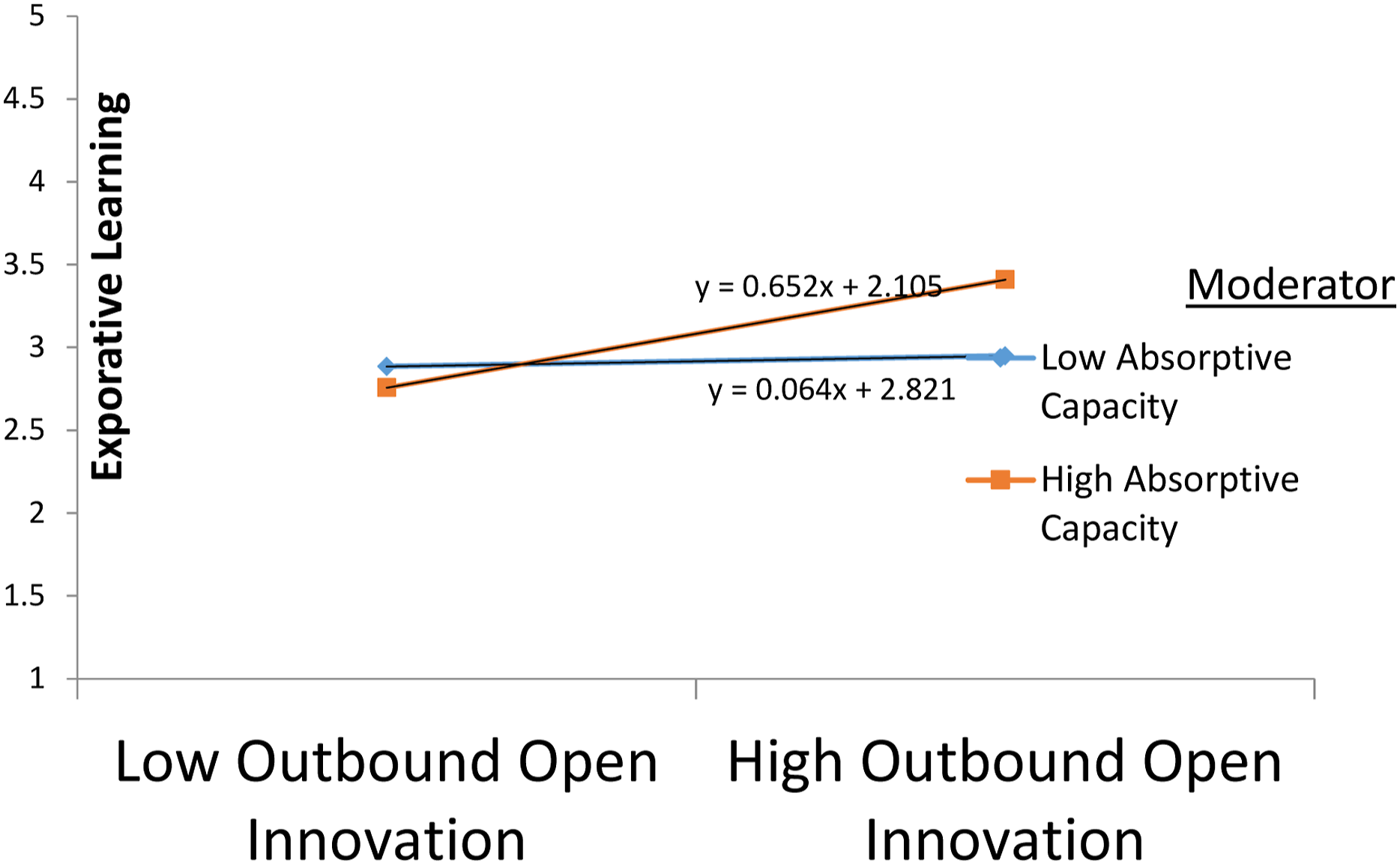
Discussion
This investigation aims to study an open model for innovative research to remove the barrier in service organizations, where the main barrier to innovation is lack of knowledge. It creates links between open innovation, organizational learning skills, absorption ability, and strategic innovation. This research supports the theory by introducing explorative and exploitative learning skills to mediate open innovation and strategic innovation. It also analyzes how absorbent ability through the open phenomenon of innovation can improve learning ability. The data from 330 pharmaceutical companies in Lahore and Karachi were collected in this study (Pakistan). In order to quantify and identify the relationship between variables, a questionnaire was adopted.
We highlighted absorptive capacity capabilities in hypothesis H1; inbound open innovation has a significant positive impact on strategic innovation. Similarly, H2 has a direct positive impact on strategic innovation. The establishment of H3a, exploitative learning ability, shows the positive mediating relationship between inbound open innovation and strategic innovation, the same for H3b, exploitative learning ability also plays a significant mediating relationship between outbound open innovation and strategic innovation. According to H4a, exploratory learning ability plays a significant mediating role with inbound open innovation. Formation of H4b, explorative learning ability plays a significant relationship in outbound open innovation. The construction of H5 shows significant results with strategic innovation. The same for H6 also shows a significant relationship with strategic innovation. Formation of H7, complete moderating role in the relationship between exploitative learning ability and inbound open innovation. Establishment of H8, complete moderating role in the relationship between outbound open innovation and explorative learning ability.
The findings of this research study show the enhanced research through the relationship between open innovation of both inbound open innovation, outbound open innovation on strategic innovation by mediation effect of the exploitative learning ability and exploratory learning ability and absorptive capacity as a moderator. The present study results prove that independent variables significantly impact the dependent variable in the presence of organizational learning abilities and absorptive capacity. In this research, previous research findings have been associated with findings under this research. The past studies also checked the relationship between these variables. Some scholars, specifically 55,59–61 argued that open innovation’s key external innovation sources are users and suggested the revolutionary view as “users are innovators.” According to, 62 open innovation should strike a balance between the capacity to profit from external knowledge resources and tap internal knowledge resources 63 and 64 conducted internal innovation study, and found that organizations should pay attention to the balance between exploratory and exploitative learning due to internal resource constraints. Because it is hard for businesses to create all technologies and markets solely through internal forces, they must constantly seek out useful outside knowledge that can be translated into internal personnel to absorb knowledge components and improve existing products and technology. Exploratory learning promotes innovative exploration of new knowledge and new abilities beyond the boundaries of previous experience, characterized by breaking dominant design standards and business processes, allowing for the production of a new combination of innovation. 65
The bootstrap method was used to check the mediation effect of exploitative learning ability and exploratory learning ability. According to the test results, Inbound open innovations do not directly affect the exploitative learning ability (p = .217) and have no direct effect on the exploratory learning ability as well (p = .294). Therefore, H1a and H1b were not accepted. The same approach positively influences the exploitable learning ability of outbound open innovation activities(p < .05). However, there is no direct relation between outbound open innovation and exploratory learning ability (p = .98), so that H2b was not supported. It implies that exploitative learning is a mediating factor that entirely impacts the path between outbound open innovations and strategic innovation. Because open innovation activities have no significant positive impact on innovation, exploitative and exploratory learning abilities, but serve as significant mediators in the relationship between outbound open innovation activities. The literature also showed that outbound open innovation activities significantly directly affected exploitative learning ability (p = .05) when measured using the same way. So, the results showed there was a full mediation effect.
5
Thus, exploitative learning ability is a mediating factor that impacts the path of outbound open innovation activities on the strategic innovation completely and the full mediation impact value estimate is 0.064. Initially, the results indicate that inbound open innovations could have a direct effect on strategic innovation, indicating that new ideas play a significant role, the results include (
The empirical results show that the effect of outbound open innovation on strategic innovation is promoted by exploratory learning and also evaluate the difference between exploitative and exploratory learning. The process of implications of outbound open innovation on strategic innovation demonstrates the value of the knowledge-sharing technique. The findings also suggest that inbound open innovation activities and outbound open innovation activities influence strategic innovation through exploitative learning ability and exploratory learning ability. The value of mediating effect of explorative learning ability between inbound open innovation and strategic innovation is (
Our results show that the Inbound Open Innovation method has a positive effect on strategic innovation (β = 0.114)—with a critical ratio value of 2.623 (p < 05): the standard error is 0.044. The H1 results in Table 7 suggest that the outbound open innovation method positively impacts strategic innovation. The absorptive capacity shows significant relation between inbound open innovation and exploitative learning ability (
Theoretical contribution
This study contributes to theoretical knowledge by enriching many significant relations between open innovation, organizational learning ability, strategic innovations, and absorptive capacity after data analysis.
Major implications of organizational learning theory and absorptive capacity theory have been revealed in this research. The first result indicates that open innovation directly affects strategic innovation, representing that strategic innovation makes new ways in the organization. The second result shows that inbound open innovation directly affects strategic innovation by mediating exploitative learning ability, representing the knowledge needed to refine and change the existing technologies. The third perspective of this research shows that the empirical research on outbound open innovation can directly impact strategic innovation through explorative learning ability, indicating that new knowledge explores new values. The fourth outcome is that the explanation of the knowledge is a process of innovation from an organizational learning perspective. These findings depend on knowledge management at the inter-organizational level. Because of a large degree of market uncertainty, it needs to refer to open innovation to make strategic innovation more successful. Open innovation brings the boundaries of external knowledge streams to inside knowledge that favors organizations to bring new knowledge and expand the inside market for progressive technological abilities. The fifth finding is that absorptive capacity plays a vital role in enhancing external knowledge and internal knowledge. All of these effectively reinforce the perception that improves and circulates within the organization and facilitate strategic innovation.
Managerial implication
Along with the theoretical contribution of the study, it also focuses on enhancing managerial implications. The developing impact of open innovation on strategic innovation needs to be developed as the core activity into the market’s organizations, knowledge, and technologies. Organizations should adopt open innovation, both inbound open innovation and outbound open innovation, to raise the performance of the innovation, inward and outward knowledge, to increase the level of both exploitative learning ability and explorative learning ability and reshape of strategies in the organizations. Primarily, the firms need to adopt technical strategies that emphasize the innovation process. The findings of this research prove the empirical evidence of open innovation on strategic innovation. Adopting open innovative activities is a more beneficial guideline to the managers to raise the business development. It also shows that appropriate measures, procedures, and the use of organizational learning ability help allocate and form organizational knowledge. This study also specifies that organizational learning ability is important for strategic innovation. Therefore, the organization should increase inward and outward knowledge to enhance the absorptive capacity to develop organizational learning ability. This may improve both knowledge management and innovation. These implications may be helpful to the employees. They can vigorously attain knowledge into the organization and motivate them to explore external knowledge and reduce problems and difficulties. This study focuses on the enormous impact of absorptive capacity through erection, assimilation, and reconstruction assets for enlarging knowledge competencies to create knowledge. Firms need to build knowledge first that intends to place the new information, provide the organized preparations, learning, and train to develop and produce the system of the organization as the firms need to enhance, strengthen the culture and strategies to remove organizational issues and innovation problems.
Therefore, all the management should be well-versed about the abilities, precise current market research, and complete information that will be the organizational power. Managers would know about the certainty of innovation into exploitative learning processes, exploratory learning processes, absorptive capacity and strategic innovation. The following are the significance of this study: first, this study would help managers understand the effect of open innovation on strategic innovation through organizational learning to increase efficiency, productivity, and gain competitive advantage through absorptive capacity. Second, the current research is developing new insights for management to explore new perspectives of open innovation and organizational learning through absorptive capacity acting as a catalyst that helps make decisions and improves extortion, pressures, and information development. The managers will gain high-level motivation and effectiveness through organizational learning because the knowledge exploits and explores new ways.
Conclusion
This study underlined the contributions to know and establish the research zone and recognizing the applied characteristics of open innovation (inbound open innovation and outbound open innovation). It contributes to the competencies of foundations and procedures of absorptive capacity. This study has organizational learning theory and absorptive capacity theory in Asia’s new perspective because Asian firms have the maximum potential for development. The relation between open innovation, organizational learning abilities, absorptive capacity, and strategic innovation has been worked out.
Complete data has been tested on SPSS and AMOS that were collected from pharmaceutical companies in Pakistan. The findings show that open innovation has a significant relation with strategic innovation by mediating the role of exploitative learning ability and explorative learning ability with the moderation of absorptive capacity. The majority of the hypotheses have been accepted as the p-value of all the variables is less than .05. This study would help managers gain motivation and effectiveness across the organization through organizational learning because the knowledge exploits and explores in a new way. Open innovation brings the boundaries of external knowledge streams to inside knowledge, which favors organizations by bringing new knowledge and expanding the inside market for progressive technological abilities. Absorptive capacity also plays an important role in enhancing external and internal knowledge that would help managers. These implications may also be helpful to the employees in general. They can vigorously bring knowledge into the organization to reduce problems and difficulties. Organizational learning ability, exploitative learning ability, and explorative learning ability are important to enhance the organization. And the managers would know about the certainty of innovation into Exploitative learning processes, exploratory learning processes, absorptive capacity and strategic innovation.
Limitations and future research directions
Although it is extensive research, however, some limitations could be addressed through future studies. Sample quality should be enhanced to attain further relevance. The research can be conducted at the national/international level, and the results may vary accordingly. Therefore, further investigation is required to check the reliance of open innovation on strategic innovation in the presence of organizational learning ability. This research can also be extended by adding other related variables in its theoretical framework, for example, knowledge sharing, organizational learning culture, empowering leadership as mediator effect. The longitudinal design of data collection in future studies would help understand the causal relations among them. Future research can also be carried out using other probability sampling techniques to increase generalizability.
Footnotes
Declaration of conflicting interests
The author(s) declared no potential conflicts of interest with respect to the research, authorship, and/or publication of this article.
Funding
The author(s) received no financial support for the research, authorship, and/or publication of this article.
