




Abstract
The globalization revolution has led to many countries considering advancing technology, which has led to electronic finance becoming an important aspect in all economic and financial sectors. This study aims to investigate the impact of information and communication technology (ICT) on the financial development index of six Gulf Cooperation Council (GCC) countries from the period 2000 to 2016. The results are reported in terms of two main ICT variables: fixed broadband and Internet users as a proxy of ICT and domestic credit to private sector as a percentage of gross domestic product (GDP) and broad money supply/GDP as two proxies of the financial development index. This methodology used fixed effects (FEs) estimations, and the results show that an increase in fixed broadband has a statistically significant and positive effect on both proxies of financial development. In terms of domestic credit as a percentage of the GDP proxy, the positive effects of ICT (broadband) are greater than the one from Internet users. A 1% increase in fixed broadband leads to approximately 2% increase in financial development, but the Internet user variable resulted in about a 0.09% increase. The other money supply proxy increased by 0.40% when ICT increased by 1%. Additionally, money supply increased by 0.11% when the Internet user ratio increased by 1% .To control for the endogeneity problem, the study used a generalized method of moments estimator, and the results confirm the previous results of the FE. Moreover, the negative impact of economic growth and natural resources was found to be valid and significant, while urbanization and trade openness were found to significantly and positively affect both financial development proxies. The main conclusion of the study is that GCC countries should take action in building an effective joint information system to help construct efficient economic sectors.
Keywords
Introduction
The impact of information and communication technology (ICT) in the financial economy has become increasingly apparent, increasing productivity to extend into foreign investment. In addition, several countries also build political and strategic relationships with each other and, resultingly, become free economies. 1
In recent years, ICT has become inconsistent within conventional systems in terms of improving the efficiency of financial systems. 1 Many developed countries enhance ICT, business intelligence, and business research to match the strategic trade of other countries. 2 The information technology sector enables several industries to maintain a competitive advantage in the global market through certain innovation services. Specifically, ICT refers to a wide range of IT technologies that address and manage electronic information. 3
The emergence of the ICT sector in society has enabled multiple aspects of companies’ operations, which are able to interact and conduct business activities more efficiently through their digital networks. 4 ICT has also significantly resolved issues related to time constraints and distance to increase the efficiency of financial and economic business activities. 5 Furthremore, ICT services are implemented by organizations of all sizes in both the public and private sectors of multiple industries. 6
Electronic finance have become one of the most important instruments for maintaining effective internal control over financial reporting, 7 and the use of modern financial applications has led to increased competitiveness 8 in communication sector. The rapid, global growth of the ICT sector has made it necessary for all countries to consider its causes, especially in terms of financial applications. 9 Specifically, Gulf Cooperation Council (GCC) countries are trying to increase their wealth by developing their industrial sectors to advance their international economic classification.
Many studies have indicated a positive correlation between the use of electronic applications and financial growth. A positive correlation has also been observed between a country’s economic development and mobile phone usage. 1,6 Providing E-information allows for a reduction in price fluctuations while simultaneously supporting economic sectors. Some studies, such as those by Costello and Donnellan 10 and Dewan and Ramaprasad, 11 have focused on the impact of economic variables on small- and medium-sized enterprises, while other studies 3,9 have focused on iPhone mobile applications and have a greater impact on social aspects.
Donner 9 noted that ICT primarily contributes to economic and social development and also has a major impact on improving employment and productivity rates. The 10% improvement of the level of technology will lead to a 0.75 reduction in the percentage of unemployment and a 1.02 increase in the proportion of per capita gross domestic product (GDP). 12 Another study 13 also confirmed that technology plays a key role in reducing poverty, increasing job opportunities, and improving living standards.
ICT encompasses software, hardware, media collection, storage, networks, transmission, processing, and presentation of information 14 .Moreover, fixed, mobile, and Internet networks all constitute the ICT infrastructure. 15 The rapid expansion of ICT activities is critical to economic growth, and the use of this technology enables all companies to determine how economic and social life information accessibility can help companies reduce production costs and improve productivity. 15
The ICT sector is an important sector because it contributes to cost reductions of financial intermediation services, including commercial banks and microfinance institutions, to expand business activities. 11 The ICT sector facilitates the operations of bank branches by increasing their flexibility of operations as well as banking risk disclosures to ensure the banking sector works safely. 16
In addition, ICT allows for an improved collection of information, which can be used to more efficiently determine applicant creditworthiness to help facilitate deposits. 15 Therefore, information technology and communication networks can efficiently improve access to the Community institutions. 17 Countries have increasingly found new ways to improve financial integration, and ICTs, such as mobile financial services, have become essential for assessing whether these plans can promote economic growth. 18
This study aims to provide information on ICT, especially the Internet (% of the population), which is used as ICT policy variables, and fixed telephone subscriptions, which play an important role on financial development. Specifically, this study will attempt to address the gap of infrastructure in the telecommunications sector. This sector contributes to the development of the financial sector and positively reflects on economic growth in GCC countries. The implementation of this study within the GCC countries adds value to the previous literature, since these countries receive revenue from their oil wealth, upon which their economic systems are formed. The economic systems also involve electronic financial systems that require financial resources to ensure the effectiveness of all economic sectors. This study took place over a period of 17 years from 2000 to 2016.
The main contrbution of this study is its analysis of the ICT sector, using Internet (% of population) use as an ICT policy variable and fixed telephone subscriptions on financial development sector. This study aims to stimulate the prominence of the telecommunications sector in terms of its process for economic and financial development. The operations of ICT also increase the speed and accuracy of electronic activities in a society. The efficiency of ICT processes contributes to cost reduction, which subsequently helps increase the productivity of the telecommunications sector. Furthermore, the development of the ICT sector within GCC countries improves these countries’ worlds’ rankings while also contributing to a well-established growth accounting framework to evaluate the role of ICT as capital input.
This article is organized as follows. Following the introduction, the applications of E-finance in ICT and financial practices will be discussed. Then, a review of previous empirical studies that have analyzed the effects of ICT indifferent countries will take place followed by a presentation of the methodology, which includes the data and the analyzed variables. After this, focus is placed on the results of the empirical study and the subsequent discussion. The last section contains the conclusion and policy implications.
Applications of E-finance in ICT and financial practices
ICT provides several benefits within the business sector specifically through its efficient, fast-paced, and electronic storage and communication components. ICT is now a platform that has been integrated into all workplaces to manage all activities of ICT in a cost-effective manner. 18
Information technology is designed to finance world-class work. Specifically, the financial market is an example of global markets that operate through the Internet. 9 Without information technology, financial markets cannot compete with global development, and financial companies cannot continuously and competitively persist in society.
ICT allows for the effective management of online services and provides financial institutions with valuable information. 7 It also creates an electronic storage system that helps protect a company’s records. 11 The Internet is a tool of communication and information technology, helping to store a wealth of information to main analysis trends, technology, programs, and human resources. 12
Opportunities for the development of e-commerce have led to the creation of many opportunities in society. 18 Information technology and communication services have become available in online banking systems, providing online banking services, e-banking services, and banking services to Internet companies. 8,10
These banks are centrally operated, provide suitable governance, and understand the value of the learning process. 15 The e-operations often involve technological advances, such as reducing transaction costs, expanding access to target customers, more efficient systems and technologies to enhance customer information collection, and allowing for diversification products between customers. 12 They are also the most effective tools for controlling efficient, internal processes. 4 Electronic commerce has become an important business term over the past few years, helping to increase ICT use to simplify work procedures. 13
Several governmental and private institutions alike have used electronic applications to implement their work in different units, and, more recently, it has become a criterion for ranking these institutions. 4 The banking sector has been one of the most prominent sectors in the field of electronic finance in terms of providing its services to customers in a more accessible manner by offering electronic payment services, electronic transfers between customers, transfers, and cash registers. 12 Smartphone applications have also had a significant impact on the development of the ICT sector, and many financial transactions are now being carried out through these phones. 9,13 The use of the Internet has also contributed to for growth of the ICT sector. 9
This article presents a comprehensive understanding of GCC countries and the digital economy. Internet activity and digital technology use have grown rapidly among these countries despite certain geographical and natural resource differences, and this shift presents a major opportunity in the context of policy agendas. GCC countries have been trying for economic diversification in the region. As presented in Table 1, these countries have some of the highest penetration rates for Internet and mobile phone use, with particularly high rates among youth, resulting in a skilled generation of technology consumers. Thus, these GCC countries will play a significant role in dictating digital development in the Middle East.
Internet metrics of GCC.

Source: Prepared by Authors extracting data from ITU (2016) and Measuring the Information Society Report. 19
Literature review
ICT has a major impact on economic and social aspects. 10,15 This sector has developed in many countries over the past three decades, 16 and the methodologies differ at both the national and international level. More extensive studies on the use of ICT can encompass to a GDP, productivity, and employment. 8
Major developments in the ICT sector used to be mainly concentrated in developed countries, since these economies not only work to transfer resources and stimulate growth but also address the needs of their beneficiaries. 1 In recent studies, 5,7,10,11 however, the positive impact has been in the ICT sector due to the association between this sector and other economic activities, such as transport, electricity, investment, inflation, and water. To provide an analysis of the previously mentioned variables, a study 20 found that fixed investment has had a positive impact on economic growth and that investment in public sector infrastructure such as ICT also plays a prominent role in promoting economic activity growth. It is also noted that low- and middle-income countries have the advantage of investing money in economic activities. 21
Chowdhury 6 argues that the increase in number of Internet users by 1% contributes to a decrease in the impact of inflation by 40%, which explains how communication technology improves the economic environment. This study focuses on how investing in ICT can contribute to increased corporate performance calculated by three indicators: internal rate of return, labor productivity, and expansion in local export markets. The results indicate that the ICT investment sector has a positive impact on the general expansion of the market. On the other hand, it has a negative impact on labor productivity, and this investment has no significant impact on the performance of the company.
More recent theories note that economic growth should be facilitated by the development and adoption of process innovation. New growth theories point to the effects of modern telecoms and networks, which show that Internet technologies have different quality standards. 22,23 Furthermore, the technology sector in this type of study is examined in the following studies.
Romer 22 argues that the diagnosis of long-term economic growth based on an increase in the margin of production leads to the improvement of input quality that contributes positively to achieving a competitive advantage. This feature is apparent through the use of technology, which is emerging faster in larger countries than smaller countries. He also explains that the trend of returns in the long-term is greater than the short-term. ICT helps distribute ideas among institutions and promotes the role of competition in the development of innovative products that contribute to the creation of effective activities in a macro economy.
Benhabib and Spiegel 24 highlighted that certain emerging countries follow developed countries in their use of technology, while the Nelson-Phelps catch-up model of technology diffusion was used to predict total factor productivity growth. Additionally, they explain that 22 of 27 countries exhibit low levels of human capital but have experienced more rapid growth of productivity than the leading countries. Datta and Sumit 25 pointed out that the economic benefits of information technology and telecommunications can be directly affected by a country’s increase in labor and demand and can indirectly contribute to social revenues. Also, investment in the telecommunications sector is increasing, making up the main factor involved in productivity growth in countries’ economies. Also, indicate a strong and positive relationship between the ICT infrastructure and the economic growth of the 22 of Organization of the Petroleum Exporting Countries (OPEC).
As mentioned in the above studies, investment in ICT contributes to cost reduction by adopting information systems for retrieving data, improving the flow of information, strengthening the betting process in the market, and presenting market forces with a balanced supply and demand. 16 A negative impact can result from opportunity costs involving investments, expenditures, information technology, communications, food, education, education, skills, and so on. 26
This development of the investment sector will contribute to economic growth, infrastructure in countries as study of Hardy 27 which found that the relationship between ICT, smartphone use, and economic growth is positive, specifically indicating the major role of phones in economic and financial growth via the increase in telecommunications sector.
Meanwhile, Norton 28 proves that the infrastructures of ICT and economic growth are significant and positive. Also, networks of infrastructure communication are important in economic growth, as Waverman et al. 16 argue that mobile- and fixed-line phones indicate that countries have developed advanced mobile phone networks, which has led to an effective positive impact on growth in these developing nations. Also, Madden and Savage 29 explain the positive relationship between investment and infrastructure based on developing the ICT sector to achieve economic growth.
Trade freedom positively contributes to the increasing productivity of the ICT sector, since Frehund and Weinhold 30 examined the impact of Internet services on business processes and found that the relationship is significant and positive. This study examined how economic openness and trade freedom are important factors in increasing the welfare of societies and their technological development. Specifically, economic openness has also contributed to an increase in foreign investment, where the key to this is technology and has been proved in a study. Choi 31 explains that the increase in the quality of technology in a country positively contributes to its income from foreign investments, which is reflected in its GDP. Additionally, Choi 31 pointed out that the impact of increased Internet use is a point of attraction for foreign investment, which help contribute to improving productivity. This study found, via a weighted squares analysis, that when the number of Internet hosts or users in the host country increased by 10%, inflow of foreign direct investment (FDI) increased by more than 2%.
Meanwhile, Frehund and Weinhold 32 pointed out that the Internet has a positive impact on bilateral trade, reducing the fixed costs in the market and indicating that the Internet stimulating trades. In addition, a 10% increase in Internet usage could lead to a 2% increase in export growth. Furthermore, the Internet does not directly affect the relationship between distance and trade; however, at the same time, it enhances competition as a result of the evolution of services due to Internet use. There are also some obstacles, including misuse of energy, unequal income, location, high costs, electronic models to the progress of the telecommunications sector, as the following studies indicate. For example, a study by Noh and Yoo 33 examines the impact of Internet use and unequal income on the growth of a country’s economy. Data were collected from 60 countries, and the results found that the adoption of the Internet is a negative indicator for countries that suffer from income inequality because the digital divide hinders economic and financial growth.
Furthermore, misuse of energy as a part of ICT also negatively affects economic growth, as Ishida 34 argues. This study estimated this long-term relationship and divided the model between the production and demand function. The results showed that there is a stable long-term relationship not only for the production function but also for the function of energy demand. However, in terms of production function, the long-term impact on IT investment is statistically inaccurate. The results indicate that the long-term flexibility of investment in the ICT sector is energy consumption. Thus, the prevalence of ICT moderately and evenly contributes to energy consumption but does not contribute to an increase in GDP. Furthermore, Shiu and Lam 35 indicate a significant correlation between development and economic growth in high-income countries, which will play an active role in increasing GDP.
Cieślik and Kaniewska 36 pointed out that growth of the infrastructure of countries are affected by the level of implementation of electronic services in a country. A theoretical model was developed to determine the positive causal relationship between the infrastructure and national income level. It also noted the need to constantly consider communications policy as an integral component of regional policy, aiming to reduce disparities in spatial income levels in Poland. Additionally, this study noted that the cooperation and coordination among the European Union regulations positively reflected on regional development in Poland.
Additionally, the electronic model effect on ICT sector growth, as Najarzadeh et al. 37 found, involves appositive and strong relationship when using electronic applications in production. The study indicates the Internet performs multiple functions, especially regarding economic activities and transactions. The results showed that the Internet has a positive impact on productivity, and when Internet use increases by 1%, it will lead to an increase in GDP by US$8–US$14. Additionally, education, health, and capital formation sectors contribute significantly to improving production. On the other hand, the low cost of ICT is essential for improving the economic performance; as Gruber et al. 38 estimated, the returns and cost of broadband infrastructure through different assumptions of technical performance. Their findings reveal that benefits from the expansion of broadband coverage will increase economic growth. Also, they indicate that the implementation of the broadband infrastructure objectives requires a precise digital plan. Broadband infrastructure revenue depends on how quickly the service is implemented. Furthermore, costs and revenues are closely associated with each other, displaying a positive relationship with broadband usage. Moreover, public policy plays a prominent role in supporting broadband infrastructure. The cost of ICT software also plays a prominent role in financial development, as Salahuddin and Gow 39 argued, in terms of long-term economic growth.
The political, social, and policies sector is a critical element in economic growth that affects ICT cost, as examined by the following studies:
Nasab and Aghaei 40 indicate that the governments of OPEC support the demand for the Internet to expand into all industrial and service activities. Also, they suggest that economic growth stems from ICT investment, which requires the implementation of specific policies that facilitate this sector’s investment. Qiang et al. 41 explain that Internet broadband usage leads to a greater increase in GDP in developing countries than their developed counterparts.
Crandall and Singer 42 highlight broadband use as an investment that contributes to creating jobs and increasing employment rates. Specifically, they refer to an analysis on the economic impact of broadband aiding consumer welfare, job creation, and production, revealing that broadband use predictions are conservative in terms of their reflection of economic and labor well-being. Additionally, they noted that economic policies play a major role in identifying the determinants of ICT investments.
Dimelis and Papaioannou 43 argue that the largest impact value of ICT concentrated on size, strong relationships between countries and percentage of foreign investment .Their results reveal the potential effects of FDI on the growth of productivity in 42 different countries. They also show that ICT growth is high in emerging countries, while the proportion of foreign investment is relatively low. Additionally, the increase in foreign investment had a positive relationship with communication and information technology.
Thompson and Garbacz 44 found that, in less wealthy countries, there is a significant impact of mobile broadband use on economic development and thus the positive GDP. The study indicates that the significant growth in broadband communication services has also led to increase in financial growth. The results of the estimated sample indicate that mobile broadband has a significant, direct impact on GDP, while low-income countries benefit more from broadband.
Zagorchev et al. 45 suggest that incentives and policies in the ICT sector play a prominent role in promoting ICT investments to stimulate financial development and positive economic growth. He noted that the timing of ICT deployment varies by country, and that electronic technologies and applications have boosted the growth of several economic activities, such as agriculture and industry. Financial development speeds up the process of technology deployment, which can cause greater responses to changes in financial development. Also, they suggest that certain sector-specific technologies introduced in less developed economies.
Yousefi 46 showed that ICT impact was more significant in middle-income countries than high-income countries, and, in both cases, it positively contributes to economic growth. This proves that country income level affects the different responses to the development of the telecommunications sector.
Through these previous studies, the results can be divided into four pillars, the first of which referred to the impact of ICT electronic finance on financial development. Specifically, Tcheng et al. 20 indicate that electronic applications stimulate foreign investment, which in turn helps boost economic growth. Haacker 21 highlighted that technology application prices are important in assessing the extent to which they are used to build the infrastructure of countries. Waverman et al. 16 highlighted that cost is considered an important variable in determining the level of electronic application use, since cost subsequently determines the price of service delivery, which itself is determined by the level of supply and demand in the market. Cost is a key element in attracting and using the electronic applications of a country in all product, industrial, and service sectors. Various studies 29,31,43 have highlighted how the development of infrastructure via its adoption of information technology contributes to improving the level of domestic and foreign investment. Meanwhile, other studies 30,32 have indicated that electronic services contribute to the efficient implementation of financial facilities in financial markets, which improves trade; however, the usage of these services depends on their cost, as noted by Chowdhury, 6 and electronic use helps reduce inflation.
The second pillar is the impact of ICT electronic finance on economic growth. A study by Benhabib and Spiegel 24 referred to electronic applications which determine the level of economic growth and its speed. Other studies 42,37,20 have revealed that, in many industries, technology is used to execute operations by innovating and stimulating productivity. In a study by Datta and Sumit, 25 they highlighted that productivity levels may competitively increase from advanced technology use, which subsequently increases companies’ incomes. Furthermore, Salahuddin and Gow 39 pointed out that the use of electronic applications (e.g. Internet applications) may also contribute to sustainable development.
The third pillar is the impact of ICT electronic finance on social development; as Crandall and Singer reveal, 42 ICT contributes to improving employment rates. However, other studies 16,34,35,44 have shown that the use of smartphone applications positively contribute to economic growth, especially GDP. Finally, the fourth pillar refers to the impact of ICT electronic finance on laws and legislation development, as Cieślik and Kaniewska 36 pointed out, which can determine the importance of income level in the development of the countries’ infrastructure as well as the development of their electronic service sectors. Zagorchev et al. 45 highlighted that policies in the telecommunications sector play a prominent role in stimulating financial and economic development.
The present study highlighted GCC countries. This study is the first in the field to examine the ICT sector through electronic financial activities and their overall impact on financial development. This study is filling the gap to the economic dimension by identifying financial indicators and addressing the impact of the Internet and its usage on electronic finance.
Methodology
Data and empirical model
This study examined a panel of six oil-dependent economies in GCC countries (Kuwait, Qatar, Oman, Bahrain, UAE, and Saudi Arabia) using data from the World Development Indicators (WDI) 47 of the World Bank during the period 2000–2016. Consistent with recent literature, two different proxies for ICT were used similar to those presented by Tchamyou 48 and Amavilah et al. 49 Individuals who use the Internet (% of the population) was used as an ICT policy variable to specifically refer to both corporate and individual Internet users who have used the Internet in any region in the last 3 months. 47 This included several different sources of Internet: computers, mobile phones, personal digital assistants, gaming devices, digital television, and so on.
Asongu and Roux 50 specifically examined fixed telephone subscriptions, specifically in response to the reforms in subscriptions that help more rapidly access public Internet except for Internet subscriptions through mobile cellular networks. These previous indicators became two main independent variables in the present study, while the main dependent variable was financial development. A review of the literature indicated that there are various ways to measure financial development; for example, monetary aggregate M2 as a percentage of nominal GDP is a measure of financial depth. However, the availability of foreign funds in governments in the financial system makes the total monetary a mediator to financial development. For enhance robustness, therefore, this study used another proxy of financial development: the deposit liabilities-GDP ratio. This variable takes into account the ratio of broad money supply/GDP and plays a major role in financial intermediary effectiveness in the market. This variable was collected from the WDI. 47
Four control variables 47 were used by previous studies on financial development determinants, namely GDP growth rate, which refers to the total value of production in the same country. Trade openness refers to opportunities to trade with other countries without strict restrictions, while the urbanization ratio refers to the population shift from rural regions to urban cities and towns.
Bhattacharyya and Hodler 51 included the oil rents to GDP ratio as a control variable to refer to the volatility of oil prices as a percentage of GDP within the petroleum sector. Inclusion of this variable allows for the validation of the natural resource-finance curse. Table 2 lists the descriptive statistics for all variables used in this study and presents the standard deviation data for the entire series, which is approximately distributed around the mean. It shows that, on average, approximately 45% of the population in GCC countries uses the Internet, depicting that ICT is very important within these economies. Furthermore, the domestic credit constitutes about 59% of GDP, while the broad money supply/GDP constitutes 53%.
Descriptive statistics.

Source: STATA.Version 15 output.
FD: foreign direct; GDP: gross domestic product; ICT: information and communication technology.
Table 3 presents the pairwise correlations matrix. The correlation coefficient variables do not pose any multicollinearity threat as indicator models of ICT.
Pairwise correlations.

Source: STATA.Version 15 output.
FD: foreign direct; GDP: gross domestic product; ICT: information and communication technology.
* Significant at the 0.05 level.
To avoid spurious regression, panel unit-root tests were performed for all variables. Table 4 presents the results of the panel unit-root tests versions with trend and lags, which were included to provide greater robustness. The given p values exceeded the conventional significance levels at first difference; thus, it can be concluded that all variables were stationary at first difference, meaning all were integrated of order one I (1). Thus, one might predict a long relationship between these variables. The next step involved examining the co-integration test, which was done via the Kao test for co-integration. The results of the Kao test are reported in Table 5.
Panel unit-root tests.

Source: STATA.Version 15 output.
ADF: Augmented Dickey–Fuller test; FD: foreign direct; GDP: gross domestic product; ICT: information and communication technology; PP: Phillips–Perron test.
***p < 0.01.
**p < 0.05.
*p < 0.1.
Kao co-integration test.

Source: STATA.Version 15 output.
ADF: Augmented Dickey–Fuller test; HAC: Heteroskedasticity and Autocorrelation Consistent Covariance.
After performing Kao test for panel co-integration (residuals-based test), it became clear that Kao statics were significant at 5%. In this case, the null hypothesis that there is no co-integration was rejected, which means there is a long relationship between the dependent and independent variables. The next step involved identifying the presence of the multicollinearity problem. Therefore, a variance inflation factor (VIF) test was used.
Table 6 presents the VIF results for the two estimated models. A close examination of the statistics revealed that all VIF statistics were less than 10. Conventionally, if all VIF are less 10, there is no multicollinearity issue in the models.
Variance inflation factor.

Source: STATA.Version 15 output.
GDP: gross domestic product; VIF: Variance inflation factor; ICT: information and communication technology.
The study first applied the FEs model as a preliminary estimate to take into account the country characteristics effect (heterogeneity). However, due to its inability to control for the effect of reverse causality and omitted variables (endogeneity), an alternative estimator was adopted to give the power to our results: the generalized method of moments (GMM) estimator. The GMM estimator allowed for the elimination of the differences between countries via panel data analysis. In addition, the estimation procedures mitigated the heterogeneity of data in the control process by using an instrumentation process.
The use of time-invariant indicators also improved upon the issue of homogeneity, as Bond et al., 52 Arellano and Bover, 53 Blundell and Bond, 54 and Arellano and Bond 55 presented better estimation techniques when compared different metrics with others. Most of the empirical studies on panel data apply the system GMM, which proposed by Arellano and Bover 53 and developed by Roodman 56,57 . The system GMM estimator, despite using more instruments, is less biased than the first differencing and level GMM estimators by deriving the second order bias of the system GMM estimator. And System GMM is fit for the small sample studies (Love and Zicchino 58 and Baltagi 59 ).
This study estimated the following model:

where FDi,t is financial development measured by two proxies of domestic credit as a share of GDP and broad money supply/GDP; ICTi,t is a proxy of electronic finance measured by Internet (% of population) and fixed telephone subscriptions; GDPgrowthi,t is the GDP growth constant prices USD 2005; Nat.resi,t is the natural resources proxied by natural resource (oil) rents as a percentage of GDP; Cont.Var is the control variables including urbanization and trade openness; ϑi is the country-specific effect; and ∊t is the error term.
Results and discussion
The Hausman test strongly rejected (at 1% significant level) the null hypothesis of an efficient random effects model; thus a FEs approach was used. This method reduces various biases as well as minimizes the risks of possible multicollinearity by focusing on variables and helping control persistent phenomena within the country.
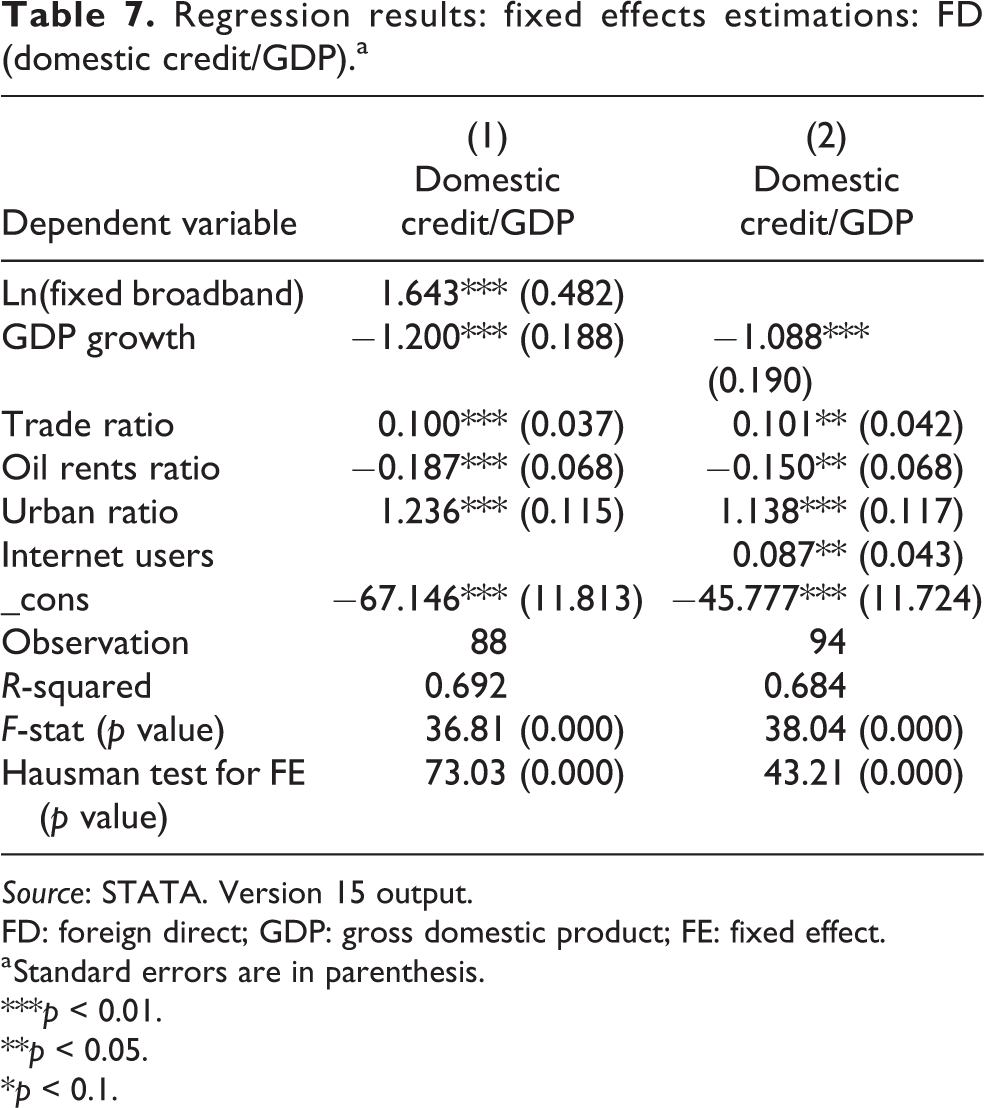
The results of the FEs estimations are reported in Table 7. The results are reported for two main ICT variables: fixed broadband and Internet use. The results show that information and technology communication boots financial development in GCC economies. It was also found that an increase in fixed broadband has a statistically significant and positive effect on domestic credit as a percentage of GDP. The positive effects of ICT1 (broadband) are greater than the one from Internet users. A 1% increase in fixed broadband leads to an approximate 2% improvement in financial development, while the Internet user variable results in about 0.09%. Consistent with economic theory, trade openness and urbanization were statistically significant at a 1% significance level and had a positive effect on financial development.
Regression results: fixed effects estimations: FD (domestic credit/GDP).a
Source: STATA. Version 15 output.
FD: foreign direct; GDP: gross domestic product; FE: fixed effect.
a Standard errors are in parenthesis.
***p < 0.01.
**p < 0.05.
*p < 0.1.
The model was reestimated again using money supply as a proxy of financial development. The results of these estimations are reported in Table 8. It can be seen that ICT measured by broadband promotes financial development; however, in terms of magnitude, the impact of ICT on broad money supply/GDP (measure of financial development) is smaller than the one on domestic credit. The results show that money supply increased by 0.40% when ICT increased by 1%. This impact became smaller when Internet use was an alternative to financial development. Additionally, money supply increased by 0.11% when the Internet user ratio increased by 1%.
Regression results: fixed effects estimations: FD (money supply/GDP).a

Source: STATA. Version 15 output.
FD: foreign direct; GDP: gross domestic product; FE: fixed effect.
a Standard errors are in parenthesis.
***p < 0.01.
**p < 0.05.
*p < 0.1.
It was also found that economic growth deterred the financial development measure. It was statistically significant (at the 1% level) and had a negative effect on the domestic credit/GDP ratio for the considered GCC countries. This result is consistent with the findings of Narayan and Narayan 60 while inconsistent with Beck and Levine, 61 who concluded that bank credit significantly enhanced economic growth for a panel of 40 developed and developing economies.
The growth in banking transactions was notable in developed countries as well as in the Middle East (including the GCC countries), which overall led to the design of more efficient policies. Another result involved the effect of natural resources (oil rents/GDP) on financial development. Specifically, Table 7 presents that natural resources negatively affect financial development. Natural resources measured by the oil rents/GDP ratio hindered domestic credit/GDP, while the coefficients of oil rents were significant at the 1% level and had a negative effect of approximately 0.2.
These results are consistent with most previous studies, which mention that fixed investment has had a positive impact on economic growth through investments in public sector infrastructure such as ICT. Furthermore, it also plays a prominent role in promoting economic activity growth. 20 New ICT growth theories show there are different quality standards. 22,23 The use of ICT can promote competition in regard to the development of new products and business models, while the dissemination of new information can occur through the adoption of new technologies, which will contribute to economic growth. 24
The Internet has increased the form of data processing and has led to the increased productivity of companies using IT technology. 22 Datta and Agarwal 25 pointed out that the economic benefits of ICT can be directly affected by an increase in labor and demand in a country.
ICT also contributes to reducing costs; 6 specifically, Heeks 26 found that the negative impact of ICT and cost may be generated by the opportunity costs of investments, expenditures, information technology, communication, food, education, skills, and so on. Hardy 27 found that there is a positive relationship between ICT and economic growth, while Norton 28 found that there is a significant and positive relationship between the infrastructure of communication technology and economic growth.
Based on these results, it can be interpreted that GCC governments are trying to capitalize on digital activities through various economic and financial processes. Specifically, there is increasing use of Internet and technology to build infrastructure in the ICT sector, but most countries in the region still face significant obstacles to digital transformation due to lack of appropriate management structures and digital technology still being in its infancy.
Sometimes companies do not work with governments toward the advancement of premium technology. This can be seen in the United Arab Emirates, which is the most advanced country in GCC region in the field of communications and information, with Qatar and Bahrain in the second and third place, respectively. Additionally, Saudi Arabia, Kuwait, and Oman are still behind the curve in terms of digital adoption in the region.
The GCC is still both a consumer and creator of digital technology, and all countries scored below the average in terms of information, technology supply, and innovation. The GCC countries depend on foreign countries to develop many sectors in society.
However, there are some obstacles on ICT: The digital infrastructure is still lacking in terms of digital services and products for private consumption, private investment, government expenditure, imports, and exports. As a result, the contribution of the digital economy to the GDP of these countries is still lower than digital and venture capital economies. However, prospects for growth in the digital economy remain positive. The adoption rate of the Internet is high among youth in terms of various activities.
The GCC has ambitious plans for further development, with an aim of becoming a region with digital growth opportunities. Highlighting this sense of urgency is the need to diversify the current economic base of the GCC. Specifically, dependence on hydrocarbons poses structural economic risks, and exploring sustainable post-oil options is recommended. Also, legal frameworks must be developed to ensure the safety of the digital business environment.
Thus far, the issue of potential endogeneity has not been discussed. Estimates may be biased due to homogeneity issues, and the financial development index many respond to higher growth rates in the economy. Therefore, the model was reestimated again by performing the GMM estimator to control for endogeneity issues. The results of the GMM are reported in Tables 9 and 10.
Regression results: GMM estimator.a

Source: STATA. Version 15 output.
AR1: Arrelano-Bond test for the first-order autocorrelation; AR2: Arrelano-Bond test for the second-order autocorrelation; GMM: generalized method of moments; GDP: gross domestic product.
a Standard errors are in parenthesis.
***p < 0.01.
**p < 0.05.
*p < 0.1.
Regression results: GMM estimator.a

Source: STATA. Version 15 output.
AR1: Arrelano-Bond test for the first-order autocorrelation; AR2: Arrelano-Bond test for the second-order autocorrelation; GMM: generalized method of moments; GDP: gross domestic product.
a Standard errors are in parenthesis.
***p < 0.01.
**p < 0.05.
*p < 0.1.
Table 9 confirms the previous results of FE, and it can be noted that the magnitude of the ICT impact on financial development becomes greater after considering the issue of endogeneity. A 1% increase in fixed broadband number enhances financial development by 2.13%, while Internet use leads to a 0.097% increase in FD. In addition, the negative impact of economic growth and natural resources is still valid and significant. In this vein, the positive and significant effect of ICT on financial development remains even after using alternative measures for financial development (Table 10).
However, urbanization and trade openness were found to significantly and positively affect financial development. These results were also confirmed by other studies, like that of Frehund and Weinhold, 30 who found that the relationship is significant and positive in terms of access to markets and provides timely services to customers. Meanwhile, Choi 31 explains that an increase in the quality of technology in a country contributes positively to its income from foreign investment, which is reflected in its GDP. Cieślik and Kaniewska 36 found that the relationship between the infrastructure and ICT sector is positive and statistically significance, while Najarzadeh et al. 37 found that the relationship between Internet use and productive work is positive and strong.
Salahuddin and Gow 39 indicate a positive relationship between Internet use and economic growth and financial development, while Nasab and Aghaei 40 emphasize the need to adopt specific policies to encourage information technology investment and communication to promote economic growth. Crandall and Singer 42 explain that increasing broadband investments will lead to increased employment and GDP. Dimelis and Papaioannou 43 found a more direct and significant impact on foreign investment by information technology in developing countries than developed countries.
Thompson and Garbacz 44 show that the impact of broadband has been positive for economic growth in less developed countries. Zagorchev et al. 45 emphasize the need to adopt incentive policies to develop and encourage investments in the information technology sector. Yousefi 46 showed that the technology sector has significantly emerged in the highest income countries, since the sector is fairly costly.
Through this, it can be interpreted that it is essential to consider electronic crime and its risks to the commercial environment. Regardless of the direct financial losses it causes, electronic crime can be harmful on many levels, leading to the loss of intellectual property and confidential business information as well as reducing the competitiveness of enterprises. This can produce opportunity costs, including service and employment cuts. The process of developing Arab countries, including the GCC countries, requires the formation of new laws to promote the growth of ICT.
There are many ongoing ICT developments and infrastructure initiatives in the Arab world. This initiative is strategically important due to the expected size of the investment of ICT and the ways in which it benefits national ICT plans. Technological progress is a measurable process in terms of the achievements of the network and telephone, regional and global connectivity, and the operation of e-government facilities.
These GCC countries have thus created an encouraging environment for ICT implementation; however, there is still much progress to be made. The geographical differences between the Gulf countries has led to a strategic difference in the development of national plans, as most of the GCC countries have greater wealth than others, which sometimes exceeds international standards and thus must be properly exploited.
However, it is important to note that these countries have made unexpected progress over the past years, and a national telephone budget has been allocated to ICT and remains a priority for most countries in the region. Successful interregional networking initiatives are increasingly linked to Arab countries. This is a major example of the ability of the Arab countries to cooperate in the establishment of solid and flexible communication and networks.
Lack of awareness of new technology as well as natural resistance is an underlying cause of the low prevalence of ICT in many parts of the Arab world. In general, ICTs and e-commerce reflect the fragmentation of Arab society on a larger scale. Companies and multinationals respond favorably to ICTs. Moreover, through the establishment of transactions and e-commerce, many Arab central banks pave the way for electronic banking operations and online payment services.
Saudi Arabia and the UAE have played major roles in exploiting many online services to further improve their own banking services. Infrastructure is the key to financial progress, and smart card technology promotes online banking, while entrepreneurship opportunity abounds in e-commerce.
Conclusions and policy implications
ICT has emerged in many industrial, service, and financial activities and have contributed to enhancing the efficiency of electronic transactions, leading to improved performance. The ICT sector is an important sector in which all economic and financial activities aim to achieve sustainable development. ICT in financial management has also led to the efficient implementation of various operations related to activities that promote financial transactions. Therefore, the efficiency and effectiveness of ICT have produced significantly reliable productivity. There is also an urgent need to develop more security measures to ensure better communication with customers.
Electronic finance has diversified in recent years, and Internet use involves many commercial operations, which have led to the development of this sector. As electronic payment methods have evolved, all financial institutions have begun to compete to provide the best service in the market. Overall, the development of the ICT sector has a major impact on the financial and economic development of GCC countries.
This study investigated the impact of ICT electronic financial applications on the financial development index of GCC countries. It examined a panel of six economies within the GCC countries from the period 2000 to 2016. The results reported involved two main ICT variables: fixed broadband and Internet use as a proxy of ICT electronic financial applications and domestic credit to private sector as a percentage of GDP and broad money supply/GDP used as two proxies of the financial development index. Four control variables were used in accordance with recent studies on financial development determinants, namely GDP, growth rate, trade openness, and the urbanization ratio. The oil rents to GDP ratio was used as a control variable.
This methodology used FEs estimations, and the results show that an increase in fixed broadband has a statistically significant and positive effect on domestic credit as a percentage of GDP. Moreover, the positive effects of ICT (broadband) are greater than those of Internet users. A 1% increase in fixed broadband leads to approximately a 2% improvement in financial development, while the Internet user variable resulted in about 0.09%. The impact of ICT on broad money supply/GDP (measure of financial development) is smaller compared with the impact on domestic credit. The results show that money supply increases by 0.40% when ICT advanced by 1%. This impact becomes smaller when the Internet user is an alternative to financial development. The money supply improves by 0.11% if the internet user ratio increases by 1%. The results are consistent with the literature, in which it was found that trade openness has positive statistical significance at a significant level of 1% on its impact on financial development. It was also noted that economic growth is a measure of financial development, showing negative statistical significance for the domestic credit/GDP ratio. Furthermore, the perspective of natural resources is measured by the oil rents/GDP ratio, and the results show that it negatively affects financial development and hinders the development of domestic credit/GDP. Furthermore, the coefficients of the oil rents were significant at the 1% level, and the negative effect was about 0.2.
To control the endogeneity problem, the study used a GMM estimator, and the results confirmed the previous results of FE. It was noted that the magnitude of the ICT impact on financial development becomes greater after issue of endogeneity was considered. A 1% increase in the fixed broadband number enhanced financial development by 2.13%, while Internet use led to a 0.097% increase in financial development. The positive and significant effect of ICT on financial development still held even after using the money supply measure of financial development. Meanwhile, the negative impact of economic growth and natural resources was still valid and significant. However, urbanization and trade openness were found to significantly and positively affect financial development. By identifying the study variables, the researchers linked three main dimensions the following ICT-FD as having appositive relationship, while also finding that economic growth and FD had a negative relationship. Additionally, natural resources and FD had a negative relationship as well.
The study also recommends that GCC countries promote green information technology that has the potential to enhance environmental efficiency and design processes significantly. Finally, the effective coordination between ICT policy, energy policy, and growth policy is vital for addressing the issue of climate change in the region and contributes to the promotion of information technology, which ultimately reflects positively on financial development. In regard to future studies, the researchers found that it would be beneficial to expand the sample size to include more countries and analyze the impact of ICT use on groups of countries depending on their level of economic development. The main limitation of the present research was the size of the study sample in terms of GCC countries.
Footnotes
Author’s note
Mohamed Elheddad is now a Visiting Lecturer at Business School, University of Buckingham, UK.
Declaration of conflicting interests
The author(s) declared no potential conflicts of interest with respect to the research, authorship, and/or publication of this article.
Funding
The author(s) received no financial support for the research, authorship, and/or publication of this article.
