




Abstract
With ever-increasing market competition and advances in technology, more and more countries are prioritizing for advanced and intelligent manufacturing technology as a top priority for improving product design and reducing production waste towards promoting economic growth. Consequently, this study empirically tests the set of intelligent manufacturing elements (IMEs) that affect product design towards minimizing production waste at mineral water factories in the Kurdistan region of Iraq. The results of this study were based on the data obtained from the mixed methods represented in a questionnaire survey and semi-structured interviews in the framework of the case study. The questionnaire survey already has been tested. The sample of the study was 269 respondents selected based on a stratified sampling technique. The criteria for choosing the respondents to be part of the study were based on the status of full-time employee of the organization. The findings showed that among the IMEs addressed in this study, each intelligent device and intelligent process had had a strong impact on improving product design, and hence the efficient use of manufacturing resources towards reducing manufacturing waste in the industrial organizations.
Keywords
Introduction
It can be clearly and notably observed that manufacturing systems have undergone many changes. Such changes are largely marked within the international setting of multifaceted industrial build-up. They can also be the result of the age of an advanced competence, superior tractability and of a product reduced cost. Historically, the process of manufacturing control dominated the early 50s where engineers came up with numerous techniques which analyse or shape manufacturing processes to suit the demands of technological processes, to specialize the manufacturing fields and to apply pressure to the decrease of production costs. 1 Thus, it was largely claimed that the ultimate goal was to raise demand for improved product design and optimal utilization of available resources by reducing the percentage of wastes towards raising the quality of the product as much as possible. 2 As the development of automation is constantly progressing, it is significant to tackle the creations and the conceivable applications of comprehensive and beneficial manufacturing patterns by depending on Intelligent Manufacturing System (IMS). This mainly due to that this system (IMS) has a high ability to meet the needs of the market volatile in terms of the designs and product specifications, as well as quality and price. 3 –5
IMS formally commenced in 1995 with the membership of Japan, the United States, Canada, and Australia and the projects established in the first 2 years were generally developments of those which had formed the basis of an earlier 2-year feasibility study. The agreement in 1997 of Switzerland and the EU to join IMS and the opportunities to link into the European Research and Technology Development Framework programme have had a profound impact on the breadth of the IMS programme and provided further recognition of its relevance and importance to the manufacturing world of today. 6 Thus, almost all OECD nations now participate in IMS. Each of these regions has established a domestic secretariat for IMS having direct links with industry and the government and each of the regions contributes to the maintenance of the small international secretariat located in Australia. 7,8
The international regulations of IMS include in providing local assistance and a framework for companies and research groups to identify and define issues requiring resolution, to seek appropriate project partners worldwide, to establish a mutually beneficial agreement on workload and disposition of Intellectual Property Rights (IPR) and in some instances, to link into sources of government funds. 9 These regulations and provisions cover both mandatory and optional aspects and deal with the requirement for a cooperation agreement between project partners, ownership of intellectual property brought to a project (background) and developed within a project (foreground), the dissemination of information, licence rights, confidential information and applicable law. 8,9
On the other hand, the IMS consists of the many international approaches and systems as follows 8,10,11 : (1) Next Generation Manufacturing approaches which are developing and integrating intelligent information and processing technologies to support complete product life cycles for the next generation of manufacturing systems. (2) Holonic Manufacturing approaches which are developing discrete, continuous and batch manufacturing systems through integrating highly flexible, agile, reusable and modular manufacturing units. (3) Knowledge Systematization – Configuration Systems for Design and Manufacturing (Gnosis) that aims to establish the framework for a new manufacturing paradigm through the use of knowledge-intensive strategies covering all stages of the product life cycle. (4) Metamorphic Material Handling system which is able to change their shape in a highly flexible, automated and autonomous manner to meet the varying demands from a flexible manufacturing system. (5) Organizational Aspects of Human-Machine Coexisting Approach which aims to pursue a practical methodology to establish the optimum relationship between humans and manufacturing facilities based on ergonomic, informational and sociotechnical studies on next-generation manufacturing systems. (6) Digital Die Design System (3DS) which is a system for constructing a powerful digital die design, it applies particularly to sheet metal forming. (7) Rapid Product Development which is the approach that aims to explore, adapt and integrate tools and strategies for accelerating the development and deployment of new products with improved quality. (8) Intelligent Composite Products, this is an approach that aims to develop an integrated design system for composite materials based on the concept of parallel development of the product and process.
Thus, what the current research will make high interest for a wide range of organizations and people interested in the current field of study is that the idea and main aim of the implementation of the IMS is akin to any normal manufacturing system in terms of increasing efficiency of the manufacturing process and improving product design and reducing production waste, thereby meeting the challenge which represent in the globalization of the world economy and growth of competition as well as the rapidly changing customer requirements in the market which, in turn, are forcing major changes in the production styles and configuration of modern manufacturing organizations. All these towards pleasing the demands of the customers which are fluctuating promptly, 12 where the appeal in favour of the customer is mostly accomplished when there is an efficient level with a very reasonable cost in the business environment. 13,14
In addition, management and control of production organizations currently are impossible without an application of appropriate techniques supporting decision-making at each stage of an organization’s functioning from design through to product exploitation. Intelligent manufacturing techniques are an example of such available techniques that enable composite automatization of technological and organizational preparation for manufacture, current supervision, technological process control, organization and management. These techniques have sufficient flexibility in satisfying the changing production styles and highly dynamic variations in product requirements. 15
Moreover, in the business organization, the ultimate demand for manufacture improvement is to increase their competitiveness in the world markets. 16 Given the importance of the foregoing, the competitiveness is possible to achieve not only through improving product quality, shortening of delivery date and decreasing of production costs, but also through what the current study has been contributed in reviewing the set of intelligent manufacturing elements (IMEs) which will have an effective role during providing and implementing them properly in influencing on improving and the permanent development of product design and thereby increasing the efficiency of the manufacturing process and reducing production waste towards promoting economic growth. All these will be driving the business organizations to enhance their competitiveness in markets with volatile needs. Thus, the IMEs and their impact will be discussed in detail in the theoretical aspect of the current research which, in turn, will more motivate on the importance of contribution which was highlighted in the current search for those who are concerned in this field of the study.
Literature review and hypothesis development
Intelligent manufacturing is a comprehensive classification of manufacturing aiming at improving concept production and product transaction. Manufacturing can be defined as a multistage process which creates a product from raw materials. On the other hand, intelligent manufacturing is a subset used for computer control and high levels of flexibility in physical processes. There is an increased training for the workforce for such flexibility and the use of technology rather than specific tasks as is customary in ordinary manufacturing. Intelligent manufacturing also means the use of common intelligence for people, processes and machines to influence the macroeconomics of manufacturing. Intelligent manufacturing aims to increase the efficiency of manufacturing resources, improve product design, reduce production waste and thus improve business value and safety, all while meeting customer requirements in terms of delivery and quality.
However, there are the set of key elements of intelligent manufacturing represented in intelligent devices, intelligent employees, intelligent processes, intelligent connectivity and intelligent infrastructure, which have a real and effective role in enhancing the efficiency of manufacturing resources, improving product design and reducing the percentage of wastes in business organizations. For this important issue, the current study sought to investigate whether any of these elements have a greater impact in improving the product design towards reducing production waste, thus improving the economic and competitive situation of the organizations under study by meeting the rapidly changing customer requirements in terms of suitable quality and price. The following is a discussion of the literature related to these set of elements along with building the hypotheses that can reflect the real reality for the impact of these elements.
IMEs and hypothesis development
The ultimate aim of the current study is to provide a better understanding of the actual impact of the set of the IMEs on the product design towards minimizing production waste at the Kurdish mineral water plants. Subsequently, the current study will focus on the basic five elements of relevant intelligent manufacturing, each with their own hypotheses:
Intelligent devices
An intelligent device is any type of equipment, instrument or machinery which has the ability of its own computing capability. 5,17 As computing technology becomes more advanced and less expensive, it can be integrated into an increasing number of devices of all types. 18 For example, in an intelligent device, the intelligent sensors, controls and software applications work together to obtain real-time information and share those with the arrival of final goods down the production line. ‘Smart Devices’ will enable machines to take independent actions. 12,19
In order to effectively use manufacturing resources and the improvement of product design in line with rapidly changing situations and requirements in the manufacture of products in world markets, intelligent manufacturing requires that intelligent devices be capable of changing their behaviour in response to these changes of situations and manufacturing requirements.
12,20
Managing and changing the behaviour of the intelligent device is basically based on past experience and learning capabilities possessed by those managing smart devices.
18,21
The term ‘intelligent device management’ means using the software to manufacture products that assist managers in controlling devices and equipment through the global IP network. This type of resource is often used in manufacturing and in other systems where many different devices have to communicate with each other and collaborate over long distances.
22,23
Thus, according to the above, intelligent manufacturing and efficient use of manufacturing resources and improved product design can have a significant and real role towards reducing of manufacturing waste which can occur as a result of rapid and sudden changes in product design and manufacturing in order to respond to volatile market demands. As such, the following hypothesis can be formulated:
Intelligent employees
Intelligent is used in its broad sense to refer to the high intelligence quotient (IQ). Webster’s dictionary defines it as ‘mentally alert, knowledgeable, witty and clever’. 13 Yet, when it comes to the consideration of intelligence in a more particular sense, it is possible to observe that an employee with a distinguished IQ differs from an intelligent employee. The former has skills of comprehending, analysing and reproducing information. The latter may have such qualities but must have possessed worldly wisdom and also have a common sense which is mainly a reflection of his own personal experience. 24 A smart employee is likely to have an easier time developing cross-cultural communication skills if he or she does not already own them. Kwintessential, a trade organization specializing in cultural ethics, emphasizes that intercultural communication skills are key to gaining a competitive advantage in today’s business world. The intelligent employee sees the big picture and understands the political and competitive advantage associated with an ability to adapt to his or her surroundings. 25
Thus, as the vision of the intelligent factory has become a reality in today’s business environment, the abundance of productive experience of the intelligent employees in the industrial organizations that follow the smart manufacturing approach will lead to much faster processes of product design and manufacturing, greater flexibility and more efficient exploitation of materials, with reduced complexity and downtime.
12
Moreover, the intelligent employees are very important to the success and effectiveness of any organization and the management should motivate them.
26
As the continuous development of computer software and machinery replaces labours in most industrial organizations, the intelligent employee is able to learn these systems and adapt to these changes and find methods to take a personal approach in an impersonal environment.
27
Thus, motivating the organization’s management and their ability to communicate with intelligent people who may occupy various jobs and are located in various geographical areas and providing them with relevant information in real time will enable them to provide the intelligent design for the product and the optimal exploitation of the manufacturing resources towards minimizing the production waste that may result from designs that do not meet the satisfaction of customers in terms of quality and safety of the product.
28
Out of the aforementioned discussion, the following hypothesis is considered:
Intelligent processes
Intelligent processes are dynamic, flexible processes that focus directly on the consumer that is constantly improving and adapting. In an era where compliance and governance are essential, organizations must ensure these processes are transparent. 29 Once a process is transparent, it becomes possible to make it adaptive, driving continuous improvement by evaluating how the process works, thus ensuring the process stays intelligent in the face of change. 30 Also, the intelligent processes are the technologies that combine fundamental processes design with robotic process automation and machine learning (ML). These are, indeed, the triggers of initiating progress as far as business is concerned and can be considered to a large extent the future endeavour aiming at increasing the competence of employees. This can be represented by the form of avoiding repetition and routines of various tasks. Such improvements will ultimately lead to a better connection with the customers by providing more efficient services at different levels. 31,32 Intelligent processes mimic the activities of human beings and learn over time to do them better. The elements of intelligent rule-based operations are enhanced by decision-making capabilities through advances in deep learning and knowledge technology. 33
While intelligent processes take over rote tasks, workers are capable of concentrating on properly replying to the needs and the demands of the customers. They ought to consider new methods that are largely found in news, events, social media, embedded sensors, and so on which can be of great significance to accomplish business goals.
32
The key aim of intelligent processes is to consolidate the proficiency, increase worker performance, decrease the possible occurrence of work potential risks, and to improve responding to the demands of the customers as soon as possible.
34
In addition, the full value of intelligent processes is demonstrated by the achievement of significant productivity gains in terms of increasing product design efficiency, minimizing manufacturing waste and improving both the safety of the working environment and the quality of the products.
12
All these, in turn, enhance the confidence of the industrial organizations in achieving the rapidly changing market’s requirements and thereby enhancing the company’s economic value and competitiveness. In light of the discussion above, the following hypothesis was formulated.
Intelligent connectivity
Intelligent connectivity in industrial organizations is the culmination of the basic information and communications technology that links everything that assists to walk the processes of production line smoothly and efficiently in terms of smart sensors down to equipment that operates according to the principle of industrial intelligence and rich infrastructure. 5 Intelligent connectivity is often referred to as ‘Internet of Things (IoT)’, where the invisible system of interpersonal relationships, devices and equipment that have built-in technology to communicate, sense or interact with their external or internal environments provide superior performance with guaranteed production levels. Moreover, IoT shows a networked world in which multiple objects are integrated with electronic sensors, motors or other digital devices so that they can be networked and connected for the purpose of collecting and exchanging data. 35 Generally, IoT can provide advanced communication with physical objects, systems and services, allowing communication between objects and data sharing. In various industries, control and automation of lighting, heating, automation, automated vacuum and remote monitoring can be achieved through the IoT. One of the key technologies in the IoT is automatic identification (auto-ID) technology, which can be used to perform smart operations. 31,12
Thus, intelligent communication of this level allows complete business integration, with some potential of products that can exist outside the actual device in the product cloud. Data from these products can be evaluated to improve operational efficiency and allow informed decision-making.
3
In terms of simplification, the benefit of harnessing intelligent connectivity for industrial organizations allows for an interconnected management solution once products are connected. Organizations can then evolve to offer more complex product designs and less damage in terms of manufacturing waste, which ultimately makes these products have a higher value. All these, in turn, can significantly improve efficiency and business growth, thereby enhancing the economic and competitive position of these organizations. Thus, according to the facts above, the following hypothesis was set up:
Intelligent infrastructure
Intelligent infrastructure takes care of real-time information available among various plants, equipment, processes, devices and people. It may include information technology (IT) infrastructure such as Satellite link, Ethernet connectivity, Wi-Fi routers, Remote PC service, Data storage service, Fibre optic link, Civil structure, Mechanical, Electrical and Electronic hardware. 36,37 The intelligent industrial infrastructure is also called the Connected Enterprise, which is considered intelligent, optimized and secure. The interrelated enterprise is the convergence of IT and operations technology (OT) in a single unified architecture to take advantage of operational, business and transactional data to improve enterprise performance, processes and supply chain. By using intelligent infrastructure components which interact with mobile devices, products and individuals, a conscious infrastructure will better support complexity and enable more efficient manufacturing of goods. 10,38
Intelligent infrastructure is also helping to improve the utilization of intelligent devices and equipment towards design of products and to manufacture them more efficiently and with less damage in terms of production waste. This is accomplished by the plant-floor OT and business-level IT, which are characteristics of intelligent infrastructure. For example, an organization may incorporate intelligent monitoring devices into its inhaler product lines for real-time data collection and analysis to improve the design efficiency of products and their manufacture, thereby maintaining their high quality.
39,40
Thus, the fifth hypothesis was formulated according to the above discussion.
Methodology of study
This section discusses the methodology used in the study in terms of the study model, the data collection tools and procedures. The current study is descriptive and focuses mainly on obtaining better understanding of the true influence of the set of IMEs in the product design towards reducing production waste. To achieve this end, the study was performed by conducting a cross-sectional survey along with semi-structured interview to obtain data and information from the officials and employees who work full-time in Kurdish mineral water factories. The model of the study is established in accordance with the aforementioned foregoing as in Figure 1.

Study model.
Based on the sampling table provided by Krejcie and Morgan, 41 the sample size for a population of 891 is 269 respondents in three Kurdish mineral water plants. On the basis of the strata and proportional representation condition of stratified sampling that satisfy verifying the key aim of the current study, the sample for each mineral water plant was 87, 89 and 93, respectively. It is worth noting that the trademarks of these plants are unrevealed as the human resources (HR) department of these plants recommended. All the relevant and prerequisite data are provided by the administrative boards of the plants and, hence, are considered the population of the study. The participants (who represent the sample) varied according to the level of education. Research strategy aids to a large extent in systemizing the operation variables, gathering reliable information and analysing them and, by doing so, a solution can be founded to the key problematic areas which the research arises. 42 As noted earlier, the current study aimed to explore and understand the impact of the set of IMEs in the product design towards reducing production waste in three Kurdish mineral water factories. On the basis of that, the approach of mixed method by using both quantitative and qualitative methods (survey questionnaire and semi-structured interviews concurrently) of data collection within the framework of the case study was selected, which in turn makes the findings more valid and reliable. The following is a detailed discussion of the methods used to collect data in the present study.
Data collection methods
The questionnaire used in the present study consisted of three sections. The first section was related to IMEs which consisted of intelligent devices, intelligent employees, intelligent processes, intelligent connectivity and intelligent infrastructure. These five dimensions were measured using 20 items (4 items for each dimension, respectively). The second section of the questionnaire was interested in the items measuring the implementation of IMS in terms of improving product design and optimal utilization of available resources by reducing the percentage of wastes, decreasing of production costs and meeting customer requirements in terms of quality, price and delivery date, and other specifications which can explicitly demonstrate the insights of the employees concerning how to carry out the procedures of the IMS in their factories. These dimensions have been measured through 15 items, which were also classified on a five-point Likert-type scale on the basis of measuring the percentages of agreement or disagreement. The third section of this survey encompassed the demographic information of those involved as the sample of the study like gender, age, fieldwork experience and education level. To guarantee that the questionnaire achieves the aims of the study and to ensure obtaining objective results as far as validity is concerned, the questionnaire was subjected to test by using a special checklist, this is for verifying whether the questionnaire covered all aspects considered necessary, such as organizational, educational, technical and environmental aspects.
One of the most important criteria for designing a questionnaire is that the questions are short, relevant and easy to understand. Meanwhile, it is important to ensure that respondents interpret the questionnaire questions correctly. Hence, the questionnaire contained a number of questions out of which the respondents have total freedom to choose from a list of items. This is recommended in the post (mail) surveys. In cases where it is significant, an open-ended choice is given to confirm that the questions are interpreted objectively and efficiently by the respondents so as to arrive to a precise interpretation of the given questions. This improves the reliability and validity of the instrument. To ensure a high degree of content and to build validity, the questionnaire was based on appropriate theory and literature and was previously tested by academics and practitioners in the field of the IMS to ensure that all terms used were relevant and clear. At the same time, all data collection procedures have been written in detail to ensure that the process is replicated and that good reliability is enabled.
The procedures of the questionnaire survey were as follows. The designed questionnaire was passed through the procedures of drafting, pretesting, finalizing and production, which was followed by first mail, first reminder using mail and the second reminder using the phone. Based on the study, objective questions were formulated to cover all relevant aspects. The content of the question and formula had been carefully chosen. The questionnaire (written in English) was then taken through a series of tests. The first test was conducted by the designers and then it was presented in a seminar as part of an annual meeting with the industrial competitiveness centre at the Chamber of Commerce in the Sulaymaniyah city/Kurdistan region of Iraq. After that, other colleagues and PhD students at the Faculty of Management and Faculty of Engineering at the University of Sulaymaniyah tested the draft of the questionnaire translated into Arabic. The remarks were considered by the researcher and were implied in the final version of the questionnaire. On the other hand, the translation was examined carefully so as to ensure credibility and authenticity.
The Arabic version of the questionnaire was, then, examined practically matching it to the actual fieldwork. This was accomplished by sending it with a cover letter to one of the plants participating in the research project so as to confirm its reliability. The production manager at this plant was asked to write his reflections on how clear the questions were and how easy they were to answer. After that, the questionnaire was revised and retested again with the same manager. When the researcher was satisfied with the questionnaire, the required number of survey questionnaires had been reproduced and were given to the respondents through the senior managers of the chosen plants. The data were then collected from each of the respective plants. It is worth mentioning at this point that those in charge of the administration in the three plants made the process of data collection possible, easier and efficient. The number of the respondents (which represent the sample of the study) was 269. The method used was proportional sampling method under stratified sampling technique which can efficiently meet the requirements of the aims of the study. The total number of the collected questionnaires was 213, out of which 11 were neglected due to their inappropriateness. Thus, the final sample for data analysis was 202; this indicates that the response rate has reached 75.09%.
In addition to the survey questionnaire, the semi-structured interviews were also conducted for an efficient comprehension of how the set of IMEs in terms of improving product design influences the reduction of the production waste in the mineral water industry. These interviews assisted the researcher to have more in-depth information about the implementation of the IMS, as well as the effect which the set of IMEs can have concerning improving product design and reducing production waste in the factories under study. The main focus of the sample of the study was on the middle management represented in Production, Maintenance, and HR of each selected mineral water plant. As far as the respondents who were supposed to be part of the semi-structured interviews, the purposive sampling technique was applied. Selecting the respondents for eliciting the replies through the interviews were based on the following criteria: functional level being the head of the department in the plant; staff members with efficient information and experience concerning the process of applying the IMS; staff members having authorities and are decision makers at the departmental level; and mainly and directly involved in implementing the IMS.
All the interviewees’ voices were recorded and then written down for documenting the major ideas, views and opinions. The written interviews were given to the respondents for credibility and to give more chances to either add or delete something from what they had already said. Such procedure would definitely validate the replies and hence would enhance the obtained results.
Data analysis
The following are the findings that were obtained as a consequence of processing the collected data through the survey questionnaire and the statistical techniques which were used to test the hypotheses along with the semi-structured interviews. This is to get more knowledge and in-depth information about the influence that could be played by the set of IMEs towards improving product design and reducing production waste at the Kurdish mineral water plants.
General information of respondents involved in survey questionnaire
This section is devoted to expose general information about the respondents. The information comprised a number of demographic characteristics such as gender, age, fieldwork experience and education level. This is shown in Table 1.
Respondents’ background (N = 202).

Source: Organized by the researcher depending on the demographic details data of the questionnaire.
Table 1 shows that the percentage of males was 79.70% and the females was 20.30%. Such percentages reflect a general and actual representation of male/female employees in most industrial sectors in Kurdistan region of Iraq. As for Age, the above table shows that the percentage of the respondents who were less than 25 years was 29.21%, the percentage of those between 25 and 34 years was 36.63%, whereas the percentage of those between 35 and 45 years was 23.76% and finally the percentage of those who were more than 45 was 10.40%. Hence, the highest percentage were from the young generation who usually have sufficient capabilities and enjoy vitality and good response for modern and updated systems of technology and their implementation, such as the IMS. Fieldwork experience shows that most of the respondents had more than 5 years’ experience and less than 10 years and with a percentage 34.65%, 25.25% less than 5 years, 23.76% between 11 and 15 years, while the percentage of those who had more than 15 years’ experience was 16.34%. Thus, the percentages clearly show that the majority had sufficient experience as far as tackling new systems, such as the IMS is concerned; this, in turn, implies that they are entirely capable of achieving acceptable levels of the results when operating with such systems, which represent in developing performance, improving product quality and, most importantly, decreasing, as much as possible, manufacturing waste. As for the education level, the table shows that most of the employees hold a bachelor’s degree (51.49%), diploma degree (28.71%), and high school graduates (18.32%), in addition to those who have a high educational degree with a percentage of 1.48%. Such percentages clearly imply that the majority of the employees have a good level of education. This means that, in addition to being mostly young, they are capable of coping with modern technology and come up with good ideas and meaningful programmes that make the implementation of IMS problem-free in their plants.
Profile of interview respondents
This section is devoted to showing a brief illustration of respondents’ general information who were subject to interviews. Semi-structured interviews were conducted with the directors of the three main departments such as maintenance, production and HR. There were seven interview questions that were asked of the interviewees. These questions focused on the importance of the implementation of the IMS in terms of improving the efficiency of the factory towards improving the design of products and their impact in reducing production waste along with the capabilities enjoyed by employees in dealing with these intelligent systems and the difficulties they encounter during implementation. The interviews were transcribed for analysis purposes and to identify major themes. Before analysis was conducted, themes identified in the interviews were coded using predetermined coding. This predetermined coding corresponded with the research questions of the study. It is also worth mentioning that codes (A, B and C) were given to each of the three factories and their names were not mentioned at the request of the HR department in these factories. Once coding was completed, interviews were analysed using content analysis approach. The content analysis was used to triangulate the results of a qualitative study with the results of quantitative analysis. The content analysis of the interviews has been done according to the questions that were asked from the interviewees. The brief profile of the interview respondents is provided in Table 2.
Brief profile of interview respondents.

Source: Organized by the researcher depending on interview respondents’ information.
HR: human resources; IMS: intelligent manufacturing system.
Pearson correlation analysis for variables
The main aim of using Pearson correlation was to establish a connection between the IMEs and product design aiming at reducing production waste. Pearson correlation checks the significant connection between variables. 42 The correlation findings were pointed out in Table 3.
Correlation matrix for variables of study.
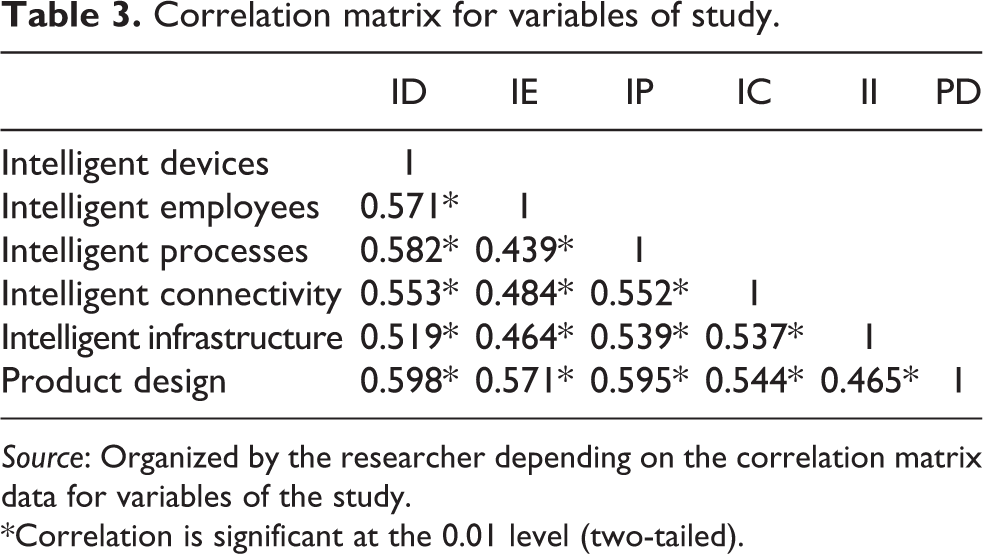
Source: Organized by the researcher depending on the correlation matrix data for variables of the study.
*Correlation is significant at the 0.01 level (two-tailed).
Pearson correlation findings were found to be significant for all study variables. The findings referred that the intelligent devices, intelligent processes, intelligent employees and intelligent connectivity have significant positive and strong relationship with the product design (r = 0.598, r = 0.595, r = 0.571, r = 0.544), respectively. Intelligent infrastructure was found to have a moderately strong and positive association with the product design (r = 0.465). Intelligent devices were found to have a strong positive association with the intelligent processes, intelligent employees, intelligent connectivity and intelligent infrastructure (r = 0.582, r = 0.571, r = 0.553, r = 0.519), respectively. Intelligent employees were found to have a moderately strong and positive association with intelligent connectivity, intelligent infrastructure and intelligent processes (r = 0.484, r = 0.464, r = 0.439). Moreover, the intelligent processes were found to have a strong positive association with the intelligent connectivity and intelligent infrastructure (r = 0.552, r = 0.539), respectively. As well, it found that intelligent connectivity had a strong positive association with intelligent infrastructure (r = 0.537, p < 0.01). Once association was established between variables, regression analysis using multiple regression technique was conducted and their findings integrated with the results of the content analysis of the interviews, which were used to triangulate the results of a qualitative study (interviews) with the results of the quantitative analysis (regression analysis). The results of the regression analysis are shown in the following section of the current study.
Regression analysis for IMEs and product design
To check the impact of the IMEs on product design with the aim to reduce production waste, the multiple regression analysis was performed for the elements of intelligent manufacturing and product design. The regression has been performed to make sure which of the elements are most influential on product design towards reducing production waste in the three plants under study. Table 4 displays the findings of the multiple regression analysis.
Multiple simultaneous regression analysis for dimensions of IME–PD model.a

Source: Organized by the researcher depending on the data of multiple regression analysis for dimensions of IME–PD model.
aPredictors: (constant) intelligent devices, intelligent employees, intelligent processes, intelligent connectivity, and intelligent infrastructure; dependent variable: product design.
The regression results indicated that intelligent devices (β = 0.534, p < 0.05) have a strong influence on the product design towards reducing production waste in industrial organizations under study. It means that intelligent devices would have an influence of 53.4% on improving the product design, which will, in turn, lead to effective use of product manufacturing resources in line with rapidly changing situations and requirements in the manufacture of products in order to reduce production waste in the industrial organizations. 2,12,20 All these are mainly due to the fact that intelligent devices are capable of changing their behavior in response to changes in situations and manufacturing requirements. Managing and changing the behavior of the intelligent device is basically based on past experience and learning capabilities possessed by those managing smart devices. 5,18,21
In addition, Chen 33 said that the provision of cloud computing technology which provides an Internet-based computing service will make of the intelligent devices to collect the data and information in real time and well provide them from all areas in the product life cycle. Thus, the data will then be processed through cloud computing, and accurate decisions can be made continuously and autonomously with little or no human intervention.
Moreover, the results of semi-structured interviews revealed that most of the respondents stressed that intelligent devices have an effective impact on product design towards reducing production waste in their companies. For example, AR2, BR1 and CR1 referred that the intelligent devices and equipment have an effective role in improving product design and thus walk the manufacturing processes more safely and smoothly towards the production of defect-free products, which in turn, lead to improving the efficiency of manufacturing resources and significantly reducing manufacturing waste. Respondent AR3 and CR2 noted that the intelligent devices not only improve the design of the products in the factory but also assisted to reduce the errors that can occur in the production process of products, which in turn lead to reduce the percentage of defective products significantly and raise the level of customer satisfaction on the products of the factory in terms of quality in particular.
The regression findings revealed that the intelligent employees (β = 0.379, p < 0.05) have an influence on improving the product design towards reducing production waste in industrial organizations. It means that the intelligent employees who have abundant production experience will have the ability to make product design processes and manufacture faster and more flexible to cope with the fluctuations in product production requirements that can occur in the global markets, thus increasing the efficiency of manufacturing resources and reducing production waste. 12 Moreover, intelligent employees are very important to the success and effectiveness of an organization. They are often ambitious and want to make an extra effort to achieve the organization’s goals. They also have creative ideas that make the organization’s processes, whether productive or service, more capable and efficient to face any changes that may occur in the markets in which these organizations operate. All these, in turn, will assist to improve the competitiveness of these organizations. Accordingly, the management of the organizations must motivate such employees and provide them with the necessary support. 26
Further, Chen 33 referred that one of the key characteristics of human intelligence is the capability to learn. Thus, it should follow the strategy of ML, which refers to the capability to understand and learn the inside of a physical system by the intelligent people for computing algorithms based on data. For manufacturing systems, the implementation of an ML algorithm by intelligent employees makes it feasible for a machine or other device to learn its baseline and working conditions automatically. It is also feasible to create and upgrade a knowledge base throughout the manufacturing process. 43
In addition, the results of the interviews revealed that most respondents pointed out that there is a remarkable role for intelligent employees in making the stages and processes of PD and manufacture more efficient in terms of the use of available resources to suit the requirements of the volatile customers in the current markets. For example, AR2, BR1, CR2 and CR3 said that ‘the intelligent employee is the employee who has the confidence of himself. A confident employee is also more willing to take risks or go for challenges that an uncertain counterpart would shy away from. Great outcomes come from people who have faith in their abilities and talents. Thus, such employees will be more efficient in dealing with precision devices and equipment as well as production processes, and thus produce products with more economical designs in terms of price, more efficient in terms of quality and less waste in terms of production. This is what most business organizations are looking for in the face of intense competition today’. [sic]
Based on the foregoing, it can be observed that the results of regression analysis along with the results of interviews for the model of the IMEs–product design indicate support for the second hypothesis; therefore, hypothesis 2 has been accepted.
Similarly, the regression findings pointed out that intelligent processes also have a significant role in product design. This means that intelligent processes would have a significant influence (52.1%) on improving products design efficiency, minimizing manufacturing waste, the safety of the working environment and improving the quality of the products in the industrial organizations. 12 All these will, in turn, lead to radically enhanced efficiency of those organizations, increased worker performance, reduction of operational risks, 34 and then increasing their confidence in the face of volatile market requirements and thereby enhancing their economic value and competitiveness.
Grigori et al. 44 mentioned that the intelligent manufacturing processes for any organization in order to be smarter, this organization needs to follow the technology that can offer ML and predictive analytics tailored to the unique processes. Thus, with a foundation of operational insights, real-time analytics and the ability to quickly generate reports to support intelligent manufacturing processes, this makes the organizations be more determined to own the technology referred to above; this is in order to be more prosperous in their insights and analysis and make their intelligent manufacturing smarter.
Moreover, the findings of semi-structured interviews showed that all respondents were positive about the effective role of intelligent processes in improving product design, where the respondents AR3, BR2 and CR1 referred that the intelligent processes not only help to improve product design and reducing the manufacturing waste but also help to reduce downtime and speed up product production in general, as well as speed to adapt these processes to any changes that can occur in specification and characteristics of products to keep pace with changes in market requirements. In addition, intelligent processes assist in making the working environment safer by removing repetitive, replicable and routine tasks in the factory.
Thus, the results of the regression analysis along with the results of interviews for the IME model–product design indicate that their results support the third hypothesis; therefore, hypothesis 3 was accepted.
In addition, the regression results showed that the intelligent connectivity (β = 0. 497, p < 0.05) has an effect on improving the product design towards reducing production waste in industrial organizations under study. This means that the intelligent connectivity (IoT) in the industrial organizations can assist in allowing for the sharing of data and information between these devices, systems and then the business integration. 12,31 This leads to the possibility of producing designs for higher quality and more economical products in terms of the manufacturing waste, which ultimately makes these products, in the end, have a higher value in the market. 3
Furthermore, the results of interviews indicated that intelligent connectivity has a positive effect on the productive process of the factory as a whole, where the respondents AR3 and CR2 mentioned that the intelligent connectivity among the devices and equipment of the factory has a large role in the speed and accuracy of data transfer between these devices and equipment; this is what helps to extract the designs for more useful products that are less harmful in terms of production. Intelligent connectivity allows for the rapid ability to make any change requiring product specifications in line with the requirements of volatile customers. All this, in turn, can significantly improve efficiency and business growth in the factory, thereby enhancing the factory’s economic and competitive position.
Based on the foregoing, it can be observed that the results of regression analysis along with the results of interviews for the model of the IME–product design indicate support for the fourth hypothesis; therefore, hypothesis 4 has been accepted.
However, the regression results displayed that the intelligent infrastructure (β = 0. 182, p < 0.05) has an effect, but is somewhat weak on the product design in industrial factories under study. This is mainly due to the fact that building a complete intelligent infrastructure, especially in the third world countries, requires large capital. This is because this element (intelligent infrastructure) is needed to build advanced IT such as Satellite link, Ethernet connectivity, Fibre optic link and other technologies. 36,37 Due to the inability of many business organizations, including the organizations under study, to provide sufficient capital for the establishment of such technology, the result of the present study indicates that the intelligent infrastructure has a slight impact on the product design.
Nevertheless, intelligent infrastructure is essential to improve the efficiency of product design and manufacture and thus maintain the high quality in many industrial organizations. 39,40 This means that smart infrastructure, whether in organizations under study or other business organizations that seek to improve the design of the product towards reducing the manufacturing waste, should provide sufficient capital for its establishment (smart infrastructure) in a manner that helps to create favourable circumstances in the organization as a whole to improve the use of smart devices and equipment to design and manufacture products more efficiently and which are less harmful in terms of production. This is accomplished by the plant-floor OT and business-level IT, which are characteristics of intelligent infrastructure.
Moreover, the above result was confirmed by a number of respondents such as AR1, AR2, BR3 and CR2 interviewed in the current study. Based on the results of the regression analysis and the results of the interviews, hypothesis 5 was accepted.
Summary of the findings
This section provides the summary of findings. The present study was conducted to investigate the impact of the set of IMEs on the product design in reducing production waste. The data were collected using mixed methods represented in a questionnaire survey and semi-structured interviews. The study hypotheses were tested using parametric tests such as Pearson correlation for establishing the association between the major variables of the study. To investigate the influence of independent variables (IMEs) on product design with the aim to reduce production waste, the multiple regression analysis was performed. Table 5 displays the results of the study hypotheses.
Results of the study hypotheses.

Source: Organized by the researcher depending on the results of data analysis.
The practical implications of the current study
The findings of the current study showed that implementing IMS successfully by the industrial organizations toward improve the production lines effectiveness, the safety at the work environment and attain the desired competitive advantage in terms of the high ability to meet the needs of the market volatile depends on providing and implementing properly for the set of IMEs which were addressed in the current study. Thus, the practical implications of the current study which would help the three factories’ management under study to improve the implementation of the IMS and getting the desired results are represented in the following: Diagnose the IMEs that are most influential on product design towards reducing production waste in the three plants under study. Diagnose the obstacles that prevent the improving of implementing the elements of intelligent manufacturing properly (such as intelligent infrastructure) in the factories under study. This would assist the factories’ management to take the necessary measures to address these obstacles and thereby getting the desired results of implementing the IMS as much as possible. The results of the study were revealed that the factories managements need to take more attention with the intelligent devices in terms of providing these devices and using them effectively. This mainly due to the high ability of these devices on improving the design of the products and reducing the errors that can occur in the production process, which in turn, can lead to reduce the percentage of defective products significantly and raise the level of customer satisfaction on the factory products in terms of quality in particular. The study findings revealed that IEs have also an influence on improving the product design towards reducing the production waste in industrial organizations. Therefore, the factories’ management should give those employees the necessary empowerment and autonomy to implement their tasks well. The study results revealed the need to pay attention by the factories’ management with smart processes and provide all that is necessary to make them more efficient in improving products design, minimizing manufacturing waste, safety of working environment and improving the quality of the products in plants. The factories managements should give attention with the intelligent connectivity, this because of its big role in the speed and accuracy of data transfer between the factory devices and equipment, which in turn, will help to extract the designs for the more useful products and the less harmful in terms of production.
Conclusion and future research directions
In light of the globalization of the world economy and the growth of competition, as well as rapidly changing customer requirements in the market, business organizations are working closely to modernize the industrial base by using the common intelligence of people, processes and machines in one system called IMS. This is done with the aim of influencing the macroeconomics of manufacturing by improving product design towards improving manufacturing resources, improving business value, increasing safety, reducing waste while meeting customer requirements for delivery and quality, and thereby improving the market share of the organization and keeping it in the forefront of competition.
Thus, the results of the study showed that there are several elements of intelligent manufacturing that have an important effect on improving product design towards improving manufacturing resources and reducing manufacturing waste. These results revealed that each intelligent device and intelligent process of IMEs had had a strong impact on improving product design, leading to the optimum use of manufacturing resources and reducing manufacturing waste in the industrial organizations. All these are mainly due to the fact that intelligent devices are capable of changing their behaviour towards making any changes in product design in response to changes in situations and market requirements. Intelligent processes also have the ability to reduce the downtime of factory devices and equipment in general, thereby accelerating product production. In addition, the speed of adaptation of these processes in response to any changes that can occur in the specifications and characteristics of products enables companies to keep pace with changes in market requirements.
The findings of the study revealed that both intelligent connectivity and intelligent employees have played a significant role in improving product design and improving the efficiency of manufacturing resources to reduce manufacturing waste. This is because intelligent connectivity (IoT) in the industrial organizations can assist in allowing for the sharing of data and information between these devices, systems and then the business integration, and thereby the ability to produce designs for more quality and more economical products in terms of the manufacturing waste, which ultimately makes these products have higher value in the market. Intelligent employees also have the confidence in themselves and thus they are more efficient in dealing with precision devices and equipment as well as production processes, and thus produce products with more economical designs in terms of price, more efficient in terms of quality and less waste in terms of production. This is what most business organizations are looking for in the face of intense competition today. However, the study results displayed that the intelligent infrastructure had a somewhat weak product design towards reducing manufacturing waste. This is mainly due to the fact that providing intelligent infrastructure for all business organizations, including the organizations under study, requires large capital. This is because this element (intelligent infrastructure) requires advanced IT such as Satellite link, Ethernet connectivity, Fibre optic link and other technologies, which require considerable financial capacity.
Although this study yielded interesting results, the study is not without limitations. The foremost being the sample size. Only three organizations were selected and respondents to the survey belonged to these three selected organizations. Increasing sample size and the number of organizations may affect the results of the study. Further, doing a comparative study of organizations that have implemented and organizations that are in the process of implementing IMS would definitely reveal results that could provide more insights into the successful implementation of this system. In addition, the researcher faced many difficulties (limitations) during the current study. These difficulties are as follows: (1) The difficulty of determining the date for interviews with department managers (especially production department), due to their preoccupation most of the time. (2) The difficulty of obtaining the approvals and the many routine procedures, this is for the purpose of allowing to conduct the practical part of the current study in the three Kurdish mineral water plants. This is mainly due to the critical security situation in Iraq in general. (3) The time and the high cost to go to the three mineral water plants. (4) The lack of enough academic publications in this area, particularly in Iraq and in the Middle East generally.
As for the future research directions, there are many organizational factors as well that affect the implementation of these elements such as top management, organizational culture and HR policies that are also needed to be investigated in detail for successful and effective implementation of the IMS. Future researchers could take up any of these factors and detail analysis could be conducted for organizations that are implementing the elements of this system to gain useful insights. Besides, studying the role of organizational factors in the implementation of IMEs would enhance the theoretical and practical sides of the current study and also would provide an explanation more comprehensive about the role of these factors in the implementation of those elements in details. As well as, it is desirable if future research is focused on the role of the elements that are addressed in the current study on the overall effectiveness of production lines towards improving product efficiency in terms of quality and price. This can enhance the theoretical model which has taken into account this aspect in the current study. In addition, it provides a suitable explanation of the cumulative impact of the implementation of IMEs on the overall effectiveness of production lines in the organization under study as a whole. On the other hand, it is better for the future researches that conducting the comparison among the factories that implement IMS in their productive processes in different countries (cross-country), and not the comparison among the three factories in the same country, which the current study conducted it in terms of the state of IMS implementing.
Footnotes
Declaration of Conflicting Interests
The author(s) declared no potential conflicts of interest with respect to the research, authorship and/or publication of this article.
Funding
The author(s) received no financial support for the research, authorship and/or publication of this article.
