




Abstract
How to educate project management (PM) professionals has always been a topic for debate, and it remains popular to discuss the teaching and learning of PM within higher education sector. Learning approaches such as action learning and game-based learning are proven effective in enhancing students’ participation and motivation. Game-action learning (GAL) offers an attractive and challenging learning environment for students to learn and apply, in specific problem scenarios. GAL supports a better understanding of the importance of critical concepts and fills the teaching gaps. This article presents a game-based action learning (GAL) approach in simulating a new product development project, which can be adopted in an short intensive course or a semester long subject. In this article, reflections from the instructor’s perspective are presented to offer a good reference for educators who are keen on using GAL in PM teaching.
Introduction
Project management (PM) is clearly important in organizations, and project managers are often the key persons dealing with complex realities. 1 –3 They are the generalists dealing with all the relevant tasks in a project setting, leading the project teams toward the objectives, striving for adequate resources and quality. The competences of a project manager have been widely discussed with the emphasis on management control of various types of projects in chaotic business environments. 4 It is important that project managers should have the ability to exercise effective control in projects.
Teaching and learning of PM within higher education sector has been a popular topic for discussion. The growing interest in the teaching of PM is due to several reasons, such as the acceptance of the need to enrich PM scholarship, changes in the conceptualization of PM, and the need to propose effective approaches to transform project managers into reflective practitioners. 1,3 A number of scholars have been working on the imperatives associated with the teaching and learning of PM. These include Geist and Myers, 5 who suggested the best practice in PM teaching and learning by combining practical activities and theoretical teaching and learning approaches.
In regards of the challenges existing in teaching and learning of PM, merely conceptual or theory understanding is not sufficient for students to be effective project managers. Therefore, the research question posed in this study is: can game-based action learning be an effective approach in PM education?
To fill the gap between theory learning and practical knowledge, the objective of this article is to present a mixed approach combining both action learning and game-based learning (GBL). It has proven that action learning and GBL are effective in enhancing students’ participation and motivation.
The study proposed to use GBL and project-based action learning (PAL) in teaching PM using a new product development simulation project. This article thus contributes to the area of knowledge by demonstrating the applicability of using game-based action learning in PM education.
The presented game-action learning (GAL) approach was implemented in a postgraduate PM subject at one of the universities in Hong Kong. The subject was an elective subject offered to students within the Faculty of Engineering. The PAL game was implemented as an integral part in the PM course to complement the classroom teaching. Students were divided into groups to perform the game-related tasks, and their reflections on the PAL game as well as their academic performance were collected.
The background and literature reviews of challenges in teaching PM, and the theoretical background of game-based action learning, are presented in the second section. It is followed by sections presenting the methodology, the implementation, results, and discussion.
Review of literature
Projects can take place anywhere in the real world which is complex and full of uncertainties. Not only affected by global economic trends, projects are also affected by regulatory or environmental issues. Project managers are the key person dealing with projects within organizations of complex realities. 1 –3 Project managers therefore have to fight with uncertainty and complexity related to their work. 6,7
PM education
In reality, projects are generally multidisciplinary and interrelated with multiple aspects, and project managers are generalists dealing with all the relevant tasks in a project setting, leading the project teams toward the objectives, striving for resources and quality. The competences of a project manager have been concerned for the management control of projects in chaotic business environments. 4 To deal with the highly complicated projects, project managers should have the ability to exercise effective control over projects. Berggren and Soderlund 8 emphasized interaction as learning practice, whereas Pant and Baroudi 9 suggested emphasis on both hard and soft skills.
Key competences required for an effective project manager have been widely discussed in textbooks and research works. 10 It is agreed that project managers are not simply specialists in a particular discipline, but more importantly generalists to watch over all the aspects throughout the project life cycle, from the project conception stage to planning, execution, and completion.
The complex nature of projects has attracted the interest of PM educators in regard to the required competences for the various functions, 3,11,12 the required skill sets, 1,6 the team management, 13,14 and pedagogical approaches. 2,3,12,15
Teaching and learning PM
Some educators have emphasized on the importance of practical experience and system thinking ability of project managers, 2,12 including the required skill sets and theoretical concepts. It has been well accepted by many PM educators that theoretical understanding and practical experience are equally important. Therefore, it has become a concern for educators in the field to incorporate both theoretical and practical parts.
Project-based and action learning
Action learning was first proposed by Revans 16 as a method to solve real-life problems, and it involves taking action and reflecting upon the results. The definition and effectiveness of project-based learning have been studied. Based on project-based learning and action learning, the PAL framework 17,18 was first designed and developed, working as a practical organization learning (OL) tool to bring the OL concept into practice and to help a specific company to maintain its competitiveness. Differing from action learning, the PAL framework is implemented in a real working scenario and solves problems in project operations. Project goals as well as team and individual learning objectives which are set first are achieved through the learning process. 17,18
Game-based learning for PM education
GBL balances the subject matter and the players’ ability to learn and apply and may include specific problem scenarios. 19 Some recent studies have proven the effect of GBL in engineering education context, 20 –22 some are in specific disciplines, such as electronic engineering and computer-aided design assembly. 23,24
With an attractive and challenging learning environment, 25 GBL promotes motivation, supports a better understanding of the importance of critical concepts, 26 and fills the teaching gaps between theory and practical experience in the classrooms. 27 However, rarely studies were carried out to investigate the applicability of using games in PM. A study carried by Rumeser and Emsley 28 attempted to investigate how a group of master students preferred project games to other learning methods. Results showed the key reasons for students to prefer the PM games are fun, attractiveness, and teamwork. Also, games stimulate the reality and offer the desirable unique experience, which is complex, challenging, and realistic.
Methodology
Development of a project action learning game
The PM action learning game was inspired by a game used in an operation management subject, 29 that was primarily developed for students to develop the skills required in operation optimization. In this article, some of the game rules and constraints were adopted but the game was modified to focus on the project processes.
The game used in this study simulates the realistic product development projects from the very beginning conception stage to the closing stage. Students were assumed to work as a project team to develop a new product (a paper flying object), from scratch to the production till the sales to the client (sole client). Rules and other criteria are detailed in Online Appendix 1.
There are a few core features incorporated in the game design, including simulation of real-life projects, clear objectives and constraints, cooperative and team learning, and PAL. The details of these features are discussed in the “Key features and facilitation strategy of the game” section.
Implementation
The development game was implemented in one of the elective subjects (Technology PM) offered to the postgraduate engineering students in a university in Hong Kong, in the second semester of academic year 2017/2018. The class was of 50 students. The majority of students in the class have first degrees in engineering disciplines, whereas some of them are from business or social science degrees disciplines.
Data collection
To justify the effect of game learning on students’ learning, performance of students in the game and in the subject was collected. These include the assessments of two tests, one was scheduled in the midway of the course and another was in the later stage (i.e. day 2 and 4). Results are presented in “Performance of students” section.
The PAL game
Key features and facilitation strategy of the game
Simulation of real-life projects
The learning game we present in this article simulates the realistic product development projects from the beginning conception stage to the closing stage. Students are grouped in teams and have to design a new product from scratch (according to the criteria of the product specifications) to the production and then consider the sales to the client. The whole project is divided into several key stages along the project life cycle (Figure 1):

Project life cycle. (a) Definition of product (specification, scope); (b) contracting (a contract confirming the set objectives); (c) production operation planning (process planning, job design); (d) resources planning (materials, manpower for production, and budget); (e) control and monitoring, risk management; (f) execution of plan (production); and (g) closing (evaluation).
Clear objectives and constraints
In the conception stage, students are provided with the requirements of the project, as well as the constraints (i.e. resources and time):
The task is to produce a “high-tech” product: paper-flying objects (i.e. paper plane) to particular customer specifications.
There are two main types of product design, and standardized selling prices vary upon the design and types of materials.
Each team needs to design two types of products with a minimum of 12 units at least 20 cm in length. In addition, all products (flying objects) must be able to fly a linear distance of 6 m.
Constraints are the materials supply and the available budget (line budget of HK$480). Materials provided are white paper ($2 per sheet), colored paper ($3 per sheet), and paper clips ($3 each).
Therefore, teams should come to define their own objectives with reference to the constraints (time, cost, and performance); this simulates the triple constraint condition at the conception stage.
Cooperative and team learning
Students are grouped into teams of 4–5, and each team has a team profile that was produced through self-analysis of team roles. 30 Teams were told the game rules and other information at the beginning, so students had to discuss among teammates regarding the strategy (e.g. high end product with low volume or low end product with high volume).
Students within the same team would have to go through all the stages together, for the shared goals. Through the project processes, they learn cooperatively to associate the textbook knowledge with the tasks in the project.
Project-based action learning
Based on project-based learning and action learning, the PAL framework 17,18 was proposed and developed, primarily for working as a practical OL leaning tool for learning teams within organizations. Differing from action learning, the PAL framework is implemented in a real working scenario and solves problems in project operations. Project goals and learning objectives are achieved through the predefined learning process. 17 With the clear goals and direction, students are more motivated to learn and to apply the learnt knowledge. 31 In this PAL game, students were grouped into teams, consisting of both full-time and part-time students. With reference to the PAL framework, 17 students were told to identify individual learning goals, while setting up the team project goals and learning goals.
The PAL game implementation
The PM course
The postgraduate PM subject was offered as an elective subject to around 50 students from a Master degree program in Technology Management (MScTM) in a university in Hong Kong. The subject was also offered to postgraduate students from other departments within the Faculty of Engineering.
The majority of students in the class have first degrees in engineering disciplines, whereas some of them are from business or social science degree disciplines. Half of the students were full-time students (pursuing a Master’s degree in 1 year) and most of them were fresh graduates without working experience. The rest are part-time students with working experience.
Outline of the course
Since half of the class is part-time students, the subject was run on a weekend block mode, that is, 4 full days in consecutive weekends (two Saturdays and Sundays).
The first day was mainly for students to consider fundamental PM concepts, and then students were divided into groups of 5–6 and the game started on day 2. Details of the game are attached in Online Appendix 1, and the key tasks are summarized as below (Table 1):
Summary of tasks in the PAL game in the four stages.

PAL: project-action learning.
Assessment scheme
Adopting the PAL evaluation proposed in the previous works for PAL teams, 17,18,32 evaluation of students learning is based on three main assessment components:
Team level—group report
Each team is required to submit a report documenting the whole project life cycle from the conception stage, planning stage, execution to closing. In the group report, teams are required to reflect on their team performance, with reference to the process and the experience they have gained.
Peer evaluation
Each team member has to evaluate the performance of peers in the same team.
Individual reflection and assessment
Each student has to submit his or her own reflection (Online Appendix 2) on the learning process and what he or she has learnt from the game, as well as new insights they have gained.
The structure of this reflection is flexible but is expected to incorporate the learning process of the specific project, self-evaluation on individual performance, and the reflection on the learning in the subject. Through the self-reflection on the learning process, students are more aware of their learning objectives that are crucial to the performance. The effectiveness of learning is thus to be reflected in the academic performance of students.
Performance of students
Students’ academic performance was recorded, specifically the tests and game performance. Table 2 presents the summary of results:
Summary of academic results of students in groups.
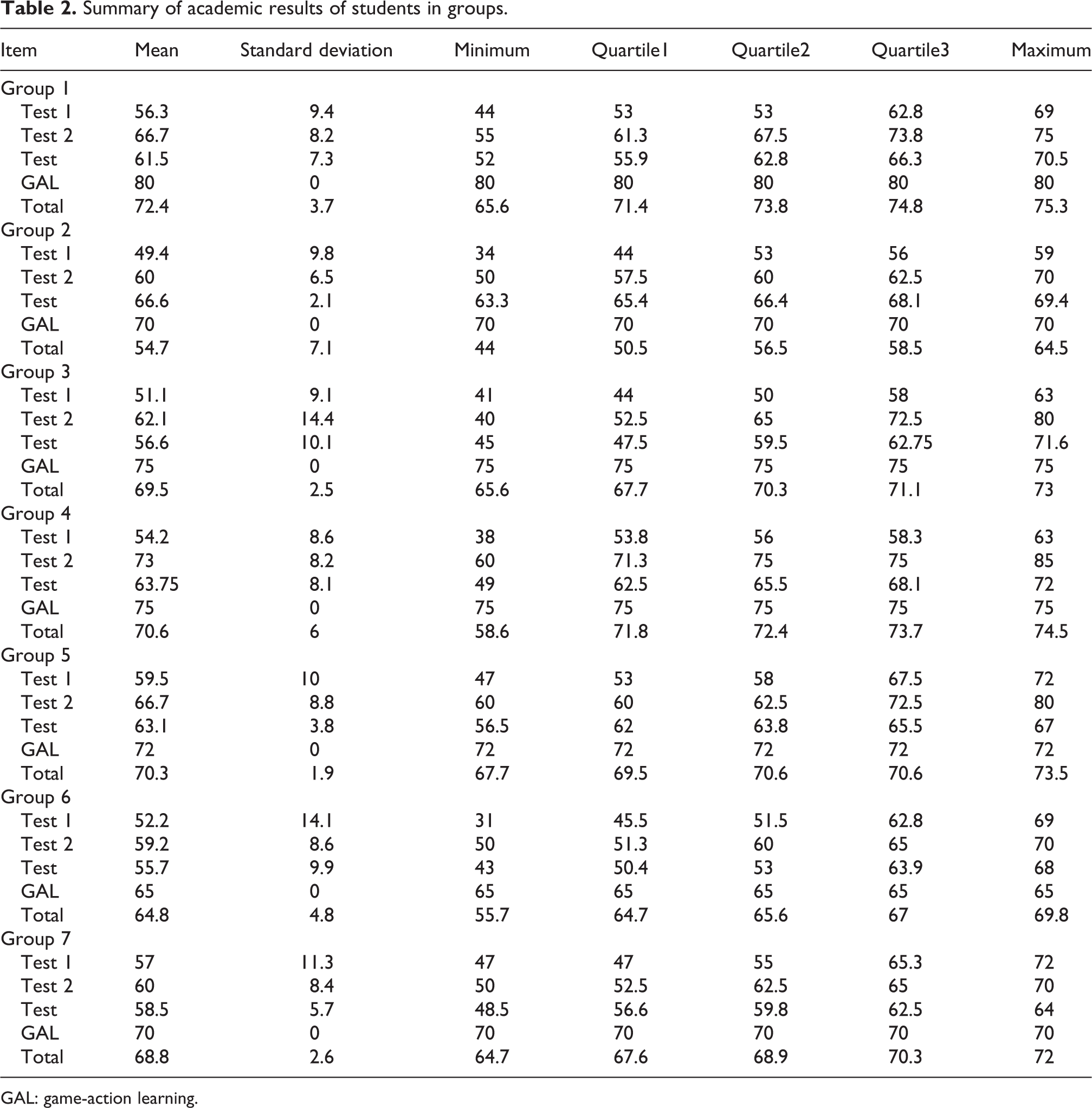
GAL: game-action learning.
Though it is a small class of seven groups, there are some interesting observations noted from students’ results. Test 1 and 2 were arranged in the midway and later stage of the course (i.e. day 2 and 4). Assuming that both tests are at same difficulty levels, performance of test 2 is relatively better than test 1 in all seven groups. This implies the progress of students’ learning. More interestingly, groups of better performance in the GAL (game project) show greater difference between test 1 and 2, for example, group 1.
Discussion
Using PAL game in PM education
The use of game-based learning: students appreciated the adoption of game-based learning and stated, “it helps us to learn by doing and experience, as the game simulates real life projects” in their individual reflections and feedback. It does not matter what is the product to be developed in the game as long as the game offers the opportunities to students to work in teams and to go through all the processes in the project. Within teams, students learnt to cooperate with teammates. The competitive nature of the game also motivated teams to participate.
Adoption of action learning
The PAL game encouraged students to engage in the tasks, and they associated those tasks to the learning objectives. Students also learnt cooperatively in teams. Action learning acts well as a method to learn to solve real-life problems and involves taking action and reflecting upon the results. The simulated game offers students the opportunity to think from the perspective of a project manager, by associating the challenges faced from the game to the real-life situation.
Learning facilitation in the PAL setting
We adopted the PAL framework proposed earlier 17,18 in this PM course. Within the PAL game setting, project goals and learning goals at the team and individual levels are of equal importance. While students are applying the learnt knowledge in the game to achieve project goals, their learning goals are achieved through the learning process.
Roles of team members
In this exercise, students were allowed to form groups according to their own preferences. It can be seen that most students simply picked those with closer relationships or friendships. Some teams found they failed to perform effectively due to multiple team factors, such as lack of a decisive leader or implementer who could execute the plan effectively. On the other hand, some teams were more effective with well-defined team role assignments, the characters of the members were identified and they were assigned to different roles according to their character. This observation shows the need for incorporating team-grouping guidelines, such as to use some developed surveys for team roles identification. 30
Contributions
This article contributes to the literature on PM education. The study has proposed to use GBL and PAL in teaching PM, while the game aims to simulate a real new product development project. This article also has demonstrated the applicability of using game-based action learning in PM education, for its effectiveness in enhancing learning motivation and therefore the performance of students.
Limitation
The game is designed as a simulation of a real new product development project, by incorporating the project life cycle, team management, resources, time, and quality constraints issues. However, this game still suffers from a few limitations, such as the simplified resource constraints, a single-project situation, and the oversimplified simulation of external risks. Thus, it requires experienced instructors to introduce some ad hoc uncertainties in the game, to provide a better-simulated project environment.
Conclusion
How best to provide effective PM education has been an on-going topic among educators. By combining practical activities and theoretical teaching and learning approaches, imperatives associated with PM teaching are suggested. Action learning and GBL are proven effective in enhancing students’ participation and motivation. This article presents a GBL approach simulating a new product development project, which can be adopted in an intensive course or a semester long subject. This game is developed based on the primary framework from a previous learning game used for teaching production operations. 29 In this article, it is proven that the same game scenario can be used for different subjects’ areas, as operation management, budgeting, scheduling, human resources, and so on. PM is a complex subject and the game-based action learning approach can be an effective vehicle in the learning process.
Supplemental material
Online_Appendix_1_and_2 - Teaching project management using project-action learning (PAL) games: A case involving engineering management students in Hong Kong
Online_Appendix_1_and_2 for Teaching project management using project-action learning (PAL) games: A case involving engineering management students in Hong Kong by Kris MY Law in International Journal of Engineering Business Management
Footnotes
Declaration of conflicting interests
The author(s) declared no potential conflicts of interest with respect to the research, authorship, and/or publication of this article.
Funding
The author(s) received no financial support for the research, authorship, and/or publication of this article.

Supplemental material
Supplemental material for this article is available online.
References
Supplementary Material
Please find the following supplemental material available below.
For Open Access articles published under a Creative Commons License, all supplemental material carries the same license as the article it is associated with.
For non-Open Access articles published, all supplemental material carries a non-exclusive license, and permission requests for re-use of supplemental material or any part of supplemental material shall be sent directly to the copyright owner as specified in the copyright notice associated with the article.
