



Abstract
In light of a recent spike in natural and man-made disasters, there has been an increase in interest in disaster prevention education and training. The effectiveness of both publicly-funded and voluntarily organized disaster education (DE) has attracted wide attention. More studies are needed to understand the innovative pedagogical practice and the impact of technological advances on disaster learning content development, effectiveness and motivation. This study investigates the application of augmented reality (AR) in DE and training. An AR-enhanced tool named ‘disaster-proof warrior’ was developed and tested to evaluate its enhancement effect on learning under two collaborative learning modes. A series of quasi-experiments involving 85 elementary school subjects was carried out to assess the learning effectiveness and the subjective reaction in learning motivation. The results showed the AR embedded learning tool is effective in engaging and motivating collaborative team knowledge building. This study adds to the existing literature of AR applications in education and training as well as providing a useful reference for future development and improvement of national DE and training.
Introduction
Natural or man-made disasters and emergencies are increasing all over the world causing serious disruption to communities, and leading to casualties, environmental, financial and economic losses.1–3 Though the vulnerability of certain communities and individuals to disasters is unavoidable, individuals can play a key role in reducing the impact of disasters by improving their resilience and recovery capacity.4–6 Various studies7–10 have shown that Disaster education (DE) is a cost-effective tool against risk as well as reducing injuries, damages and deaths and accordingly improving recovery. Hence, the general public, including children, should be trained in disaster prevention as well as have a good understanding of community cooperation (i.e. resource allocation) in disaster recovery.9,11,12
Governments and non-governmental organizations all over the world have looked into advancements in technology in developing new approaches in disaster prevention education to train children and the general public. Disaster prevention education for children aims to provide knowledge and skills for individuals to reduce their vulnerability to disasters.13,14 The aim is to provide knowledge, innovation and education to create a culture of safety and resilience at all levels. Educational materials about preparedness, warnings and self-protection should be disseminated to children from kindergarten onwards. Teachers and parents should be given training in integrating disaster prevention materials into classroom teaching so that children receive the knowledge and information needed to protect themselves from disasters.7,9,10 Hence, raising the level of awareness and preparedness at home can reduce children’s vulnerability to disasters.
Currently, there are various types of formal and informal school-based DE programmes. Some of these are outside of the curriculum. 4 Education programmes such as workshops, exercises and manoeuvres, preventive measures, booklets and training with the help of officials and engineers are underway. However, some studies question the effectiveness of current approaches and advocate the use of technology to enhance learning and teaching adaptive skills in response to disasters.14,15 Some major challenges identified for further study include lack of disaster prevention education in the formal curricula, requiring effective learning tool for education, 16 and missing linkage between learning theory and practices. 17
This study aims to investigate a relatively new application of augmented reality (AR) in DE for children in group learning under a specific collaborative learning context, either in school or community. Augmented reality has a unique advantage for displaying digital learning contents on smart devices overlying a physical context,
18
for example, real-world objects or physical learning material in handouts or quiz cards. In terms of the learning process, AR technology helps improve process skills such as critical thinking, problem-solving, and communications
19
via individual and collaborative task.
20
Studies21–23 found that AR can assist the learner in understanding and learning new concepts and phenomena that cannot be viewed in the real world. Augmented reality in mobile devices allows learning to happen outside the classroom, therefore enhancing flexibility and accessibility243. Apart from AR, further technology such as virtual- or mixed-reality can also be utilised to support learning.25,26 Blending digital components into the real world is significant.
27
Using AR, learners were allowed to interact in physical situation with natural disaster learning materials in a simulated environment.
28
The innovative designs in this study include an AR embedding app named ‘disaster-proof warrior’, developed as a specialized digital app for supporting teachers in teaching disaster prevention knowledge and skills under its specific learning context. The tool captures different invisible disaster-relevant information and overlays it with the quiz card to provide additional digital contents. The superposition of disaster impacts and reality in terms of quiz questions and digital answers could help to educate children. Furthermore, children’s DE is commonly conducted in groups.
10
The effectiveness of possible learning modes has yet to be explored further. Along with the app tool, two types of learning modes were investigated in this research following the collaborative learning strategy of team game tournaments (TGT).
29
One is to use a board game format in combination with the app tool for group learning. The other involves less formal character training development through imagination and creativity using story making.
30
The presented scenario covers three disaster cycles i.e. disaster impact, mitigation and preparedness. Hence the research questions are: • How to effectively use the AR tool to enhance the learning experience in disaster prevention? • Do learners in groups using the board game format with the AR tool outperform those using collaborative story making with the AR in learning achievement and motivation?
Literature review
DE for children
Studies have shown DE is becoming increasingly important. Children are among the most vulnerable sections of the population during a disaster. Moreover, DE for children is helpful in responding disasters and accidents. School is critical for raising awareness, and collecting and disseminating knowledge and information about disasters. DE is conducted in diverse settings, including formal and informal school-based programmes, or even non-formal programmes outside of the curriculum. Collaborative DE between school and community not only adds to the richness and variety of education but has also been considered effective and therefore emphasised more frequently. The modes of collaborative learning upon DE combining formal, informal or even non-formal education are wide ranging.
Considering learners’ collaborative learning, computer-supported collaborative learning environments have increased considerably.15,31–33 The rapid development of mobile technology has accelerated the shift from conventional peer-to-peer interaction to digital immersion involving virtual scenarios.33,34 Mobile collaborative learning involves collaborative tasks with peers via mobile technology, 35 and interaction with each other to achieve a certain learning goal.36,37 Collaborative DE with the advancement in mobile technology is rarely investigated. More attention must be given to it. Therefore, this research investigates what collaborative learning modes in combination with mobile technology can be effective.
AR in collaborative learning
Studies show AR technology provides learners with a more immersive and engaging learning environment.30,38 AR technology creates a possibility for collaborative learning around virtual content in non-traditional environments. 36 Several studies have shown that AR technology has been successfully integrated or applied to a collaborative learning approach. For example, Lin et al. (2013) 39 found that learners’ knowledge using AR collaborative learning was significantly better than traditional collaborative learning in the subject of physics. Wang et al. (2014) 40 found that an AR simulation plays a more supportive role in the learners’ collaborative inquiry learning than a traditional 2D simulation. Also, Wu et al. (2013) 41 found that an AR simulation would be more suitable for learners to conduct inquiry tasks collaboratively. This happens since the AR has features in providing visualization that improves the processes and outcomes of collaborative learning. 24 Moreover, adding mobile technology helps students to interact with their peers’ face to face. 32 The interaction would be helpful in creating a space that enhances peer collaboration to achieve the creation of new knowledge. 31 In sum, studies revealed that AR has shown a great opportunity to be integrated into collaborative learning. However, the learning outcomes of AR in different collaborative learning activities remain unknown.
Collaborative learning
In terms of educational value, learning effectiveness under collaborative learning could be affected by different learning strategies that are derived from different learning results and behaviour under specific learning activities.42–44 One of the major strategies is team games tournaments. A team game tournament is a stepwise collaborative learning strategy comprising four steps, namely, whole-class presentation, group discussion, tournaments and group recognition. 29 Group learning could be conducted in structure as well as unstructured learning activities. Several studies discovered that structured collaborative learning activities provide learners with structured learning guidance to gain and understand knowledge. Studies also found that unstructured learning activities enable a more flexible and interactive mode than structured collaborative learning. However, few studies have been done into comparisons between structured and unstructured collaborative learning activities. Therefore, this study attempts to investigate the learning outcomes of different collaborative activities.
Research design and methodology
The research was conducted in the following three activities, that is, preparation of course materials and design of the AR tool, conducting the teaching and data analysis. The experimental design of this research investigates whether the two modes of AR-enhanced collaborative learning could enhance learning outcomes in terms of learning achievement and motivation. The assessment procedures were summarized in Figure 1. The two collaborative learning activities were a board game and role-playing characters. Amongst the many possible activities, the two activities were decided on due to learning effectiveness, scalability, maintenance, and cost-effectiveness. Under the learning strategy, two game-based learning activities were developed. The research was conducted using a pre-test–post-test quasi-experimental design. Pre-test was a pre-assessment of learning achievement and motivation, conducted 1 week before the start of the experiment. Learning achievement was assessed in terms of quiz was designed based on the table of specifications (TOS)
45
using Bloom’s taxonomy to evaluate learners’ overall understanding of the related knowledge. Learner motivation was assessed using a questionnaire adapted from the ARCS Model of Motivation,
46
including 28 questions related to Attention, Relevance, Confidence and Satisfaction. Post-test was a post-assessment of learning achievement and motivation, conducted 1 week after the start of the experiment. Each pupil was asked to fill the motivation questionnaire and quiz in pre-test and post-test. Assessment procedures.
Participants
A total of 85 participants were drawn from four fifth grade classes. Forty-two subjects (24 male and 18 female) from two classes were assigned to the AR-enhanced board game group, while 43 subjects (23 male and 20 female) were in the AR-enhanced role play characters in this research. The participation of the experiment was based on acquiring parental permission for children participation and participants who have completed all the questionnaires and quiz.
Learning content development
The original idea was to collect and develop knowledge and information related to typhoons, earthquakes, and fires so as to facilitate DE education. Furthermore, the learning contents were to be disseminated and utilized amongst schools and communities. The course and learning contents were based on the Taiwan Curriculum Standard for the fifth grade. Various sources including the student handbook, related textbooks, and teacher’s manuals produced by major publishers in Taiwan were used to develop the learning contents. Instructor’s teaching materials were also developed to guide teachers on how to use the developed tools. AR has its advantages in providing augmented contents in terms of 3D/2D visualization with/without animation or textual cues of a visual icon or environmental context, for example, to provide answers or information under a specific visual context, or to navigate to find a way. The original idea for developing the tool was to provide an editable and scalable version to accommodate a wide range of teaching modes and purposes in DE. The developed AR app consists of two parts, namely, physical quiz cards and an app. The learners would need to activate the app and thus scan the paper cards to trigger the digital contents. Through the app, learners could also explore the developed information related to the three types of natural disasters, typhoons, earthquakes and fires. Among the many learning contents for DE, the introductory knowledge was covered in the three disaster cycles, that is, disaster impact, mitigation and preparedness. The goals are: (1) learn to prepare and deal with the natural disasters and (2) understand the causes of these disasters. Figure 2 shows the player’s operational flow and interface designs of the app. Once activated, the app allows the user to utilize the AR Function, or simply search for the developed information through the AR and information functions. To utilize the AR Function, the learner first clicks the button with the camera icon. By clicking on the camera button, the learner uses its internal lens to scan the problem shown on the paper card. Then, the corresponding answer to the problem card is provided. Learners can repeatedly practice answering the relevant questions by scanning the paper cards. As shown in the middle image of Figure 3, two buttons are displayed on the first page, allowing users to select ‘Camera’ to trigger AR embedded digital contents, and to select ‘Read’ to activate supplemental reading related to typhoons, earthquakes and fires. The left image of Figure 3 shows a snapshot of the augmented answers concerning the questions about the possible effects from typhoons. The e-book (see the right image of Figure 3) includes the information provided in this study concerning disasters, preventive approaches, possible damages and corresponding common sense. Disaster Prevention Warrior operational flow and interface design. APP features of AR-based disaster prevention using typhoon as example: (a) Typhoon-related physical quiz card (A.1) to show digital content of the scan inquiry; (b) E-book content related to typhoons.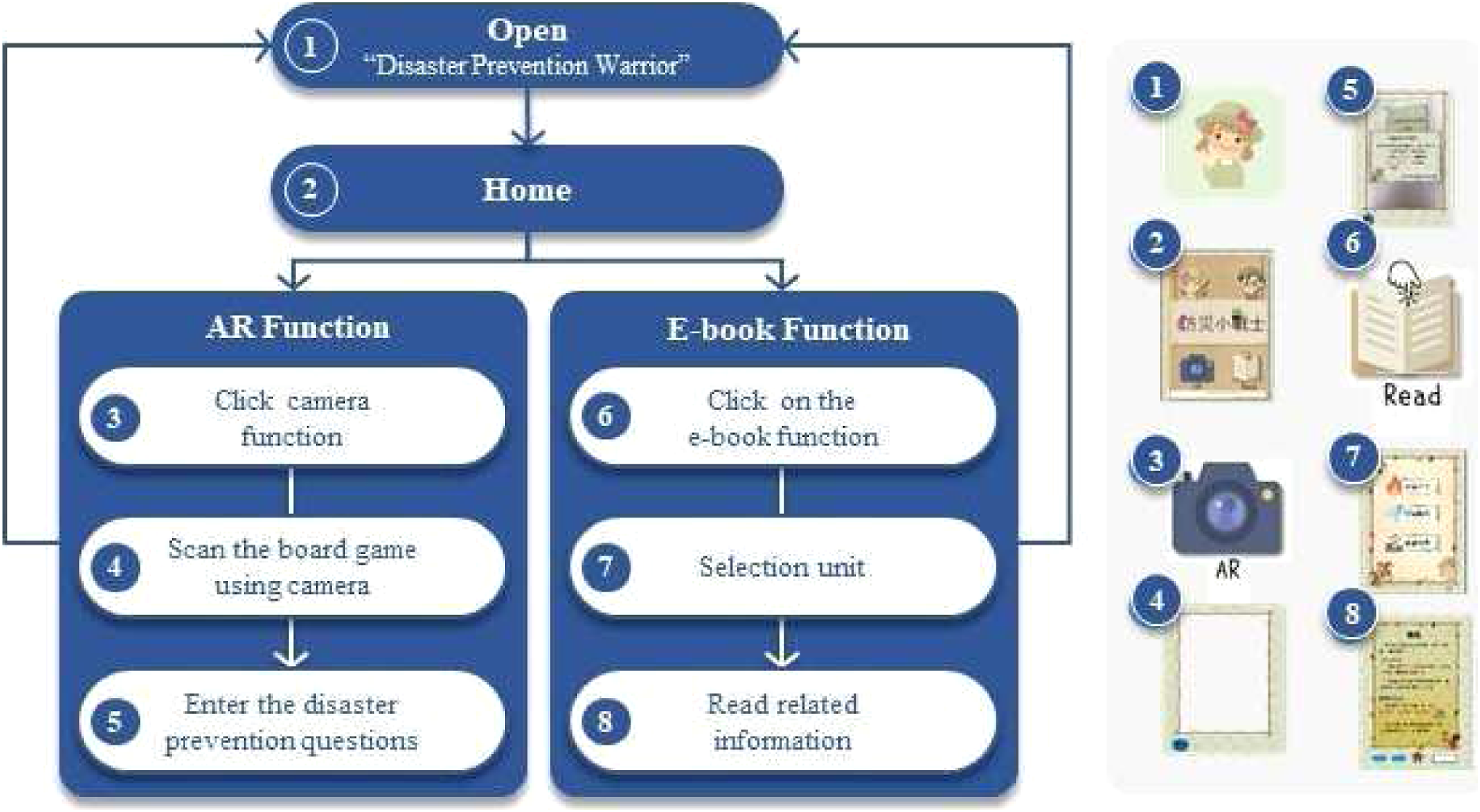

Activities for developing the board game involved domain-experts, researchers and designers. A cartoon-like adventure style was chosen. This provides schools and communities with the opportunity to use, modify, repair or even customize the game to fit each individual’s need. The possible customizations of the board game include changing the way of asking a question or modifying the size of the quiz card.
The following subsections describe the APP design and configuration. (1) Software homepage
The overall design aims to be user-friendly and fit elementary learners’ preferences. Hence, a cartoon-like adventure style was chosen as the software homepage.
Collaborative learning activities
To engage learners’ interest, two collaborative learning activities were developed in combination with the AR tool. The original idea was to design a simple and fun activity that has the features of low-cost, scalability, customization and ease of maintenance. A review study 16 suggested the use of team approach to enhance learners in disaster prevention education. In this research, we followed the collaborative learning strategy of team game tournaments (TGT) 29 to develop two gaming approaches in combination with the AR app tool. One involved the use of a board game format. The other applied less formal character training development through imagination and creativity using story making. Under many possible ways of delivering the learning activities, the research team decided to look at the following two directions. One was to use a common board game. The board game was developed for groups of 2–5 players. The winner is therefore a group-based rather than an individual. The winning group is the one with the shortest completion time. Players in a group collect ‘question cards’ laid upside down and position their counters on a matched ‘answer’ field. Each player is asked to acquire the required trophies in the shortest possible time. Players take turns to play. When a player is playing, the team members utilizing the app tool to help the player in completing the game. Once all players in a group complete and acquire the trophies, the game ends. The board game was planned to have the ‘atmosphere’ of helping team members and time sensitivity to train learners to be prepared to respond properly. Furthermore, teachers have the flexibility to redesign the board game, for example, change the ‘question cards’ or modify the rules of the game. The app tool can still be used with the redesigned game.
The other activities were planned to be used with common teaching equipment, for example, whiteboard and pens. A brainstorming technique is used to have each group create fictional characters to prevent, respond to, or recover from disasters. With the knowledge and information support from the AR tool, each team proposes, discusses and sketches characters. The activity was conducted with a time-sensitive setup.
In summary, both activities were designed with the team-game tournaments strategy to be conducted inside or outside school. The time-sensitive activities were arranged under the use of an AR app tool and involved group members working together to overcome the challenge.
Assessment procedures
In the AR-enhanced board game group, the course began with an introduction to disaster prevention and preparation with reference to events that have recently made the news. This introductory section utilized a typical PowerPoint presentation for teaching and lasted for 15 minutes. Having completed the introductory section, participants were divided into four to five groups for further learning sections. Each group was composed of four participants. Each group was equipped with a set of AR-enhanced paper cards and an iPad mini tablet (IOS 10.0). This also lasted for 15 minutes. The tablet allowed participants to scan the cards, and get additional feedback or answers about related disasters. In this section, in addition to the information shown on the existing paper cards, the participants were taught to get access to the AR-enhanced learning tool to acquire relevant digital knowledge. The following section was conducted to provide each group with a board game. The game required each member in the group to work together to cope with its challenges, to manoeuvre to the correct terrain on the card and to complete the required tasks. The section lasted for 20 minutes.
Having completed the activity, each group was asked to discuss what happened during the game, and what to do in the future for a better result. The instructor provided participants with answers or suggestions raised during the game. The final part of this section was spoken responses to questions. The first participant providing the correct answer to the given question was rewarded with a self-made gift. The last section lasted for 15 minutes. Having completed the experiment, each participant was asked to conduct a post-assessment of learning achievement and motivation.
In the AR-enhanced brainstorming group, all the sections were planned to be the same as the AR-enhanced board game group, except for the cooperative activity. Instead of a board game, a brainstorming activity was arranged. Each group was equipped with a whiteboard and pens. Participants were guided to come up with a fictional character that was capable of preventing or recovering from a disaster by use of certain means. Each group assigned one member to the front platform to share what the character would be and how well the character would cope with a disaster.
Results and analysis
Participants
Distribution of participant characteristics.
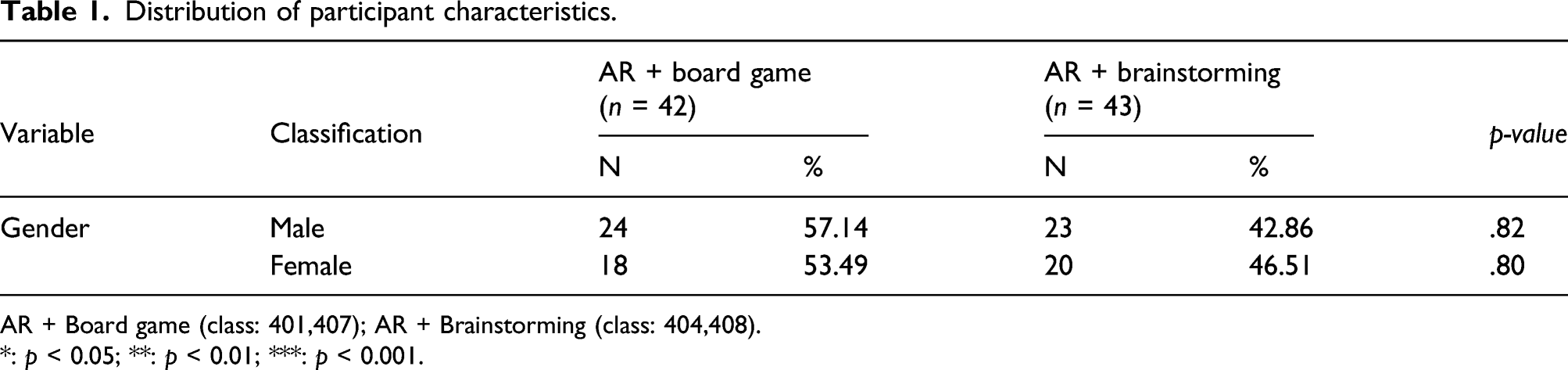
AR + Board game (class: 401,407); AR + Brainstorming (class: 404,408).
*: p < 0.05; **: p < 0.01; ***: p < 0.001.
Pre-test comparison of learning achievement and ARCS learning motivation.

AR + Board game (class: 401,407); AR + Brainstorming (class: 404,408).
*: p < 0.05; **: p < 0.01; ***: p < 0.001.
Learning achievement
Post-test comparison of learning achievement.

AR + Board game (class: 401,407); AR + Brainstorming (class: 404,408).
*: p < 0.05; **: p < 0.01; ***: p < 0.001.
Comparison of pre-test and post-test learning achievement.

AR + Board game (class: 401,407); AR + Brainstorming (class: 404,408).
*: p < 0.05; **: p < 0.01; ***: p < 0.001.
Learning motivation
Post-test comparison of ARCS learning motivation.

AR + Board game (class: 401,407); AR + Brainstorming (class: 404,408).
*: p < 0.05; **: p < 0.01; ***: p < 0.001.
Comparison of pre-test and post-test ARCS learning motivation.

AR + Board game (class: 401,407); AR + Brainstorming (class: 404,408)).
*: p < 0.05; **: p < 0.01; ***: p < 0.001.
Discussion
Currently, children in elementary schools are educated about disasters through educational books, leaflets, in-class presentations, workshops or sometimes via simple online games. The AR tool along with each of the two collaborative activities would be helpful in disaster preparedness education for elementary schools. The novelty of this work includes the use of technology to enhance learning in response to disasters. Further, an AR embedding app named ‘disaster-proof warrior’, developed as a specialized digital app for supporting teachers in disaster prevention teaching. This paper studies how AR technologies could revolutionize the teaching of disaster prevention and management in schools. In particular, the study aims to show how AR influences students' knowledge and experience. A mobile AR app along with playing cards and collaborative learning activities were developed. The developed AR educational tool covers a range of natural disasters such as earthquakes, floods, fires, first aid in extreme temperatures and emergency calls. A pilot study was conducted on elementary school students to test the AR application and collaborative learning effect on the educational process and students' experience. The results showed that the developed AR suite (i.e. app, playing cards and board game) supported its educational goals and motivation in generating interest and providing an immersive experience for the students. The results provide a better understanding of the relative merits of the AR-based board game. Moreover, the results showed that the AR apps and the developed activities have potential to educate elementary school children about disaster prevention and the measures to be taken in case of such an emergency.
Learning achievement
In the pre- and post-comparison (see Table 4), the two groups showed significant improvement in terms of knowledge acquisition, indicating that each type of learning strategy effectively promotes learning. However, the degree of learning achievement differed among the two groups, with the AR-enhanced board game group significantly outperforming the AR-enhanced brainstorming group, indicating the potential for using the AR-based learning aid combined with the board game. The group using the board game outperformed (p < 0.05) the AR-enhanced brainstorming group on the post-test, suggesting that the learning aids may enhance learning in specific ways, for example, short-term memory was enhanced in comparison with other multimedia activities. Previous related studies had addressed the impact of board game aids in comparison with typical multimedia-based learning. 47 Playing board games could make a positive contribution to the development of mental skills such as forming cooperative relationships, concentration and making observations.48,49 Future investigation should seek to identify factors that contribute to the enhancement effect on AR-based tools.
Learning motivation
As shown in Table 6, both groups showed significantly higher scores for learner motivation. The significant improvement by the AR-enhanced brainstorming group in terms of pre- and post-activity performance might be explained by the fact that the class was conducted in an AR-based instruction fashion and thus produced a significant difference in motivation. Limited studies have found using board games could additionally enhance learning motivation for middle graders.
Study limitations
In this study, we only used two group comparisons that did not include traditional classroom learning about natural disasters. Also, the discrepancy in different instructors’ approaches to teaching materials in the AR-enhanced board game and AR-enhanced brainstorming groups needs to be investigated further. The use of the board game could cause potential side effects that could require further investigation. For example, the instructor observed that some standby team members did not notice whether the on-going player needed help or not. Instead, they were eager to play the game, and this might add additional pressure to the player. This might cause some disputes within the team. Furthermore, to finish the game in the shortest possible time, some learners would rush into finding answers when reading the information from AR cards and e-books, and this might negate the learning effectiveness.
Conclusion
An AR-enhanced tool has developed for introducing knowledge and information on typhoons, earthquakes and fires in DE for children. The tool was developed to be easy to operate and maintain. Furthermore, the tool was used with two types of cooperative learning activities. The results with the tool have shown positive results in terms of learners’ learning motivation as well as achievements. Furthermore, the use of cooperative board games has also shown positive results in learning motivation and achievement.
Limitation and future research
Possible improvements would include realistic exercises, for example, practicing how to protect oneself during an earthquake. Adding more interactivity or user-friendly designs into the app. Furthermore, developments in multimedia mean that more assistance through e-text-related content, audio guidance and video playback will be available in the future. Card design could be improved, so as to play a new rule in adjusting the difficulty of the game, or to add role-playing rules so that each player has an additional role to play within the game.
Footnotes
Acknowledgements
The authors would like to thank students and instructors who participated in this research and Dr. Sherry Yueh-Hsia Chiu and Jou-Yin Yeh who helped in data compilation.
Declaration of conflicting interests
The author(s) declared no potential conflicts of interest with respect to the research, authorship, and/or publication of this article.
Funding
The author(s) disclosed receipt of the following financial support for the research, authorship, and/or publication of this article: This work was supported by the Ministry of Science and Technology, Taiwan under Grant MOST 108-2221-E-182-008-MY3,109-2511-H-152 -002 -MY2 and the Research Fund of Chang Gung Memorial Hospital under Grant BMRPD67.
