



Abstract
Technical visits of installations related to course content can support learning, engagement and motivation of engineering students. However, the COVID-19 lockdown has prevented many in-person activities on campuses. In this work, we propose a framework for developing virtual tours, which we applied to replace in-person visits of heating, ventilating and air-conditioning (HVAC) rooms of buildings located on the campus in an HVAC undergraduate course. The virtual tours rely on many pictures taken in the mechanical rooms, as well as on technical drawings and information integrated in the visits. Students were provided in advance with a series of questions which they had to answer by navigating through the virtual tours. A survey allowed to assess what students appreciated and the difficulties that they encountered during the virtual visits. We found that the virtual visits had several advantages compared to in-person visits, such as allowing students to take the tour at their own pace and extending the learning experience to include other features (e.g. reading technical drawings). Different examples and suggestions of improvement are presented in the paper. The tours had a positive impact on students’ learning and engagement, with overall positive feedbacks from the students. The main hurdle encountered by students was the difficulty to locate themselves in the rooms, which we addressed by adding room layouts in the visits.
Introduction
During their training, engineering students must assimilate a vast amount of theoretical knowledge in many fields (e.g. manufacturing, fluid mechanics, dynamics, control, heat transfer, HVAC systems, etc.). In such context, knowledge decay is a concern, 1 and as a result, different learning strategies have been developed to engage students more actively. Active learning strategies, such as field trips, lab activities or team projects, have the ability to increase knowledge retention, 2 as well as to increase the interest of the students. 3 However, due to the COVID-19 pandemic, distance learning activities have bloomed, and many feared that this situation could eliminate or severely limit this type of activities.
Distance learning comes with several challenges, especially in programs where technical activities, usually in an in-person format, are required in the curriculum (e.g. engineering programs). 4 In Ref., 5 the lack of real experiments was identified as a source of worries for chemical engineering students in a distance learning program. In Ref., 6 in an attempt to improve distance learning in construction engineering education, current students and graduates from a cyber university were asked to evaluate their program based on proven evaluation indices regarding the curriculum, study contents, and student support. The results showed that all surveyed students found that their program's curriculum and the quality of the contents were satisfactory, but providing practice and experiments was identified as the most significant way to increase students’ satisfaction. In a distance learning context such as the one forced by the current COVID-19 pandemic, such findings increase the importance of replacing in-person technical activities with alternative virtual activities.
Students’ motivation is a concern in distance learning contexts. However, recent research conducted during the COVID-19 pandemic has shown that students tend to be more motivated by distance learning,7,8 and improved the learning outcomes of their courses. 9 Indeed, modern technologies have been applied to work on improving student learning performance and motivation.10,11 As an example, immersive learning environments as an educational infrastructure to develop smart campuses have been investigated in. 12 In, 13 the performance of two separate groups who followed the same training but with different methods (i.e. one was trained with regular textbooks while the other was trained with augmented reality (AR) environments) were compared. The results showed increased motivation for the AR group, and a significant performance difference between the groups. As shown in, 14 AR environments can provide an improved understanding of concepts and learning performance in comparison to in-class environments for engineering students. These studies show that using modern technologies to enhance engineering education can improve the learning performance of students. However, due to the pandemic, many universities and colleges do not allow presential activities, and purchasing AR equipment for every student would be prohibitive. Thus, more accessible methods have to be considered in the current global context.
One such method is the use of virtual field trips (VFTs) or virtual laboratories, which have previously been implemented with good results in engineering courses15–18. In1,6 engineering students participated in a VFT and a real field trip (RFT) of the same plant successively and answered a survey to see to what extent VFTs could replace RFTs. The results showed that students identified the VFT as a useful tool to provide pre-knowledge for the RFT but thought that the virtual could not replace the in-person version. They rated the RFT higher than the VFT as the former gave them a better perception of their environment and the possibility to communicate with experts. The fact that students had no control over the VFT could explain such observation, as the visit consisted of a video played for them. In, 17 more control was given to students by letting them navigate through a virtual visit with hotspots and 360-degree panoramic views. To evaluate the effectiveness of using a VFT as opposed to an RFT to transfer construction-safety knowledge, a classroom was separated in two groups: a group (1) visiting the site, and another (2) virtually visiting the site. The results showed that students appreciated the freedom they had while virtually visiting the construction site, as well as improved knowledge transfer in comparison to the traditional method. Indeed, the group participating in the virtual tour got statistically higher results at the exam related to the tour than the other group. Still, it required educators to guide students and answer their questions, and students were not free to visit at their own pace through parts of the virtual visit. With students learning at different speed, 19 producing a virtual tour that let them follow a VFT at their own pace through the entire visit could ensure that every student has reached the learning objectives. A similar methodology was followed in 20 where a virtual electrical circuits laboratory for engineering students was developed. The results showed that students participating in the virtual activity were more successful in solving complex problems and scored higher on conceptual understanding tests than students who participated in a traditional computer-based activity. Groups participating in virtual or physical laboratories were also compared in, 21 with the group in the virtual activity showing increased critical thinking and experimental design.
The concept of virtual tours of building systems is also emerging in the industry to support cognitive processes of different stakeholders. For example, Lassandro et al. 22 introduced virtual tours of school buildings to make energy audits results compelling to managers and community. 360-degree panoramic photography was used and info hotspots on each investigated element of the building allowed the viewer to open files about technical details.
Virtual field trips in which students can freely navigate is akin to online serious games, which were shown to positively influence students’ learning outcomes in combination with traditional learning methods. 23 Ubiquitous game-based learning has been analyzed in Ref. 24 and was found to increase students’ technology engagement. In Ref. 25 a game-based laboratory exercise received positive feedbacks from engineering students, and students participating in the gaming activity got higher assessment scores than those from a control group who did not participate.
As can be seen from the above literature review, although strategies to enhance students’ practical learning in a virtual environment have been described, little attention has been devoted to the virtual visit of infrastructures or exploration of equipment, an important learning experience in many engineering courses. The integration, adaptation and results of these strategies to different course contexts is often not well documented, which can prevent take-up by other faculty members. In this work, we tested virtual tours of heating, ventilating and air-conditioning (HVAC) mechanical rooms to replace real, in-person tours and analyzed how students engaged in them in a distance learning context. Even though these virtual tours were not formally designed to be serious games, students had to search within rooms in search of answers to questionnaires, providing a playful experience similar to that of a scavenger hunt. More specifically, we present the development of these virtual tours and we explain how these tours have been used to meet a number of learning objectives in a mechanical engineering course. The virtual tours allowed students to circulate in a series of mechanical rooms of the campus where HVAC equipment can be found in a search for information to answer a questionnaire. HVAC mechanical rooms can be complex, and efficiently emulating them in the form of virtual tours is not trivial. Case studies of such an approach in engineering courses is lacking in the state-of-the-art. Section 2 introduces the course and the learning objectives behind the virtual tours. In Section 3, we detail how the virtual tours were developed. Section 4 presents some concrete examples and excerpts from the tours. A survey was carried out to measure the effectiveness of the learning experience as well as the overall appreciation of students, and the results are presented in Section 5.
Course description and learning objectives
The course in which the virtual visits were implemented is called Introduction to HVAC systems and is offered at Université Laval, a large university in Canada. It is an elective course with an enrolment of 30 to 50 senior students in mechanical engineering. The course covers topics such as psychrometric processes, thermal comfort, indoor air quality, building heat transfer, heating and cooling load calculations, piping and plumbing, air distribution, and integration of renewable energy. In the course, students develop an understanding of the working principles behind different pieces of HVAC&R equipment (e.g. coils, air handling units, chillers, boilers, pumps, fans, expansion tanks, etc.). They also learn state-of-the-art sizing procedures, relevant standards and codes, and they study a variety of possible design options.
Over the years, we developed in the course a collaboration with the Building Services (BS) from Université Laval. As part of this association, visits of mechanical rooms in the building in which students attended lectures over the course of their bachelor's degree have been organized for a number of years. These mechanical rooms contain the different pieces of HVAC equipment. In the past years, students also had the opportunity to visit the central heating and cooling plant of the campus where steam and chilled water are produced and distributed through tunnels to the different buildings of the campus to satisfy their heating and cooling needs. These different visits took place during course time and were led by BS staff. The visits have always been highly appreciated by students. For many students, this was their first visit of a mechanical room. The visits offered a unique opportunity to observe the HVAC equipment of a building with which the students had a special connection, having had lectures, meetings and labs in that building during their degree. This infrastructure is always invisible and students, as most people, do not suspect their very existence and complexity. The visits were also an eye-opener to many students, revealing the relevance and application of what they had learnt in the course. As opposed to textbooks in which only a few pictures or sketches of isolated and clean pieces of equipment are shown, the visits allow students to discover how these rooms are designed and spatially organized, by observing pieces of equipment and their connections in real situations.
Due to the COVID-19 pandemics, most courses at Université Laval went online starting in March 2020 and activities on the campus have been highly restricted. Therefore, visiting in 2020-2021 the HVAC&R and energy infrastructures of the campus with the students was simply not possible.
Because the visits were highly appreciated and beneficial to the training of students, a decision was made to develop a series of virtual visits of these mechanical rooms. The main learning objectives behind the virtual visits were to get students to:
Discover how mechanical rooms are designed and operated, and more generally, how buildings are heated, cooled and ventilated; Identify the main components of HVAC&R systems and their arrangement in a real context; Explain the working principles behind these systems, their design and their operation, in relation with the material covered in the course; Read technical drawings and compare them to actual systems.
As will be explained in the following sections, students had to answer questionnaires while taking the virtual tours and the questions were designed to allow verifying that the objectives mentioned above were met. For example, students had to find specific components in the room to answer a question and it was thus possible to observe whether they were capable to identify it (objective 2 above).
Development of virtual visits
In this section, we present the steps of the development of the virtual visits, which are illustrated as a workflow in Figure 1.
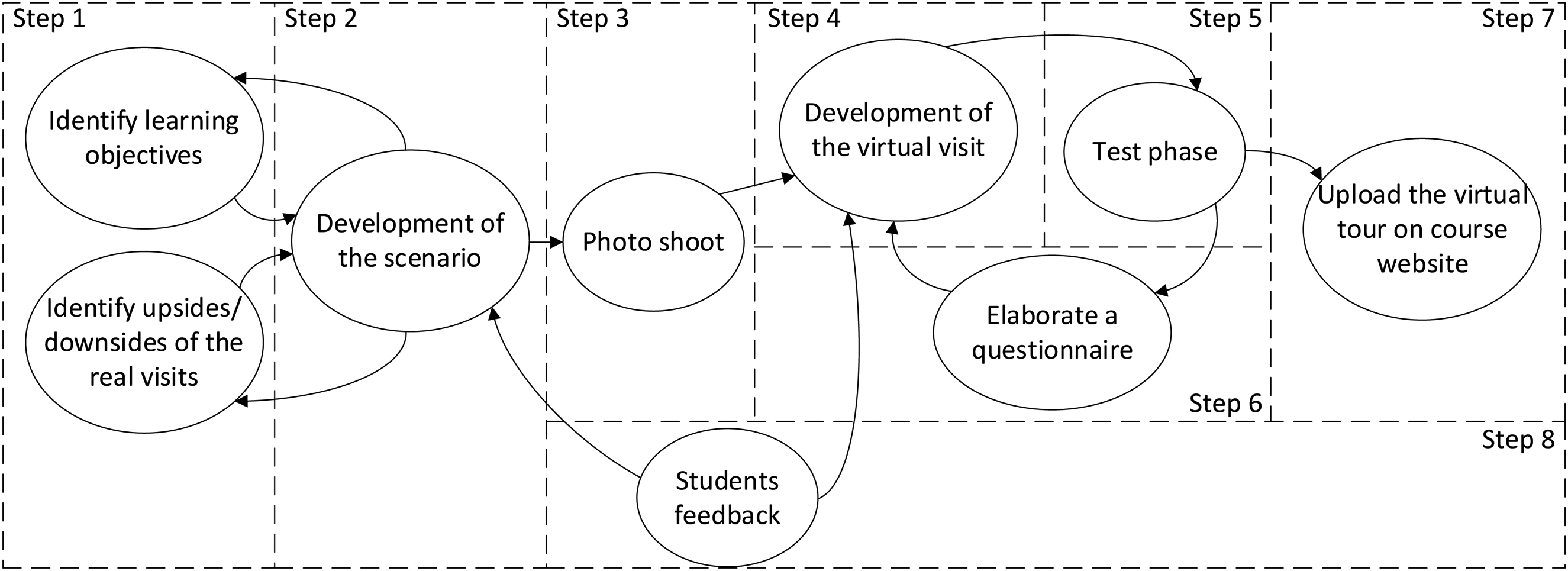
Workflow for the development of the virtual tours.
The first step consisted in elaborating the learning objectives introduced in Section 2 and more generally, the reasons justifying the development of the virtual tours. The design of effective virtual field trips for e-learning was explained in Ref., 26 where linking the content of the virtual tours with the learning content seen in the classroom is identified as essential. As mentioned above, the tours had been an integral part of the course for several years, and the situation was a good occasion to reflect on the actual added-value that the visits brought to students in the past and that we wanted to preserve (e.g. allowing students to “put an image” on pieces of equipment or systems seen in the course, understand the layout in mechanical rooms, etc.).
It was also an opportunity to address some downsides of the in-person visits. In the past, students frequently reported difficulties to hear what the BS staff was saying in the mechanical rooms since these rooms are often very noisy. The virtual visit concept allowing students to visit the rooms as many times as desired and at their own pace, we envisioned that these visits would still be relevant on the long term, even when actual visits would be allowed. Indeed, the virtual visits give the students an opportunity to revisit misunderstood components, which is not possible in regular visits. In addition, they provide the teacher with the possibility to add further information, schematics, plans, etc., to increase the students understanding of these components and their role in a mechanical room.
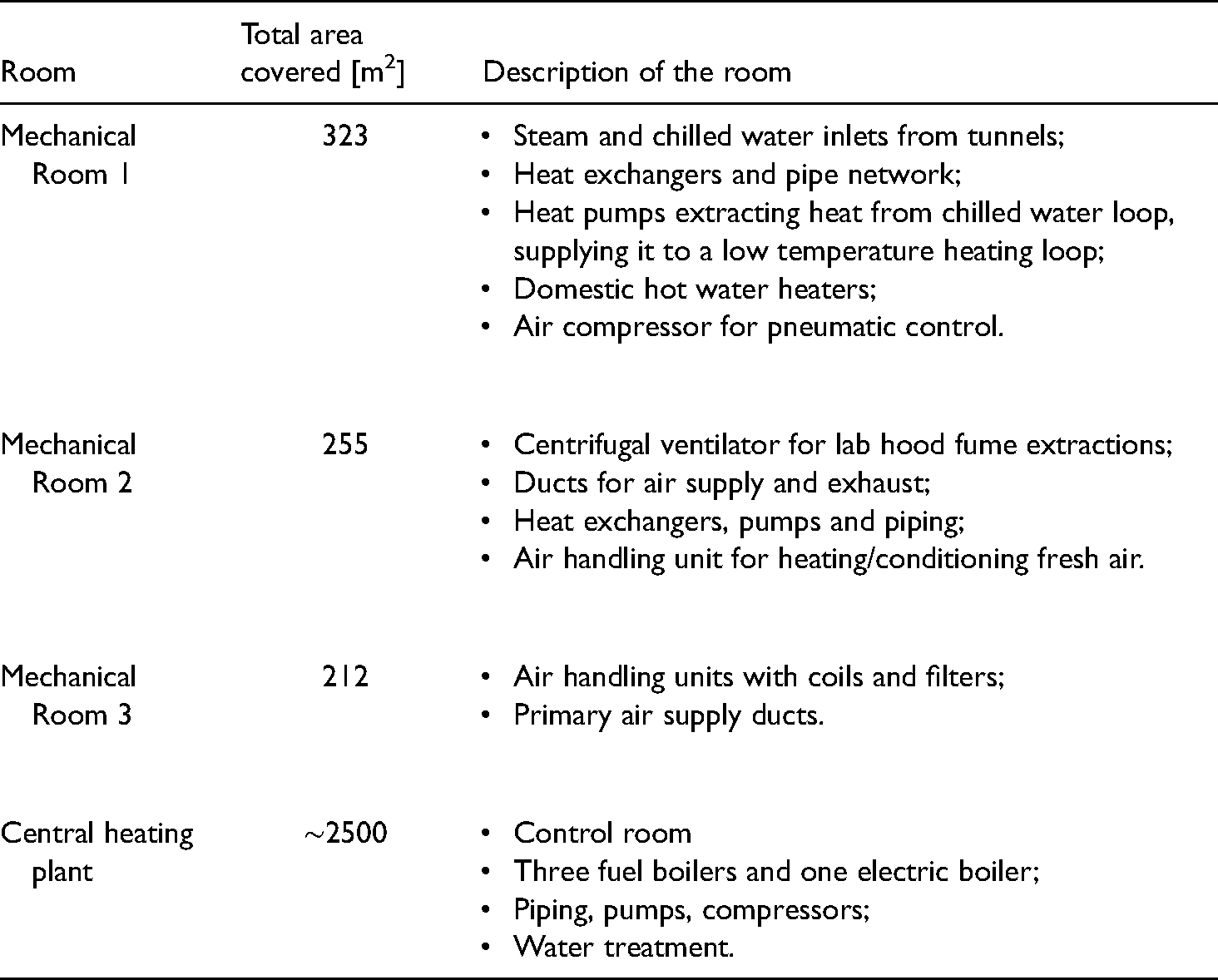
In the second step, we developed a preliminary scenario of each virtual visit based on the identified learning objectives, as well as the upsides and downsides of the regular visits. A total of four mechanical rooms were considered, leading to an equal number of scenarios. These rooms are described in Table 1. The scenarios included a rough listing of the pieces of equipment that would be seen during the visit, but mostly it aimed at detailing what the students would see and do in order to achieve the learning objectives. It should be mentioned that we were familiar with the installations to be visited, which facilitated the elaboration of the scenarios.
Characteristics of the visited rooms, each leading to a different virtual tour.
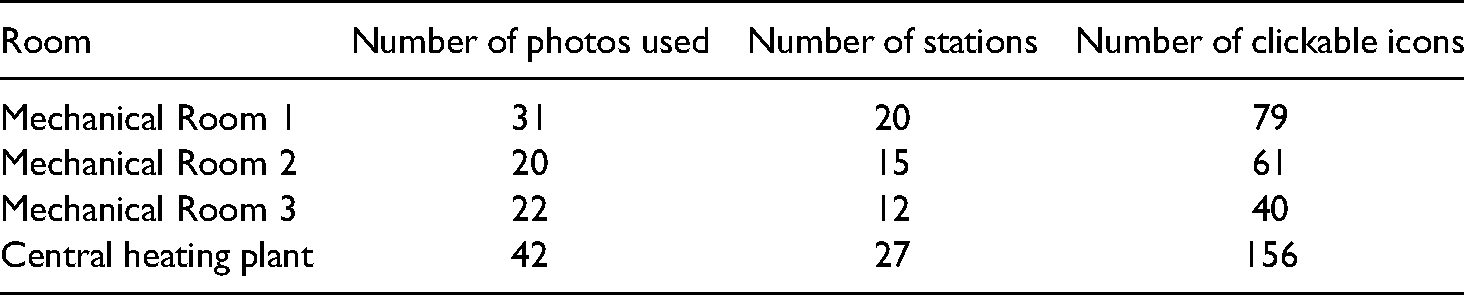
Then, in step three, a photo shoot of the installations was organized with the BS staff. To emulate the in-person visits, it is essential to take several pictures. 360° panoramic views 26 can also be taken even though in our case, we only used panoramic pictures covering 180° or less. Still, combining panoramic pictures provided a good “feeling” of the room layout and overall ambiance, without the complexity of handling 360° images. Developing the preliminary scenarios before the photo shoot helped to identify the required photos and ensured that they were taken during a single visit of the room. During these sessions, we took a large number of pictures (including panoramic pictures) and collected from the BS engineers more information on the systems, their design, operation, maintenance, etc. Table 2 presents the number of pictures retained for the virtual visits, as well as the number of visited stations and clickable icons to quantify and compare the complexity or each visit. Drawings of the mechanical rooms were also provided to us when available. In addition to providing the “raw material” for the virtual visits, the photo shoot sessions allowed to refine and complete the scenarios.
Number of pictures, stations and clickable icons in each virtual tour.
Increasing the covered area increases the numbers of photos and stations required to develop a virtual visit. Thus, it is useful to know in advance the main features of the visited installation in order to plan the photo shoot and ensure that the required photos are taken. Using the pictures, the virtual tours were developed with Storyline 360 (step 4), an application used to produce interactive e-learning courses provided with Articulate 360. 27 This software provides the possibility to follow the virtual tours on a smartphone, tablet or laptop. This ensures that all students are able to do the virtual activities at any place or time.
In Storyline, visits are made of slides between which interactions are built using simple programming logic (e.g. if variable equals value Z, then do action X, else do action Y). The virtual visit proceeds as a real visit, allowing someone to move in the room from one point to another. Many items (e.g. compressors, heat exchangers, etc.) were tagged and information was added for these specific items (e.g. identification, role of the equipment, relation to other items, etc.). In the virtual tours, it is this information that the students are hunting for in order to answer a questionnaire. When possible, the relation between the technical drawing and the pictures were highlighted with clickable buttons. Making sure that the students were free to explore was essential to produce a “game-like” experience. For that purpose, the students can freely navigate through the tours by clicking on icons. There is a specific icon for each action, and the same icons are used in all four virtual tours so that the students instinctively know the result of their action and easily navigate through the frames. For a general understanding of the proceeding of our virtual tours, Figure 2 presents a schematic representation of the logic between two areas of a virtual tour.
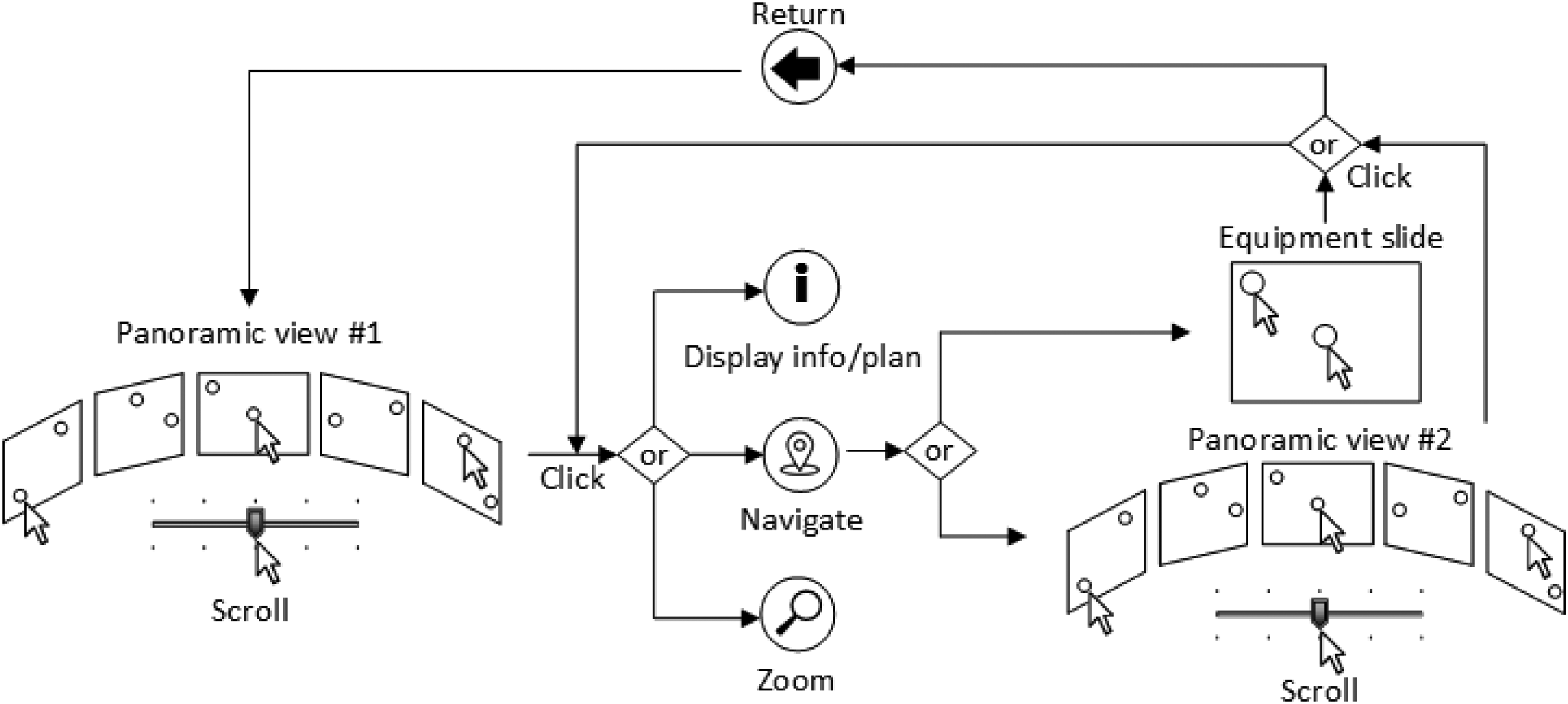
Schematic representation of the logic between two panoramic views of the virtual tours.
In Figure 2, the student starts in an area of the room illustrated as panoramic view #1 and can change the angle of view by using the scrollbar. By clicking on an icon (represented as a circle in Figure 2), the student can either navigate to another area (panoramic view #2) or slide of a specific piece of equipment, display technical information, zoom on a specific region of the area or display technical plans of the room for localisation. The option to return to the previous view is always available to ensure students can return to the entrance of the room or zone.
The navigation through the virtual visits and the access to information or plans are ensured using clickable buttons. As seen in Table 2, the number of clickable buttons increases with the “size” of the visit. For example, the central heating plant visit uses much more clickable icons than the others since it covers the largest area. There are many transition zones (i.e. zones without equipment, but used to access equipment) in this visit, which required the use of clickable icons to access the equipment. This explains the much higher number of clickable buttons in the central heating plant in comparison with the other visits.
In the fifth step, the virtual visit was tested in order to validate its proper functioning and to complete the information provided through the visit. As the visits increase in size, the programming logic behind their operation becomes more complex. This required to go through each visit many times in order to validate that the interactions between each room, zone or piece of equipment were working properly. The BS staff also contributed to that step, providing useful details and precisions, and validating that the provided technical information was correct. We used the online review platform from Articulate 360 for that purpose. In the end, a final version of the virtual tour was obtained. Section 4 presents some segments of these virtual tours.
Simultaneously (step 6), we elaborated a questionnaire that the students had to fill in during or after the visit. The questions required the students to explore the scenes, find pieces of equipment, etc., in order to find answers and make sense of the visit. The questions were formulated to assess whether the learning objectives mentioned in Section 2 were met. For example, to verify that students could identify the main components of HVAC&R systems, we asked questions such as “In what order does the exhaust air go through the components of the air handling unit?”. The students’ understanding of the working principles of HVAC&R systems could be validated with questions such as “Why is the area of the hot air duct smaller than that of the cold air duct in the dual-duct air system?”. Finally, to assess the ability to read technical drawings, some plans were provided to the students and they had to answer questions such as “Based on the original technical drawings, how does the domestic hot water used to be produced?”. It should be noted that all the information required to answer the questions was provided in the virtual visit, i.e. there is no need for students to search answers online or in textbooks.
The questionnaire was made available prior to starting the visit. Although questions could have been integrated directly in the virtual visit with Articulate 360, it was decided to use a distinct form in the university's web portal to facilitate the collection, grading and analysis of the results. Note that the questionnaires were much more elaborate than when in-person visits were organized in the past. This was made possible by the very nature of the virtual visits which give more time and details to the students. Unfortunately, this also means that it was not possible to compare students’ grades with the two approaches (virtual vs. previous in-person visits) since the evaluation methods where very different from the previous years.
Finally, the virtual tours were set online on the course website (step 7). A small portion of the final grade was attributed to the visits to encourage students to take them. At the end of the semester, students were asked to evaluate the virtual tours and provide their feedback and appreciation of the tours (step 8). The results and information gathered from the students is presented in Section 5.
Examples of virtual tours
This section presents some examples taken from the virtual tours and gives explanations about a sequence of actions that a student could take to navigate through these sections of the visits. Since students are free to explore, the sequences of actions represent only one possibility of how the visit could occur. Note that each student performed the virtual visits individually.
Excerpt from mechanical room 2
Mechanical room 2 is used to extract lab hood fume and condition outside air to replace the extracted air using centrifugal ventilators and air handling units. Figure 3 shows a simplified layout of the mechanical room, as well as some of the stations that could be visited, along with clickable buttons allowing navigation between these. This example was selected to illustrate the navigation process in the virtual visits.
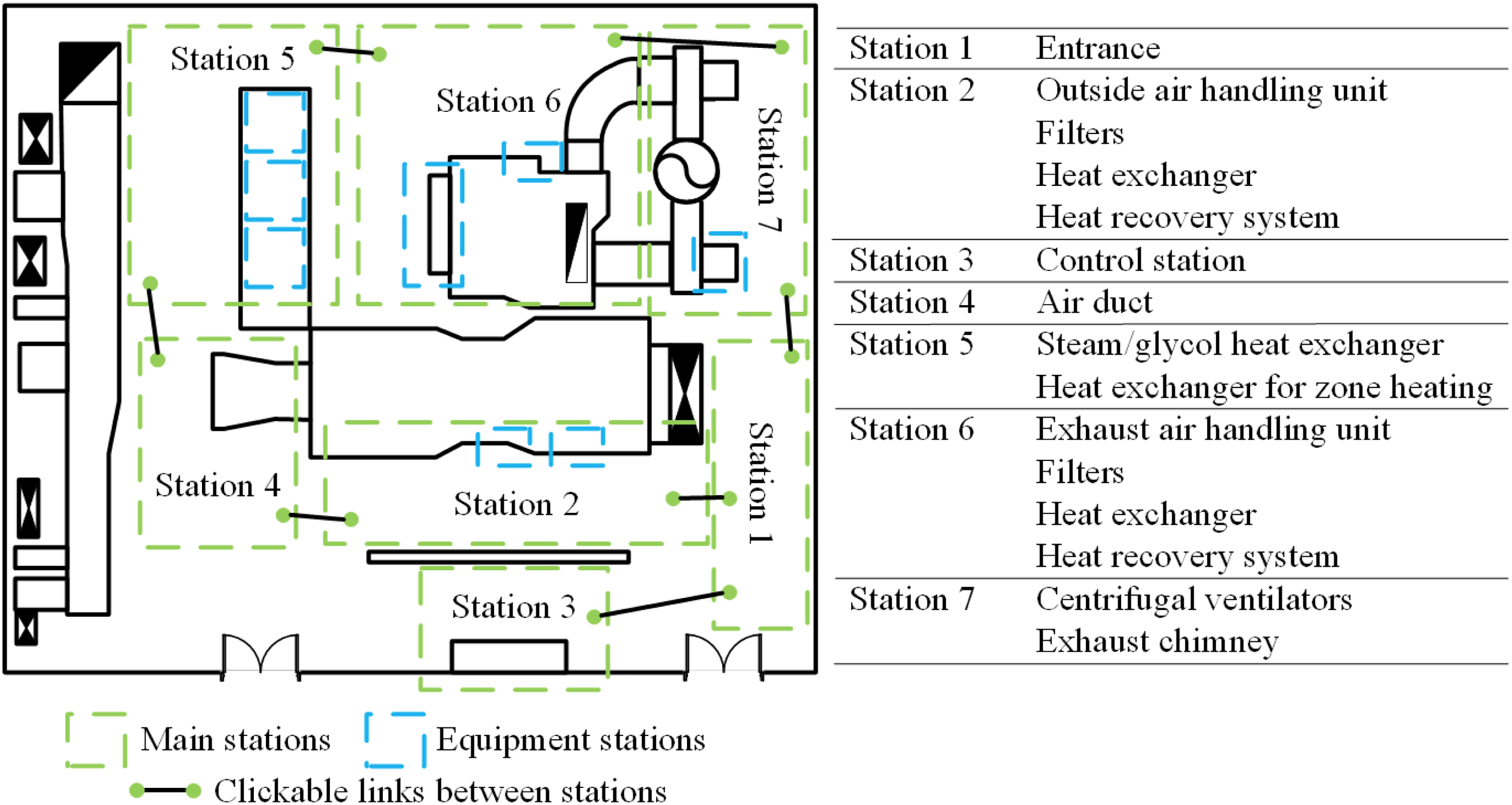
Example of navigation through the room for the virtual tour of mechanical room 2.
The virtual visit is separated in stations and students can travel between stations using clickable icons (illustrated as green circles in Figure 3). Main stations are mostly incorporated in the virtual visits as panoramic views (i.e. as if the student spins around in the middle of the station). From the main stations, it is possible to access specific equipment stations via clickable icons. For more details as to how the developed virtual visits work, Figure 4 presents a part of the virtual visit of mechanical room 2, and explanations about the virtual visit's process are given below. Again, this example is selected to explain how students can navigate through the virtual visit.
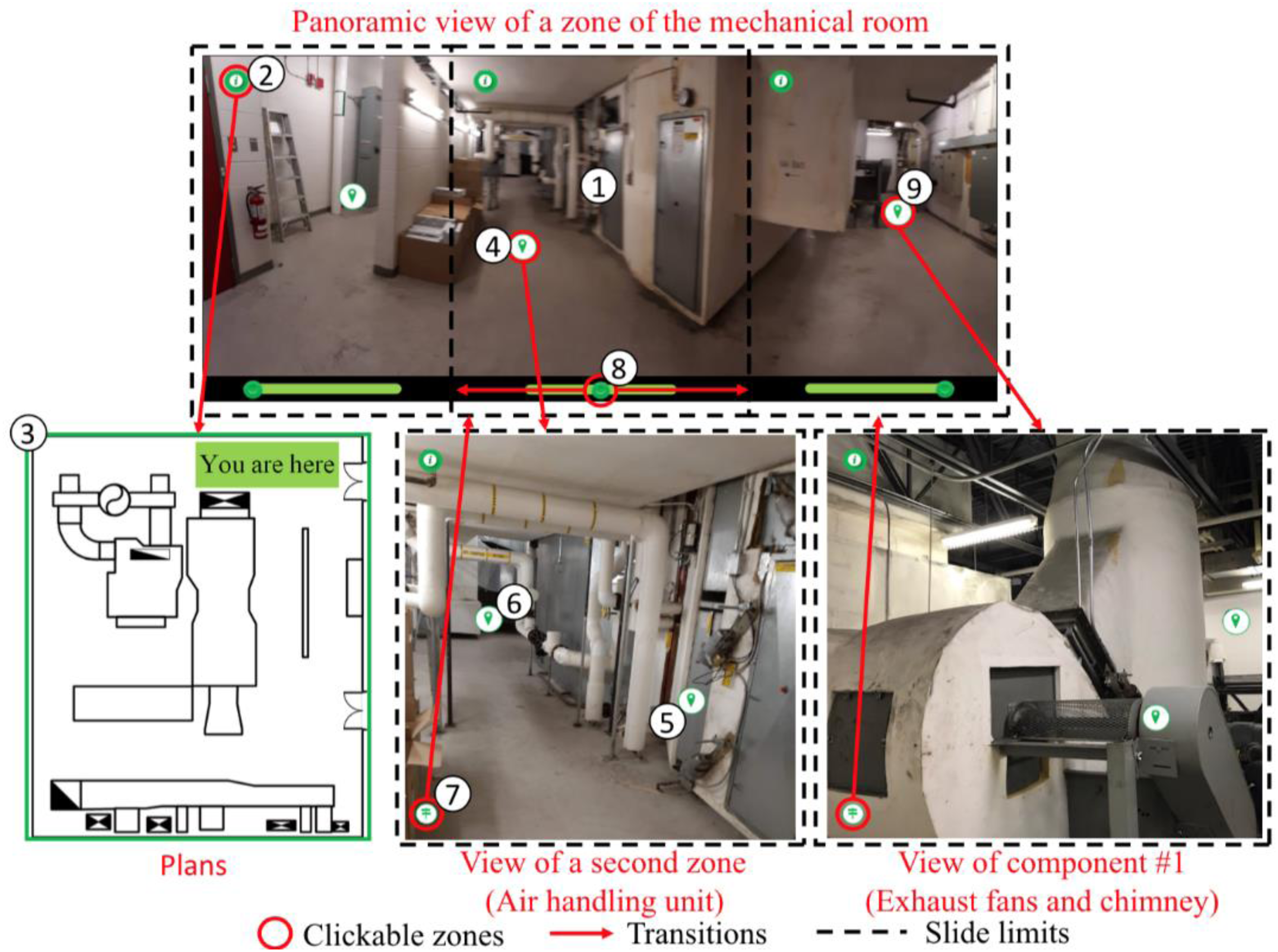
Example of a segment of the virtual tour of a ventilation room.
Students start this part of the virtual tour in the entrance of the mechanical room (station 1 in Figure 3, see (1) in Figure 4). They can navigate left or right in the panoramic view of the entrance by using the green scrollbar at the bottom of the screen. If the students get lost during the visit, hovering the cursor over the information icon located in the upper left corner of the screen (see (2) in Figure 4) will show the plans of the mechanical room (see (3) in Figure 4). The station where the students are currently in is highlighted in green in the plans. As previously specified, reading technical drawings is one of the learning objectives of the course in which these virtual tours are developed. Using these plans as a location tool introduces students to the information they provide. Furthermore, these plans contain technical data that the students had to go through in order to answer questions from the questionnaire. For example, we asked in the questionnaire “What is the diameter of the exhaust chimney for the return air?”, or “What are the dimensions of the duct for delivering conditioned air at the exit of the air handling unit?”. Answering these questions required students to locate specific equipment in the plans and extract sizing information.
Clicking on the location icon near the middle of the panoramic view (see (4) in Figure 4) takes the students to a side view of the air handling unit (station 2 in Figure 3) used to condition outside air. There, a clickable location icon (see (5) in Figure 4) can be used to zoom on the filters and heat exchanger of the air handling unit. This would allow students to access the information required to answer other questions such as: “To save energy, the air handling unit uses heat recovery from the return air. In what fluid is this heat stored before being transferred to the outside air?”. It is also possible to reach the back of the mechanical room (station 4 in Figure 3) by clicking on a location icon (see (6) in Figure 4).
To return and visit another zone via the entrance of the mechanical room, a return button located in the bottom left corner of the screen will take the students back to the previous panoramic view (see (7) in Figure 4). Then, students can use the scrollbar to navigate to the right (see (8) in Figure 4) and click on the location button (see (9) in Figure 4) that will move them to the centrifugal ventilators and exhaust chimney (station 7 in Figure 3). There, they can access the information on the motors of the centrifugal ventilators and find the answer to questions such as “What is the nominal speed of the electric motor of the centrifugal ventilators?”. Students can also access the right side of the mechanical room (station 6 in Figure 3) with a location icon or return to the entrance with the return button.
Excerpt from the central heating plant
The central heating plant is used to produce steam for heating all buildings of the campus. Figure 5 presents a part of the virtual visit of the central heating plant. This example is selected to explain how students can access information about the pieces of equipment presented in the virtual visits.
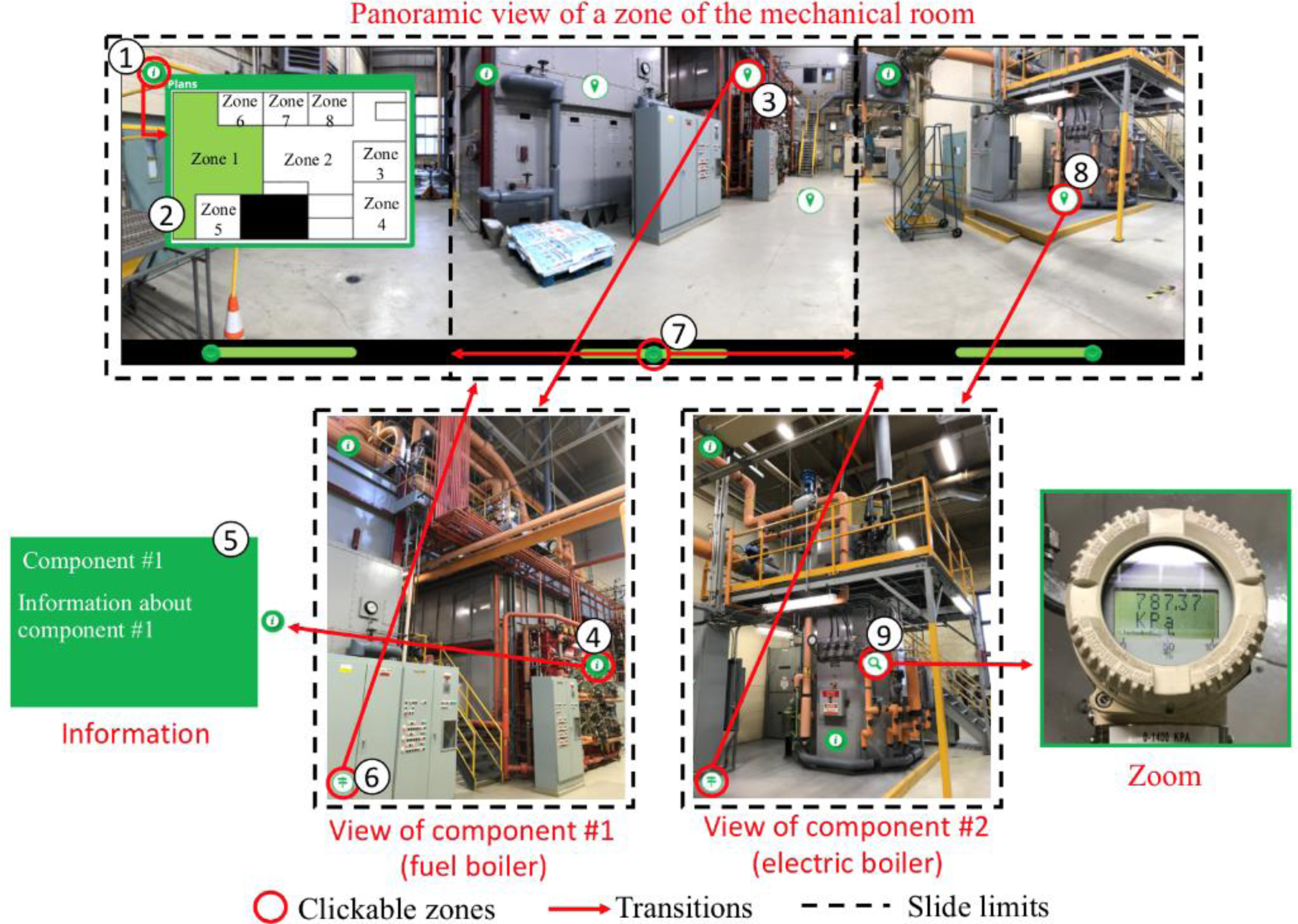
Example of a segment of the virtual tour of a central heating plant.
In the selected upper frame of Figure 5, students are located in the main room of the central heating plant where four boilers are located, including three fuel boilers and one electrical boiler. To move left or right in the panoramic view, a scrollbar is used. At any time during the visit, students can locate themselves by hovering the cursor above the information icon (see (1) in Figure 5) to show a simplified layout plan of the central heating plant (see (2) in Figure 5). As in the visit of mechanical room 2, the current location of the student is highlighted in green in the plans. Technical drawings were also provided in the virtual visit. By analyzing them, students could find the answer to questions such as “What is the diameter of the condensate return duct at the entrance of the central heating plant?”. Again, these questions were provided in advance in a separate questionnaire on the course web platform.
From the panoramic view of the room, students can get closer to one of the fuel boilers by clicking on the location icon (see (3) in Figure 5). For more information about this specific boiler, students click on the information icon (see (4) in Figure 5). More specifically, they will learn about the nominal power of this boiler, the process of producing steam, the fuels that it uses, and more. This information is displayed in green boxes (see (5) in Figure 5) that appear upon clicking on the information button. This can provide the answer to the following question from the questionnaire: “Which fuel is most commonly used in the fuel boilers of the central heating plant?”.
To return to the panoramic view and get closer to another boiler, students click on the return button (see (6) in Figure 5). Then, scrolling to the right (see (7) in Figure 5) shows the electric boiler, which is accessed by clicking on the location button (see (8) in Figure 5). As for the fuel boilers, an information icon provides information about the electric boiler that can be used to answer the following question: “Why is an electric boiler installed in the central heating plant?”. In that case, the campus uses an electric boiler in order to benefit from low electricity price outside of peak demand periods. In addition, students can read the pressure of the steam produced in the boiler by hovering the cursor over the magnifying lens icon (see (9) in Figure 5). This shows a zoomed picture of the reading on the pressure gauge. To ensure that students visit each boiler station, we asked in the questionnaire “What is the nominal power of the fuel boilers and the electric boiler?”.
Results from survey of students
At the end of the semester, we prepared an online survey and we asked students to take it. This survey acted both as a research tool to evaluate whether the virtual tours constituted an effective learning experience and as a quality management tool by collecting students’ suggestions of improvement and general appreciation. 15 students out of 33 answered the survey. Due to the particular situation caused by the lockdown, students were highly solicited to answer surveys about the digital transition in courses, their motivation and mental health, etc., which prevented us from achieving a higher response rate. First, we analyze their answers to questions regarding the overall learning experience.
To the question “Had you visited a mechanical room before the course? If so, in which context?”, we found that a significant portion of the students had never visited mechanical rooms before, around 43%. Most of the students who had the chance to visit a mechanical room prior to the course did so during summer jobs or internships, but some only visited one or two specific type of installation. The visit was thus answering a real need for students.
We also asked students “Could you summarize things that you have learnt while doing the virtual visits?”. Students mentioned specific aspects of how some equipment and systems work (mentioned by 40% of respondents). Regarding the pieces of equipment, many students said that they discovered their actual size (33%) through the visit, and more generally, just how they looked like (27%). Many also said that the visits allowed them to better understand space usage in mechanical rooms and how the layout is organized (27%). When asked “Are there concepts from the course that the visits helped you to understand better?”, most students mentioned that the visits helped them to “visualize” the systems that they studied in the course, and how pieces of equipment are positioned and connected together.
For the next question, we asked “Which aspects of the virtual visits were the most formative?” The most common comments were related to the visualisation of real systems (40%) and to the possibility to move freely in the rooms in order to discover the layout and answer questions at your own pace (33%). Students also mentioned that they appreciated the explanations provided for each equipment (27%) and the possibility to develop their capacity at reading HVAC technical drawings (13%).
To assess the quality of the virtual tours and improve the virtual tours, we were also interested in collecting suggestions of improvement from the students, and we asked them “Which elements of the virtual visits could be improved?”. The majority of the students mentioned that they sometimes got lost during the first visits, having difficulty to situate themselves spatially (67%). Having noted these difficulties ourselves in the first two visits, we added maps/layouts in the next ones. Students mentioned that this helped them to have a better sense of where they were exactly at each moment during the visit. Some students indicated that the quality of some pictures could be improved (20%) and that the transition between frames was sometimes too abrupt (13%). One student mentioned that even more information could be included in the visits. Figure 6 presents a summary of the most significant and representative comments.
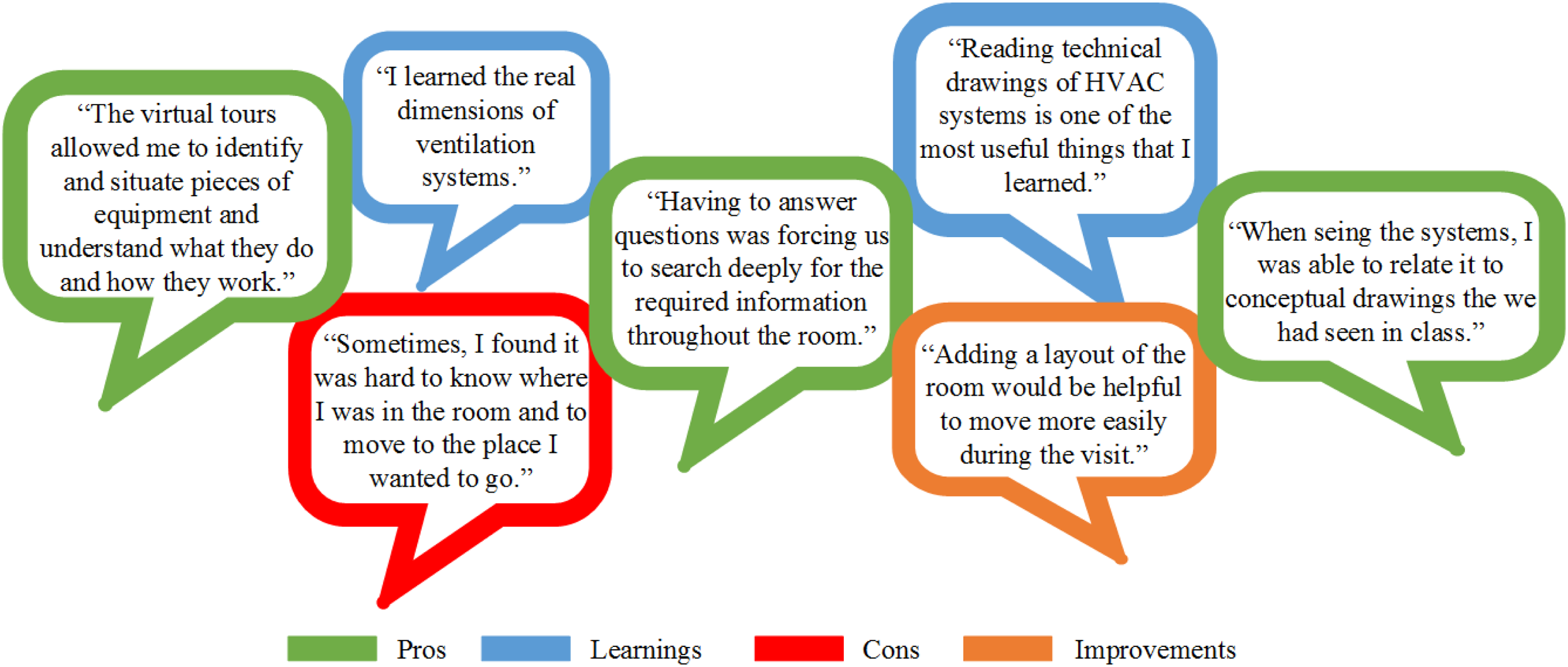
Selected representative comments from the students.
In the survey, a blank space was also left to collect any additional comment from the students. Overall, students provided more positive feedbacks, some even saying that they preferred virtual visits over real visits since it allowed them to go at their own pace and revisit stations as needed. A student mentioned that answering the questionnaire by navigating through the virtual visits made them think of vintage video game quests, which they appreciated.
Finally, we asked students to grade their overall appreciation of the visits on a scale from 1 to 5. The average mark was 4.4/5. Overall, students’ satisfaction was thus considered very good and the survey tended to show that the virtual visits allowed to meet the learning objectives.
Conclusions
This paper describes how virtual visits of HVAC mechanical rooms were developed to replace in-person visits of these installations due to the restrictions imposed by the COVID-19 lockdown. A general and step-by-step framework is proposed to develop virtual visits. Then, excerpts from the virtual tours are presented, with detailed explanations of what students saw and had to do during the visits. Finally, students were surveyed to assess their appreciation of the virtual visits. The tours had a positive impact on students’ learning and engagement. Students mentioned that they liked to be able to perform the visits at their own pace and the possibility to explore the rooms as they wanted to search for answers to the proposed questionnaire. They also indicated that they tended to get lost in the rooms, which we addressed by adding layouts in the visits so that students could always locate where they were.
To enhance the immersive experience, we thought of potential improvements in the future version of the visits:
Audio and video segments could be integrated to the visits so that students could better understand the “ambiance” in mechanical rooms. Videos of BS staff members providing additional explanations about the system could also be added. Infrared images could be used to visually represent temperature distributions in specific equipment and installation. Providing the students with the ability to “travel fast” to a specific zone by simply clicking on the corresponding part of the plans could help simplify the navigation in large virtual visits such as that of the central heating plant, as notified by students in the evaluation survey. Include trouble-shooting activities in the visits, in which students will need to identify problems in a room and solve them.
With the emergence of smart campuses that can share data,28,29 virtual visits could also be an interesting option for visualization of building operational data for students. For example, monitored data could be accessible by the students in activities where they are asked to find the temperature of fluids or flow rates in various pieces of HVAC equipment.
Finally, it is worth to mention that even though this project was triggered by the COVID-19 situation, we found many advantages to the virtual tours compared to the in-person visits, such as:
It provides the possibility for students to perform the tour at their own pace, as many times as they wish, and to explore the rooms as they want. It avoids the problem of not hearing what the BS staff members were saying in noisy mechanical rooms. All students thus had access to the information during the virtual tours. It allows to integrate aspects that were not covered in in-person visits, such as reading technical drawings and comparing them visually with the installations, analyzing technical data, identifying pieces of equipment, etc. Virtual visits allowed to significantly expend the number and type of questions that can be asked to students, creating an experience sharing similarities with serious games.
In the future, even when in-person visits will be allowed, our intention is to continue using the virtual visits in combination with in-person visits. Complementing virtual tours with in-person visits would offer a more complete and effective way to ensure a better understanding of how these complex systems are spatially organized, designed and operated. It will be interesting to develop hybrid teaching strategies relying on the strengths of both types of tours.
Footnotes
Acknowledgements
The authors are grateful to the staff of Building Services from Université Laval for their help and their time in elaborating the virtual visits, and in particular Marise Vallières, Marc Fontaine and Patrick Jobin. The authors are also grateful to Christian St-Pierre, an education advisor at the Faculty of Sciences and Engineering, who guided the authors through the development of the virtual visits.
Declaration of conflicting interests
The author(s) declared no potential conflicts of interest with respect to the research, authorship, and/or publication of this article.
Funding
The author(s) received no financial support for the research, authorship, and/or publication of this article.
