




Abstract
This study ascertains whether three positive organizational behaviour capacities (optimism, self-efficacy and self-monitoring) predict attitude towards organizational change. Design of this study was cross-sectional, and data were collected with self-report measure. One hundred sixty-nine employees were drawn from 21 organizations in Delta State, Nigeria. The participants were made of 108 (64%) females and 61 (36%) males, with the mean age of 40.21 years (SD, 9.13). Simple regression analysis revealed that optimism, self-efficacy, and self-monitoring, positively and significantly predicted attitude towards organizational change. While multiple regression analysis revealed that only self-efficacy positively and significantly contributed to attitude towards organizational change. It was concluded that the predictors influence employees’ attitude towards organizational change with self-efficacy contributing the highest influence to organizational change attitude. It was recommended that for successful employees change acceptance, optimism, self-efficacy and self-monitoring should be structured into policies and strategies for organizational implementation.
Keywords
Introduction
Every society desire effective functioning of organizations as almost every product available to human are from organizations. Concern for organizational effectiveness (i.e. the degree an organization meets its stated goals) occupied much space in organizational behaviour literature. An organization is a deliberately coordinated group of people that functions for a reasonable length of time with the aim of achieving some set objectives and goals. 1 This statement clearly expressed the position of human factor in the functioning of any organization. Organizations are constantly adapting and changing due to the socio-economic and technological environment. Organizational change expresses activities that evolve from a present state to another expected state in attempt at achieving organizational effectiveness. 2 Organizations, both private- and public-owned, are downsizing, offshoring, outsourcing or computerizing to achieve efficiency. Organizational change takes variety of forms, such as organizational planned/unplanned, structural and behavioural process. In theory and research, organizational change has been well discussed and the consensus is that, change is inevitable for competitive advantage, survival and existence. These changes thus have implication for employees’ attitude. 3,4
Organizations are experiencing one form of change or the other, but the success of any change effort has been observed to be largely a function of the employees’ attitude towards that change. 5,6 Faghihi and Allameh 7 reported a positive significant association between employee’s attitude towards change and employee readiness for change. An employee’s readiness for change often reflect in such employee acceptance and commitment to that change. Both in theory and research, attitude have been vigorously linked with behaviour. 3,4 Landy and Conte 8 defined attitude as a relatively stable feelings or beliefs that aim at a specific person, group, idea, job or other object. Theory of reasoned action 9 proposes that actions are best predicted by intentions, and that intentions are in turn determined by a person’s attitude. It is this theory that metamorphosed into the theory of planned behaviour with additional element of perceived behavioural control. The validity and usefulness of this theory has received satisfactory degree of confirmation. 10 Similarly, empirical support for the influence of attitude on behaviour abounds. Haas et al. 11 observed among police officers that perceptions of fair treatment by supervisors and trust in supervisors (attitude) were positively associated with compliance (behaviour). Theoretical and empirical positions on the links that exist between attitude and behaviour point to the necessity for examination of employees’ attitude in relation to organizational variables, such as change.
Attitude towards organizational change is among organizational variables that attract much effort of researchers and practitioners. Organization change literature is massive, 12 with coverage comprising forms, antecedents and consequences. Similarly, studies have examined organizational change attitude from the perspective of resistance (negative) and acceptance (positive), which is often expressed as a continuum. 6 Other studies 13,14 have added extensively knowledge of what are the antecedents, predictors and determinants of employee attitude towards organizational change. The consequences of organizational change attitude are the degree of acceptance or rejection of a given change. Attitude could be positive or negative with each having implication for the success of an organizational change. Negative attitude to change has implication for change apathy, lack of commitment and anti-change behaviour, while positive attitude to organizational change leads to employee commitment and successful organizational change efforts. 15 The position of the literature relating to attitude and successful organizational change efforts underline the necessity for evidenced-based knowledge of employees’ characteristics that influence attitude towards organizational change. Studies that represent individual and organizational predictors of attitude towards organizational change exist. 7,14,16 –19 Although, individual levels studies focus mainly on demographic- and organization-related employee factors such as job satisfaction and change participation.
Obviously, there is dearth of study that examined predictors of attitude towards organizational change from psychological capital (PsyCap) perspective. PsyCap is concerned with application of positively oriented human resource strengths and psychological capacities that can be measured, developed and managed for organizational performance. 20,21 PsyCap is a higher-order construct in which individual’s positive psychological state of development are exemplified by self-efficacy, optimism, self-monitoring, hope, resiliency, well-being, among others. The term is said to carry a changing feature depending on the situation rather than having a stable characteristic feature. 22 According to Luthans and Youssef 23 and Luthans et al., 24 PsyCap is a combination of human resource capacities which in this study refers to employees’ positive psychological state of development – self-efficacy, optimism and self-monitoring. Self-efficacy deals with succeeding at challenging organizational tasks, optimism is to succeed now and in the future 21 while self-monitoring is to succeed at harmonizing ones behaviour to organizational requirements. 25 This definition clearly assumed that PsyCap has implication for organizational functioning. The concept of PsyCap has attracted much research work. Literature has documented studies that found desirable and practically useful association between PsyCap and a few organizational variables. For instance, studies have shown that PsyCap has a positive impact in enhancing sustainable competitiveness, reduce costs, mitigate negative influences, enable positive work-related outcomes and positive organizational change for the benefit of the organizations. 21,22,26 Self-efficacy, subjective well-being, optimism and resilience have significant and positive effect on innovation. 27
The list of PsyCap is increasing as more variables that meet inclusion criteria are been identified while the key variables of optimism, self-efficacy and self-monitoring are examined in this study. These three PsyCap factors were among the few that have been widely cleared to meet inclusion criteria of acceptable measures, and which can be manipulated for the desired organizational outcome. The present study serves as presenting research from different cultural environment, which may have influence on research instruments, conceptual constructs and relationships between variables 28,29 and also as an extension of research where such research is lacking. This study to the best of our knowledge is the first to examine PsyCap of self-monitoring along with optimism and self-efficacy PsyCap. The self-monitoring inclusion will enable generalization of results beyond what the core PsyCap offers. Finally, the sample for this study cut across both the public and privately owned organizations, making the study result applicable to broader organizations.
PsyCap of optimism and organizational change
Optimism is widely discussed from two perspectives: dispositional and explanatory. Depositional perspective presents optimism as an inclusive personality component characterized by overall positive expectations. That is, optimism expresses an individual overall belief of experiencing more positive things than negative ones in the future. 30 On the other hand, explanatory perspective is concerned with how individual explains the causes and influences of previous positive and negative events to create expectancies about the future. 31 This perspective suggests that optimists attribute causes of negative experiences to external forces, while pessimists attribute causes of negative experiences to internal forces. Dispositional and explanatory perspectives differ in that the latter sees optimism as a learned skill, while the former sees optimism as a stable personality trait. However, in terms of measurement tools, both perspectives correlate significantly. 32
Both nature and nurture have been implicated as determinants of optimism. The former expresses genetic factors, while the latter indicates social influences.
33,34
Optimistic individuals experience less distress during adversity than pessimistic individuals, optimism predicts active coping with stress while pessimism predicts avoidant coping.
34,35
Shaheen et al.
36
study on optimism and psychological stress showed that those high in optimism experience less stress during pre- and post-diagnosis of ailment in comparison with those low in optimism. Creed et al.
37
observed that participants high in optimism reported high levels of self-esteem and low levels of psychological distress, while those low in pessimism reported low levels of self-esteem and high psychological distress. Similarly, the relationship stress has with attitude towards organizational change is well documented in the literature. For instance, study indicated that highly stressed individuals were less committed and more reluctant to accepting organizational change interventions
38
while optimists individuals were more committed to the mission of their organization than pessimistic individuals.
39
In the predictive study of employee change acceptance and positive view of changes, Wanberg and Banas
40
reported that optimism was related to higher levels of change acceptance, while Wang
26
found positive relationship between employee optimism variables and change-supportive behaviour. Similarly, Avey et al.
41
reported that self-efficacy and optimism were indirectly related to organizational change. In Elias
42
study, employees with positive attitude towards change behaved in a manner that is supportive and facilitate change initiative. In line with the above review, it was proposed that: H1. Optimism positively and significantly predicts attitude towards organizational change.
PsyCap of self-efficacy and organizational change
Self-efficacy expresses belief in one’s capability to perform a specific task. It is believing and seeing oneself as being able to cope with the challenges of life.
43
It is also a belief about one’s ability to exercise one’s skills under changing and challenging conditions.
44
Self-efficacy has three dimensions which comprises of magnitude (an individual belief about the degree of tasks difficulties he/she can reach), strength (how strong or weak the belief about magnitude is) and generality (how much the belief about one’s capability can be expressed across situations).
45
Like optimistic individuals, high self-efficacy individuals possess certain characteristics that dispose them favourably to change. For instance, Maddux
44
indicated that individuals high in self-efficacy show resilience to adversity. According to Akhtar et al.,
46
individuals with low self-efficacy play down on their abilities, while individuals with high self-efficacy feel capable of doing what they want to do. Studies that reported relationships between self-efficacy and organizational change include Kumar and Kamalanabhan,
47
Anthony and Mohankumar
48
and Emsza et al.
49
Kumar and Kamalanabhan
47
in their study observed that the factors of optimism and change self-efficacy were significantly related to employees coping with organizational change. While, Anthony and Mohankumar
48
and Emsza et al.
49
reported significant positive relationship between self-efficacy, change self-efficacy and readiness for organizational change. In line with the above review, it was proposed that: H2: Self-efficacy positively and significantly predicts attitude towards organizational change.
PsyCap of self-monitoring and organizational change
Self-monitoring is a personality trait referring to an individual’s tendency to match expressive behaviour to interpersonal cues for situational appropriateness.
50
It is also described as a psychology-based approach that regulates behaviour to the necessity of work activities
25
According to Armenakis et al.,
51
organizational members often consider each other’s behaviour for cues on the meaning of events and circumstances in the organization. This concours with Mehra et al.’s
52
description that self-monitoring is the extent to which individuals are willing and able to monitor and control their self-expressions in any situations such as workplace. Just as Boz et al.
25
posited that people change their sensitivity to harmonize their behaviour, according to the requirements of the organizational situation. Thus, examining self-monitoring from the perspective of PsyCap is novel to the literature and is included because it meets the criteria for inclusion. Additionally, it is a positively oriented human resource strengths and psychological capacities that can be measured, developed and effectively managed for performance improvement.
53
High self-monitor individual adapt and modify self-presentation and behaviour to fit social situation,
54
response through appropriate behaviour to signals in work relationships,
55
signs of others,
25
sensitive to social cues
56
and manipulate expressed self-images to a greater extent,
57,58
thus making them to have remarkable ability to adapt to other’s expectations. In contrast, those with low levels of self-monitoring lacks ability to provide appropriate behaviour in work environment,
55
cannot adapt quickly because of difficulty in distinguishing their feelings and reactions,
59
talk quite openly,
60
concerned with the assessment of the social climate
61
and often ignore social signals because of having a weak desire to change their own presentation in accordance with social requirements.
62
Goksoy
59
reported that readiness for organizational change was influenced by factors such as self-monitoring and perceived fairness of previous change. Rafferty and Simons
4
observed that self-monitoring has impact on readiness for change and added that readiness for change had been implicated in resistance to or acceptance of change efforts in organizations. In line with the reviews, it was proposed that: H3: Self-monitoring positively and significantly predicts attitude towards organizational change.
A theoretical explanation for linking optimism, self-efficacy, self-monitoring and evaluative beliefs regarding organizational change can be derived from Taylor’s
61
cognitive adaptation theory. Taylor
61
proposes that when an individual faces a threatening event, such individual finds meaning in experience, and self-esteem, through adjustment. As suggested in the theory, the degree to which PsyCap is present in individual influences ability to cope in stressful situations. Organizational change is an example of a stressful event for organizational members. Similarly, Helgeson et al.
63
study found that PsyCap of self-esteem, mastery and optimism predicted reduced psychological distress, while enhancing psychological well-being, higher work satisfaction and lower work stress during the transition. Research on PsyCap has two features that require attention. First, literature on PsyCap is mainly on antecedent of workplace attitude and behaviour. There is lack of research concern for predictors of PsyCap. There should be comprehensive information on PsyCap that would enable appropriate manipulation for the desired outcomes. Second, although empirical concern for PsyCap and work variables with implication for performance is growing, there are still number of variables that have not received research attention. This implies that literature on PsyCap is not robust for wide application. H4: Optimism, self-efficacy and self-monitoring positively and significantly predict attitude towards organizational.
Methodology
Sample and procedure
Participants for this study were 169 employees from 15 public and 6 privately owned organizations in Delta State, Nigeria. Public organizations participants were 75% of the sampled population. The use of many organizations was to test the research hypotheses with diverse sample of organizations. On the average of seven participants was drawn from each of the participating organizations. The participants consist of 108 (64%) females, and 127 (78%) married. Although, the number of males and females, married and unmarried, and public and private organizations used in the study were unequal, this imbalance has no direct effect on the results as the tested hypotheses were not on gender, marital status and organization type. Participants’ mean age was 40.21 years (SD, 9.13), with both junior and senior members of the staff included in the sample, so as to enable generalization of findings to all employees. Every participant had formal education with the majority holding first degree or its equivalents. The high usable rate of questionnaire recorded in this study could be explained by the respondents’ level of education.
After approval from the appropriate authorities, the questionnaires were administered to employees in the sampled organizations at their work places. A total of 200 questionnaires were distributed, within an interval of 4 weeks, 185 responses were received. However, after data cleaning involving removal of those not appropriately completed, 169 responses were used for data analysis. This return rate is satisfactory as it exceeded survey response rate levels and trends in organizational research. 64 Specifically, Baruch and Holton 64 reported average response rate of 52.7% for studies that utilized data collected from individuals. Similarly, the return rate also goes above Babbies 65 suggestion of 50% return rate being adequate, 60% return rate being good and 70% return rate being very good. The participant sample size of 169 was adjudged satisfactory as it is in congruent with Dewberry 66 recommendation that when the effect size expected is unknown, the sample size required for a medium effect size should be adopted. Therefore, the sample size adopted has above 90% power of detecting a significant association between each pair (p < 0.05) level of significance, if such an association exists.
Research instrument
This study used self-report questionnaire for data collection. The questionnaire had two parts. The first part sought for information on basic characteristics of the respondents and the organizations. The individual items include sex, age, designation, employment status, years already spent in the organization, the highest formal level of education attained, while items on organizations were type, nature of activity and years in existence.
The second part covered items from the adopted scales. Scheier and Carver’s 30 Life Orientation Test–Revised (LOT–R) scale was used to measure optimism. The scale measures generalized optimism with a 10-item statements that include four fillers. Three of the six-item statements were framed in optimism direction, while the other three-item statements were framed in pessimism direction. Despite the seemly two-dimensional feature of the scale, some researchers 67,68 viewed the scale as unidimensional with confirmatory factor analysis 69 confirmed the measure to be unidimensional. The scale is also the most utilized measure of optimism from dispositional perspective. 37 Scheier et al. 70 reported Cronbach’s α = 0.78 and test–retest reliability α = 0.56 to 0.79 on the scale. Higher scores on this measure indicate higher levels of optimism.
Schwarzer and Jerusalem’s 71 10-item scale on generalized self-efficacy (GSE) was adopted. GSE refers to an individual’s belief in overall ability to achieve necessary performances across a wide variety of different situations. 72 The scale was developed to measure general sense of perceived self-efficacy with the objective of predicting individuals coping with daily issues and adaptation after stressful life experience. The scale was developed in German but has been rendered into about 25 languages, 73 which is an indication of its wider acceptance. Higher scores on this measure indicate higher levels of GSE. Therefore, GSE scale was adjudged more appropriate for this study than specific self-efficacy scale. In a number of studies, 69,74 satisfactory psychometric properties had been reported on the scale.
Self-monitoring was measured with Lennox and Wolfe’s 57 13-item scale. The scale was developed as a response to the weaknesses of Snyder’s 50 25-item self-monitoring scale. Lennox and Wolfe 57 noted that Snyder’s scale showed a stable factor structure that was not in agreement with the five-component theoretical structure that underlined the development of the scale. The scale has two dimensions: ability to modify self-presentation and sensitivity to expressive behaviour of others. The former dimension has seven items, while the latter has six items. Lennox and Wolfe 57 reported α = 0.77 for the seven items, α = 0.70 for the six items and α = 0.75 for the total scale.
Dunham et al.’s 75 18-item scale was used to measure attitude towards organizational change. This scale measured the three components, cognition, affection and behaviour tendency of attitude. Each subscale has six items. The scale has been reported to have satisfactory psychometric properties. 7,76
Four factors informed the choice of the variables in this study. First, the scales have been widely used with satisfactory reports on their psychometric properties. Second, the scales have been satisfactorily used in different cultures. 77 This goes with the confidence that these measures can be validly used in this research location. Third, the scales are ‘technically acceptable’ survey instrument. As Zmud and Boynton 78 advanced, a scale is technically acceptable if it meets at least four characteristics: its constructs were each measured by multiple items; attempt was made to assess the instrument’s psychometric properties; its use was described in a referred journal; and it could be reconstructed. It is abundantly clear in the research studies that the scales adapted in this study met these requirements. Finally, the scales have moderate and sufficient number of items, that is, items range between 6 and 18. For instance, Harvey et al. 79 suggested that, at least four items per scale are needed to test the homogeneity of items within each latent construct. Generating sufficient variance among respondents through scaling gives validity to statistical outputs. 80 Wide scale points also control the effects of central tendency, that is, the tendency of respondents to avoid extreme end of scales. All these increase the validity of the measures. For the present study, α = 0.59, 0.97, 0.86 and 0.90 were obtained for optimism, self-efficacy, self-monitoring and organizational change, respectively. Six-point Likert method of summated rating scale (6 – strongly agree, 5 – moderately agree, 4 – agree, 3 – disagree, 2 – moderately disagree, 1 – strongly disagree) was adopted as it generates enough variability in response.
Design and statistical method
A cross-sectional research design was adopted as data were collected at one point in time. 81 Cross-sectional design is appropriate for this study as the hypotheses tested were in generalized and sweeping forms (e.g. optimism positively and significantly predicts attitude towards organizational change). This type of hypothesis presentation has potential for result generalization that is associated with survey. As Holton and Burnelt 82 expressed, survey study enables one to use smaller groups of people to make inferences about larger groups that would have been prohibitively expensive to study. With these feats, little wonder that survey study is most frequently used in organizational research. 83 However, this study used non-random sampling technique (convenience sampling) in selection of both the organizations and the participants. It is a convenience sample because the participants used were on basis of availability and it is also a common feature in organization studies, 84 particularly in research location where sampling frames are often not available or extremely difficult to access.
This study adopted simple and standard multiple regression analysis. Two sets of data analysis were carried out. The first analysis was on predictive relationship between the predictors and attitude towards organizational change, while the second was on the predictive relationship between the predictors and the three dimensions of attitude towards organizational change. Regression statistical tests go with a number of assumptions and some of these were met in the design of this study. The assumption of independent data from the respondents was met in the process of data collection. The requirement for measurement at interval level was achieved through the design of the research questionnaire. The research questionnaire was design along Likert’s summated rating scale format. Although with some level of controversy, data from at least four-point Likert scale are widely treated as interval level data. For the requirement of linearity, scatter plots indicated linear relationship between the predictors and the criterion variable. IBM_SPSS statistics version 25 software was used for data analysis.
Analysis and results
Table 1 presented Cronbach’s α statistics on the various measures used in this study. Cronbach’s α reliability assessed the internal consistency of scales and it is widely adopted test of scale reliability. Nunnally and Bernstein 85 remarked that reliability based on internal consistency should be the reliability of choice, followed by the addition of test–retest reliability if deemed necessary. Cronbach’s α has become one of the most important statistics in scale development. 86 It is widely and well reported in studies that Cronbach’s α = 0.70 is satisfactory. 87 Therefore, except optimism, the values obtained for the scales are satisfactory.
Reliability analysis (Cronbach’s α) of the research scales.

The level of Cronbach’s α coefficient reported in this study for optimism is not unexpected for a few reasons. The optimism scale has six items (excluding the four fillers) and this number could be adjudged to be small. It is well documented that the number of items on a scale has effect on its reliability. Of the six items that constitute the optimism scale, three items were worded in optimism direction, while the other three items were worded in pessimistic direction. Two sets of items that were worded in different direction may not likely yield high Cronbach’s α coefficient. The range of Cronbach’s from α = 0.56 to α = 0.79 reported by Scheier et al., 70 the developers of the scale included low Cronbach’s α coefficient. The possible approach to increase the Cronbach’s α coefficient observed in this study was to delete the weak items from the scale, but that was not done as it would leave the six-item scale (excluding the fillers) to be too few.
Tables 3 and 4 included Durbin–Watson and variance inflation factors (VIFs) tests for all the tested relationships, respectively. Durbin–Watson test statistics were between 1.73 and 2.15. The obtained values were within the acceptable level with reference to autocorrelation. VIFs values were all below 10 and this indicated absence of collinearity within the data. 88,89
Table 2 presented statistics on mean, standard deviation and correlation coefficients of the studied variables. The statistics revealed moderate degree of optimism, self-efficacy, self-monitoring and high degree of attitude towards organizational change among the participants. With a six-point Likert scale, the following mean were observed for optimism
Mean, standard deviation and correlation coefficient on research variables.

*p < 0.05 level (two-tailed).
**p < 0.01 level (two-tailed).
Table 3 presented simple regression analysis predicting attitude towards organizational change and the PsyCap of optimism, self-efficacy and self-monitoring. As indicated by the relationship between optimism and attitude towards organizational change was positive and significant (R = 0.27, p < 0.01). The analysis of variance test indicate that the regression was statistically significant (F(1, 168) = 14.08, p < 0.01) in predicting attitude towards organizational change. The R 2 indicated that optimism accounted for 7% variance in attitude towards organizational change. On the basis of Cohen’s 90 criterion, R 2 = 0.07 is slightly above small effect size. The small difference between R 2 = 0.078 and adjusted R = 0.072 which is 0.06 indicates a good cross validity; that is, this model has the potential to apply to other samples from the same population. The β = 0.26 value means that for every one unit increase in optimism, attitude towards organizational change increases by 0.26.
Simple regression analysis of optimism, self-efficacy and self-monitoring on attitudes towards organizational change and its dimensions.

**p < 0.01 level (two-tailed).
The R = 0.61, p < 0.01 indicated that the relationship between self-efficacy and attitude towards organizational change was modest, positive and significant (F(1, 168) = 99.58, p < 0.01), The regression statistics means that self-efficacy predicted attitude towards organizational change (good model). The R 2 indicated that self-efficacy account for 37% variance in attitude towards organizational change. On the basis of Cohen’s 90 criterion, R 2 = 0.37 indicates large effect size. This model has the potential to apply to other samples from the same population. The β = 0.53 means that for every one unit increase in self-efficacy, attitude towards organizational change increases by 0.53.
On the relationship between self-monitoring and attitude towards organizational change, the finding indicated R = 0.37, p < 0.01 which was positive and significant. The regression result showed that self-monitoring statistically predicted attitude towards organizational change (F(1, 168) = 27.98, p < 0.01). Self-monitoring accounted for 14% variance in attitude towards organizational change. On the basis of Cohen’s 90 criterion, R 2 = 0.14 indicates slightly above medium effect size. The small difference between R 2 = 0.14 and adjusted R = 0.13 which is 0.01 indicates a good cross validity; that is, this model has the potential to apply to other samples from the same population. The β = 0.31 means that for every one unit increase in self-efficacy, attitude towards organizational change increases by 0.31. In sum, the relationship between the predictors and the dimensions of attitude towards organizational change were positive and significant.
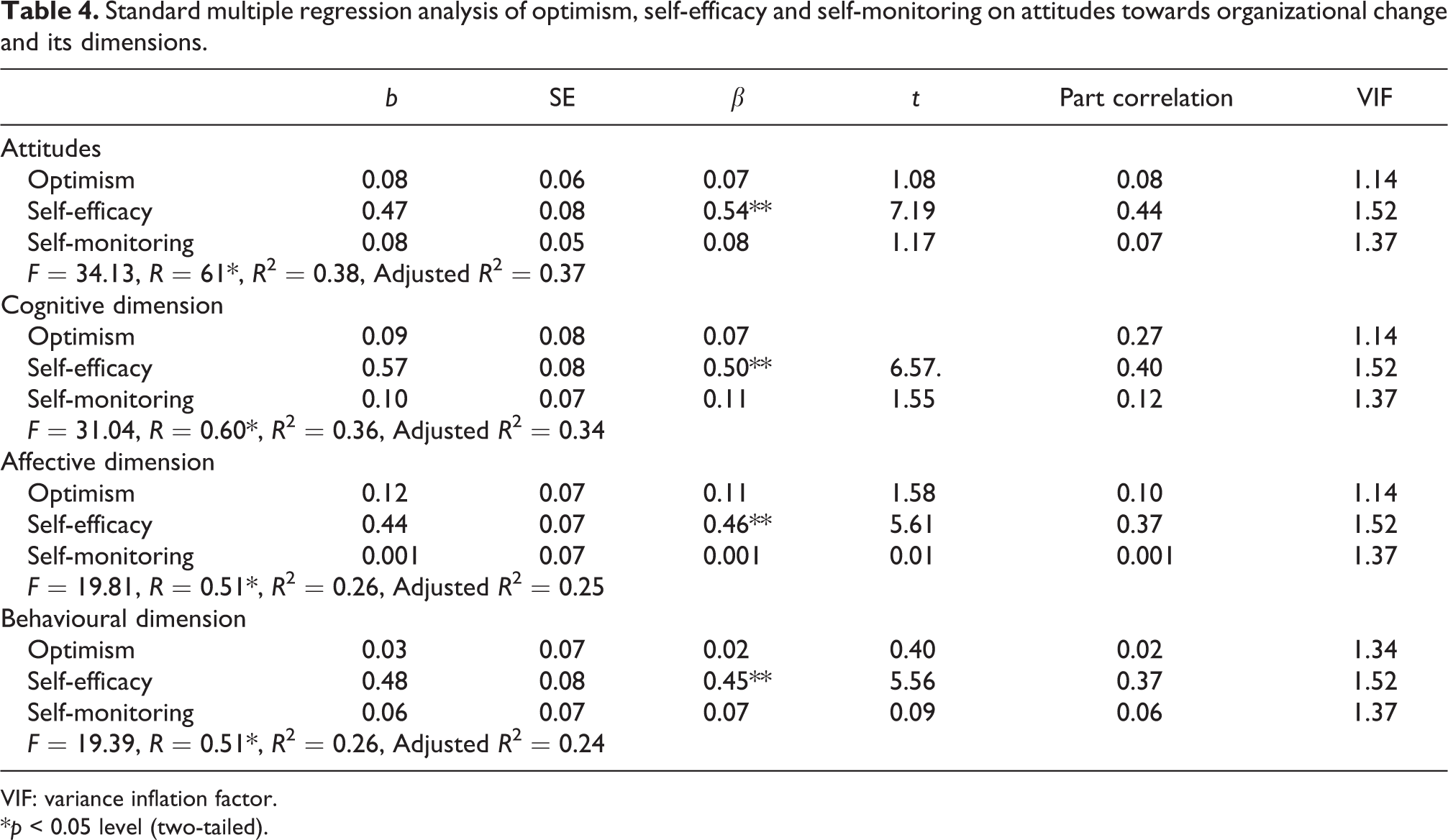
Table 4 presented multiple regression analysis predicting attitude towards organizational change and PsyCap of optimism, self-efficacy and self-monitoring. The findings revealed that only self-efficacy (β = 0.54, p < 0.01) statistically contributed significantly to attitude towards organizational change prediction. The factors of optimism (β = 0.07, p > 0.05) and self-monitoring (β = 0.08, p > 0.05) were not statistically significant.
Standard multiple regression analysis of optimism, self-efficacy and self-monitoring on attitudes towards organizational change and its dimensions.
VIF: variance inflation factor.
*p < 0.05 level (two-tailed).
Part correlation revealed that optimism explained 4%, self-efficacy 22%, and self-monitoring 3% variances in attitude towards organizational change. The R = 0.61 was the correlation coefficient between the criterion variable and all the predictor variables taken together. The small difference between R 2 = 0.38 and adjusted R 2 = 0.37 which is 0.01 showed a cross validity. On the basis of Cohen’s 90 criterion, R 2 = 0.38 indicates large effect size. Overall, the analysis of variance test F(3, 165) = 34.13, p < 0.05) indicated the combined PsyCap factors of optimism, self-efficacy and self-monitoring were statistically significant predictor of attitude towards organizational change.
On the specific dimensions of attitude towards change, the result showed that only the PsyCap factor of self-efficacy had significant influence on cognitive dimension β = 0.50, p < 0.01; affective dimension β = 0.46, p < 0.01; and behavioural dimension β = 0.45, p < 0.01. Again, the relationship between self-efficacy and each of the dimensions of attitude towards organizational change was positive and significant. No significant prediction was recorded for optimism and self-monitoring on the three dimensions of attitude towards change – cognitive, affective and behavioural.
Discussion and conclusion
This study ascertains whether PsyCap of optimism, self-efficacy and self-monitoring as individual variable and also as combined variables predict attitude towards organizational change. The predictor variables were also examined on the three dimensions of the criterion variable. The hypotheses tested were supported. Optimism, self-efficacy and self-monitoring as dimensions and as a composite positively and significantly contributed to attitude towards organizational change. The findings supported cognitive adaptation theory and the empirical studies of researchers such as Wanberg and Banas, 40 Wang 26 and Kumar and Kamalanabhan. 47 Wanberg and Banas 40 reported that personal resilience was related to higher levels of change acceptance, while Wang 26 found positive relationship between PsyCap and change-supportive behaviour. Kumar and Kamalanabhan 47 findings showed that change self-efficacy significantly relate with employee’s coping with organizational change. Just as Rafferty and Simons 4 observed that self-monitoring had impact on readiness for change and noted that readiness for change was implicated in resistance to or acceptance of change efforts in organizations.
Optimistic, high self-efficacy and high self-monitoring individuals are associated with certain characteristics that are favourable to experience of changes. Compared to pessimistic individuals, optimistic individuals are more likely to see good things happening to them from organizational change as individuals have been reported to cope better in stressful situations. 34 –37,39 High self-efficacy individuals would believe that they have the competence to adapt to changing situation, 44,46 –49 while self-monitoring individuals by their nature are able to adapt to changing situation. 25,55 –59 These characteristics associated with individuals high in PsyCap have the potential to cause more positive evaluative belief about organizational change from such individuals.
Findings from multiple regression standardized regression coefficients showed the unique and distinctive contribution of the individual variables in the model. Although, the combined influence of the predictors was positively significant, only self-efficacy factor was positively and significantly predicted attitude towards organizational change. Not only that self-efficacy has the largest influence, the size of the difference was very large on attitude towards organizational change. In other words, self-efficacy presents the greatest unique contribution in the model. This is because individuals who believe to have the competence (self-efficacy) for adapting to the demand of a given change are likely to have more positive attitude towards the change.
Another critical finding of this study come from the observed relationships between the predictor and the criterion when the latter was analysed as one-dimensional and as multi-dimensional variable. The patterns of observation in terms of regression parameters were very much similar in the two forms of analyses. The analyses revealed that the relationships between optimism, self-efficacy, self-monitoring and attitude towards organizational change and its three dimensions were all positive. Also, that self-efficacy had the highest contributory influence on attitude towards organizational change and its dimensions. This could be explained from the result indicating high correlation coefficient between the criterion variable dimensions. It thus confirms the relatedness of the three elements of attitude – cognitive, affective and behavioural. Long ago, Ostrom 91 found a positive relationship between the three components of attitude when it was observed that the association between verbal attitude measures and non-verbal attitudinal responses was highest when both came from the same attitude component. Also important was that the obtained effect sizes for the various relationships tested which ranged between small to large.
A few conclusions could be reached from the findings of this study, that is from the results of the simple and multiple regression analyses, it could be concluded from the simple regression that optimism, self-efficacy and self-monitoring are important predictors of employee’s attitude towards organizational change. While result from multiple regression indicated that self-efficacy has the greatest unique contribution in predicting attitude towards organizational change. Optimism, self-efficacy and self-monitoring relate in similar manner with attitude towards organizational change and dimensions of attitude towards organizational change. Finally, considering the need for successful change efforts, the observed effect sizes are meaningful and important. It has been abundantly noted in the literature 90,92 that the practical utility of effect size is dependent on context than magnitude.
Implication for practice
The findings of this study have some implications for practice. First, the results revealed that optimism, self-efficacy and self-monitoring positively influence attitude towards organizational change. Theory of planned behaviour posits that evaluative beliefs about organizational change have implication for acceptance or rejection of that change. This implies that for a successful change, organization need employees who are high in optimistic, self-efficacy and self-monitoring traits. Therefore, it is recommended that organizational management should design workplace behaviour and policies in a way to fit these variables so as to earn employee acceptance of organizational change issues. This may be achieved through training and development. Since change is an integral part of organizations and it is always ongoing, therefore the findings of this study have human resource management implication such as recruitment and selection exercise. Consequently, organizational practitioners need to reflect on how PsyCap factors can be helpful in employee recruitment and selection processes. Finally, because self-efficacy made the largest contribution to the prediction of attitude towards organizational change, self-efficacy should be considered first among the evaluative belief on organizational change by the organizational management.
Limitations and future research
This study has some limitations which point to directions for future research. Self-report questionnaire was the sole tool for data collection. This method of data collection is widely associated with common method variance that includes social desirability bias, halo effect and same source variance. To address social desirability bias, future studies should include social desirability scales in measures to identify and removed respondents with such characteristic. Same source variance could be addressed by having the independent and dependent variables in separate questionnaires. The design of this study was cross-sectional, which does not identify cause–effect relationship. To enable causal interpretation, future studies should explore quasi-experiment and longitudinal study. In the literature, optimism is presented from two perspectives: dispositional and explanatory. However, almost every study on optimism adopts either dispositional or explanatory measure. There is need for future studies to combined measures developed on the two perspectives for holistic understanding. This study examined the direct predictive relationship between the predictors and the criterion variable. It is well noted in organizational behaviour literature that relationship between two variables is often moderated and mediated by other variables. Knowledge of the role of third variables in organizational behaviour is required to generate explanations for why and how two variables relate. Future studies should theoretically and empirically propose mediators and moderators of the relationship between the predictors and criterion variable.
Footnotes
Declaration of Conflicting Interests
The author(s) declared no potential conflicts of interest with respect to the research, authorship, and/or publication of this article.
Funding
The author(s) received no financial support for the research, authorship, and/or publication of this article.
