




Abstract
Differing from managing a general supply chain, handling environmentally sensitive products (ESPs) requires the use of specific refrigeration systems to control the designated range of storage conditions, such as temperature, humidity, and lighting level in a cold chain environment. In general, third-party logistics (3PL) companies are authorized to handle ESPs, who therefore need to have a good cargo monitoring system in the cold chain environment, without which the functional quality is difficult to control and manage. This may result in product deterioration and even inventory obsolescence of the ESPs due to the lack of such systems, so there is a need to develop an effective cargo monitoring system to prevent such situations. This article proposes an Internet of Things-based cargo monitoring system (IoT-CMS) to monitor any environmental changes of ESPs in order to ensure their functional quality throughout the entire cold chain operational environment. Operational efficiency, maintenance strategy, environmental change, and electricity consumption are considered in real-life cold chain operations. Through applying (i) a wireless sensor network to collect real-time product information, together with (ii) fuzzy logic and case-based reasoning techniques to suggest appropriate storage conditions for various ESPs, effective storage guidance can be established. Through conducting the case study in a 3PL company in Hong Kong, the performance in customer satisfaction, obsolescence rate, and inventory visibility after adoption of IoT-CMS is evaluated. It is found that the functional quality of ESPs can be effectively assured, and the overall customer satisfaction is increased.
Introduction
Due to increasing public awareness on product safety and quality, the cold chain is developed to maintain a designated range of environmental conditions using certain refrigeration and dehumidification systems. 1 The cold chain also refers to the handling and traceability of various environmentally sensitive products (ESPs), such as agricultural, frozen, and pharmaceutical products. 2 –4 In real-life situations, ESPs are typically handled in three different storage regions, namely temperature-controlled, chilling, and freezing sections, so as to meet their distinctive storage requirements. In addition, customers who own the ESPs will frequently monitor the storage conditions, especially for ambient temperature and humidity, because fluctuation of storage conditions may lead to product quality deterioration or even obsolescence. Third-party logistics (3PL) service providers have to bear certain risks in compensating customers if their products are damaged. In order to minimize the risks, 3PLs are willing to apply state-of-the-art technologies to satisfy their customers’ requirements.
Figure 1 shows two critical challenges in the cold chain environment. Currently, 3PLs use temperature data loggers to monitor cargo conditions during supply chain activities. However, they are limited in regard to viewing real-time cargo conditions, and the loggers also have limited memory for storing the collected data. The formulation of follow-up plans is affected if accidents occur. It is also difficult to store all the sensor data for a long period during the storage and transportation processes or with a high frequency of data collection. On the other hand, cold storage facilities are divided into the three aforementioned sections with the adoption of refrigeration and dehumidification systems. However, external factors, such as the frequency of operations and machine maintenance, may affect the stability of such systems. Inappropriate storage procedures also increase the electricity consumption. In other words, there is lack of effective storage guidance in handling these external factors in warehouses. In this article, an Internet of Things-based cargo monitoring system (IoT-CMS) is designed to formulate effective storage guidance under a cold chain environment. The wireless sensor applications are built on IoT platform to achieve the goals of real-time monitoring and alert management. The design of the IoT monitoring application consists of four major layers, namely device layer, connectivity layer, IoT cloud layer, and application layer. Every cargo item has a wireless sensor attached which operates in wireless communication protocols, such as Bluetooth, so that the monitoring logic and mechanism can be built in the IoT development platform, resulting in automatic environmental monitoring. According to the operational efficiency, maintenance strategy, and environmental change in the cold chain facilities, fuzzy logic (FL) is then used in examining any adjustments of storage conditions and change of electricity consumption. The outputs from the FL are stored and loaded into the case-based reasoning (CBR) for aiding the decision support process. In order to maintain stable environmental conditions and minimize the electricity consumption, CBR is then applied to establish storage guidance for workers, and hence the functional quality of the products can be monitored and managed effectively.

Existing challenges under cold chain environment.
This article is divided into six sections. Literature review section consists of cold chain management, IoT applications, and FL and CBR. The system architecture of IoT-CMS is proposed in “Design of the IoT-CMS” section. Case study section describes a case study to investigate the feasibility of the proposed system, followed by the results and discussion of IoT-CMS in “Results and discussion” section, and the final section presents the conclusions.
Literature review
This section reviews the literature related to the design of the IoT-CMS in cold storage facilities. It covers (i) cold chain management, (ii) IoT applications, and (iii) FL and CBR.
Cold chain management
Cold chain management has two vital roles, namely cold storage and transportation, for maintaining the quality of perishable products, such as fresh food and pharmaceuticals, among supply chain activities. 5,6 It covers the basic functionalities of supply chain management, which are production, processing, transportation, and distribution. 7 However, it has strict requirements in information integrity, resource management, and product quality. 8,9 The cold chain monitoring and storage conditions are particularly important in maintaining designated environmental conditions, as stated in various international regulations, such as Hazard Analysis Critical Control Point, Good Agricultural Practice, and Food and Drug Administration. 10 –12 It shows the importance of cargo traceability and monitoring, without which foodborne illnesses or quality deterioration may occur. In order to maintain and monitor the product quality in storage and transportation, enabling technologies, including freeze-chill technology and temperature indicators, are applied to control and record the information in cold supply chains. 13 These technologies are also applied to cold storage facilities, for example, the chiller and freezer, which keep the products in an appropriate storage environment, but do not monitor the pallet level or item level. On the other hand, in order to monitor the conditions of the product and storage region in real time, radio frequency identification (RFID) and wireless sensor networks (WSNs) are feasible solutions to collect real-time sensor data, such as item identity, ambient temperature, and humidity. 14 Several researchers have developed particular RFID-based systems for identifying and monitoring cargo and relevant logistics resources, for example, material handling equipment and packing materials. 15,16 However, the deployment of RFID-based systems is deemed to be unaffordable and expertise-required for small and medium enterprises (SMEs). The implementation cost for RFID depends on hardware, middleware, and services. 17 Since most SMEs are not asset-based businesses, their logistics premises, such as warehouses, are rented so that the property owners will increase the rental fee if SMEs install fixed system hardware in their facilities. In addition, such monitoring applications will create a large volume of data in the corporate information technology system, which is difficult to manage and may incur the cost of purchasing and licensing the local database. Recently, the development of IoT has provided various platforms to build tailored-made and usage-based billing applications of sensor networks and automatic identification. IoT systems are also capable of integrating with artificial intelligence (AI) and data mining techniques so as to develop in-depth analysis and system automation. Therefore, the adoption of IoT is an efficient way to monitor the cargo and storage conditions in a real-time manner.
IoT applications
Due to the mature development of RFID and WSNs, IoT is introduced for advanced fusion of sensor techniques, efficient wireless connectivity, and predictive analytics. 18 The fundamental concept of IoT is that pervasive objects, which are equipped with identifiable and sensing techniques, are able to interact with each other to achieve a common goal. 19,20 The IoT applications are built on cloud-based platforms, for example, IBM Waston IoT, AWS IoT, and Microsoft Azure IoT Suite, such that the automatic data collection and complicated computations can be completed inside the platform. The IoT applications are typically divided into four domains, namely transportation and logistics, health care, smart environment, and personal and social domains. 21 The current applications in the transportation and logistics domain include assisted driving, environmental monitoring, and augmented mapping. It implies that cargo monitoring is feasible in the IoT platform. On the other hand, IoT also standardizes the transmission protocols for the signal propagation. Bluetooth is one of the applicable standards to transmit information between master and slave devices. 22 It has a great communication range of 10–100 m, depending on the transmission power. The mesh architecture in Bluetooth is also a recent innovation for transmitting sensor data more efficiently. The recent literature shows the attention paid on the development of sensor networks and corresponding applications. 23,24 They provide a solid foundation on sensor node development and system deployment, but the applications are limited to enable cloud services and to provide decision support functionalities. The collected data are stored and managed in a physical local database that requires expertise and profession to host and maintain the stable services. Real-time sensor data can be collected and handled in a cloud-based platform, which is more secure and efficient only if the applications connected to the Internet. Since IoT provides a comprehensive platform to perform various functions, such as real-time data collection, the collected data can be further analyzed using AI techniques. These approaches help develop an intelligent system for decision support in real-life situations. Chang et al. 25 proposed a RFID-based air-cargo monitoring system to provide tracking and tracing in air-cargo operations using an ultra-high frequency RFID application for collecting various identifications automatically. It mainly collected the identification data, namely Stock Keeping Units (SKUs), Master Air Way Bills (MAWBs) and location ID, and time data so as to improve the communication between various supply chain parties. Yeoh et al. 26 developed a ubiquitous containerized cargo monitoring system by applying motion sensors to keep tracking and tracing the container movement and enable a low-power listening mechanism, resulting in improving network convergence time. Hsu et al. 27 applied RFID technology to streamline the import cargo customs clearance process in the Taiwan Air Cargo Terminal through the automatic identification function, resulting in less waiting and clearance times.
FL and CBR
FL and CBR are two different techniques in the field of AI. FL is used to develop engineering applications with the capability of handling imprecise, uncertain, and vague information. 28 Since some information is difficult to be clearly defined, such as temperature, it can be fuzzified so as to be applicable in the decision-making area. It is widely used in the logistics industry for monitoring supplier performance, selecting appropriate suppliers, and controlling air-conditioning systems. 29 –31 Environmental conditions are vague so that FL is a promising tool to handle these aspects in developing specific applications. On the other hand, CBR is developed by imitating human logical thinking to solve problems. 32 Previous successful experience and cases are initially stored in a case library. The problem is solved by extracting a previous similar case and then revising it as a solution which will be stored in the case library for future use. It is also widely adopted in the logistics industry for buyer–seller negotiations and product quality assurance. 33,34 Since input attributes for case retrieval in CBR may not be easy for collection and definition, FL is an enabling methodology to handle uncertain and vague data input. The integration of FL and CBR can improve the applicability and flexibility of solutions. Subbotin and Voskoglou discussed the feasibility of applying FL to formulate solutions by CBR in order that both quantitative and qualitative information can be utilized. 35 In addition, the integration of CBR and FL can improve the knowledge elicitation and effectiveness of intelligent system implementation. 36 Hence, it is feasible for formulating effective storage guidance for assuring the cargo quality and enhancing work efficiency.
In summary, with the growth of cold chain management, cargo monitoring is more important to ensure the product quality during the entire supply chain activities. However, there is lack of concern on the environmental fluctuations during logistics operations, especially for handling ESPs, and decision support in storage sections. It may lead to product deterioration or even poisoning without appropriate environmental conditions. The concept of IoT provides the knowledge about the system infrastructure and network to build a tailored-made monitoring system in a cloud-based platform. The collected data are further processed to establish effective storage guidance through the integration of FL and CBR. By integrating the aforementioned technologies and techniques, the cargo conditions and storage guidance can be monitored and established, respectively. Therefore, it can satisfy the customers’ requirements and enhance operational efficiency.
Design of the IoT-CMS
In order to enhance cargo management in a cold chain environment, an IoT-CMS is proposed, integrating both IoT concepts and AI techniques. Figure 2 shows the system architecture of IoT-CMS that consists of three modules, namely the data acquisition module (DAM), the storage condition adjustment module (SCAM), and the guidance establishment module (GEM).

System architecture of IoT-CMS. IoT-CMS: Internet of Things-based cargo monitoring system.
Data acquisition module
In this module, the real-time sensor data and static data are integrated into a cloud-based database. On the one hand, the static data refer to warehouse, product, and operation information. Table 1 presents several key examples of static data to support the computations in the other two modules. The warehouse information is related to the basic information of the premises, such as floor area and height; the product information is related to the cargo itself, such as product category, storage type, and required storage conditions; the operation information is related to the existing work procedures and storage conditions. On the other hand, the real-time sensor data are collected using TI SimpleLinkTM SensorTags which support several sensing technologies, such as ambient and object temperature, humidity, light, and orientation. All collected data are then uploaded to a cloud-based database for storage and handling. The stored data support further computation and alert management by monitoring the data in real time.
Key examples of static data.

Storage condition adjustment module
Based on the collected data, storage conditions are adjusted using FL in this module. As shown in Figure 2, the input parameters are the frequency of the inbound and outbound operations, the frequency of machine maintenance, the average cargo temperature, and the humidity. The output parameters are adjustments of storage temperature and humidity, and percentage change of electricity consumption. With the use of FL, there are three key components, namely fuzzification, inference engine with knowledge repository, and defuzzification. In the fuzzification, the input parameters are converted into fuzzy sets by assigning membership functions. The fuzzy subset A is defined by membership function µA(x) with element x as follows

The fuzzy sets are then processed in the inference engine that is defined by Mamdani’s method integrated with fuzzy rules defined in the knowledge repository. 37 This inference engine is used in aggregating all crisp input values to estimate an appropriate adjustment in output values. The knowledge is expressed in the form of IF-THEN rules which are defined by the domain expert and then stored in the fuzzy rule repository, that is, IF attribute_A is fuzzyclass_1 (antecedent statements), THEN attribute_B is fuzzyclass_2 (consequent statements). In Mamdani’s method, a set of input values is fuzzified using equation (1) and then evaluated with the existing fuzzy rules to calculate the corresponding membership values in the antecedent membership functions. Based on the rule description, the calculated membership values can be applied to obtain other membership values in consequent membership functions. By aggregating all membership values in consequent membership functions, where the OR operator is applied for multiple antecedent attributes, the bounded area in membership functions can be defined. Afterward, centroid defuzzification is applied to convert the output fuzzy sets into crisp value x′ by calculating the center of gravity, as follows

The adjustments of storage conditions are used to support the establishment of storage guidance establishment in the following module.
Guidance establishment module
The collected data in DAM and the outputs in SCAM are inputted in this module to establish effective storage guidance for supporting the routine operations in cold storage management. This module applies the technique of CBR to extract useful previous cases for establishing an appropriate and effective guidance. The indexing tree structure of GEM consists of four elements, namely product type, warehouse size, storage type, and storage temperature difference between monitoring and adjustment, as shown in Figure 2. There are four primary processes in CBR. First, a new set of parameters is used to search for similar cases using the nearest-neighbor approach, as in equation (3). The case similarity is calculated by measuring the element similarity and its weighting for element significance

The most similar case is then selected to be reused in this module. A domain expert in the cold chain will assess the extracted previous cases and investigate any revisions. The revised case is the solution for the particular problem. In addition, the solution is then retained in the case library for supporting further case generation. Through integrating the DAM, SCAM, and GEM, effective storage guidance is established for workers to follow, hence assuring the product quality under a cold chain environment.
Case study
The proposed methodology is applied in a case study as described in this section. It covers the (i) company background, (ii) existing problems in the company, and (iii) Implementation of IoT-CMS.
Company background
AOC Limited is a member of the Chevalier group, and its business covers the cold chain logistics in cooperation with Chevalier Cold Storage and Logistics Limited. Cold chain services are provided in an 18-storey, 28,000 metric tons capacity building. The building is divided into five sections: a freezer section, chiller section, temperature-controlled section, bonded section, and international standard fine wine section. In the toughest environment, the freezer’s temperature is kept at −16°C to −20°C in order to meet the requirements for storing meat, seafood, and other kinds of frozen food. In the chiller, the temperature is maintained at 1–4°C for storing vegetables, fruits, and dairy products. The temperature-controlled and bonded sections are kept at 18–22°C. Also, the fine wine section is kept at 16°C and humidity less than 75%. In response to the growing demand for cold chain services, the company has been accredited and upgraded to ISO 9001:2008. Thus, the workflow and operation procedures have been standardized to provide a high level of quality service. Therefore, it provides comprehensive services alongside the provision of transportation, one-stop logistics services, and other professional cold chain services.
Existing problems in the company
As the company is a 3PL service provider covering cold chain services, numerous customers request both refrigerated storage and transportation services. The customers always require a report of their cargo conditions to ensure that the handling requirements, such as storage temperature and humidity, can be met. The company currently is (i) having difficulties in providing a real time reporting of cargo conditions covering the entire storage and transportation processes. This is because the information from data loggers is typically extracted at the end of the service. On the other hand, the company recorded (ii) a fluctuation of electricity consumption because of frequent inbound and outbound operations. Due to the air exchange between the refrigerated and docking regions, it becomes more difficult to maintain the designated storage conditions. There is lack of a predictive measurement for the warehouse to evaluate the change of electricity consumption in the existing operations. Furthermore, the frontline workers set the first priority as completing the operations rather than maintain a stable storage environment. Storage guidance needs to be given to strike a balance between these considerations.
Implementation of IoT-CMS
The proposed system, IoT-CMS, was implemented in the case company for assuring the quality of handling cargo. There are four implementation stages, namely (i) automatic data collection and storage, (ii) determination of membership functions and knowledge for FL, (iii) storage condition adjustment, and (iv) storage guidance establishment by CBR, as shown in Figure 3.
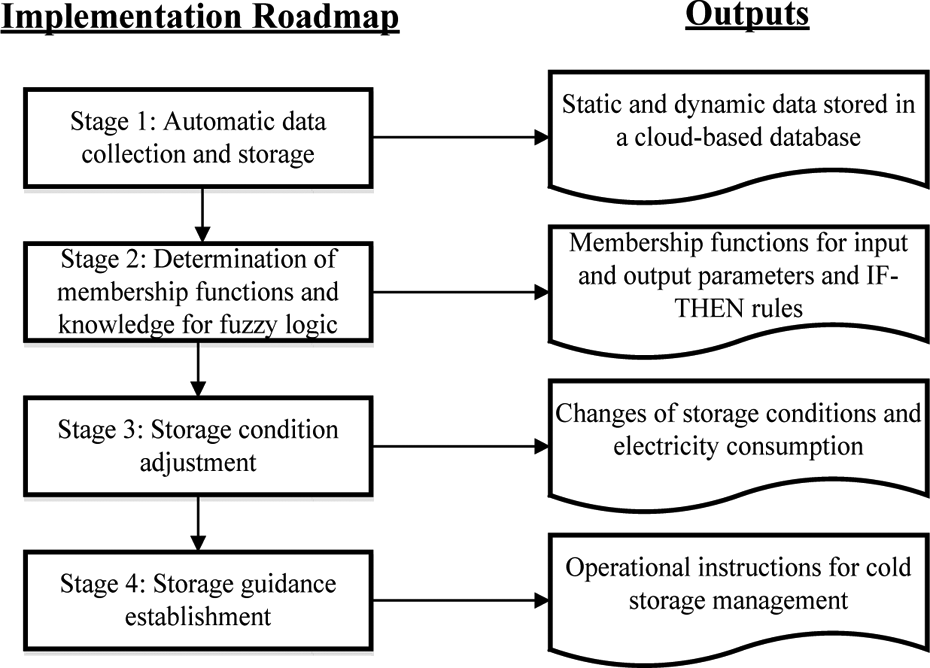
Implementation roadmap of IoT-CMS. Internet of Things-based cargo monitoring system.
Stage 1: Automatic data collection and storage
Through investigating the operations of the case company, the static data can be collected in regard to warehousing, product, and operations. An interview was also conducted with the warehouse manager to obtain domain expert knowledge for building the repository. On the other hand, using TI SimpleLinkTM SensorTags, the sensor data can be collected automatically and stored in the specific database. Figure 4 shows the collected sensor data processed by the JSON format. The sensing devices support nine types of data, namely ambient temperature, object temperature, humidity, pressure, altitude, three-axis acceleration, three-axis gyroscope, three-axis magnetic measurement, and light. The data are then transmitted to the cloud-based centralized database using this format for storage and analysis. In addition, alert management can be developed by real-time data monitoring in the database. Once the cargo conditions violate the specified limits, an alert is sent to the managers for assigning follow-up actions. Hence, it can minimize the seriousness of quality deterioration and costs incurred in any incidents.

Real-time sensor data collected in DAM. DAM: data acquisition module.
Stage 2: Determination of membership functions and knowledge for FL
By interviewing the domain expert in the cold chain and investigating the logistics processes, the fuzzy membership functions and knowledge can be formulated to support the function of storage condition adjustment. Table 2 presents the defined membership functions for the input and output parameters in SCAM. The fuzzy class refers to the conversion from crisp values to fuzzy sets with the defined types and lengths of membership functions. The types, trapmf and trimf, are used in the proposed system and they refer to trapezoid and triangular shapes of membership functions, respectively. The output measurements are the percentage changes of storage conditions and electricity consumption, and it can be used to adjust the conditions and forecast the electricity consumption, respectively.
Predefined membership functions in SCAM.
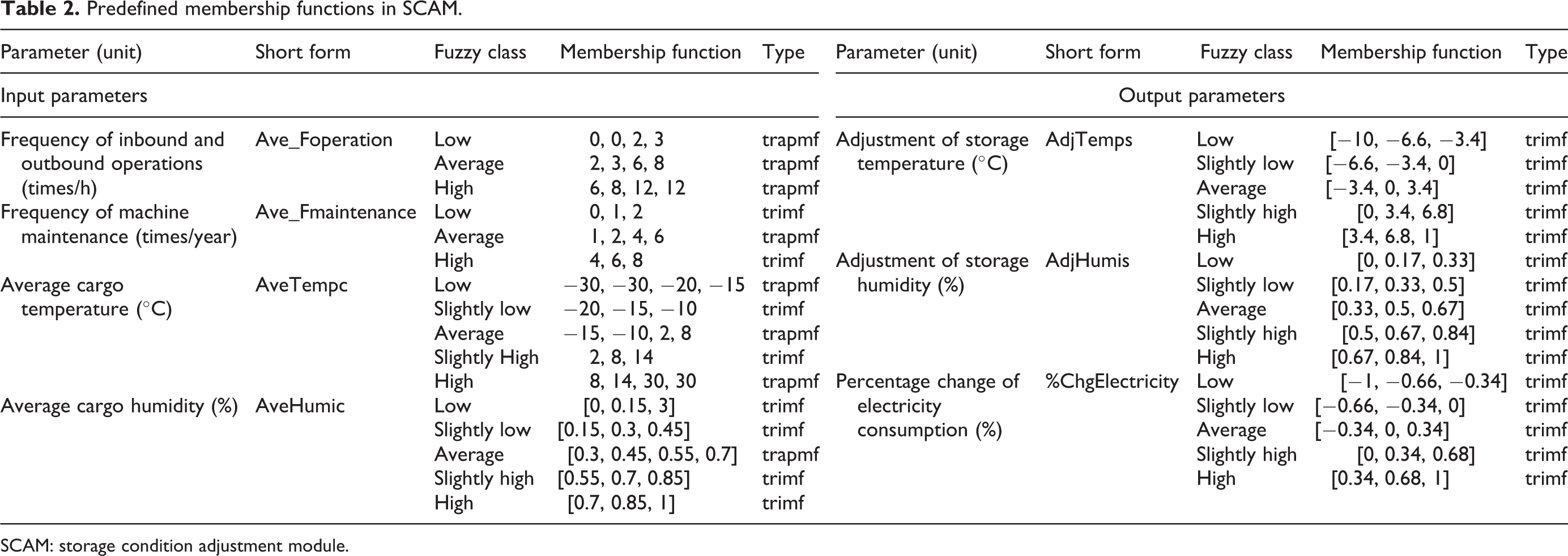
SCAM: storage condition adjustment module.
On the other hand, the knowledge repository contains a set of IF-THEN rules to evaluate the output by adoption of human knowledge. As the SCAM is implemented using the FL design toolbox in MATLAB, Figure 5 shows the rules that are created in the MATLAB environment. For example, the rule is: IF (frequency of inbound and outbound operations is high) and (frequency of machine maintenance is low) and (average cargo temperature is high) and (average cargo humidity is slightly high) THEN (adjustment of storage temperature is low) and (adjustment of storage humidity is slightly low) and (percentage change of electricity consumption is high).

Intuitive knowledge in SCAM. SCAM: storage condition adjustment module.
Through these preparations, the proposed system can evaluate the appropriate storage conditions under the cold chain environment.
Stage 3: Storage condition adjustment
Through applying the defined membership functions and knowledge, the storage conditions and electricity consumption can be adjusted using FL. An example record is extracted in the case company to show the results of SCAM, as shown in Figure 6. In this example, the frequency of inbound and outbound operations is 7 times/h; the frequency of machine maintenance is once a year; average cargo conditions are 5°C with 40% humidity. The proposed system suggests that the temperature should be reduced by 1.62°C; the humidity should be increased by 25%; the electricity consumption should be increased by 30%. Therefore, the workers and managers are able to have a clear understanding on how their operations affect the storage conditions and power consumption.

Inputs and outputs in SCAM. SCAM: storage condition adjustment module.
Stage 4: Storage guidance establishment
According to the results in SCAM, parts of the measurements are then inputted to GEM in this stage. In order to formulate effective guidance using CBR, an indexing tree structure is proposed to evaluate essential elements in the retrieval process, as shown in Figure 7. Hence, similar cases can be extracted for developing a new solution for the specific problem. The domain expert is also involved in the case revision process in adjusting the contents of the proposed plan. Afterward, effective storage guidance is established such that the workers can follow it to maintain the designated storage conditions for the product. In this case, the cargo is classified as agricultural; the storage region size is 31–50 CBM; the storage type is chilling; the temperature difference between adjustment and existing is 1.1–3°C. In the guidance, it shows that the storage region cannot be used within the next 20 min until the storage conditions meet the handling requirements. The inbound and outbound operations should be consolidated so as to reduce the impact of air-exchange between the refrigerated and docking regions. Otherwise, the electricity consumption can be expected to increase in this period. It provides directions on improving the storage management under a cold chain environment; therefore, the functional quality of the cargo can be assured.
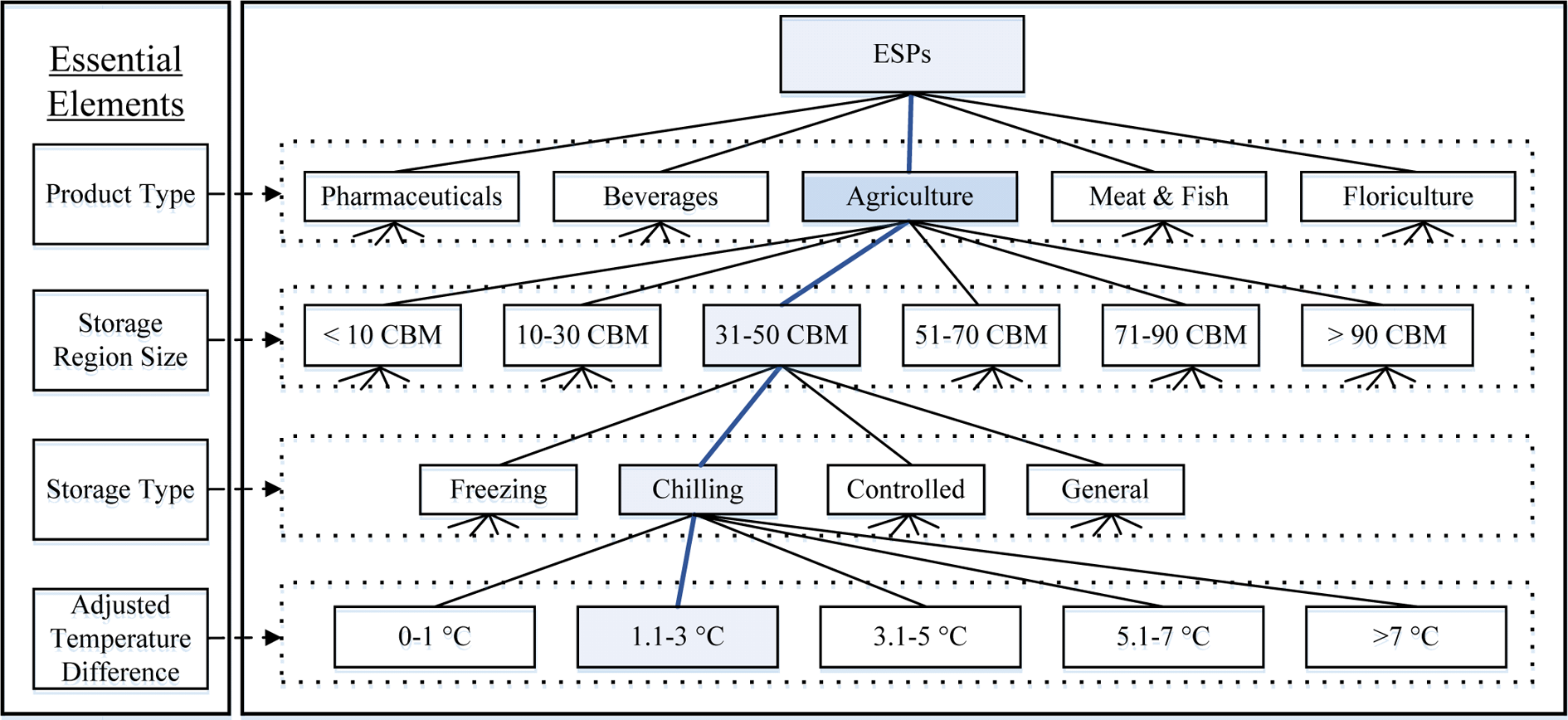
Indexing tree structure in GEM. GEM: guidance establishment module.
Results and discussion
Through the implementation of IoT-CMS, AOC Limited is able to monitor and analyze cargo conditions in a real-time manner so as to establish effective storage guidance so that the functional quality can be assured. According to the implementation roadmap of IoT-CMS, a system simulation was conducted in the case company for 10 working days in order to validate the performance of the proposed system. In addition, a comparative analysis was also conducted for model verification through comparing the performance in customer satisfaction, obsolescence rate, and inventory visibility between before and after implementing the IoT-CMS.
System simulation
In AOC Limited, a simulation was conducted by retrieving the required input data for 10 working days, splitting into morning and afternoon sessions. Table 3 shows the system results after using IoT-CMS. It shows 20 sets of the output data, including adjustment of storage temperature, adjustment of storage humidity, and percentage change of electricity consumption, generated from SCAM. Although the SCAM can be applied on an hourly basis, it is impractical to adjust the storage temperature and humidity too frequently. Hence, every single day is split into two sections, namely morning and afternoon sections. The SCAM is applied at the end of each time section so that the outputs can be used for the next time section.
System results of applying IoT-CMS.

IoT-CMS: Internet of Things-based cargo monitoring system.
The proposed system has the tendency to reduce the storage temperature in order to maintain in a stable and low temperature. Similarly, the storage humidity is also adjusted to keep in the average range defined in the membership function which is appropriate for working inside the storage facilities. The average adjustments of temperature and humidity, and percentage change of electricity consumption during this 10 working days are −2.045°C, +9.64%, and −10.382%, respectively. It is implied that the storage temperature should be reduced by around 2°C, and the humidity should be increased by around 10% in order to meet the best handling requirements of ESPs. By completing the above adjustments and considering the input parameters, the electricity consumption is estimated with a 10.4% reduction on average. Based on the simulation results, it is implied that when the operation frequency is high and the average cargo temperature is slightly high to high, reduction in electricity consumption is less than in other cases. However, this simulation was only conducted in one case company, and it is difficult to show the effects of the change of frequency for machine maintenance. Figure 8 shows the comparison of temperature data for the cargo and storage environments with the original setting and implementing the new IoT-CMS. The original cargo temperature (AveTempc) is adjusted according to the effect of adjustment of storage temperature (AdjTemps) so that the resultant cargo temperature is generally lower than the original.

Temperature data for cargo and storage environment.
Afterward, according to the simulation results from SCAM, the GEM is applied to generate the customized storage guidance so as to improve the productivity and ensure the cargo is handled in accordance with the prescribed conditions. Figure 9 shows the user interface of the proposed system to illustrate its functionalities. The staff members are able to monitor the real-time cargo conditions and receive messages if any incidents occur. When receiving cargo in the cold storage facilities, SCAM and GEM are developed to support the warehousing operations so that the storage conditions are stable and meet the handling requirements from customers. In addition, customers can check their cargo information and conditions through the proposed system, therefore maximizing product visibility.

User interface of IoT-CMS. IoT-CMS: Internet of Things-based cargo monitoring system.
Model verification
Apart from conducting the simulation to validate the system performance, a comparative analysis is illustrated in this section to study the effects before and after implementation of IoT-CMS. The comparative analysis is based on three major criteria, namely customer satisfaction, obsolescence rate, and inventory visibility. In view of customer satisfaction, there are three elements to investigate the difference between original setting and comprehensively implementing the proposed system, that is, number of complaints, order fulfillment rate, and average satisfaction rate. Table 4 shows the summary of the comparative analysis, where the data are collected after implementing the proposed system for 10 working days. The number of complaints is significantly reduced from 8 to 2, while the order fulfillment rate and satisfaction rate recorded 5.45% and 17.33% increments, respectively. Thus, overall customer satisfaction has been improved. On the other hand, the product obsolescence rate for handling ESPs is decreased from 13% to 8% of total number of handled ESPs. The proposed system also enables real-time visibility regarding product information and its environmental conditions. Overall, implementation of the proposed system brings positive effects to the case company so as to improve not only operational effectiveness but also the entire business competitive edge.
Comparative analysis of implementing IoT-CMS.

IoT-CMS: Internet of Things-based cargo monitoring system.
Regarding the benefits through implementation of IoT-CMS, it is found that (i) the effectiveness of warehousing operations is enhanced and (ii) customer satisfaction regarding the provided services is also increased.
Enhancing effectiveness of warehousing operations
Since the company has four types of storage regions, each region has its own specific environmental conditions. Traditionally, the workers and warehouse managers set a fixed set of environmental conditions, but there is a lack of considering of the impact of air exchange due to routine warehousing operations. The proposed system is able to adjust the storage conditions at the beginning based on the real-life operations. The change of electricity consumption can also be indicated to understand the seriousness of the situation. The adjustments are used to stabilize the storage conditions. Hence, storage guidance can be established to provide instructions on how to achieve stabilization of the storage conditions. The storage practice is therefore more practical and effective with regard to handling ESPs.
Increasing customer satisfaction
Through implementing the proposed system, customers are able to access and monitor the conditions of their cargo and the storage conditions. When the customers have any comments and feedback related to the existing operations, the system can collect them to use in GEM, and the warehouse managers can revise the storage guidance for future cargo handling. Afterward, the revised case is stored in the case library so that the entire proposed system is more applicable to real-life situations. Therefore, customer satisfaction continues to increase because of the improved services.
Conclusions
Since 3PL service providers have to handle thousands of environmentally sensitive items in the cold chain environment, their customers also have various handling requirements for storage conditions and cargo monitoring. The functional product quality is a primary concern for customers in selecting logistics service providers. In order to provide such services, cargo monitoring and effective storage guidance should be formulated so as to maintain a competitive edge in the market. Therefore, in this article, an IoT-CMS is designed for assuring the product quality in a real-time manner. By the adoption of IoT, the cargo can be monitored with respect to environmental conditions, where the sensor data are uploaded to a cloud database. The customers can easily access the information through the Internet. Through the adoption of FL and CBR, effective storage guidance is formulated to aid the routine warehousing operations. A relationship between real-life operations and electricity consumption is also developed, which gives insight to warehouse managers in forecasting the power consumption in cold storage facilities. To conclude, the developed system can enable a total monitoring of cargo and provide effective storage guidance to improve the operational effectiveness. Hence, the quality of the cargo and associated services can be assured and improved. Although the proposed system is beneficial to cold chain service providers, there are still two major limitations, that is, (i) relying on domain experts and (ii) Internet accessibility. Since this system is developed by IoT, FL, and CBR, the deployment of fuzzy membership functions and rules relies on the domain expert in the cold chain. This may be a difficult process to extract and transform the knowledge from the domain expert into the useful format in system deployment. On the other hand, the cloud services are applied in the proposed system to store identification data, sensor data, and time data for real-time monitoring. However, the use of cloud services strictly requires a stable Internet covering for transferring the data in the IoT service platform. Further work is suggested to refine the SCAM in designing the fuzzy rules and membership functions to enhance the reliability and feasibility. This is a significant contribution for cargo monitoring for maintaining prescribed product quality during cold chain operations where IoT applications, FL, and CBR are applied to formulate the effective storage guidance and monitor cargo in real time.
Footnotes
Acknowledgements
The authors would like to thank the Research Office of the Hong Kong Polytechnic University and AOC Limited for supporting the project (project code: RUDV).
Declaration of Conflicting Interests
The author(s) declared no potential conflicts of interest with respect to the research, authorship, and/or publication of this article.
Funding
The author(s) received no financial support for the research, authorship, and/or publication of this article.