




Abstract
The healthcare industry has been focusing efforts on optimizing inventory management procedures through the incorporation of Information and Communication Technology, in the form of tracking devices and data mining, to establish ideal inventory models. In this paper, a roadmap is developed towards a technological assessment of the Internet of Things (IoT) in the healthcare industry, 2010–2020. According to the roadmap, an IoT-based healthcare asset management system (IoT-HAMS) is proposed and developed based on Artificial Neural Network (ANN) and Fuzzy Logic (FL), incorporating IoT technologies for asset management to optimize the supply of resources.
1. Introduction
In recent years, hospitals have been facing significant cost pressure when it comes to maintaining their medical supplies. With the ever-increasing patient load in hospitals and major revisions in healthcare policies, the demand for these supplies is always rising. It has thus become especially important to ensure that they are effectively utilized. Recognizing that poor inventory management reflects ineffective usage of organizational asset, and that errorprone manual systems of past and present make it difficult to track medical supplies' movement, many hospitals today are implementing systematic approaches for the control and utilization of their medical resources. With the influx of technology, many of these methods now involve the usage of tracking devices, for example, through Internet of Things (IoT) based systems, to control the movement of medical equipment and establish the usage culture. These data can be used for pattern forecasting in order to move inventory management towards achieving an optimal spread of available medical supplies throughout the hospital. A study of the available literature on IoT applications in the healthcare industry, asset management in hospitals, and forecasting methods for asset management is included in this section.
1.1 IoT Applications in the Healthcare Industry
The Internet of Things (IoT) is an emerging technology which is generally recognized as representing a revolution in Information and Communication Technology (ICT). It is expected to have a wide range of applications in various industrial sectors, including healthcare (Xu et al, 2014b; Yang et al, 2014). According to the latest Hype Cycle of newly emerging technologies, IoT was in one of the top three ‘innovation trigger positions’ in 2014, showing a tendency to grow towards the peak of the Hype Cycle (Burton & Willis, 2014). The Internet of Things Strategic Research Roadmap is based on the following definition: “The Internet of Things allows people and things to be connected anytime, anyplace, with anything and anyone, ideally using any path/network and any service” (Guillemin & Friess, 2009). The concept of IoT can be regarded as “an extension of the existing interaction between humans and applications through the new dimension of things' communication and integration” (Guillemin & Friess, 2009). There is a broad range of key opportunities for applications in different industries, such as healthcare, intelligent building (i.e. green building), product and brand management, retail and logistics management, people and goods transportation, and so on (Atkinson, 2014; Monares et al., 2014; European Commission, 2013; Istepanaian & Zhang, 2012; Guillemin & Friess, 2009). IoT is expected to play an important role across Europe (e.g. Horizon-2020) (European Commission, 2013; Sung & Chang, 2013) and Asia (e.g. China's 12th Five-Year Plan) (Atkinson, 2014; Sung & Chang, 2013) during the next decade. Ultimately, IoT is expected to include 26 billion connected units, and incremental revenue generated by suppliers of IoT products and services are expected to exceed US$ 300 billion, mostly in services, by 2020 (Gartner, 2013). This will result in US$ 1.9 trillion in global economic value-added through sales in diverse end markets (Gartner, 2013).
By adoption of the methodology of roadmapping (Cheng et al., 2014), a roadmap of developments in healthcare management by IoT technologies (e.g. Radio Frequency Identification, RFID and Wireless Sensor and Actuators Network, WSAN) in the period 2010–2020 was developed in this paper, as shown in Figure 1. Many researchers have been active in healthcare restructuring that leverages IoT technologies in medical asset management (Lee & Palaniappan, 2014; Ng et al., 2014), optimizing medical resources (Jara, 2014; Xu et al., 2014a; Jara et al., 2010), monitoring healthcare situations (Shahamabadi et al., 2014; Sung & Chang, 2013; Castellani et al., 2012; Istepanaian & Zhang, 2012; Luo et al., 2012; Sung & Chiang, 2012; Istepanian et al., 2011), and increasing the use of home healthcare (Monares et al., 2014; Sebestyen et al., 2014; Yang et al., 2014; Yang et al., 2014a; Pang et al., 2013; Tarouco et al., 2012). Lee and Palaniappan (2014) developed an RFID-based inventory management system (RFID-IMS) for tracking medical devices' utilization and managing their inventory levels using real-time data. Jara (2014) conducted a feasibility study for the use of RFID/NFC (Near Field Communication) technologies for improvement of quality assurance in drug identification. Shahamabadi et al. (2014) proposed a solution to establish a hospital wireless network (i.e. mobile network) using 6LoWPAN technology for healthcare monitoring in the IoT environment. Xu et al. (2014a) demonstrated a resource-based data model to store and access the IoT data to support decision-making in emergency medical services. Yang et al. (2014) proposed an IoT-based intelligent home-centric healthcare platform (iHome system) leveraging RFID as well as WSAN technologies for in-home healthcare services.
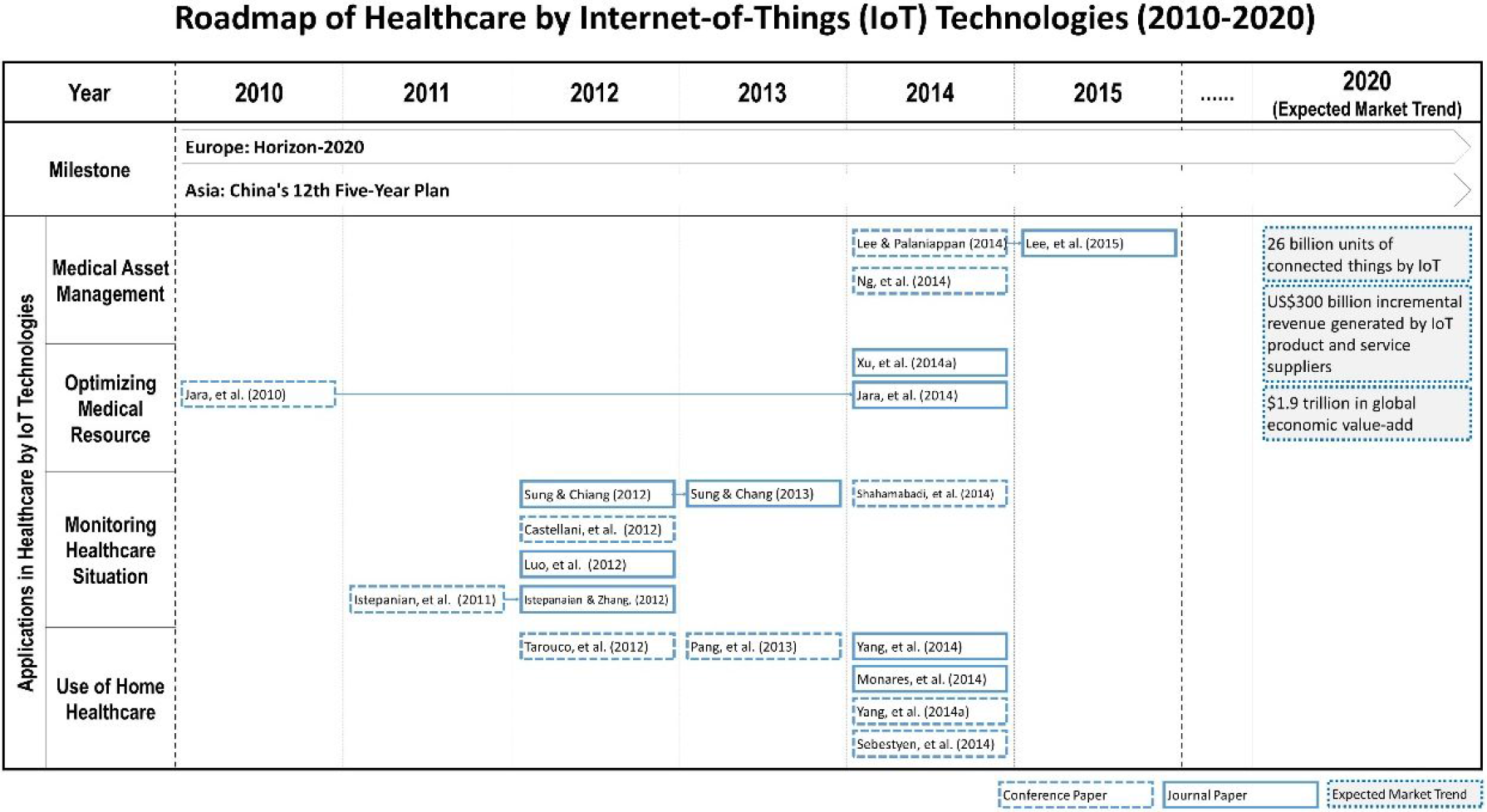
Roadmap of Healthcare Industry by Internet-of-Things (IoT) Technologies (2010–2020)
1.2 Asset Management in Hospitals
Apart from using IoT to manage the inventory levels of medical assets, the role of demand forecasting in this context has increased significantly due to various innovative and effective concepts of forecasting and inventory management, which have helped greatly in keeping the cost of hospital operations under control (Kelle et al., 2009). Managing inventory levels is important in the operation and management of the hospital's assets. Hospital operators have to review in-patient flow constantly in order to make decisions about resource capacity. In-patient care is one of the main drivers of demand for resources in hospitals (Broyles et al., 2010). In-patient systems have very complex throughput systems that make medical inventory planning very complicated. Factors of the in-patient flow process, such as non-stationary arrival and varying medical processes, make current static forecasting models rather obsolete (Lee et al., 2011), as they do not capture the compound behaviour of the true in-patient system. However, mismanagement of resources has a considerable impact on the lives and wellbeing of the patients being served. Forecasting plays a critical role in medical inventory management. The challenge that most hospital managers face is the lack of visibility and integration of already-present data, i.e. data that are routinely collected but stored in different information systems, into useful demand forecasting that can help improve medical inventory management (Parker & DeLay, 2008). Current medical inventory management systems can be divided into four main conceptual components: physical infrastructure, inventory planning and control, information system, and organizational embedding (de Vries, 2011).
Due to the huge amount of medical items and humanintensive working processes, current systems cannot provide timely and accurate inventory management and forecasting. To improve this situation, the future of inventory management will involve building up an automated work-flow system that requires minimal manual interaction. Medical amenities' replenishment requirements will be aggregated and orders placed automatically. The usage data will also be recorded for use by the hospital management in predicting future demand.
1.3 Forecasting Methods for Asset Management
Improvements in statistical models and forecasting techniques have enabled investigation of complex throughput and the modelling of ideal inventories and inventory management by processing data inputs. Current time-series methodology first attempts to identify forecasting parameters such as trend cycle, seasonality and irregularity, and then extrapolates these components to come up with the forecasts. However, these trend-cycle and seasonal data components of a time forecast tend to evolve over time, and need to be continuously revised for higher accuracy in forecasting. In addition, a key assumption in the time-series forecasting model is that the activities responsible for influencing the past will continue to influence the future. This is often a valid assumption in forecasting short-term demand, but falls short when attempting to forecast for a long-term analysis (Chase, 2013).
The artificial neural network (ANN) is an analytical learning method inspired by biological nervous systems such as the human brain. A large number of interconnected neurons, each one only responsible for performing a simple task, allow for performance of much more complex tasks, such as voice and image recognition, with high speed and accuracy (Zou et al., 2008). The ANN is very closely based on the idea of the biological neural network in that it is formed of interconnected nodes analogous to neurons. Each neural network comprises three critical components: node connectivity, network topology, and learning rules (Hansen & Nelson, 2003). A neural network forecast is proposed to handle the deficiency. This uses analytical methodologies that make use of historical demand data as inputs and updates information over time as the number of training datasets provided is increased (Lee at al., 2011). The adaptive and learning abilities of this neural network improve the forecasting accuracy so that better decisions can be made.
Fuzzy logic (FL) is a form of logic used to formulate ‘approximate reasoning’, by which the true values represented by FL fall between the discrete false (0) and true (1) (Biacino & Gerla, 2002). An FL-based system consists of four main components: fuzzification processer, fuzzy rules, inference engine, and defuzzification processer. The fuzzification processer converts crisp inputs into fuzzy sets by using the linguistic variables and membership functions. Fuzzy rules are used to determine the relationship between the inputs and outputs of a fuzzy system. The rules are expressed in the form of IF-THEN rules and defined based on the knowledge of experts or experimental outcomes. The inference engine performs inference based on the fuzzy rules to generate fuzzy outputs. The fuzzy outputs are then converted to non-fuzzy or crisp outputs by the defuzzification processer (Mohd Adnan et al., 2015). FL has been applied in many applications in inventory management. Demand forecasting is one such application that has been of particular interest to many researchers. Petrovic et al. (2006) proposed an FL-based decision support system for product demand forecasting. This system incorporated subjective forecasts and statistical forecasts to deal with the issue of uncertain and imprecise historical data and improve the accuracy of the forecast result (Petrovic et al., 2006). Candan et al. (2014) presented a neuro-fuzzy model for product demand forecasting in the pharmaceutical industry, considering product sales statistics from the past six years. In the literature on demand forecasting, most of the forecasting methodologies are based on historical statistics or comments from experts, or both. Almost all the mentioned studies focus only on the amount of demand. Few researchers have rigorously considered other factors that may directly or indirectly affect the demand, and adopted these in their models.
1.4 Summary
On the whole, the existing methods offer considerable support for decision-makers implementing demand forecasting for asset management. Although many previous studies have demonstrated that medial asset management can be implemented successfully using ANN and FL approaches, little attention has been paid to medical asset management leveraging IoT that integrates ANN and FL approaches. In order to address the key issues found in the existing methods, this paper aims to present the design and development of an IoT-based healthcare asset management system (IoT-HAMS) which incorporates ANN and FL approaches for forecasting of demand for medical assets in hospitals. By taking advantage of ANN and FL approaches, the ANN forecasting approach aims to address asset demand forecasting in normal conditions (i.e. daily and regular operations), whereas the FL forecasting approach is concerned with asset demand forecasting in abnormal conditions (i.e. ad-hoc, unexpected or emergency operations).
2. IoT-based Healthcare Asset Management System (IoT-HAMS)
The IoT-based healthcare asset management system (IoT-HAMS) integrates with IoT technologies, e.g. RFID and WSN, which not only tracks various healthcare-related assets such as infusion pumps, blood bags and medical waste, but also monitors the conditions of such assets, such as temperature, humidity, acceleration and orientation. Consequently, the system not only increases visibility of the location and demand characteristics of assets, but also benefits many other aspects of asset management, such as preventive maintenance, shelf-life estimation, and identification of products with high deterioration potential. The data collected from RFID and WSN devices can be returned to the internal ANN module and FL module for asset demand forecasting. Figure 2 illustrates the system architecture of the proposed system. The system components include RFID and WSN devices (IoT devices), IoT middleware, graphic user interface (GUI) for rules input and modification, cloud database, ANN module, FL module, and core management engine. The details are described in the following subsections.

System architecture of IoT-HAMS
2.1 Information Collection
In the perspective of system implementation, every asset should have an RFID tag, used as its identity, and some assets that require careful monitoring should also have wireless sensor nodes. In a building containing the assets, the RFID gateway should be deployed at each main entrance and there should be sufficient WSN base stations to cover the building. As the scope is different, the deployment strategy will not be discussed in this paper. When the infrastructure of the system is ready, the meta-data (e.g., access time, location and conditions) of the assets will be collected automatically through IoT middleware. The IoT middleware operates as a smart agent. On the one hand, the IoT devices connect and send the raw data to the middleware, and the middleware then passes the data to the back-end system after performing data pre-processing (e.g. aggregation, filtering and normalization). On the other hand, the back-end system is able to configure and control the IoT devices in a straightforward way through the middleware. Apart from the data provided by IoT devices, another information source is the professionals themselves, such as doctors, nurses and organization operators. In the healthcare industries, especially hospitals and nursing homes, unexpected or emergency conditions may occur at a high rate. A computer system therefore may not react to these conditions instantly or appropriately. Therefore, the proposed system provides a GUI for professionals to finetune the asset demand forecasting result based on real situations, using their professional knowledge and experience. Professional judgements are considered via editing and adding fuzzy rules into the system, and the new rules can be executed instantly. This approach helps to refine the result for decision support and enable better reaction to the unexpected conditions.
2.2 Information Persistence and Utilization
Through the Internet or Intranet, the information from the IoT devices and the professionals will finally reach the core management engine of the proposed system. The engine works as a server to interact with the main modules of the system. The collected information will then be transferred to the cloud database for storage. The cloud database allows practitioners to link other databases for, e.g. patient information, inventory information, supplier information and doctor information, in an efficient and effective way; finally, a data network will be established. Thus, more useful and relevant information can be further mined for decision support, specific analysis and forecasting.
In the back-end of the proposed system, the ANN and FL modules are designed to perform asset demand forecasting, which is an important feature of the proposed IoT-HAMS. The ANN module firstly collects the asset usage data in a certain period captured by the IoT devices from the cloud database, and then performs a preliminary calculation for demand forecasting. A detailed description of the ANN module can be found in our previous work (Lee & Palaniappan, 2014). Generally, the ANN forecasting is capable of providing better results than some other traditional forecasting techniques, such as time series and casual forecasting (Jones et al., 2008; Setzler, 2007). According to Jones et al. (2008), the SARIMA model can be used to forecast patient numbers at different facilities with competitive results compared to the ANN. Realizing the limitation of some forms of regression, Setzler (2007) also compared ANN with MEDIC and Navïe for temporal and spatial ambulance demand forecasting, and his results showed that the ANN includes mean squared errors of the four levels of granularity. However, as mentioned in section 2.1, the frequency of unexpected or emergency conditions is higher in hospitals and nursing homes than in other contexts, and the occurrence pattern may vary day by day. Since ANN training requires a long period of time and a large quantity of examples, ANN forecasting may not instantly or appropriately respond to unexpected or emergency conditions, and therefore may not provide accurate and satisfactory results in such situations. Considering this limitation of the ANN module, an FL module is proposed to refine the ANN forecasting results, in which the outputs from the ANN module are transformed into an input fuzzy set. The other input fuzzy sets include both internal and external factors that influence changes in demand, such as internal inventory level, supply lead time, and emergency level. This approach may reduce the dominance of the ANN module in the forecasting results and better take into account practical and instant conditions affecting asset demand. Through a Web-based GUI, professionals can easily modify the weight and range of these fuzzy sets. The system also allows professionals to add new input fuzzy sets and membership functions, and to define new rules when new associations between the identified or new factors and the asset demand are found. Finally, the forecasting results and the input fuzzy sets specified by professionals will be output to the GUI for decision support. Consequently, the decision-makers may not only consider the forecasting results for their decisions, but also the judgments of professionals.
By leveraging the capabilities of IoT technologies, the proposed system increases the visibility of asset location and status, thereby streamlining the process of asset allocation and improving the asset maintenance strategy. For some important assets such as blood bags and medicine, the system can provide a 24/7 monitoring service. It assists identification of items with high potential for deterioration, prompting managers to work out timely measures to remedy the situation. Furthermore, with the asset demand forecasting of the ANN module, managers can accurately control the supply requests in the manner of either purchase or borrowing. At the same time, with the adjustment of the FL module, the system automatically reserves an inventory buffer to dilute the effect of unexpected or emergency conditions. The proposed system helps save time, money and other resources so nurses and physicians can concentrate on their business of delivering high-quality services to the public.
3. Trial Implementation and Case Study
To realize the capability of the proposed system, a case study was conducted in Tan Tock Seng Hospital (TTSH), one of the biggest multi-disciplinary hospitals in Singapore, with 170 years of experience pioneering medical care and development (Tan Tock Seng Hospital, 2014). At the time of writing, TTSH has 40 clinical and associated health departments with 16 specialist centres powered by more than 7,000 healthcare staff. TTSH provides services to an average of 2,000 patients at its specialist clinics and 460 patients at its emergency department daily.
TTSH currently holds 827 infusion pumps that are manually tracked for usage and preventive maintenance by the healthcare workers in the wards. Management of such a huge number of infusion pumps leads to several problems, for example:
Manual Search for Pumps for Patient Usage
Healthcare workers must perform a manual search within the ward for available infusion pumps and then check with other wards manually if there are no infusion pumps available. This causes an increase in the time patients must wait.
Manual Administrative and Paperwork
Due to the lack of visibility of the infusion pumps, a lot of administrative time is spent on locating the pumps for periodic maintenance or stock-taking, or finding ‘lost’ pumps. When a certain ward has a shortage of pumps and a need arises for a loan or a swap, healthcare workers must spend time searching manually. When they locate the pump, they must devote more time to manually completing paperwork and transferring the equipment. This decreases the time available for direct patient care.
Fluctuation in Infusion Pump Supply
Pumps are periodically taken away for maintenance, with replacement units supplied. This batch maintenance approach creates periodic variations in the supply of inservice pumps in the different wards, as a shortage of pumps can result.
In this study, the proposed system framework was trial implemented in TTSH. The ANN forecasting and FL inference were carried out using the neural network toolbox and fuzzy logic toolbox, respectively, in Matlab. The forecasting focuses on daily pump demand over one month. The historical data on actual demand in the previous month are first collected as input for the ANN module to calculate the demand forecast. Then, the preliminary results from the ANN module are used as one of the four inputs for the FL module. The other three inputs are the Emergency Level (EL), the Stock Level (SL) and the Available Loan (AL) from adjacent organizations. The data for SL and AL are collected from other databases and the data for EL are provided by the relevant professionals. Figure 3 shows the settings of the ANN and FL modules. For the ANN module, a feed-forward back-propagation model is used, as it is one of the most popular and effective models for complex multi-layered networks. Two hidden layers and 10 neurons are set for network topology. Problems that require more than two layers are rarely experienced, as neural networks with two hidden layers can represent functions within most geometric dimensions. The Levenberg-Marquardt training function is used, as it is the one of the most efficient optimization algorithms. The FL module consists of four inputs, one output and 177 rules, and the centroid method is selected for defuzzification. For successful implementation, medical practitioners are interviewed to establish the requirements to align the system with business operations. A pilot run obtains feedback to improve and refine the designed system to better fit the needs of nurses and physicians. Training is conducted so they able to use the system appropriately.

The settings of the (a) ANN and (b) FL modules
Figure 4 illustrates the results from the outputs of the ANN module as well as the results after adjustment of the FL module, compared with the actual pump demand in the same period. The illustrations show that some of the estimated demands from the ANN module match the actual demands with a slight variation, but some show large differences, especially on days 9, 27 and 30. In contrast, the forecasting results adjusted in the FL module better fit the actual demand than the results from the ANN module. The improvement of the forecasting results may indicate that the FL module enhances the forecasting results to a higher level of accuracy, since more other factors (i.e. emergency level, current stock level, and available supply level) directly and indirectly contributing to the asset demand forecasting are considered. In situations where the judgements of the professionals on these factors indicate different trends to those indicated by the forecasting results from the ANN module (e.g. on days 9, 27 and 30), the FL module is able to mitigate the dominance of the results from the ANN module and consider more other factors through the predefined fuzzy rules, thereby refining the forecasting results to be closer to actual demands. The error analysis shown in Table 1 also presents a similar conclusion. The forecasting results adjusted by the FL module are improved by 57.5% in the Mean Absolute Deviation (MAD) analysis, by 79.7% in the Mean Squared Error (MSE) analysis, and by 55.2% in the Mean Absolute Percentage Error (MAPE) analysis compared to the forecasting results from the ANN module. The error analysis results indicate that the FL module effectively improves the accuracy of the forecasting results from the ANN module in the case study.

The results from the outputs of the ANN module and after adjustment of the FL module, compared with actual pump demand
Error analysis of the results from the ANN and FL modules

Three potential benefits of using the IoT-HAMS for nurses' productivity, patient safety and maintenance planning are as follows:
Optimizing Nurses' Productivity
The new system should save time and allow nurses to channel more of their time into direct patient care by reducing the time spent on searching for infusion pumps, periodic maintenance, stock-taking or locating ‘lost’ pumps, as well as handling the necessary paperwork when there is a pump loan/swap.
Improving Patient Safety
Automation of the current inventory management system should prevent and reduce risks to improve patient safety. The ultimate goal of this proposed inventory management system is to ensure an undisrupted infusion-pump service for patients, and also to provide timely detection of defective infusion pumps during pump operations for enhanced patient safety. The system should collect utilization and movement data and allow for the most efficient allocation of the infusion pumps, allowing patients with a greater need for the pump to be given a greater priority.
Enhance Maintenance Planning
The system should provide better information to allow a maintenance schedule that is based on pump utilization and availability, rather than batch maintenance. This provides a more proactive way to ensure pump functionality and availability during maintenance periods.
4. Conclusion
More and more researchers are paying attention to the application of IoT technologies in various industries, including healthcare. This paper has presented a roadmap for a technological assessment of IoT in the healthcare industry in the period 2010–2020. According to the roadmap, the IoT-based healthcare asset management system (IoT-HAMS) for medial asset management is developed based on ANN and FL modules, and trial implemented by leveraging IoT technologies. The IoT-HAMS is composed of seven modules: RFID and WSN devices (IoT devices), IoT middleware, GUI for rules input and modification, cloud database, ANN module, FL module, and core management engine. The ANN module aims to forecast demand of healthcare assets (e.g. infusion pumps), whereas the FL module is concerned with striking a good balance between preliminary results from the ANN, EL, SL and AL modules with a higher level of accuracy. The presented case study provides a positive illustration to demonstrate the capability of the proposed system.
The IoT-HAMS was deployed successfully at TTSH in Singapore. Compared with the existing method at the hospital, the proposed system was reported to be relatively effective in terms of improving nurses' productivity, patient safety, and maintenance planning.
Hospitals represent one of the most human-intensive working environments in the healthcare industry. Most tasks are carried out by healthcare workers manually. Studies regarding process design and reengineering should be conducted in the future to improve the productivity of inventory management and reduce the operational cost. The medical asset management presented in the current study could also be further expanded to apply to a larger group of products with the use of IoT technologies (i.e. RFID and WSN). Ultimately, a comprehensive system of inventory tracking and forecasting can be established to provide better medical services to patients.
Footnotes
5. Acknowledgements
The authors would like to express their sincere thanks to the Research Committee of the Hong Kong Polytechnic University for providing the financial support for this research work under Project No. RT3B and RT3C. The authors would also like to thank Mr Darren Lee from the Tan Tock Seng Operations Department for his continuous support during the course of this research.