




Abstract
The study provides a discussion about the leadership style of small businesses owner-managers at Santo Domingo de los Tsáchilas, Ecuador, supported on contingency theory of leadership. And adaptation of Hershey and Blanchard questionnaire was made in order to make it clear to the target population. A total of 175 owner-managers of small businesses and 1218 employees comprised the respondents of the study. The perception of leadership style of owner-managers and employees, style range, and style adaptability and perception of the maturity degree of employees were the variables involved in the hypotheses raised. In spite of totally or partially proving the hypothesis raised, findings of the study revealed mixed support to the theory which impedes giving clear recommendations about how to behave in certain organizational situations in the context of small Ecuadorian businesses. Results of the study caution owner-managers of small businesses to consider carefully the way they behave in certain situation to the enrichment of employee motivation toward work with the purpose to obtain a better performance of their enterprises; but should avoid assuming that there are more or less appropriate leader behaviors based on the results of this research. The study constitutes a starting point to focus the research related to leadership style in small companies, considering the preponderance of this type of business in the economy of Ecuador.
Introduction
Complexity of today imposes challenges to the exercise of leadership; organizations of all size are made up of people with sufficient autonomy to create their greatness and leaders have to make it sustainable by aligning the interests of all members with the vision, mission, and values of such organizations. 1 –3
Leadership styles are always evolving according the context leaders faces, with newer elements complementing, perfecting, and accompanying more traditional styles. In fact, what makes a leaders effective depends, more than is commonly realized, on the context around them, 4,5 that is why a research on leadership in specific local contexts is still needed, because the degree to which an individual demonstrates the qualities of leader depends not only on his own characteristics but also on the characteristics of the situation in which he finds himself.
In particular, leadership in small business is identified as indispensable to ensure its growth and survival. 6 –10 With a right behavior, leadership have the best opportunities to succeed, because a particular kind of performance at a particular context could encourage employees to share his creative ideas and opinions, provide a clear direction to accomplish purposes and objectives, and appeal to show the highest commitment with the outcome expected of their action. 7,11 –14
This study is anchored on contingency theories which fundamental underpinning is that there is no one best or unique style of leadership that transcends across all situations, 2,15,16,17,18 what is effective in some situations could have no effects or even dysfunctional effects in others. Those theories argue that the best type of leadership depends on situational variables and that no one style of leadership pertains or should be followed to all given workplace situations. For this reason, effective leaders can adapt their leadership style based on the nature of the group, the situation, and the objectives to be achieved. 8,15,16,19,20
The main objective of this work is to study the leader behavior facing particular situations at small enterprises of Santo Domingo, Ecuador, using Paul Hersey and Kenneth H. Blanchard approach. 15,16,21,22 The study seeks to explore the peculiarities of the behavior of small businesses owner-managers in his leader performance within the Ecuadorian context and expose the similarities and dissimilarities with other studies. The authors have the intention that this research is able to generate information and acts as the additional reference to the future researchers and the academicians that intend to study leadership on contingent approach.
The article presents the organization as follows. The next sections, the theoretical concepts of leadership, contingency theories, and the importance of its study at small businesses are introduced and their relationship is discussed. After this, there is an explanation of the method of investigation employed. Then, the results of the research are described followed by a discussion of them. The main results and discussion came out of the results of the multidimensional unfolding in the analysis of situation and way to act of the small businesses owner-managers that participate in the study. The article ends with the conclusions that contain the limitations of the research and recommendations for future research.
The contingency leadership theory
Scholars seem to agree that leadership involves a process of influence in order to achieve goals. 12,23 –27 That is why the success or failure of an organization in achieving the goals for which it is created is connected, in most cases with the kind of leadership that operates in the organization. 28,29
By being closely related to change, leaders set the direction to follow in developing a vision of the future and are concerned with the ideas that their followers can bring to align and inspire them to achieve it, this involves a more intuitive and sympathetic relationship with people evolving with the situation to inspire others to achieve what they otherwise would not accomplish on their own. 2,8,11
The literature on leadership is abundant and much of it is confusing and contradictory, with diverse approaches to explain it. 17,29 Among different approaches, contingency theories related to leadership are prevalent and represent a mediating middle-of-the-road in the understanding leadership pointing out the limitations of the traits and behavior approaches and integrating previous research results. 25,29
The studies directed to the situational leadership theory (SLT) 16,22 and the least preferred coworker 19 are considered the most popular and important to the field. However, the issue of the situation as an element to be considered in the study of leadership was a subject of discussion in the proposal of other authors of the time. 30 –32 Those authors revealed the importance of situational variables, their effect on specific personalities, and the behaviors of effective leaders. Contingency leadership theory undertakes that leadership characteristics are significantly dependent on contextual factors. 20,33,34
The contingency theories of leadership express the need for the leader to adjust the behavior based on a rational understanding of the situation and assume a leadership style that is appropriate for the occasion. This way of conceive leadership expels the dogma that there are better and worse leadership styles, 33 and there is no “one size fits all” approach to leadership, depending on the situation that varies the way of leaders’ behavior. 15
Some scholar point out the ambiguity surrounding the contingency theories of leadership, making its validation limited and difficult, but, on the other hand, it makes clear about the importance for future research around this topic, mainly because those theories suffer an important number changes, since it was first introduced that open new ways of research and its wide acceptance and its strong intuitive appeal. 15,20,17,35 –37 Some papers on Situational Leadership Theory 15,17,20 point out some difficulties in terms of measurement, inconsistencies in the model and alert that any conclusion out of it must be cautious. 25,36 Nevertheless, authors decided to follow this theory, not for an empirical validation of its hypothesis, but like a theoretical framework to understand what kind of behave use small businesses owner-managers in the relation with the situations they face while they are in charge of their enterprises.
There are no lack of serious studies that have attempted to isolate crucial situational factors that affect leadership effectiveness, some of the moderator variables used in the development of contingency theories include the degree of task structure, the quality of follower–leader relationships, the leader’s position of power, clarity of the subordinates’ role, group norms, availability of information, acceptance of leader decisions by follower, and maturity of followers. 20,17,38 The SLT attempts to provide an understanding of the relationship that exists between an effective leadership style and the maturity or readiness level of the group. 36,39 –41
Maturity is defined, under the perspective of the situational approach, as the willingness and ability of a person to take responsibility for directing the behavior, and the combinations of a high and low levels on each dimension made arise four status that can be used to describe persons as follows:
15,16,21
Individuals who are neither willing nor able to take responsibility. Individuals who are willing but not able to take responsibility. Individuals who are able but not willing to take responsibility. Individuals who are both willing and able to take responsibility.
Depending on the level of these variables, leaders must employ the most suitable leadership style to fit the given situation (see Table 1).
Four different types of situational leadership.

Despite the prevalence of this approach, only a few studies have included the empirical analyses of the relationships between leadership behaviors at specific organizational contexts. 4,5 Research leadership is something of a niche topic within the study of small businesses because of the importance of leadership in the success of an enterprise. 12 Exploring the behavior of small business owner-managers in the face of particular situations could provide important insights for the survival of their businesses and the stability of their staff, a fundamental key in this kind of enterprises, could also be useful to design a training program to improve the leadership skills. 6
It has been possible to verify the existence of theoretical and practical orientation studies of leadership in small businesses. Such studies trying to explain the following: (1) the way to improve leadership competencies as a way to support the growth, expansion, and continued success of their enterprises; 13,39 (2) the role of leadership in affecting the effectiveness of strategy generation and execution; 42 (3) identify the factors that make a leadership style more efficient; 8 (4) the impact of leadership on fostering new product innovation; 7,9 and (5) understand and measure entrepreneurial leadership style. 14,43 These studies, from their different approaches, seek to improve the leadership skills of small business owners-managers in order to have a positive impact on their respective enterprises as well as on the territory where they perform.
Taking into account the aforementioned is where the study of leadership in the Ecuadorian context becomes relevant. Ecuador is the second country in the world with more entrepreneurs, its total early-stage entrepreneurial activity is 33.6%, meaning that “one in three adults in the country has developed activities related to creating a business or already had one that did not exceed 42 months of existence” (p. 10). 44
The percentage of people considered to possess knowledge and skills to undertake reaches 72%; among the entrepreneurs, 87% is perceived competent. The reality is that only 13.7% of entrepreneurs are professionals, 30.4% have completed secondary education, 38.6% have only primary education, and many state that they do not have formal education, and this could respond to the low survival of a large number of enterprises. 44 With this dominant reality, it is convenient to analyze what leadership style the small businesses owner-managers use and how they adapt it to the situation they face within their enterprises.
Taking into consideration the theoretical aspects presented and the reality of the analyzed locality, the following hypotheses are expected to be tested:
If the formulated hypotheses are valid, it would be demonstrated that leadership style, aspect not included in analyzes related to entrepreneurship in Ecuador, could be contributing to the behavior of the indicators mentioned above.
Steve Forbes made some recommendations to Ecuadorian entrepreneurs at the Congress of Leadership and Business Growth, held in Quito, including developing a growth strategy and effective communication of their vision through the organization; gain and maintain trust; be able to delegate tasks and maintain detailed follow-up to ensure that the critical points of the strategy have been met; attract and develop the human talent necessary for the effective functioning of the organization; and finally, develop a unique and new culture so that people are inspired by a vision and know what is allowed and what is not. 18 All are closely related to leadership and should be taken into account by the small business owner-managers, recognizing the challenges that will have to be faced in order to achieve the future development of its enterprises.
Method
According to the zonal division existing in Ecuador, Santo Domingo de los Tsáchilas is a province that belongs to zone 4. The economic growth of the province is booming, characterized by the entry into the market of small enterprises. The fastest growing economic sector is commerce with 3477 businesses taking into account the database of the National Institute of Statistics and Censuses and the National Secretariat of Planning and Development. Its last modification was on September 9, 2016.
The study included 175 small business commercial owner-managers which operate in the domestic market and expressed an interest in participating in the study. This statistically corresponds with a 95% confidence level and a margin of error assumed of 7.24%. The number of employees of those businesses ranges from a minimum of 3 to a maximum of 18 for a total of 1218 members.
To reach this sample, a non-probabilistic snowball sampling technique with two steps was used: Identified possible owner-manager in the population interested to participate in the study. Ask this owner-manager to encourage other owner-managers to come forward (and then ask those people to engage others). Participants were not obligated to provide any other owner-managers.
Once the recommended participants start to repeat, the process finishes. Such samples are biased but lead to higher response rates, because participants are willing to become involved in the study. 45 There was no negative response once the participants were identified.
Those kind of small business were chosen, because much of the existing research contingency theories has so far focused on service-oriented organizations in education, healthcare, and armed services. 36 This sector of the economy is prevalent at the locality and have the potential to increase the knowledge of whether contingency principles are demonstrable in a small business commercial sector. In addition, homogenizing the sample sought to prevent the influences of variables such as type of organization, the nature of the problems they face, and their complexity and the market pressures to which they are subject.
A Spanish translation of a leadership style questionnaire, adapted by authors from leader adaptability and style inventory (LASI), 22 was used for the purpose of generating quantitative data in order to determine the current leadership style of the owner-managers investigated that were predominantly male (64%) and average age was 38.5 years.
LASI assumes that the respondent are involved in each of the 12 situations originally contemplated, and 48 multiple options for each situation.
The adaptation of the questionnaire responded to two fundamental causes: the need to contextualize the statement of questions and response options and the claim of the participants of an easy and quick instrument to respond. The final instrument was subject to a validity of content and was made up of 12 situations and 12 options to choose to reflect the behavior of the participants in each of them 22 (see Table 2).
Final questionnaire.

There is no direct relationship between a situation and a choice of response. Respondents can choose any option to deal with a particular situation. The score given to each alternative action choice is the one originally used, taking into account the aforementioned changes (see Table 3), “the highest probability of success of the alternatives offered in the given situation is always weighted A +2. The behavior with the lowest probability of success is always weighted a -2” (p. 28). 22
Codification used.

The questionnaire allows to study self-perception style, style range, style adaptability, and also followers’ maturity because one simple questions was included at the end claiming information about owner-managers and members’ perception about the level of maturity. The questionnaire uses a four point’s scale to measure the perception of both investigated groups: 16,22,36,37 (1) individuals who are neither willing nor able to take responsibility; (2) individuals who are willing but not able to take responsibility; (3) individuals who are able but not willing to take responsibility; and (4) individuals who are both willing and able to take responsibility.
LASI has been tested for its reliability and measurement validity in previous studies. 15,37 However, it was considered necessary to develop a pilot study, before the instrument was finally administered, in order to detect possible shortcomings, since it was susceptible to modifications due to the context of its application. Questionnaires were distributed to owner-managers and their employees while at work.
The unfolding is a geometric model for preference and choice. It situates choices and alternatives as points in a joint space. An individual will pick the alternative in the choice set closest to its ideal point and multidimensional unfolding procedure allows researchers to explore similarity structures among objects in this multivariate data set. 46 The multidimensional unfolding procedure was used here to detect meaningful underlying dimensions that allow to examine the relationships between situations and behaviors presented in the questionnaire described above.
Data supplied to run the procedure take the form of rectangular proximity matrix, Δ ∈ Μn × n , where n is the number of stimuli 47

Each element δij Δ represents the proximity between the situation i and the behavior j. From this matrix, it is possible to calculate the distance between two stimuli, any i and j among subjects (s)

The technique allows to transform the judgments of preference into distances represented in a multidimensional space. In this research, a visualization of the relationship between the behavior and the situation that face the owner-managers is showed. The objective is to obtain the best fit with the smallest number of dimensions, since the interpretation of solutions obtained in more than three dimensions is extremely difficult.
The evaluation of the visualization to determine whether its configuration seems reasonable is done subjectively. This evaluation is accompanied by the stress measure, which indicates the proportion of the variation of the disparities not taken into account by the multidimensional analysis.

Stress is minimized when objects are placed in a configuration such that distances between objects are best adjusted to the original distances. The greater the difference between the disparities and the distances, that is, between f (δij ) and d 2ij , the greater the stress and, therefore, the worse the model. Its minimum value is zero. 46,47 To obtain the solution of the unfolding model as well as the measures to determine whether it is suitable or not, we used the IBM SPSS 23. 48
Results and discussion
Since the first hypothesis (hypothesis 1) addresses the relationship between owner-managers and employees’ perception of leadership style, the multidimensional unfolding procedure was used to test the dissimilarities between them. Separate tests were conducted for owner-managers and employees 46 (see Table 4).
Measures obtained.

The measure of stress indicates the proportion of the variation of the disparities not taken into account by the multidimensional analysis. Stress is minimized when objects are placed in a configuration such that distances between objects are best adjusted to the original distances. The algorithm attempts to minimize penalized stress; by analyzing both cases, this measure is considered small enough.
The coefficient of variation for the transformed proximities is relatively large to the coefficient of variation for the original proximities. This suggests that the transformed proximities for each row are near-constant, and thus the solution will provide great discrimination between objects.
Shepard’s rough nondegeneracy index, which is reported as a percentage of different distances, is far from 0. This is a clear numerical indication that there are sufficiently different distances and that the solution is not degenerated.
The sum-of-squares of DeSarbo’s intermixedness indices are a measure of how well the points of the different sets are intermixed. The closer to 0, the more intermixed the solution. If they are not intermixed, this is a warning sign that the solution may be degenerated. The reported value is very low, indicating that the solution is intermixed.
Results show optimal measures that allow to interpret with high confidence the common space of the relations between situation and behavior in both owner-managers and employees (see Figure 1).

Joint plot of common space.
The joint plot of the common space shows a final configuration of the relationships between situation and behavior preferences of owner-managers (left) and employees (right). The relationships are clearly split into clusters according to preference behavior in a particular situation, with considerable within-cluster variation along the horizontal dimension. This is a visual confirmation that the solution is not degenerated.
Based on Figure 1, Table 5 shows the comparison between owner-managers and employees, being able to appreciate the convergences and divergences between the two.
Comparison owner-managers—employees.

Owner-managers perceive themselves using more often the coaching or selling and supporting or participating style which indicates that, in their opinion, they are always oriented toward the relationship, but not always to the task. On the other hand, the followers perceive their leaders using mixed styles (words in bold in table 5) in different situations, sometimes very worried about the task and little by the relation and vice versa. Only in S3, S8, and S10, it is possible to see a total equality between the perceptions of the two groups under study. These results corroborate the hypothesis and allow to affirm that there are differences in the perceptions of the leadership styles between the owner-managers and their employees.
Results show little support for the hypothesis 2 related to style range. Table 6 shows the means for behaviors collapsed across situations both for owner-managers and employees.
Means for behaviors collapsed across situations.

While the employees have an inverse zeta-like movement following the quadrants 1, 4, 2, and 3, the owner-managers have a counterclockwise move through the quadrants 2, 3, 4, and 1 (see Figure 2). 22
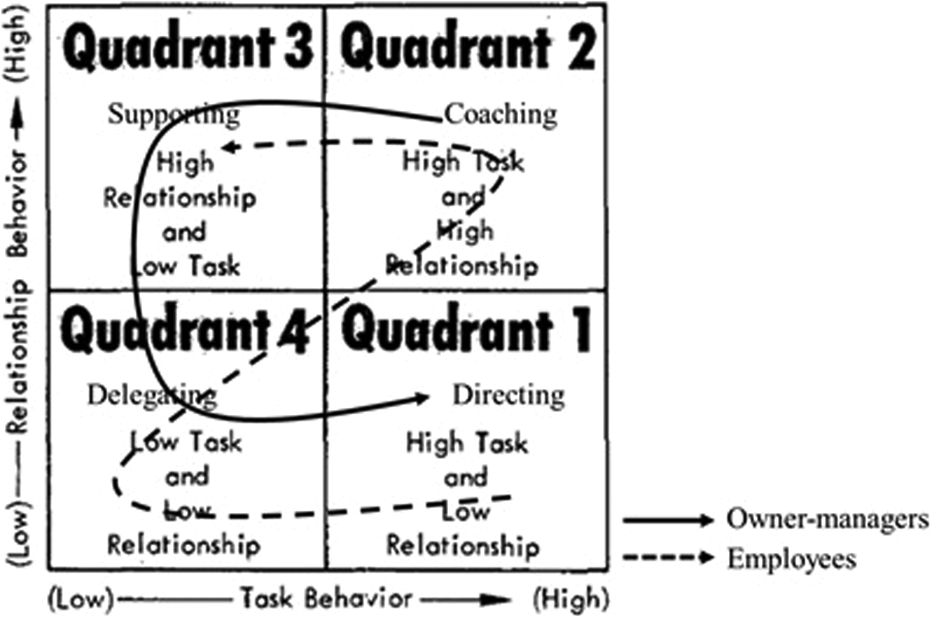
Comparison of perceptions of leadership style.
Despite the existence of predominant leadership styles, the use of a variety of them in diverse situations is appreciated. The owner-managers consider a balance between coaching or selling and supporting or participate with a relationship orientation in both cases, while employees perceive that the style most used by their leaders is directing or talking followed by delegating without orientation to the relationship in both cases.
In relation to the hypothesis 3 that involves the leadership style adaptability, the results are shown in Table 7, where it is possible to appreciate the comparison between the owner-managers and his employees and convergences and divergences between both.
Comparison owner-managers—employees (style adaptability).

As can be seen, according to the perception of their leadership style, the owner-managers show a low degree of style adaptability or effectiveness, on the other hand, from the perception of the employees, there is a degree of style adaptability or superior. In general, considering the results found, it is possible to state that the leadership style adaptability hypothesis is fulfilled for the owner-managers, not for the employees, who perceive their managers behavior, in certain situations, in the way that they are expected to behave.
The results related to the validation of hypothesis 4, concerning the level of maturity of members of the organization, are shown in Figure 3.

Comparison of perceptions of level of maturity.
The owner-managers perceive their employees with an average level of maturity according to the mean obtained (2.37), while the employees perceive themselves with a high degree of maturity according to the mean obtained (3.51). In order to relate this result to the one obtained previously, it is necessary to take into account that the leadership theory that has been followed so far establishes some bench marks between the degrees of maturity and the appropriate leadership style.
As can be seen in Figure 4, there is a correspondence between the results obtained and the principles of the SLT that states that the behaviors of the quadrants 2 and 3 seem to be more appropriate when people manifest average maturity. This corresponds with the owner-managers’ perception of the level of maturity of their subordinates and the perception of their own style of leadership. So they are behaving correctly from their point of view. Following the theory, 15 when working with people who show maturity above the average, the greater probability of success appears with behaviors collected in quadrant 4. In this case, the leader uses the correct leadership style according to the perception of the owner-managers’ style of employees, as well as the perception of their level of maturity. The mismatch is seen in the employees’ perception of the use of directing style which is not congruent with the perception of their level of maturity. The above expressed allows to conclude that the style of leadership is mostly congruent with the perception of the level of maturity of the employees. 22

Congruence between leadership style and the level of maturity of employees.
Conclusions
This article set out to study the contingency theories of leadership for Ecuador owner-manager, its measurement, and relevance. Using a sample of 175 owner-manager and 1218 employees, the situational leadership survey found mixed empirical support like other previous studies. 49 –52
The findings indicate that there is a mismatch at perceptions of leadership style between owner-manager and their employees. This finding is corroborated when the style range is analyzed. Although it is true that a variety of leadership styles is perceived by both owners and employees, they differ diametrically between them.
According to the results, neither the owner-manager perception of his own behavior nor employees’ perception of owner-manager behavior, in certain situation supported the expectations specified in Hersey and Blanchard’s work. 22
The leadership style directing or telling (high directing and low supporting) typically associated with lower overall job satisfaction and lower organizational commitment (the most unfavorable general job attitudes) was the perceived style of leadership by employees. Nevertheless, it is recognized that this shows opinions mixed with coaching or selling style, but the former is predominant. And delegating (low directing and low supporting) associated with satisfaction with supervision and with communication, the poorest work-specific attitudes, was found as the second style.
In the research, we could find a consistent association between those leadership styles with high significance for the owner-manager (coaching and supporting) and the perception of the degree of maturity of the employee.
In the same way, the delegating style is related to the employees’ perception of their degree of maturity, but as was noted before, a mismatch between directing style and the degree of maturity was found. What is interesting in this case is that a relationship is perceived between leadership style and employee maturity, but these perceptions are quite different.
In spite of the relationship between leadership and performance is mediated by the group dynamics and personalities of group members, its motivation and satisfaction, variables not analyzed in this study, with the results found, would be expected to find that the businesses studied showed low performance and high turnover. However, it is known that these companies show a pattern of sustained growth in the last 5 years and low turnover. There is still the question of whether this state of affairs is sustainable over time. Even though the hypotheses were totally or partially validated, our results failed to clarify a recommendations for small businesses, because things seem to be going well in a strange way.
As discussed earlier, leadership plays a central part in understanding the behavior of the group and of the organization as a whole, since it is the leader that usually provides the direction toward the achievement of the goals. Therefore, a better understanding of leadership is important in improving group performance. The study reinforces the fact that the accurate nature of leadership and its relationship to particular situations and subordinate satisfaction, commitment, and performance is still uncertain. Although much has been learned about leadership, many opportunities of research still remain to be explored. 24
The results of the study urge owner-managers of small businesses to consider the role of their behavior in certain situations taking into account the impact of such behavior on employees’ attitudes toward work and the performance of their enterprises. However, they are prevented from assuming behaviors based on the results of this research with the hope of obtaining successful results. The essence of situational theory goes against this position.
Despite the aforementioned, the study is considered as a starting point to focus research related to the style of leadership in small businesses in the Ecuadorian context, taking into account the preponderance of this type of business in the economic context of this country.
One aspect that is considered that could affect the results of this study is the low educational level of both employers and employees, all of which affected the compression of the nature of the applied instrument despite its validity and proven reliability. It is also considered that, in future investigations, other variables such as satisfaction, commitment, and alignment of the employees with the objectives of the organization should be included that may allow to find new findings that facilitate the orientation of the small business owners in terms of styles of leadership and situation.
Footnotes
Declaration of conflicting interests
The author(s) declared no potential conflicts of interest with respect to the research, authorship, and/or publication of this article.
Funding
The author(s) received no financial support for the research, authorship, and/or publication of this article.
