




Abstract
Organizations are spending large amounts of money on their energy consumption. The scarcity of energy resources, along with their price volatility, has become a major concern for all industries. Consequently, the need for managing and conserving energy has recently gained larger attention. A good management always pursues savings opportunities with minimum investments; hence, establishing an energy management system can provide the right approach to detect opportunities and sustain improvements. This article proposes the Lean Six Sigma energy management model (LSS_EnMS) based on the framework of International Organization for Standardization (ISO) 50001 for energy management, supported by the LSS approach define, measure, analyse, improve and control (DMAIC). The LSS_EnMS model applies the DMAIC approach to the energy management process in companies and incorporates the needed tools to define system requirements, analyse energy data, establish a systematic approach to identify energy opportunities and finally to guarantee sustainable system improvements. The model has shown the compatibility of Six Sigma approach with the ISO 50001 framework and has provided guidelines for effective system implementation. A prominent pharmaceutical company in Jordan was taken as a case study to show the significance of this model, and how this approach can lead to valuable and advantageous results in terms of real case application.
Keywords
Introduction
Sigma б is a Greek letter which has been used in statistics to measure variability and deviation from standards and has become an indicator for the performance level of an organization. A 6б level means that only 3.4 failures per million opportunities are detected in a process; this Six Sigma goal is achieved by designing the process to be time efficient with better utilization of resources. 1 Motorola first adopted the Six Sigma concept in the mid-1980s; companies like General Electric and AlliedSignal have followed Motorola’s path of success, achieved immense savings for their businesses and became known quality leaders. 2
Six Sigma can be perceived as a metric when it is used to raise the quality level of a process, where the higher the sigma levels the better the process performance. It is also perceived as a methodology when applying the define, measure, analyse, improve and control (DMAIC) approach to a process; following these five phases can help improve processes, minimize the cost of poor quality and achieve the Six Sigma goal of reduction in number of defects. A broader perception of Six Sigma utilizes its scientific approach in developing a management system, which effectively corresponds to organizational goals and satisfies business requirements. 3
A Six Sigma–based system can surpass other quality systems in its capability of building a strong organizational infrastructure, empowering employees in system implementation and offering quantitative and qualitative tools to be used in operational analysis and process improvement. 4
Michel George and Robert Lawrence have combined Six Sigma and Lean concepts since 2002 in order to gain the benefits of both quality initiatives, and a better approach utilizes resources, incorporates human aspects, improves shareholder value, reduces all kinds of waste and tackles process variation. 5
Although Lean Six Sigma (LSS) was first implemented to improve manufacturing processes, it has proved its effectiveness in other business processes. In this proposed work, LSS is utilized to solve sustainability problems faced by organizations. Its tools are integrated into an energy management system (EnMS) to improve the processes and procedures incorporated in the system.
Quality concepts have evolved since the 1920s. They commenced by inspecting final products and performing quality control, which were usually product oriented and corresponded reactively to failures. After that, the quality assurance concept was introduced which is process oriented and corresponds proactively to failures. Subsequently, organizations developed quality management systems which incorporated human aspects, system approach, leadership and customer focus strategies. 6
A quality management system (QMS) usually corresponds to a set of standards that are translated into requirements to be fulfilled by organizations. It follows Shewhart’s cycle approach: plan, do, check, act (PDCA); this approach represents the framework at which system requirements are performed and applies to organizations of different sizes and industry types. In 1978, the first family of International Organization for Standardization (ISO) 9000 standards was published. It was subsequently revised repeatedly in 1994, 2000 and finally in 2008. A new version was approved and released on September 2015. ISO 9000 standards and requirements rely on the eight pillars of quality, derived from the ‘deming quality principles’ which are customer focus, leadership, process approach, system approach to management, factual approach to decision-making and mutually beneficial supplier relationship. 7
Integrating the concepts of LSS and QMS has beneficial outcomes and can generate a well-developed framework which incorporates the advantages of both systems. 8 –10 QMS generally offers a high level of processes to be implemented in a system according to pre-specified standards, without providing a road map on how to implement those processes; here, LSS offers the toolset to implement processes and to comply with standards. 9
Generally, LSS strives to achieve financial success by establishing a special organizational infrastructure, which engages qualified and competent staff at the operational level and empowers employees in system processes. Moreover, LSS is an objective-oriented approach in which the aspects of project management are more structured; furthermore, it provides more emphasis on stakeholder values and business needs. QMS also allows for process documentation and considers regulations when designing processes. It also encourages management support to embrace change and continual system improvement. 10
The ISO is responsible for developing management systems and publishing standards that are globally accepted. Organizations seek ISO certification to achieve business excellence and competitive advantage in their markets. Many ISO management system standards have been developed for different areas, including quality management (ISO 9000), environmental management (ISO 14000), risk management (ISO 31000), food safety management (ISO 22000) and energy management (ISO 50001). 11
The ISO 50001 EnMS was first published in June 2011, and similar to ISO 9000, it follows the PDCA framework for continual improvement. This energy management standard intends to help organizations optimize their energy consumption in a systematic manner and considers the role of management in supporting energy projects, incorporates energy in organizations’ policy, monitors energy consumption and controls improvements.
The ISO 50001 framework shows the requirements for implementing an EnMS. This starts by setting organizational energy policy goals and identifying legal requirements, followed by the planning phase which mainly includes the energy review process. After that the identified opportunities are implemented and sustained.
ISO 50001 utilizes technical energy measurements and the experience of energy practitioners when selecting projects for improvements. Therefore, supporting this energy management framework with a data-driven approach like LSS is anticipated to provide preferable results. Like other management systems which follow the PDCA approach, ISO 50001 can be integrated with LSS which follows the DMAIC approach.
Previous work mainly focused on the energy audit process as an approach for achieving energy savings. In his book, Krarti 12 introduced the general procedure for the conventional energy audit process in buildings, which includes utility data analysis, walk-through survey, baseline for energy use and evaluation of energy savings measures. Avina and Reshat 13 emphasized the shortcomings of poor energy audits, such as missing beneficial measures, overestimation of savings, focusing on certain energy systems while neglecting others, providing incomprehensible energy audit reports and inaccurate estimation of costs. Avina 14 also investigated the variation in energy audit implementation with regard to the audit quality as well as the auditor experience. Moreover, the author explains how to select a good energy auditing company to conduct the audit effectively.
Escrivá-Escrivá et al. 15 have stated that the problem with the traditional concept of energy audit is that the audits take place at a given point in time, without any continuous follow-ups to guarantee sustainable improvement. Therefore, the authors have proposed a continuous assessment model using different energy rating factors. Other improvements on the energy audit process have incorporated the concepts of Six Sigma and Lean. Knapp 16 presented the lean audit approach, which has the advantages of avoiding error propagation, realizing energy savings by reducing work in process and increasing project management control. Seryak and Kissock 17 proposed the lean energy analysis approach; this approach seeks to identify, quantify and eliminate non-value added energy use. Jacoby 18 demonstrated the effectiveness of integrating the two concepts Six Sigma and Lean to reduce emissions from manufacturing processes and energy costs to improve safety and increase capacity.
The Six Sigma approach has expanded and gained broader perception in the minds of energy managers and researchers of energy efficiency. Furphy 19 has addressed in her master thesis how a Six Sigma methodology can be applied to the Leadership in Energy and Environmental Design for Existing Buildings (LEED-EB) program to help companies achieve sustainable results; as a result of her work, the Six Sigma methodology was found to be compatible with LEED-EB requirements. While Lee et al. 20 presented a Six Sigma-based energy management planning procedure to lower energy cost, develop management commitment and achieve continuous improvement. Cherrafi et al. 21 performed a review and analysis of the literature concerning a possible model for integrating three management systems: lean manufacturing, Six Sigma and sustainability; their literature survey has shown literature gaps and future research directions for this integration. Also, Cherrafi et al. 22 presented a framework that methodically guides companies through a five stages and 16 steps process to effectively integrate and implement the Green, Lean and Six Sigma approaches to improve their sustainability performance.
After the release of ISO 50001 energy management international standards in 2011, research was more focused on developing strategies and methodologies to help companies achieve compliance with those standards. Wu and Ponte 23 presented the structure of an integrated and computer aided framework which supports continuous energy efficiency improvement cycles and the requirements of ISO 50001. Wu and Ponte 23 explained the sustainable energy management aspects of the ISO 50001 international standard, covering energy management policy, system design, implementation planning and energy management audit-related process models. Gopalakrishnan et al. 24 developed a standard methodology using flow charts and a software tool referred to as the ‘ISO 50001 Analyzer’ to facilitate the development of an ISO 50001 EnMS. The designed software was also considered as a reference guide for energy management consultants to assist manufacturing plants and comply with ISO 50001 requirements. Méchaussie et al. 25 presented a methodology to carry out energy audits in compliance with the European standard EN 16247-1 and including the ISO 50001 requirements of the energy planning phase; the authors’ proposed approach incorporates the identification of major energy consumers, evaluation of system energy efficiency, identification of energy savings opportunities and monitoring of system energy consumption. Karcher and Jochem 26 identified main success factors for the effective implementation, operation and certification of an EnMS in accordance with ISO 50001.
Many research articles have combined the Six Sigma (DMAIC) and QMS (PDCA) approaches to improve processes and gain benefits from both. Pfeifer et al. 10 showed the beneficial outcomes of integrating Six Sigma and QMS approaches in process analysis, choice of project participants, planning of project resources, documentation of results and conformance between project and process objectives. Karthi and Devadasan 8 explored the integration of LSS with the ISO 9001 standard QMS and provided a road map for implementing LSS through ISO 9001:2008 standard-based QMS. Marques et al. 27 proposed an integration framework where the life cycle stages inherent to a Lean and/or Six Sigma project can be systematically linked to the applicable clauses and subclauses of ISO 9001:2015.
This work provides an EnMS framework which incorporates LSS tools and techniques into ISO 50001 EnMS1 and will be referred to as LSS_EnMs. It also suggests a new road map based on this integration to develop, analyse, improve and control a well-structured EnMS, and it will also follow the DMAIC phases of LSS with the appropriate toolset to be used.
Research methodology
The idea of integrating LSS with ISO 50001 evolved after conducting a literature survey on the conventional energy audit processes and the problems associated with poor implementation. These conventional audits usually achieve temporary improvements, which are not sustained by controls and follow-up procedures. Therefore, the LSS approach was introduced to satisfy this need for a well-managed and more controlled energy audit process.
The proposed DMAIC approach of LSS creates a solid understanding of process control and management. It will first define all the needed requirements, measure the current energy situation, analyse the collected data, carry out the improvements and finally sustain these improvements with effective controls. Moreover, LSS offers a good toolset to be used in analysing and interpreting energy data.
ISO 50001 proposes a framework for EnMS implementation, and like other QMSs, it follows the PDCA cycle. ISO 50001 shows the requirements that companies need to comply with in order to be certified in energy management. The main question raised at this point was whether or not a Six Sigma–based approach can be integrated with this system to ensure effective implementation. In trying to answer this question, many articles and academic papers were reviewed. They have provided evidence on the validity of integrating Six Sigma with QMSs, but no academic work has explored the use of Six Sigma in supporting an ISO 50001 EnMS. This work will be the first to investigate the use of Six Sigma in supporting the ISO 50001 framework. A summary of the research methodology is illustrated in Figure 1.

Research methodology.
Proposed model
This study illustrates the use of LSS tools in building a well-structured EnMS, which corresponds to ISO 50001 requirements. LSS offers many statistical, non-statistical and managerial tools which can ease the implementation of energy management practices in an organization; this was ascertained in literature as described before.
The DMAIC_ LSS approach is constructed on the base of ISO 50001 framework in order to formulate a new EnMS framework called the LSS_EnMS, which is supported by LSS tools and techniques. The proposed framework integrates PDCA and DMAIC approaches and suggests amendments to the conventional ISO 50001 framework. Figure 2 shows the proposed model framework, combining the ISO 50001 framework with DMAIC phases of LSS.

LSS_EnMS-proposed model. LSS_EnMS: Lean Six Sigma energy management model.
The define phase incorporates important aspects in this model; it is considered as a preparation phase to ensure effective and efficient implementation of the system. It includes policy definition, stakeholder analysis, system charter, communication and training plans. It also considers the system’s organizational infrastructure, with clear responsibilities and authorities being identified for each process player.
The measure, analyse and improve phases in the LSS_EnMS cover all requirements of the planning phase in ISO 50001 but add more analytical and problem solving techniques to achieve those requirements like gap analysis, root cause analysis, variation analysis and different validation techniques.
The control phase corresponds to the checking requirements in ISO 50001. It includes the detection and management of nonconformities through monitoring activities. Nonconformities may result from the measurement process itself, competency of staff, compliance with legal requirements, new design evaluation, procurement strategy and stakeholder concerns and awareness. Nonconformities are also predicted in this phase through the use of the risk assessment procedure to generate a contingency, as well as corrective and preventive action plans. Referring to ISO 50001 requirements, internal audits are also included in this phase to sustain and detect deficiencies.
The model’s proposed integration between the ISO 50001 framework and the LSS DMAIC approach is clearly described in Figure 3, which shows the operational add-ons for each system. LSS provides more emphasis on stakeholder values and offers analytical and problem solving tools; it also considers human aspects when designing processes. ISO 50001 however guarantees management support and compliance with legal requirements and requires more emphasis on documentation of procedures and processes.

ISO 50001 and LSS add-ons. LSS: Lean Six Sigma.
The new framework proposes the DMAIC approach for energy management and provides tools to implement ISO 50001 requirements. Each requirement in the ISO 50001 standard has its corresponding requirement in the proposed framework. The integration of ISO 50001 and LSS approaches is indicated in Table 1; the ISO 50001 standard requirements are listed in the first column, the LSS DMAIC approach in the second column and the proposed LSS_EnMS in the third column. This table summarizes the proposed methodology, lists candidate tools to facilitate its implementation and illustrates the LSS_EnMS road map.
LSS_EnMS integrated framework.

DMAIC: define, measure, analyse, improve and control; LSS_EnMs: Lean Six Sigma energy management model; SEU: significant energy users; O&Ts: objectives and targets; EMO: energy management opportunity; EnPIs: Energy Performance Indicators; CPA: Corrective and Preventive Action; FMEA: Failure Mode and Effect Analysis.
Apparently, the two systems overlap in certain aspects and complement each other in other aspects. This can be inferred from Table 1; defining system policy and legal requirements as well as training and communication requirements of ISO 50001 were considered early in the define phase of the model, and LSS techniques like stakeholder analysis and process definition were also added to proactively correspond to system uncertainties. The measure, analyse and improve phases in the LSS_EnMS cover to a great extent all requirements of the planning phase in ISO 50001 but add more analytical and problem solving techniques to achieve those requirements, such as conducting gap analysis, root cause analysis as well as validation techniques. While in the control phase, the LSS tools were utilized to generate better nonconformity detection and management procedures, including all sources of nonconformities (design, procurement, compliance with legal requirements, system deficiencies, awareness and competency programs). Moreover, risk analysis was an essential step to be added in this phase and was effectively introduced using the failure mode and effect analysis (FMEA) tool of LSS.
Model application and discussion
A prominent pharmaceutical industrial company in Jordan was taken as a case study to illustrate the application of the LSS_EnMS in a real case utilizing real energy data. Some assumptions were made in the qualitative analysis described in this study, especially those concerning the human aspects of the system such as energy team selection and stakeholder analysis.
The company initiated the implementation of the ISO 50001 EnMS in the beginning of 2015 and has conducted an energy review as part of fulfilling the requirements for ISO 50001. After applying the model phases to this case, the results demonstrated the energy data and provided a better understanding of the ‘as is’ energy situation. Moreover, the LSS tools used in the model have helped clarifying the requirements of ISO 50001, especially when mentioned in the context of systematic management approach. Another important feature of this model is its simplicity and ease of implementation.
In the define phase, writing the problem statement, the business case and the goal statement was the first step, while showing its significance in identifying the company’s current situation and the need for improvement. Furthermore, the scope of work was defined along with the required resources and time frame. A high-level system process map was also introduced using the supplier, input, process, output and customer technique of LSS, as shown in Figure 4.

SIPOC tool applied to energy management process.
Also, the LSS_EnMS team was built based on a systematic approach and using effective LSS tools such as employee selection matrix. Responsibilities and authorities were allocated among all process players using the responsible, accountable, consulted and informed (RACI) matrix, as shown in Figure 5. One of the significant additions of LSS is the stakeholder analysis, where all stakeholders of the system were identified, their perceptions and interests were addressed and management strategies were specified accordingly.
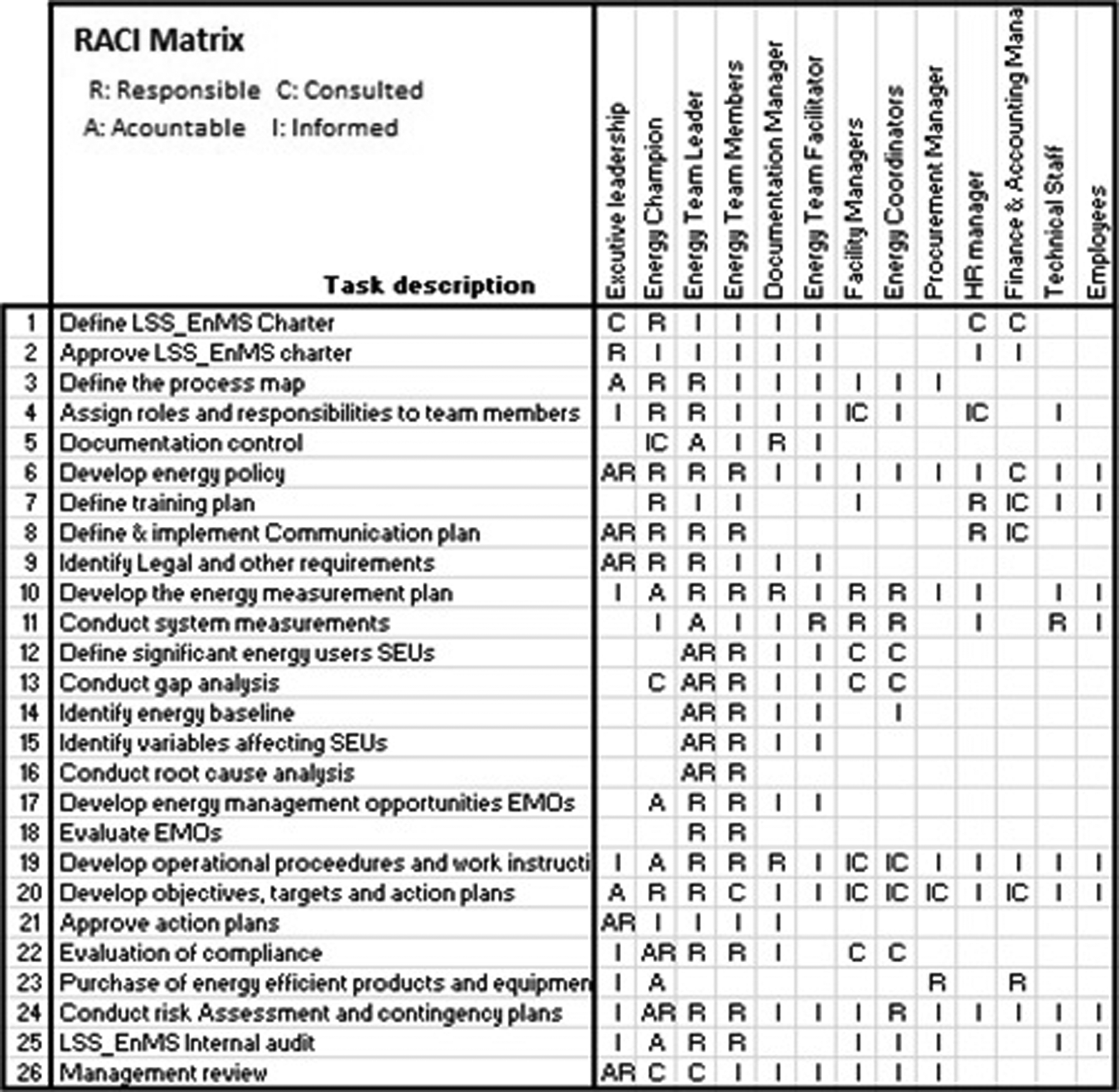
RACI matrix applied to the LSS_EnMS. LSS_EnMS: Lean Six Sigma energy management model.
In the measure phase, after identifying all energy consumers, a detailed measurement plan was established using the 5W1H tool of LSS in order to evaluate the as is energy consumption in the company and to break it down according to the different energy consumers. Based on the measurements taken, Pareto analysis was then used to identify the significant energy users (SEUs), in order to keep team efforts focused on the right areas for improvements. The analysis incorporates two levels, system level and facility level; as shown in Figure 6, the significant energy consumers in this company are the Heating, Ventilation and Air Conditioning (HVAC) system and the steam and hot water boilers consuming 78% of the energy. Figure 7 shows that the SEUs are concentrated in the Penicillin plant. The main plant reaching a percentage of 72.2, while the other buildings such as the Quality Control (QC) and analytical research departments can be neglected in future analysis due to their low contribution in energy consumption. The corporate building can be given second priority in the investigation.

Pareto chart for energy systems.

Pareto chart for company’s facilities.
The next step was to evaluate those SEUs against legal requirements and operational standards; this was done by means of a gap analysis, comparing SEUs’ performance to the nameplate (nominal) and best in class performance.
Many statistical and non-statistical quality tools were used successfully in the analytical phase. The main goal was to analyse the driving factors, define the energy baseline and identify the root causes for (significant) energy consumption. Regression analyses were first applied to the electricity use in the company, and it was found that the most prominent variables affecting electricity use were the cooling degree days and the Penicillin plant production; these variables can predict electricity consumption by 69.7%. Accordingly, energy performance indicators were specified and will be monitored in future analysis.
Other techniques like the 5 Whys were applied in this case to analyse potential causes and energy gaps for each SEU. The identified root causes were represented and categorized in the cause and effect diagram, which was established in order to focus on root causes and facilitate the identification of energy management opportunities (EMOs).
In the improve phase, the team nominates improvement ideas for investigation based on the identified root causes. The next step will be to prioritize ideas and select best solutions to be implemented; for that purpose, a Six Sigma tool like the solution selection matrix is utilized. Evaluation criteria were defined, which include effectiveness, cost, ease of implementation, time and environmental impact. Weighted criteria and scaling (from 1 = Low to 3 = High) were used to formulate the matrix. The prioritized selected EMOs are then validated for their financial viability. Objectives and action plans were established for each EMO.
Finally, in the control phase, the operational procedures and work instructions were identified for each SEU, and employees were briefed accordingly. The next step was to identify and manage nonconformities, which can be either detected or predicted. For both cases, strategies were developed to investigate system performance, identify sources of non-conformance and develop corrective and preventive action plans.
In order to detect nonconformities, they were categorized according to their nature, and corrective strategies were established for each type. Figure 8 shows nonconformity types and strategies for correction.

Nonconformity categories and correction strategies.
Risk analyses were also conducted in order to prevent any unwanted nonconformity to occur in the future. These analyses include internal/external risk identification, evaluation, prioritization and management. FMEA was used for this purpose, and output from this analysis was preventive actions and contingency plans which feed into the improve phase again.
Conclusion
This study has proposed a model which uses the Six Sigma DMAIC approach to support the framework of ISO 50001 and its implementation. The model also includes a valuable toolset to analyse and control the energy management processes. To the best of the author’s knowledge, this proposed model was the first to combine the LSS and ISO 50001 system approaches and has provided beneficial outcomes which can be summarized as follows: more emphasis on stakeholder value analysis, guidelines for EnMS implementation, analytical and statistical tools for interpreting energy data, more consideration dedicated to human aspects when designing energy management processes, incorporating project management techniques and practices, more clear and defined system objectives, resources and processes and strong organizational structure established with defined roles and responsibilities.
The proposed model has provided a clear selection process for the energy team and its responsibilities by building an organizational infrastructure and clarifying responsibilities using Six Sigma tools such as the RACI matrix. Moreover, the model has provided the adequate analytical procedure for evaluating energy variables and defining EnPIs. This was achieved by building the energy consumption equation using regression analysis.
Another contribution of the proposed model was the use of Pareto analysis when selecting SEUs in order to narrow down the analysis and focus efforts on major consumers. The model has also provided a road map for defining nonconformities and strategies to correct and prevent their occurrence.
Footnotes
Declaration of Conflicting Interests
The author(s) declared no potential conflicts of interest with respect to the research, authorship, and/or publication of this article.
Funding
The author(s) received no financial support for the research, authorship, and/or publication of this article.