



Abstract
Aboriginal and Torres Strait Islander Languages can play a significant role in ensuring connection to land, culture, Songlines, kinship, history and stories for Aboriginal and Torres Strait Islander children. However, colonization and past adverse governmental policies, have rendered many Aboriginal and Torres Strait Islander languages endangered and even extinct. The aim of the project was to develop an Indigenous Methodological Framework (IMF) that connects Country, Traditional Owners and Aboriginal and Torres Strait Islander communities and informs the development of an Indigenous Languages program in an independent service attached to an Independent Early Learning Centre (ELC) in Regional Queensland that would benefit all children.
Introduction
Early Childhood centres in Queensland provide education for children from birth to 5 years of age in line with the national Early Years Learning Framework (Australian Government Department of Education [AGDE], 2022). These services deliver access to playgroups, early childhood education and care, and some health services and family support. There is also the provision of online services that support capacity building of educators who work in the kindergarten sector to identify and support Aboriginal and Torres Strait Islander children who are learning Standard Australian English as an additional language or dialect (AGDE, 2022).
Since 2021 several cultural, arts and language programs have been awarded funding from the Federal government to ensure that children and young people will have access to history and First Nations languages of Australia, see the Indigenous Languages and Arts program (Office for the Arts) and Aboriginal and Torres Strait Islander Languages Policy Partnership (LPP). It is vital that Aboriginal and Torres Strait Islander languages are recognised and implemented at every level of education, including the early years and higher education programs at universities. Aboriginal and Torres Strait Islander languages are central to culture and community and ways of life. According to the United Nations Declaration of the Rights of Indigenous Peoples (UNDRIP) Article 13 states that Indigenous peoples have the right to revitalize, use, develop, and transmit their languages and oral traditions to future generations (UNDRIP, 2007). The Australian Curriculum clearly subscribes to inclusion of Indigenous languages, stating that, “the learning of an Aboriginal or Torres Strait Islander language incorporates the realities of its people and facilitates students’ deep engagement with knowledge, ways of being and ways of knowing. It develops in students an understanding of historical, current and ongoing connection to Country/Place and culture.” (Australian Curriculum, 2025).
Critical to implementation is employment of Aboriginal and Torres Strait Islander peoples to deliver Indigenous Languages programs, across all sectors, working with non-Indigenous educators to ensure that the delivery of such language programs is culturally authentic. Another important element of teaching Aboriginal and Torres Strait Islander languages is seeking and receiving permission from Traditional owners and ensuring that there is continued consultation and employment of local Traditional Owners who are the knowledge holders within the Community.
Aboriginal and Torres Strait Islander Languages can play a significant role in ensuring connection to land, culture, Songlines, kinship, history and stories (O’Brien & Bobongie-Harris, 2023). Language attrition in Communities for Aboriginal and Torres Strait Islander peoples of Australia is a result of colonisation and past adverse government policies which rendered Indigenous languages as obsolete and unnecessary. Redressing that loss is a vital step in reconciliation and social justice, and an urgent educational priority as highlighted in the 2020 Closing the Gap report (Australian Government, 2020), and 2019 Advancing Aboriginal and Torres Strait Islander Education: An action plan for Queensland (Queensland Government, 2019). By promoting Aboriginal and Torres Strait Islander languages in educational contexts, we can instil a sense of cultural identity and connectedness to schooling for Aboriginal and Torres Strait Islander children, ensuring that languages are passed on to future generations (Purdie, 2009) and encourage and develop a new understanding of Aboriginal and Torres Strait Islander culture for non-Indigenous children. For non-Indigenous children and young people studying an Aboriginal and Torres Strait Islander language it can provide “intellectual challenge and development while also giving them insight into and understanding of Indigenous Australian cultures and knowledge” (Australian Curriculum, 2025).
In many parts of Australia, Aboriginal and Torres Strait Islander languages are being revitalised and are being taught to both Indigenous and non-Indigenous children in classrooms through Indigenous Language Programs (ILPs). While some ILPs are achieving overall success there is no clear Indigenous Methodological Framework to assist educators to develop language programs at their schools that approaches this work in ways that creates reconciliation and partnerships with Aboriginal and Torres Strait Islander communities as decisions makers. Only through an appropriate IMF can cultural knowledge be transferred at the local level. Without a clear IMF, educators may not fully understand how to engage with Country, Traditional Owners, or Aboriginal and Torres Strait Islander communities to develop sustainable Indigenous Languages Programs within educational contexts. As such, applying a decolonising methodological lens to this research, promotes local Indigenous knowledges and experiences from within the community that can then challenge Eurocentric methodology models of research in this space recognising the heterogeneity and cultural diversity of Aboriginal and Torres Strait Islander peoples across Australia.
The Federal government is committing $14 million over three years to employ a First Nations Language and Culture Teacher in sixty schools across Australia. At this time however, there is no specific national funding allocated to include First Nations language programs in Early Childhood settings.
Literature Review
Of the 6,700 languages spoken in the world, around 3,000 are at risk of extinction. Most of these are Indigenous languages (Rogers & Campbell, 2015), with one Indigenous language dying every two weeks (United Nations, 2016). Established in 1994, the Victorian Aboriginal Corporation for Languages is working towards the implementation of policy and legislation in Victoria to revitalize Indigenous languages (Milkins, 2020). The NSW Government is a step ahead, being the first Australian state or territory to pass an Aboriginal Languages Act (2017) to support Communities with language reclamation (Lowe & Giacon, 2019). In 2023 the Queensland government targeted a small amount of funding for First Nations Languages Programs (FNLP) to support schools with the provision of additional resources, to work in partnership with Traditional Language Owners around the co-design of Aboriginal and Torres Strait Islander language programs in schools across the state. Although a small step, this is a promising start to ensure that Indigenous Languages are prioritised in the Queensland education system, as many children in very remote and rural areas continue to speak Aboriginal and Torres Strait Islander languages as their first language.
Only 30 out of more than 100 Aboriginal and Torres Strait Islander languages and dialects in Queensland are spoken regularly (Battley & Kesteven, 2015). The Yuwi language of the Mackay region in Queensland was one of the languages considered extinct until 2015, when the State Library of Queensland conducted language workshops with the Community (Battley & Kesteven, 2015). Mackay is the regional area selected for this research program. At present there are no formalised Indigenous language programs in the Mackay region, although Battley and Kesteven (2015) describe Yuwibara Elder Gary Mooney’s vision of getting the language into local schools so that future generations can learn the cultural language of the Yuwi people. Other Yuwi Elders support this vision, stating their confidence in resurrecting the language within the next generation (Maddison & Wykeham, 2020). The Community’s work in translating the children’s book, The Very Hungry Caterpillar, as well as their goal to continue translating children’s books and Yuwi stories to read in kindergartens, preschools and schools (Meixner, 2019) has begun the realisation of this vision.
Hinton (2011) states that new models must be developed in order to teach endangered languages to young children. Immersion models such as language nests, which originated in New Zealand in 1982, are popular around the world. However, they require considerable funding and resources to be sustainable (Daigneault, 2019). They also require fluent speakers of the endangered language, which is not attainable when revitalizing a language. This research project developed a much-needed IMF to engage early childhood teachers in a practical way. As Nakata (2023) contends, Indigenous knowledges cannot be fully conveyed without language, and it is the responsibility of the Community to teach the local language. This is congruent with Hinton’s (2001) assertion that although language is the key to culture, if it is taught outside of traditional culture, then knowledge of culture will be lacking. Thus, it is vital that early childhood educators are connected with Community.
Sellwood & Angelo (2013) highlight that language protection is the configuration of languages spoken, heard, and identified within a specific place. (Simpson et al., 2019) identify that the ‘language ecology of every place and community is not necessarily well understood, and this raises questions about the language learning needs of children and adults, in regard to Aboriginal and Torres Strait Islander languages, and also the teaching of English (p. 2).’ Rather than continue to adopt a deficit view and approach to Aboriginal and Torres Strait Islander languages being spoken at home and in school settings, and the continued enforcement of Standard Australian English, educators have a responsibility to understand and acknowledge that Article 13 of the United Nations Declaration on the Rights of Indigenous Peoples clearly states that: Indigenous peoples have the right to revitalize, use, develop and transmit to future generations their histories, languages, oral traditions, philosophies, writing systems and literatures, and to designate and retain their own names for communities, places and persons. (United Nations Declaration on the Rights of Indigenous Peoples, 2007)
An IMF may support new and beginning teachers across Queensland who teach in early education centres and schools that have a high population of Traditional language speakers. Educators could benefit exponentially through engagement with an IMF to support the implementation of Aboriginal and Torres Strait Islander language programs. Further to this, higher education programs in Queensland could also consider the benefits of offering pre-service teachers an opportunity to engage with linguistic specialists, using IMF to support future teaching practices in remote and rural locations.
Research Design
This is a qualitative research project that draws on a modified version of the Bobongie-Harris et al. (2021). Indigenous Research Framework Country, Community and Indigenous Research, which uses Indigenous research methodologies: Deep Listening, Yarning, and Storytelling. The research plan was designed to provide Professional Development experiences for Early Learning Centre Staff to connect with Traditional Owners, Country, and Community and included Indigenous languages where relevant. Figure 1 outlines this approach. Indigenous Methodological Framework (Indigenous Languages)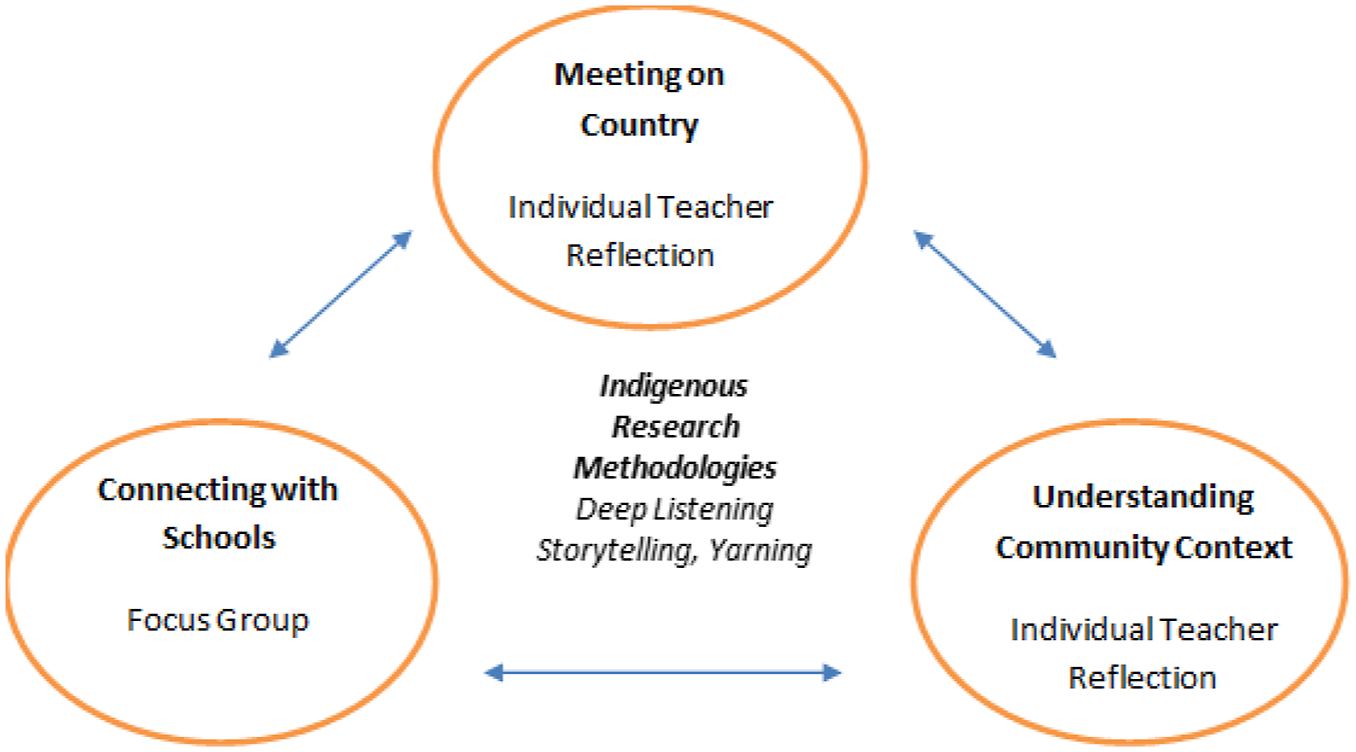
Early childhood educators were asked to consider appropriate Community connections and cultural protocols, in alignment with the Department of Education Queensland’s policy documents: Aboriginal and Torres Strait Islander Languages in Education Queensland Schools and/ the Advancing Aboriginal and Torres Strait Islander education: An action plan for Queensland (Department of Education, 2011, pp. 6,13). Through Deep Listening, Yarning, and Storytelling, the Early Learning Centre educators engaged with the communication of Indigenous Knowledges, processes, and protocols through Country and in collaboration with Community (O’Brien & Bobongie-Harris, 2023).
Indigenous Research Methodologies
There were three Indigenous research methodologies adopted for this project included Deep Listening, Yarning and Story Telling. 1. Deep Listening is a methodology based on respect. Respect that is in our relationships with each other and our relationships to the land. Deep listening is taking a minute to breathe and connect, to build relationships and establish trust. Deep listening involves listening to what is NOT said. It pays attention to the spaces between what is being said. Throughout this process you need to focus and connect to the participants you are speaking with and concentrate on what they are really trying to say. In a Western research paradigm, researchers listen for information that will benefit their own agenda. They don’t listen to the spaces between (Brearly, 2015).
A Jiman/Bundjalung researcher, Atkinson (2002) was the first to use Deep Listening, specifically Dadirri, as a culturally safe research methodology through which she could listen to the spaces between. Dadirri is a concept and practice from the Ngan’gikurunggurr and Ngen’giwumirri language groups of the Daly River region of the Northern Territory (Ungunmerr, 1988). Atkinson (2002) explains that although Dadirri is not a Western research methodology, but a Community methodology and practice, it still gathers information (through deep listening and observations), builds knowledge (by sensitivity and awareness), and develops understanding (through reflection and contemplation). [Dadirri highlights] “a knowledge and consideration of community and the diversity and unique nature that each individual brings to community; ways of relating and acting within community; a non-intrusive observation, or quietly aware watching; a deep listening and hearing with more than the ears; a reflective non-judgmental consideration of what is being seen and heard; and, having learnt from the listening, a purposeful plan to act, with actions informed by learning wisdom and the informed responsibility that comes with knowledge” (Atkinson, 2000, p. 16).
In essence, Dadirri allows participants to connect with themselves and their environment. It creates the space for respectful relationships to be built and opens the way for participants to co-direct the sharing of knowledges (Ungunmerr-Baumann et al., 2022). 2. Yarning is a relational methodology in its own right. Hughes and Barlo (2021) speak about Yarning as a formal strategy of negotiation where information sharing is used in partnership with Aboriginal and Torres Strait Islander participants and allows for the development of culturally safe and impartial research.
As research has a colonial legacy, it is important that research conducted by or with Indigenous people uses decolonizing methodologies and an Indigenous Research Paradigm. According to Dean (2010), the use of yarning as a decolonizing methodology reflects four fundamental elements of an Indigenous Research Paradigm: systems of knowledge; ways of doing; Indigenous perspectives; and research participation. In an Indigenous Research Paradigm, epistemology and ontology are based on relationships, and axiology is grounded in relational accountability (Wilson, 2008). A Yarning methodology can alleviate settler colonial research processes through its relationality and the lived experiences of Indigenous people (Barlo et al., 2020). It privileges Indigenous ways of knowing, being and doing, which are formed by relationality (Kennedy et al., 2022).
Bessarab and Ng’andu (2010) emphasise the relationality of yarning. Using yarning as a methodology strengthens the relationship between the researcher and participants, establishes connections, sets expectations and determines accountability. It is this relationality which gives participants the opportunity to be partners in, rather than contributors to, the research process, allowing negotiation of roles and expectations during the yarning sessions (Dean, 2010). In order for this to occur, trust needs to be established. This occurs in Social Yarning, which takes place before the Research Topic Yarn. During Social Yarning, introductions and connections are made, and relationships are formed. Research Topic Yarning is where information is gathered from the participant through stories that relate to the research topic. The yarn is informal, but it does have an established agenda, and a firm beginning and end (Bessarab & Ng’andu, 2010). 3. Storytelling is a narrative which provides research material. ‘Stories are not separate from theory; they make up theory and are, therefore, real and legitimate sources of data and ways of being’ (Brayboy, 2005, p. 430). Kovach (2012) refers to storytelling as a feature of all Indigenous societies where oral tradition is dominant within the culture. Storytelling is an integral part of everyday life. It is used when interacting with others, and when imparting knowledge that is passed down from one generation to the other (Bobongie, 2017).
Storytelling is at the core of Indigenous epistemology, pedagogy and research (Iseke, 2013). The use of storytelling in research emphasises the epistemological importance of relationality, fostering respectful, responsive research (Chambers et al., 2018; Wilson, 2008). Its importance as a methodology in Indigenous research is widely recognised, challenging dominant Western perspectives, and as Chan (2021) articulates, Indigenous people can reclaim and own their stories, rather than be defined by the stories that colonisers have historically told. Storytelling serves as an epistemological approach to understanding and sharing lived experiences, transcending boundaries of time, place, and culture. (Barlo et al., 2020).
Theoretical Framing
The theoretical framing of this study draws on Moodie’s (2018) Decolonising Race Theory (DRT). Stemming from the need for a theory that could be applied to Indigenous contexts, Moodie (2018) balanced critical race theory with her focus on decolonisation, recognising ‘the ontological diversity and the place-based and sovereign claims of Indigenous peoples’ (p. 36). This theory aligns with envisioning, a strategy offered by Smith (2012), which involves the process of ‘reclaiming, reformulating and reconstituting Indigenous cultures and languages’ (p. 143). As a decolonising process, envisioning ensures that cultural protocols and processes are adhered to without having to contend with the colonial structures that have sought to eliminate them. Indigenous sovereignty is centred, and Indigenous futurity is created (Bishop, 2024).
DRT is comprised of seven tenets, which include: logic of elimination; indigeneity as a political tool for justice; sovereignty and indigenous futurity; cultural interface; relationality and collectivism; indigenous methodologies; and reparative activism (Moodie, 2018, pp. 38–42). The tenets relevant to this study are outlined below.
Logic of Elimination
Throughout history, colonial systems have repeatedly attempted to eliminate Aboriginal and Torres Strait Islander languages. Of approximately 250 languages spoken before colonisation, only 13 are still strongly spoken in communities today (Rademaker, 2018). Some were eradicated by massacres and forced removals, others through education policies in the Protection and Assimilation eras, which forbade the speaking of first languages in mission schools. Rademaker (2019) asserts that language is central to Indigenous belonging and connection to the land, and so settler-colonialism attempted to eliminate this connection through absorption into the dominant language culture and by silencing the languages through sheer dominance. The development of an IMF addresses this loss, promoting the revitalisation of languages through connection and cultural identity.
On Yuwi Bara (Country), where this study was conducted, the Frontier Wars of the mid-1800s decimated the local Yuwi people. This, in addition to other influences of Europeans, such as the removal of the Yuwi people to missions in the late 1800s, resulted in the loss of laws and customs (Roth, 1908) as well as the loss of language. In 2015, the State Library of Queensland conducted a Yuwibara language workshop with the Mackay community, where over 500 words were found that had been collated by the mission superintendent of the Mackay Aboriginal Reserve in the late 1800s. Prior to this, the Yuwibara language had been considered extinct. From this workshop, the Yuwibara Language Group was formed, to revitalise the language. Since then, in conjunction with the Mackay Regional Council Library, several children’s resources have been produced, and the group is working with businesses to promote awareness of the language in the community (Queensland Government, n.d). This project provides the next step, in developing an IMF which will enable Early Years teachers to develop an Indigenous Language program in conjunction with Country and Community.
Sovereignty and Indigenous Futurity
Moodie (2018) advocates for land-based pedagogies in education. The understanding of Country that is paramount in developing an IMF reinforces Indigenous sovereignty and futurity. The participants in this project met together with the Critical Friend and Traditional Owners for an on-Country Professional Learning Experience to allow them to come to an understanding of Country through the Yuwi perspective. This included the Traditional Owners using words from the Yuwi language that have been revitalised. Through Deep Listening, Yarning, and Storytelling, teachers had the opportunity to reflect on their cultural position in relation to the languages, stories, and histories relevant to Country. Working at the local level with Community on Country, is paramount to developing an IMF that is relevant to Early Learning Centres developing understandings around First Nations Language, thus emphasising sovereignty and Indigenous futurity.
Cultural Interface
Moodie (2018) suggests that Nakata’s (2007) cultural interface theory allows the opportunity to explore Indigenous and Western knowledge production and the subsequent power structures that occur in Eurocentric educational contexts, where Western traditions of power are dominant (Burgess et al., 2022). Revitalising language through an IMF challenges these structures, repositioning expertise from Western to Indigenous knowledge, challenging the power structures of Eurocentric education.
Relationality and Collectivism
It is the responsibility of educators to teach about the obligations that Indigenous people have to Country (N. Moodie, personal communication, May 31, 2022). This study helped participants understand this relationality with Country through Deep Listening, Yarning and Storytelling; engaging with Country; and building connections with Community. It is through these practices that the Indigenous Methodological Framework can be used in schools to develop sustainable Indigenous Language Programs, where cultural knowledge can be transferred at the local level. This complements the Indigenous methodologies tenet. Colonialism painted Indigenous methodologies as primitive and exotic, whereas DRT promotes the use of Indigenous methodologies to share knowledge.
The research questions for this project were: 1. How can teachers engage and connect with Country and Indigenous communities in Mackay through knowledge of history and culture, and understanding Indigenous languages? 2. How do educators apply these understandings to plan and incorporate best practices and strategies embedding Aboriginal and Torres Strait Islander history and culture and languages throughout the Early Learning Centre?
Methods
The research project utilised different people and their diverse skillsets with each contributing to the research project in different ways. Professional Learning Experiences were provided by Traditional Owners and facilitated by a ‘Critical Friend.’ The Traditional Owners provided the educators with Indigenous Knowledges, based on their connections to Country, Indigenous Languages and personal experiences.
The idea of utilising a Critical Friend in research can be traced back to Costa and Kallick (1993), who suggest that this is a person with whom the researcher has a relationship with and who can be trusted to ask challenging questions. The Critical Friend also helps to provide a change of focus, and to offer critique of the researcher’s work. This requires a delicate balance, as there is the risk of the Critical Friend placing more importance on the friendship rather than critiquing the researcher in a non-threatening manner (Appleton, 2011). MacBeath and Jardine (1998, p. 41) emphasise this by defining critical friendship as “a successful marrying of unconditional support and unconditional critique.” It is important that the Critical Friend fully understands the research undertaken.
In this study, the Critical Friend was an expert in the field, allowing for a hands-on role in facilitating Professional Development experiences for the participants. The experiences employed Indigenous Research Methods and processes previously discussed of Deep Listening, Yarning and Storytelling.
The Professional Learning Experiences were called ‘Meeting on Country’ and ‘Understanding Community Context’ as demonstrated in Figure 1. The ‘unknown’ in this framework is the Early Learning Centre; the Early Childhood Educators’ strategies and plan in connecting with Country and Community and their understanding of Aboriginal and Torres Strait Islander languages in the area. The data collected was to provide information to complete this void demonstrating an interconnectedness between all three.
Early Childhood Educators from an Early Learning Centre in regional Queensland were the participants. The Lead Researcher and Research Assistant took notes on the ‘On Country’ location and the Early Learning Centre Classrooms, observing resources and practices that demonstrate current engagement with Country and Community.
Prior to the research project beginning, the Lead Researcher was aware that there were at least two participants (Early Childhood Educators) who may identify as Aboriginal and/or Torres Strait Islander.
Professional Learning Experiences
Meeting on Country
The Critical Friend and Traditional Owners came together to present an On-Country Professional experience working with to the Early Childhood Educators to assist them to understand Country through Yuwi perspective and with some Yuwi language. Through Deep Listening, Yarning, and Storytelling, Early Childhood Educators had the opportunity to reflect on their cultural position in relation to the languages, stories, and histories relevant to Country.
Understanding Community
Using the simple, yet complex Indigenous Research Methods of Deep Listening, Yarning, and Storytelling, the Critical Friend facilitated a yarning circle in a culturally safe environment where Early Childhood Educators were able to develop an understanding of: (1) cultural protocols, processes and community needs specific to the regional community, and (2) the diversity of Aboriginal and Torres Strait Islander languages in the region and the impact that this has when engaging with community.
Engaging in Indigenous Research Methods of Deep Listening, Yarning and Storytelling, led by the Critical Friend throughout the Professional Experiences provided participants with opportunities to consider and apply new knowledge and reflect on and share about their own personal practice during data collection.
Engagement
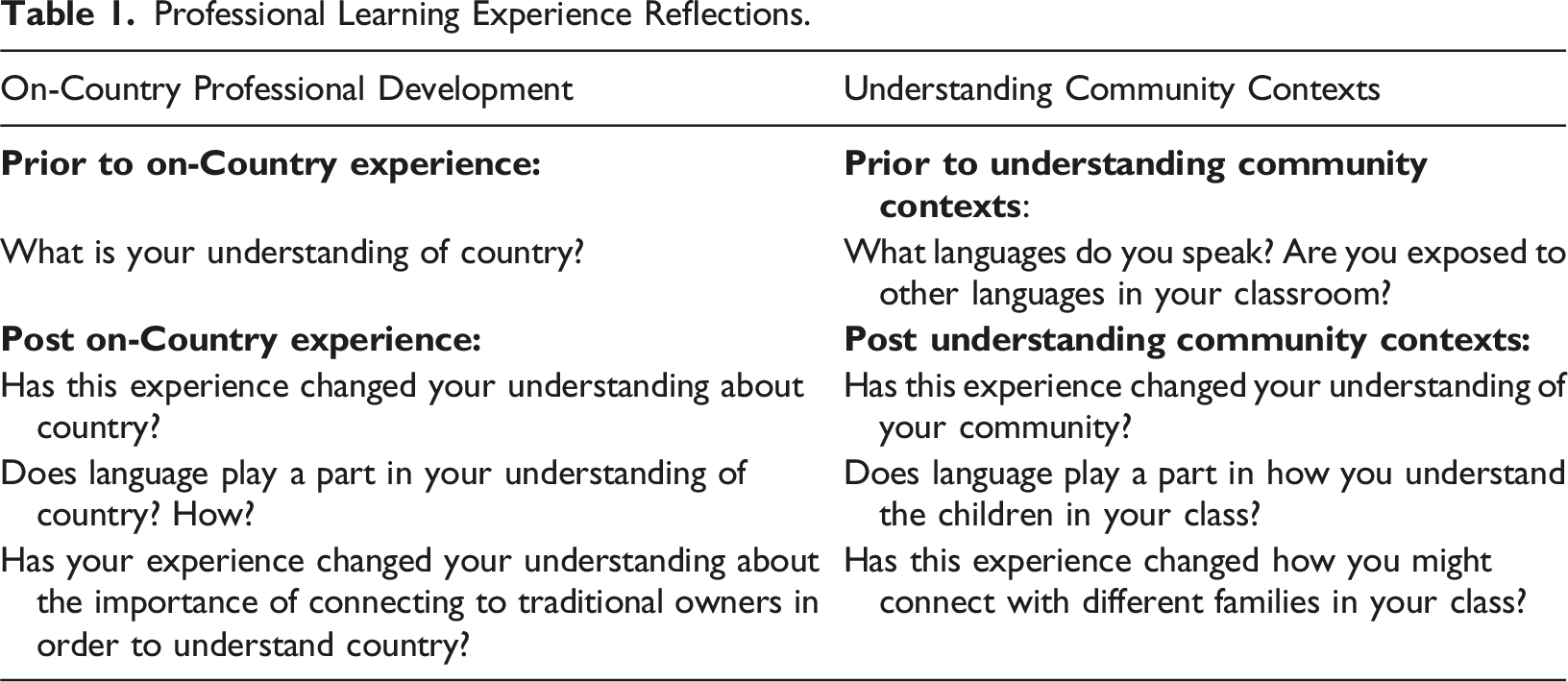
The self-reflections were designed for Early Childhood Educators to understand themselves and how they feel they can contribute to embedding Aboriginal and Torres Strait Islander Knowledge of history, culture and their understanding of languages into their classroom practices as part of a greater engagement strategy with Traditional Owners and the Community.
After the interviews and self-reflections, the Early Childhood Educators came together for a Focus Group where they discussed a plan of engagement with the Professional Development Facilitator (and Critical Friend), the Chief Investigator and Research Assistant. The Focus Group was designed for the Early Childhood Educators to reflect on current engagement practices and take a Whole Centre Approach to engaging with Traditional Owners, Country and Community to provide more opportunities to learn and understand more about their Aboriginal and Torres Strait Islander students and their history, culture and language. The participants in the research project were given pseudonyms and remain anonymous.
Professional Learning Experience Reflections.
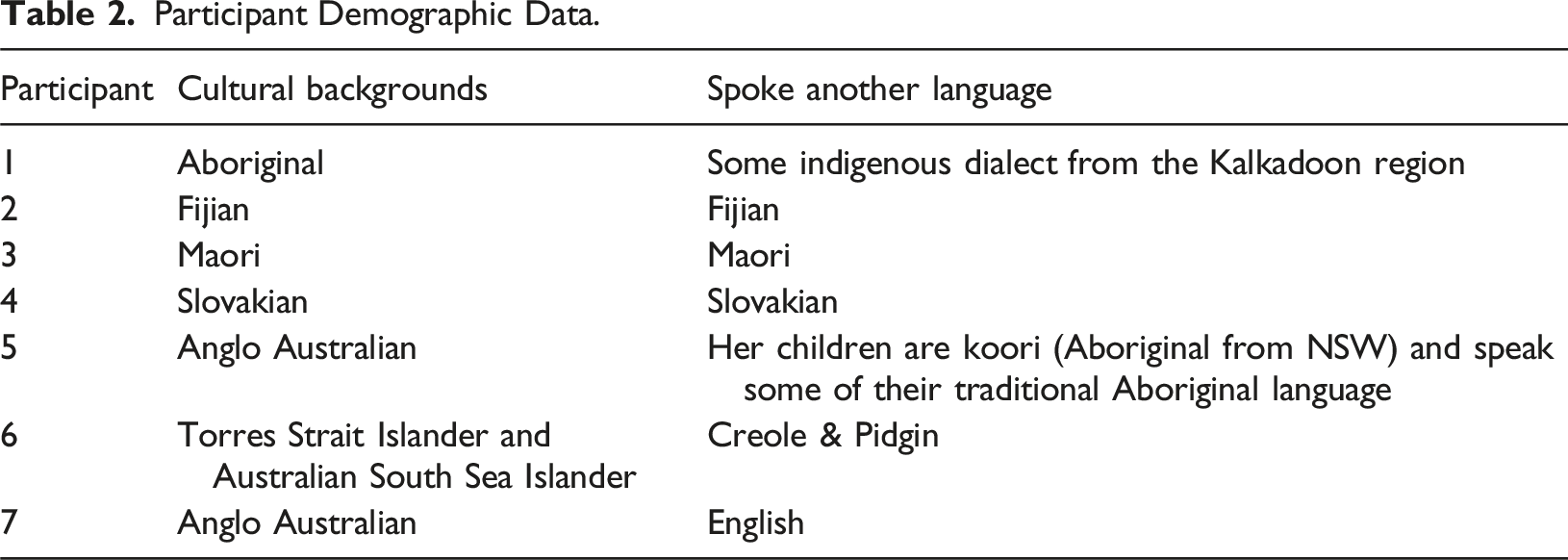
Participant Demographic Data.
Participants
Out of the 10 Educators at the Early Learning Centre: • 7 participated in the On-Country PD Experience. • 6 participated in the Understanding our Community PD (1 was absent). • 7 participated in the Focus Group. • 3 staff chose not to participate in the project.
The intention was not to collect any demographic data, however when the participants were telling their stories and yarning with the Research Assistant, the information was provided freely because of their self-reflections about themselves as cultural beings.
The participants also shared the languages spoken at home by students and their families. These included: Mandarin, Tongan, Jamaican English (Jamaica), Urdu (Pakistan), Zimbabwean, Punjabi – Hindi, Nepal and Chinese.
The research project went through a rigorous review by the ethics committee at Queensland University of Technology (Application 4076). Throughout the course of the research project, there was constant communication between researchers and two participants who identified as Indigenous. The Professional Development and the reflective process about Country, Community and Indigenous Languages had the potential to be triggering for the Indigenous participants. All participants’ well-being was regulated and always monitored. All participants were told that if they didn’t want to participate, or if they wanted to withdraw from the research project at any time, that they could do so.
Findings
The following section analyses the participants’ responses using the theoretical framework of DRT.
On-Country
Moodie (2018) acknowledges that the decolonising aspect of DRT does not always need to be taken in the literal sense of Indigenous sovereignty and land rights but can also be related to the inclusion of Indigenous perspectives in the curriculum or by the centring of the core concepts of place and relationality. Thus, in analysing the languages project through Moodie’s (2018) DRT, it can be seen that participants focused on these core concepts of place and relationality in their experience in the on-Country professional experience and through the role of the Critical Friend and Traditional Owners.
Moodie’s (2018) Sovereignty and Futurity tenet advocates for land-based pedagogies. Being on Country with Traditional Owners provided the participants with the opportunity to understand Country from a Yuwi perspective, reinforcing a Yuwi sense of sovereignty and emphasising the importance of relationship to place. Most participants demonstrated a general understanding of Country, with definitions ranging from ‘connection’ to ‘respecting’ all things on Country and an understanding that there are certain processes and protocols attached to Country. One participant noted the change in thinking that the on-Country experience provided: I thought Country is just a place where people are from different nations. They just go and live together, work together, sharing their experiences, sharing their knowledge, which last night I realised it’s a little bit more than that. It’s going a little bit deeper. It’s going from inside of the person, what do they gain from the land, from the surroundings of them. So, I realised the Country, it's not just a place but a Country, it’s who we are, who the land [relates] and the connection, actually the connection, what it is altogether.
The participants drew on their personal context in developing an understanding of Country. An Indigenous participant commented that growing up, Country ‘was just everyday living for us,’ and a participant who is non-Indigenous to Australia, but Indigenous to another country, said that Country makes ‘you feel like you’re part of the environment and nature’. After the on-Country Professional Learning Experience, this participant commented that it: reminded me that I still need to uphold...my culture, the experience, the language that I use for my children. You know, for my children at home so that they can understand where... they really come from.
Participants acknowledged that language provides an important connection to Country, with an Indigenous participant commenting on how singing and music connects people to Country. Moodie’s (2018) Logic of Elimination is reflected in Yuwi language loss, and this was acknowledged by a non- Indigenous participant who stated that: It made me really sad to know last night that most of the traditional languages of Australia have been lost…It would be good to get the kids understanding some of that language and make it like an everyday part of their lives.
It was acknowledged that a relationship with Elders is important for the teaching of language, thus providing connections back to Country and aligning with Moodie’s (2018) Relationality and Collectivism tenet. For one Indigenous participant, this was particularly poignant, as they reflected that: We have lost a lot of our land and our culture with our family because elders have passed on and we didn’t think we needed to [keep that connection], but it just happened.
Community
Moodie’s (2018) Logic of Elimination is reflected in participants emphasising English as their dominant language, even though most participants used some language other than English in their own homes. An Indigenous participant reflected on their language loss but counteracted this by using the language they do have to share a joke with their family, stating, ‘we use it to embrace happiness.’ This participant broadened this concept to connecting with families in their class, saying that making the children laugh, ‘even if it’s in my language,’ helps her find connection with students from different backgrounds.
Participants also acknowledged that using culturally responsive practices is important for establishing connection not only with students, but with the wider community. A non-Indigenous participant stated that, ‘I have to take on that responsibility of putting in the effort to getting to know the community better and build a stronger connection’, thus reflecting the core of Moodie’s (2018) Relationality and Collectivism tenet. Another participant articulated this by stating: The kids these days don’t really - wouldn’t really understand or have a feeling of how it was for our elders growing up. I think our children need to be more linked with that, talking with elders...because it opened up my eyes.
Participants emphasised that the centre could use language that the Indigenous children use at home to provide an environment where they feel culturally safe and connected. Countering the Logic of Elimination (Moodie, 2018), an Indigenous participant outlined how they could use Yuwi language cards to help children articulate their emotions in class.
Engagement
The emphasis on using language in the centre complemented participants’ goals for the future, which included engaging with Traditional Owners and Elders so that they are regularly sharing their language and traditional knowledge with the children. Participants also stated that they would like to include more Aboriginal and Torres Strait Islander songs into their teaching and learning, thus reclaiming language and resisting the Logic of Elimination (Moodie, 2018).
Other goals included engaging more with Community and the use of culturally responsive pedagogies. The Learning Centre educators realised that incorporating language into their centre could not be achieved without engaging with Indigenous methodologies, using the Indigenous Knowledges, processes and protocols that they were introduced to in the on-Country professional experience. They specifically mentioned introducing the use of yarning circles, doing weaving for art, and incorporating Aboriginal and Torres Strait Islander symbols into the classroom.
This study allowed the participants the opportunity to explore Indigenous knowledge production and reflect on their own knowledge. Moodie’s Cultural Interface tenet allowed them to explore how revitalising language and using Indigenous methodologies challenges the Western traditions that education is built on in Australia.
After yarning further in the focus group, the participants identified a list of goals that they would like to implement into their ELC: (1) Learn more about the Indigenous languages used on Yuwi Bara, (2) Inclusion of Acknowledgement of Country, (3) Display of both Aboriginal and Torres Strait Islander Flags, (4) Involve Indigenous families in the ELC, (5) Use the correct terminology and spelling, including capital letters, (6) Professional development in culturally responsive pedagogy and practice, (7) Use Yarning Circles, (8) Understand Ceremony, for example: Sorry Business, (9) Develop a Reconciliation Action Plan (RAP).
Limitations
The context of each ELC and Indigenous Country is different. This study was done in one ELC and on one Country. The experiences of this research could potentially differ depending on where the research is being conducted in Australia.
Implications
In the broader scope of Indigenous Languages and their connection to research practice, knowing and understanding the community context is of importance. This begins with learning about the history of Country and in this case the history of the Yuwi Peoples, the Traditional Owners before and after colonisation in 1788 and why there is a need to revitalise the language.
The initial focus of the research project and establishing an IRM was based on Indigenous Languages. Once the Yuwi language was identified as one that was limited and at the Language revitalisation stage the research project pivoted to connecting to Country and Community, and understanding why the Yuwi language was limited and what other Indigenous languages were being used in the community. In applying this IRM, on different Country, there might be cause, to modify accordingly.
Conclusion
The design of an innovative Indigenous Methodological Framework centred on connection to Country, Community, and School that can be used as a model to guide other educators/schools in their development of an Indigenous Language Program. It can be modified to suit the context of the educational setting. Developing and maintaining relationships with Critical Friends within each community is an asset and integral to Indigenous Knowledge production in Early Childhood settings. While the Yuwi language is still in its revitalisation stage, The ELC will establish appropriate protocols and processes to enable the educators and the Aboriginal and Torres Strait Islander communities to work together to embed Indigenous languages of the area (including Yuwi Language) into ELC programming.
Footnotes

Funding
The author(s) disclosed receipt of the following financial support for the research, authorship, and/or publication of this article: This work was supported by the Queensland University of Technology (202000117).
Declaration of Conflicting Interests
The authors declared no potential conflicts of interest with respect to the research, authorship, and/or publication of this article.