



Abstract
Australian early childhood education and care [ECEC] has faced a series of change and reform since 2009, including the introduction and later revisions of key curriculum and qualify frameworks, increased qualifications, shifting theoretical knowledge and pedagogies, and challenges from the COVID-19 pandemic. Consequently, early childhood professionals [ECPs] have been confronted with a succession of substantial changes impacting their professional practice. This paper reports on a qualitative, post-structural study identifying workplace and learning discourses as key influences for the reform engagement of eleven ECPs from kindergarten settings in Victoria, Australia. Foucauldian Discourse Analysis [FDA] revealed specific subjective positions and discursive practices among participants. Recommendations are offered to address issues related to the uptake of reform initiatives. It is anticipated that these findings may generate greater opportunities to support our existing, emerging and future generations of ECPs as they lead the transformation of ECEC and transition through complex times of uncertainty.
Keywords
Introduction
Change within early childhood education and care [ECEC] is not a new concept; rather, it has intensified over time. Since its inception, it has been well-documented that the very foundations of global ECEC were built upon reform. This has been evident within Australia from the historical evolution of the field and its underpinning social, economic, and political influences; including changing familial needs, government agendas and regulations, and the growing status of human capital and workforce participation (Crome, 2023; Press, 2015; Shelley, 2021). According to Shelley (2021), ECEC has ‘evolved as specific repositories of hope’ for Australia’s states and territories ‘seeking to boost their productivity and secure enhanced life outcomes for citizens’ (p.1). This has been further exacerbated by the impacts of the COVID-19 pandemic on the Australian education sector more broadly, where greater attention was drawn to ‘the vital role education plays in society’; reinforcing the integration between ‘education policy-making’ and ‘the economy and national interest….’ which has ultimately ‘subjectified teachers as responsible in the service of the economy’ (Crome, 2023, p. 1181, original emphasis). This is clearly visible amid escalating tensions regarding the societal value of ECEC and the responsibilities placed upon early childhood professionals [ECPs] as they continue to support young children, families and essential workers across Australian communities, following their intensive role on the frontline of the COVID-19 pandemic (Bryant, 2020; Logan et al., 2021; WHO, 2020). The term ‘ECP’ is used here to describe those who occupy various professional roles, titles and positions of employment within the ECEC field.
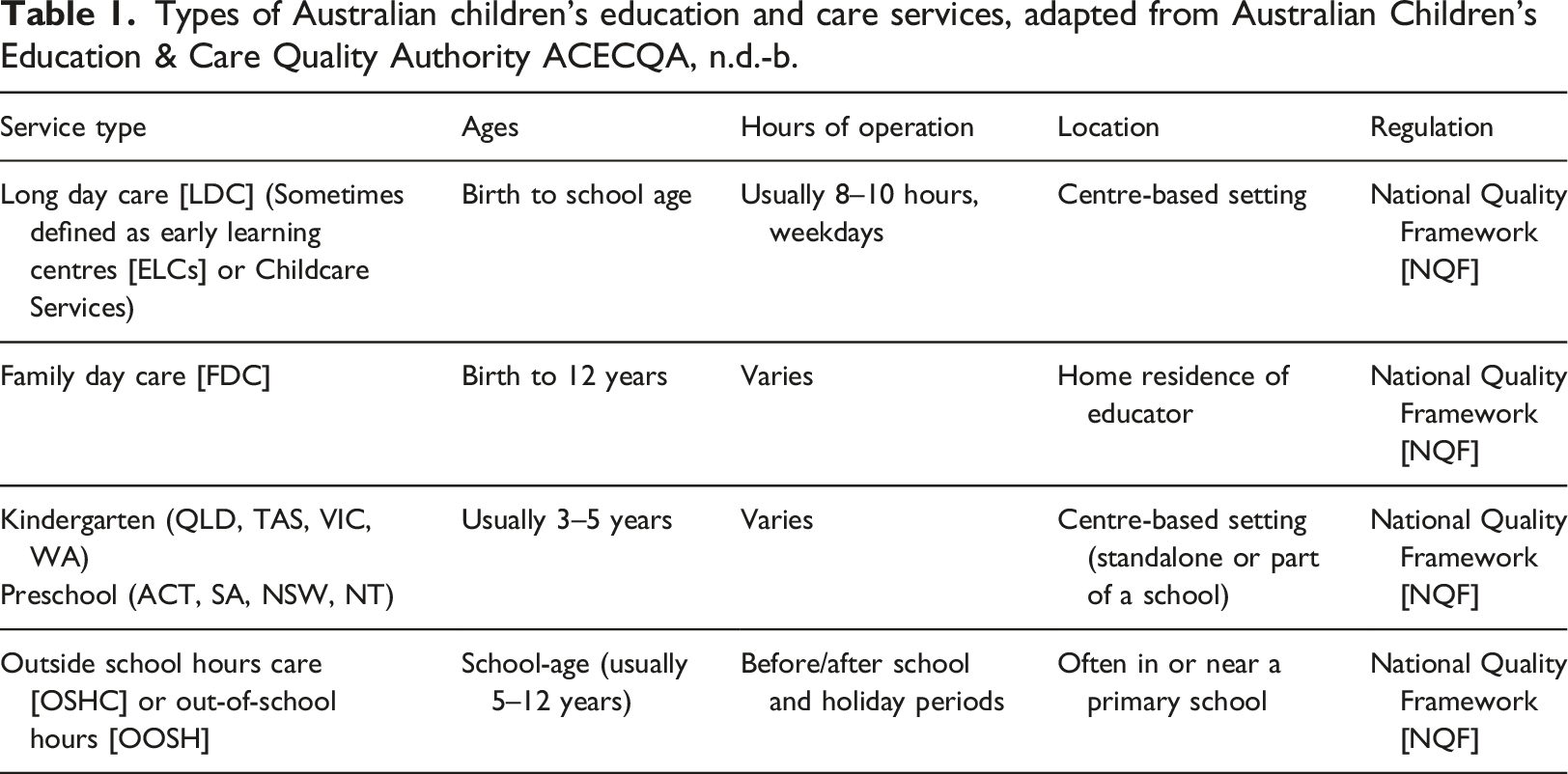
Types of Australian children’s education and care services, adapted from Australian Children’s Education & Care Quality Authority ACECQA, n.d.-b.
Key national and Victorian early childhood reforms, impacting ECPs from 2009.
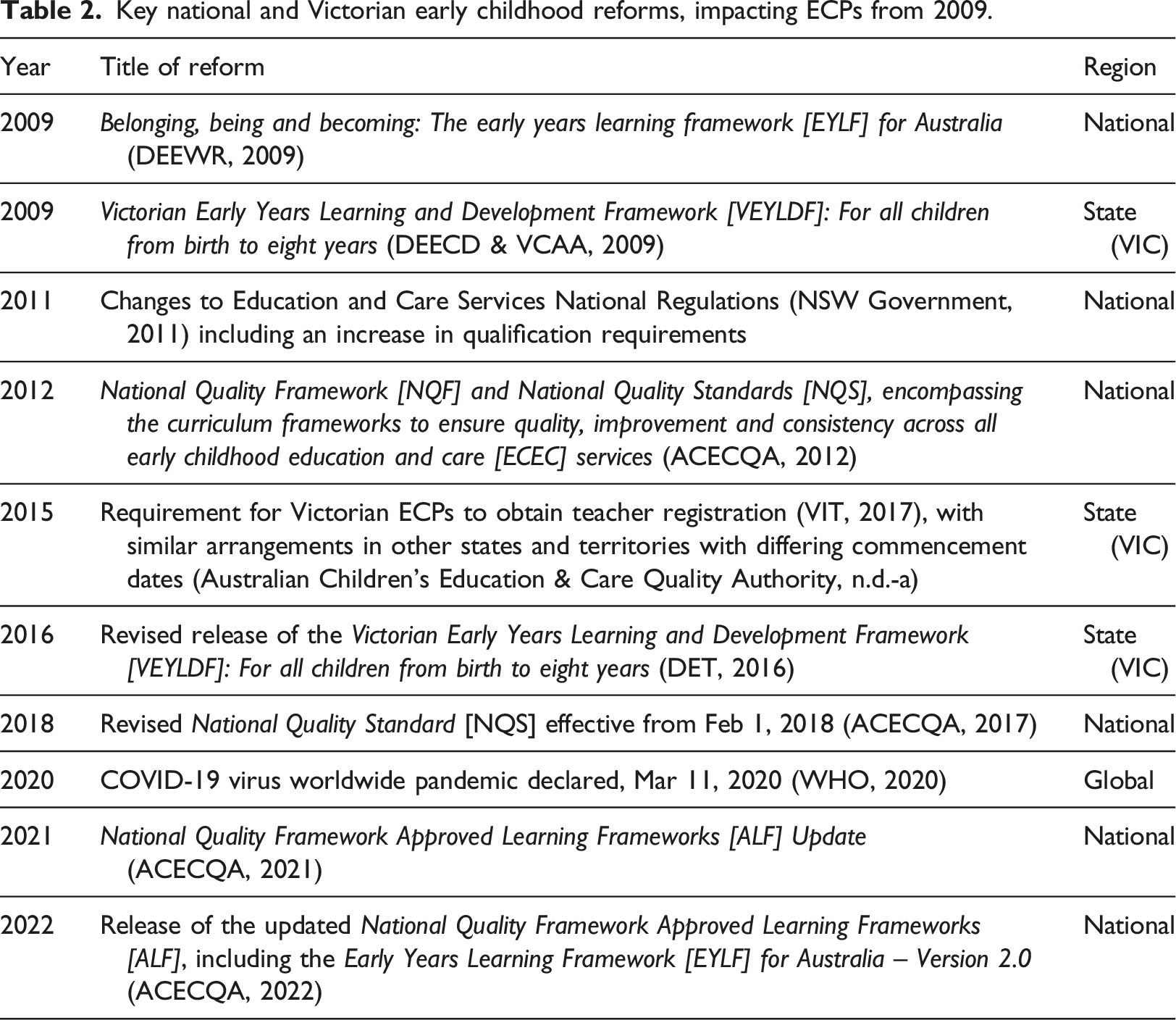
The reforms depicted in Table 2 comprise a series of changes, relating distinctively to the shifting knowledge base of ECE, and the increasing professionalisation of the field (Martin et al., 2020). Furthermore, the National Quality Framework [NQF] (ACECQA, 2012) has ‘created opportunities for advocacy and change’ and ‘consigned responsibility’ to all ECPs (Hunkin et al., 2022, p.177). Policy directions have been influenced by the value attributed to specific theoretical and pedagogical perspectives (or knowledge), and the subsequent rise of dominant discourses and EC reforms at state, national and global levels.
This complex landscape illustrates clear connections to interpretations of Foucault’s concepts of discourse, knowledge and power. According to Foucault (1972), discourses are not defined by reality; rather, they encompass certain perceptions of the world. Moreover, discourses can acquire positions of power (Foucault, 1980) when they are valued among institutions. These institutions advocate specific views of the world which then become normative (Rivalland, 2010). Specifically, power can shape dominant discourses among institutions when specific knowledge is privileged by the individuals within. When such discourses differ between institutions, conflicting tensions may arise. This relates to what Foucault (1974) defined as the politics of knowledge, wherein ‘there cannot be particular types of subjects of knowledge, orders of truth, or domains of knowledge except on the basis of political conditions that are the very ground on which the subject, the domains of knowledge, and the relations with truth are formed’ (p.9). In the Australian ECEC context, these political conditions have been influenced by significant change, particularly since the introduction of the national curriculum and quality frameworks.
This paper explores key discourses (as experienced by ECPs) associated with the time of EC reforms beginning in 2009, to understand how their occupation of subject positions and adoption of discursive practices associated with available discourses may influence their reform engagement.
Understanding the complexities of change and reform
Change plays a major role in understanding and implementing policy reforms. This has become abundantly clear in the field of ECEC. Within any context, change agents such as policy-makers and policy-actors need to recognise the discourses among people and their culture, practices, systems and technology, as these discourses can manipulate how receptive people are to change (Rodd, 2015). It is also essential to contemplate what form of change is actually transpiring. Within the Victorian context, ECEC may be described as undergoing induced change (Rodd, 2015), as this type of change is more reflective of the vast impact that specific discourses have had on various individual, institutional and organisational contexts during reform processes. Though, according to Moss (2014), ‘the ubiquity of change, even transformative change, does not mean it has a universally agreed meaning’ (p.7, original emphasis). This highlights the importance of understanding that a discursive construct such as change cannot be perceived as a set truth (Arribas-Ayllon & Walkerdine, 2017).
While the literature on change and reform is developing rapidly, this paper refers to some of the fundamental models and ideas, including educational change (Pendergast et al., 2005) and organisational change (Hiatt, 2006). For instance, the Educational Change Model (Pendergast et al., 2005) encompasses an eight to seventeen-year cycle of change, comprising the Initiation, Development and Consolidation Phases. This model recognises that during the transition between the first two phases, individuals often experience what is termed an implementation dip (Pendergast et al., 2005), signifying a ‘drop in confidence and a loss of momentum’ (p.88). However, it is understood that ECPs and services were only provided approximately one year to understand and translate the reforms beginning in 2009 to their practice. Meanwhile, the ADKAR Organisational Change Model (Hiatt, 2006) portrays several components required for meaningful and sustainable change to occur. These include: an awareness of the necessity for change; a desire to engage in change; access to the required knowledge for change; the ability to procure and enact relevant skills and behaviours; and reinforcement for maintaining change. This model distinguishes that numerous cognitive processes are required, but also acknowledges that an understanding of contextual factors is essential – as well as adequate resources, support and training. When reflecting on the Australian EC reform context, this would imply that ECPs need to be aware of these processes, and have an initial desire to engage with them. They would also require the knowledge for understanding the reforms, and the ability to source and enact specific skillsets needed to translate these reforms to their practice. As such, understanding the why and the how of reform initiatives is essential (Gorrell & Hoover, 2009).
Individuals often require some convincing as to why certain reforms are deemed necessary. This may be achieved more effectively if they are involved in the reform process and are provided opportunities to collaborate and communicate their perspectives. An approach such as this can ensure that reforms are not perceived as imposed, top-down initiatives (Baker & Foote, 2003). Otherwise, ‘micro resistances’ are more likely to ensue as ‘local, quiet and invisible but multiple…responses to discursive policy manoeuvres (Archer, 2022, p. 431). However, recent research into change within the ECEC sector has acknowledged ECPs as ‘frontline leaders and change agents’ and the importance of capacity-building in the leadership of change (Lee, Douglass, Zeng, et al., 2022, p. 1). This research identified three key components involved in their Leadership for Change [LfC] model that can support ECPs in building their capacities for not only engaging in change, but leading change: 1) adopting an ‘entrepreneurial mindset’ that encompasses creativity, innovation and adaptability; 2) enhancing knowledge and skills in ‘reflective practices, collaboration, efficacy, and innovative approaches’; and 3) ‘taking action to lead change’ (Lee, Douglass, Zeng, et al., 2022, p. 5). This model offers an approach toward change that can foster attitudes of empowerment among individual educators and facilitate workplace cultures of resilience and adaptability.
It is important to explore how these ideas have been represented in relation to EC reform. This paper draws on data collected through qualitative interviews with ECPs from Victorian kindergartens, following the 2009-2012 EC reform period in Australia. The purpose of this focus is to reflect on the previous engagement of ECPs with reform processes to develop a deeper understanding to best support them through these continual reform processes, now and into the future. The following sections outline the overarching design and methodology for this research study.
The study
This paper draws on findings from a broader research study involving 39 ECPs from three cohorts: namely, Long Day Care [LDC] centres, school-based Early Learning Centres [ELCs] and Kindergarten settings in Victoria, Australia. While findings from the broader study have been published elsewhere (Armstrong, 2019), this paper represents key findings from the latter kindergarten-based cohort.
The aim of this study was to explore the specific discourses, subject positions and discursive practices visible among participants as they engaged in the 2009-2012 EC reform period, by addressing the overarching research question: How do educational reform discourses shape and reshape the positioning and engagement of early childhood professionals in Victorian kindergarten settings? (Armstrong, 2019).
Given the current context and complexities impacting ECEC in Australia, and the recent release of the updated Early Years Learning Framework [EYLF] for Australia – Version 2.0 (ACECQA, 2022), it seemed timely to revisit this data to further explore what else can be learned from the previous round of reforms. The following sections portray how this occurred.
Methodology
This study utilised a post-structural approach to methodology, as it sought ‘to understand the dynamics of relationships between knowledge/meaning, power and identity’ (Hughes, 2010, p. 51). Upon receiving ethical clearance from the Monash University Standing Committee for Ethical Research on Humans (CF15/2312 – 2015000933), Victorian ECPs working in kindergarten settings were invited to share their perspectives and experiences of reform engagement following the 2009-2012 EC reform period. Recruitment methods involved advertising through online EC forums to communicate with and recruit participants. The relevance of online research methods has been discussed by Fielding et al. (2008, p. 3), who argued that ‘it is hardly an exaggeration to observe that the internet has had, is having, and will have a major impact on research methods at every stage of the research process, and beyond’. As a result of this recruitment process, eleven participants agreed to contribute to the study.
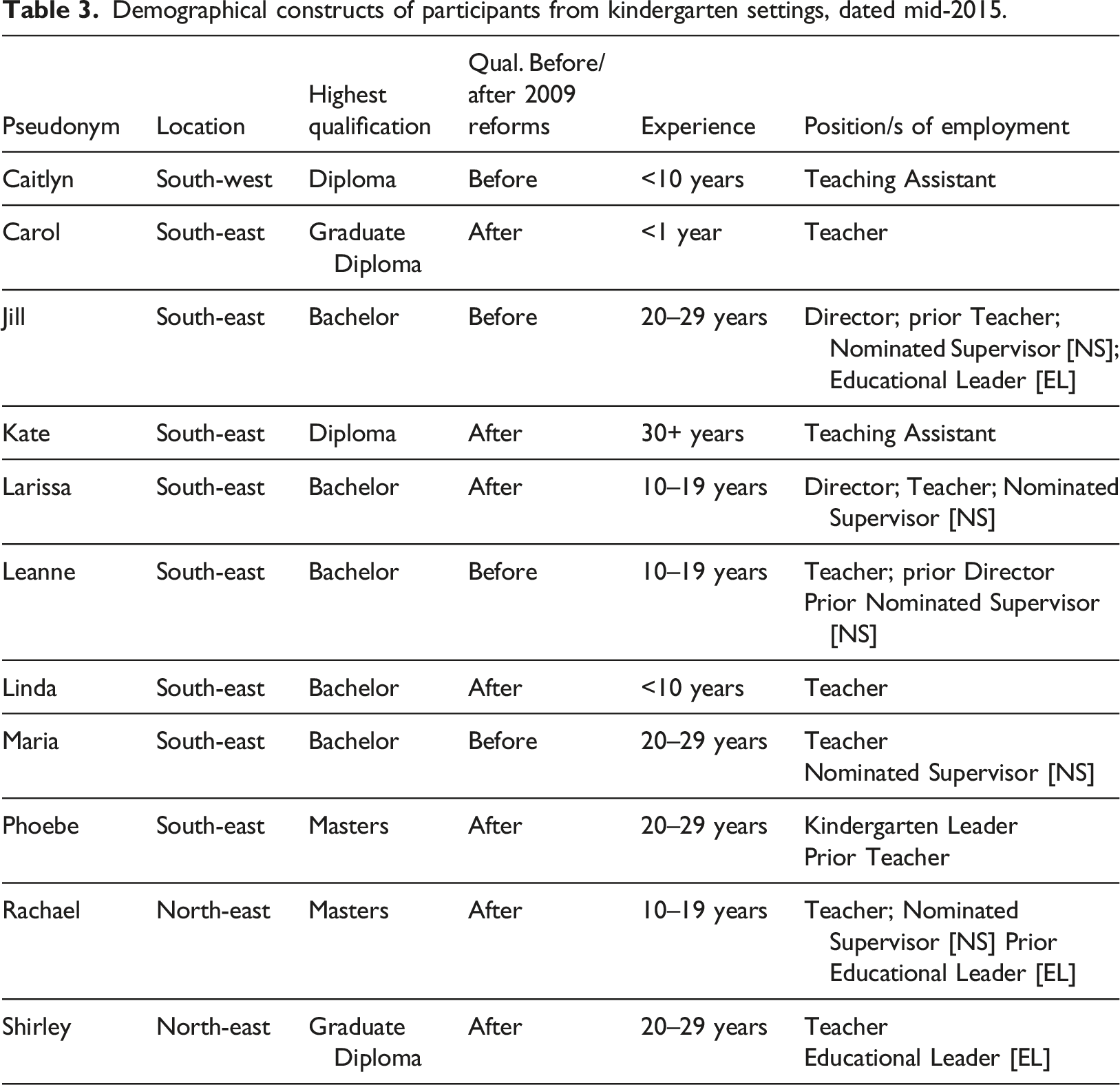
Participants
Demographical constructs of participants from kindergarten settings, dated mid-2015.
Data collection
Methods of data collection utilised in this study encompassed participant engagement in a single, audio-recorded, 30–60-min qualitative, semi-structured interview. During these interviews, participants were prompted to share their experiences of the 2009-2012 EC reform period, perspectives of policy reviews, and how their pre-service and in-service teacher education may have influenced their reform engagement.
To ensure accuracy throughout the transcription process, consent was obtained from participants authorising audio and visual recordings during these interviews, and pseudonyms were used throughout the process. A total of 11 hours of audio-recorded interview data was collected and transcribed verbatim. To ensure accuracy and validity, interview transcripts were then distributed to all participants for member-checking (Creswell, 2014).
Data analysis
The study adopted a post-structural perspective to explore how ECPs engage with EC reform. This proved an effective lens, as it illuminates that ‘everything and everyone can – and does – shift and change all the time’ (Hughes, 2010, p. 50). A practical application of this post-structural framing enabled opportunities to unpack discourses related to EC reform and examine the way in which specific discourses shape (and reshape) the subject positions and discursive practices of ECPs in the field.
Conceptualising discourse, power and knowledge
This research utilised an informed interpretation of Michel Foucault’s concepts of discourse, power, and knowledge (Foucault, 1972, 1980, 1994) to support the analyses of available discourses, subject positions and discursive practices taken up by ECPs during the 2009-2012 EC reform period. In accordance with Arribas-Ayllon and Walkerdine (2017), ‘…discourses are not objects but rules and procedures that make objects thinkable and governable, and they do not ‘determine’ things but intervene in the relations of what can be known, said or practiced’ (p.120, original emphasis). This construction of discourse has underpinned the study explored throughout this paper, as it emphasises the significance of acknowledging the interrelated and shifting discourses associated with EC reform, and the potential exclusion of dominant discourses within the field. It also permits a recognition of specific tensions, limitations and silences associated with these discourses. These understandings also highlight the interconnections between discourse and power.
Power can be perceived in diverse and complex ways. As Foucault (1980) explained: In any society, there are manifold relations of power which permeate, characterise and constitute the social body, and these relations of power cannot themselves be established without the production, accumulation, circulation and functioning of a discourse. There can be no possible exercise of power without a certain economy of discourses of truth which operates through and on the basis of this association (p. 93).
Four facets of power, adapted from Foucault (1980, pp. 92–93).
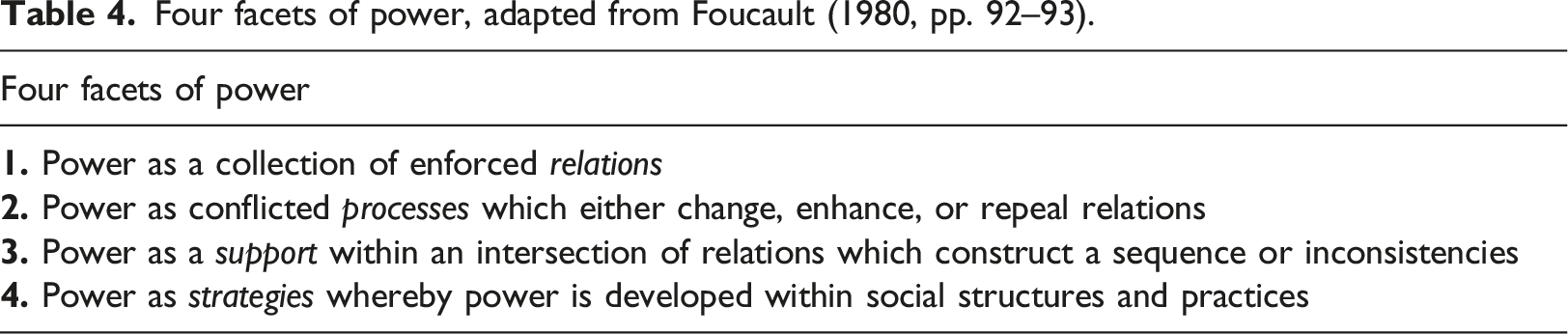
This related to identifying the presence of power relations and processes of power, and how structural and relational power could be perceived as strategies of power as a support, or as an effect of power as a conflict among ECPs and their perspectives and experiences of reform engagement.
Data analysis for this research also acknowledged connections with Foucault’s (1994) concept of knowledge and how this can be perceived as ‘an activity that produces subjects and the ways in which they interact within and against their social and material worlds’ (Jackson & Mazzei, 2012, p. 60). This denotes that knowledge influences the way in which subjectivity, practices and interactions are formed. However, it is also recognised that knowledge is constantly ‘…shaped by political, social and historical factors – by ‘power’ – in human societies’ (O’Farrell, 2005, p.54). Thus, it is necessary to analyse how these factors impact the constructions and restrictions of knowledge, and how this may apply to EC reform.
The use of Foucault’s concepts of discourse, power and knowledge accentuated the language used by participants and the discourses available to them at the time of interview; identifying politics of knowledge and perceived truths associated with their engagement during the 2009-2012 EC reform period.
Applying foucauldian discourse analysis
Components of Foucauldian Discourse Analysis [FDA], adapted from Willig (2013).
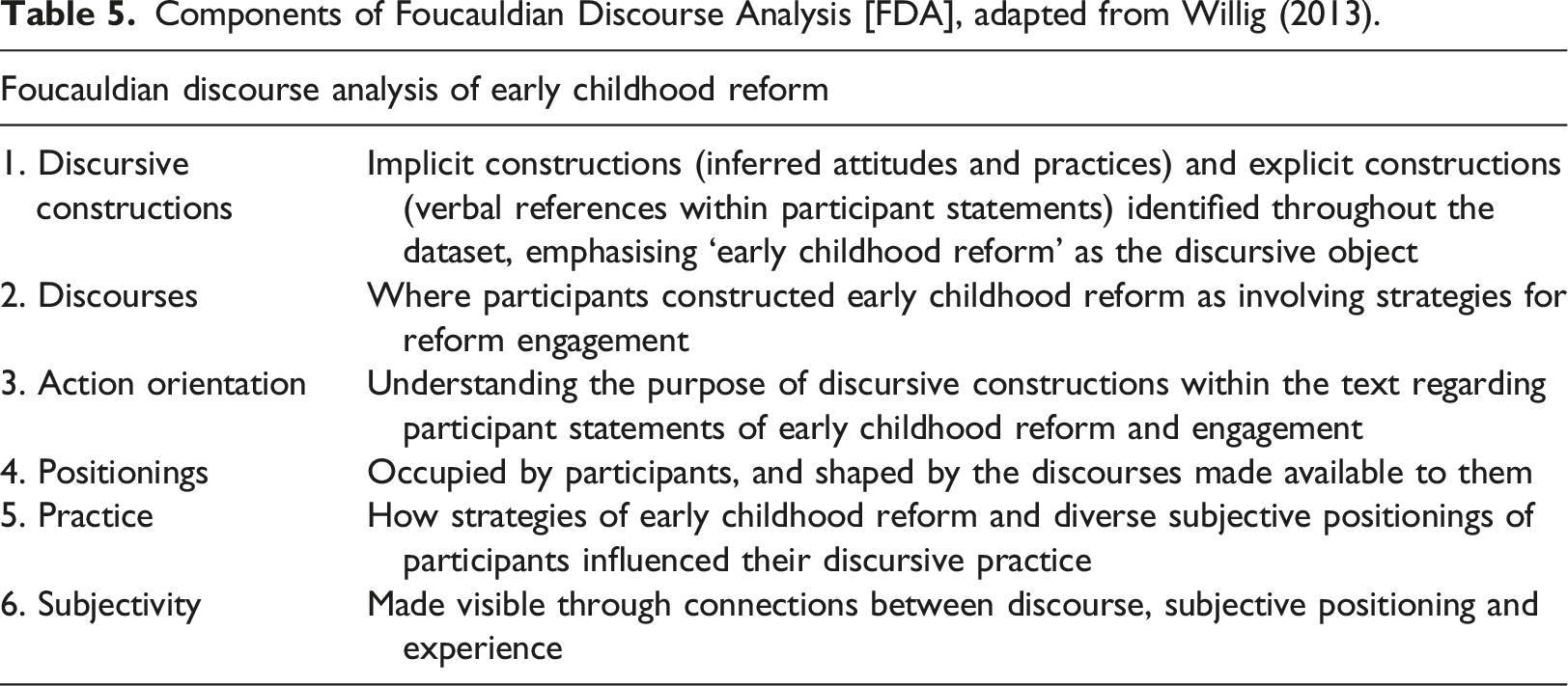
During this FDA process, text from interview transcripts was deconstructed, identifying ‘early childhood reform’ as a discursive object through the discovery of implicit and explicit discursive constructions of EC reform and how specific discourses influenced the subject positions and discursive practices of participants. Discursive practices associated with the specific discourses available to participants were identified as strategies (defined as conflicts and supports) for reform engagement. Through the examination of these discourses, certain subject positions occupied by these participants were also made visible (Arribas-Ayllon & Walkerdine, 2017). According to Willig (2013, p. 131), FDA ‘allow[s] the researcher to map some of the discursive resources used in a text and the subject positions they contain, and to explore their implications for subjectivity and practice’. In other words, this process reveals various phrases and concepts that are inferred from texts and practices; offering ways of understanding their impacts upon the subject positions held by participants at a certain time, and how these subjective positionings influence past and present discursive practices adopted by participants. FDA sheds light on the diverse reform engagement strategies (discursive practices) taken up by participants during the time of 2009–2012 EC reform period. This is a particularly relevant consideration, as the interpretive nature of these reform initiatives was dependent upon the subject position and comprehension of individual ECPs in the field (Sumsion et al., 2009). Consequently, these diverse interpretations influenced the discursive practices being made available to each participant through their own subjective positioning (Willig, 201).
Limitations
During this research, several limitations were recognised. Firstly, due to its small-scale nature and use of purposeful sampling, the results of this study cannot be generalised or transferred to the broader population of ECPs in the ECEC field (Bryman, 2012). Secondly, it is acknowledged that FDA is constrained to its emphasis on discourse and its incapacity to address non-verbal discourses (Willig, 2013). Furthermore, this method avoids the use of a more linear or prescriptive approach to data analysis, as clarified by Arribas-Ayllon and Walkerdine (2017, p. 110): …Foucault’s ideas are challenging to understand and apply, partly because his elliptical style of writing often avoids explicit formulation, and because his view of discourse is more diffuse than linguistic approaches.
This aligns with the broader application of Foucauldian theories, as ‘over the course of his writings, Foucault’s ideas and methods had changed in relation to the problems he worked on… As such, there is no consistent programme of work from which to extract a methodology’ (Arribas-Ayllon & Walkerdine, 2017, p. 110). Due to these limitations, it is accepted that the dialogue derived from each participant was considered unique, denoting the incomparable nature of these analyses.
Reliability and validity
The reliability and validity of this study were strengthened by specific approaches applied throughout the semi-structured interviews. These approaches encompassed a direct alignment between the focus of interview questioning and research aims, using rapport-building techniques and a consistent approach to each interview (Gray, 2014). Reliability was further bolstered through a meticulous approach to cross-checking during the processes of transcription, coding and analysis (Creswell, 2014). Validity was also enhanced by member-checking techniques, where participants were encouraged to assess the accuracy of their interview transcripts (Creswell, 2014). Consequently, the combination of these approaches effectively supported the reliability and validity of this study.
Throughout the sections that follow, key findings and discussion are presented which highlight certain discourses, subject positions and discursive practices identified among the eleven participants from Victorian kindergarten settings during their experiences of the 2009-2012 EC reform period.
Findings: Exploring discursive responses to change and reform
The perspectives, experiences and subjective positionings of individuals are influenced by certain discourses. Notably, discourses are not generated by individuals. Rather, individuals (subjects and their positions) are produced by discourse (Foucault, 1972; Prado, 2000). As reflected in the works of Foucault (1980) and later interpreted by Rivalland (2010), this study aimed to ‘capture the fluidity of available discourses and power relations that are present in human interactions and social practices’ (Rivalland, 2010, p. 95). When analysing data from this cohort of ECPs, it was found that certain workforce and learning discourses that were available to them during the time of the 2009-2012 EC reform period influenced the kind of subject positions and discursive practices taken up by these individuals. The sections that follow highlight some of the key findings visible among participants from Victorian kindergarten settings during the 2009-2012 EC reform period.
Positions of in/experience, resistance and acceptance
Engagement with change and reform can invoke a range of responses (Archer, 2022; Hiatt, 2006; Lee, Douglass, Zeng, et al., 2022; Pendergast et al., 2005; Rodd, 2015). This section presents participant responses that indicate a connection to the workplace and learning discourses that were available to participants at the time of their interviews. The findings and discussion offer some understanding of how these discourses influenced the kind of subject positions occupied by these participants.
For example, Jill (a Kindergarten Director with over 20 years of experience in the field) reflected on the changing landscape of ECEC: “I’ve been around 22 years in the profession…. even though you can spend a lot of time at a preschool, the landscape is constantly changing…. it’s just constantly evolving and there's just new challenges all the time to drive you crazy”.
This suggests that even from a position of experience, the constant fluidity of the EC field may cause challenges and various responses among both individuals and workplaces. This is where workplace discourses may be seen as a significant influence on reform engagement. These discourses render various discursive practices that shape the subject positions of those who inhabit them. While power relations reside within the institutions of the workplace, they bidirectionally affect and are affected by relations of power. Workplace discourses and institutions are affected by what Foucault termed as the apparatus of the state, indicating ‘the various institutional, physical and administrative mechanisms and knowledges structures, which enhance and maintain the exercise of power within the social body’ (O’Farrell, 2005, p.129). Hence, the social body represents the EC field, and the mechanisms and structures encompass the influences of governmental and political agendas on policy-makers, and the content knowledge privileged among discourses. Although it appears that workplace institutions are fundamentally affected by these power relations (Foucault, 1980), these institutions also affect these relations through their own policy enactment, and the knowledge embedded within their own mechanisms and structures. Intrinsically, these power relations transpire through actions within these institutions. As ‘power is impersonal, it is not anyone’s power, because it is a web of relations among actions rather than among agents’ (Prado, 2000, p. 73, original emphasis). In relation to this complexity, Foucault (1980, p. 39) has explained that ‘power reaches into the very grain of individuals, touches their bodies and inserts itself into their action and attitudes, their discourses, learning processes and everyday lives’. This can be interpreted in connection with participant responses, where power has influenced their uptake of specific subject positions (attitudes) and discursive practices (actions and learning processes) through the discourses available to them at the time.
Findings also revealed indications of a position of resistance among some workplaces. Throughout Foucault’s extensive works, he acknowledged that ‘where there is power, there is resistance’ (1978, p.95). Not only is there a strong connection between power and resistance, but there is also what Foucault (1978, pp. 95–6) described as ‘a plurality of resistances, each of them a special case’. As previously discussed, the introduction of change and reform initiatives can lead to ‘micro resistances’ as key responses to change (Archer, 2022, p. 431). Such responses were visible when examining how participants spoke of the 2009-2012 EC reform period and change more broadly.
When examining these responses more closely, it seemed that ECPs with previous experience working in LDC settings found the transition to the National Quality Framework [NQF] and its Assessment and Rating process (ACECQA, 2012) quite smooth. These participants ultimately recognised the connection to their previous experience with the National Childcare Accreditation Council [NCAC] accreditation system. Whereas two participants spoke of how the experience of some of their colleagues were limited to kindergarten settings, causing anxiety about new requirements, and an unfamiliar sense of judgment towards their professional practice. For instance:
Shirley offered: “I had the exposure to this sort of negativity that kindergarten teachers…were putting on it. Because I think the comparison, I was in long day care when you had this – the old accreditation process, – if you were up to scratch in that sort of process, then I don’t think things really had to change awfully much to slot into the frameworks, it just made sure everyone was talking the same talk. So…because I was working at the time and sort of evolving anyway, I felt like it wasn’t…a massive change, but I definitely know that a lot of people were making it out to be massive work”.
While Rachael explained: “…there was resistance all over the board…. …[for] a lot of people in long day care, it was like ‘well, we’ve had accreditation, and now we’ve got this. It’s just the same process but with different things in it’. So, it wasn’t so…foreign to be graded and marked on what we’re doing. I found a lot of resistance in sessional kindergarten – for better or worse, I think some of this resistance is very important, because they were never graded or marked or assessed on anything. So having someone come in [an Assessor, as part of the National Quality Framework [NQF] and its Assessment and Rating process (ACECQA, 2012)] is a completely foreign idea. …for some of my friends who’ve been working only ever is sessional for like, fifteen or twenty years – to them, it’s very, very invasive, because they feel like they should be trusted as professionals, that they do know what they’re doing, and they shouldn’t need…a grade put on that because it’s undermining them – their own professional judgement. So, I saw a lot of resistance in both…good resistance and bad resistance”.
These examples of in/experience with the prior NCAC accreditation process highlight the presence of subjective positions of acceptance and ‘knowing’ (as a strategy of power), as well as perceived positions of resistance and ‘not knowing’ (as an effect of power) among Victorian ECPs in kindergarten sector. As such, the discourses available within the institutions of kindergarten settings were ‘bound up’ in their own practices (Willig, 2013, p. 130). Ultimately, it appears that these workplace discourses have shaped subject positions of in/experience among kindergarten ECPs about the processes involved in the EC reforms relating to quality assessment.
Certain themes emerged among several participants which reflected a position of resistance present within the workforce discourses available to them. These themes involved time constraints, workload concerns and feelings of anxiety. In some cases, this occurred until the changes were perceived as mandated through the 2012 introduction of the National Quality Framework [NQF] (ACECQA, 2012). For example, Rachael referred to how she recalled her colleagues holding an “attitude” of: ‘…we’ll implement this when we
These responses denote levels of ‘micro-resistance’ and ‘local practices of resistance’ among these participants and their colleagues (Archer, 2022, p. 439). To better understand the emotional transition that change involves, Gronlund and James (2008, p. 18) have proposed: We may need to rant and rave in anger and denial until we accept that the change is inevitable and necessary. Then and only then can we embrace it and truly grow in our thinking and our practice. And that takes time and effort.
In terms of the 2009-2012 EC reform period, it appears that some participants were still in the beginning stages of this emotional transition, seemingly experiencing a sense of overwhelm and unpreparedness, from a position of ‘not knowing’ – not understanding the why and the how of the reforms (Gorrell & Hoover, 2009), and unaware of specific expectations to translate these changes to practice. Markedly, Rachael’s comment regarding her colleagues could signify what has been termed as duty-bound learning, a discursive practice where learning occurs when perceived as compulsory (bound by duty) – as published elsewhere (Armstrong, 2019). This practice is often based on regulatory requirements, and may ultimately lead to feelings of disempowerment. According to Foucault’s Four Facets of Power, power is perceived ‘as a collection of enforced relations’ (1980, pp.92–3). Respectively, the enforced way in which the reforms beginning in 2009 were introduced illustrates a deployment of power (Arribas-Ayllon & Walkerdine, 2017). As a result, the uptake of duty-bound learning as a discursive learning practice may be seen as an effect of power (Foucault, 1980).
As reforms are often perceived as a top-down, imposed change (Baker & Foote, 2003), this can intensify pressures on ECPs through enforced power relations (Foucault, 1980), impacting their motivation, engagement and morale (Moore & Fink, 2003). As such, these positions of resistance and ‘not knowing’ can be seen as an effect of power (Foucault, 1980), whereby the processes of power are conflicting and repealing relations between ECPs and reform initiatives.
When individuals are privy to workplace discourses that reflect a collective position of acceptance of change and reform, effective engagement is more likely across the broader workplace, but also among individuals. This resonates with aspects of the change models and approaches described earlier (Hiatt, 2006; Lee, Douglass, Zeng, et al., 2022; Pendergast et al., 2005). It appeared that this kind of workplace discourse was present for Phoebe (a council kindergarten leader with over 20 years of experience), as she shared how her staff responded to the 2009-2012 EC reform period: “…everybody was quite receptive to it. However, it was a period of heightened stress because it was viewed at the time as something extra that we had to do, and in an era where time was really – our workloads were high, and time was…precious”.
In some cases, this related to connections to previous practice that aligned with the 2009-2012 EC reforms: “I think what the easy thing was for us…we were documenting learning in various ways anyway… And then we could just say ‘let’s all just use this’. So, the documenting of the learning was not a lot different” (Shirley). “….it was just a container, basically [an implicit inference regarding the same information being packaged differently]. It doesn’t change the information in it or the way that you do what you say you’re going to do…” (Rachael).
These workplace discourses reflect not only the position of acceptance, but also the position of experience and ‘knowing’, and seemed to lessen the impacts of change for these participants. EC workplace institutions may differ in their provision of support for ECPs during reform processes. For instance, accessibility to professional learning opportunities often relies on the value that individual workplace institutions attribute to ongoing learning and knowledge acquisition (Colmer et al., 2015). This conveys that workplace institutions can ‘structure and constrain’ the potential actions of individuals within their institutions (Prado, 2000, p. 77). However, the approaches taken in Shirley and Rachael’s kindergarten settings reflect more positive attitudes and responses, such as an ‘entrepreneurial mindset, leadership competencies, and capacity to act as change agents and leaders’ (Lee, Douglass, Zeng, et al., 2022, p. 16). These attitudes and responses appeared to manifest through specific discursive practices for reform engagement.
Self-initiated learning as a discursive practice for reform engagement
Self-initiated learning was identified as a key discursive practice within the workplace and learning discourses available to participants during the 2009-2012 EC reform period. Foucault’s concept of discursive practices involves ‘the practices (or operations)’ associated with specific discourses (Bacchi & Bonham, 2014, p. 173). Hence, discourse encompasses ‘the dimension of practice’ (Pecil, Vieiral & Clegg, 2009, p.381), and the ‘active deployment’ of these discourses (Bacchi & Bonham, 2014, p. 177). When examining the discursive practices associated with the discourse of learning, participants inferred these practices as being a support for reform engagement. This practice was located from what has been defined as a revolutionist subject position, shaped by contemporary content knowledge and lifelong learning. Notably, this subject position and its associated discursive practice (described below) were also present among the Victorian LDC participant cohort involved in the broader study, and detailed elsewhere (Armstrong, 2019).
As its name suggests, the discursive practice of self-initiated learning signifies learning that is initiated by an individual. It denotes a level of self-motivation, as well as a value for learning new knowledge. Although the literature indicates that change can often reduce levels of motivation (Moore & Fink, 2003), attributes of self-motivation were still visible among some participants: “It was…just a matter of learning, for yourself really. Googling and…researching everything myself… “…getting my own knowledge…. …up until my Bachelor, a lot of it was self-taught” (Linda). ““I remember thinking ‘people are carrying on about this’. It was interesting…because I embrace the frameworks rather than get stressed about them. I think they’re really positive. I remember going ‘yeah, this is new and different, I’d better keep learning about it” (Shirley). “…I did a lot of my own thinking” (Rachael). “…with the Practice Principles, that was more of a self-discovery…. That was more individual – the Practice Principles were more an individual-based learning than it was from another person” (Leanne). “…you definitely have to be flexible…you definitely can’t be stuck in your old ways. Not moving with the times” (Linda).
There is a strong connection here to the second phase of the ADKAR Organisational Change Model, where individuals need to first possess a desire to engage in change (Hiatt, 2006). The combination of self-motivation, the desire for change, and learning can result in individuals developing a sense of empowerment. These statements resonate with previous research where some Victorian ECPs ‘showed some confidence with unfamiliar discourse…due to their own professional learning’ (Kilderry et al., 2017, p.346). This highlights the benefits of self-initiated learning as a discursive practice for understanding the unfamiliar discourses associated with EC reform initiatives.
When analysing this through a Foucauldian lens, knowledge acquired through self-initiated learning ‘is not simply a product; but actually enables and sustains power relations’ (Prado, 2000, p. 77, emphasis added). For these participants, power relations have been enabled and sustained through their revolutionist subject positions, and engagement in their discursive practice of self-initiated learning of new knowledge. This can also be viewed as a strategy of power, where power is developed through the social structures of the EC field and the discourses of learning made available to ECPs (Foucault, 1980).
These participant statements reflect a range of positive responses, including an ‘entrepreneurial mindset’, adaptability and a proactive response to change (Lee, Douglass, Zeng, et al., 2022). The contrast between the broad nature of the 2009-2012 EC reforms and the more prescriptive discourses of previous approaches to practice indicates how self-initiated learning can be enacted as a discursive practice to assist in understanding the diverse approaches to EC reform – despite the historical knowledges (or the ‘archaeology of knowledge’) associated with ECEC discourses. As Foucault (1978) claimed, ‘In a way we are nothing other than what has been said, centuries ago, months, weeks ago’ (p.469). However, this archaeology of knowledge offers ‘a model of what has happened that will allow us to free ourselves from what has happened’ (Foucault, 1974, p.644), indicating that ECPs can still move beyond the knowledges of the past and embrace new and emerging knowledges in ECEC.
Considerations for future early childhood reform engagement
The interconnections between workplace and learning discourses require thorough consideration when planning for the development of reform initiatives. To accommodate effective reform engagement, it is essential to consider key ideas from the models and approaches presented throughout this paper. For example, the lengthy transition cycle detailed in the Educational Change Model (Pendergast et al., 2005); and the phases of the ADKAR Organisational Change Model (Hiatt, 2006) could be provisioned for the implementation of future reforms. It would be beneficial for policy-makers to consider how learning and workplace discourses can shape (and reshape) the subject positions, discursive practices and engagement of ECPs within reform processes. Recognition is needed for the subject positions identified through participant responses – including positions of in/experience (involving ECPs employed by diverse service types), in addition to positions of resistance and positions of acceptance (as visible through the various responses to change and reform) (Archer, 2022; Lee, Douglass, Zeng, et al., 2022). Furthermore, the practices of self-initiated learning and duty-bound learning taken up by ECPs assigned to implement these reforms also need to be contemplated. Recognising the diverse subject positions and discursive practices associated with learning, knowledge and skills can support ECPs ‘on the continuum from resistance to acceptance of new ideas’ (Gronlund & James, 2008, pp. 21–22). These measures may enable relevant stakeholders in ECEC (such as policy-makers and workplace institutions) to support meaningful and sustained change and a smoother transition for future EC reform initiatives.
Conclusion
This paper reported findings from a post-structural study with eleven participants from Victorian kindergarten settings to explore what can be learned from their previous experiences of the 2009-2012 EC reform period. A Foucauldian lens revealed the significance of acknowledging the discourses, subject positions and discursive practices available to ECPs as they experience the complex processes of change and reform. This remains incredibly relevant as the Australian ECEC field progresses and continues to encounter change. Further research is needed to explore where ECPs are now situated, particularly as they enter the next phase of reform engagement and transition to the updated curriculum framework (ACECQA, 2022). As a sector, there is a strong need to ensure the production of effective approaches to reform to best support Australia’s existing, emerging and future generations of ECPs as they lead the transformation of ECEC in these complex times.
Footnotes
Acknowledgements
I wish to thank the Victorian early childhood professionals who took the time to participate in this research. Their contribution has afforded meaningful insight into perspectives and experiences of reform engagement. Additionally, I offer my gratitude to Dr. Corine Rivalland and Dr. Hilary Monk who have imparted their profound support, guidance and mentorship throughout the completion of this research and beyond.
Declaration of conflicting interests
The author declared no potential conflicts of interest with respect to the research, authorship, and/or publication of this article.
Funding
The author received no financial support for the research, authorship, and/or publication of this article.
