



Abstract
Early Childhood Education (ECE) has potential to influence physical activity levels and participation among children. Factors include early childhood educator’s teaching practices, self-efficacy and quality of the movement environment. A cross-sectional study of early childhood teachers’ self-reported, self-efficacy using online Early Childhood Educator Confidence in Outdoor Movement, Physical Activity, Sedentary and Screen Behaviours (ECE-COMPASS) Questionnaire and ECE movement environment from Movement Environment Rating Scale (MOVERS) was assessed. Descriptive statistics were conducted to analyse data. Early childhood teachers (n = 42) rated (means [SD]) for task (7.2 ± 2.3) and barrier (7.0 ± 2.5) self-efficacy (out of 10). ECE (n = 6) movement environment quality (out of 7); 1 (4.0 ± 1.1), 2 (4.0 ± 0.4), 3 (3.8 ± 0.6), 4 (4.0 ± 0.6) and overall total score (4.0 ± 0.3). Early childhood teachers rate themselves as self-efficacious in delivering physical activity; however, quality of the movement environment was adequate.
Introduction
Physical activity during the first five years of life is fundamental to the health and future wellbeing of children, and physical activity habits begin to develop in early childhood (Dutton, 2017; Scott et al., 2020). Physical activity within the physical domain of child development is interdependent, inter-related, and overlaps other domains (social/emotional and cognitive/language). It is often referred to as active play during the first five years of life (Bruijns et al., 2023a). Compositional data analyses demonstrate that relative time spent engaging in physical activity throughout the day, especially moderate-to vigorous-intensity physical activity (MVPA), may be the most beneficial for improving bone and skeletal health, increasing fitness, and developing fundamental movement skills in young children (Bourke et al., 2023). Therefore, engaging in sufficient levels of physical activity early in life may help develop physically active children, adolescents, and adults (Carson et al., 2020).
The World Health Organization’s (WHO) Global Action Plan for Physical Activity (GAPPA) has set a target to reduce physical inactivity by 15% by 2030 (World Health Organization, 2019). GAPPA applies to children of all ability levels worldwide and is intended to be culturally and contextually sensitive. It recommends that children aged (3–5) years should engage in 180 minutes of total physical activity, including 60 minutes of MVPA, each day (World Health Organization, 2019). Unfortunately, children under five are not meeting physical activity recommendations, evidently spending much of their day in sedentary behaviour (Butler, 2021; Carroll, 2021). In New Zealand (NZ) the rates of overweight and obesity emerging in children four years old reflect the increasing obesity rates seen in the NZ child population overall (Morton et al., 2017). Moreover, the results from the 2022 Aotearoa NZ physical activity report card (children and youth 5–18 years) conclude overall, 58.1% (score of C+) participated in 420 min/week of MVPA, with a smaller proportion of girls meeting the threshold than boys or children and youth of another gender (Wilson et al., 2023).
To increase physical activity levels the NZ Ministry of Health developed Active Play resources as a result of a review of the physical activity guidelines and resources for under-fives in NZ (Ministry of Health, 2016, 2017). Gibbons (2015), questioned whether teachers and student teachers in NZ are attuned to what it means to have health as a key part of the curriculum, and explored whether health is a marginal consideration in the ECE curriculum, Te Whāriki. Notably, WHO Global Standards for ECE are designed to align with the primary goal of ECE to support a child’s learning and development to their full potential (World Health Organization, 2021). Standard one refers to building children’s knowledge and skills. The intent of Standard one is also to respond to the needs of early childhood (EC) teachers, as they reported needing greater guidance on how to promote physical activity, manage appropriate levels of sedentary behaviour (including screen time), and reduce long periods of sitting among children in their care (World Health Organization, 2021).
Significantly, EC teachers’ physical activity knowledge and teaching practices influence young children’s early uptake of physical activity behaviours in childcare settings, and they serve as important daytime role models (Nilsen et al., 2023; Tonge et al., 2016). Therefore, to support EC teachers in taking an active teaching role in facilitation of quality physical activity, further understanding of their self-efficacy in the promotion of physical activity behaviours during the childcare day is needed (Copeland et al., 2012; Gehris et al., 2015; Tucker et al., 2022). Qualified teachers undertake at least three years of Initial Teacher Education (ITE) or equivalent, and registered teachers must hold a current practising certificate (registered) to be employed in a teaching position in NZ. A practising certificate shows satisfactory recent teaching experience, have undertaken professional development, and are fit to be a teacher. These must be renewed every three years and are not sector-specific. (Teaching Council of Aotearoa New Zealand, 2025), To measure EC teacher self-efficacy the Early Childhood Educators’ Confidence in Outdoor Movement, Physical Activity, Sedentary and Screen Behaviours (ECE-COMPASS) Questionnaire was developed by Western University in Canda (Bruijns et al., 2023b). To our knowledge, this instrument has not been used to assess EC teacher self-efficacy in NZ licensed ECE. According to Bandura’s Social Cognitive Theory, self-efficacy is belief in the capability to carry out desired courses of action in the service of valued goals, Bandura (1986) and is one of the most important and robust determinants of behaviour (Bandura, 2004). In support of this theory, Klassen and Tze (2014) revealed that task self-efficacy was the strongest psychological predictor of teaching performance. As such, to effectively prepare undergraduate EC teachers for their work post-graduation, it is critical that their ITE scaffolds development of self-efficacy in relation to a wide range of teaching contexts, including facilitating physical activity and children’s development of physical literacy (Tucker et al., 2022). Sadly, in NZ It is of concern that ITE programmes may allocate only a minimum number of hours to address childhood physical activity (and nutrition) because domain-specific knowledge (e.g. subject content) is not always taught in-depth to EC teachers (McLachlan et al., 2017).
ECE have potential for early intervention in improving children’s physical activity participation, (Bruijns et al., 2023b), and to positively influence holistic child development (Kazmierska-Kowalewska et al., 2021). Importantly, (Bower et al., 2008) noted that nearly 50% of the variation in physical activity during ECE hours was attributed to the ECE setting, supporting evidence that environmental determinants of physical activity behaviour are important (Estevan, 2021; Howie, 2014). Furthermore, in NZ, ECE are required to meet both legislative and regulatory measures to operate, these measures have potential to impact variations in physical activity. (Hanrahan, 2018; Ministry of Education, 2017b; Stover, 2020).
To evaluate structural and process quality factors of ECE associated with physical activity, Archer and Siraj (2017) developed the Movement Environment Rating Scale (MOVERS). MOVERS is a comprehensive tool designed specifically to assess the pedagogy and provision of the physical domain in ECE. To our knowledge, this instrument has not been used to assess the quality of the movement environment in NZ licensed ECE. Many young children attend ECE and the Organisation for Economic Cooperation and Development (OECD) state that 71% of children access and participate internationally; with a higher percentage in NZ where 87% of children aged (3–5) years attend ECE (Coe, 2020; Vaughn et al., 2021).
NZ has an internationally unique approach to ECE, which includes a bicultural early childhood curriculum, a robust infrastructure of organisation and management overseen by the NZ Ministry of Education, and a growing reputation for innovation in early childhood teaching and learning (McLachlan, 2011). ECE in NZ is a mix of community-based and privately owned services Kamenarac et al. (2024), and the government funding scheme is equitably accessible to all, provided they meet the regulatory standards and licensing criteria including teacher-child ratios, space and health and safety (Ministry of Education, 2008a, 2008b). A component of the NZ Government early learning action plan (2019–2029) specifies that teaching staff and leaders are well qualified, diverse, culturally competent and valued. Furthermore, objective (3.5) is to improve ITE to ensure that teachers are well-qualified to implement the curriculum in collaboration with other professionals (Ministry of Education, 2019b).
The NZ bi-cultural early childhood curriculum Te Whāriki provides teachers with a framework for justifying responsive and relational teaching (Hohaia-Rollinson et al., 2021; Ministry of Education, 2017a, 2017b). There is also a suite of resources designed to support EC teachers deliver Te Whāriki such as He Māpuna te Tamaiti (a child is a mother) Ministry of Education (2019a), Kia kori tahi (physical wellbeing in early learning) Ministry of Education (2022) and Kōwhiti whakapae (strengthening progress through practice), (Ministry of Education, 2023). EC teachers are responsible for the delivery of Te Whāriki and decision making about curriculum opportunities.(Ministry of Education, 2017a, 2017b). These curriculum decisions relating to physical activity, as suggested by Razak et al. (2020) may be constrained by management decisions, fear of risk and litigation, lack of knowledge or strong discourses about the types of physical activity that should be offered to children.
In NZ the ECE sector expects ITE providers to foster among students and graduates an equity disposition, which includes a commitment to engage with new knowledges, understandings, opportunities and challenges with positivity and resourcefulness (Education Council, 2017;
Therefore, given the combination of ECE being noteworthy sites of impact, the escalating attendance of children in ECE and gap in EC teacher ITE, it makes sense that strategic approaches are focussed on supporting EC teachers, and key stakeholders for young children (Brown et al., 2023). According to Kurka et al. (2015), ECE is a key stakeholder where children frequently spend time and are potential influencers on their physical activity and sedentary behaviour. Furthermore, Driediger et al. (2018) suggested targeting ECE to support physical activity levels of young children, particularly higher-intensity energetic play so that physical health and mental wellbeing of this population may be positively affected.
Studies, such as a recent one by Tonge et al. (2020), have reported significant relationships between children’s physical activity, sedentary behaviour, sex, and environmental factors such as routine and size of the outdoor ECE environment. For example, boys were more active and more likely to meet physical activity recommendations compared with girls (Tonge et al., 2020). Therefore, consideration of quality of the ECE movement environment in promotion of physical activity behaviours is important. Against this background, there is a need for more knowledge about EC teaching practices, self-efficacy and the physical activity environment in ECE in NZ. Hence, in this study, research methodology is explained, findings from the questionnaire (ECE-COMPASS) and assessments (MOVERS) are presented and the implications for physical activity in ECE and directions for further research are considered.
Methods
A cross-sectional study, made up of two parts was undertaken in 2022 when the effects of COVID-19 were still evident. In NZ the national lockdown and continued disruption caused by COVID-19 instigated a dramatic shift in the way that ECE operate. These changes have the potential to impact on the learning and wellbeing of children in ECE (Education Review Office, 2021). Part one comprised of EC teachers self-reporting their self-efficacy in outdoor movement, physical activity, sedentary and screen behaviours via an online questionnaire (ECE-COMPASS). Forty two EC teachers from 225 ECE (18.66% response rate) completed the questionnaire within the distribution timeframe. Participants were provided with a study information sheet with consent documentation. The questionnaire was distributed from April 2022 to September 2022 via the Qualtrics (Qualtrics, Provo, UT) online platform, allowing confidential responses and geographic reach (Brandon et al., 2014). The questionnaire required 20 to 25 minutes to complete. Inclusion criteria was qualified and either fully or provisionally registered EC teachers.
Part two was an assessment examining the quality of the ECE movement environment (MOVERS). The primary author participated in a two day interactive, evidence-based professional development assessor program on MOVERS in 2022 in Australia. (The Victorian Government, Updated 2024). MOVERS observations were carried out at each ECE on the same day of the week and for the same duration for a full day (9a.m. to 4p.m.) between May 2022 and September 2022. Recruitment continued until the intended sample of six ECE volunteered to participate (2.66% response rate). Inclusion criteria was that ECE were licensed and located within the Ministry of Education region of Hawkes Bay, NZ. Ethics for this study was provided by [removed] Ethics Committee.
Measures
Early Childhood Educator Confidence in Outdoor Movement, Physical Activity, Sedentary and Screen Behaviours (ECE-COMPASS) Questionnaire
The Early Childhood Educator Confidence in Outdoor Movement, Physical Activity, Sedentary and Screen behaviours (ECE-COMPASS) Questionnaire (Bruijns et al., 2023) was used to determine EC teacher self-efficacy to promote physical activity, outdoor play and minimise sedentary behaviour in childcare settings. The tool comprises 31 questions, including 21 task self-efficacy and 10 barrier self-efficacy items (scored as unique composites), since task and barrier self-efficacy are recognized as distinct types of self-efficacy, producing composite scores for these subscales is appropriate (Bruijns et al., 2023). Scores are rated on a scale from 0 (not confident at all), 5 (moderately confident) to 10 (completely confident). Task self-efficacy refers to one’s confidence in ability to complete a task, while barrier self-efficacy refers to one’s confidence in ability to complete a task in the face of challenges or barriers (Bandura, 1986). ECE-COMPASS was developed via expert consensus, and showed high internal consistency (Cronbach’s alpha > 0.90 across subscales) and modest temporal stability (test-retest statistics > 0.62; [Bruijns et al., 2023]).
Movement Environment Rating Scale (MOVERS)
To determine environmental movement quality of ECE in our study, the MOVERS scale (Archer & Siraj, 2017) was used. MOVERS rating scale assesses the environment supporting children’s physical development and movement, with focuses on process and structure quality, including pedagogy, children’s physical experience and EC teacher’s practices. The scale comprises 11 items, which are distributed into four subscales: subscale 1 curriculum, environment, and resources for physical development (items 1–4); subscale 2 pedagogy for physical development (items 5–7); subscale 3 supporting physical activity and critical thinking (items 8–10), and subscale 4 parents/ carers and staff (item 11). Each item consists of several indicators that describe practice. Items are rated on a 7-point scale: 1 = inadequate; 3 = minimal; 5 = good; and 7 = excellent, with midpoint scores of 2, 4 and 6.
MOVERS assessment of each ECE required an observation by a trained assessor, followed by a discussion with an ECE leader, such as a Head Teacher, Director, or Manager. The observation was supplemented by a review of documentation in relation to certain items, such as ECE policies and learning stories. MOVERS test-retest reliability has been determined (intraclass correlation coefficient 0.959; p < .001), percentage agreement and weighted Kappa, demonstrating excellent reliability (0.904; p = .001). Internal consistency of the scale has been determined using Cronbach’s alpha, producing α = 0.94 for the first MOVERS observations and α = 0.89 for the second MOVERS observations (Kazmierska-Kowalewska et al., 2021).
Data Analysis
Descriptive statistics, including means and standard deviations (M ± SD), and median and interquartile range (IQR) were calculated in Microsoft Excel (Microsoft Corporation, Redmond, WA) for the ECE-COMPASS questionnaire and MOVERS. These data are presented in the form of composite (ECE-COMPASS task and barrier self-efficacy) scores and composite (MOVERS subscales) overall score. Although almost all questions scores were not normally distributed, both mean and standard deviation (M ± SD) or median and interquartile range (IQR) are presented to enable comparison to previous literature. ECE-COMPASS moderately confident scores and ECE-COMPASS content overlap with MOVERS items are presented.
Results
Participant Demographics
EC Teacher and ECE Characteristics
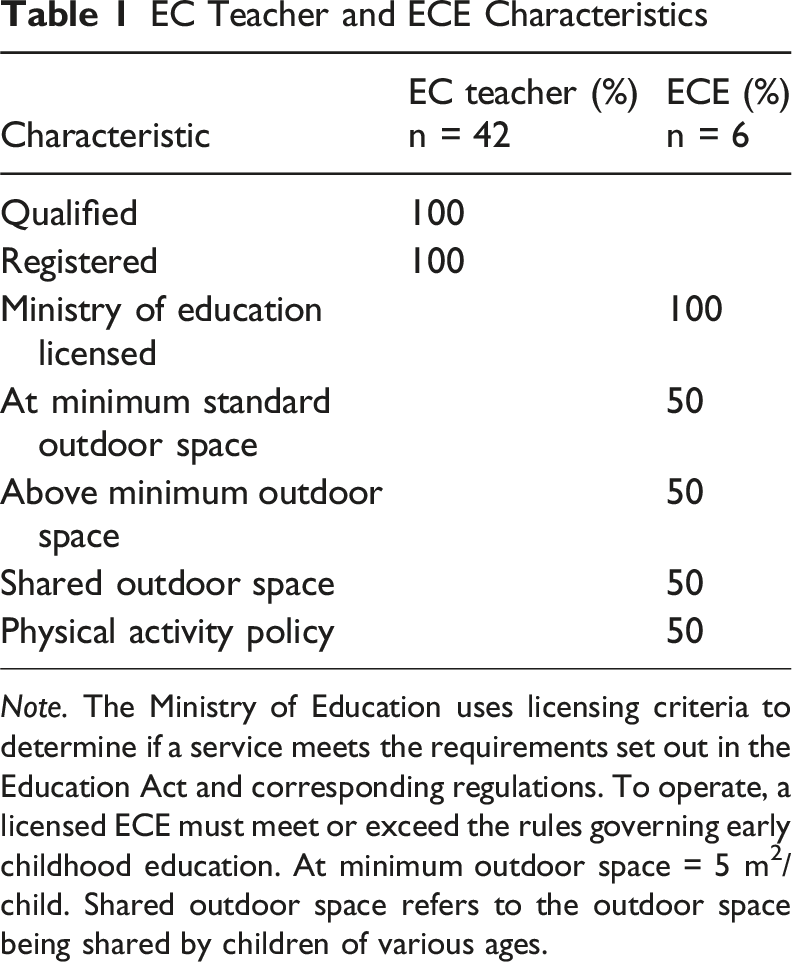
Note. The Ministry of Education uses licensing criteria to determine if a service meets the requirements set out in the Education Act and corresponding regulations. To operate, a licensed ECE must meet or exceed the rules governing early childhood education. At minimum outdoor space = 5
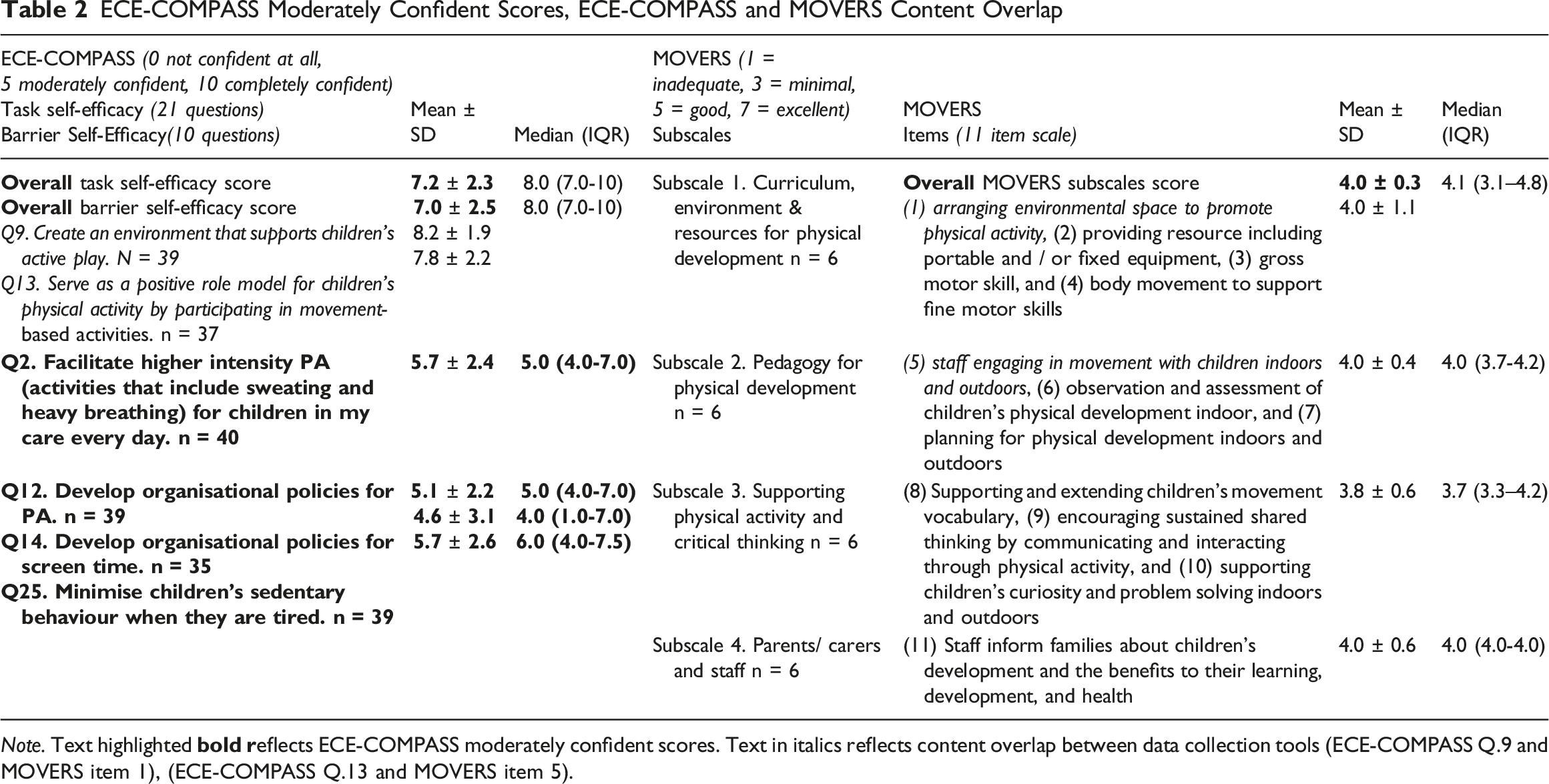
ECE-COMPASS Moderately Confident Scores, ECE-COMPASS and MOVERS Content Overlap
Note. Text highlighted
MOVERS subscale (M ± SD) scores ranged from 3.8 ± 0.6 to 4.0 ± 1.0. The lowest rated item being subscale 3 (supporting physical activity and critical thinking), the highest rated item being subscale 2 (pedagogy for physical development). The overall total score was 4.0 ± 0.3. Median (IQR) scores ranged between lowest rated item 3.7 (3.3–4.2) subscale 3 (supporting physical activity and critical thinking), highest rated item 4.1 (3.1–4.8) subscale 1 (curriculum, and resources for physical development). See Table 2 for MOVERS scale ratings and MOVERS, ECE-COMPASS content overlap.
Discussion
The aim of this study was to gain a moment in time insight into EC teacher’s practices, self-efficacy and physical activity environment in the facilitation and promotion of physical activity behaviours among young children in licensed ECE in NZ. To our knowledge, this is the first study that incorporates EC teacher practices, self-efficacy and independent assessor observation of the quality of the movement environment.
Considering the moderately confident and above self-efficacy scores we found for both task and barrier EC teacher self-efficacy, there appears to be a generally good level of self-efficacy expressed by EC teachers in their ability to deliver quality daily physical activity behaviours. Our scores are similar to those of a study carried out in Canada who found that EC teachers (n = 121) scored similarly in both task self-efficacy (7.5 ± 1.6) and barrier self-efficacy (7.5 ± 2.0; (Bruijns et al., 2022). These scores are perhaps surprising given that EC teachers typically receive limited training in physical activity in their pre-service teacher training, and McLachlan and McLaughlin (2022) argue there is a need for teachers to have robust understanding of learning and development. For example, in a Canadian study, pre-service EC teachers (n = 1,292) were asked about their physical activity and sedentary behaviour training during their college/university education and nearly 70% indicated that they had not completed any physical activity-specific courses (Bruijns et al., 2019). Furthermore, Foulkes et al. (2020) revealed there was limited understanding about the concept of physical activity among EC teachers; however, knowledge of child development was evident and all participants agreed that there was a need for further training. Moreover, (McLachlan et al., 2017) suggest that in NZ, it is of concern that ITE programmes may allocate only a minimum number of hours to address childhood physical activity (and nutrition) because domain-specific knowledge (e.g. subject content) is not always taught in-depth to EC teachers. Given that children’s physical activity levels in ECE are less than optimal, Nathan et al. (2022), there appears to be a disconnect between EC teachers’ self-efficacy, practice and children’s physical activity, indeed an opportunity to bridge the gap between policy (prescriptive licensing criteria and regulations) to practice (EC teachers curriculum delivery). Further work exploring this disconnect is needed because supporting the process quality of EC teacher-led physical activity has been determined as an effective way to promote high levels of MVPA among children aged (3–6) years (Coleman, 2013; Duff, 2019).
Most EC teachers’ self-efficacy scores were above moderately confident, but lower scores were reported for four questions: facilitate higher intensity physical activity for children in my care every day; develop organisational policies for physical activity; develop organisational policies for screen time; and minimise children’s sedentary behaviour when they are tired. Accordingly, it is reasonable to conjecture that EC teachers lack knowledge, fear higher intensity physical activity due to the perceived potential risk of such activities, and do not believe higher intensity physical activity is necessary, thus have not explored opportunities for such activities. Professional learning to improve EC teacher self-efficacy in facilitating and promoting higher intensity physical activity in ECE may be beneficial. This reflects WHO Global Standards for ECE, responding to the needs of EC teachers needing greater guidance on how to promote physical activity and manage appropriate levels of sedentary behaviour (including screen time) and reduce long periods of sitting.
The lower scores for developing organisational policies for physical activity and screen time are perhaps not surprising, as it is well documented that there is a dearth of physical activity and sedentary behaviour policies within ECE (Nathan et al., 2022; Sollerhed et al., 2021). To date, within the NZ context, there are limited guidelines which explicitly focus on physical activity for ECE, (Ministry of Health, 2017), and a lack of physical activity information in ECE resources at both policy and implementation level. Of concern is the likelihood that policies around physical activity are missed, and that there are gaps that exist between knowledge and governance of health and education in ECE (Gibbons, 2015).
In NZ, teachers’ practice within ECE is guided by a variety of national mandates, and individual ECE philosophies. Specifically, within ECE there are Ministry of Education resources for EC teachers such as He Māpuna te Tamaiti (each child is precious and unique) for promoting proactive, intentional approaches supporting the development of children’s social and emotional competence, and Kia Kori Tahi (let us play together) for promoting physical wellbeing in early learning (Ministry of Education, 2019a, 2022). However, there is no explicit instruction on recognising the development components of physical activity, such as to develop stability children need to have their head out of an upright position and take part in activities that involve rolling, spinning, and hanging upside down. Thus, within the NZ context there is ample opportunity to improve policies that focus on physical activity and other related behaviours. These are reflected by the low score on question two (facilitate higher intensity physical activity for children in my care every day) and question 25 (minimise children’s sedentary behaviour when they are tired). Additionally, there is scope to develop physical activity policies, reflected by the low score on question 12 (develop organisational policies for physical activity) and clearer guidelines on levels and categories of activity required for optimum child development and on limiting screen use, and more EC teacher training (Gerritsen et al., 2016). Furthermore, the role of the EC teacher is central to the promotion of physical activity within ECE, therefore collective support from policy makers, Ministry of Education and ECE owners/ leaders is required to ensure impact on practice for positive outcomes for children.
In our study, MOVERS subscale item scores indicate the quality of the ECE movement environment was adequate. Interestingly, studies from Norway, Canada and Australia have reported slightly lower MOVERS scores than NZ. For example, a study from Norway ECE (n = 46) reported an average MOVERS score of 2.7 ± 0.7 (Krogager et al., 2022), likewise a study from Canada ECE (n = 19) reported average MOVERS scores as 3.4 ± 1.1 (Zhang et al., 2021), and a study from Australia ECE (n = 13) reported average MOVERS scores of 3.2 ± 0.6 (Kazmierska-Kowalewska et al., 2021). All four countries (i.e., NZ, Norway, Canada and Australia) share similarities in that ECE is not compulsory, and all have an early years curricula or framework where physical activity or active play is recognised. These collective results suggest there is room for improvement in quality of the ECE movement environment across the globe. Improving quality of the movement environment may be achieved through EC teacher professional learning as professional learning is the main knowledge transfer approach within the early childhood sector and has been shown to be effective in modifying EC teachers’ pedagogy and practice (Clarke et al., 2021). Professional learning which explicitly unpacks and explores the notion of quality inclusive of resources, equipment, interactions between EC teachers and children and families, planning, observing, and assessing is needed (Siraj et al., 2019).
The two instruments used in conjunction in our study (ECE-COMPASS and MOVERS) illustrate content overlap. For example, question 9 (ECE-COMPASS); “create an environment that supports children’s active play” aligns closely with item 1 of MOVERS; “arranging environmental space to promote physical activity.” Further, question 13 (ECE-COMPASS); “serve as a positive role model for children’s physical activity by participating in movement-based activities”, aligns closely with item 5 of MOVERS; “staff engaging in movement with children indoors and outdoors.” For both instruments, the role of the EC teacher is particularly pertinent. The ECE-COMPASS questionnaire suggests that the role of the EC teacher is about facilitation, leading, adapting, supporting, incorporating, programming, communicating, role modelling, engaging, planning, and intentionally providing physical activity experiences in the indoor and outdoor environment. Similarly, the role of the EC teacher is pertinent to high quality environments, involving EC teacher planning, encouraging, engaging, arranging, extending, working alongside children, role modelling and communicating. Despite similarities between instruments used in this study, a disconnect between the two data sets was reported (i.e., above moderate EC teacher self-efficacy and adequate movement environment quality). The datasets were collected by two different methods, self-report versus observation, which may provide insight into the disconnect; however, further investigation on a larger scale is warranted.
Similar instruments were used in studies, such as Hinkley et al. (2015) who carried out audits on Australian and Canadian ECE that drew on physical activity and sedentary behaviour items from existing instruments: 13 items from the Nutrition and Physical Activity Self-Assessment for Childcare (NAP SACC; Ammerman et al., 2007) and one item from the Environment and Policy Assessment and Observation (EPAO) tool (Ward et al. (2008). However, both similar tools (NAP SACC and EPAO) have a dual focus on nutrition and physical activity whereas in our study (ECE-COMPASS and MOVERS) focused solely on physical activity, illustrating a potential intersection of the impact of EC teachers’ and quality of the movement environment in physical activity facilitation in ECE.
A strength of our study is the use of two valid and reliable data collection tools to investigate current practices. To the best of our knowledge, these instruments have not previously been used in conjunction internationally, and never in NZ, hence providing an original insight into the physical activity environment in ECE. However, the results of our study should be considered in light of the following limitations. First, the study includes a generalizability of findings, as participant demographics are unknown and small sample sizes (ECE, n = 6, EC teachers n = 42). EC teacher self-efficacy scores may have been subject to social desirability bias, as they were self-reported, and associations were not made between ECE-COMPASS and MOVERS. No inter-rated reliability took place as there was only one trained MOVERS assessor in NZ, however all MOVERS observations took place on the same day of the week for the same hours. Recruitment occurred during COVID-19, and during this time the ECE sector experienced significant challenges including low staff numbers and significant competing demands (Education Review Office, 2021). The COVID-19 pandemic led to the temporary suspension of in-person activities and prompted a re-adaptation of pedagogical practices within ECE organisations. One of the substantial challenges in this process appears to have been promoting children’s participation and autonomy within a context in which (for hygiene reasons) certain materials could no longer be used, groups could not be mixed, etc. (Van Laere et al., 2021). All MOVERS observations took place in the final stages of the COVID-19 pandemic amidst elevated levels of child and teacher absence, and anecdotally more teacher time required for cleaning and sanitising.
Conclusion
Our investigation sought to understand the teaching practices and self-efficacy of EC teachers and quality of ECE movement environments in promoting and facilitating physical activity for young children in NZ, licensed ECE. Both task and barrier EC teacher self-efficacy results indicate that this sample of EC teachers expressed above moderate confidence; however, the quality of the ECE movement environment was adequate. This disparity between EC teacher self-perception and independent assessment of the quality of the movement environment indicates there is potential for improvement, potentially utilising professional learning.
Without doubt physical activity is important from a young age, and ECE has potential for promotion of physical activity; however, factors such as EC teachers’ self-efficacy and quality of the movement environment are important considerations to best facilitate positive impact. Our study findings provide an original initial insight and a compelling indication that EC teachers need additional training in this area and serves to inform a wider scale study of NZ ECE.
Footnotes
Acknowledgments
The Royston Health Trust supported the primary author to conduct this research.

Funding
The authors received no financial support for the research, authorship, and/or publication of this article.
Declaration of Conflicting Interests
The authors declared no potential conflicts of interest with respect to the research, authorship, and/or publication of this article.