



Abstract
Early childhood teachers (ECT) can significantly enhance the quality of early childhood education and care settings and children’s development. In response to a critical teacher shortage in Australia, governments and stakeholders are developing strategies to attract and retain the supply of ECTs, with the impact of these strategies on teacher quality unknown and unknowable, as no tool exists to assess ECT quality. This paper addresses this empirical gap by presenting the methodology and findings from the exploration stage of the development of the Teachers in Early Education tool. Analysis of data from expert stakeholders and documents, resulted in identification of 256 unique codes, organised into 26 categories across four domains: Purpose, Principles, Content and Design. Reflecting the diversity and complexity of the skills, knowledge, and practices, as well as the personal, professional, relational and contextual factors requiring consideration when assessing ECT quality, a conceptual model of ECT quality is proposed.
Keywords
Degree-qualified early childhood teachers (ECTs) have been shown to significantly contribute to the quality of early childhood education and care (ECEC) settings and to children’s development (Degotardi, 2010; Manning et al., 2019; Tayler, 2016). ECEC sectors globally, however, are facing critical ECT shortages, exacerbated by the Covid-19 pandemic (Jobs & Skills Australia, 2024; OECD, 2021). In response to this workforce crisis, governments and sector stakeholders in Australia and internationally are developing strategies to build workforce supply, including attracting and retaining ECTs (ACECQA, 2021; OECD, 2021; Productivity Commission, 2024a).
Notwithstanding the value of these initiatives, efforts to build an ECT workforce require concurrent attention to the building of a quality ECT workforce. This imperative is grounded in our reflections on research, policy, and initial teacher education that appear to be inadvertently bringing into question the value-added contribution ECTs can and indeed should be making to the quality of an ECEC setting. In short, in order to build a sustainable early childhood (EC) system that children and their families in Australia have a right to, simply focusing on the supply of teachers is insufficient— there must also be a focus on the quality of teachers.
To respond to this concern, this paper reports findings from a study that aimed to investigate the perspectives of expert stakeholders from the Australian ECEC context on what constitutes teacher quality and how this might be assessed. We share learnings from our work to co-design a novel tool— the Teachers in Early Education (TEE) tool—to assess ECT quality in the context in which they are working. Our goal is ultimately to develop a tool for researchers to use to establish a much-needed evidence base on the quality of ECTs in Australia. In this paper, we identify a diversity and complexity of skills, knowledge, and practices that these stakeholders expected ECTs to hold and perform to demonstrate ‘quality’. To commence work to develop a robust construct of ECT quality, we also share an initial and urgently required conceptual model of teacher quality specific to early education.
In what follows, after outlining our reflections on the ECT quality ‘problem’, we explain the co-design methodology and then present findings from our preliminary identification based on stakeholders’ views on what should be assessed when determining ECT quality. We conclude by proposing an initial conceptual model of ECT teacher quality.
The ECT Quality Problem
ECTs make up 11% of the ECEC workforce in Australia (Productivity Commission, 2024b), yet ECT quality, and how it varies according to individual and contextual characteristics, is unknown. Research, policy, and initial teacher education (ITE) provisions suggest variability in ECT quality, prompting the need for workforce initiatives to pay due attention to increasing the supply of quality ECTs.
With respect to ECEC research, there is an emphasis on workforce supply with less attention to workforce quality, in addition to a conflation in the literature of ECTs and vocationally-qualified ECEC educators (Fenech et al., 2021). Additionally, research findings do not unequivocally show that the employment of ECTs makes a difference to ECEC quality and children’s developmental outcomes (Early et al., 2006; Yang et al., 2025), or that the difference is substantive or more than what vocationally qualified educators make (Bonetti & Blanden, 2020; Warren & Haisken-DeNew, 2013).
In Australia, this problematisation of ECTs as contributors to ECEC quality is compounded by policy and ITE approaches. With respect to policy, Education and Care Services National Regulations (New South Wales Government, 2021) do not stipulate ECT-specific roles or responsibilities, nor do they require educational leaders— responsible for “lead[ing] the development and implementation of educational programs in the service” (Regulation 18)— to be ECT-qualified. There is also no differentiation in the Early Years Learning Framework (AGDE, 2022) as to the distinct pedagogical roles and responsibilities of ECTs and vocationally-qualified educators, with Grieshaber and Graham (2017) finding that: there is no difference between qualified teachers and other staff in terms of the work in which educators with direct contact are expected to engage … the [Early Years Learning] Framework requires all educators in direct contact with children to make decisions about pedagogy, principles, resources, assessment and learning outcomes (p. 99).
This lack of distinctiveness between what ECTs and vocationally-qualified educators do and how they do it, and conversely, the implication that teachers and other educators can and do undertake the same work, potentially diminishes the need for degree-qualified teachers in ECEC settings.
Policy responses to the ECT workforce shortage may be exacerbating the quality issue, with services in some jurisdictions able to meet ECT staffing requirements by employing approved ‘suitably-qualified’ persons deemed to be ECT-equivalent. Such persons include individuals enrolled in an approved ECT degree program who have completed at least 50% of the qualification (or hold an approved diploma level qualification), and registered primary or secondary school teachers who also acquired an ECEC diploma qualification (ACECQA, n.d).
Early childhood ITE programs are increasingly diverse in Australia, with no evidence to show which program features best prepare ECT graduates to effectively work with children in the early years. While some programs qualify graduates to teach children aged birth-5, the majority are birth-8 or birth-12 focussed, providing graduates with a dual-career qualification to teach in ECE settings and the early years of primary school (Fenech et al., 2021). Programs vary markedly in duration (from three to four-year undergraduate and one to two-year postgraduate degrees); the awarding of credit for previous study (from two units to two years of study); course content that focuses on early childhood; and professional experience with children aged birth-five years— minimum of 40 and maximum of 90 days (Boyd, 2020).
Collectively, the research findings and current approaches to the preparation, regulation, and employment of ECTs in Australia bring into question the need for, and efficacy of, ECTs. Rather than conclude that ECT regulatory requirements should be watered down (NSW Productivity Commission, 2022), we propose that greater attention ought to be paid to ECT quality. This means addressing currently unanswered questions, such as: • What is the quality of the ECT workforce like, including other suitably qualified educators deemed to be ECT-equivalent? • What early childhood ITE program features best support graduate quality? • Are quality ECTs and quality early childhood teaching different to who vocationally qualified educators are and what they do? • How is the quality of ECT graduates influenced by the context in which they work?
In posing these questions, we are not suggesting that we lack a quality ECT workforce in Australia. We are, however, maintaining that there is likely to be variability in ECT quality, and therefore cautioning against efforts to fast-track supply that may be compromising ECT quality and in turn, inadvertently mitigating the need for ECTs. Policy levers that support pathways for quality preservice and graduate ECTs are needed but require an evidence base that addresses our questions about approaches that best support ECT quality.
Limited Understandings of Teacher Quality in Early Childhood Education
Despite significant attention to the quality of ECEC settings in the Australian and international literature, far less attention has been paid to ECT quality. Calls to better understand teacher quality in ECEC have persisted for over two decades (AACTE, 2004; Blank, 2010; Lillvist et al., 2014), yet limited progress has been made. In Australia, for example, researchers recently drew attention to the fact that “a workforce strategy (2022–2031) has been developed to ensure a sustainable, high-quality workforce, but there is little information about what is recognised by the profession as ‘good’ teachers and teaching” (Nolan et al., 2024, p. 2).
Beyond ECEC, ‘teacher quality’ has been the focus of significant research for some time, arising from concerns with the quality of public education and the identification that teacher qualification is not always directly related to child outcomes (Rimm-Kaufman & Hamre, 2010). Consequently, much of the literature on teacher quality has focused on primary and secondary teachers. For example, the Education Endowment Foundation’s (EFF) (2023) recent review of literature on measures of teacher quality did not include research on early childhood teacher quality. Nevertheless, the literature on teacher quality from primary and secondary contexts has identified some important considerations. First, it is acknowledged that teacher quality is difficult to define (EFF, 2023). Second, teacher qualifications alone cannot be used as a proxy for teacher quality (Rimm-Kaufman & Hamre, 2010). Third, as per Cotton et al.’s (2023) work, consideration needs to be paid to individual teacher factors that impact on practice, including knowledge, skills and attributes, and the intellectual, affective and intrapersonal qualities that teachers need. Fourth, whereas initial research on teacher quality (e.g., what a teacher knows) often referred to quality teaching practices (e.g., what a teacher does), the importance of contextual factors impacting teacher quality is increasingly recognised (Bowe & Gore, 2017; Rimm-Kaufman & Hamre, 2010). Indeed, the EFF’s definition of teacher quality as “the characteristics of an individual teacher including characteristics resourced by the system in which they work that are linked to student outcomes” (EEF, 2023, p. 6) underscores the importance of context for teacher quality.
Given the importance of context, arguably, teacher quality in birth to five ECEC settings, which are vastly different from those of primary and secondary settings, will require different attributes, knowledges, and practices of ECTs than those of their peers working with school-aged children. We contend that the lack of attention to the work of ECTs has resulted in understandings of teacher quality that obscure and fail to take into consideration the unique characteristics of ECT quality.
Likewise, policy documents, whilst intended to gather evidence about teacher quality, do not adequately reflect the work ECTs do in birth to five contexts. Darling-Hammond’s (2021) paper “Defining Teacher Quality Around the World”, for example, focused on teaching standards across five jurisdictions including Australia. In most cases, these standards do not include, or marginalise, ECTs. In Australia, while teachers are required to meet professional teaching standards (Australian Professional Standards for Teachers [APST], AITSL, 2011) to be registered as an ECT, concerns remain that the standards are school-centric (Fenech & Watt, 2023). Similar concerns have been expressed about required teacher performance assessments (Bird & Charteris, 2020) that higher education institutions use to assess the quality of final year ECTs enrolled in birth-8 or birth-12 programs, but not birth-5.
Given the importance of ECT quality for child and social outcomes, the limited literature conceptualising ECT quality in early childhood, and the associated lack of assessments of teacher quality that adequately reflect the work ECTs do and the contexts in which they do it, there is an urgent need for a tool to assess ECT quality. In the remainder of the paper, we report on the initial stages of our development of a tool—the TEE tool—intended to address this research gap, beginning with details of our methodology and presenting the findings of our approach.
Methodology
The Tool’s development is grounded in a theorising of ‘quality’ as multi-dimensional, socially constructed, and context specific. Situated in complexity theory (Cochran-Smith et al., 2014), the study adopts a holistic, ecological conceptualisation of workforce issues, whereby the development and retention of a quality ECT workforce is viewed as contingent on multiple components that interact within and across varying complex nested systems over time. These components include individual ECTs; EC ITE programs; ECE workplaces; ECEC policies, laws and industrial conditions; and public discourses about ECEC and ECTs. Accordingly, the project considers the factors that support the supply of a quality ECT workforce in Australia to be multidimensional and dynamic, and which interact with and impact each other in complex, nonlinear ways.
We acknowledge that what constitutes ECT quality is contentious, controversial, and multi-perspectival. We aim to address these challenges by using implementation science and co-design approaches to develop the TEE tool so that is robust, valid and reliable, and fit for purpose. Specifically, the Tool will be: • grounded in theory and informed by and serve research into ECT quality; • able to assess and differentiate ECT quality; • consistent with Australian national requirements for ECTs; • acceptable to a range of stakeholders; and • manageable, feasible, doable, transferable. and scalable.
Informed by the four stages of implementation science articulated by Metz et al. (2015)— exploration, installation, initial implementation and full implementation—we report on the research design and findings from the first exploration stage of the Tool’s development.
Method
The exploration stage of the development of the TEE Tool followed three steps. Using a modified Delphi approach (Trevelyan & Robinson, 2015). Step 1 involved gathering stakeholder opinion; Step 2 involved analysis of this data; and Step 3 entailed a follow-up survey in which findings were presented to Stakeholders for consensus.
Step 1: Gathering Expert Opinion
This step aimed to ascertain expert opinion on what constitutes teacher quality. A two-day workshop was held with 32 expert participants, including researchers, teachers, service providers, policy makers, and representatives from unions and peak bodies from across Australia. All participants were informed of the purpose of the workshop and consented to use the data obtained. The project (including the subsequent survey discussed in Step 3) was approved by the Human Research Ethics Committee (HREC) of The University of Sydney [Approval No. 2023/466] according to the National Statement on Ethical Conduct in Human Research (2007).
The workshop was structured into three sessions. First was a discussion of the ECT quality problem, which resulted in broad support for the development of a tool that could be used to assess ECT quality. Second were presentations from academics— with follow-up roundtable discussions— intended to interrogate understandings of teacher quality in birth to five contexts. The third and longest session built on the previous two and focused on how the TEE tool might be developed. This session included stakeholder discussion on three provocations: 1. What would you want the TEE tool to do? 2. What do you consider should be underlying principles of the TEE tool? 3. What do you consider is essential to include in the TEE tool?
Data generated from the three sessions included: • research assistant notes on participant responses to the facilitated provocations and other conversations generated by the workshop presentations (17 pages); • collated transcriptions of participant (anonymous) contributions gathered via sticky notes (2 pages) • participant contributions via follow-up email (2 pages) • open-text comments from the workshop evaluation form (2 pages) • participant-identified documents (e.g., relevant Australia scholarly papers; policy documents; regulatory requirements) for the researchers to consult post workshop.
Step 2: Analysis
The aim of this step was to analyse the data to identify underlying
To ensure robust data analysis across the data set, the authors co-designed a coding tree based on initial analysis of the data that was used subsequently to analyse all data. Together within NVivo (Version 12), we deductively and inductively analysed one document identified at the workshop—the Australian Professional Standards for Teachers (AITSL, 2011). Deductive content analysis involved examining the data line by line, using the heuristic framework of the four concepts related to the design of the Tool - Purpose, Principles, Content, and Design. Through consensus, we organised the data under these conceptual categories; hereafter referred to as domains. Inductive thematic analysis involved coding data within each domain, based on emerging concepts. We used a comparative approach, memoing and mapping ideas as themes started to emerge, constantly refining codes based on consensus. The result from this first stage of data analysis was a coding tree with three sub-levels.
Second, we refined the coding tree. For this purpose, and to support inter-rater reliability, we undertook three rounds of independent analysis of data, applying the agreed analytical approach and codes, editing and adding new codes when necessary, and then coming together to compare notes/edits, coding, and suggestions for changing or adding to the sub-codes until consensus was reached.
Third, all remaining data were analysed by a research assistant, using the refined coding tree, adding new codes to the tree as new ideas emerged. To ensure consistency, the RA first blindly analysed the documents that had already been analysed by the authors. This analysis was then checked by one author.
By the end of this process, we had a multi-level coding tree arranged hierarchically with four domains, 26 categories and subcategories, and a total of 256 unique individual codes (see Figure 1). Multi-Level Coding Tree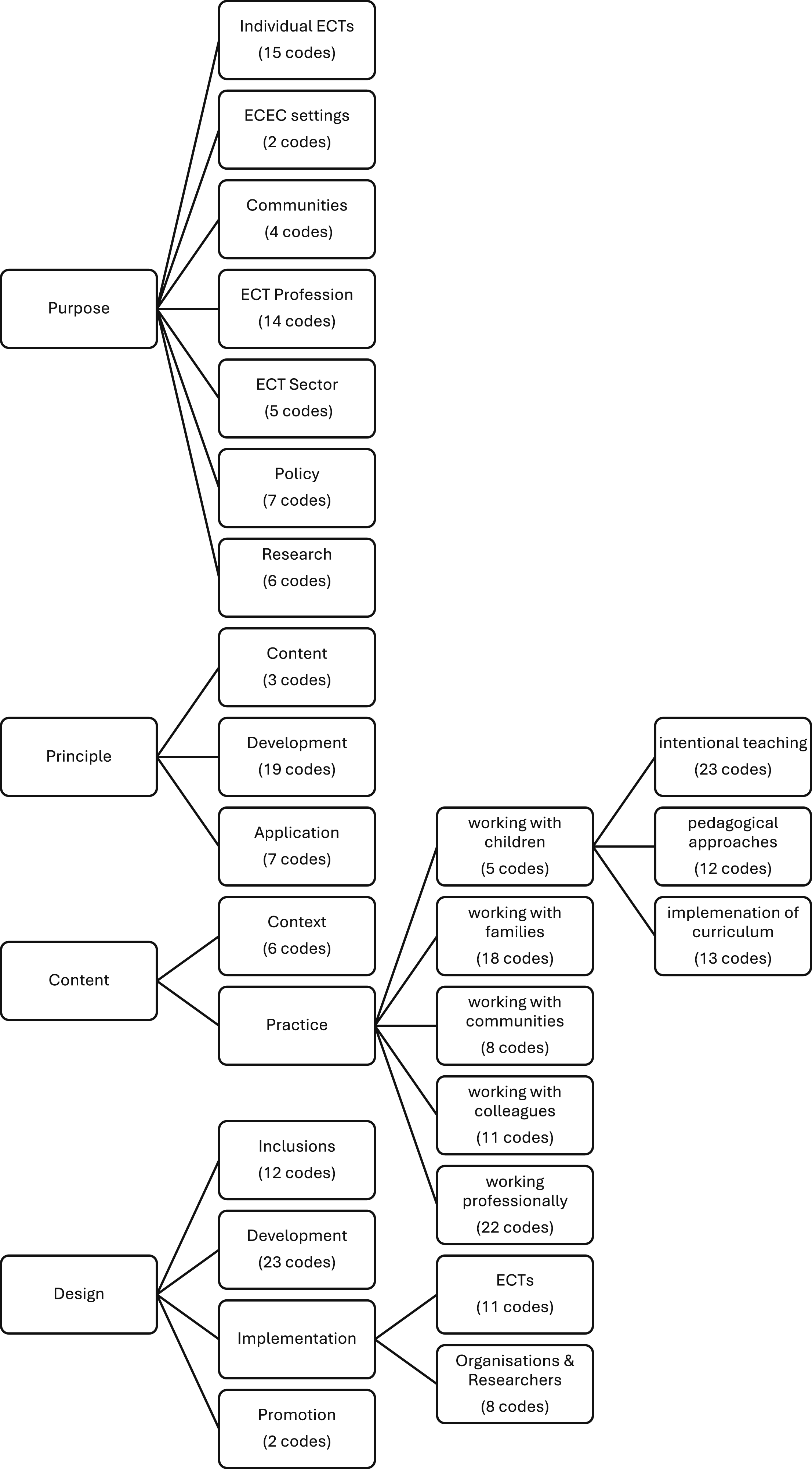
Step 3: Survey of Experts
The aim of this step was to test the face validity of the codes generated above with early childhood experts in Australia, including leading EC researchers, policy makers, providers. We developed an anonymous survey that turned each of the codes into a statement and asked experts to indicate their level of agreement on each of the statements on a Likert scale. Participants also had the opportunity to provide open-ended written comments. The survey was sent to all participants involved in Step 1 (Workshop) who indicated interest in being involved in the Tool’s development, and to other content experts in our network (35 in total). Twenty-two surveys were completed and returned.
Overall, there were very high levels of agreement across the codes, with most items scoring above four (1 = strongly disagree to 5 = strongly agree). In relation to
Of particular note, participants agreed strongly (>4.50) that the Tool should have practical application by supporting ECTs’ individual self-reflection (provide guidance for an ECT to analyse all aspects of their practice; what they are doing well and how they might do things differently; 4.68); and thinking about learning and teaching (enhance an ECT’s conceptualising of pedagogy and children’s learning; 4.64), as well as support individual services by supporting a professional learning community (foster collegial enquiry and evidence-based conversations about practice; 4.10).
Moreover, there was strong agreement that the TEE Tool should define quality teaching in ECEC (create a clear, national definition of quality teaching in the ECEC B-5 space; 4.59), and that it should make explicit ECTs’ work: what they do, how they do it, and what’s needed to do it (that is, clearly outline the scope of ECTs’ practice, and the knowledge, skills, and dispositions needed to do it; 4.55). Whilst one participant commented that the existing Standards (APST; AITSL, 2011) were adequate for assessing teacher quality, the responses indicate strong agreement that the Tool could bring a much-needed approach for assessing the quality of teachers in birth-5 settings, albeit complementing and building on these existing Standards.
Participants also agreed or strongly agreed with the proposed values and philosophical/theoretical approaches for
Relatedly, amongst considerations for the development of the TEE tool that respondents strongly agreed to, were its need to capture the complexity and diversity of ECTs’ work (avoid simplistic or reductionist assessments of ECTs’ work; 4.68), be process-oriented (view evaluation as a participatory process of interpretation and judgement; 4.5), and assess holistically (rather than in standardised ways; 4.81). Respondents also strongly agreed (4.5) that the TEE tool should be specific to ECTs who work in settings that cater for children aged birth-five years. However, two participants questioned the focus on the birth-5 setting given that the international definition of early childhood is birth to eight. Thoughtful critique included the need to ensure that the Tool is adaptable over time to ensure its relevancy, and the need to be mindful of the burden on ECTs of engaging with such a tool.
Findings From Content Domain

In relation to its Design, there was strong agreement with including an Acknowledgement of Country1 (4.82), and critical information such as the vision and purpose of the Tool (4.73), definitions of key terms (4.59), and a statement about ethical use of the Tool (4.64). There was also strong agreement that the Tool must be easy to use (4.86), have clear and accessible language (4.82), and that ECTs should be able to administer the Tool as a means of self-assessment (4.73).
Discussion
In this study, key considerations across four domains (Purpose, Principles, Content and Design) for the design of a tool to assess ECT quality, arising from consultation and co-design processes with EC stakeholders, were identified. Strong support for such a tool was established, with high expectations for what it might achieve for a range of stakeholders, including useful guidance on design features. Importantly, there was strong agreement for the need to contextualise the assessment of ECT quality with respect to the context within which they work.
Of note, however, are the number and nature of codes in the Content domain that indicate ECT quality. Collectively, these codes demonstrate the diverse and complex nature of the EC specialisation. According to our analysis of data from ECEC experts and papers and policy documents recommended to review, quality ECTs are required to demonstrate intellectual, theoretical, and pedagogical knowledge across a range of curriculum areas. They must use these knowledges to engage in, reflect on, and lead pedagogical and relational practices, approaches and strategies, when working with children, as well as work reflexively with colleagues, families, and communities. At the same time, ECTs are required to maintain and grow their professionalism, as well as contribute to the profession more broadly. These are high expectations for ECTs and extend well beyond those aspects assessed in the APST (AITSL, 2011).
What is less clear, however, is how many of the indicators of teacher quality – such as provide feedback to families about children’s learning and day – are distinct from the work of a vocationally-trained educators. This distinction is with respect not only to what ECTs and educators do, but how they do it. While these distinctions remain unclear, the need for and discrete contributions of specialist ECTs to quality ECEC settings remain vulnerable. Further work to differentiate the indicators is therefore needed and will serve as a focus of the TEE tool’s development.
As previously noted, during the workshop we identified slippage in the use of teacher quality and teaching quality, and we have continued to grapple with differentiating between the two conceptually. To this end, and based on our analysis of the data, we have integrated our understandings of ECT quality into a preliminary conceptual map (Figure 2). Emerging Conceptual Model of Early Childhood Teacher Quality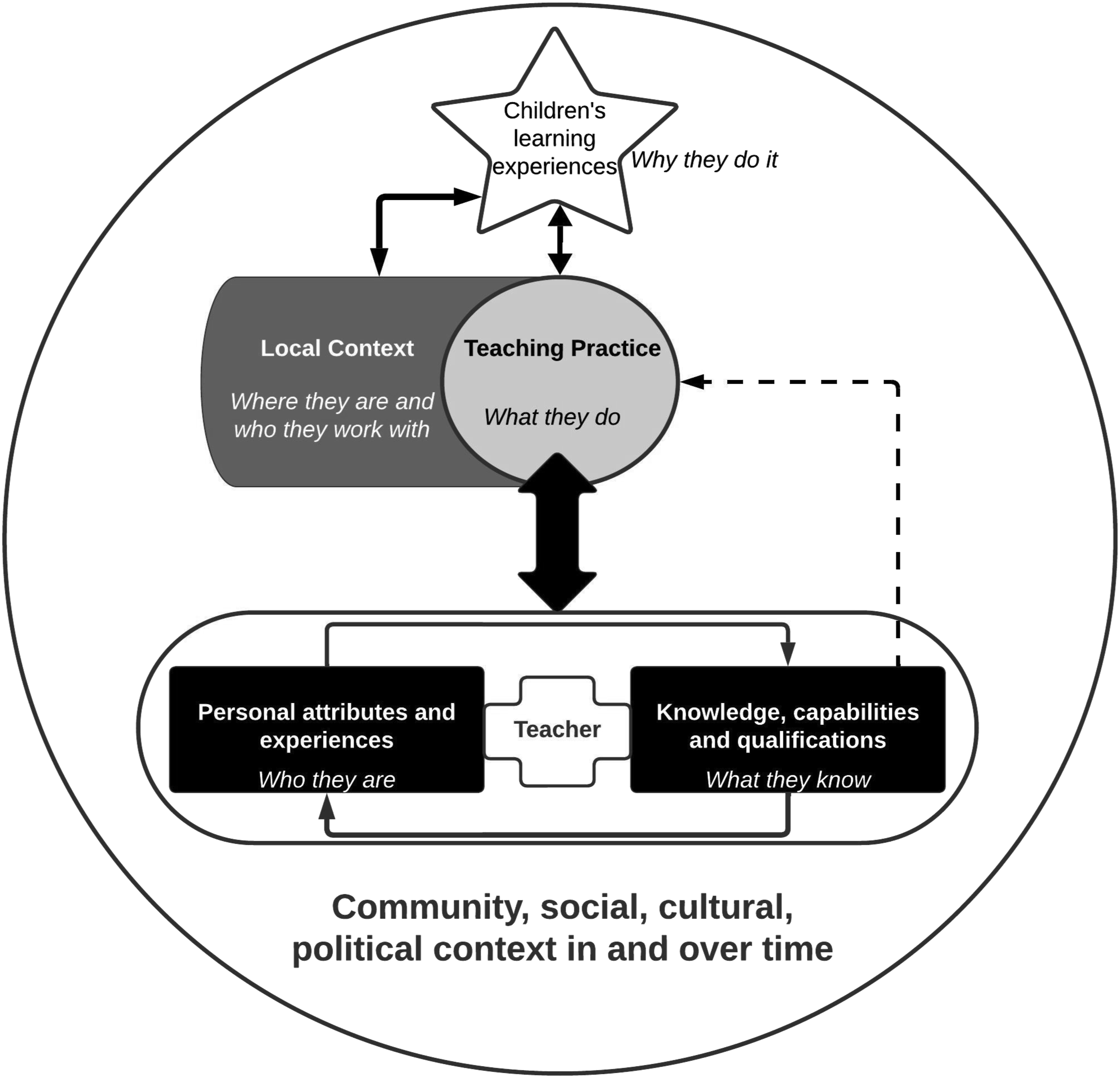
Based on an ecological framing, the model challenges the assumption in policy, discussed in the introduction, that all ECTs with an EC degree qualification will be able to practice such that children’s learning, development and wellbeing will be supported. The model presents a complex and ecological conceptualisation of ECT quality, with several key components. The first key component is ECT personal attributes and experiences (Who they are) and knowledge, capabilities, and qualifications (What they know), that when combined, represent the individual teacher. Second, is ECTs’ teaching practice (What they do). This practice is conceptualised as occurring bi-directionally, affecting and being influenced by the local context in which they are situated (Where they are and who they work with) and within the larger community, social, cultural, and political context, in and over time (outer circle). Given the purpose of their work being to support children’s learning experiences (Why they do it), it is essential that teacher quality be considered as both being and in a continual and contextual state of becoming. Our next step is to test, and if needed, refine the robustness of our conceptual model by undertaking a large-scale and systematic scoping of the literature to identify if and how the construct ‘early childhood teacher quality’ as identified from expert ECEC stakeholders in Australia, aligns with conceptualisations in national and international literature.
Conclusion
In this paper we have presented work on the exploration stage of the development of a tool intended to be used in the first instance by researchers to develop understandings about ECT quality in Australia. We have argued that the TEE tool is needed to redress current research, ITE and policy approaches that do not assess ECT quality, and which are potentially contributing to equivocal findings pertaining to associations between ECTs and ECEC quality, diminishing ECT quality, and threatening the requirement for ECTs in ECEC settings. At the level of the individual teacher the TEE tool will enable an assessment of ECT quality, while also generating data pertaining to individual and contextual factors supporting or constraining the level of assessed quality. Ultimately, the TEE tool will be used to develop an evidence base to inform the preparation, regulation, and employment of ECTs, and in turn, the development of a quality ECT workforce.
Footnotes
Acknowledgements
We acknowledge the Academy of Social Sciences in Australia, the University of Sydney, and Macquarie University for financially supporting the research presented in this paper. We appreciate the time and expertise shared by TEE stakeholder research participants. We also wish to thank our research assistants, Wilma Murdoch and Lauren Bedford-Rolleston, for assisting with collecting and coding data. We acknowledge our critical friends and fellow ARC CIs, Associate Professor Megan Gibson, Professor Susie Garvis, and Professor Wendy Boyd.

Funding
The author(s) disclosed receipt of the following financial support for the research, authorship, and/or publication of this article: This research was funded by the Australian Government through the Australian Research Council (DP240100249) and by the Academy of Social Sciences in Australia.
Declaration of Conflicting Interests
The authors declared no potential conflicts of interest with respect to the research, authorship, and/or publication of this article.