



Abstract
Early childhood teacher (ECT) shortages in Australia have prompted a government, employer, and higher education focus on upskilling pathways for diploma-qualified educators. Distinctions between ECT and diploma-qualified educator roles—and what each is expected to know and do—are, however, unclear. This paper reports on the first stage of a doctoral study investigating the efficacy of upskilling to build the supply and quality of Australia’s ECT workforce. Thematic analysis of employer interviews (n = four) and industrial documents (n = eight)—including awards, enterprise agreements, and job descriptions—revealed distinct expectations of ECTs in professional knowledge, leadership, and responsibilities with families and communities. Employers noted that in practice, these distinctions vary with context, graduate preparedness, and ECTs’ professional growth. Findings also revealed ambiguity and a discourse of equivalence that positions ECTs and diploma-qualified educators as interchangeable, risking devaluation of the ECT role. Implications for policy and service providers are discussed.
Introduction
Degree-qualified early childhood teachers (ECTs) are recognised as contributors to quality early childhood education and care (ECEC) through their influence on educational programs, curriculum, learning environments, and interactions with children (Degotardi, 2010; Manning et al., 2019). Evidence showing the positive impact of ECTs on ECEC quality is, however, equivocal, with some studies suggesting that qualifications alone do not consistently lead to improved quality or developmental outcomes (Yang et al., 2025). Variability in the calibre of ECTs, and diverse approaches to early childhood teacher education, challenge the assumption that higher qualifications equate to teacher quality (Fenech et al., under review). Adding to this complexity are well-documented workforce challenges, with international and Australian literature highlighting persistent ECT shortages and turnover that threaten the attraction, retention, and long-term sustainability of a quality ECT workforce (Fenech et al., 2021; Kim et al., 2024).
To address workforce shortages and increase the supply of ECTs in Australia, initiatives have been developed to upskill the existing vocationally-qualified educator workforce. The upskilling of diploma vocationally-qualified educators to an ECT-degree qualification is one strategy endorsed in both the Productivity Commission’s (2024a) Inquiry into ECEC and Australia’s ten-year National Workforce Strategy (2022-2031) (Australian Children’s Education and Care Quality Authority [ACECQA], 2021). Government and higher education incentives and workplace supports such as scholarships, paid practicum subsidy, accelerated courses, and study leave are available to support upskilling (ACECQA, 2021; Productivity Commission, 2024a). These efforts occur amid ongoing ambiguity around the distinct roles, responsibilities, and expectations of ECTs and diploma-qualified educators, who work together in centre-based, regulated ECEC services in Australia (preschool and long day care settings), thus raising important questions around what distinctive contribution ECTs make to ECEC quality.
The ambiguity surrounding the roles and responsibilities of diploma-qualified educators and ECTs is reflected in the literature. In Australian ECEC research, a conflation between vocationally-qualified educators and ECTs has been identified (Fenech et al., under review), making it difficult to determine what uniquely constitutes the work of ECTs. While some international studies have explored the impact of teacher qualifications on classroom quality and children’s developmental outcomes, distinctions between different qualification levels remain unclear, partly due to inconsistent ways researchers define qualifications (Yang et al., 2025). The term ‘teacher’ is loosely used to encompass all degree and vocationally-qualified educators, reinforcing the conflation between ECTs and other educators in the literature (Fenech et al., under review).
To inform understandings about differences in the work of ECTs and diploma-qualified educators, this paper presents findings from a qualitative study that aimed to examine whether what ECTs know and do differs from diploma-qualified educators, from the perspective of ECEC employers. The paper begins by outlining factors pertaining to the Australian Qualifications Framework (AQF; AQF Australian Qualifications Framework Council, 2013), National Quality Framework (NQF; ACECQA, 2025a), teacher education pathways, and limited empirical evidence that together, contribute to role ambiguity between ECTs and diploma-qualified educators in Australia.
Factors Contributing to Role Ambiguity
Limitations of the AQF
AQF Descriptors for Diploma and Bachelor Degree Qualifications
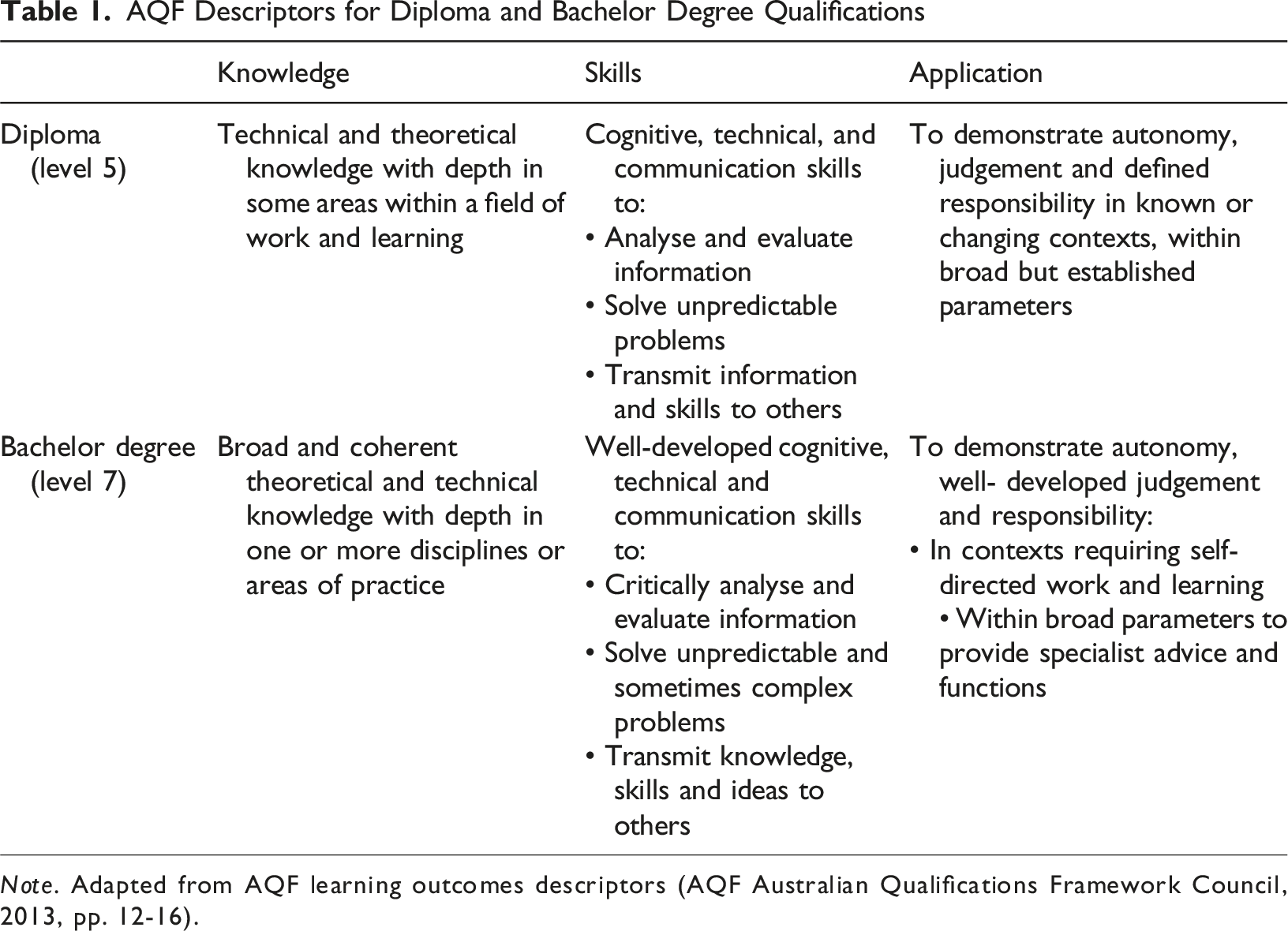
Note. Adapted from AQF learning outcomes descriptors (AQF Australian Qualifications Framework Council, 2013, pp. 12-16).
While the AQF is intended to differentiate qualification levels, distinctions between diploma and bachelor degree graduates remain unclear due to what have been described as vague, overlapping descriptors (Perkins et al., 2019). As Table 1 shows, the AQF relies on minor word or phrase changes, without clearly outlining how these terms build upon one another.
Ambiguities in the NQF
Ambiguities in the AQF have trickled down to sector-specific policies, such as the NQF which operates as the ECEC national regulatory framework (ACECQA, 2025a). Despite mandating qualification levels, the NQF does not clearly differentiate the work ECTs and diploma-qualified educators do. The Children (Education and Care Services) National Law [CECSNL] (2010) defines preschool programs as educational programs delivered by qualified ECTs, thereby distinguishing their expertise from that of diploma-qualified educators. The Education and Care Services National Regulations [ECSNR] (2011) define ECTs as persons with an approved early childhood teaching qualification. Both the Regulations and NQF further specify the role in terms of an ECT’s responsibilities—working directly with children, planning programs, mentoring educators, facilitating research, or acting as educational leader (ACECQA, 2025a; ACECQA, 2025c; November; ECSNR, 2011). These responsibilities, however, are not unique to ECTs, leaving the distinction between ECTs and diploma-qualified educators unclear. For example, educational leaders are not required to be ECT qualified (ACECQA, 2025a). Additionally, the National Law defines an educator as “an individual who provides education and care for children” (CECSNL, 2010, s. 5), thus encompassing both ECTs and educators. This definition is adopted into the approved learning framework, the Early Years Learning Framework [EYLF] (Australian Government Department of Education, 2022), which refers to all who work with children as ‘educators’. The assumption that all educators are expected to perform complex teaching tasks ignores differences in qualifications and pay, reflecting a policy landscape that lacks clear role differentiation within the ECEC workforce (Grieshaber & Graham, 2017).
Variability in Initial Teacher Education Pathways
As the body that accredits early childhood degree and diploma programs, ACECQA sets curriculum requirements for each qualification, with differences outlined in their respective accreditation standards. Although both qualifications are required to address child development and care, degree-level ECT programs—offered as three- or four-year bachelor (AQF level 7) or one- or two-year postgraduate (AQF level 9) qualifications—are required to include more advanced content in specific developmental domains (language, social and emotional); early intervention and supporting children with complex or additional needs; continuity in learning (including transition to school); and partnerships with families and communities, including Aboriginal and Torres Strait Islander perspectives (ACECQA, 2024b). Diploma programs are centred on practical applications of care, safety and program delivery, with less emphasis on the theoretical and pedagogical foundations that inform educational practice (ACECQA, 2024a). In addition to program content, degree-level ECT programs require more supervised professional experience: 80 and 60 days for bachelor and post-graduate programs respectively, compared to 240 hours (approximately 32 days) for diploma programs (ACECQA, 2024a; ACECQA, 2024b)—reflecting distinct expectations around the depth of preparation.
Universities’ structuring and delivery of initial teacher education (ITE) programs for ECEC diploma-qualified students further contributes to role ambiguity. Universities have discretionary power in awarding credit for diploma qualifications, with some granting no credit and others awarding credit for up to 50% of a degree (Boyd, 2020), suggesting variation in how tertiary institutions recognise the knowledge and skills of diploma-qualified educators (Fenech et al., 2021). Postgraduate courses, such as Graduate Diplomas, further illustrate this inconsistency, with some universities offering one-year accelerated pathways for diploma-qualified educators with five years’ recent Australian ECEC experience to obtain their teaching qualification (Productivity Commission, 2024b). These variable and accelerated pathways risk devaluing ECTs by making their knowledge, skills and responsibilities seemingly interchangeable with diploma-qualified educators.
Limited Empirical Evidence on Role Differentiation
Some Australian research has sought to identify distinctions in the professional practice of ECTs and vocationally-qualified educators, yet understandings of these distinctions remain limited. Degree-qualified ECT participants in one study demonstrated higher quality interactions and more complex interpretive skills in recognising and interpreting infants’ behaviours and communication than vocationally-qualified educators (Degotardi, 2010). A recent national study examining the work of exemplary ECTs and vocationally-qualified educators found that roles and responsibilities varied according to qualification levels (Gibson et al., 2023). Differences in the work of degree-qualified ECTs and Certificate III-qualified educators were identified, with ECTs more involved in communication with families, and administrative or planning tasks (Gibson et al., 2023). The distinction between the work of diploma educators and ECTs was less clear. The study highlighted differences in what informed practice, with diploma-qualified educators emphasising practical skills while ECTs drew equally from skills, theoretical knowledge, and professional dispositions (Gibson et al., 2023). Additionally, ECTs often drew on theory to mentor educators and guide higher level discussions within teams (Gibson et al., 2023). Although these studies indicate how degree-qualified ECTs and diploma-qualified educators enact certain practices differently, to our knowledge, no Australian study has yet directly explored differences between what ECTs and diploma-qualified educators are expected to know and do.
The Current Study
The study reported on in this paper aimed to address the aforementioned gap by investigating how the work of ECTs is distinct from that of diploma-qualified educators in the Australian ECEC sector. The investigation sought the perspectives of key informants—early childhood professionals with high status, specialised knowledge, and expertise who influence ECEC provider policies, structures, and expectations—and examined relevant industrial and organisational documents. The research question that guided the study was: What are the differences between what ECTs and diploma-qualified educators are expected to know and do?
The study is a component of the Australian Research Council (ARC) funded Teachers in Early Education (TEE) Project (DP240100249) which is investigating the supply and quality of the ECT workforce in Australia. The paper reports on findings from the first stage of a doctoral study that is investigating the efficacy of upskilling to address the chronic shortage of Australia’s ECT workforce.
Methodology
The study is situated in a social constructionist paradigm, which recognises that knowledge and meaning are co-constructed through social interactions and situated within broader social, cultural, and historical contexts (Crotty, 2020). Aligned with this perspective, the paper explores how expectations of ECTs and diploma-qualified educators are constructed, influenced by, and understood within systemic structures by drawing on both Bronfenbrenner’s bioecological theory and Foucault’s concept of discourse.
Bronfenbrenner’s bioecological model (Bronfenbrenner & Morris, 2006) positions individuals as embedded within, and mutually influenced by, ongoing interactions with multiple environmental contexts. While this paper focuses on data primarily in the exosystem—broader structural factors such as sector and organisational policy that shape role expectations—it also considers the macrosystem, where dominant discourses construct and legitimise particular understandings of the respective status, value, and roles of ECTs and diploma-qualified educators (Bronfenbrenner & Morris, 2006).
Foucault’s (1978) conceptualisation of discourse offers a critical lens to examine how these roles are constructed. Discourse is understood as a system through which power and knowledge are mutually shaped and reinforced, determining what can be known, said, and recognised as truth within specific contexts, in this case, the ECEC sector in Australia. Through language and knowledge constructions of roles, subject positions, and institutional truths, discourse functions as a mechanism of power through which the roles of ECTs and diploma-qualified educators are defined, differentiated, and enacted. From this perspective, industrial documents such as modern awards (national minimum employment benchmark), enterprise agreements (above-award organisation or workplace-level negotiated employment conditions), and job descriptions, and key informant perspectives are not treated as objective descriptions of practice, but as discursive tools and sites through which professional roles are negotiated and regulated (O’Farrel, 2005). Discourse in this context reveals and reproduces the broader power relations that determine what is recognised, valued, or marginalised within the ECEC sector (O’Farrel, 2005). This lens enables an exploration of how the ECT role is constructed differently from that of diploma-qualified educators.
Recruitment
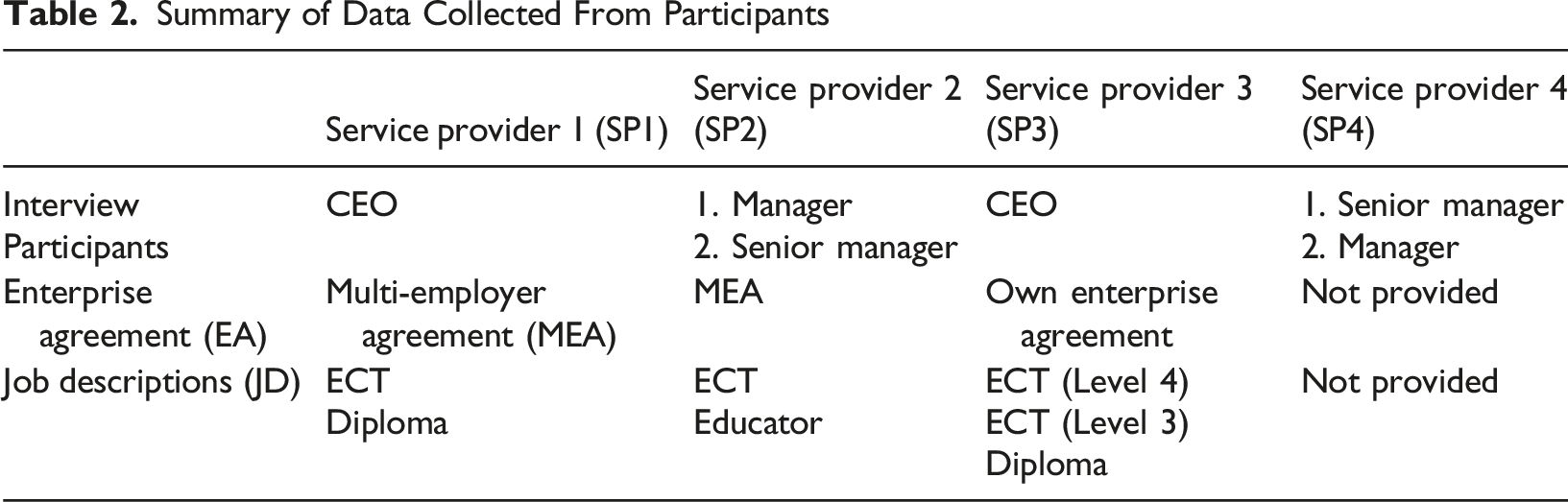
Summary of Data Collected From Participants
Data Collection and Analysis
Two sets of data were collected, from interview with key informants, and industrial and organisational documents. Interviews were conducted with key informants who were well positioned to provide contextual insights into organisational practices and perspectives. Interviews were approximately 60 minutes’ duration and conducted online via Zoom, following a semi-structured interview guide that was shared with participants prior to their scheduled interview. Interviews focused on how the roles and responsibilities between ECTs and diploma-qualified educators differ in their organisation and the knowledge, skills, and expertise they expected ECTs to have.
To supplement the interviews, publicly available industrial awards—the Children Services Award (CSA) 2010 (Fair Work Commission, 2025a) and the Education Services (Teachers) (EST) Award 2020 (Fair Work Commission, 2025b)—and organisation job descriptions were also reviewed. Publicly available enterprise agreements were retrieved and verified by participants via email to ensure the researcher had accurate documents for identifying the employment conditions for ECTs and diploma-qualified educators in each participant’s organisation. Organisational documents were also collected, specifically the ECT and diploma-qualified educator job descriptions. Participants emailed their organisation’s job descriptions to the researcher (Author 1) prior to the interview. Each interview was transcribed using Zoom’s automated transcription function and subsequently edited for accuracy. All transcripts and documents were managed and coded using NVivo.
The industrial documents and interview transcripts were analysed using both inductive and deductive thematic analysis. Thematic analysis is a flexible, systematic method for identifying patterns of meaning across qualitative data and interpreting them in relation to the research question (Clarke & Braun, 2017). The analysis followed a six-phase approach (Braun & Clarke, 2012). These phases were: 1) familiarisation with the data through reading and reviewing transcripts; 2) generating initial codes inductively to capture recurring language and concepts, supplemented by deductive codes that located role constructions within the broader ecological system; 3) identifying potential themes that reflected emerging patterns around role expectations; 4) reviewing and refining themes through a discourse lens to examine how both roles were constructed through language and concepts; 5) defining and naming themes to describe how expectations were constructed across the data; and 6) reporting on themes in this paper.
Findings
Analysis of the interview transcripts and industrial and organisation documents identified three key themes: 1) distinct expectations of ECTs; 2) expectations versus reality; and 3) ambiguity around differences. Figure 1 provides a visual summary of the three key themes and their associated codes, which are unpacked in the section that follows. Overview of Key themes and associated codes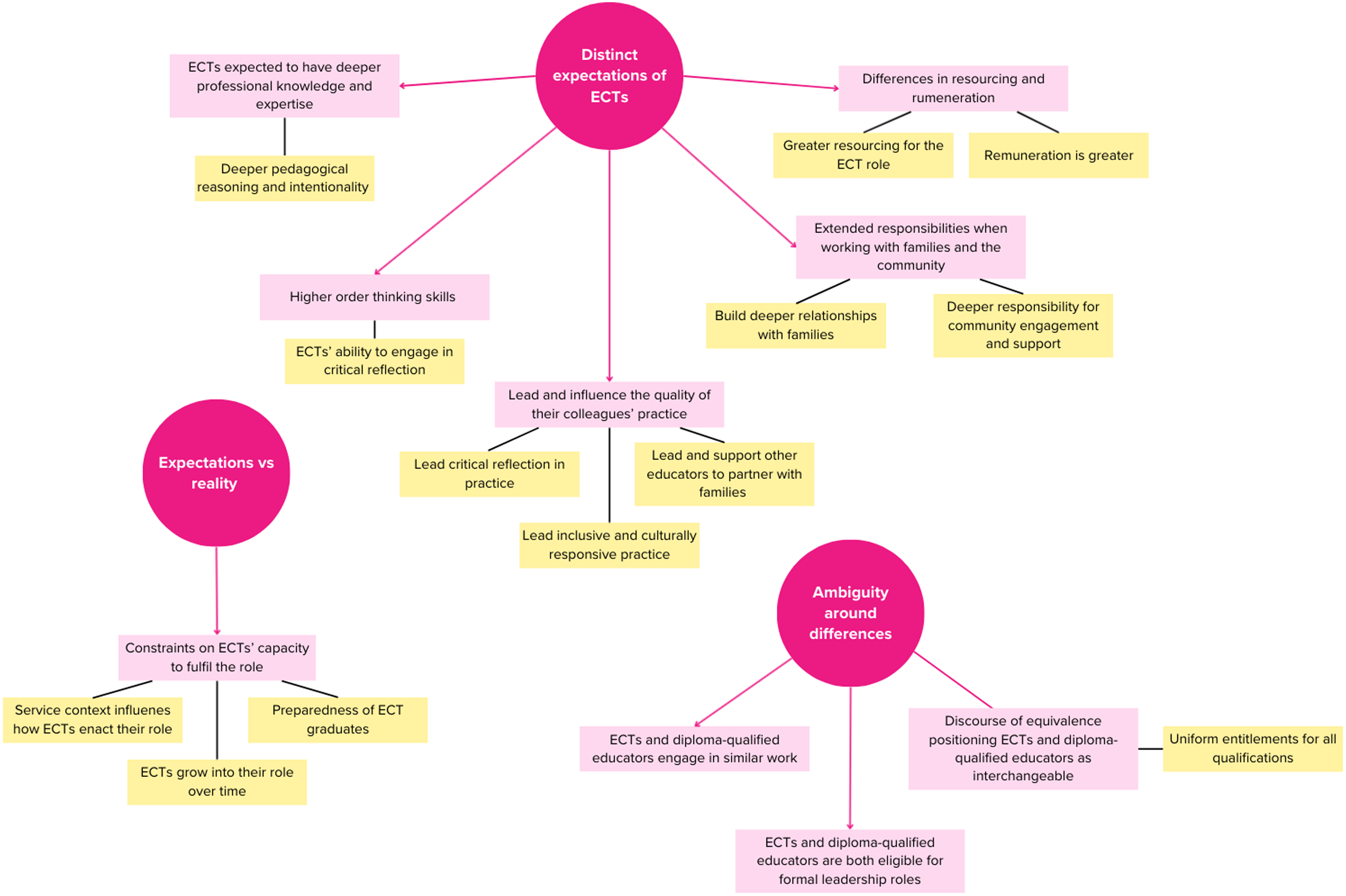
Theme 1: Distinct Expectations of ECTs
All four participants expressed expectations that ECTs to have deeper professional knowledge and expertise than diploma-qualified educators. This expected pedagogical depth and knowledge was attributed to ECTs’ degree qualification and expected advanced focus on child development and key curriculum areas. For example, job descriptions from one organisation showed that ECTs but not diploma-educators were required to: “implement teaching and learning programs that support all areas of development… [including] STEM, Literacy, Numeracy, Foundational skills & the Arts” (JD, SP1). This deeper knowledge was expected to translate to ECTs having deeper pedagogical reasoning and intentionality. One key informant, for example, noted that ECTs are expected to have “a higher level of knowledge in terms of the theory; the architecture behind the planning, programming and curriculum” (KI1, SP4). KI1, SP2 also noted that “there’s… an expectation… that they have deeper knowledge of child development… [and] that ability to really engage with children in a way that’s going to develop curriculum”.
Higher order thinking skills were consistently described as specific to the ECT role and foundational to how ECTs go about their practice, with one key informant noting that ECTs “bring that sort of higher lens to it” (KI1, SP4). ECT job descriptions, and not that of diploma educators, reflected this expectation, for example, that ECTs “engage in critical reflection and practitioner research to inform practice” (JD, SP1). Key informants emphasised that ECTs’ ability to engage in critical reflection extended beyond surface-level thinking, describing it as an “analysis weave” (KI1, SP4) that integrates research, critical reflection, and interpretation. Critical reflection was seen as a tool and not “just [for] reflection’s sake but actually driving either a behaviour or an action” (KI, SP1).
The anticipated deeper professional knowledge and expertise of ECTs established a further expectation, that ECTs lead and influence the quality of their colleagues’ practice. ECTs were expected to lead critical reflection in practice by “guid[ing] and mentor[ing] other staff to critically reflect on their work” (JD, SP1) and make “recommendations for change within the team” (JD, SP3). This leadership involved challenging practice through “critical conversations and having those sounding boards” (KI1, SP4). ECTs were also expected to lead inclusive and culturally responsive practice, drawing on their “understanding around working with community [and the] complex social and ethical considerations that are taken on within courses” (KI2, SP4). Alongside this knowledge, ECTs were expected to lead and support other educators to partner with families by “support[ing] team members in upskilling their communication with families” (JD, SP2) and “support[ing] the thinking of others” (KI, SP1).
Stemming from their expected greater expertise and leadership responsibilities, ECTs are also positioned to take on extended responsibilities when working with families and the community. This expectation included building deeper relationships with families by “confidently articulat[ing] [learning and development] to families” (KI2, SP2) and recognising that they are working within a broader ecosystem—“it’s children in families… in community” (KI, SP3). Key informants highlighted that working with families requires deep critical thinking, particularly when supporting “disadvantaged and vulnerable communities” (KI2, SP4). As one participant explained: What’s so important with that higher order thinking is to understand that difference is not necessarily wrong… it’s not a black or white understanding, and there’s nuance and there’s difference, and there’s diversity (KI1, SP4).
While job descriptions for diploma-qualified educators typically focused on relationships with children and families, only ECTs were expected to engage more deeply by “develop[ing] and maintain[ing] strong relationships with children, families, educators and the community” (JD, SP2), highlighting their deeper responsibility for community engagement and support. Other examples of ECTs having different responsibilities include expectations to “plan for community involvement… and enable children to be active participants in their local and broader communities” (JD, SP1), and “liaise with external agencies to support children” (JD, SP3). One key informant explained that ECTs often lead these community relationships, maintain “connections in community”, and know “where to go” for referrals (KI, SP1).
These distinctions between ECTs and diploma-qualified educators are reflected in different resourcing and remuneration across all four organisations, particularly for programming and professional development. Greater resourcing for ECTs is evident in one enterprise agreement that entitles ECTs to 4 hours weekly non-contact time (EA, SP3), compared to 2 hours for educators who are not room leaders (i.e., person in charge of a group of children), while another organisation reported ECTs receiving 5 hours compared to four for diploma-qualified educators (KI1, SP4). All but one organisation reported providing additional programming time to ECTs compared to diploma-qualified educators, reflecting their greater pedagogical responsibilities. Across all four organisations, ECTs are supported through dedicated mentoring to guide them through teacher registration. In one case, this is formalised in the enterprise agreement, allowing ECTs “to accrue up to 10 hours of time in lieu per calendar year, for professional development required to maintain their accreditation” (EA, SP3). Remuneration is greater for ECTs, with their greater pay aligning with their elevated responsibilities. As one key informant noted, “people with [a] diploma expect people of higher pay to have a bit more responsibility” (KI, SP3), highlighting a perceived link between pay and role differentiation.
Theme 2: Expectations versus Reality
Although ECTs were expected to have deeper knowledge and expertise than diploma-qualified educators and take on higher responsibilities, as outlined in Theme one, in practice this was not always the case. Findings highlighted that these expectations were often constrained by ECTs’ capacity to fulfil their role as expected. All key informants acknowledged that not all ECTs have the same professional capacity, emphasising that “there’s the person within the qualification as well” (KI1, SP4). The service context was also perceived to influence how ECTs enacted their role, with one key informant noting that “your role as a teacher… if you’re the only one [is very different] compared to say, where you’re a teacher of eleven” (KI, SP1), with responsibilities and available support varying. Another KI (SP3) emphasised the employer’s role in supporting the professional development and growth of ECTs. Participants also recognised that ECTs grow into their role over time, with more experienced ECTs contributing more: “a new graduate… [is] newly learning to apply their new knowledge… [but others] have been developing themselves through professional development and engagement” (KI, SP3). This professional growth is formally recognised in SP3’s organisation through the classification of teachers with over five years’ experience as “senior teachers” (EA, SP3), supported by a separate job description. At the same time, concerns were raised about the preparedness of ECT graduates, with one key informant explaining that those entering through a graduate diploma or master’s “don’t have the years of knowledge and understanding about teaching and early childhood… they’ve done one or two years versus three or four, and they’ve done much less prac” (KI2, SP2), further contributing to the view that not all ECTs are able to meet expectations that exceed those of diploma educators.
Theme 3: Ambiguity Around Differences
Eligibility for Formal Leadership Roles

Building on this ambiguity, a discourse of equivalence positioning ECTs and diploma-qualified educators as interchangeable further blurred distinctions. This discourse was evident in both industrial and organisational documents. Job descriptions in one organisation (SP2) are nearly identical for educators (including certificate III and diplomas) and ECTs. Even at the industrial level (Fair Work Commission, 2025a; 2025b), conditions such as non-contact time are standardised to 2 hours per week for any employee responsible for program delivery. This standardisation can result in confusion and tension within services, particularly when perceived pay discrepancies are not matched by clear differences in responsibilities: “we also have pushback from centre managers who understandably will say… Why am I paying so much more for a teacher than a diploma. I’m doing it because I have to under the regulations, but I actually can’t see the difference” (KI2, SP2).
Discussion
All data sources in this study affirm that ECTs are expected to make a distinctive contribution to ECEC services; one that differs from diploma-qualified educators. Previous research has shown that ECTs are generally well prepared in areas such as child development, pedagogy, inclusive practice, relationships with families, and interactions with children (Boyd et al., 2022; Degotardi, 2010). This study reinforces and extends these findings by highlighting that what differentiates ECTs may be both what they do, and how they do it—through the consistent application of higher order thinking, including purposeful, analytical, action-oriented reflection, and research-informed inquiry, across all areas of practice. While ECTs have been recognised for leading others through their theoretical insights and curiosity (Gibson et al., 2023; Nolan et al., 2024), this study clarifies the scope of their expected leadership in guiding critical reflection, inclusive and culturally responsive practice, and supporting others in partnering with families. Expectations for ECTs to advocate for and build families’ understanding of quality ECEC is supported by earlier work (Fenech et al., 2019), however, this study identifies a distinct professional expectation for ECTs to lead engagement with the broader community, including schools and external agencies. Collectively, these distinctions show that ECTs—from exosystem-level perspectives—are expected to enact their role differently, though the extent to which these expectations are realised is shaped by structural and contextual factors that influence ECTs’ capacity to do so.
In the absence of clear structural or industrial differentiation between ECTs and diploma-qualified educators, responsibility for defining and supporting the ECT role shifts to organisations. This responsibility is compounded by an undersupply of ECTs (Fenech et al., 2021) and regulations that set only minimum requirements for ECTs relative to service size, for example, one ECT for 25 or more children, or two for over 80 nationally, with some state-based grandfathered regulations, such as in New South Wales, requiring up to four ECTs (ACECQA, 2025a). The combination of regulatory requirements that mandate only a limited number of ECTs and shortages of ECTs in the workforce may compel employers to require diploma-qualified educators to take on responsibilities intended for ECTs, particularly in services where few or no ECTs are present. Adding to this complexity is the variation across Australian service providers—including governance type, profit status, setting type, and service quality (ACECQA, 2025b)—which further complicates how the ECT role is constructed. Although previous studies suggest that ECTs are more likely to be supported with resources and professional development opportunities in not-for-profit, preschool, and higher-quality services that exceed the minimum ECT requirements (Fenech & Watt, 2022), findings from this study show that discursive constructions of the ECT role can either reinforce or undermine ECTs’ capacity to enact their role. When ECEC continues to be positioned through macrosystem discourses of care, maternalism, low professional status, and as less legitimate than formal schooling (Fenech et al., 2021), emphasis on defining and elevating the ECT role is weakened, permitting organisations to construct their own discursive truths about what it means to be an ECT and the ways in which responsibilities, expertise, and professional expectations are conveyed.
Although findings from this study primarily focused on the distinct expectations of ECTs compared to diploma-qualified educators, key informants highlighted factors in the ECEC exosystem that affect ECTs’ capacity to meet them. While the construction of ECTs as knowledgeable experts aligns with ACECQA’s (2024b) curriculum requirements involving more advanced content, there is an underlying assumption that all ECTs possess the same level of preparedness, without considering ITE program quality and delivery. Key informants echoed concerns about inconsistent preparation, supporting earlier research that master’s and dual-degree (birth-12) programs lack depth in early childhood content (Boyd et al., 2020). Such concerns would be applicable to increasing graduate diploma program offerings, given that they are generally one-year, half the duration of a master’s program. Despite calls for greater clarity and the absence of a clear evidence base for which program features best support graduate quality, current regulation permits wide variation across institutions in terms of course structure, delivery mode, accelerated pathways, and practicum arrangements (Boyd et al., 2022; Fenech et al., 2021). While such variability in ITE programs supports ECT supply, it can create caveats in ECT graduate quality that risk devaluing their contribution within services and blurs the professional distinction their qualification is intended to provide.
Findings supported previous research that showed that ECTs are expected to lead and mentor others (Gibson et al., 2023). Leadership was positioned as an inherent part of the ECT role, yet the authority to lead was not always accompanied by a formal leadership title or structural support, such as additional non-contact time or targeted professional development. Preference for ECTs to take on formal leadership roles is loosely expressed and similarly evident in research on educational leaders (Zhou & Fenech, 2022), yet significant discretion remains at the service-level, as there is no regulatory requirement for these roles to be held by ECTs, except when an ECT is required to lead a preschool-aged group in services receiving universal access funding (ACECQA, 2025a). Even where formal leadership roles include structural supports, ECTs may still be expected to lead without access to these resources. This ambiguity around who is expected to lead, under what conditions, and with what qualifications not only challenges the framing of leadership as a distinctive feature of the ECT role but also reinforces the broader systemic inconsistencies in how the ECT expertise is constructed, recognised, and operationalised across the sector.
Implications for Policy
Findings from this study have implications for governments, unions, and providers, and emphasise the need to address systemic inconsistencies in how the ECT role is constructed, positioned, and supported.
At the regulatory level, there is scope for the NQF to clearly articulate the intent of requiring the employment of ECTs, including how their expertise is expected to contribute to services.
Revisions could include formal recognition of ECTs’ distinctive leadership and the requirement that roles such as educational leader and centre director be undertaken by ECTs. Given service context influences on the enactment of the ECT role, regulatory frameworks could also include requirements for service providers to support ECTs to implement the role as intended. As Australia’s ECEC Workforce Strategy (ACECQA, 2021) seeks to strengthen professional recognition and provide clearer qualification and career pathways, greater attention to defining the distinctions between ECTs and diploma-qualified educators may support motivation to upskill and bolster ECTs’ professional status. Furthermore, the Workforce Strategy has prioritised increasing the supply of ECTs, however, concerns remain about the quality of graduates (Boyd et al., 2020; Wong et al., 2025). Improving graduate quality may require greater scrutiny within ACECQA’s ITE approval process to ensure consistency in program structure, course content, and assessment.
At the industrial level, clearer recognition is needed to reflect the expertise and distinct expectations placed on ECTs. This could include increased non-contact time, paid professional development hours to meet teacher registration requirements, and remuneration that reflects their professional standing as equivalent to their primary and secondary teaching counterparts. Such provisions would not only support the professional demands of the role but also reinforce the unique contributions of ECTs within the workforce, and in turn, strengthen attraction to and retention in the role.
At the organisational level, greater attention is needed around how the ECT and diploma-qualified educator role is differentiated and supported in practice. Clear job descriptions that articulate role-specific responsibilities and expectations can help distinguish between ECTs and diploma-qualified educators. An additional job description for experienced ECTs may also support their professional growth over time. Targeted resources such as increased non-contact time, supports for meeting teacher registration requirements, and targeted professional learning, could also support ECTs to meet the advanced pedagogical demands of the role. Further supports could include dedicated time for ECTs to lead team collaboration, contribute to the service’s self-assessment tool, and form community partnerships.
Limitations and Future Research Directions
This study is one of the first to explore the differences between what ECTs, as distinct from diploma-qualified educators, are expected to know and do. While small in scale and findings cannot be generalised, they nonetheless provide valuable insights into how the ECT role is constructed, interpreted, and enacted across different organisational contexts. Since the study focused on how what ECTs know and do is different to that of diploma-qualified educators, participants’ responses may have been steered by the wording of interview questions which emphasised role differentiation. Importantly, the data did not claim that all ECTs or diploma-qualified educators enact their roles in the same way. Given that findings suggest that the ECT role is shaped by the individual enacting it and systemic expectations and local service contexts, further research that explores role differentiation from the perspective of diploma-qualified educators who are upskilling or have upskilled to an ECT qualification would be valuable. Findings also support the need to examine EC ITE programs more closely to better understand who are accessing these pathways, and what the impact of upskilling is on practice quality. Such investigations would help build an evidence base to inform future workforce planning and upskilling strategies.
Conclusion
This paper contributes to the limited body of literature on diploma-qualified educators and ECTs by exploring the differences in what they are expected to know and do, drawing on the perspectives of six key informants across four ECEC organisations, alongside analysis of modern awards, relevant enterprise agreements, and job descriptions from three of those organisations. While there is a general expectation that ECTs should bring value to the quality of ECEC services, findings highlight a lack of consistent understanding across the sector about how their role differs from that of diploma-qualified educators. This study shows that role expectations are discursively constructed through complex and at times unclear regulatory, industrial, and organisational systems, highlighting the need for greater clarity and consistency to ensure that ECT expertise is recognised, supported, and enacted. Without a unified sector-wide definition of the ECT role, fragmented expectations will continue to undermine the professional recognition and effective enactment of ECT expertise.
Footnotes

Ethical Considerations
This study received The University of Sydney ethics approval (2024/HE001242).
Funding
The authors disclosed receipt of the following financial support for the research, authorship, and/or publication of this article: This study is supported by The study is a component of the Australian Research Council (ARC) funded Teachers in Early Education (TEE) Project (DP240100249). The first author is a scholarship recipient of the Commonwealth Research Training Program.
Declaration of conflicting interests
The authors declared no potential conflicts of interest with respect to the research, authorship, and/or publication of this article.