




Abstract
This paper presents findings from a study investigating the multiple perspectives of attachment theory and practice through the voices of early childhood educators. Attachment theory has influenced research, policy and practice over the last six decades, offering a framework for understanding risk and protective factors in early childhood. Despite the increasing literature highlighting the importance of attachment relationships, attachment theory has been primarily considered from a medical health or psychological perspective and little is known about educators’ perspectives of attachment theory. In total, 488 Australian educators responded to the online survey, demonstrating a wide interest in the topic of attachment. One early childhood service was selected to participate in semi-structured interviews and observations. Findings indicate diverse perspectives in how educators support attachment relationship development, which varied according to their knowledge, understanding and experience of attachment relationships.
Keywords
Introduction
It is widely accepted that high-quality early childhood education and care (ECEC) supports positive developmental outcomes for children. A growing body of literature suggests these outcomes are influenced by the quality of the relationships and early childhood experiences in early years settings (Bowlby, 2007) and highlights the importance of children’s relationships with consistent educators to ensure they feel safe and secure in their caregivers’ absence (McCain, Mustard, & Shanker, 2007). Research suggests these attachment relationships are developed through a combination of both quality of ECEC and infant/toddler-educator interactions (Australian Association for Infant Mental Health (AAIMH), 2013) and consequently, there is an increased focus on the infant/toddler-educator relationship and an attention to the quality of infant/toddler settings.
Within developing countries, an increasing number of infants/toddlers attend formal ECEC with 36% of Australian children under two years of age attending settings such as ECEC (Australian Bureau of Statistics (ABS), 2018). This is during a sensitive time for attachment development. Many studies have reported on attachment theory, ECEC quality and non-familial care in relation to children’s attachment relationships with their primary caregivers; however, despite the literature highlighting the importance of educator-child relationships, few consider attachment theory from the perspective of educators or explain what relationship development looks like in practice for infant/toddler educators (Drugli & Undheim, 2012). It is important that educators understand attachment theory and have an awareness of how to support the development of attachment relationships to support positive development. The purpose of this study was to investigate educators’ knowledge and understanding of attachment theory and determine the practices utilised to support infant/toddler-educator relationship development.
Literature review
Attachment theory
Attachment theory was developed by John Bowlby in the 20th century to understand an infant’s reaction to the short-term loss of their mother and has since affected the way the development of personality and relationships are understood (Bowlby, 1969). Bowlby proposed that children are pre-programmed from birth to develop attachments and maintain proximity to their primary attachment figure, who was typically their mother but could be any person assuming the role of mother-figure for that child. He used the term ‘attachment’ in a conscious effort to move away from deficit terms such as ‘dependency’ and ‘over dependency’, which were historically used to explain what Bowlby coined as ‘attachment behaviours’ (Bowlby, 1969). Defined as ‘seeking and maintaining proximity to another individual’ (Bowlby, 1969, p. 194), attachment behaviours allow infants to stay close to their attachment figure by either demonstrating signalling behaviours such as crying and smiling, or approach behaviours such as following and clinging (Ainsworth & Bell, 1970)
Secondary attachment figures are people with whom children develop a close attachment relationship, known well by their primary attachment figure (Bowlby, 1969). In contrast to enduring primary attachments, Bowlby proposed secondary attachments could vary both in identity and quantity and could provide children security in the absence of their primary attachment figure.
Stages of attachment development
Bowlby (1969) proposed there were four stages of attachment development that a child will encounter in the first three years of life. Ainsworth, who worked closely with Bowlby, took his proposed phases of attachment development in the early years and assigned them with specific titles. Three of the phases occur within the first year of life, with the fourth phase occurring towards the end of the third year of life or beginning of the fourth year (Ainsworth, Blehar, Waters, & Wall, 1979/2014).
The phases were: Pre-attachment. Attachment in the making. Clear-cut attachment. Goal-corrected partnership.
How a child experiences these phases of attachment development were thought by Bowlby to influence their self-worth.
The importance of the development of attachment theory
The development of attachment theory is important because it provides a way to understand how secure attachments in early childhood can support children’s future brain development (Siegel, 2012). An infant’s brain is shaped by their early experiences (McCain et al., 2007) and the quality of these experiences has a substantial effect on development. Attachment relationships play an important role in supporting children to develop to their potential (Colmer, Rutherford, & Murphy, 2011) and influence future physical and mental wellbeing (McCain et al., 2007).
The research on attachment theory and emerging information highlighting the positive impact of quality interactions between educators and children has important implications for educators working in ECEC. The introduction of a National Quality Framework (NQF) in 2012 (Australian Children’s Education and Care Quality Authority (ACECQA), 2017) resulted in a focus predominantly on structural measures of quality including improved educator-to-child ratios and qualifications of educators, despite the Early Years Learning Framework (EYLF) highlighting the importance of children developing attachment relationships to feel ‘safe, secure and supported’ to learn (Department of Education, Employment and Workplace Relations (DEEWR), 2009, p. 21).
Although structural measures of quality do contribute to overall quality, Torii, Fox, and Cloney (2017) recommend prioritising process quality, as educator-child interactions significantly impact children’s learning and development and are believed to be a greater determinant of quality (Ishimine & Taylor, 2014). This was confirmed by the effective Early Educational Experiences study, also known as the E4kids study, which conducted the longest-running longitudinal study into ECEC in Australia. In total 2494 children attending ECEC settings were randomly recruited to participate in the five-year study to assess the impact of ECEC on children’s learning and development (Taylor et al., 2016). One of the most significant findings was confirmation of the positive impact interactions had on children’s development.
Application of attachment theory in ECEC settings
The first year of life is considered a critical period for attachment development and infant/toddlers require a secure base in ECEC, in addition to home, to develop secure attachments (Lee, 2016). It is critical that educators understand the importance of secure relationships and their impact on children’s future wellbeing. Instead of a single primary attachment figure, van IJzendoorn et al. propose that children need access to consistently available attachment figures who can include a combination of their mother, father or paid caregiver(s) (1992). As a result of a network of attachment figures, children’s secure base is maintained when separating from a specific attachment figure.
One of the key features of high-quality infant/toddler ECEC provision that supports the maintenance of this secure base is the implementation of an approach known as primary caregiving (AAIMH, 2013). Primary caregiving involves an educator maintaining responsibility for a small group of children and places high value on interactions and caregiving rituals including feeding and nappy changing. The educator provides a secure base for the child to support them to confidently explore their environment and develop additional relationships. Similar to primary caregiving, the Circle of Security is a framework that supports educators to enable children to feel secure in their environment through educators’ understanding of their relationship with children (Dolby, 2007). Based on attachment theory, the approach supports educators to consider children’s behaviours and think about how they can be supported in the context of the relationships.
In their study into child-educator relationships, Drugli and Undheim (2012) found that almost all 35 educators interviewed perceived their relationships with children in their education and care setting as positive. This was in comparison to two-thirds of parents who perceived the relationship between educators and their children as positive. Additionally, educators did not feel that any educators within their setting needed to improve the quality of their relationships with children. The researchers concluded that when cross-referenced to previous studies of a similar nature, educators overestimated how positive their relationships were. Although there are many studies on attachment theory, quality of care in ECEC and the effect of non-familial care on a child’s attachment to their primary caregivers, Drugli and Undheim (2012) argue there are limited studies considering attachment from educators’ perspectives.
Recchia, Shin, & Snaider (2018) propose our understanding of attachment development is largely based on the parent-child relationship and question its translation to ECEC settings. They suggest limited literature explains what attachment relationship development looks like in practice for infant/toddler educators. The purpose of this study was to investigate educators’ knowledge and understanding of attachment theory and determine the practices utilised to support infant/toddler-educator relationship development.
The questions that are being reported on are: What are early childhood educators’ knowledge and understanding of how early attachment relationships develop? What are early childhood educators’ beliefs around attachment relationships?
Methodology
This study was framed by an interpretive theoretical framework (Creswell & Clark, 2011) to understand attachment theory and practice from multiple perspectives, through the voices of early childhood educators. The use of surveys and interviews aimed to enhance the interpretive framework and provide a further depth of knowledge (Creswell, Shope, Plano Clark, & Green, 2006). This paper comes from a broader study and will be reporting on the online survey and semi-structured interview findings. In Phase One, data were collected from participants through an online survey, providing the researcher with a general picture of participants’ perspectives and practices from their point of view. The Phase Two semi-structured interviews provided an opportunity for deeper exploration into emerging themes.
Participants
Educators working with infants/toddlers in Australian ECEC settings were invited to participate in the Phase One online survey via Facebook, email and by participants sharing the survey link with colleagues. In total, 488 educators responded to the survey. All respondents were working towards a minimum of a Certificate III qualification, and held qualifications ranging from a Certificate III to a postgraduate level. The largest group held a diploma/advanced diploma level qualification (55%), followed by those with bachelor-level qualifications (22%), higher than the national average of 13% of educators with bachelor level and 39% with diploma/advanced diploma qualifications (Social Research Centre (SRC), (2017).
Respondents represented all age groups, with the largest cohort aged 25–34 years (32%), followed closely by the 35–44 group (26%). These age demographics were a reasonable representation of the national average of 31% of educators aged 25–34 years and 22% aged 35–44 years (SRC, 2017). Over half of the respondents (53%) had 10 years’ experience or more and 23% had 5–9 years of experience, more experienced than the national average of 37% with 4–9 years’ experience and 30% with 10 or more years of experience (SRC, 2017). Participants were not asked to report on gender.
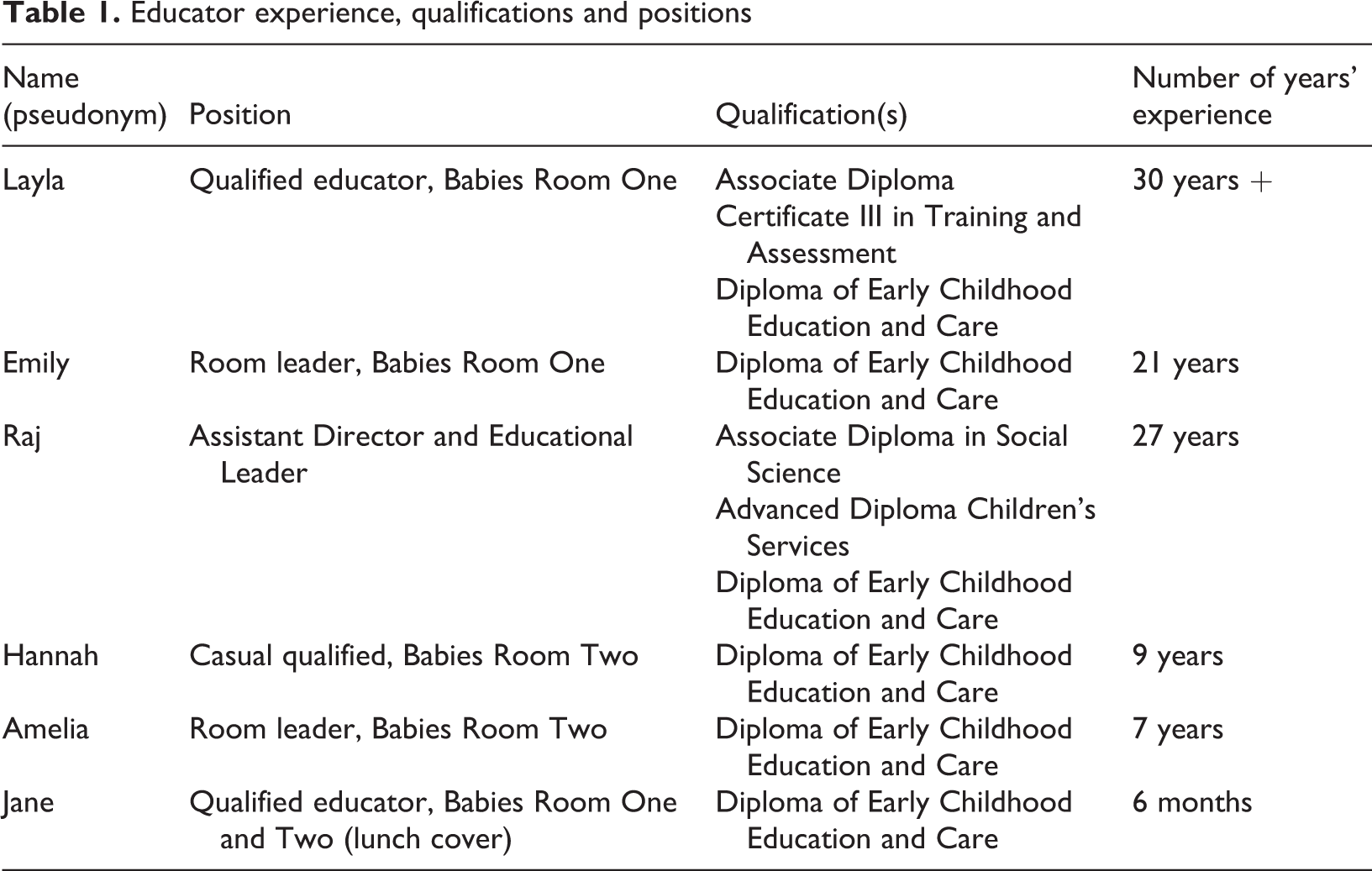
At the end of the Phase One, participants in Perth, Western Australia were invited to express their interest in Phase Two. Perth was selected for geographical convenience as this was where the researcher was located. To maintain anonymity, interested participants were given a second link to provide their service contact details. In total, 28 expressions of interest were received, and the researcher chose by placing all service names in a hat and drawing one at random. Six educators working directly with infants/toddlers participated, with further information documented in Table 1.
Educator experience, qualifications and positions
Data collection
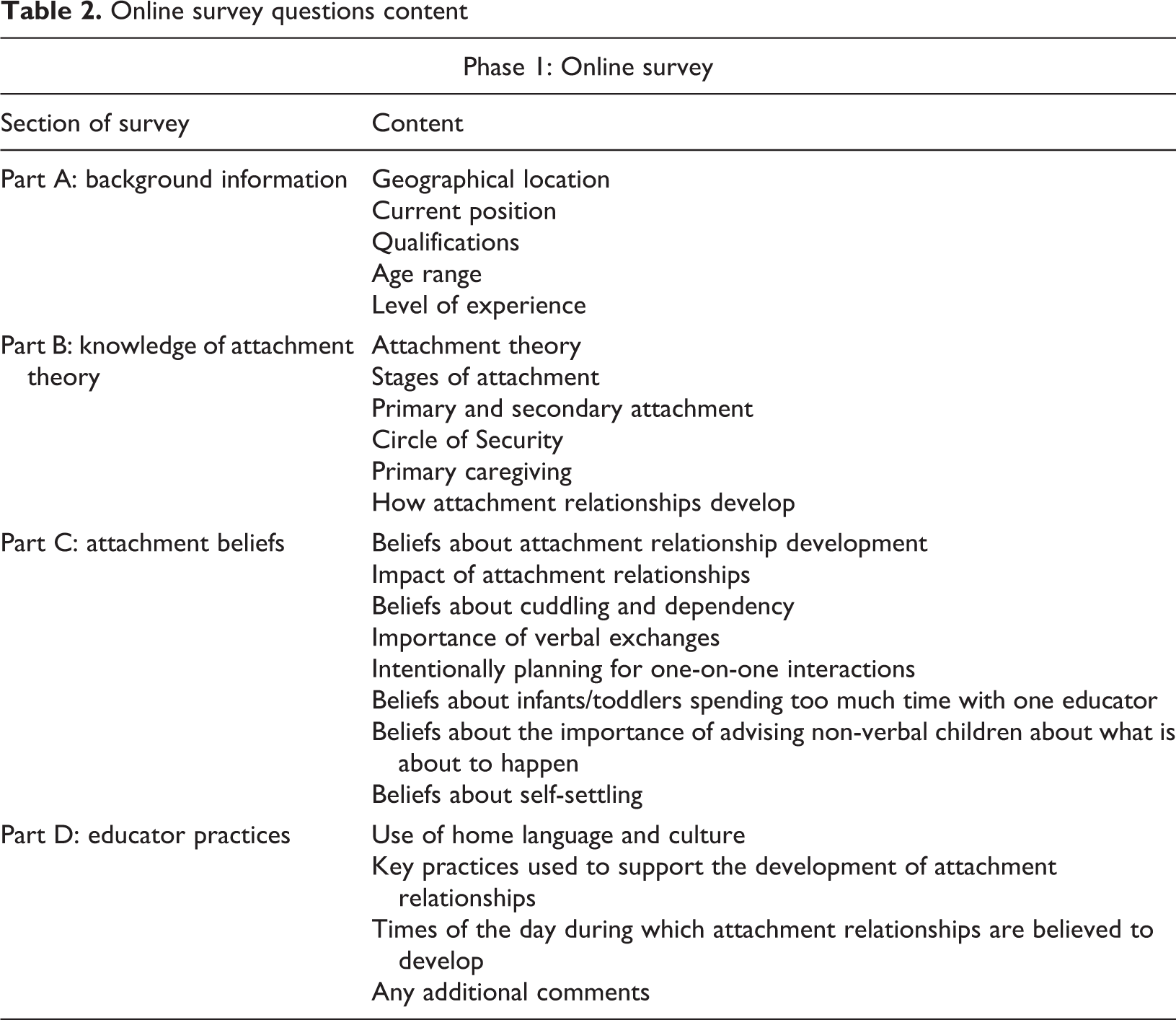
Phase One data were collected through an anonymous online survey using Qualtrics, a survey development and analysis software. The survey was available for four weeks and consisted of 29 questions grouped into four sections outlined in Table 2. Questions asked in Part A: background information were for the purpose of data analysis for statistical differences between the different groups. Part B sought to gain an understanding of educators’ knowledge and of key attachment concepts. In Part C, respondents were asked questions to understand their beliefs about the features of supportive attachment relationships such as spending time with an infant/toddler, responsiveness and supporting infants/toddlers to initially develop a relationship with one and then more educators. Part D questions aimed to ascertain the practices that educators utilised to support the development of attachment relationships.
Online survey questions content
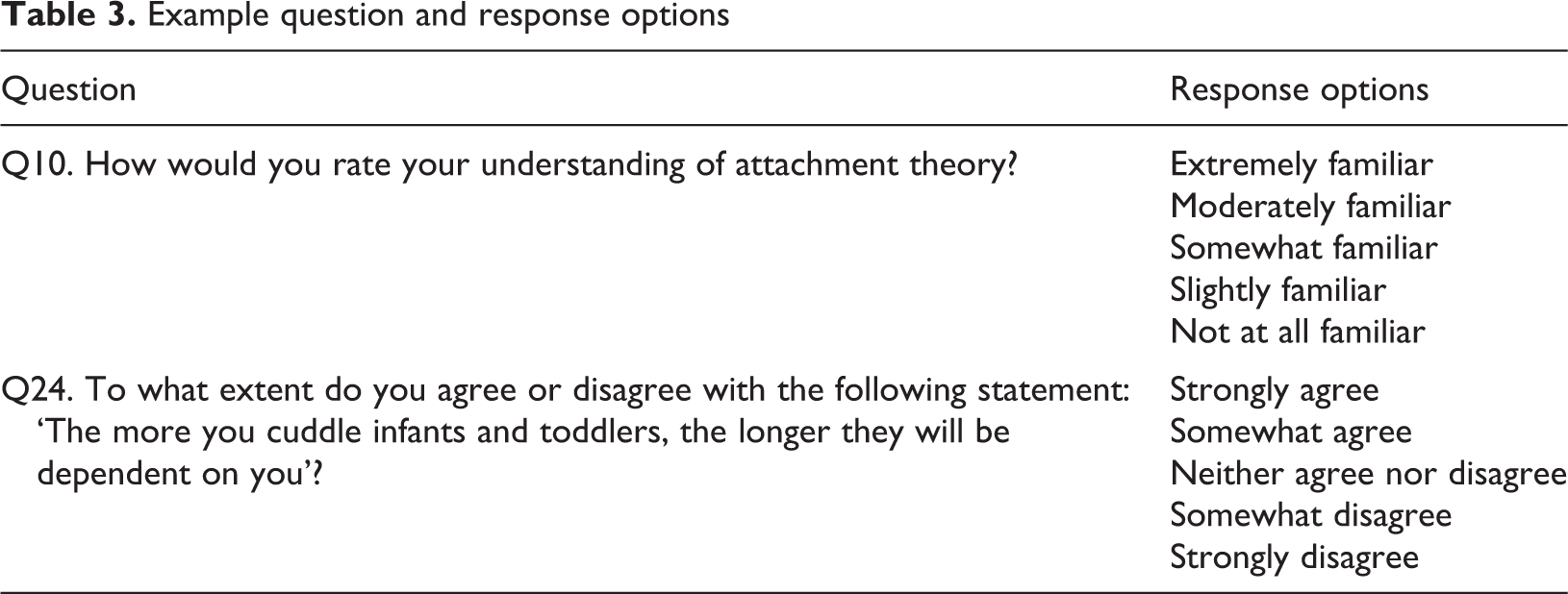
The survey consisted of a mix of open-ended and closed-ended questions and five-point Likert scale questions were used at various stages to elicit the participants’ perceptions and attitudes towards various a statement. Examples of questions and response options are provided in Table 3.
Example question and response options
Semi-structured interviews were held at the service, varying in duration from 20 minutes to one hour and were recorded using an application on the researcher’s mobile phone. Interview questions were based on the online survey questions and indicators from the relationships scale of Reflect, Respect, Relate, a tool designed to assess the quality of relationships in ECEC settings (Department of Education and Children’s Services (DECS), 2008). The relationships scale focuses on the quality characteristics of the relationship between educators and children and comprises of four signals relating to supportive relationships: responsiveness, positive interactions, quality verbal exchanges and appropriateness. Questions were open-ended to extend on initial survey findings and clarify concepts and practices that participants had pointed to, permitting the emergence of previously unidentified perspectives (Adams & Cox, 2008). During the interview, participants were asked to provide their opinion on results from three quantitative questions asked in the survey.
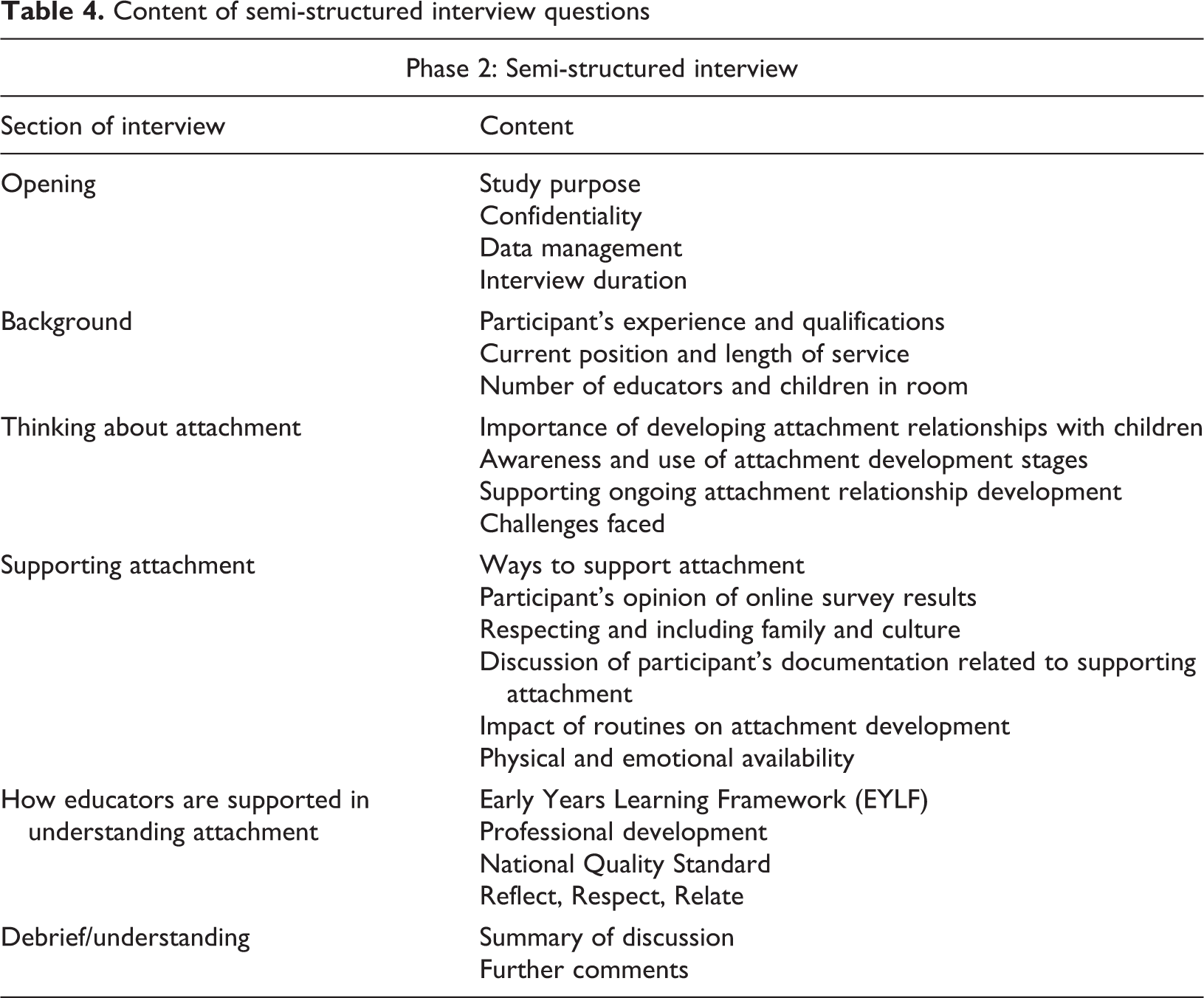
The semi-structured interview had five sections, which are documented in Table 4. The questions asked in the background section were to support data analysis for statistical differences between different educators and the rooms in which they worked.
Content of semi-structured interview questions
Analysis
Phase One data were analysed through Qualtrics software, which allowed the researcher to generate reports and tables. The data were collated under each of the survey questions and the researcher was able to filter the results by age, qualification and level of experience to ascertain any emerging trends. Qualtrics was used to create graphs as a visual representation of the quantitative data and allowed the researcher to search for key words or phrases and code the qualitative data by theme. Categorised themes were then re-examined and combined to reduce overlap.
Phase Two semi-structured interview data were transcribed and uploaded for analysis into NVivo, a qualitative data analysis software. Interviews were read multiple times to code key concepts and identify emerging themes then compared with other interview transcripts to identify common themes.
Ethical considerations
Ethics approval was granted by the Edith Cowan University Human Research Committee (approval 17490) and the Australian Government National Statement on Ethical Conduct in Human Research (2007- Updated 2018) prior to study commencement. To ensure informed consent in the online survey, page one contained an information letter outlining the purpose of the study with participants required to select ‘I agree’ to proceed. Informed consent was sought for semi-structured interview participants prior to commencing.
Findings and Discussion
What are early childhood educators’ knowledge and understanding of how early attachment relationships develop?
This section reports findings related to educators’ knowledge and understanding of how early attachment relationships develop. It relates to research question one: ‘What are early childhood educators’ knowledge and understanding of how early attachment relationships develop?’. Online survey participants rated their familiarity with attachment theory on a five-point Likert scale rating from not at all to extremely familiar. In total, 91% of educators reported being familiar with attachment theory, and of these, 60% had either moderate or extreme familiarity. All semi-structured interview participants reported being aware of attachment theory. Of online survey respondents working with infants/toddlers, 9% had not heard of attachment theory and 11% had heard of attachment theory with slight familiarity. The data were considered in relation to the qualifications, ages and experience of the respondents; however, no significant difference was found. Although a group of participants was unaware of the term attachment, they may have supported attachment relationships through their practices regardless. Thus, the interpretation and understanding of attachment could be based on different perspectives, including educators’ own personal attachment experiences. This view is confirmed by Rolfe (2004), who proposed attachment relationship quality can be influenced by an educator’s own childhood attachment experiences.
Stages of attachment development
Of the online survey respondents, 42% claimed to be either extremely or moderately familiar with stages of attachment. Educators were invited to describe their understanding of the stages of attachment development in their own words, to further elicit their knowledge and understanding of attachment. A total of 57 comments acknowledged the four stages of attachment development, and the names of each of the stages were consistent with either Ainsworth et al.’s (1979/2014) or Schaffer and Emerson’s (1964) stages of attachment development. Ainsworth et al. (1979/2014) proposed the following four stages: (1) pre-attachment; (2) attachment in the making; (3) clear-cut attachment; and (4) goal-corrected partnership. Shaffer and Emerson (1964) proposed four similar stages: (1) asocial; (2) indiscriminate attachment; (3) specific attachment; and (4) multiple attachment.
All six educators who participated in the semi-structured interviews were aware of the stages of attachment and listed stages consistent with Ainsworth et al. (1979/2014). The educators articulated their use of these stages in their practice with infants/toddlers.
It appeared that in both the online survey and the semi-structured interviews, educators identified characteristics of stages of attachment development. Respondents to the online survey recognised characteristics including ‘stranger anxiety’, ‘separation anxiety’ and the development of primary and subsequently secondary attachment relationships. In the semi-structured interviews, Raj, the educational leader at the participating ECEC service, proposed that the characteristic of separation anxiety was a critical aspect of early development. Jane, a diploma-qualified educator who covered lunches in both rooms of the participating service, suggested this period of development occurred typically between 9–12 months of age and could be difficult in terms of separation anxiety, as at this point, she believed infants had developed a strong bond with their parents. Although acknowledging this was a common occurrence, she considered this separation anxiety was a form of trauma.
Separation anxiety, stranger anxiety and the development of primary and subsequent secondary attachment figures are characteristics typical of the third stage of attachment development (Bowlby, 1969). He suggested that in this third stage, typically between six and 24 months of age, stranger and separation anxiety begin to emerge and infants develop primary and subsequent secondary attachment relationships. This would suggest that educators are aware of the characteristics of the more visible attachment phase. It may also suggest they are unaware of the preceding and proceeding stages, or do not have a ‘formal’ definition of these stages. This has implications for educators in understanding the continuum of attachment development to support a child through each of the stages.
Primary and secondary attachment figures
In the online survey, educators were asked to describe their understanding of primary and secondary attachment figures. The concept of this primary attachment figure being a lifelong bond was expressed by 18 educators, which echoes Bowlby’s (1969) emphasis on the enduring nature of the primary attachment bond.
Educators defined secondary attachment figures as extended family and close family friends, viewing themselves as secondary attachments in an ECEC setting. Bowlby (1969) considered these secondary attachments as special bonds with whom infants develop a close relationship, but also highlighted that these attachment relationships can vary in both quantity and quality. When defining secondary attachment figures, educators made no mention of longevity in relation to the secondary attachment figure.
Some online survey respondents reported they considered themselves ‘primary caregivers’ as opposed to secondary attachment figures. This concept of primary caregivers as educators is consistent with the concept of primary caregiving proposed by Colmer et al., who describe how at home, the parent is the primary caregiver, however, in the ECEC setting, the primary caregiver is the educator (2011). Ebbeck, Phoon, Tan-Chong, Tan, and Goh (2015) proposed that primary caregiving is one of the key determinants of a secure attachment relationship between educators and children. Semi-structured interview participants did not mention the concept of secondary attachment figures but spoke about the primary caregiver as an educator within the ECEC setting.
Educators being supported in their understanding of attachment development
To further examine the support educators may have received to enhance their understanding of how early attachment develops, semi-structured interview respondents were asked how they felt supported in their understanding of attachment development through the EYLF (DEEWR, 2009) and National Quality Standard (ACECQA, 2017). One of the semi-structured interview participants, Emily, reflected on support offered by the EYLF in understanding attachment relationships, changing her mind while answering the question: ‘I think…yes, it does…but. It is one’s own personal knowledge that actually defines it and what we have been taught through development, which I don’t believe that all students are actually taught through development units—about attachment and all the theorists, not enough work is done, cos, for infants especially that’s where it starts. All children, it is a very big part, so no I do not think it does.’
None of the educators participating in the semi-structured interviews had attended or were aware of professional development specifically relating to attachment theory within ECEC settings or reported receiving training as part of their studies. All, however, expressed an interest in participating in professional learning relating to attachment theory. Raj voiced her disappointment that ‘most of the training is Sydney/Melbourne based…we need a lot more. A lot more to be actually based this side here. We are very limited with training in our state’.
Hannah shared that she enjoyed attending professional development, reflecting that ‘there’s always room for improvement’. She disclosed that she would like to engage in additional professional development to ‘better, explain myself as to—I guess I can’t explain myself so well because maybe I don’t have a firm understanding as to why I do things, I just know I do them’.
At the end of both the online survey and semi-structured interviews, participants were invited to provide further comments. In total, 55 educators provided further comments at the conclusion of the online survey, of which 18 (33%) related to initial qualifications and ongoing professional development on the topic of attachment. Within these comments, a strong theme related to how educators were supported in their understanding of attachment development, with online survey participants suggesting more work was required to fully support educators in their understanding.
One educator commented: ‘I am really pleased to hear of further research in this area. As a graduate from a four-year bachelor in Early Childhood Education, I entered the early childhood profession with a limited understanding of infants and toddlers as I feel the course content was strongly focused on the three to five age group.’
The AAIMH (2013) recommend ongoing focused training for educators working with infants as part of high-quality care to support their knowledge and understanding of attachment theory.
What are early childhood educators’ beliefs around attachment relationships?
This section reports on key findings based on research question 2. To ascertain educators’ beliefs about attachment relationships, survey participants were asked to respond to statements related to the four signals of relationship quality from Reflect, Respect, Relate (DECS, 2008), which are documented in Table 5.
Questions relating to educator beliefs
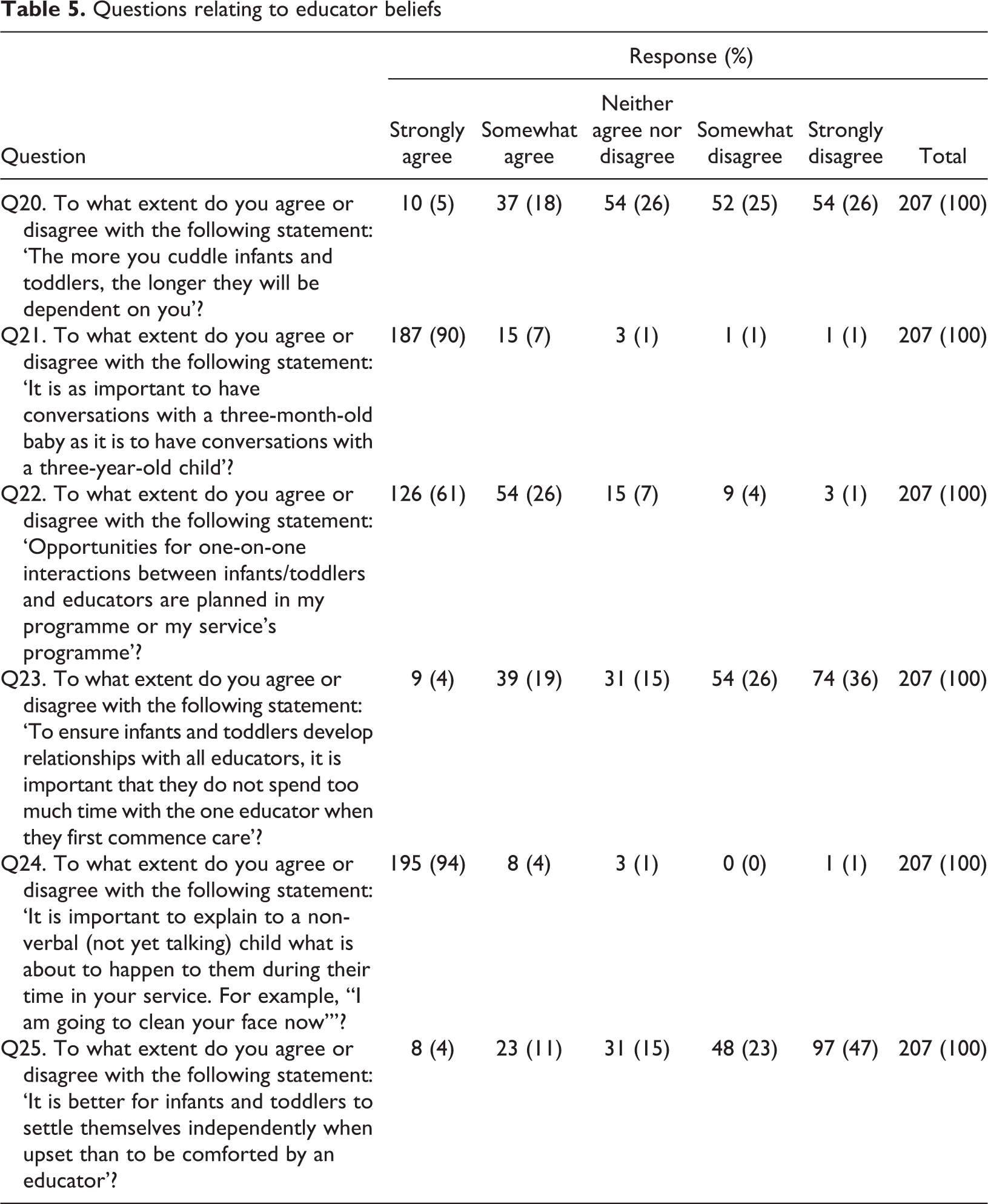
The data were considered in relation to the qualifications, ages and experience of the respondents; however, no significant difference was found. Based on initial survey findings, emerging themes were extended in more detail through semi-structured interviews. Three key themes are documented in the proceeding paragraphs.
Dependency
Bowlby consciously used the term ‘attachment’ to move away from the term dependency, which was historically used to explain attachment behaviours (1969). Defined as ‘seeking and maintaining proximity to another individual’ (Bowlby, 1969, p. 194), attachment behaviours allow infants to stay close to their attachment figure. Online survey participants rated their level of agreement with a statement about the relationship between affection and dependency and 52% of educators somewhat or strongly disagreed the more an infant/toddler was cuddled, the longer they would be dependent on an educator. In total, 23% somewhat or strongly agreed with this statement. This is a significant number of educators believing dependency is linked to physical affection. However, it can be argued this finding can be interpreted in either a positive or negative manner, as each educators’ perspective of dependency could differ.
The semi-structured interview participants were asked their opinion on the survey responses relating to dependency. Educators expressed a variety of perspectives, with Emily and Hannah considering dependency as a positive and essential requirement for infant/toddler care. Amelia argued that dependency was not ‘good’ in group care as many children require one educator’s support. Raj argued that the physical cuddling of children did not create a relationship of dependency, but a relationship of trust. Jane believed it was important to consider each child’s varying needs but proposed it was unfeasible in group care to provide physical affection to children at all times. It was interesting to note, however, that when speaking about one particular child in her room at a later stage of the interview, Jane shared that she would cuddle this child on demand. Bowlby (1969) defined dependency positively, proposing it led to independence in later life. He maintained that securely attached infants seeking contact with their attachment figures for reassurance will be more self-reliant than insecurely attached infants.
Planning for one-on-one time
Spending one-on-one time with children is one of the indicators of positive interactions, one of the four signals of the relationship tool within Reflect, Respect, Relate (DECS, 2008). Of survey respondents, 87% either somewhat or strongly agreed that they planned for one-on-one time within their programme, with 5% somewhat or strongly disagreeing. All semi-structured interview participants reported planning for one-on-one time when an infant/toddler first commenced at the setting to support their sense of security in the new environment. Interestingly, it appeared their perspective changed once infants/toddlers were settled. One educator believed that once an infant/toddler appeared secure they should be encouraged to develop relationships with other educators, with several suggesting they should be actively discouraged from spending too much time with one educator to avoid the infant/toddler becoming upset, for example, when an educator went on holiday or left the service.
Self-settling
Responsiveness relates to how educators respond to children’s needs through their physical and emotional availability in a respectful, prompt and sensitive manner and is a signal of a quality relationship. Responsive educators follow children’s cues and distressed children are comforted quickly (DECS, 2008) rather than encouraged to self-settle.
Findings suggest the sector holds diverse and complex perspectives relating to self-settling. In total, 15% of online survey educators either ‘somewhat agreed’ or ‘strongly agreed’ that it was better for infants/toddlers to self-settle when upset rather than being responded to by an adult. Overall, 70% either somewhat or strongly disagreed with this statement. When asked their opinion of these survey results, most semi-structured interview participants believed infants/toddlers needed the physical and emotional responsiveness of a trusted educator within a safe and secure environment. Educators discussed the realities of group care, sharing how they would prioritise which child to respond to first when distressed, depending on their needs. The belief of some educators that self-settling was better than being comforted when distressed contradicts Ebbeck et al.’s claim that educators’ responsiveness to young children’s distress contributes to the development of attachment relationships (2015).
Limitations
As with any study, there are limitations and constraints. The first limitation was the participation of just one ECEC setting in Western Australia participating in the semi-structured interviews. Semi-structured interview participants had been provided with the interview questions in advance and would have had an opportunity to familiarise themselves with the concepts, which may have affected their responses. The setting’s expression of interest to participate may also indicate attachment theory was a topic with which they were familiar and had experience in and again may have affected the positivity of their responses. Therefore, although findings may be applicable to some ECEC settings, they cannot be generalised to all.
Conclusion
The purpose of the NQF is to provide all children with high-quality ECEC in the years of life considered critical in laying down the foundation for future development (ACECQA, 2017). Secure attachment relationships support this, and consequently, educators need to understand how to develop attachment relationships with infant/toddlers. The study findings contribute to a small but growing body of research on attachment theory and practice in ECEC settings. If attachment relationships between educators and infant/toddlers are integral to quality ECEC, then the findings also have implications for how ECEC settings consider how they measure the quality of their relationships. Defining educators’ practices that support attachment development also warrants further investigation, as does consideration to how educators operationalise attachment theory in practice in ECEC settings.
This study is unique in that it investigated attachment theory from educators’ perspectives rather than a psychological lens. The dilemma faced is how to support educators to understand and embed this information into practice, while considering the realities of group care within an ECEC setting.
Footnotes
Declaration of conflicting interests
The author(s) declared no potential conflicts of interest with respect to the research, authorship, and/or publication of this article.
Funding
The author(s) received no financial support for the research, authorship, and/or publication of this article.