




Abstract
Economic inequality has been increasing as a global trend and has profound implications for subjective well-being. However, the affective dimension of subjective well-being remains relatively underexplored. The present research aimed to understand the psychological impact of economic inequality on individuals’ affect and the underlying mechanisms. We hypothesized that economic inequality would decrease positive affect and increase negative affect. Across three experimental studies (N = 450), we found strong evidence that high economic inequality increased negative affect, but had no significant effect on positive affect. Moreover, we examined income as a moderating variable and found that income did not moderate the effects of economic inequality on either positive or negative affect (Studies 1 and 2). Regarding potential mechanisms, we focused on cognitive factors, as they represent the immediate psychological processes through which inequality-related information is interpreted and given meaning. Specifically, the present study examined three cognitive factors: system justification beliefs, social comparison, and attributions for inequality. The results showed that system justification beliefs explained the effects of economic inequality on both positive and negative affect, such that awareness of high economic inequality weakened system justification beliefs, which in turn elicited lower positive affect and stronger negative affect (Study 3). However, social comparison (Study 2) and attributions for inequality (Study 3) did not account for the effects of economic inequality on either positive or negative affect. These findings contribute to the literature by establishing the causal effect of economic inequality on negative affect and by identifying a mediating mechanism that accounts for the relationship between economic inequality and both positive and negative affect.
Keywords
Introduction
In the past 40 years, economic inequality has been increasing as a global trend (Saez & Zucman, 2016; Solt, 2020). One of the major consequences of economic inequality posited by theorists is its impact on subjective well-being (Buttrick & Oishi, 2017; Du, 2024; Wilkinson & Pickett, 2019). Researchers in diverse fields have tested this relationship, including those in psychology (Du, King et al., 2019; Oishi et al., 2011), sociology (Delhey & Dragolov, 2014; Kelley & Evans, 2017), public health (Koyama & Fujiwara, 2023), and economics (Alesina et al., 2004; Ferrer-i-Carbonell & Ramos, 2014). Many studies have provided supportive evidence of a negative relationship between economic inequality and subjective well-being (for reviews, see Buttrick et al., 2017; Ferrer-i-Carbonell & Ramos, 2014; Wilkinson & Pickett, 2019). However, positive or null associations between economic inequality and subjective well-being have also been reported in a number of studies (Cheung, 2016; Fahey & Smyth, 2004; Kelley & Evans, 2017; Rözer & Kraaykamp, 2013; Senik, 2004; Sommet & Elliot, 2022). This inconsistency is also reflected in meta-analytic reviews that have yielded divergent findings on the relationship between economic inequality and well-being (Ngamaba et al., 2018; Patel et al., 2018; Ribeiro et al., 2017). A key limitation underlying these mixed findings is that almost all studies are correlational. Although recent longitudinal findings (Du et al., 2024; Du, King et al., 2019; Elgar et al., 2017) have strengthened our confidence in the negative implications of economic inequality, the correlational nature of the data cannot rule out the potential effects of unmeasured factors. This methodological gap points to a need for experimental work that can control for potential third variables, which may yield a clearer and more robust pattern of findings.
To our knowledge, only two studies have employed experimental designs to examine the impact of economic inequality on well-being. However, these studies either focused solely on the cognitive aspect of well-being (i.e., life satisfaction; Liu et al., 2024) or examined affective outcomes without testing potential underlying mechanisms (Stancato et al., 2024). Therefore, the current research addresses these gaps by experimentally investigating the causal effect of economic inequality on affect, and examining several different mediator variable candidates.
The Relationship Between Economic Inequality and Affect
Subjective well-being reflects people's appraisals and evaluations of their lives and encompasses two aspects: cognitive and affective. The cognitive dimension is conceptualized as life satisfaction, involving global judgments about one's life as a whole; whereas the affective dimension represents emotional responses to daily life experiences, encompassing both positive and negative emotions (Diener, 1984; Du et al., 2017; Kahneman et al., 2004). Although both dimensions reflect individuals’ responses to events and circumstances in their lives (Diener et al., 2018), life satisfaction is more strongly associated with stable life circumstances such as income, while emotional well-being is more sensitive to immediate situational experiences (Kahneman & Deaton, 2010). Accordingly, one might expect emotions to be more responsive to experimental manipulations of economic inequality. Indeed, previous research has shown that exposure to situational economic inequality is associated with a higher incidence of air rage on flights (DeCelles & Norton, 2016) and with less positive emotion during social interactions (e.g., joy and gratitude; Stancato et al., 2024). The current research therefore used emotion (i.e., positive affect and negative affect) — the affective aspect of well-being — as an indicator to examine the causal effect of economic inequality on subjective well-being.
Rising income inequality makes status hierarchies between different social groups increasingly salient and distinct (Sommet & Elliot, 2023a), with higher-class individuals possessing greater resources to buffer against economic risks (Jachimowicz et al., 2020), while lower-class individuals typically facing scarcity and diminished resilience to economic vulnerabilities (Sommet et al., 2018). Given these differential vulnerabilities to economic risks, the affective impact of inequality may vary by social class. Social class can be operationalized in several ways, including wealth, income, education, occupational prestige, and subjective socioeconomic status (Adler et al., 2000; Cohen et al., 2017; Hout, 2008). Indeed, previous research focusing on the income dimension of social class has found that, among individuals living in high inequality regions, lower-income groups experience lower levels of subjective well-being and higher levels of depressive symptoms, while higher-income groups experience no such decline in well-being (Du, Chi et al., 2019; Oishi et al., 2011). As an exploratory analysis 1 , we examined whether social class—operationalized through income —moderated the effects of inequality on affect. Specifically, participants were informed of their salary level in a virtual clothing company scenario, which served as an indicator of their income-based social class position within the organization (Benedetti & Chen, 2018).
Mediators of the Relationship Between Economic Inequality and Affect
The current research also aimed to uncover psychological mechanisms underlying the effect of economic inequality on affect. Although various mechanisms (e.g., status anxiety, perceived competitiveness) may contribute to the effect of inequality (Melita et al., 2023; Sommet & Elliot, 2023a), we focus on cognitive factors because they represent the immediate psychological processes through which inequality information is interpreted and given meaning. Recent evidence suggests that economic inequality shapes individual thoughts and beliefs, such as perceptions of what people need and what they consider to be fair rules and outcomes (Goya-Tocchetto & Payne, 2022), while individual cognitions are closely linked to emotional responses (Pessoa, 2008). Therefore, cognitive processes are likely to account for the relationship between economic inequality and affect. In the current research, we investigated three key cognitive factors that are particularly relevant to economic inequality: upward social comparison, which involves comparing oneself to those who are better off financially and shapes what one believes to be “enough” (Galvan & Payne, 2024; Melita et al., 2023); system justification beliefs, which reflect broad ideological orientations about the legitimacy and fairness of the existing system (Kay & Jost, 2003); and attributions for inequality, which capture individual beliefs about the causes of economic success or failure (Davidai, 2018).
First, social comparison has been theorized to account for the effect of economic inequality on subjective well-being (Cheung & Lucas, 2016; Du et al., 2024). Economic inequality encourages people to categorize their social world into the “haves” and the “have-nots” (Peters et al., 2022), develop mindsets that emphasize competition and achievement (Du et al., 2022; Sommet & Elliot, 2023b), and shift their focus toward relative income (Kim & Sommet, 2023). This dynamic fuels social comparison thinking, prompting people to evaluate their economic standing relative to others (Chen et al., 2021; Cheung & Lucas, 2016). Although people may compare their wealth relative to wealthier individuals (upward social comparison), poorer individuals (downward social comparison), and those who have similar wealth (lateral social comparison), higher levels of economic inequality particularly leads to stronger upward social comparison, due to the heightened visibility of income disparity and the desire to meet personal needs (Cheung & Lucas, 2016; Liu, Wu, et al., 2025; Payne et al., 2017; Sommet & Elliot, 2023a). Additionally, economic inequality fosters a sense of relative deprivation (Liu et al., 2024), which is closely linked to upward social comparison rather than downward or lateral comparisons (Gheorghiu et al., 2021). Such upward comparison means that the standards for “enough” are likely to always be out of reach, leading to persistent feelings of being left behind (Goya-Tocchetto & Payne, 2022); this is associated with poorer well-being (Du et al., 2024) and may evoke various negative emotions, like envy and contempt (Fiske et al., 2007). Therefore, we hypothesized that upward social comparison would mediate the effect of economic inequality on affect, reducing positive affect and increasing negative affect. However, for a more comprehensive picture, we also explored whether other comparison types (i.e., general comparison, downward comparison, and lateral comparison) play a significant role, without offering a priori predictions.
Second, system justification may mediate the impact of economic inequality on affect. People in more unequal societies may perceive social reality as more unfair. Survey research has shown that residents in the U.S. perceive more unfair treatment from others during time periods with higher economic inequality (Oishi et al., 2011). Further, when individuals perceive economic inequality, they not only become more aware of unfair treatment from others, but also come to view the system as unfair in general (Barreiro et al., 2019). System justification theory proposes that people are motivated to defend and justify existing social, economic, and political systems, even when such systems may be disadvantageous to them. Importantly, system justification beliefs serve a palliative function in that they reduce depression, dissonance and uncertainty, and increase positive affect and satisfaction (Jost et al., 2008; Jost & Hunyady, 2003). Goudarzi et al. (2020) found that participants who regarded the economic system as justified, compared with those who did not, experienced lower levels of autonomic arousal and reported feeling less negative affect after watching videos depicting homelessness. Building on these findings, we proposed that system justification beliefs may serve as a key psychological mechanism in the relationship between economic inequality and affect. Specifically, when economic inequality is salient, individuals may find it increasingly difficult to maintain system justification beliefs. As these beliefs weaken, people are more likely to view the system (e.g., country, society, company) as unfair, thereby experiencing reduced positive affect and increased negative affect.
Third, attributions for economic inequality may also mediate the relationship between economic inequality and affect. Individuals can attribute financial success and failure to internal dispositions (e.g., hard work, ability, talent) or external factors (e.g., luck, social relationship, economic system). Prior studies showed that people tend to attribute success and failure to external factors such as luck and policies when economic inequality is salient (Davidai, 2018; García-Castro et al., 2020). This is consistent with findings that rising inequality is associated with weakened meritocratic beliefs—reduced conviction that individual effort leads to success (Bartram, 2023). Importantly, these attributions have implications for emotional responses. Research demonstrates that when participants are asked to indicate the causes of poverty, internal attributions for poverty elicit negative affect, such as anger toward the poor, whereas external attributions generate positive affect, such as sympathy and compassion (Cozzarelli et al., 2001; Osborne & Weiner, 2015); this is likely because external attributions frame poverty as stemming from uncontrollable circumstances rather than personal failings. In contrast, Davidai (2018) examined attributions for wealth and poverty (i.e., the causes of both financial success and failure) and found that external attributions activated by rising economic inequality reduced one's hope for the future (e.g., weaker beliefs in upward mobility), which may increase dissatisfaction with current circumstances, decrease positive affect and increase negative affect. Given that we focused on attributions for inequality—explaining the income gaps between employees—more closely align with Davidai's approach of examining attributions for both ends of the economic spectrum rather than with research on poverty attributions alone, we hypothesized that economic inequality would activate more external attributions for inequality, which would reduce positive affect and increase negative affect, while also exploring the moderating role of internal attributions without specific directional predictions.
The Present Research
The present research aimed to investigate the causal relationship between economic inequality and emotions (i.e., positive affect and negative affect) and examines whether social comparison, system justification beliefs, and attributions mediate the relationship between economic inequality and affect. We hypothesized that rising economic inequality would reduce positive affect (H1) and increase negative affect (H2). These effects would be mediated by stronger upward social comparison (H3), weakened beliefs in system justice (H4), and more external attributions for inequality (H5). We also explored whether the income level modulates the relationship between economic inequality and affect, but did not formulate specific hypotheses given mixed findings in the existing literature (Du et al., 2024; Du, King et al., 2019; Oishi et al., 2011).
We conducted three studies to test these hypotheses. Study 1 tested the causal relationship between economic inequality and emotions; specifically, we manipulated economic inequality and examined its effects on positive affect and negative affect. Studies 2 and 3 aimed to replicate the effects of economic inequality on positive affect and negative effect. Moreover, we examined social comparison (Study 2), system justification beliefs (Study 3), and attributions for inequality (Study 3) as potential mechanisms in the relationship between economic inequality and affect. In addition, we explored whether the effect of economic inequality on affect would be different for high- and low-income individuals in Studies 1 and 2.
In all studies, we manipulated economic inequality by using a company scenario where participants were told that they worked in a department with different monthly salary levels. The structure of income distribution varied by condition. The current research was reviewed and approved by the Institutional Review Board at the corresponding author's university. Complete materials, raw data, and scripts reproducing the findings are available via the OSF: https://osf.io/e95st/overview.
Study 1
Study 1 aimed to test the hypothesis that economic inequality decreases positive affect and increases negative affect. We also examined the potential moderating effect of income level.
Methods
Participants
Participants were students at a university in Guangzhou, China. A total of 179 participants completed the study. Six participants who failed the attention checks were excluded, leaving 173 participants (132 females and 41 males) with an average age of 20.39 years (SD = 1.70) in the final sample. We conducted a sensitivity analysis using G*Power (Faul et al., 2009) for a one-way between-subjects ANOVA, focusing on the effect of economic inequality 2 due to its centrality to the research. The analysis showed that the sample size is sufficient to detect a medium-sized effect (η2 = .04) with .80 power (α = .05).
Procedure and Materials
Study 1 used a 2 (economic inequality: high vs. low) × 3 (income: high vs. middle vs. low) between-subjects design. Participants were randomly assigned to one of the six conditions. At the start of the experiment, they read and signed a consent form and then reported their demographic information. Next, participants received the experimental manipulations of economic inequality and social class. Participants read a description of a clothing company, which was adapted from previous research (Benedetti & Chen, 2018). Participants were told that they worked in a department of this company, where there were three employees (including themself). Then, participants were randomly assigned to one of two conditions in which they either read that the gap among the monthly salaries of the employees was large (10,400 vs. 5,100 vs. 1,000 CNY in the high-inequality condition) or small (6,200 vs. 5,100 vs. 4,300 CNY in the low-inequality condition). Participants were also randomly assigned to one of three income level conditions by being told that they had the high, middle, or low income. Following the manipulations, participants answered three multiple-choice questions that served as attention checks (i.e., “What are the products of the company?”, “What is your monthly income?”, and “How many employees does your department have?”), and a manipulation check question: “How large is the income gap among the three employees in your department?” (1 = very small, 7 = very large).
Next, participants were asked to report their emotions using the expanded version of the Positive and Negative Affect Schedule (the PANAS-X; Watson & Clark, 1994), which includes an 18-item subscale for positive affect (e.g., “Please indicate to what extent you are feeling joyful right now”) and a 23-item subscale for negative affect (e.g., “Please indicate to what extent you are feeling afraid right now”). Participants responded on a 1 (not at all or very slightly) to 5 (extremely) scale. The positive affect scores and the negative affect scores were averaged, with higher scores indicating higher positive affect (α = .95) and negative affect (α = .94). Finally, participants were thanked and debriefed.
Results
Manipulation Check
Statistical analyses were conducted in SPSS 26.0. We ran a manipulation check using a 2 (inequality: high vs. low) × 3 (income: high vs. medium vs. low) ANOVA to examine whether participants in the high-inequality condition perceived a more unequal income distribution than those in the low-inequality condition across the three income level conditions. The main effect of economic inequality was significant, F(1,167) = 223.58, p < .001, η2 = 0.57. Participants in the high-inequality condition (M = 5.90, SD = 0.77) perceived a larger income gap than those in the low-inequality condition (M = 3.67, SD = 1.21). The main effect of income was significant, F(2,167) = 6.98, p = .001, η2 = 0.08. Participants in the low-income condition (M = 5.19, SD = 0.13) perceived a larger income gap than those in the middle-income condition (M = 4.61, SD = 0.13; p = .001) and the high-income condition (M = 4.59, SD = 0.13; p = .002), whereas there was no significant difference between the high-income and the middle-income conditions (p = .95). Importantly, the interaction between economic inequality and social class was not significant, F(2,167) = 2.46, p = .089, η2= 0.03, indicating that the inequality manipulation was equally effective across all social class conditions. These results suggest that the manipulation was successful.
Economic Inequality, Social Class, and Affect
Regarding positive affect, a 2 (inequality: high vs. low) × 3 (income: high vs. middle vs. low) ANOVA revealed no significant main effect of inequality, F(1,167) = 2.27, p = .134, η2 = 0.01, such that participants in the high-inequality condition (M = 2.46, SD = 0.08) and the low-inequality condition (M = 2.63, SD = 0.08) did not report different levels of positive affect, which was inconsistent with H1. However, we found a main effect of income, F(2,167) = 20.19, p < .001, η2 = 0.20, such that participants in both the high-income condition (M = 2.85, SD = 0.10; p < .001) and the middle-income condition (M = 2.75, SD = 0.10; p < .001) reported higher positive affect than those in the low-income condition (M = 2.04, SD = 0.10), whereas there was no significant difference between the high-income and the middle-income conditions (p = .45). The interaction effect was not significant, F(2,167) = 0.49, p = .615, η2 = 0.01.
Regarding negative affect, the ANOVA revealed a main effect of inequality, F(1,167) = 4.95, p = .027, η2 = 0.03, such that participants in the high-inequality condition reported higher negative affect (M = 1.89, SD = 0.06) than those in the low-inequality condition (M = 1.70, SD = 0.06; p = .027), which was consistent with H2. The main effect of income was also significant, F(2,167) = 13.97, p < .001, η2 = 0.14, such that participants in both the high-income condition (M = 1.51, SD = 0.08; p < .001) and the middle-income condition (M = 1.81, SD = 0.07; p = .010) reported lower negative affect than those in the low-income condition (M = 2.08, SD = 0.08). Moreover, participants in the high-income condition reported lower negative affect than those in the middle-income condition (p = .006). However, there was no significant interaction effect, F(2,167) = 0.32, p = .728, η2 < 0.01.
Discussion
This study showed that when exposed to an environment with high economic inequality, participants experienced increased negative affect, confirming our hypothesis. However, economic inequality did not significantly influence positive affect, which is inconsistent with our hypothesis.
Although economic inequality has differential impacts on subjective well-being across income levels in correlational studies (Du, King et al., 2019; Oishi et al., 2011), we did not observe such a pattern in our experiment. One potential explanation is that we examined only three income groups in Study 1, whereas previous research showing this moderating effect had distinguished five income groups (Du, King et al., 2019; Oishi et al., 2011). Therefore, Study 2 re-examined this question using five income groups and further investigated the underlying mechanisms through which economic inequality impacts affect.
Study 2
Study 2 aimed to conceptually replicate the findings of Study 1. Moreover, Study 2 extended Study 1 by examining whether the effects of economic inequality on affect are accounted for by upward social comparison.
In Study 2, we altered the manipulation of economic inequality used in Study 1 by distinguishing five income levels, in contrast to the three income levels in Study 1. Additionally, Study 1 used the absolute monthly salaries in each income group, which differed between the high-inequality and low-inequality conditions, potentially obscuring our results. To address this limitation, Study 2 employed income proportions, which not only avoided this issue but also allowed for easier comparisons among participants to induce a strong sense of income disparity. Furthermore, Study 2 not only described economic inequality in the text, but also visually depicted it in a pie chart portraying the varying percentages of total salary across five groups; this has been shown to be an effective manipulation of economic inequality in prior work (Côté et al., 2015; Du et al., 2021).
Methods
Participants
Participants were students at a university in Guangzhou, China. The target sample size was set to approximately match that of Study 1. After excluding 9 individuals who failed the attention checks, the final sample consisted of 180 participants (146 females and 34 males), with an average age of 19.88 years (SD = 1.71). As in Study 1, we used G*Power to conduct a sensitivity analysis focused on the one-way between-subjects effect of economic inequality 3 . The analysis showed that the sample size is sufficient to detect a small-sized effect (η2 = .04) with .80 power (α = .05).
Procedure and Materials
Study 2 used a 2 (inequality: high vs. low) × 3 (income: high vs. middle vs. low) between-subjects design. Participants were randomly assigned to one of the six conditions. The procedure was similar to that of Study 1. After providing informed consent and reporting their demographic information, participants received the materials manipulating economic inequality and income level. Participants were told that they worked in a department of a clothing company with five employees, including themselves. While specific income levels were not disclosed, a pie chart adapted from previous research (Côté et al., 2015), depicted the proportional income distribution among the five employees. In the high-inequality condition, the proportions were 81%, 11%, 4%, 3%, and 1%, whereas in the low-inequality condition, they were 30%, 22%, 19%, 16%, and 13%. Participants were randomly assigned to one of the three income level conditions—high, middle, or low—corresponding to the top, middle, or bottom income among these five income groups. Following the manipulation materials, participants answered three attention-check questions and a manipulation-check question. These questions were identical to those used in Study 1, except for the attention-check question on income amount. In Study 2, we modified this question to focus on income rank (high vs. middle vs. low) because Study 2 used income proportions, rather than absolute monthly salary, to indicate social class.
Participants then answered four questions on social comparison by indicating their inclination to compare their income with that of their coworkers on a 1 (strongly disagree) to 5 (strongly agree) scale. The items were adapted from prior research on social comparison (Schneider & Schupp, 2014) and modified to fit the socioeconomic context. One of the four questions asked whether participants tend to compare with their coworkers in general. The remaining three questions asked participants to specifically indicate whether they tend to compare with the coworkers who had higher, lower, and about the same salary, which assessed upward comparison, downward comparison, and lateral comparison, respectively, with higher scores indicating higher social comparison.
Next, participants reported their positive and negative affect using the Positive (α = .93) and Negative (α = .93; Watson & Clark, 1994) Affect Schedule, as in Study 1. Lastly, participants were thanked and debriefed.
Results
Manipulation Check
Statistical analyses were conducted in SPSS 26.0. A manipulation check using a 2 (inequality: high vs. low) × 3 (income: high vs. middle vs. low) ANOVA showed that the main effect of economic inequality was significant, F(1,174) = 103.76, p < .001, η2 = 0.37. Participants in the high-inequality condition (M = 5.93, SD = 0.87) perceived a larger income gap than those in the low-inequality condition (M = 4.40, SD = 1.15). In contrast, the main effect of income, F(2,174) = 2.18, p = .116, η2 = 0.02, and the interaction between economic inequality and income was not significant, F(2,174) = 1.55, p = .216, η2= 0.02, indicating that the manipulation was successful.
Economic Inequality, Social Class, and Affect
Regarding positive affect, a 2 (inequality: high vs. low) × 3 (income: high vs. middle vs. low) ANOVA revealed no significant main effect of inequality F(1,174) = 1.33, p = .250, η2 = 0.01, such that participants in the high-inequality condition (M = 2.50, SD = 0.08) and the low-inequality condition (M = 2.38, SD = 0.08) did not report different levels of positive affect, which was inconsistent with H1 but consistent with Study 1. There was a significant main effect of income, F(2,174) = 11.16, p < .001, η2 = 0.11, such that participants in both the high-income condition (M = 2.70, SD = 0.09; p < .001) and the middle-income condition (M = 2.52, SD = 0.09; p = .002) reported higher positive affect than those in the low-income condition (M = 2.10, SD = 0.09), whereas participants in the high-income and the middle-income condition did not report different levels of positive affect (p = .161). However, the interaction effect was not significant, F(2,174) = 0.12, p = .883, η2 < 0.01.
Regarding negative affect, the ANOVA revealed a significant main effect of inequality, F(1,174) = 10.13, p = .002, η2 = 0.06, such that participants in the high-inequality condition reported higher negative affect (M = 1.80, SD = 0.05) than those in the low-inequality condition (M = 1.56, SD = 0.05; p = .002), which was consistent with H2 and with Study 1. The main effect of income was also significant, F(2,174) = 9.05, p < .001, η2 = 0.09; participants in both the high-income condition (M = 1.49, SD = 0.07; p < .001) and the middle-income condition (M = 1.67, SD = 0.07; p = .022) reported lower negative affect than those in the low-income condition (M = 1.89, SD = 0.07); moreover, participants in the high-income condition reported lower negative affect than those in the middle-income condition (p = .051). However, there was no significant interaction effect, F(2,174) = 1.05, p = .353, η2 = 0.01.
The Mediating Effect of Social Comparison
In light of documented association between income level and affect, income level was entered as a covariate in subsequent analyses 4 . To examine the mechanisms of different types of social comparison, we tested whether the different types of the social comparison (i.e., upward, downward, lateral, and general) mediated the relationship between economic inequality and both positive and negative affect, respectively, including all mediators simultaneously in the two separate models for positive and negative affect. The mediation analyses using Process 4.2 (Hayes, 2022) in SPSS with 10,000 bootstraps (Yzerbyt et al., 2018) are presented in Figures S1a and S1b.
The results showed that the effect of economic inequality on upward comparison was not significant (b = 0.23, SE = 0.15, 95% CI [−0.06, 0.53]). Upward comparison positively predicted negative affect (b = 0.11, SE = 0.05, 95% CI [0.02, 0.20]), but not positive affect (b = −0.03, SE = 0.07, 95% CI [−0.16, 0.11]). The indirect effect of economic inequality on either positive (b = −0.01, SE = 0.02, 95% CI [−0.05, 0.03]) or negative affect (b = 0.03, SE = 0.02, 95% CI [−0.01, 0.08]) through upward comparison was not significant, which was inconsistent with H3. Similarly, we did not find any significant mediation effects of general comparison, downward comparison, and lateral comparison (see details in Table S1). We also examined the mediating role of each type of social comparison separately on the relationship between economic inequality and affect. However, we still found no evidence supporting mediation by any type of comparison in the relationship between economic inequality and affect (ps > .50; see Supplementary Materials).
Discussion
Study 2 replicated the findings of Study 1, demonstrating that economic inequality increases individuals’ negative affect, but not positive affect. Despite the increased differentiation of income groups in this study, we still did not find a moderating role of income in the relationship between economic inequality and affect. Furthermore, social comparison did not explain the influence of economic inequality on either positive or negative affect. Study 3 aimed to examine alternative potential mechanisms that may underlie the effect of economic inequality on affect.
Study 3
In Study 3, we used a simple one-factor between-subjects design (economic inequality: high vs. low) to examine the mediating effects of system justification and attributions on the relationship between economic inequality and affect. Since income did not emerge as a moderator in Studies 1 and 2, we did not include a manipulation of income level in Study 3; all participants were assigned to a middle-income group.
Method
Participants
Participants were students at a university in Guangzhou, China. After excluding 3 individuals who failed the attention checks, the final sample was 97 participants (78 females and 19 males), with an average age of 19.68 years (SD = 2.95). We conducted a sensitivity analysis using G*Power focused on an independent samples t-test examining the effect of economic inequality, which showed that the sample size can detect a medium sized effect (d = .57) in an independent-samples t-test (α = .05, two-tailed), with .80 power.
Procedure and Materials
The Study 3 procedure is similar to Study 2, except that all participants were assigned to the middle-salary position in a department of the clothing company. Following the economic inequality manipulation, participants completed an 8-item system justification scale, which was adapted from Kay and Jost (2003) and modified to suit the scenario (e.g., “In general, the internal system of my company operates as it should”). Participants responded on a 1 (strongly disagree) to 7 (strongly agree) scale, with higher scores indicating higher system justification beliefs (α = .81).
In addition, participants completed an 8-item attribution scale, which was adapted from Chow and Galak (2012) 5 and modified to suit the scenario, including both external attributions (e.g., “In my company, the income gap between employees is attributed to personal luck”; α = .47) and internal attributions (e.g., “In my company, the income gap between employees is attributed to personal ability and talent”; α = .60) of inequality. Participants responded on a 1 (not important at all) to 7 (very important) scale, with higher scores indicating greater emphasis on either external or internal attributions.
Next, participants reported their positive affect and negative affect using the Positive (α = .93) and Negative (α = .93; Watson & Clark, 1994) Affect Schedule. Finally, participants were thanked and debriefed.
Results
Manipulation Check
Statistical analyses were conducted in SPSS 26.0. A manipulation check showed that participants in the high-inequality condition perceived a larger income gap (M = 5.67, SD = 0.75) than those in the low-inequality condition (M = 4.47, SD = 1.17), t(95) = 5.96, p < .001, d = 1.22, which indicates that the manipulation of inequality was successful.
Economic Inequality and Affect
We examined whether economic inequality influenced participants’ affect. We found that participants in the high-inequality condition (M = 2.34, SD = 0.72) and the low-inequality condition (M = 2.29, SD = 0.56) did not report different levels of positive affect, t(95) = 0.39, p = .694, d = .08, which was inconsistent with H1 but consistent with Studies 1 and 2. In contrast, participants in the high-inequality condition (M = 1.77, SD = 0.52) reported higher negative affect than those in the low-inequality condition (M = 1.46, SD = 0.43), t(95) = 3.20, p = .002, d = 0.65, which was consistent with H2 and with Studies 1 and 2.
The Mediating Effect of System Justification Beliefs
We examined the mediating role of system justification beliefs in the relationships between economic inequality and both positive and negative affect. The mediation analyses used Process 4. 2 (Hayes, 2022) in SPSS with 10,000 bootstraps (Yzerbyt et al., 2018), and the results are presented in Figures 1(a) and (b).
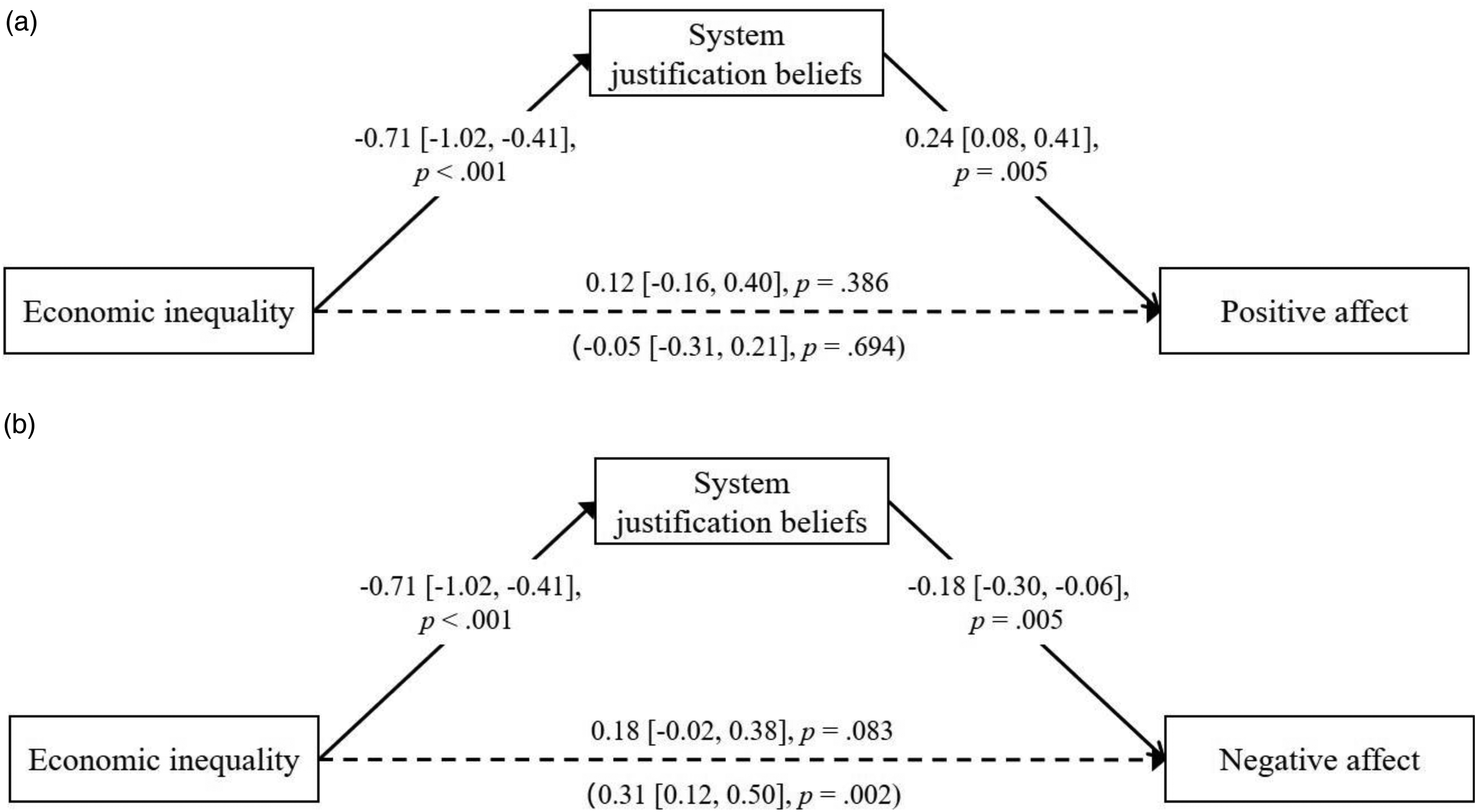
(a) Study 3: Results of the mediating role of system justification beliefs in the relationship between economic inequality and positive affect. Note. The results above the path between economic inequality and positive affect represent the influence of economic inequality on positive affect via system justification beliefs; the results below the path represent the direct influence of economic inequality on positive affect. Numbers in brackets reflect 95% confidence intervals and round brackets reflect the total effect of economic inequality on positive affect. Significant paths are in bold; dashed lines reflect non-significant paths. (b) Study 3: Results of the mediating role of system justification beliefs in the relationship between economic inequality and negative affect. Note. The results above the path between economic inequality and negative affect represent the influence of economic inequality on negative affect via system justification beliefs; the results below the path represent the direct influence of economic inequality on negative affect. Numbers in brackets reflect 95% confidence intervals and round brackets reflect the total effect of economic inequality on negative affect. Significant paths are in bold; dashed lines reflect nonsignificant paths.
The results showed that the effect of economic inequality on positive affect was not significant. However, there was a significant indirect effect through system justification beliefs (b = −0.17, SE = 0.07, 95% CI [−0.33, −0.04]), which is consistent with H4. Specifically, economic inequality weakened system justification beliefs, which in turn positively predicted positive affect.
The results showed that the effect of economic inequality on negative affect was significant. Furthermore, this effect was mediated by system justification beliefs (b = 0.13, SE = 0.04, 95% CI [0.04, 0.22]), which is consistent with H4. Specifically, economic inequality weakened system justification beliefs, which in turn negatively predicted negative affect. Moreover, the direct effect of economic inequality on negative affect was no longer significant when system justification beliefs were taken into account.
System justification beliefs have been shown to buffer the relationship between social class and subjective well-being, with low-class individuals who hold stronger system justification beliefs reporting higher well-being (Bahamondes et al., 2019). Consistent with this buffering function, individuals with stronger system justification beliefs perceive lower levels of economic inequality (Du & King, 2022; Kteily et al., 2017). These findings suggest that system justification beliefs may attenuate individuals’ subjective experience of inequality and may buffer its negative consequences. Therefore, we examined whether system justification beliefs moderate the effect of economic inequality on affect. However, the results did not support this idea (see Supplementary Materials).
The Mediating Effect of Attribution for Inequality
We examined the mediating role of external and internal attributions for inequality in the relationships between economic inequality and both positive and negative affect. The mediation analyses used Process 4.2 (Hayes, 2022) in SPSS with 10,000 bootstraps (Yzerbyt et al., 2018).
The effect of economic inequality on external attributions was not significant (b = 0.12, SE = 0.15, 95% CI [−0.19, 0.42]). External attributions negatively predicted positive affect (b = −0.17, SE = 0.09, 95% CI [−0.35, −0.003]), but not negative affect (b = 0.11, SE = 0.06, 95% CI [−0.02, 0.24]). The indirect effect of economic inequality on either positive (b = −0.02, SE = 0.03, 95% CI [−0.09, 0.04]) or negative affect (b = 0.01, SE = 0.02, 95% CI [−0.03, 0.06]) through external attributions was not significant (see Figures S6a and S6b), which was inconsistent with H5.
Similarly, the effect of economic inequality on internal attributions was not significant (b = −0.15, SE = 0.15, 95% CI [−0.45, 0.15]). Internal attributions positively predicted positive affect (b = 0.18, SE = 0.09, 95% CI [0.01, 0.35]), but not negative affect (b = −0.09, SE = 0.06, 95% CI [−0.22, 0.04]). The indirect effect of economic inequality on either positive (b = −0.03, SE = 0.03, 95% CI [−0.09, 0.04]) or negative affect (b = 0.01, SE = 0.02, 95% CI [−0.02, 0.07]) through internal attributions was not significant (see Figures S7a and S7b).
Additionally, emerging research suggests that attributions for inequality may moderate individual responses to economic inequality. Piff et al. (2020) found that external attributions for poverty increase support for egalitarian policies. Moreover, the relationship between perceived inequality and redistributive preferences is stronger among individuals with external versus internal attributional tendencies (Bai et al., 2025). These suggest that external and internal attributions may moderate the relationship between economic inequality and affect. We tested these hypotheses, but did not find evidence of moderating effects of attributions (see Supplementary Materials).
Discussion
Study 3 replicated the findings of Studies 1 and 2 indicating that economic inequality increases negative affect but not positive affect. System justification beliefs mediated the effect of economic inequality on affect, while attribution for the income gap did not explain the relationship between economic inequality and affect.
General Discussion
The current research employed experimental methods to manipulate economic inequality and investigate its causal effects on emotional experience. Specifically, we focused on both positive affect and negative affect, and examined potential psychological mechanisms underlying the effect of economic inequality on affect.
Economic Inequality and Affect
Across three studies, we found that individuals facing high economic inequality reported increased levels of negative affect compared to those facing low economic inequality. This finding supports the theoretical perspective that economic inequality is a risk factor for subjective well-being (Buttrick et al., 2017; Du, 2024; Wilkinson & Pickett, 2019). However, we did not observe significant differences in positive affect between the high and low economic inequality groups.
Previous studies examining life satisfaction and happiness have generally found a minimally negative or non-significant relationship between economic inequality and subjective well-being (Du et al., 2024; Ngamaba et al., 2018; Sommet & Elliot, 2022). Conversely, when considering mental illness-related morbidity, such as depression, economic inequality has been more robustly associated with subjective well-being (Du et al., 2024; Patel et al., 2018; Ribeiro et al., 2017). In addition, in an experimental study, Stancato et al. (2024) found that economic inequality increases negative affect and decreases positive affect during social interactions. Considering economic inequality as a type of economic threat, our findings are consistent with a broad scope of literature demonstrating that economic threat produces far-reaching emotional and behavioral consequences (e.g., stress, anxiety, depression, neural responses, increased work hours, and even suicide; Diener et al., 2010; Fitch et al., 2011; Liu, Sommet, et al., 2025; Nash et al., 2020). These findings suggest that when facing economic threats such as economic inequality, people may exhibit a negativity bias, characterized by a greater likelihood of experiencing and expressing negative emotions, rather than positive emotions, as an adaptive response to the environment (Baumeister et al., 2001; Rozin & Royzman, 2001). In other words, through focusing more on negative information and emotions, individuals are more likely to be aware of potential dangers and take necessary protective measures.
Our results did not reveal a moderating role of income level in the effect of economic inequality on affect. This finding aligns with Du et al. (2024), who found similar null effects in the relationship between inequality and well-being in a college student sample, but contradicts existing research in community samples showing income-based differential vulnerability (Du, King et al., 2019; Oishi et al., 2011). This pattern suggests that income moderation effect may depend on sample characteristics. Additionally, our manipulation of income level may not have fully captured the experiences of individuals who are very rich or very poor in society (Du et al., 2024). Therefore, caution should be exercised when interpreting our findings. We encourage future researchers to examine this issue with more economically diverse and representative samples.
Economic Inequality and Affect: Psychological Mechanisms
Our findings suggest that individuals’ beliefs, particularly system justification beliefs, can explain the relationship between economic inequality and affect. These findings are consistent with previous research which found that system justification is associated with increased positive affect and decreased negative affect (Goudarzi et al., 2020; Jost et al., 2008; Vargas-Salfate et al., 2018). Individuals with strong system justification beliefs tend to perceive the social system as stable, consistent, and predictable. This renders them less prone to threat and to experiencing negative affect in the face of a threatening event (Vasilopoulos & Brouard, 2020), which suggests that individual ideology can shape perceptions and behaviors in the context of inequality (Kteily et al., 2017). Previous research has utilized longitudinal data to examine the mediating role of system justification in the relationship between subjective economic inequality and prosocial behavior (Li et al., 2023). The current study employs an experimental approach to manipulate economic inequality, enabling a more rigorous test of system justification beliefs within the context of economic inequality. This experimental methodology enhances our understanding of how system justification mechanisms operate in the realm of economic inequality. However, it is noteworthy that our manipulation in Study 3 varied both income distributional patterns and middle-class salary proportion. Although participants may have oriented their attention toward distributional rather than absolute differences, the proportional differences may still limit our ability to isolate pure inequality effects. Future research should consider experimental designs that maintain constant absolute wealth for middle-income groups while manipulating inequality levels to replicate and further validate our findings (e.g., Sánchez-Rodríguez et al., 2019).
Our findings align with previous research showing that individuals who engage in more upward comparison experience negative consequences, such as lower self-esteem and higher levels of negative emotions and depression (Niu et al., 2018; Vogel et al., 2015). However, we did not observe a significant effect of economic inequality on upward comparison, which may explain the non-significant mediation effect of upward comparison. This pattern contrasts with existing theorists proposing that upward comparison is a key mechanism underlying the negative effects of economic inequality (Du et al., 2024; Payne et al., 2017). One possible explanation is that our experiments asked participants to compare themselves with ingroup colleagues, which might have made them hesitant to engage in upward comparison due to social norms of harmony (Sundararajan, 2020). Future research could examine the role of ingroup-outgroup identity in shaping the relationship between inequality and upward comparison.
Similarly, although previous research has shown that individuals who perceive high economic inequality tend to make external attributions (Davidai, 2018; García-Castro et al., 2020), we did not find a significant effect of economic inequality on attributions in our study. One important consideration is that the attribution framing we used differed from that in previous research. Although our attribution scale was intended to assess participants’ personal beliefs, its third-person framing may have prompted participants to report perceived descriptive norms within the company scenario rather than their own causal attributions. However, research on the false consensus effect (Ross et al., 1977) suggests that people often project their own beliefs onto others, implying that these perceived norms were likely correlated with participants’ personal attributions, making this measure a reasonable—though imperfect—proxy. Future research should employ first-person wording and consider assessing attributions at both the individual and group levels to more precisely capture these constructs. In addition, the reliability of our attribution measure was relatively low, which may have reduced its sensitivity and made it more difficult for participants to connect the attribution items to the economic inequality scenario. Future studies may benefit from using more context-specific attribution measures with stronger psychometric properties.
Intriguingly, we found a significant positive relationship between internal attributions and positive affect, indicating that when individuals attribute inequality to internal factors, they perceive inequality as changeable through personal effort, fostering a more optimistic outlook. In contrast, external attributions were negatively associated with positive affect, suggesting that framing inequality as beyond individual control leads to a diminished sense of positivity. However, Piff et al. (2020) found that when perceiving high economic inequality, external attributions not only mitigate negative stereotypes towards those experiencing poverty, but also bolster support for policies aimed at redistributing wealth. In other words, while external attributions foster a sense of helplessness and reduced positivity, they motivate societal action towards more equitable outcomes to some extent. Future research is needed to explore the interplay between attributional processes, affect, and attitudes in shaping people's understanding of economic inequality.
Although system justification beliefs, social comparison, and attributions have all been proposed as mechanisms linking inequality to affect, only system justification beliefs showed significant mediation in our studies. This suggests that these pathways respond to structural inequality cues with different sensitivity. System justification beliefs are known to be responsive to contextual cues, particularly when individuals encounter information that highlights structural disparities (Jost et al., 2017; Jost & Banaji, 1994). Our inequality manipulation presented participants with structural information about income distributions—cues that immediately implicate abstract, system-level ideological schema, which in turn predicted emotional responses. By contrast, social comparison and attributions operate at interpersonal and micro-levels, making them less responsive to structural manipulations. In our study, economic inequality did not reliably alter either social comparison tendencies or causal attributions of income differences. As discussed earlier, the ingroup comparison context may have activated modesty norms that obscured inequality effects, while the third-person framing and low reliability of attribution measurement prevented participants from connecting attribution judgments to economic inequality they experienced. These patterns suggest that structural inequality cues preferentially activate macro-level ideological beliefs over micro-level interpersonal judgments. However, this is a post-hoc explanation that requires validation through designs that measure all mechanisms simultaneously.
Limitations and Future Directions
Despite the methodological strength of our experimental design, this research has several limitations. First, the reliability of the attribution scale in Study 3 was relatively low, particularly for external attributions. We suspect that external attributions may capture different factors, measuring both individual-level (i.e., luck) and organizational-level (i.e., executive positions) influences. Future research could differentiate between types of external attributions to provide more precise measurement. Second, research has suggested that individuals from different social classes may vary in their system justification beliefs and attributions for inequality (Brandt, 2013; Brandt et al., 2020; Mijs & Hoy, 2022). Due to the specific focus of our experimental design, we were unable to examine whether social class moderates the mediating roles of system justification beliefs and attributions for inequality. Future research would do well to examine whether social class moderates these mediating pathways. Third, the assessment of affect relied on self-reported measures, which might be prone to bias (Ciuk et al., 2015). Moreover, the general measures of positive and negative affect may have overlooked more specific emotional responses (e.g., anger, shame, scorn) that could provide deeper insights into the particular types of emotions elicited by economic inequality. Future research could control for socially desirable responding, employ indirect measurement methods, and examine specific emotion types to obtain a more robust and sensitive assessment. Fourth, given that the current research exclusively focused on university samples, future research should adopt a more diverse range of samples to enhance the generalizability of the findings. Finally, although the current experimental design provided a test of the causal relationship between economic inequality and system justification beliefs, previous longitudinal research suggests that economic inequality and system justification beliefs can predict each other over time (Du & King, 2022; Li et al., 2023). Future research is needed to build upon this foundation by exploring the dynamic causal interplay between economic inequality and system justification beliefs in more depth.
Conclusion
The present research aimed to document the causal relationship between economic inequality and affect, and to uncover the underlying mechanisms responsible for this relationship. We demonstrated a causal effect of economic inequality on negative affect, but not positive affect. Additionally, economic inequality was indirectly associated with both positive and negative affect through system justification beliefs. Our findings illuminate a psychological pathway through which inequality shapes emotional experience, which enriches our understanding of the role of economic inequality in influencing well-being.
Supplemental Material
sj-docx-1-pac-10.1177_18344909251411063 - Supplemental material for Economic Inequality Increases Negative Affect: Experimental Evidence
Supplemental material, sj-docx-1-pac-10.1177_18344909251411063 for Economic Inequality Increases Negative Affect: Experimental Evidence by Wenxuan Liu, Hongfei Du, Anli Chen, Tong Li, Peilian Chi and Andrew J Elliot in Journal of Pacific Rim Psychology
Footnotes
Acknowledgments
We acknowledge the valuable contribution of study participants’ who provided their time and data to this project.

Ethical Considerations and Informed Consent Statements
The current research was reviewed and approved by the Institutional Review Board at the corresponding author's university (GZHU 2019014).
Funding
The authors disclosed receipt of the following financial support for the research, authorship, and/or publication of this article: This work was supported by the MOE (Ministry of Education in China) Project of Humanities and Social Sciences (24YJA190001) and the Start-Up Fund of Beijing Normal University at Zhuhai (111032101) awarded to Hongfei Du.
Declaration of Conflicting Interests
The authors declared no potential conflicts of interest with respect to the research, authorship, and/or publication of this article.
Data Availability Statement
Supplemental Material
Supplemental material for this article is available online.
Notes
References
Supplementary Material
Please find the following supplemental material available below.
For Open Access articles published under a Creative Commons License, all supplemental material carries the same license as the article it is associated with.
For non-Open Access articles published, all supplemental material carries a non-exclusive license, and permission requests for re-use of supplemental material or any part of supplemental material shall be sent directly to the copyright owner as specified in the copyright notice associated with the article.
