




Abstract
The goal of the current study was to experimentally manipulate perceived overqualification (POQ) among a sample of therapists and assess this manipulation’s effect on task meaningfulness, positive affect, and negative affect. To conduct the experiment, we had participants read a clinical case vignette and then randomly assigned them to answer questions using their specialized clinical skills (control group) or using simple recall and transcription (perceived overqualification group). The POQ group reported significantly greater perceived overqualification and significantly less task meaningfulness than the control group. Perceived overqualification also mediated the relation between the experimental condition and task meaningfulness. The groups did not differ on positive or negative affect. Results support previous research and theory suggesting that perceived overqualification can have deleterious effects on job attitudes, which has implications for organizational and individual interventions.
Perceived Overqualification Among Therapists: An Experimental Study
Scholars have increasingly recognized perceived overqualification (POQ) as a key form of underemployment that predicts various outcomes, such as meaningful work, positive and negative affect, self-rated health, and psychological well-being (Johnson & Johnson, 1997; Harari et al., 2017). Research has also established that POQ could potentially harm the productivity and efficiency of organizations by increasing counterproductive workplace behaviors, job search behaviors, and turnover intensions as well as decreasing organizational commitment and citizenship behaviors (Harari et al., 2017). Therefore, POQ represents a threat the health and functioning of individuals as well as the success of organizations. However, despite these important relations, studies on POQ have mostly been cross-sectional or longitudinal, with no experimental studies that could support POQ as a cause of poorer well-being. As a result, scholars have called for experimental studies to evaluate the claim that POQ is an important target for interventions aimed at improving well-being, job attitudes, and other outcomes (Liu & Wang, 2012). Without such studies, causal propositions about POQ are premature and research cannot move forward in this area.
One relevant population for such experiments is therapists because they have specialized training that can be manipulated to create POQ and because they are increasingly responsible for administrative tasks that do not use their core skills (Edwards & Burnard, 2003; Rollins et al., 2021). Specifically, such overqualification may threaten the functioning and well-being of therapists, such as decreasing meaningful work and positive affect or increasing negative affect (Allan et al., 2020; Rollins et al., 2021; Sánchez-Cardona et al., 2020). Given this background, the purpose of the current study was to experimentally manipulate POQ with a sample of therapists and assess whether this manipulation affected task meaningfulness, positive affect, and negative affect.
Theoretical Background
Perceived overqualification is when workers believe that their qualifications – such as their knowledge, skills, and abilities (KSAs) – exceed the requirements of their job (Feldman, 1996; Maynard et al., 2006). Therefore, POQ is a form underemployment, which is a broader multidimensional construct delineating forms of employment that are inferior to the standards of full employment and that include variables like underpayment, involuntary temporary work, and field mismatch (Allan et al., 2017; Feldman, 1996). Research in this area indicates that underemployment variables operate on outcomes via two mechanisms – resource deprivation and relative deprivation. While resource deprivation underemployment variables (e.g., poverty wage employment) directly cause strain by restricting people’s ability to meet their basic needs, relative deprivation variables involve comparisons between people’s expectations for their work conditions and the reality of their situation (Allan et al., 2022). Perceived overqualification falls in the latter category because it involves workers’ KSAs self-perceptions (e.g., what am I qualified to do?) and their current job-related tasks (e.g., is this task using my skills and experience?).
To explain further, theory states that workers who experience objective overqualification (e.g., higher level of education that is required for their job) engage in a cognitive process whereby they determine whether their KSAs match their work (Liu & Wang, 2012). If workers feel like there is a mismatch, they experience POQ, and when then is a large discrepancy, workers can experience relative deprivation – the perception that their rewards, resources, or experiences are less than they deserve based on their qualifications or their observations of others with similar qualifications. For example, a highly skilled worker may expect challenge, recognition, and authority but not receive these rewards at their job in general or during specific tasks. In turn, people experiencing relative deprivation can have feelings of unfairness and mistreatment, which can translate into poorer job attitudes in the long term (Feldman et al., 2002; Liu & Wang, 2012).
While workers may form overall impressions of whether they qualify for a job through this process, they may also experience POQ and relative deprivation on specific tasks. For example, a person’s job may use their skills most of the time but have a significant portion of time dedicated to rote tasks that do not use their KSAs. For these tasks, workers can become bored, frustrated, and angry (i.e., negative affect), which may further erode job attitudes, performance, and well-being (Erdogan & Bauer, 2021; Liu & Wang, 2012). It also prevents workers from experiencing the benefits of using their skills, such as positive affect (e.g., enjoyment, engagement), job satisfaction, and task meaningfulness (Hackman et al., 2015). This is consistent with a meta-analysis showing moderate correlations between POQ and positive and negative affect (Harari et al., 2017).
Building from these perspectives, scholars have identified other possible antecedents, moderators, mediators, and outcomes of POQ (Erdogan & Bauer, 2021; Liu & Wang, 2012). Specifically, antecedents of POQ may include individual factors (e.g., gender, personality characteristics), organizational factors (e.g., unfair treatment by supervisors), and objective overqualification (e.g., overeducation). Perceived overqualification then leads to various adverse outcomes, such as poorer job attitudes (e.g., lower job satisfaction and affective commitment), lower levels of health and well-being (e.g., greater emotional exhaustion and stress), poorer performance, and higher turnover (Erdogan & Bauer, 2021; Liu & Wang, 2012). However, certain factors may mediate POQ and these outcomes, such as workers’ cognitive and emotional reactions, while other variables may moderate these relations, such as being sensitive to unfair treatment (Liu & Wang, 2012). Despite these models being theoretically and empirically based, no known studies in this area have experimentally manipulated POQ, which represents a significant gap in the literature that prevents assertions about causality (Liu & Wang, 2012).
Outcomes of Perceived Overqualification
Supporting theoretical perspectives on POQ, cross-sectional and longitudinal studies have consistently found evidence that POQ predicts various outcomes. For example, POQ is negatively related to job attitudes (e.g., meaningful work, job satisfaction), mental health, physical health, and productivity (Allan et al., 2020; Harari et al., 2017; Hu et al., 2015; Johnson & Johnson, 2000). Scholars have also found that POQ predicts less positive affect and greater negative affect (Allan et al., 2020; Harari et al., 2017) and that specific negative emotions like anger mediate POQ and counterproductive work behaviors (Liu et al., 2015). In sum, there is a wealth of research linking POQ to various outcomes, particularly showing that POQ is a risk factor for poorer job attitudes and well-being. However, despite experiments evaluating how overqualified applicants are treated during the hiring process (e.g., Erdogan & Bauer, 2021), no studies have demonstrated that POQ can be manipulated experimentally and whether manipulating POQ has implications for outcomes.
The Present Study
Given this context, the goal of the current study was to experimentally induce POQ among mental health practitioners and observe whether this affected participants’ positive affect, negative affect, and task meaningfulness. As noted previously, we chose therapists for our sample because they have specific KSAs that are susceptible to manipulation and because mental health practitioners are increasingly required to complete rote administrative tasks not associated with their KSAs, which may create vulnerability to POQ, stress, and well-being (e.g., Edwards & Burnard, 2003; Rollins et al., 2021). To conduct the experiment with therapists, we had participants either use (control condition) or not use their specialized clinical skills (perceived overqualification condition) for a clinical vignette and then assessed whether this affected POQ, positive affect, negative affect, and task meaningfulness using a survey.
From a theoretical perspective, this manipulation should create a state of relative deprivation for the overqualification group because there is a gap between participants’ skills and their task. This experience of relative deprivation should then create negative emotions (e.g., frustration, boredom) and prevent positive emotions experienced in the control group (e.g., enjoyment, engagement). Therefore, we chose positive affect and negative affect as well-being outcomes because of theory supporting affect as a key outcome of POQ (e.g., Liu & Wang, 2012) and because they could be assessed in the moment, unlike more general well-being variables (e.g., life satisfaction).
Furthermore, we chose task meaningfulness as a job attitude outcome because of its theoretical and empirical connections to POQ and its relevance to a broad range of other outcomes (e.g., Allan et al., 2019, 2020; Harari et al., 2017). Like affect, POQ predicts poorer job attitudes via relative deprivation (Feldman et al., 2002); in this case, relative deprivation would inhibit the sense of meaningfulness people receive from actively using their skills, experiencing competence, and feeling like their work makes a difference (e.g., Hackman et al., 2015). Meaningful work is also a salient factor for mental health practitioners that relates to other outcomes, such as burnout (Allan et al., 2019). While the meaningfulness of an individual task does not necessarily mean a person would evaluate their entire job as meaningful, jobs consist of many episodic tasks that can be meaningful or not, and these tasks culminate in an overall experience of meaningful work (Bailey & Madden, 2017). Finally, to evaluate the fidelity of the experiment and test the theoretical proposition that POQ mediates objective overqualification and other outcomes (Liu & Wang, 2012), we measured POQ and investigated whether it operated as a mediator between the experimental manipulation and the outcomes.
Given the literature reviewed previously (e.g., Erdogan & Bauer, 2021; Liu & Wang, 2012), we predicted that participants who were not able to use their KSAs during the experimental task (POQ condition) would report greater negative affect, less positive affect, and less task meaningfulness than the participants who were able to use their KSAs (control condition). We also predicted that POQ would mediate the relation between the experimental condition and the outcomes, such that any effect of the manipulation on the outcomes would be explained by POQ.
Method
Participants
The sample consisted of 81 therapists, ranging from 24 to 72 years of age (M = 40.91; SD = 13.73). Regarding gender, 72.8% (n = 59) identified as women, 24.7% (n = 20) as men, 1.2% (n = 1) as non-binary, and 1.2% (n = 1) as genderqueer. Regarding race/ethnicity, 90.1% (n = 73) identified as White/European American, 2.5% (n = 2) as African/African American/Black, 2.5% (n = 2) as Asian/Asian American, 2.5% (n = 2) as Hispanic/Latina/o American (n = 2), 1.2% (n = 1) as multiracial, and 1.2% (n = 1) as other. Regarding level of education, 35.8% (n = 29) had a doctoral degree and 63.0% (n = 51) had a master’s degree. Regarding field, 34.6% (n = 28) had a degree in counseling psychology, 24.7% (n = 20) in mental health counseling, 17.3% (n = 14) in clinical psychology, 12.3% (n = 10) in family and marriage therapy, 7.4% (n = 6) in social work, 1.2% (n = 1) in counselor education, 1.2% (n = 1) in school psychology, and 1.2% (n = 1) in other fields of study. Regarding primary employment setting, 38.3% (n = 31) worked in university counseling centers, 33.3% (n = 27) in private practice, 12.3% (n = 10) in community mental health centers, 3.7% (n = 3) in hospitals, 3.7% (n = 3) in residential treatment facilities, 2.5% (n = 2) in schools, 2.5% (n = 2) in behavioral health centers, and 1.2% (n = 1) in a domestic violence center. Participants saw an average of 17.20 (SD = 9.55) clients per week, and their level of clinical experience ranged from 1 to 50 years (M = 12.85, SD = 11.75). Finally, participants had a median household income of $78,000 (IQR = $53,000-$115,000).
Instruments
Perceived Overqualification
To assess perceived overqualification, we adapted the nine-item perceived overqualification scale (Maynard et al., 2006). While the original scale assesses whether people believe they are overqualification for their current job, we altered items to refer to the specific task in the present study. Sample adapted items include, “This task required less education than I have” and “My previous training is not being fully utilized on this task,” and participants responded to items on a 7-point Likert scale ranging from 1 (strongly disagree) to 7 (strongly agree). To evaluate the adapted scale, we conducted an exploratory factor analysis with principal axis factoring and promax rotation on the scale scores. All items loaded onto a single factor with estimates of .72 or above, and this factor explained 63.53% of the variance in scale scores. Maynard and colleagues (2006) also reported that scale scores correlated in the expected direction with job mismatch, positive affect, and negative affect and reported an estimated internal reliability of α = .89. The estimate internal reliability in the present study was α = .94.
Task Meaningfulness
To analyze task meaningfulness, we used an adaptation of the six-item work meaningfulness scale (Allan et al., 2018; May et al., 2004). While the original scale assesses whether people believe their job is meaningful, the adapted items to refer to a specific task. Sample items include, “The work I did on this task is meaningful to me” and “I feel that the work I did on this task was valuable,” and participants responded to items on a 5-point Likert from 1 (strongly disagree) to 5 (strongly agree). To further evaluate the adapted scale, we conducted an exploratory factor analysis with principal axis factoring and promax rotation on the scale scores. All items loaded onto a single factor with estimates of .82 or above, and this factor explained 80.29% of the variance in scale scores. May et al. (2004) reported that scale scores correlated in the expected direction with related constructs, such as work engagement and job enrichment. Allan and colleagues (2018) reported an estimated internal reliability of α = .92 for the adapted scale, and the estimated reliability in the present study was α = .96.
Positive and Negative Affect
To measure positive and negative affect, we used the 12-item Scale of Positive and Negative Experience (Diener et al., 2010). This scale measures positive and negative affect during a particular period, and we instructed participants to reflect on their feelings while completing the research task. Participants then indicated how much they experienced feelings, such as ‘positive’ and ‘negative,’ on a 5-point Likert scale from 1 (very rarely or never) to 5 (very often or always). Diener and colleagues (2010) reported that the negative and positive scales correlated expectedly with various other measures of well-being. The estimated internal consistencies in the scale development study were α = .87 (positive affect) and α = .81 (negative affect) and in the present study were α = .89 (positive affect) and α = .86 (negative affect).
Procedure
The current study was an online survey-based experiment. We first recruited therapists by sending an invitation to join the study to professional listservs (e.g., Division 17 listserv) and mental health organizations based in the United States (e.g., college counseling centers). To join the study, participants had to (a) live in the United States, (b) be over the age of 18, and (c) have a graduate degree in clinical psychology, counseling psychology, mental health counseling, or a related counseling program (e.g., MS, MA, PhD, PsyD, MSW, MFT). After agreeing to the study via an informed consent document, participants were randomly assigned to either the POQ group (n = 49) or the control group (n = 32). All participants were initially presented with the same clinical vignette about a woman struggling with interpersonal issues, emotional distress, and angry outbursts. Participants in the POQ group were induced with perceived overqualification by asking them to recall basic vignette information, such as client demographics (e.g., “What is the client’s age?”) and basic facts about the client (e.g., “What is the client’s occupation?”). In contrast, participants in the control condition applied their unique expertise to answer complex clinical questions about the case, including client diagnoses, primary areas of concern, additional information to gather, and treatment approach. Subsequently, participants in both conditions completed scales assessing perceived overqualification scale, task meaningfulness, and affect.
Analysis Plan
For the randomization check and main analyses, we conducted a series of independent samples t-tests using an experimental condition dummy variable (POQ = 0; Control = 1). Before these analyses, we conducted Levene’s test for homogeneity of variances, but no adjustments were necessary. We also tested POQ as a mediator between the experimental condition and the outcomes, again using the experimental condition dummy variable. For mediation, we used the PROCESS macro for SPSS to calculate 95% confidence intervals with 5000 bootstrapped samples (Hayes, 2017). These confidence intervals are significant when they do not contain zero. To obtain standardized estimates, we z-transformed all variables before conducting the mediation analyses.
Results
Preliminary Analysis
Descriptive Statistics and Correlations Among Study Variables.
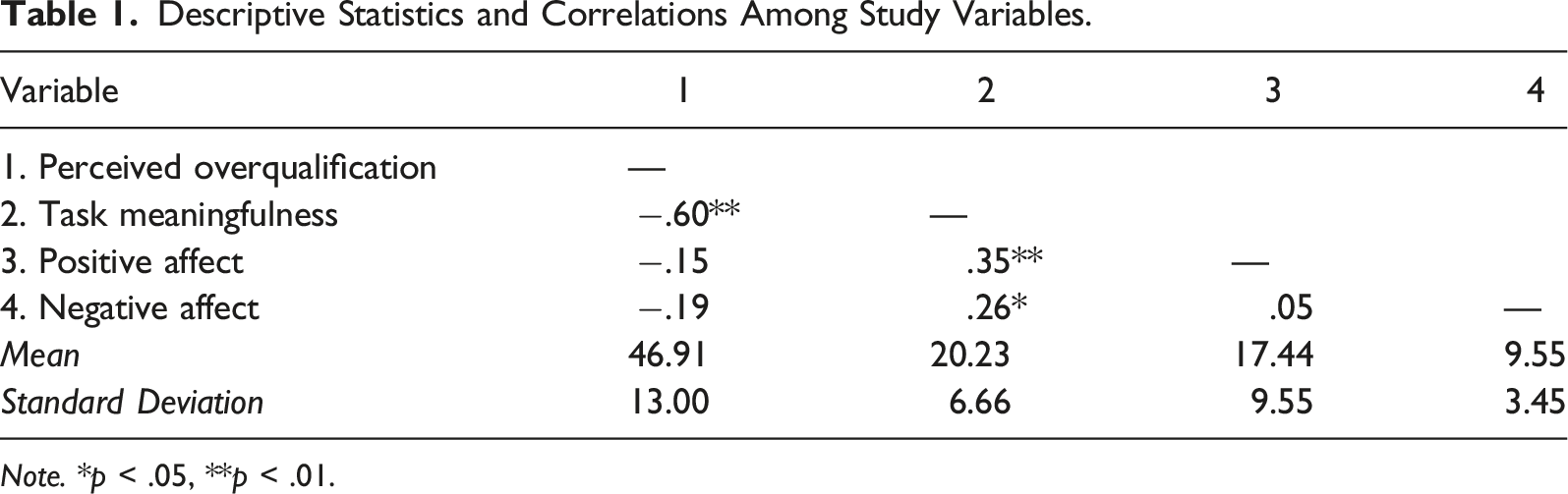
Note. *p < .05, **p < .01.
Randomization Check
For continuous demographic variables, the control condition did not differ from the POQ condition in terms of age, t(79) = .90, p = .373, or household income, t(69) = 1.58, p = .120. For categorical demographic variables, the control condition did not differ from the POQ condition in terms of gender, χ2(1) = .34, p = .562, level of education, χ2(1) = .13, p = .716, and employment status, χ2(1) = .01, p = .944. Therefore, we concluded that the manipulation was successful.
Experimental Analysis
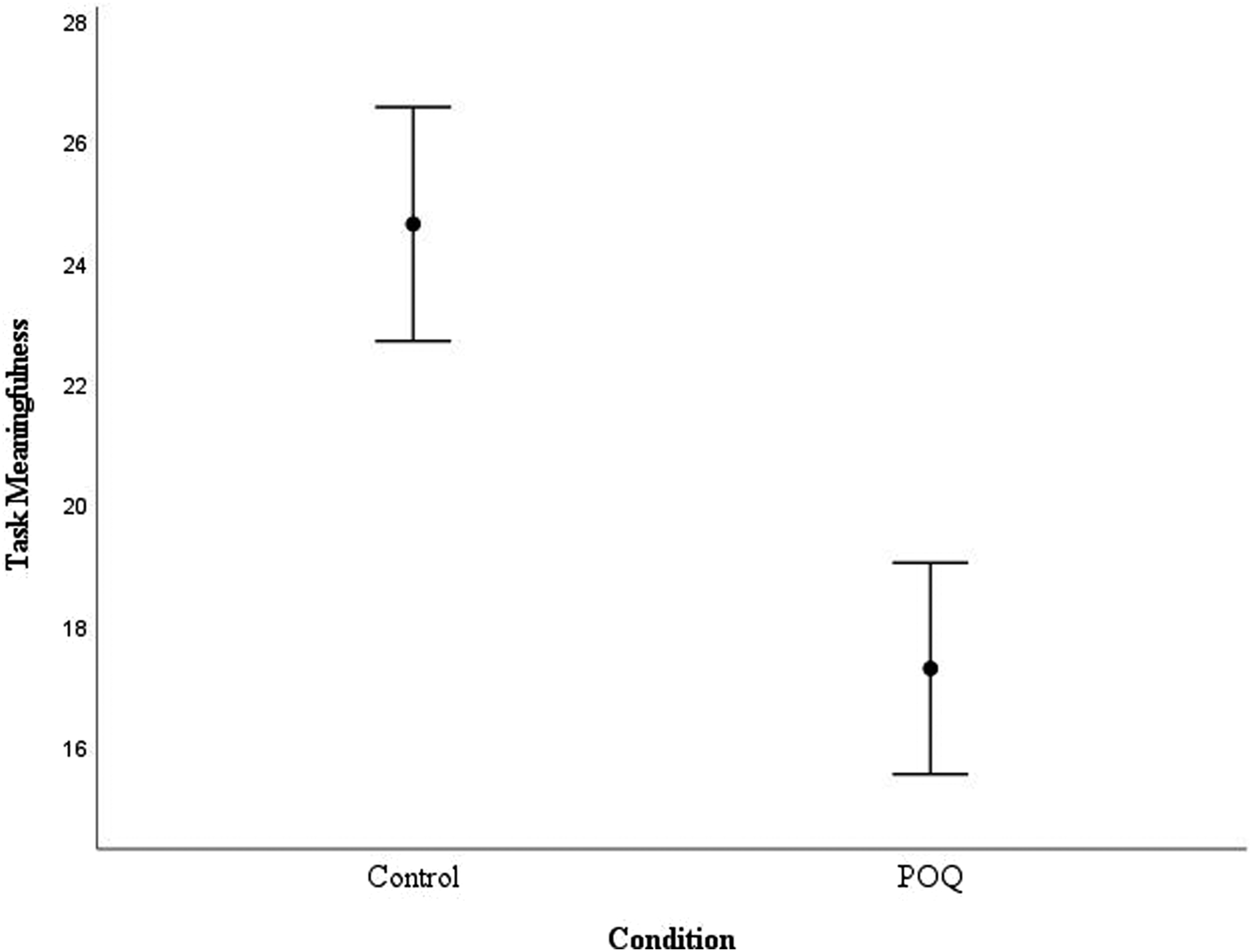
The control condition (M = 35.38, SD = 9.39) had significantly lower perceived overqualification than the POQ condition (M = 54.45, SD = 8.84), t(79) = −9.26, p < .001, d = −2.11. Figure 1 displays this effect with 95% confidence interval error bars. The control condition (M = 24.61, SD = 5.36) also had significantly higher task meaningfulness than the POQ condition (M = 17.28, SD = 5.86), t(75) = 5.60, p < .001, d = 1.30. Figure 2 displays this effect with 95% confidence interval error bars. The control condition (M = 18.18, SD = 5.49) did not significantly differ from the POQ condition (M = 16.98, SD = 5.14) on positive affect, t(71) = .95, p = .174, d = .23. Likewise, the control condition (M = 10.21, SD = 3.63) did not significantly differ from the POQ condition (M = 9.13, SD = 3.31) on negative affect, t(71) = .1.31, p = .195, d = .32. The effect of the experimental manipulation on perceived overqualification. The effect of the experimental manipulation on task meaningfulness.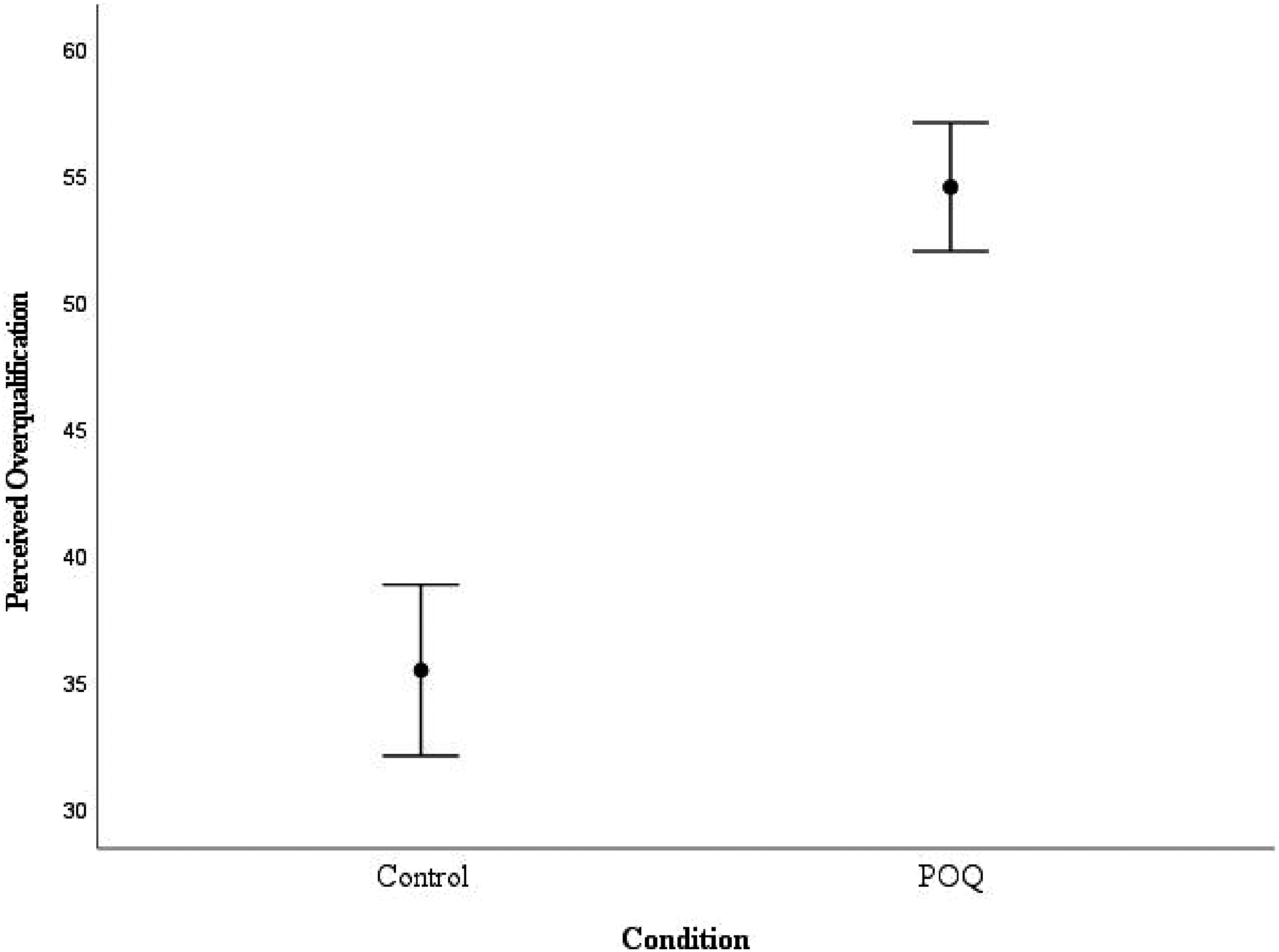
Mediation
The indirect effect of the experimental condition on task meaningfulness via perceived overqualification was significant, 95% CI [0.13, 0.55]. Furthermore, before controlling for POQ, the experimental condition dummy code significantly predicted task meaningfulness, β = −.43, p = .001, but this relation was no longer significant after controlling for POQ, β = .22, p = .097. The regression explained 38.73% of the variance in task meaningfulness. The indirect effects for positive affect, 95% CI [−0.15, 0.36], and negative affect, 95% CI [−0.12, 0.40], were not significant.
Discussion
The goal of the current study was to experimentally manipulate POQ with a sample of therapists to determine whether this affected task meaningfulness, positive affect, and negative affect. We manipulated POQ by having therapists either use their mental health expertise to analyze a clinical vignette or simply recall and transcribe basic facts. Consistent with hypotheses, we found that participants in the POQ condition reported greater POQ and less task meaningfulness than the control condition and that POQ mediated the relation between the experimental condition and task meaningfulness. However, contrary to hypotheses, the experimental manipulation had no significant effects on positive or negative affect. This study is the first to manipulate POQ in an experimental setting and establish a causal link between POQ and task meaningfulness, which advances theory and provides a potential target for intervention (Erdogan & Bauer, 2021; Liu & Wang, 2012).
Our central finding was that participants whose skills exceeded the requirements of the experimental task experienced greater POQ, which in turn decreased task meaningfulness. This aligns with previous research suggesting that basic or rote tasks relate to greater POQ (Lobene et al., 2015) and extends other cross-sectional studies finding that POQ is negatively associated with meaningful work (Allan et al., 2017; Buyukgoze-Kavas et al., 2020). In addition, the finding that POQ operated as a mediator supports the contention that POQ mediates objective overqualification and other outcomes; in other words, workers experience poorer outcomes only when they subjectively interpret themselves as overqualified (Lobene et al., 2015; Liu & Wang, 2012). More specifically, theory suggests that this subjective judgment creates a sense of relative deprivation or unfairness, which then erodes job attitudes (Feldman et al., 2002). Similarly, when therapists perform tasks that do not use their KSAs, such as filling out paperwork for insurance reimbursement, they may experience POQ that leads to other negative outcomes, and this may become a significant issue as administrative tasks become increasingly part of therapists’ jobs (Edwards & Burnard, 2003; Rollins et al., 2021).
Contrary to our hypotheses, the experimental manipulation did not increase negative affect and decrease positive affect, which contradicts a meta-analysis finding small relations between POQ and positive and negative affect (Harari et al., 2017). However, the relations in the current study trended in the right direction, with small effect sizes, suggesting that with sufficient power we may have observed significant effects. Regardless, a potential shortcoming of the measures we used was that they assessed general experiences of positive and negative affect (e.g., “good” and “bad”). Rather than these general experiences, theoretical perspectives suggest that POQ induces more specific emotional experiences, like anger and boredom (e.g., Liu & Wang, 2012). Therefore, our measures may not have been sensitive enough to capture these emotions, and future research may benefit from measuring specific emotional experiences.
Practical Implications
Mental health practitioners frequently engage in administrative tasks, including scheduling clients, contending with health insurance agencies, billing, managing communications with other providers, data input, and documentation requirements. These demands, which often fall outside of the KSAs specific to mental health practitioner training, may induce POQ like the experimental manipulation in this study. Across settings and professions, mental health practitioners spend 20%–80% of their work hours on administrative tasks (Caringi et al., 2017; Dorociak et al., 2017; Gallavan & Newman, 2013; Sullivan et al., 2003), and mental health practitioners may spend more time on administrative tasks compared to other healthcare providers (Sullivan et al., 2003). Moreover, mental health practitioners report that these administrative demands cause burnout and negatively impact client care (Rollins et al., 2021). Therefore, the findings of the present study in the context of this literature suggest that POQ may be relevant to mental health practitioners’ well-being.
Given the negative consequences of POQ in predicting meaningful work, self-rated health, and well-being (Johnson & Johnson, 1997; Harari et al., 2017), supervisors, training programs, and healthcare organizations may consider the ways mental health practitioners engage in tasks that do not match the KSAs of their profession. For example, reducing unnecessary bureaucracy or streamlining administrative tasks might be relevant to providers’ POQ. Considering the increase of telehealth services after the onset of the COVID-19 pandemic, attention to POQ may become increasingly important because mental health practitioners identify administrative burden as a primary barrier to engaging in telehealth (Perry et al., 2020).
Limitations and Future Directions
The current experiment has several limitations. First, while we intentionally chose therapists for a POQ experiment because of their many years of education and training, mental health professionals have various forms of privilege, which was reflected in our primarily white, high socioeconomic status sample. However, POQ is more common for vulnerable and marginalized populations who often have to take jobs that do not use their skills in order to meet their survival or safety needs. For example, people with lower social class backgrounds and low wage jobs are more likely to experience POQ (Allan et al., 2017, 2019), and marginalized people sometimes take jobs where they are overqualified to avoid discrimination at work or meet their basic needs (e.g., transgender and gender diverse people; Tebbe et al., 2019). Therefore, expanding our results to marginalized populations is critical to fully understand the effects of POQ and its existence within broader systems of oppression.
Second, while we sought to establish ecological validity by using a relevant experimental task, the results may not translate to therapists’ real-world experiences. Therefore, more research with diverse methodologies and experimental tasks can replicate and extend our findings. For example, longitudinal or intervention studies would corroborate the results from this study. Finally, we did not include several experimental elements and variables that may operate as mechanisms to create POQ or link POQ to various outcome. For example, theory suggests that relative deprivation links POQ to outcomes, but we did not measure this construct. We also did not prime clinicians to make social comparisons, which can be an important component of POQ. Future research can address this limitation by measuring underlying theoretical mechanisms and introducing new manipulations that reveal other psychological processes.
Conclusion
This study is the first to establish that perceived overqualification can be manipulated in an experimental setting. Specifically, the manipulation of objective overqualification led to hypothesized changes in perceived overqualification. Moreover, POQ mediated the relation between the experimental condition and task meaningfulness, demonstrating that changes in POQ correspond with changes in a job attitude outcome. While experimental studies prioritize internal validity over external validity, our results add to the growing literature identifying POQ as an important predictor of various outcomes, which supports additional research in this area.
Footnotes
Declaration of Conflicting Interests
The author(s) declared no potential conflicts of interest with respect to the research, authorship, and/or publication of this article.
Funding
The author(s) received no financial support for the research, authorship, and/or publication of this article.
Author’s Note
Preliminary results from this study were presented at the 2019 American Psychological Association Annual Convention: Sterling, H. M., Kim, T., Liu, T., Murphy, P., Kahng, S., & Allan, B. A. (August, 2019). Induced perceived overqualification in mental health professionals: An experimental study. Poster presented at the American Psychological Association, Chicago, IL.
