




Abstract
Previous studies have suggested that emotions influence individuals’ passage of time judgments (PoTJs). However, it remains unclear how this relationship manifests in daily life. Weibo provides a wealth of daily verbal expressions from individuals, offering valuable data for analyzing how emotions and PoTJs vary. Utilizing this resource and choosing a specific period of time—COVID-19—the authors innovatively examined the relationships between emotional valence, discrete emotions, and PoTJs across different timescales: weekly, bi-weekly, monthly, and over the entire year. First, they constructed a PoTJ lexicon and template based on Weibo data. This was followed by an analysis of emotional expressions in PoTJ-related posts extracted by the lexicon and template using natural language processing techniques. The findings reveal a distinct pattern: most individuals perceived time as passing quickly during the COVID-19 pandemic, while fewer experienced slow PoTJ. Regarding the relationship between emotional valence and PoTJ, the daily average percentage of posts expressing positive and negative emotions was positively correlated with fast and slow PoTJs from a dynamic perspective, respectively, and a similar pattern was found from an overall perspective. More importantly, a unique relationship was identified between discrete emotions and PoTJs. Specifically, both the dynamic and overall analyses showed a robust finding: only joy and anxiety were positively associated with fast and slow PoTJs, respectively. In contrast, for other emotions (e.g., hope, sadness), the dynamic analyses yielded inconsistent results across the different time windows, diverging from the overall analysis. These findings highlight the importance of adopting a dynamic perspective and considering discrete emotions when understanding the relationship between emotions and PoTJs.
Introduction
Passage of time judgment (PoTJ) refers to the perception of time passing, which plays a crucial role in daily life. Distortions in PoTJ are linked to various negative symptoms, including depression (Ogden, 2021), overeating (Isham et al., 2022), and drug use (Ogden & Faulkner, 2022). Given its significance, understanding the factors influencing PoTJ has attracted considerable attention from researchers (Brenlla et al., 2022; Droit-Volet & Dambrun, 2019; Droit-Volet & Wearden, 2016; Martinelli & Droit-Volet, 2022b; Ogden, 2020; Wearden, 2015), and emotion is a key factor (Droit-Volet et al., 2020; Liu et al., 2024; Martinelli et al., 2021). However, studies have yet to examine PoTJ and emotion from both an overall and a dynamic perspective using ecologically valid methods.
To investigate the relationship between emotion and PoTJ from both an overall and a dynamic perspective in daily life, this study focuses on the COVID-19 pandemic, a period during which emotional expression on social media underwent dramatic changes. During this time, negative emotion surged globally, followed by a gradual recovery (Wang et al., 2022). In China, negative emotion (e.g., fear) increased significantly in early 2020, followed by a rise in positive emotional expressions (i.e., praise words) later in the pandemic (Shi et al., 2022; Su et al., 2021). Changes in PoTJ were also reported, with some studies indicating that time passed faster, while others observed that it passed more slowly (Alatrany et al., 2022; Brenlla et al., 2022; Kosak et al., 2022; Ogden, 2020, 2021). Emotion is a key factor in PoTJ changes (Droit-Volet & Wearden, 2016; Martinelli & Droit-Volet, 2022a, 2022b), with negative emotions, such as fear and boredom, typically associated with slower PoTJ, while positive emotions like happiness and joy are linked to faster PoTJ (Martinelli et al., 2021). However, the relationship between emotion and PoTJ changes remains unclear, particularly regarding whether increases in negative emotion during the early stages of the pandemic were associated with a greater expression of slow PoTJ.
Although existing studies highlight a strong relationship between emotion and PoTJ (Droit-Volet et al., 2020; Liu et al., 2024; Ogden, 2020), many rely on survey data, which may introduce biases due to experimenters’ intentions or questionnaire content (Galesic & Bosnjak, 2009; Rockwood et al., 1997; Sjöström & Holst, 2002). In contrast, qualitative data from social media offers advantages in terms of ecological validity, sample size, and cost-efficiency (Andrews et al., 2015; Subramanian et al., 2023; Takayasu et al., 2015). Weibo, with over 224 million daily active users in 2020 (Sina Weibo Data Center, 2021), serves as a rich source of emotional expressions during the pandemic, revealing significant shifts in emotion (Han et al., 2022; Shi et al., 2022). Social media data surpasses traditional surveys in terms of volume, accessibility, and time span, making it an ideal tool for studying the dynamic relationship between emotion and PoTJ.
With advances in machine learning and natural language processing techniques, online texts from social platforms can be used to analyze individuals’ emotion or psychological characteristics (Nguyen & Van Nguyen, 2020; Zahoor & Rohilla, 2020). Recent research on sentiment analysis has found that machine learning algorithms trained with Weibo text data can accurately classify text into two or more emotion categories (Wu et al., 2018; Zhang et al., 2022). Word2vec, a statistical model, converts words into vectors and is used in psychology (Hakonen et al., 2022; Xu et al., 2014, 2021), allowing researchers to calculate the association between emotional words and posts, thus providing insights into emotional expressions on Weibo. Hence, the Weibo big-data-based approach offers a way to study the relationship between emotions and PoTJs with high ecological validity, and by analyzing the Weibo data set, we can explore the dynamic relationship between emotion and PoTJ.
How does the passage of time connect to emotion? And how does it vary with changes in emotions? To address these questions, this study employed the advanced pre-trained Bidirectional Encoder Representations from Transformers (BERT) model and Word2vec model to analyze the relationship between emotion and PoTJ in a large-scale Weibo data set. Initially, we developed a PoTJ lexicon and template to extract PoTJ-related Weibo posts, encompassing both fast and slow PoTJ posts. Subsequently, we constructed a sentiment classification model alongside a discrete emotion classifier to analyze emotional valence and the discrete emotion types present in these posts. Our overall analysis examined the relationship between emotion and PoTJ averaged over one year, while dynamic analyses investigated the correlation between monthly average emotion and PoTJ over the year. We further conducted similar correlation analyses using bi-weekly and weekly time windows to explore the stability of this relationship across different time frames. Through these analyses, we aim to enhance our understanding of the interplay between emotion and PoTJ.
Method
Data Acquisition
The PoTJ-Weibo data set was extracted from the Weibo-COV V2 data set (Hu et al., 2020), covering posts from January 20, 2020 to December 31, 2020, when COVID-19 was officially classified under the Law of the People's Republic of China on the Prevention and Control of Infectious Diseases. The data set ends on December 31, 2020, at 23:59 (Greenwich Mean Time + 8). The filtered Weibo data set contained 65,127,978 posts from 10,833,065 active users during the period (hereafter referred to as Weibo-Large). Preprocessing was performed using HarvestText to remove special characters, retaining only the user's reason for reposting. This study adhered to the Declaration of Helsinki and received approval from the Ethics Committee of the Department of Psychological and Cognitive Sciences at Tsinghua University.
PoTJ-Related Data-Set Extraction
Using the self-developed PoTJ lexicon and template (for details, see the Appendix), we extracted a PoTJ-related data set from the Weibo-Large corpus. Our goal was to identify posts that explicitly describe the subjective experience of time passing quickly (fast PoTJ) or slowly (slow PoTJ). Importantly, these labels were assigned based on explicit linguistic cues, not inferred sentiment, to ensure a transparent and replicable classification process. The extraction procedure consisted of three steps.
Lexicon-Based Extraction
Each post in the Weibo-Large corpus was segmented into words using the Jieba tool kit and matched against entries in the validated PoTJ lexicon, which was developed through participant-generated responses, semantic expansion, and expert selection (see the Appendix). Posts containing at least one matched term—for example, 时光飞逝 (“time flies”)—were retained as candidates.
Template-Based Extraction
In parallel, we applied a syntactic pattern-matching procedure based on the PoTJ template—for example, [时间]过[得]慢 (“[time] passed slowly”)—which was developed through a process similar to the lexicon. Each post in the Weibo-Large corpus was segmented into sentences based on punctuation and retained if at least one sentence matched a pattern of the template. To address the linguistic ambiguity of Chinese expressions (Huang, 2008), we excluded posts containing modal verbs (e.g., hope, wish) or words with lexically ambiguous morphemes (e.g., the character 快 “fast” in 快乐 “happiness”), based on a manually curated exclusion list.
Merging and Filtering
We merged the results from the lexicon- and template-based extractions and removed the duplicates. To exclude content such as news releases and advertisements that do not reflect personal time-passage experiences, we calculated pairwise similarity and removed posts with an over 80% word overlap. Additionally, posts containing both fast and slow PoTJ expressions were excluded to avoid interpretive ambiguity.
Through this process, we constructed the final PoTJ-Weibo data set, comprising 40,723 posts labeled as expressing fast PoTJ and 3,845 posts labeled as expressing slow PoTJ, drawn from the Weibo-COV V2 corpus containing 65,127,978 posts. These categorizations were based on the explicit semantics of the extracted expressions and reflect individuals’ spontaneous self-reports of subjective time experience in naturalistic online contexts.
Sentiment Analysis on PoTJ-Weibo Data Set
We conducted sentiment analysis to explore the relationship between emotion and PoTJ, focusing on both emotional valence and discrete emotions. Specifically, emotional valence classification was used to identify the overall affective polarity of each post (i.e., positive, negative, or neutral), while discrete emotion classification captured more specific emotional categories such as joy, sadness, or anger. These two types of classification rely on distinct emotional taxonomies and modeling techniques, as described below.
Emotional Valence Classification
The emotional valence classification of text is a classic task in sentiment analysis (Mohammad, 2016; Zhang et al., 2018). In this analysis, the valence of the emotion expressed in the post was classified into three types: positive, negative, and neutral. A deep neural network was utilized to conduct the emotional valence classification task based on large-scale data. We adopted a pretrained BERT model (Devlin et al., 2018) to encode each post into latent vectors, which were then passed through a trainable multi-layer perceptron, producing the emotional valence of the post. For the pretrained BERT model, a Chinese BERT wwm-ext model was utilized, taking a post as input and outputting a latent vector of 768 dimensions.1
During the training stage, the parameters of the pretrained BERT model were fixed, and the multi-layer perceptron classifier was trained. The data set from The Evaluation of Weibo Emotion Classification Technology competition of The Ninth China National Conference on Social Media Processing, 2020 was adopted as the training and validation set, which includes more than 30,000 general posts and 13,000 COVID-19-related posts with sentiment annotations.2 Its pandemic-related content closely aligns with the context of our study, making it a highly relevant foundation for training the emotional valence classification model. The data set labels six emotion categories, which we mapped into three emotional valence categories: happy and surprise were considered positive; anger, sadness, and fear were labeled negative; and neutral remained neutral. To classify the emotional valence of the COVID-19-related corpus, we used both all general posts and the training set of COVID-19-related posts as the final training set, and the test portion of COVID-19-related posts as the validation set. In total, the training and validation sets comprised 43,250 and 2,964 posts, respectively.
During the model training, cross-entropy loss was used as the loss function, and an early stopping strategy with 10 steps was adopted. Adam was used as the optimizer, and a two-layer perceptron with hidden dimensions of 1,024 and 512 was used as the predictor.
Discrete Emotion Classification
To capture more nuanced emotional expressions, we also conducted discrete emotion classification using Emo-Dict, a manually constructed lexicon of 3,156 Chinese emotion words categorized into eight types (Xu et al., 2021): love, joy, hope, surprise, disgust, sadness, anger, and anxiety. To determine the dominant discrete emotions in each post, we computed the similarity between post embeddings and Emo-Dict entries using word embedding vector similarity. This technique has been widely applied in natural language processing tasks such as query–answer matching (Shen et al., 2017) and sentence similarity assessment (Yao et al., 2018).
First, vector representations of all the words in Emo-Dict were obtained from the Word2Vec model trained in the section “Generation of PoTJ Lexicon”in Appendix where words not in Word2Vec were ignored, leaving vector representations of 2,902 emotional words corresponding to eight emotions in total. Here, we denote the j-th word for the k-th emotion in Emo-Dict as
Second, the sentiment scores for the eight emotions were estimated for each post in the PoTJ-Weibo data set. We split each post into words using Jieba, fetched vectors for all the words from Word2Vec, and calculated their similarity with each word in Emo-Dict:

Third, as the semantic representation of multiple vocabularies in the same emotion may differ considerably and it is necessary to estimate the emotion most likely to be expressed by one word

Finally, we obtained the post emotion score

In practice, we utilized
Both the emotional valence classifier (BERT + multi-layer perceptron) and the discrete emotion classifier (Word2Vec + Emo-Dict) were chosen for their prior validation in large-scale Chinese social media research and their computational efficiency (Guo et al., 2021; Li et al., 2023; Xu et al., 2014, 2021). In addition, the emotional valence classifier was fine-tuned on our data set to better align with the current task. Nonetheless, we recognize that these models do not offer intrinsic interpretability or contextual adaptability, which may limit the transparency of the sentiment classification. We further elaborate on these limitations in the discussion below.
Data Analysis
We analyzed the variation in PoTJ and emotion throughout the year from both an overall and a dynamic perspective. Since the volume of the PoTJ-Weibo (fast) corpus is much larger than that of the PoTJ-Weibo (slow) corpus with over ten times the number of posts), we adopted a resampling-based balancing strategy inspired by the bootstrap method (Mooney et al., 1993) for a fair comparison: random sampling with replacement was performed on the PoTJ-Weibo (fast) corpus to select a subsample comparable in size to the PoTJ-Weibo (slow) corpus. Then, for both emotional valence and discrete emotions, using our classified labels, we calculated the ratio of the number of posts belonging to each emotion in the subsample of the PoTJ-Weibo (fast) and the entire PoTJ-Weibo (slow) corpus. If PoTJ is minimally influenced by emotional valence or specific discrete emotions, the ratio should approximate that observed under conditions of neutral emotion, as identified through the emotional valence classification task. In the analysis, we applied bootstrap sampling 1,000 times, generating a distribution of fast-to-slow ratios for each emotional valence and discrete emotion. Statistical tests were then performed on these 1,000 bootstrap-derived ratio estimates for each condition, treating each iteration as approximately independent for the purpose of parametric testing. Specifically, we conducted a one-way analysis of variance (for emotional valence) and independent-sample t-tests (for discrete emotions versus neutral) using JASP (19.1.0). This resampling-based approach allows for the use of parametric tests while preserving comparability between the unbalanced corpora.
We further explored the association between emotions and PoTJ over time from a dynamic perspective. To show the overall temporal trends in posts, the daily average percentage of posts (DAPoP) for each month in 2020 from the PoTJ-Weibo (fast and slow) data sets was calculated, and similar calculations were performed for posts with different emotions (i.e., emotional valence and discrete emotions). Subsequently, the DAPoP for slow/fast and different emotions for each month was calculated, and correlation analyses were applied between the DAPoP of the negative/positive valence and the fast/slow PoTJ. The correlations between the DAPoP of discrete emotions and fast/slow PoTJ were also analyzed. We used percentages instead of total numbers for the correlation analysis to minimize bias from fluctuations in the volume of posts. In order to understand the dynamic relationship between emotion and PoTJ, we analyzed the average daily post percentages over weekly and bi-weekly time windows. This analysis allowed us to explore how emotion and PoTJ are related across different time windows, offering a dynamic perspective. We chose Pearson correlations as an initial exploratory measure due to their interpretability and compatibility with our DAPoP-derived summary statistics. However, we acknowledge their limitations in capturing temporal dependencies. Percentage-based time series are inherently compositional, and adjacent time windows may exhibit autocorrelation. These statistical constraints are addressed in Subsection of Limitations and Future Directions.
Transparency and Openness
The data and code related to the data extraction and sentiment recognition models are available on an open-source platform.3 The statistical tests, plotting, and lexicon-related data can be accessed on another platform.4 This study's design and its analysis were not preregistered.
Results
Overall Perspective
Overview of PoTJ-Weibo Data Set
A total of 40,723 posts indicated time passing quickly, while 3,845 posts indicated time passing slowly, resulting in a fast-to-slow ratio of approximately 10:1. Although the lexicon-based fast-to-slow ratio was 22:4 and the template-based ratio was 166:548, the extracted ratio remained close to 10:1 (10:0.73 for lexicons, 10:1.25 for templates). This suggests that most people experienced time passing quickly during this period rather than slowly.
Emotional Valence and PoTJ
The sentiment analysis of the PoTJ-Weibo data set revealed a nearly equal distribution of positive, neutral, and negative emotions (Figure 1a). As shown in Figure 1b, negative emotions were linked to a higher proportion of slow PoTJ, while positive emotions were associated with faster PoTJ. The one-way analysis of variance based on bootstrap-derived data revealed a significant main effect of emotional valence, F(2,2997) = 315327.465, p < .001, ηp2 = 0.995, 95% confidence interval (CI) for ηp2 [0.995, 0.996], indicating substantial differences in PoTJ across positive, neutral, and negative emotional conditions. Post-hoc tests revealed significant differences in the ratio of fast-to-slow PoTJ posts across emotion categories. The ratio was highest for positive posts (1.587 ± 0.034), followed by neutral (0.896 ± 0.020), and lowest for negative posts (0.777 ± 0.017; positive > neutral > negative, ps < .001, Cohen's |ds|> 4.832).

Results of Emotion and PoTJ from an Overall Perspective
Discrete Emotions and PoTJ
Discrete emotions were also analyzed, with joy, hope, and love comprising the majority (73.4%) of the data set (Figure 1a). Independent-sample t-tests were conducted on the bootstrap-derived ratio to compare each discrete emotion against the neutral baseline. As shown in Figure 1c and Table 1, posts expressing love, joy, hope, surprise, and anger were more likely to be associated with fast PoTJ, t(1998) values > 53.050, ps < .001, Cohen's ds > 2.372, while sadness and anxiety were linked to slow PoTJ, t(1998) values < −123.811, ps < .001, Cohen's ds < −5.537. No significant difference was found between disgust and neutral emotion in terms of fast or slow PoTJ, t(1998) = −1.016, p = .310, Cohen's d = −0.045, 95% CI for mean difference [−0.015, 0.005].
Emotion Distributions of All Posts in the PoTJ-Weibo Data Set.

Dynamic Perspective
PoTJ-Weibo Data Set Statistics
Figure 2a shows the dynamic changes of DAPoP for fast PoTJ over time, with a notable surge in the first three months followed by a gradual increase. Conversely, the DAPoP for slow PoTJ dropped sharply in the first three months, then displayed a consistent decline throughout the year.
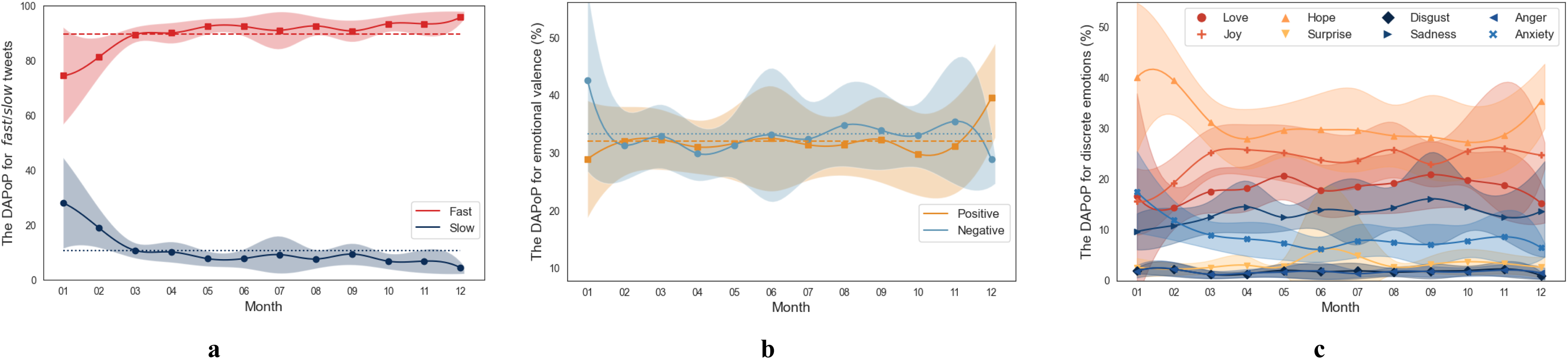
Results of Emotion and PoTJ from a Dynamic Perspective.
Emotional Valence and PoTJ
Figure 2b shows the DAPoP for both negative and positive emotional valence over 12 months. Positive emotions sharply increased in February and remained stable until September, with a notable rise in the last two months of the year. In contrast, negative emotions declined in February and December, with slight fluctuations from February to November.
Pearson correlation analyses were conducted between the monthly mean DAPoP values of emotional valence (positive, negative) and PoTJ (fast, slow). As shown in Table 2, the DAPoP of positive emotions was positively correlated with fast PoTJ, r = .603, p = .038, 95% CI for r [.045, .874], and negatively with slow PoTJ, r = −.611, p = .035, 95% CI [−.877, −.056]. Conversely, the DAPoP of negative emotions was positively correlated with slow PoTJ, r = .678, p = .015, 95% CI [.170, .901], and negatively with fast PoTJ, r = −.646, p = .023, 95% CI [−.890, −.115]. These correlations were significant in the monthly window but not in the weekly or bi-weekly windows (ps > .05).
Dynamic Correlation Between the DAPoP of Fast and Slow PoTJ Posts and the DAPoP of Positive and Negative Posts for Each Time Window.

*p < .05.
Discrete Emotions and PoTJ
Figure 2c illustrates the DAPoP for discrete emotions over 12 months, showing distinct patterns for each emotion. For instance, hope decreased sharply in the first four months, then recovered, while anxiety steadily declined in the first half of the year. Sadness increased in the first three months, followed by fluctuations.
We conducted Pearson correlation analyses between the mean DAPoP of each discrete emotion and the corresponding mean values of fast and slow PoTJ across three temporal resolutions (weekly, bi-weekly, monthly). As presented in Table 3, joy and anxiety exhibited strong correlations with PoTJ across all time windows. Joy was positively correlated with fast PoTJ and negatively with slow PoTJ (ps < .05), while anxiety showed the opposite pattern (ps < .001). Hope was negatively correlated with fast PoTJ and positively with slow PoTJ in the weekly and monthly windows (ps < .05), showing a similar trend in the bi-weekly window (p = .078). Anger showed similar patterns in the weekly and bi-weekly windows (ps < .05). Sadness was positively correlated with fast PoTJ, r = .749, p = .005, 95% CI [.307, .925], and negatively with slow PoTJ in the monthly window, r = −.751, p = .005, 95% CI [−.926, −.311]. Other correlations were not significant (ps > 0.05).
Dynamic Correlation Between the DAPoP of Fast and Slow PoTJ Posts and the DAPoP of Discrete Emotion Posts for Each Time Window.

***p < .001. **p < .01. *p < .05.
Discussion
This study examines the relationship between PoTJ and emotions during the COVID-19 pandemic using Weibo data from both an overall and a dynamic perspective. The PoTJ lexicon and template were developed to extract relevant posts, and sentiment analysis was conducted to identify emotions. The results showed that most posts indicated time passing quickly, with fewer expressing slow PoTJ. From both perspectives, negative emotions were linked to slow PoTJ, while positive emotions were associated with fast PoTJ. Specific emotions, such as joy and anxiety, were associated with fast and slow PoTJ, respectively. Other emotions showed inconsistent patterns in the dynamic analyses across different timescales compared to the overall analysis. These findings are discussed in detail below.
More Expressions of Fast PoTJ May Be Linked to Hope, Joy, and Love
Contrary to the initial hypothesis, it was found that, during this unique period, most individuals expressed that time was passing quickly. This unexpected result may be due to the fact that the majority of PoTJ-related expressions were associated with hope, joy, and love. This could also be explained by the cultural influence of Confucianism, Buddhism, and Taoism, which emphasize a positive outlook during times of hardship (Xie & Wong, 2021). Such a cultural background may have contributed to individuals expressing more positive emotions (i.e., praise words) during the pandemic (Su et al., 2021), offering a plausible explanation for the greater frequency of fast PoTJ expressions. Additionally, the results confirm the role of discrete emotions in shaping PoTJ, reinforcing previous findings that emotion significantly influences PoTJ (Droit-Volet et al., 2020; Liu et al., 2024). Positive emotions such as joy, love, hope, and surprise were found to be associated with faster PoTJ, while negative emotions such as sadness and anxiety were linked to slower PoTJ. These results suggest that PoTJ is closely tied to an individual's internal state (Droit-Volet, 2018; Droit-Volet & Dambrun, 2019). However, the influence of emotional valence on PoTJ is not always consistent. For instance, anger, a typically negative emotion, was associated with fast rather than slow PoTJ. This indicates that PoTJ cannot be fully explained by emotional valence alone, as specific emotions may correspond to different PoTJs.
Relationship Between Emotion and PoTJ from a Dynamic and an Overall Perspective
During this specific period, distinct dynamic patterns were observed in PoTJ: fast PoTJ increased steadily after an initial surge, while slow PoTJ declined and then stabilized. These changes were correlated with emotional valence and some discrete emotions. Two key findings emerged regarding discrete emotions: first, joy and anxiety showed strong correlations with PoTJ across the time windows from both a dynamic and an overall perspectives; second, hope, anger, and sadness exhibited discrepancies between these perspectives, highlighting the complexity of their relationship with PoTJ.
Relationship Between Emotional Valence and PoTJ Across Different Timescales
The association between emotional valence and PoTJ was significant from both the overall and dynamic perspectives. However, from the dynamic perspective, the association was only observed at the monthly level, suggesting that shorter time frames may not capture a stable relationship. Fast PoTJ changes were positively correlated with positive emotions and negatively correlated with negative emotions, while slow PoTJ showed the opposite pattern. These findings align with previous research (Droit-Volet & Wearden, 2016; Droit-Volet et al., 2020; Kosak et al., 2022; Liu et al., 2024; Martinelli & Droit-Volet, 2022a; Martinelli et al., 2021) and reinforce that PoTJ is not only a static, emotion-dependent phenomenon but also fluctuates in response to emotional states over time. Notably, no significant correlations were found in the weekly and bi-weekly time windows. This may be due to shorter time frames introducing noise and reducing the stability of the emotion–PoTJ relationship (Pearson, 1896). These findings suggest that the association may be inconsistent across timescales and subject to moderating factors such as time-window length. For individual-level data, previous studies have reported mixed results on the effect of emotion on PoTJ across timescales (Alatrany et al., 2022; Ogden, 2021). Emotional valence was found to predict PoTJ on a 30-minute scale but not a daily scale (Liu et al., 2024), suggesting that its influence is more prominent in shorter timescales, where emotions are more stable. However, as timescales increase, individual emotions may fluctuate (Stone et al., 2006), potentially canceling out their effects on PoTJ. In this study, “different time windows” refers to the data collection scale rather than the intrinsic timescale of PoTJ fluctuations. Even on short timescales, emotions on Weibo fluctuate dynamically (Yu et al., 2021), making it difficult to identify a dominant emotion state, which may weaken the emotion–PoTJ relationship. Therefore, we speculate that a longer timescale is necessary for capturing stable emotional influence on PoTJ when using collective data, such as from Weibo. These results indicate that PoTJ cannot be solely attributed to emotional valence. Other influencing factors must be considered in future research.
Relationship Between Discrete Emotions and PoTJ
This study also explored the relationship between specific discrete emotions and PoTJ. Notably, joy and anxiety exhibited a strong association with PoTJ from both perspectives. Joy was positively associated with fast PoTJ and negatively associated with slow PoTJ, whereas anxiety showed the opposite pattern. These findings align with previous studies (Droit-Volet et al., 2020; Liu et al., 2024; Martinelli et al., 2021; Ogden, 2020) and emphasize that PoTJ can be more accurately predicted when considering discrete emotions rather than relying solely on emotional valence. However, discrepancies between the overall and dynamic perspectives were observed for emotions such as hope, anger, and sadness. In the overall analysis, hope and anger were associated with fast PoTJ, while sadness was linked to slow PoTJ. In contrast, the dynamic analysis revealed that changes in hope and anger were correlated with changes in slow PoTJ, while sadness was linked to fast PoTJ. These inconsistencies underscore the complexity of the relationship between specific emotions and PoTJ, and the importance of considering the temporal dynamics of emotion and PoTJ. We speculate that these discrepancies may be due to various factors, including the use of different time windows in the dynamic analysis, which may introduce variability in the data and contribute to inconsistencies in the results. Furthermore, individual differences in time expectations may also play a role in modulating the relationship between emotions and PoTJ (Liu et al., 2024; Tanaka & Yotsumoto, 2017). Future research could explore the moderating effects of such expectations to further clarify the underlying mechanisms that may account for these inconsistencies.
Limitations and Future Directions
This study provides initial insights into the relationship between emotion and PoTJ using spontaneous self-reported data from social media. However, several limitations should be noted regarding the generalizability of the results. Most notably, the analysis was conducted on population-level Weibo data collected during the COVID-19 pandemic. As such, whether the observed emotion–PoTJ patterns generalize to more stable or routine contexts remains an open question. Future studies could apply the same methodology to other time periods to assess generalizability.
Second, the sentiment classification models (BERT + multi-layer perceptron for emotional valence and Word2Vec + Emo-Dict for discrete emotions) were selected for their computational efficiency and prior validation on Chinese Weibo data (Guo et al., 2021; Li et al., 2023; Xu et al., 2021; Xue et al., 2014). However, both approaches have limitations. The BERT model, while powerful, does not provide feature-level interpretability, making it difficult to trace how single tokens contribute to classification outcomes. The Word2Vec model relies on static word embeddings and thus cannot disambiguate context-dependent meanings or adapt to semantic shifts. To address these limitations, future work could explore natural language processing techniques with greater interpretability or contextual adaptability, such as SHapley Additive exPlanations or the Local Interpretable Model-Agnostic Explanations framework (Lundberg & Lee, 2017; Ribeiro et al., 2016), to enhance model transparency and reliability.
Finally, the use of proportion-based time series entails potential issues such as compositional constraints and temporal autocorrelation, which can inflate correlations or obscure true effects. Although we used Pearson correlations as an exploratory measure, future studies could adopt more advanced approaches, such as time-series regression models or compositional data methods (e.g., centered log-ratio transformation) to improve robustness.
Conclusion
This study developed a novel Chinese PoTJ lexicon and template using the Weibo database, providing valuable resources for future research. The findings revealed a distinct pattern: most individuals perceived time as passing quickly during the COVID-19 pandemic, while fewer experienced slow PoTJ. Both the overall and the dynamic analyses revealed that negative emotions were linked to slow PoTJ, while positive emotions were associated with fast PoTJ. Joy and anxiety were strongly correlated with PoTJ, with joy associated with fast PoTJ and anxiety with slow PoTJ across both perspectives. However, sadness, anger, and hope exhibited variability from the dynamic perspective compared to the overall perspective. These findings underscore the importance of considering discrete emotions and dynamic perspectives for a comprehensive understanding of the emotion–PoTJ relationship.
Supplemental Material
sj-docx-1-pac-10.1177_18344909251390027 - Supplemental material for The Covariation of Emotion and Passage of Time Judgments: Insights from Weibo
Supplemental material, sj-docx-1-pac-10.1177_18344909251390027 for The Covariation of Emotion and Passage of Time Judgments: Insights from Weibo by Yanci Liu, Jiayu Li, Peixuan Han, Feng Du, Siyu Ma, Min Zhang and Meihong Zheng in Journal of Pacific Rim Psychology
Footnotes
Acknowledgments
Yanci Liu and Jiayu Li contributed equally to the article. The authors would like to express their sincere gratitude to the participants and reviewers for their valuable contributions to this study.

Ethical Approval and Informed Consent Statements
Approval was obtained from the Ethics Committee of the Department of Psychological and Cognitive Sciences at Tsinghua University. The procedures used in this study adhere to the tenets of the Declaration of Helsinki.
Funding
This work was supported by the Natural Science Foundation of China (Grant No. U21B2026) and Tsinghua University's “Future Social Designer” program. The funding organizations had no role in the development of the study design or the collection, analysis, and interpretation of the data.
Declaration of Conflicting Interests
The authors declared no potential conflicts of interest with respect to the research, authorship, and/or publication of this article.
Data Availability Statement
The data and code related to the data extraction and sentiment recognition models are available on an open-source platform.3 The statistical tests, plotting, and lexicon-related data can be accessed on another platform.4
Supplemental Material
Supplemental material for this article is available online.
Notes
References
Supplementary Material
Please find the following supplemental material available below.
For Open Access articles published under a Creative Commons License, all supplemental material carries the same license as the article it is associated with.
For non-Open Access articles published, all supplemental material carries a non-exclusive license, and permission requests for re-use of supplemental material or any part of supplemental material shall be sent directly to the copyright owner as specified in the copyright notice associated with the article.
