




Abstract
Throughout history, scholars and laypeople alike have believed that our words contain subtle clues about what we are like as people, psychologically speaking. However, the ways in which language has been used to infer psychological processes has seen dramatic shifts over time and, with modern computational technologies and digital data sources, we are on the verge of a massive revolution in language analysis research. In this article, we discuss the past and current states of research at the intersection of language analysis and psychology, summarizing the central successes and shortcomings of psychological text analysis to date. We additionally outline and discuss a critical need for language analysis practitioners in the social sciences to expand their view of verbal behavior. Lastly, we discuss the trajectory of interdisciplinary research on language and the challenges of integrating analysis methods across paradigms, recommending promising future directions for the field along the way.
Human language is truly fascinating. When we speak, our words provide structure to an otherwise intangible relationship between the self and the world. When we write, we give shape to the very substance of our innermost, subjective experiences. Language is quintessential human potential: it has relatively fixed rules and forms, yet we can string together a combination of words that are completely unique, formulating ideas that have never been shared before—not ever—in the entire history of humankind. Even the most dull, trivial text becomes interesting when approached as a scientific question: what motivated the creation of such a boring document?
Language is at once obvious and perplexing. We can write epic novels, sing songs, and communicate intimate thoughts and feelings through language, all without explicit awareness of the psycholinguistic machinery at play. The seemingly paradoxical nature of language has made it a recurring topic of psychological study, inspiring countless theories on verbal behavior that range from the empirical to the fantastical. Theories that connect language to our thoughts, feelings, and behaviors have largely co-evolved with psychological language analysis methods—the practice of extracting psychological insights from a person’s verbal behavioral data. 1 Over the past century, language analysis methods have grown increasingly objective, systematic, and empirical, allowing for the deployment of sophisticated text analytic frameworks for psychological research in the digital age.
Today, however, language analysis theory rests at something of a standstill, despite the unprecedented availability of natural language datasets to scholars and language analysis practitioners (e.g., social media posts, SMS, e-mail, etc.). With the advent of new natural language processing frameworks, increasingly complex and nuanced approaches to psychological language analysis are appearing rapidly, and we believe that the field is due to expand both its text analysis toolkit as well as its theories about how human psychology is reflected in language. In this article, we provide a broad discussion of the past, present, and possible future of language analysis research in the social sciences. Specifically, we discuss:
(1) How psychological language analysis arrived at its current state;
(2) Today’s prevailing theory of language analysis and its shortcomings;
(3) The immediate horizon of language analysis theory;
(4) Key developments in this new age of personalized language data and the necessity for interdisciplinary collaboration.
The Secrets of Verbal Behavior: From the Mystical to the Statistical
In the early days of psychology, language was ascribed a vague, almost supernatural power to reveal the bubbling cauldron of the preconscious (Freud, 1915; Laffal, 1964). As the field increasingly turned to scientific methods, however, researchers grew skeptical of psychodynamic theories that often made murky or circular claims about the relationship between language and the rest of mental life. Allport (1942), for example, aired significant concerns about the need for more rigorous theory-testing in language analysis studies, rejecting much of his predecessors’ musings on language as unscientific and methodologically flawed. Allport saw massive potential in verbal behavior as a source of psychological data, however, he also recognized the sheer difficulty of unifying diverse approaches to language analysis frameworks under a single roof.
In the 1960’s, the so-called General Inquirer showed incredible promise as one of the first serious efforts toward a generalized and universal approach to psychological language analysis. The General Inquirer was, in many ways, a reflection of the widespread technological optimism of early Space Age social sciences (e.g., Kranz, 1970; Stone et al., 1962): a massive computer with software that could “read” texts and deduce the inner workings of the human mind was, quite literally, the stuff of science fiction (e.g., Clarke & Kubrick, 1968). By having a computer score texts for psychosocial phenomena, it was hoped that the General Inquirer would remove subjectivity, bias, and human error from the measurement process. Put another way, the General Inquirer aspired to become a standardized, scientific tool: something of a language analysis analogue to the microscope or the Erlenmeyer flask.
Early demonstrations showcased the system’s sheer potential: research ranging from the scientific study of suicide notes to political documents to folktales highlighted the range of social scientific topics that could be studied computationally (see, e.g., Colby et al., 1963; Holsti, 1965). Ultimately, however, the General Inquirer system never really caught on: it was complicated, difficult to maintain, and costly beyond most academics’ means (Psathas, 1969). Despite years of tweaking and adjusting the underlying dictionaries, researchers struggled to get satisfactory results that aligned with the “gold standard” of hand-scored texts (Smith, 1968). The gradual decline of the General Inquirer allowed language analysis methods of questionable validity to remain prominent. Other approaches, however, absorbed important lessons from the General Inquirer, and began favoring greater statistical analyses of words over subjective readings (see, for example, Martindale & Martindale, 1988; Thomas & Duszynski, 1985; Wilson, 2006). The General Inquirer marked a slow turning of the tide that would bring with it a newer, more scientific rationale for language analysis as a psychological research method.
LIWC: Little Words, Big Secrets
Historically, most language analysis research attempted to infer a person’s psychology by mapping out the content of what they said: for example, charting a client’s trajectory through treatment by counting how often the concepts of “hope” or “social alienation” are mentioned (Gottschalk & Gleser, 1969). By skimming over the small, “meaningless” parts of language—words like “the” and “than” and “not”—it was believed that the psychological significance of a text could be discovered through counting how often different meanings were conveyed (e.g., How often does the text talk about gaining versus losing power? Does the phrasing imply an action occurred actively or passively? Is the author conveying certainty or caution?).
Following the rise and fall of the General Inquirer, the idea that language may reveal hidden, esoteric clues about human psychology began taking on new forms. By the late 20th century, researchers were learning that the much-ignored “particles” of language could provide remarkably powerful insights into a multitude of psychosocial phenomena. The small, mundane parts of speech that language analysts had largely ignored—things like pronouns (I, you, we), articles (the, a, an), and negations (no, not, never)—were, in fact, reliable indicators of a how a person thinks, regardless of what they were talking about (Pennebaker, 2011; Weintraub, 1989). Some of the most important verbal behavioral markers of a person’s psychology, it seemed, were hidden in plain sight.
At the same time, some of the first truly user-friendly text analysis software—in particular, Linguistic Inquiry and Word Count, or LIWC (Pennebaker & Francis, 1999)—made the prospect of objective, automated, and transparent psychological text analysis a reality. The rise of LIWC coincided with the dawn of widespread personal computing and, for the first time in scientific history, the typical social scientist could now perform serious, objective, automated computations on language data. LIWC was nothing short of revolutionary for psychologists, and the widespread enthusiasm for language analysis was reborn.
The new wave of language analysis research was founded on a simple principle—the same principle, in fact, that had guided the General Inquirer: word frequencies represent attentional habits (Stone et al., 1966; Tausczik & Pennebaker, 2010). People who use high rates of articles (the, a, an) and prepositions (next, above), for example, tend to focus on formal or concrete concepts and their inter-relations (Pennebaker et al., 2014). People with higher social status and confidence are more focused on the external social environment than themselves, using more “you” and “royal we” words than “I” words (Kacewicz et al., 2014).
LIWC’s rapid rise to prominence helped to cement its underlying logic as the dominant rationale in the language analysis world. Indeed, much of our current understanding about the relationship between verbal behavior and psychology has been scaffolded, either directly or indirectly, by the relatively simplistic method of LIWC that is “word counting.” At its core, the word counting approach is one of scanning texts and tallying up the frequency of words from predefined categories—categories that are informed by psychological theory: emotion words (happy, upset, angry), agentic words (do, able, try), thinking words (think, understand, guess), self-referential words (I, me, my), and so on. The relative frequencies of each category, then, are typically interpreted as reflecting a person’s relative focus on each domain—something of an eye tracker, but for a person’s words. 2
From the word counting perspective, then, the “secrets” that could be extracted from a person’s language were fundamentally different from those of classical psychoanalysis. Now, the mysteries contained within people’s words were effable and calculable, but more subtle and statistical: too small to see with the naked eye, but discernible using computerized analyses of large numbers of documents. By using words to measure microscopic differences in what people pay attention to, we now had a direct pipeline into their minds and, by extension, their personalities (Boyd & Pennebaker, 2017), life experiences (Chung & Pennebaker, 2018), cultures (Michel et al., 2011), and societies (Iliev et al., 2016).
The Attentional View of Verbal Behavior
The early success and widespread popularity of LIWC helped to cement the word counting method and its basic psychometric logic—that words correspond to attentional focus—as the norm. Today, the majority of language analysis theory assumes that word frequencies reflect the relative amount of attention a person pays to a given domain, even if not stated explicitly. Pronouns are not pronouns: they are markers of who we pay attention to. “Emotion” words are not some reflection of the experience of emotions themselves: they are merely diagnostic of one’s attention to affective states. The “words as attention” approach to language analysis has been a simplistic, albeit necessary, foothold for helping the field get as far as it has.
The Merits of “Words as Attention”
For decades, the basic mantra of “words reflect attention, and nothing more” has been an intuitive, straight-forward, and reliable framework for interpreting and contextualizing language analysis research findings. The principle that verbal behavior chiefly reflects attention has been the anvil against which modern language analysis has been forged and validated. 3 Research on personality, for example, tells us that social attention is the core, defining feature of extraversion (Ashton et al., 2002). If words reflect attention, then we might reasonably expect extraverts to use more “social” words—this prediction turns out to be true (Mairesse et al., 2007).
Under the “words as attention” model, language analysis research has been able to stretch across an incredible number of topics. Over the years, a strong nomological network—one that describes the correlations between various psychological processes and attentional patterns—has been woven from the fabric of “words as attention.” The words that people use when describing their homes tell us whether they are focused on the relaxing or stressful properties of their abodes (Saxbe & Repetti, 2010). Computerized language analysis reveals that psychologists who focus on their social connections live longer (Pressman & Cohen, 2007), and that students who focus (perhaps a bit too much) on eating, drinking, and sex tend to fare worse in university (Robinson et al., 2013). Word frequencies tell us how much attention two people are paying to each other (Ireland & Pennebaker, 2010) and one’s attention to various facets of the self (Rodríguez-Arauz et al., 2017). Nearly everywhere that we find psychological language analysis today, we find the implicit assumption that verbal behavior reflects attentional processes above all else.
One of the greatest strengths of the “words as attention” interpretation has been its extensibility into otherwise difficult areas of study. Once it has been established that “cognitive” words are related to things like problem-solving and stress, for example (see, e.g., D’Andrea et al., 2012), we can indirectly estimate a person’s stress levels simply by counting their words. This basic “validation–extension” research cycle has expanded language analysis research across virtually every domain of scientific research, including public health (Eichstaedt et al., 2015), politics (Jordan et al., 2018), neuropsychology (Lumma et al., 2018), affect (Garcia & Rimé, 2019), personality (Schwartz et al., 2013), and genetics (Mehl et al., 2017). Even in the absence of other psychological measures, the existing nomological network for language analysis facilitates meaningful theory-testing, ranging from the study of daylight cycles on mood (Golder & Macy, 2011) to personality-driven business outcomes (Block et al., 2019).
The Pitfalls of “Words as Attention”
There is no question that the “words as attention” view of verbal behavior has been invaluable for advancing the science of psychological language analysis. Nevertheless, this attentional view has gradually become something of a “rocking chair theory” for language analysis scholars: like a rocking chair, “words as attention” keeps us moving, but without actually taking us very far. Put another way: “words as attention” permits the use of word frequencies as estimates of other, more interesting psychological phenomena, but it does little to further our understanding of how verbal behavior actually reflects psychological processes.
There are several growing reasons for why the field must expand beyond “words as attention” and, here, we highlight two specifically. First, “words as attention” gives us limited material with which to meaningfully expand our nomological network which, in turn, constrains the very types of empirical questions that can be probed using word counting approaches. Second, at its very core, “words as attention” is too simple a model of language, one that was never designed (or intended) to accommodate the full complexity and functionality of verbal behavior.
Overwhelmingly Descriptive Research
Under the “words as attention” model, the contribution of natural language analysis to research findings is generally interpreted through the pinhole of “paying attention to X is correlated with Y.” This correlational approach to language analysis contributes most obviously to nomological research, yet constricts research findings to conclusions like “extraverts focus on people and positive emotions” and “depressed people are self-focused relative to non-depressed people.” Psychologists working with language data have bent over backwards to demonstrate the validity of language-based psychological inferences, gaining mainstream credibility in the process. The majority of validation efforts have been geared toward demonstrating that language-based measures of psychological process show convergent validity with other conceptualizations of the same measures (e.g., self-reports, behaviors, etc.) in domains like well-being (Vine et al., 2020), social status (Kacewicz et al., 2014), values (Bardi et al., 2008), and so on. However, the “over-validation” of word counting has resulted in something of a language analysis “crud factor”—an overly complicated and meaningless network of intercorrelations with little-to-no theoretical value (Meehl, 1990).
When we unquestioningly follow the “words as attention” model of language analysis, we have stopped trying to understand how verbal behavior reflects a person’s psychology. Perhaps the most pressing issue with today’s overly-descriptive language analysis research is that verbal behavior is seldom used to unpack the very things that are purportedly being measured. Much like the perennial debate in personality psychology, one could argue that much—perhaps most—of today’s language analysis research is purely descriptive of psychological phenomena, but not explanatory of those same phenomena (see, e.g., McCrae & Costa, 1995). Rather than using natural language analysis to tease apart the antecedents, facets, and consequences of anger, for example, most studies simply use verbal behavior as a presumed measure of anger itself, or one’s attention to anger, or something very similar.
Fortunately, there is considerable room to expand and enrich our understanding of how verbal behavior reveals psychological processes. First, we recommend continued efforts toward experimentation at every stage of research, from study formulation to design to execution to analytic decisions. Today, with the widespread availability of in situ language data, language analysis research has become increasingly correlational, often by necessity. Data from Twitter, for example, does not come pre-packaged with Big 5 scores or fMRI data: psychometric specificity is often the price we pay for cheap, readily accessible data at an unimaginable scale. While valuable in its own right, we encourage supplementing psychometrically “thin” data with theory-testing through subsequent experimental work and additional, carefully selected follow-up samples (see Boyd et al., 2020). We also recommend avoiding “language luggage” studies: data collection schemes where language is collected without express purpose, but instead under the rationale that it can just be “unpacked” later. Such study designs ultimately serve to create verbal behavioral data that seldom reflects constructs of interest: it is difficult to simply “create” a linguistic measure of empathy, for example, from language samples generated in settings where empathy is unlikely to be a relevant construct (e.g., students reading a PowerPoint presentation for a class project are unlikely to suddenly become overwhelmed with feelings of a shared emotional experience with their audience).
Second, we suggest the adoption of a broader view of verbal behavioral data: one that permits words to tell us about more than attentional focus, and one that uses language to better understand how psychological processes operate. In the study of anger or aggression, for example, a typical LIWC-driven text analysis might involve counting up “anger” words to predict future aggressive behaviors. An alternative approach, however, might include an experiment wherein the links between affect and cognition more deeply probed and tested. For example, the emotional state of “anger” has several hypothesized appraisal tendencies associated with it: externalization, control, and certainty (Lerner & Keltner, 2000). An experimental condition that induces anger, then, might explore verbal behavior to determine the degree to which a person uses more “you” and “they” words (reflecting greater externalization), more agentic words (reflecting greater control), and more absolutist words (reflecting greater certainty). In this way, the deeper meaning, purpose, and utility of language is preserved and informs broader psychological theory rather than being reduced to “angry people use more ‘anger words.’” By decoupling a literal, one-dimensional interpretation of the relationship between words and anger, we return to a more intuitive place for language analysis—one that capitalizes upon (rather than discards) its complexity and nuance.
Isn’t Language Supposed to be. . . You Know. . . Social?
Ironically, treating words as attention has biased psychological language analysis—particularly computerized language analyses—away from the inherently social components of verbal behavior. 4 If we treat a person’s language as the verbal equivalent of an eye tracker, we overlook the fundamental essence of language itself: to transmit and coordinate complex information (broadly defined) with others. Scholars who are unfamiliar with the above-discussed historical rationale, traditions, and context of today’s automated language analysis methods often find themselves deeply bothered over the fact that word counting is so ubiquitous, yet does not seem to reflect even the most basic functions of language. It is widely rumored that, every night, one unlucky discourse analyst is tormented by nightmares of being chased down an endless hallway by an axe-wielding, anthropomorphic copy of LIWC.
The social aspects of verbal behavior have traditionally been downplayed in computerized language analysis primarily due to the sheer difficulty of collecting and analyzing language data from two or more people; until very recently, capturing the multitude of variables at play during social interactions was an absolutely colossal task. Often, researchers would “split the difference,” so to speak, by analyzing the language of mass media such as newspapers, speeches by political leaders, or other sociocultural artifacts as a proxy for group psychology (e.g., Hogenraad, 2003; Robinson et al., 2017). However, these studies tell us little about good, old fashioned social interactions: the type of exchange one might have with a coworker or new acquaintance at a dinner party. Even in the context of studying rich online spaces designed around social interaction (e.g., social networks, internet forums), most language analysis studies profile each group member separately, treating them largely as agents operating within a complete social vacuum.
Promisingly, the past decade has seen a steadily growing number of studies that directly explore language as complex, bidirectional social processes. Language analysis techniques such as Language Style Matching (LSM) and Latent Semantic Similarity (LSS) are currently thought to give us a “broad strokes” picture of interpersonal attention, for instance (e.g., Ta et al., 2017). While still primarily rooted in the idea of “words as attention,” it stands to reason that the more we know about when and how much two people are paying attention to each other, the better we can understand how social processes operate (see, e.g., Bayram & Ta, 2019; Doorn & Müller-Frommeyer, 2020; Heuer et al., 2020). After all, social interaction implies interpersonal attention, and the degree to which people are focused on each other is the foundation upon which social interactions are built. Nevertheless, the attentional processes captured by LSM (see Gasiorek et al., 2021) and LSS are but a small piece of a much, much larger puzzle. Attentional patterns are necessary, but not sufficient, to explain the myriad of underlying motivations and goals at play during social interactions (Berger, 2014; Horowitz et al., 2006).
Relatedly, there has been a recent increase in language analysis research that explores social cognitive domains, such as the “why’s” and “how’s” of deception, persuasion, and person perception as they occur through verbal behavior. In particular, research on persuasion has begun to thrive, with scholars starting to leverage language analysis methods in the exploration of how social appraisals are shaped by subtle linguistic cues (Althoff et al., 2014; Markowitz, 2019). Similarly, investigations of how one’s personality is inferred by others through natural language has seen recent and steady growth (Berry et al., 1997; Tong et al., 2020).
Lastly, and most recently, there have been several exciting developments in observing more elaborate social phenomena in natural language, such as group identification and interpersonal motives (Danescu-Niculescu-Mizil et al., 2013; Niculae et al., 2015). Though it is still too early to say what the impact of these developments will be for psychological and communication sciences, we urge readers to pay close attention: this work signals some of the most important paths forward for all social sciences.
The Future of Language Analysis in Psychology
The traditional word counting approach to computerized language analysis has repeatedly shown its value for psychological research. While psychologists have largely adopted a “stick with what works” mentality to text analysis methods, computer scientists and computational linguists have accelerated into an all-out arms race for better models of language, with the most rapid innovations coming from the fields of Natural Language Processing and Natural Language Learning. Combined with the accessibility of language data afforded by digital technology, the potential for these new, more computational models of language is enormous for psychological science. Given that our words reflect who we are as psychological beings, increasingly accurate models of human language will necessarily produce an increasingly clear reflection of human thought, feelings, and behavior. In the near future, computation will be used not just to model language, but to more fully realize the potential of verbal behavior as a window into the deepest secrets of human psychology.
Increasingly Faithful Models of Human Psychology Through Verbal Behavior
Ask any social psychologist, discourse analyst, communication scientist, anthropologist, historian, or sociolinguist and they will gladly tell you: context matters. Perhaps the most common critique of the word counting approach is that many/most words can take on radically different meanings depending on the context in which they appear (Grimmer & Stewart, 2013). If each instance of a given word were diagnostic of where the author’s attention is focused, one might expect the word would (in theory) map to a specific attentional target with some consistency. However, traditional word counting treats all instances of each word as equal: “play” in “the children played the game” is treated as psychometrically equivalent to “they went to the play,” “I got played by the scammer,” or “the children played the math video.” Of course, we intuitively know this to be untrue: some uses of “play” are more positive than others, whereas others have no emotional connotation whatsoever.
Variations in the meaning of the word “play,” then, should tell us very different things about a person’s psychology; indeed, research on word context finds this to be the case. Rouhizadeh et al. (2016), for example, showed that the psychological meaning of pronouns can reverse depending on the discourse context. In this work, the authors showed that well-established relationships between first-person pronouns and gender, age, and depression changed substantially depending on how they were used. For example, while females used somewhat more first-person singulars (I, me, my) than males, males were more likely to use first-persons in the context of physical attack verbs (hit, kick, strike). Despite the fact that self-referential language is one of the more robust linguistic correlates of depression (Holtzman et al., 2010), Rouhizadeh et al. (2016) compellingly showed that not all self-references are equal.
In the social sciences, we typically think of “context” as that which exists beyond the person, often conceptualized as the physical or social environment, or perhaps the specific situation within which an individual is being studied. However, we can also think of words as occurring within nested contexts: verbal behaviors occur within a discourse, which occurs at a specific time and place and involving specific individuals, and so on (e.g., Gray & Biber, 2011). Ultimately, the assumptions about how a given word reflects some underlying psychological process is tentative—completely functional, but still tentative—without a basic consideration of the discourse in which the word occurs (see Figure 1). 5
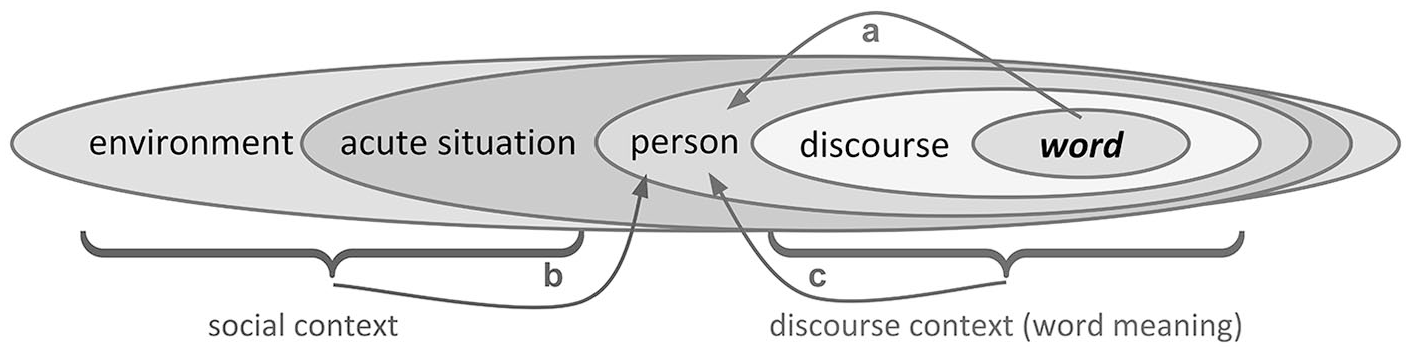
The various layers of context within which a word is observed. (a) The word count approach attempts to map words onto a person’s psychology, bypassing important contextual factors, (b) in more advanced language analysis approaches, social context is brought into the mix (e.g., as additional covariates or through experimental treatment/control groups), and (c) at the same time in more advanced natural language processing techniques, discourse context is leveraged to extract word meaning and, thus, accurate psychological meaning.
Put another way: if our “model” of language fails to account for the context in which it occurs, we lose clarity on what individual words tells us about a person’s psychology in the first place. Looking at individual words under the “words as attention” paradigm, the psychological meaning attributed to the person comes from a decontextualized understanding of the word, thus yielding an ambiguous psychosocial sense (Markowitz & Hancock, 2019). A more ideal attentional framework would be a “words in context as attention” approach, whereby features of the individual themselves are implicitly folded into the quantification of their words and what they are likely to reflect, psychologically speaking (Garten et al., 2019).
Embeddings and Beyond
The skeptical reader may be thinking “Big deal! We already account for context when hand-coding texts!” True as this may be: just as automation of the word counting method has removed the subjective, inconsistent “judgement calls” of manual scoring, so too will we benefit from computerized models of language that objectively and consistently appreciate the complex message-altering power of context (see Burleson, 2010). As our ability to computationally model all aspects of language improves, including context, our ability to objectively and reliably probe the human mind in a standardized, reproducible, and scientific fashion grows.
An important step toward the inclusion of context in computerized language analysis has been the introduction of word embeddings. Briefly described, word embeddings represent each word as a vector of values that reflect its position within a high-dimensional geometric space (much like X, Y, and Z coordinates, but far more than 3 dimensions). The principle behind how these vectors are statistically “learned” is the assumption that word meaning is derived from word context—the so-called “distributional hypothesis” best summarized by Wittgenstein (1953): “the meaning of a word is its use in language.” One of the first computational realizations of word embeddings was latent semantic indexing (Deerwester et al., 1990), which is still in use today. 6 Using such models, it becomes possible to statistically calculate something of a fuzzy representation of an entire text’s meaning (e.g., a diary entry, a tweet, a speech), then calculate the similarity of a document’s meaning to psychologically important concepts, such as “happiness” or “fairness” (Garten et al., 2018).
Nevertheless, most widely used word embeddings still treat each individual word as having a singular meaning or “sense.” Perhaps the most promising technology that approaches a more accurate, “true to psychology” model of language is the so-called “contextual word embeddings,” introduced only within the last few years in computational linguistics. These approaches to natural language processing, which utilize a deep learning technique known as transformers, produce a unique vector representing each word, as described above. Importantly, however, the precise details of each word’s vector is dependent on its exact context (Devlin et al., 2019). Thus, the word “play” in “got played by the scammer” and “played the game” will have totally different representations. Such approaches have led to unprecedented increases in performance in natural language applications ranging machine translation to speech recognition by digital personal assistants (Yang et al., 2019).
Due to their novelty, contextual embeddings have yet to see serious action in psychological research aside from classification benchmarking (e.g., Matero et al., 2019). However, we believe that the entire discipline of psychological language analysis is poised for a quantum shift. For the first time ever, words can be automatically, objectively, and reproducibly quantified in a way that inherently accounts for at least one level of context: discourse. In essence, contextual embeddings give a more stable approach to move beyond function words, mapping a nearly endless supply of open-ended content words to a finite number of dimensions quantifying their meaning.
Most importantly, transcending the word counting approach into one that computationally “understands” social and environmental contexts allows us to use language as more than simply a window into a person’s attentional focus. As we create models of language that are increasingly “true to life” in terms of how humans generate, understand, and use natural language, we will gain new opportunities to probe social psychological questions. We can already see the stirrings of some such work within the field, wherein language models are being probed for validity insofar as they reflect known psychological phenomena. For example, well-established social biases that can be found in studies of “implicit associations” have recently been shown to have analogues in how social concepts are represented in word embedding models (Bolukbasi et al., 2016; Caliskan et al., 2017). Similarly, the changing social landscape can be seen in the rapid increase of research into stereotypes, prejudices, and biases as they are formulated, embedded, and surreptitiously transmitted in our language (Carpenter et al., 2017; Snefjella et al., 2018). We are excited to see what can be learned about ourselves through the study of increasingly veridical language models created by highly collaborative teams of scholars spanning the sciences.
Greater Interdisciplinarity
We are entering an exciting time for language analysis in general, and for social psychologists in particular. Teams of computer and cognitive scientists have generated large, precise models of language going well beyond word counting. Such models are beginning to show up in the social sciences proper, often precipitating first through interdisciplinary conference proceedings and public whitepapers. However, the empirical paradigms under which newer language models are generated are often difficult to transplant directly into psychological research.
Critically, the increasing complexity of natural language processing methods directly necessitates interdisciplinary cooperation not just in the conduct of research, but also in the creation of new paradigms that facilitate the rapid and meaningful integration of new language analysis methods into the social sciences. The merits of interdisciplinary collaboration are often-discussed (e.g., Cummings & Kiesler, 2016), however, we acknowledge that lip service to interdisciplinarity is cheap. We believe that interdisciplinarity will be central to the future of language analysis research, however, it is worth taking a moment to underline the need for true collaboration across all types of boundaries.
The Bird in Borrowed Feathers
With the rise of digital technology, social scientists have gradually become more computationally savvy, on average, with programming languages like R and Python gaining traction. Similarly, computer scientists have begun to recognize the need for better theoretical models of human behavior, moving beyond a purely “informatic” view of social psychology (Wang et al., 2007). Accordingly, there has been an explosion of research at the intersection of computer science and the social sciences; most of this work falls under the umbrella term of “computational social science.”
In practice, however, a majority of research branded as “computational social science” consists of little more than intelligently engineered data pipelines that use one type of human-generated data (e.g., text or videos) to predict another (e.g., scores on questionnaires; behaviors), often providing no real test of social theories or insights into human psychology. In more extreme cases, research in this vein can be caricatured as machine learning exercises masquerading as social science. Equally problematic is the flip side of the same coin: social scientists haphazardly wielding powerful machine learning algorithms and poorly-validated language models, deriving statistically flawed interpretations of their data. For every social scientist who rolls their eyes at yet another computer scientist butchering basic theories of human behavior, there is a computer scientist wincing in pain at yet another psychologist excitedly proclaiming that “big data” and “machine learning” solved their research problems with unbelievable accuracy. In the end, each field has its own scientific norms (i.e., paradigms, in the Kuhnian sense): fitting psychological theory into the norms of machine learning or vice versa rings of the classic “square peg into a round hole” problem.
The way forward may require shedding field-specific norms in favor of developing new paradigms in computational social science that suit the unique needs of the field. Initial steps toward this goal are visible in the form of practical guides written within specific disciplines that outline other fields and norms. For example, political science papers describing computational text analysis (Grimmer & Stewart, 2013); psychology papers describing machine learning (Stachl et al., 2020), and machine learning papers describing social sciences (O’Connor et al., 2011). We see this trend moving toward the development of a new field at the intersection of several social and computational sciences, where such survey works are no longer “translated” from one domain to another but, rather, an interdisciplinary space that can be free to develop its own norms. We encourage readers to keep a highly open-minded approach to new developments in today’s interdisciplinary gaps—innovations will likely emerge rapidly and take on unfamiliar but powerful forms.
Conclusion
Language as a vehicle for studying the human condition has existed since the birth of psychology and has gone through several evolutions over the past century. Early psychology subscribed to language being a powerful window into the human psyche, but its study was ill-defined and pre-scientific. Later, an empirical thrust came about, leading to approaches where statistical inference could be applied, but the methods for quantifying psychological meaning were extremely weak. We are only now beginning to realize the true power of objective, computational methods of psychological language analysis. As our computational models of language grow increasingly true-to-life in form and function, we expect to be able to peer into the inner workings of the mind in ways that are currently unimaginable. The secrets of language are being unlocked in new and exciting ways, and we sit at the cusp of an absolutely revolutionary shift in how we conduct social scientific research.
Footnotes
Acknowledgements
The authors would like to thank Dave Markowitz, Gabriella Harari, Howie Giles, and Karolina Hansen for their helpful and insightful feedback on earlier drafts of this manuscript.
Declaration of Conflicting Interests
The author(s) declared no potential conflicts of interest with respect to the research, authorship, and/or publication of this article.
Funding
The author(s) disclosed receipt of the following financial support for the research, authorship, and/or publication of this article: Preparation of this manuscript was funded, in part, by grants from the Swiss National Science Foundation (#196255) and the US National Institutes of Health—NIAAA (r01 aa028032). The views, opinions, and findings contained in this chapter are those of the author and should not be construed as position, policy, or decision of the aforementioned organizations unless so designated by other documents.
