




Abstract
Subjective social class reflects individuals’ beliefs about their position within a social hierarchy and is associated with various important life outcomes. While many studies have investigated the psychological consequences of subjective social class, few have explored its determinants, particularly at the contextual level. This study addresses this gap by examining how individual-level income and contextual-level income inequality interact in predicting subjective social class. The authors used multilevel modeling to analyze repeated cross-national survey data from 50 countries over three decades, including a total of 311,669 participants across 288 country-year units. The preregistered interaction was not observed, but parametric and nonparametric tests provided evidence for a polynomial interaction between income and inequality: as national income inequality increased, middle-income groups perceived themselves as holding a higher social class, while the perceptions of high- and low-income groups remained unchanged. The authors discuss the role of social comparison processes and the economic structure of unequal societies in explaining the inflated social-class perceptions among middle-income groups in times of greater income inequality.
Keywords
Subjective social class is known to be shaped by comparisons with others based on material factors like income (Tan et al., 2020). Although these comparisons are embedded in specific socioeconomic environments, little is known about how the interplay between subjective social class and income differs across societal contexts (Destin et al., 2017; Grossmann & Huynh, 2013; Kraus & Park, 2017; Sánchez-Rodríguez et al., 2023). Herein, we focus on a crucial contextual factor: income inequality. Over recent decades, income inequality has risen dramatically and become a pressing societal issue worldwide (Chancel et al., 2022), drawing increased attention in both public discourse and psychological research. In this study, we ask the following question: How does exposure to inequality shape the way people evaluate their social position? Evidence suggests that exposure to inequality increases the salience of economic categories (Peters et al., 2022), prompts economic competitiveness (Sommet & Elliot, 2023b), and fuels economic comparisons (Payne et al., 2017). Given this, we examine income inequality as a socio-ecological factor that may increase the psychological weight of income in predicting subjective social class.
Subjective Social Class
Social scientists often assess individuals’ perceptions of their socioeconomic position relative to others within the social hierarchy (e.g., D’Hooge et al., 2018; Kraus et al., 2013). We refer to this construct here as “subjective social class” (for relevant conceptual work on defining and measuring social class, see Antonoplis & Chen, 2021). Subjective social class has been shown to predict a wide range of outcomes, including health and well-being (e.g., Chen & Miller, 2013; Singh-Manoux et al., 2003; Yu & Blader, 2020), self-concept (e.g., Antonoplis & Chen, 2021), cognitive tendencies (e.g., Kraus et al., 2009), and social attitudes and behaviors (e.g., Brown-Iannuzzi et al., 2020; D’Hooge et al., 2018; Piff et al., 2010). Importantly, these effects are independent of the effects of objective social class indicators, explaining variance over and above measures such as income (e.g., Adler et al., 2000; Kraus et al., 2012; Tan et al., 2020). However, while numerous studies have primarily focused on the psychological consequences of subjective social class, relatively few have investigated its determinants.
Subjective social class is largely shaped by social comparison processes, particularly those based on markers of status (Destin et al., 2017; 58-61; Kraus et al., 2012, 2013). To determine their relative position within the social hierarchy, individuals often compare their economic and cultural resources—such as income, educational attainment, and occupational prestige—with those of others (Boyce et al., 2010; Kraus & Stephens, 2012). Evidence from the USA suggests that, among these indicators, the relative importance of income in shaping subjective social class has increased over the last four decades, surpassing other indicators such as educational level and occupational prestige (Cohen et al., 2017). While these findings suggest that income is central to individuals’ assessment of their social class, it remains an open question as to whether this pattern holds across other countries and time periods. This underscores the need for large-scale cross-national research that can more comprehensively examine how the relationship between income and subjective social class unfolds across diverse cultural and socioeconomic contexts.
Importantly, the relationship between income and subjective social class is not always straightforward. Research indicates that subjective perceptions of social class are often at odds with objective indicators of status, such as income (Chen & Fan, 2015; Kraus & Tan, 2015; Li et al., 2020; Sosnaud et al., 2013; see also Auger et al., 2024). Moreover, recent meta-analytic evidence suggests only a moderate association between income and subjective social class, hovering around r̄ ≈ .30 (Tan et al., 2020). This modest effect size suggests that factors beyond material resources like income can play a significant role, and that the weight of income in assessing one's position within the social hierarchy may vary depending on the broader social context (Destin et al., 2017; Destin & Debrosse, 2017).
Generally speaking, social comparisons are embedded within specific socioeconomic contexts, shaped by both individual experiences and broader societal structures. Studies suggest that social changes, such as globalization, have broadened the range of comparisons people make (Suls et al., 2002; Sweeney & McFarlin, 2004), with the media facilitating comparisons with distant targets on a national scale (McCardle & Speck, 2019). This underlines the importance of cross-national analyses for understanding social comparison within a broader context beyond one's immediate environment (Buunk & Mussweiler, 2001). Despite this, little is known about how subjective social class varies across national contexts and over time (Destin et al., 2017). In this study, we address this gap by focusing on income inequality as a critical contextual factor.
Income Inequality
Income inequality is broadly defined as the unequal distribution of income among individuals within a given area (Solt, 2020). Since the 1980s, across the member countries of the Organisation for Economic Co-operation and Development, the income of higher-income groups has grown at a much faster rate than that of middle- and low-income groups, leading to unprecedented levels of income inequality (Organisation for Economic Co-operation and Development, 2019b). Today, the top 10% of earners in these countries holds nearly half of the total wealth, whereas the bottom 40% accounts for just 3%, illustrating the stark disparities that persist. This trend is also evident in other developed nations across the world, as well as developing economies (Chancel et al., 2022; Coffey et al., 2020; Ravallion, 2014). While this pattern is not universal—for instance, income inequality has declined in parts of Latin America, a region historically marked by high inequality—the rise in income inequality over the past 25 years applies to most countries globally, with nearly three-quarters of the global population now living in countries where income inequality has increased (United Nations, 2020).
Rising income inequality has profound psychological implications for the way people perceive themselves and their social standing (for reviews, see Gobel & Carvacho, 2024; Peters & Jetten, 2023; Sommet & Elliot, 2023a), suggesting that the degree of income inequality may shape how income affects the perception of one's social class. Research supports the idea that income inequality elevates the importance of income for estimating one's own and others’ social class. Greater economic inequality heightens economic comparisons, leading people to give more importance to personal success and achievement (Du et al., 2024), and to use income as a central benchmark for self-evaluation (Jetten et al., 2017, 2022). In highly unequal societies, wealth disparities among people become more prominent, making economic cues readily accessible attributes for self-categorization and the categorization of others (Kraus et al., 2017; Peters et al., 2022; Wilkinson & Pickett, 2009). As inequality increases, individuals perceive sharper differences between income groups (e.g., rich versus poor) and stronger similarities within groups of similar income (Connor et al., 2021; Heiserman & Simpson, 2017). As income inequality fuels social-comparison concerns, people devote more effort toward status competition in order to increase (or at least maintain) their rank in the distribution of income (Sánchez-Rodríguez, Willis et al., 2019; Sommet et al., 2019; Walasek & Brown, 2016).
In addition, prior research suggests that living in a highly unequal society can bias individuals’ perceptions of their own social class. In such contexts, being below the poverty line or belonging to a lower social class is often stigmatized, whereas higher social standing tends to be valued positively (Jordan et al., 2020; Vázquez & Lois, 2020). This classist cultural climate may motivate individuals to preserve a favorable self-image by psychologically distancing themselves from lower-class groups or by overestimating their own status (Krueger, 1998; Loughnan et al., 2011). In a similar vein, Melita et al. (2024) investigated how individuals’ perceptions of a classist social climate—a normative environment that emphasizes rigid boundaries between privileged and disadvantaged groups—can shape their self-perception. Specifically, they found that people in these climates often overestimate their own status, a process they label “status self-deception.” Although this research did not examine the effects of income inequality, it provides converging evidence that unequal social environments influence how individuals perceive their place in the status hierarchy.
Collectively, these findings highlight the importance of considering income inequality as a contextual factor when examining subjective social class. More directly relevant to our study, they suggest that the impact of income on subjective social class depends on the level of income inequality.
Income Inequality, Income, and Subjective Social Class
To the best of our knowledge, only three studies have tested the idea that income inequality increases the importance of income in shaping individuals’ self-perceptions of their social class using national-level income inequality indicators (Andersen & Curtis, 2012; Curtis, 2013; Lindemann & Saar, 2014; for research using local-level income inequality indicators, see Kim & Sommet, 2025). These studies consistently found that the relationship between income and the perception of one's social class is stronger in countries with higher levels of national income inequality. For instance, Andersen and Curtis (2012) examined 44 countries and reported that the link between household income and class identity was more pronounced in nations with greater income inequality. Moreover, Curtis (2013) studied 15 countries and similarly found that the association between household income and class identity was strongest in those with greater income inequality. Finally, Lindemann and Saar (2014) compared 21 European countries and observed that greater national income inequality predicted larger differences in subjective social class between income groups.
However, the aforementioned studies had an important limitation: they relied on a small number of higher-level units—specifically, between 15 and 44 countries. When examining higher-level effects or cross-level interactions, a small higher-level sample size significantly reduces the statistical power needed to detect contextual effects (Sommet & Morselli, 2021), which, in turn, diminishes the likelihood of documenting replicable effects (e.g., Button et al., 2013). Additionally, the studies cited above used single-point cross-sectional designs, including countries as diverse as Norway, Trinidad and Tobago, Thailand, and Mali (Andersen & Curtis, 2012). Such designs compare countries that differ on numerous dimensions beyond income inequality, raising concerns about between-country confounds and casting doubt on the reliability of the analyses.
We also note that, although not examining interactions with income, some prior studies have examined the relationship between national income inequality and general self-perceptions. For example, Loughnan et al. (2011) found that greater national inequality was associated with stronger self-enhancement biases. In contrast, Schneider (2019) found that greater national inequality was linked to lower perceived social status. While these studies suggest that income inequality may influence self-perception, the direction of the effect appears inconsistent. Moreover, both studies relied on cross-sectional samples with small sample sizes at the higher level (15 and 26 nations, respectively), limiting the robustness of their conclusions. These limitations highlight the need for high-powered studies with improved design to accurately investigate how changes in national income inequality interact with individual income to shape subjective social class over time. Our study aims to address these limitations by employing a large-scale repeated cross-sectional data set that spans many countries and decades to estimate the pooled within-country effects of income inequality over time. Unlike previous studies, which have typically focused on cross-sectional comparisons among a limited number of countries, our approach provides a more comprehensive and generalizable understanding of how shifts in national income inequality shape the subjective social class of individuals across the income distribution.
The Present Study
In the present research, we aimed to examine whether the relationship between income and subjective social class varies with changes in national income inequality over time. To address the limitations of prior research, which has often involved a small number of higher-level units, we used a large-scale repeated cross-national data set comprising over 311,000 observations from 50 countries over three decades, including 288 country-year units. We conducted multilevel analyses with country-mean centering to estimate the within-country effects of inequality without making cross-country comparisons. This approach effectively eliminates potential confounders between countries and allows us to obtain unbiased estimates of the pooled within-country effects of income inequality over time (Hamaker & Muthén, 2020). The study was preregistered, 1 and all of the materials, analyzed data, and code files for reproducing the analyses are available on the Open Science Framework platform. 2
Method
Data
We used individual-level data from the International Social Survey Programme, which is an academic cross-national collaboration that conducts nationally representative surveys across numerous countries. We pooled the responses from data collected for the International Social Survey Programme from 1987 to 2019, including only reponses with no missing values for our focal variables. Our final sample consisted of 311,669 respondents from 288 country-years and 50 countries. We combined the International Social Survey Programme data set with time-varying country-level economic data. Table 1 presents the sample demographic characteristics and time-varying country-level economic characteristics. Note that, just as for the income inequality estimates, all four time-varying country-level control variables were matched to the corresponding country and year of the survey data.
Description of the Sample and Variables.

Note. When the mean is reported, the standard deviation is given in parentheses. Political orientation was measured with a 5-point scale (1 = far left to 5 = far right). Estimates of time-varying country-level control variables were obtained from the World Bank. GDP = gross domestic product.
Variables
Table S1 presents the correlations between all the measures.
Subjective Social Class (Focal Outcome Variable)
We used subjective social class as the outcome variable. Participants rated perceptions of their rank within society in response to the following question (1 = lowest/bottom, 10 = highest/top; M = 5.15, SD = 1.97): In our society, there are groups which tend to be towards the top and groups which tend to be towards the bottom. Below is a scale that runs from the top to the bottom. Where would you put yourself on this scale?.
3
Income (Individual-Level Predictor)
We used the participants’ household income as the individual-level focal predictor. To adjust for household size, we calculated the country-year-based equivalized income using the square root equivalence scale (see Organisation for Economic Co-operation and Development, 2019a). To harmonize the measure across countries and account for inflation, we computed country-year-specific income quantiles (i.e., income ventiles; M = 10.27, SD = 5.78). 4
Income Inequality (Time-Varying Country-Level Predictor)
We used annual national Gini coefficient estimates based on equivalized household disposable income from the Standardized World Income Inequality Database as the time-varying country-level focal predictor (Solt, 2020). The Gini coefficient is a widely used measure of income inequality, ranging from 0 (perfect equality—for a given year, everyone in the country has the same amount of income) to 100 (perfect inequality—for a given year, all income belongs to one person in the country while everyone else has none; M = 32.74, SD = 8.45).
Results
Preregistered Analysis
Analytical Strategy
We employed a multilevel model to account for the hierarchical nature of the data, with participants (Level 1 units) nested within countries (Level 2 units). In line with our preregistration, we used income, income inequality (the Gini coefficient), and their cross-level interaction as focal predictors, and subjective social class as the outcome variable, while including the random slope for income. Income inequality was treated as a time-varying variable that changes across years within countries. To better approach causality, we used country-mean-centered income inequality: we subtracted the country-specific mean of the Gini coefficient (averaged across all years for each country) from each annual Gini coefficient estimate. This approach allowed us to isolate the effects of year-to-year fluctuations in income inequality within countries, thereby focusing solely on within-country variation over time (Enders & Tofighi, 2007). We also included year fixed effects (i.e., year dummies) to account for unobserved period-specific influences common across countries, thus producing estimates net of period effects (Allison, 2009; Kropko & Kubinec, 2020; Sommet & Lipps, 2025; Wooldridge, 2021). This analytical strategy allowed for comparisons within similar countries over time, rather than comparing between very different countries, thus eliminating potential between-country confounders that are difficult, if not impossible, to control for, such as cultural, historical, and economic differences. 5
We tested our model without (Model 1) and with (Model 2) a preregistered set of six individual-level control variables (gender, age, years of education, marital status, employment status, and political orientation) and four time-varying country-level covariates (total national population, poverty rate, unemployment rate, and GDP). The continuous individual-level control variables were grand-mean-centered, while the time-varying country-level control variables were country-mean-centered. The multilevel regression equation is
Findings
Contrary to our expectations, the interaction between income and income inequality was not significant in predicting subjective social class (B = 0.002, SE = 0.001, 95% CI [confidence interval] = [−0.0004, 0.004], p = .110). In plain terms, this means that the association between income and subjective social class did not vary with changes in the level of national income inequality over time within countries. The interaction term was not statistically significant in the model without control variables but became significant when control variables were included (B = −0.005, SE = 0.002, 95% CI = [−0.008, −0.001], p = .007). This suggests that the inclusion of control variables influences the interaction between income and income inequality in predicting subjective social class. However, as the results were not robust across the model specifications, we deemed the analysis inconclusive and conducted additional non-preregistered analyses. For the full results of the preregistered analyses, see the supplementary material (Table S3).
Non-Preregistered Analysis
Analytical Strategy
In a follow-up analysis, we explored whether the absence of a moderation effect could be concealing nonlinear effects: regardless of the socioeconomic context, individuals in the top and bottom income brackets may have a relatively unequivocal perception of their high or low social class; in contrast, individuals in the middle-income brackets may experience greater ambiguity in assessing their social class, with income inequality exerting a more critical influence. Based on this post hoc reasoning, we replicated our preregistered multilevel model, but this time included the linear, quadratic, and cubic income terms (i.e., Incomeij, Incomeij2, and Incomeij3, respectively) and their respective interaction terms with income inequality (i.e., Incomeij × Ginij, Incomeij2 × Ginij, and Incomeij3 × Ginij). All other aspects of this follow-up analysis remained the same as in the preregistered strategy. Specifically, we used the same variance partitioning and fixed-effects specification (two-level model with year fixed effects); applied the same centering method for income inequality (i.e., country-mean centering); and included the same set of control variables for the robustness analysis (the continuous individual-level control variables were grand mean-centered, while the time-varying country-level control variables were country-mean-centered).
Findings
We observed a polynomial interaction between income and income inequality in predicting subjective social class. Specifically, the analysis revealed a significant negative quadratic interaction between income and income inequality (Incomeij2 × Ginij: B = −0.006, SE = 0.001, 95% CI = [−0.008, −0.005], p < .001), while the linear and cubic interactions were nonsignificant (Incomeij × Ginij: B = 0.005, SE = 0.003, 95% CI = [−0.000, 0.011], p = .054; Incomeij3 × Ginij: B = −0.001, SE = 0.001, 95% CI = [−0.002, 0.000], p = .127). Table 2 presents the full results of the analysis. Importantly, the use of quadratic and cubic terms has been criticized because imposing a functional form can sometimes produce spurious findings (Kratz & Brüderl, 2021; Ranjbar & Sperlich, 2020; Simonsohn, 2018). Therefore, we replicated the analysis using a nonparametric approach by treating income ventiles as a categorical variable, allowing means to be freely estimated. As shown in Figure 1, the results from both the polynomial regression (curves) and the nonparametric regression (dots) are closely aligned, supporting the quadratic form of the interaction: when income inequality is greater, middle-income groups reported a higher subjective social class compared to when income inequality is lower, whereas no differences were observed for individuals in the top- and bottom-income groups, regardless of the level of national income inequality (for the results of the nonparametric analyses, see Table S4 in the supplementary material). This conclusion remained similar when we controlled for our preregistered set of 10 individual and time-varying country-level control variables.

Quadratic Interaction Between Income and National Income Inequality on Subjective Social Class: Comparison of Polynomial (Curves) and Nonparametric (Dots) Regression Models.
Coefficient Estimates (and Standard Errors) From the Multilevel Models Testing the Interactive Effects of Income and National Income Inequality on Subjective Social Class Without (Model 1) and With (Model 2) the Preregistered Set of Covariates.
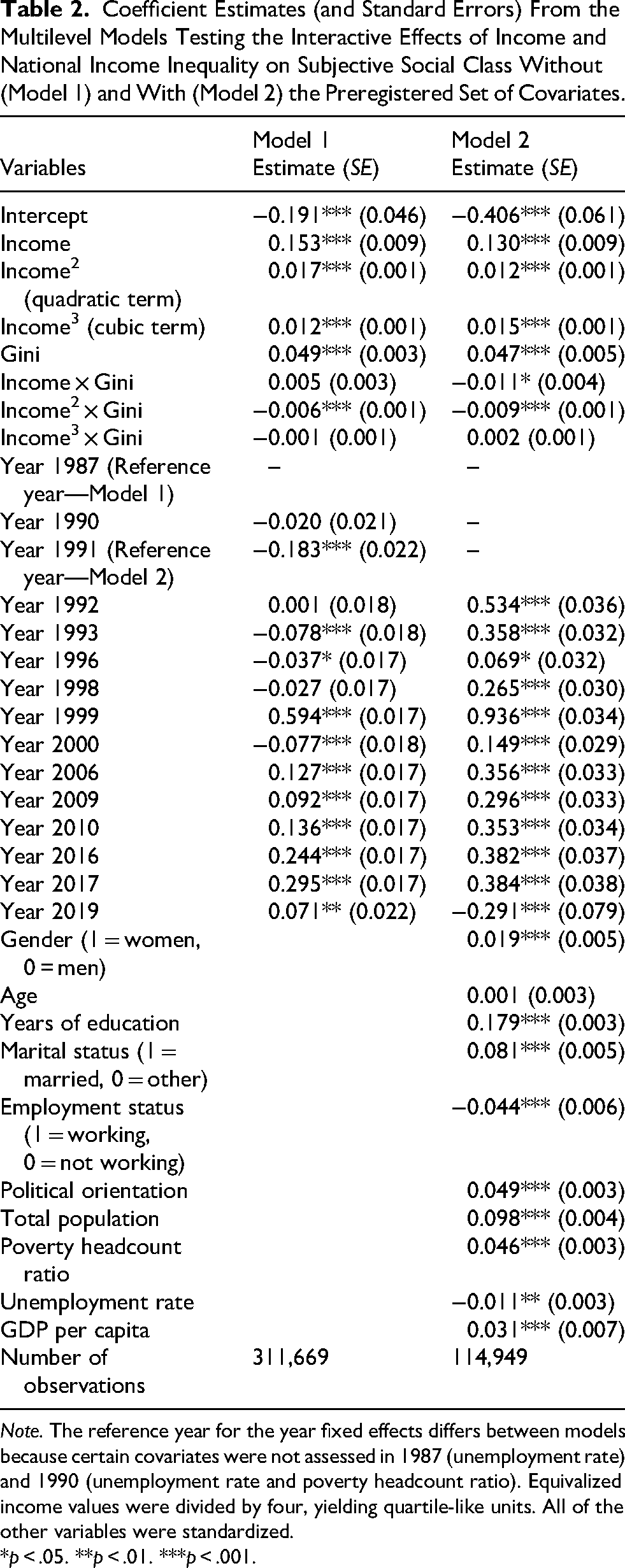
Note. The reference year for the year fixed effects differs between models because certain covariates were not assessed in 1987 (unemployment rate) and 1990 (unemployment rate and poverty headcount ratio). Equivalized income values were divided by four, yielding quartile-like units. All of the other variables were standardized.
*p < .05. **p < .01. ***p < .001.
Discussion
In this study, we examined how living in economically unequal contexts affects one's subjective social class. To do so, we used a large repeated cross-sectional data set spanning over three decades, with data from 50 countries and 288 country-year units. We found that change in national income inequality moderates the relationship between income and subjective social class. Specifically, parametric and nonparametric tests documented a polynomial interaction: as national income inequality increases, middle-income groups perceive themselves as belonging to a higher social class compared to when national income inequality is lower, whereas the perceptions of high- and low-income groups did not depend on the level of income inequality. Notably, in Income ventiles 7, 9, and 12–14, the difference in subjective social class between lower- and higher-income- inequality contexts exceeded a standardized difference of 0.1 (see Table S5 in the supplementary material), a threshold often regarded as the lower bound of practical significance in social science research (e.g., see Liu et al., 2024). This suggests that individuals in these ventiles—approximately the 35th to 70th income percentiles—may be especially sensitive to changes in national income inequality, tending to perceive themselves as belonging to a higher social class when income inequality is greater. These findings underscore the complexity of the association between income and subjective social class across contexts, suggesting that middle-income groups perceive themselves as relatively advantaged in high-inequality contexts. This unanticipated result raises several questions that could be addressed by social comparison theory and the economic structure of unequal societies.
Interpretation of Non-Preregistered Findings
Why is income inequality differentially associated with subjective social class across income groups? According to social comparison theory, individuals evaluate their social standing by comparing themselves to others, with comparisons typically occurring with similar others (e.g., Wood, 1989) in their immediate environments (Gerber et al., 2018; Zell & Alicke, 2010). In highly unequal societies, income-based segregation is more pronounced, leading people with higher and lower incomes to live in separate environments (Chetty et al., 2014; Reardon & Bischoff, 2011; for a relevant review, see Cottineau-Mugadza, 2024). This means that individuals at the top and bottom of the income distribution predominantly interact with others in their respective income brackets and compare themselves to others with similar income levels (Hicks et al., 2016). Therefore, we speculate that individuals at the top and bottom of the income distribution experience relatively less ambiguity in their perceptions of social class, regardless of rising income inequality. This may occur because income-based segregation makes it clearer where they stand within their social context. In segregated environments, individuals can more easily discern whether they are deprived or privileged, thereby reducing uncertainty about their relative social class. In contrast, middle-income groups occupy a more fluid position within the social hierarchy, making them more susceptible to shifts in subjective social class as levels of income inequality change. This fluidity results in greater ambiguity when assessing their social class. Unlike individuals at the upper and lower ends of the income spectrum, who typically have stable perceptions of their social standing due to “ceiling” and “floor” effects, those in the middle-income groups face more uncertainty in their social comparisons. This increased uncertainty may help account for the tendency for middle-income group members’ perceptions of their social class to vary as a function of changes in the levels of national income inequality.
At the same time, we acknowledge that alternative explanations remain plausible. For example, social sampling theory suggests that individuals infer the broader status structure from the distribution of others in their immediate network (Galesic et al., 2018). In highly unequal societies, this can lead to biased perceptions, particularly at the extremes of the income spectrum, because individuals are disproportionately surrounded by similar others (Dawtry et al., 2015; Fiedler, 2000; Galesic et al., 2012). Such distortions may result in central tendency biases, whereby individuals with both higher and lower incomes misperceive their status—either underestimating or overestimating it, respectively (Dineen et al., 2017; Evans & Kelley, 2004)—thereby widening the gap between objective and subjective social class at both extremes. Beyond social sampling theory, subjective social class is likely shaped by multiple mechanisms, including cognitive biases and motivational forces (e.g., ideology, self-interest), which may operate differently across income groups. For example, recent work has shown that middle-income individuals place greater weight on occupational status when assessing their social class than individuals at the top or bottom of the distribution (Kirsten et al., 2023). Together, these insights highlight the need for further research into whether subjective social class follows linear or nonlinear patterns across the income distribution, and how broader structural factors, such as national income inequality, shape this relationship.
What, then, might account for the tendency of middle-income group members to perceive themselves as belonging to a higher social class when income inequality increases? One possible explanation is that more unequal societies often exhibit a right-skewed economic structure, where a small group of individuals captures a disproportionately large share of the total income while the majority earns relatively little (e.g., see Chancel et al., 2022; Donovan et al., 2021). In such contexts, middle-income groups are positioned above a mass of people from lower-income groups, which likely increases the frequency of downward comparisons and, in turn, boosts their relative subjective social class. Moreover, while extreme poverty has declined globally over recent decades (Hasell et al., 2022), income inequality has substantially widened in most countries (Blanchet et al., 2022). This widening gap has resulted in a growing population of individuals with incomes lower than those of middle-income groups. Furthermore, even as individuals tend to engage in upward comparisons (i.e., the unidirectional drive upward; Festinger, 1954), the impact of such comparisons may be limited for members of middle-income groups due to people's cognitive tendency toward insensitivity to large numbers (Jackson & Payne, 2021). Research has shown that people tend to be insensitive to large numerical differences, with larger values having diminished psychological effects (Jackson & Payne, 2021; Kahneman & Tversky, 1979). This implies that the extreme wealth of the highest earners may not substantially influence the subjective social class of middle-income group members. This could partly explain the tendency for middle-income group members to report a higher subjective social class in contexts of greater income inequality.
Again, we acknowledge that an alternative interpretation is also plausible. Some studies suggest that middle-income individuals may experience heightened economic insecurity and status anxiety due to their intermediate position in the socioeconomic hierarchy (e.g., Frank, 2013; Winkelmann & Winkelmann, 2010), which could lead them to underestimate their subjective social class. From this perspective, the observed pattern may not reflect a heightened sense of status in more unequal societies but rather a reduction in their usual tendency toward modest or cautious self-placement. Inequality may therefore attenuate underestimation rather than inflate subjective social class, highlighting the need for further research on how inequality shapes self-evaluative biases across income groups.
Although the observed curvilinear relationship between income and subjective social class was not anticipated in our preregistered hypothesis, our results align well with prior research suggesting that middle-income groups are particularly sensitive to income inequality. For example, income inequality is more predictive of redistributive preferences among middle-income groups than among other income groups in European samples (Kevins et al., 2018), and greater income inequality is associated with lower income satisfaction among middle-class individuals in Switzerland (Winkelmann & Winkelmann, 2010). Furthermore, income inequality has been shown to specifically increase the general consumption of middle-income households, particularly for visible goods, in the USA (Bertrand & Morse, 2013). Our study goes beyond these prior findings by extending the investigation to broader cultural contexts outside of western societies, thereby contributing to a more comprehensive understanding of how income inequality affects middle-income groups.
Notably, our findings diverge from a previous experimental study showing that participants assigned to the middle-income group in a fictional society perceived their in-group as less wealthy under high-inequality conditions (Sánchez-Rodríguez, Jetten et al., 2019). However, this discrepancy should be interpreted with caution as this experiment examined perceptions of in-group wealth rather than self-perception of social class and was conducted in an artificial context that may not reflect real-world socioeconomic realities.
Limitations
Three limitations should be noted. First, the study used observational data, which prevents causal inference. Although repeated cross-sectional data provides a better approximation to causality than single-point cross-sectional data (Grosz et al., 2020), studies using longitudinal designs are needed. In addition, experimental approaches could complement observational designs by isolating the mechanisms through which income inequality and individual income jointly shape subjective social class.
Second, the research relied solely on the Gini coefficient as the measure of income inequality. While the Gini coefficient is the most widely used metric for assessing income inequality and strongly correlates with other income-distribution metrics (e.g., Kawachi & Kennedy, 1997), it does not provide detailed information on how income is distributed across different parts of the population. For example, two distributions with the same level of inequality—one driven by a large number of individuals with low income and the other by a small number of wealthy individuals—may have different psychological effects (for a relevant review, see Jachimowicz et al., 2023). Recent studies have begun to address this distributional issue, revealing important differences (e.g., Blesch et al., 2022). Thus, future research would benefit from employing more refined indicators of income inequality that can differentiate inequality concentrated at either end of the income distribution. Such an approach would help determine whether similar findings hold across more specific inequality measures, ultimately providing a more comprehensive understanding of how income inequality affects subjective social class.
Third, there is evidence that individuals misperceive not only their own social class but also the level of income inequality in society (e.g., Gimpelson & Treisman, 2018). Because psychological responses to inequality may be driven more by perceived inequality than objective inequality (Schmalor & Heine, 2021; Willis et al., 2022), future research should take this factor into account.
Conclusion
Despite the study’s limitations, our findings suggest that middle-income individuals perceive themselves as relatively advantaged in high-inequality contexts due to their position above a larger lower-income group. In contrast, those at the top and bottom extremes of the income distribution are less affected by rising national income inequality. This nuanced interaction between income and income inequality highlights that income does not always predict subjective social class uniformly; rather, it depends on the broader socioeconomic contexts and, particularly, on how income is distributed within countries.
Supplemental Material
sj-docx-1-pac-10.1177_18344909251372719 - Supplemental material for Middle-Income Groups Perceive Themselves as Belonging to a Higher Social Class When National Income Inequality is Greater
Supplemental material, sj-docx-1-pac-10.1177_18344909251372719 for Middle-Income Groups Perceive Themselves as Belonging to a Higher Social Class When National Income Inequality is Greater by Youngju Kim and Nicolas Sommet in Journal of Pacific Rim Psychology
Footnotes
Ethical Approval and Informed Consent
This study used publicly available secondary data from the International Social Survey Programme. Ethical approval and informed consent procedures were implemented by the original national survey teams in accordance with each country′ legal and ethical standards. For more information on the study materials, procedures, and data collection processes, visit 
Funding
The authors received no financial support for the research, authorship, and/or publication of this article.
Declaration of Conflicting Interests
The authors declared no potential conflicts of interest with respect to the research, authorship, and/or publication of this article.
Supplemental Material
Supplemental material for this article is available online.
Notes
References
Supplementary Material
Please find the following supplemental material available below.
For Open Access articles published under a Creative Commons License, all supplemental material carries the same license as the article it is associated with.
For non-Open Access articles published, all supplemental material carries a non-exclusive license, and permission requests for re-use of supplemental material or any part of supplemental material shall be sent directly to the copyright owner as specified in the copyright notice associated with the article.
