




Abstract
Previous research indicated that exposure to disgusting stimuli often leads to more negative attitudes toward gays. However, these findings primarily stemmed from Western cultures and were inconsistent. It remained uncertain whether the impact of disgust would apply to diverse cultural contexts. This study aimed to fill this gap by investigating whether the influence of disgust, previously observed, extended to an unexplored non-Western setting, Turkey. In Study 1, an online experiment was conducted to explore the connection between disgust and attitudes toward gays. Study 2 aimed to replicate these findings in a laboratory setting and examined the role of political attitudes. Study 1 found no significant link between disgust and disapproval of gays. However, in Study 2, there were significant correlations between political conservatism, disgust sensitivity, and negative attitudes toward gays. Notably, disgust did not significantly affect negativity toward gays in either study. Moreover, while political conservatism would lead to negative attitudes, it did not moderate the relationship between disgust and negativity toward gay individuals in Study 2. Present findings expand the ongoing debate about the causal role of disgust in disapproval of gays, providing original insights into a non-Western cultural context.
Over the past two decades, social psychological research has made significant strides in uncovering how and why disgust affects guiding avoidance behaviors toward marginalized out-groups within society (Rozin et al., 2008). In this manner, the pathogen avoidance strategy and behavioral immune system (BIS) have been proposed as a fundamental evolutionary mechanism underlying conservative political ideology, acknowledged for the role of disgust in in-group favoritism and the creation of social divisions (Schaller & Duncan, 2007; Thornhill et al., 2009). Given that prejudice has generally been conceptualized as negative beliefs about others coupled with emotional reactions (Allport, 1954), and affect appears as a strong predictor of negative attitudes as well or better than cognitive determinants (Stangor et al., 1991), relevant research has attempted to observe the role of different emotions in prejudicial attitudes toward various marginalized out-groups.
Consistent with this conceptualization of prejudice, BIS has approached negativity toward out-groups by considering the roles of emotions, with a particular emphasis on disgust (Schaller & Park, 2011). According to the BIS, perceiving certain groups as socially deviant leads individuals to display protective mechanisms toward those groups to avoid potential disease contamination (Duncan et al., 2009; Kiss et al., 2020). The benefits of the emotion of disgust in social relationships, therefore, lie in inhibiting contact with out-groups that might harbor novel pathogens for members of the in-group (Park & Schaller, 2009), in line with the main assumptions of evolutionary psychology regarding the protective role of core disgust against pathogens (Rozin et al., 1997). This, in turn, decreases the risk of disease contamination through avoidance strategies toward marginalized groups. Therefore, it would align with the assumptions of the BIS to expect that the groups perceived as either violating normative expectations regarding hygiene or having norms differing from society's traditional hygiene norms would be more negatively perceived (Kiss et al., 2020).
In this context, gay men appear as a potential target group of prejudice in many ways. Gay men have generally been stigmatized due to HIV and AIDS (Lawrence & Husfeldt, 1990; Vincent et al., 2016), perceived lack of purity (Kang et al., 2019; Terrizzi et al., 2012), or engagement in anal intercourse, which is seen as contrary to heteronormative values and perceived as risky for disease transmission. In line with this, sexual disgust was found as a mediator of the link between heteronormative values and hostility toward gay men (Ray & Parkhill, 2021).
In the last two decades, previous research has tested the correlational link between sensitivity to disgust, as a trait, and prejudice toward gays. Inbar et al. (2009a, 2009b), for instance, showed that people with higher sensitivity to disgust intuitively exhibit greater negative evaluations toward encouraging gays to kiss in public, relative to heterosexuals. In another research, sexually unconventional behaviors—often viewed as deviations from societal norms—were found to be associated with greater negativity in individuals with higher levels of disgust sensitivity (Heerdink et al., 2019). Besides, Crawford et al. (2014) found that negative attitudes toward out-groups that challenge traditional sexual norms were associated with disgust sensitivity (Crawford et al., 2014). In addition to these findings, the relationship between conservatism and disgust is particularly pronounced regarding issues related to purity, such as abortion and gay marriage (Crawford et al., 2014; Inbar et al., 2009a, 2009b).
Since correlational findings are not sufficient to demonstrate the causal role of disgust and prejudice toward gays, relevant research has also attempted to observe the impact of increased disgust on this link with an experimental approach. To examine the causal link between disgust and homonegativity, the inducement of disgusting scenarios (Inbar et al., 2009a, 2009b), exposing participants to unpleasant odors (Cunningham et al., 2013; Inbar et al., 2012), and showing disgusting videos (Horberg et al., 2009) were used. For instance, Eskine et al. (2011) found that gustatory disgust intensified the perception of moral wrongness. In addition to this, some of these findings showing the significant impact of disgust on revealing prejudicial attitudes toward gays also highlighted the role of political orientation (Inbar et al., 2012; Terrizzi et al., 2010). Inbar et al. (2012), for instance, showed that liberal individuals induced with disgust exhibited fewer negative attitudes, while disgusted conservatives revealed more negativity toward gay people. Therefore, this evidence suggests that prejudice toward gays and disgust sensitivity might be moderated by the liberal (or conservative) political orientations of individuals.
However, some studies have failed to replicate the significant link between conservatism, disapproval of gays, and disgust sensitivity. For instance, Tybur et al. (2010) found no significant association between disgust sensitivity and political conservatism. Contrary to the study of Eskine et al. (2011), Johnson et al. (2016) showed no support for the impact of gustatory disgust on moral judgments. Białek et al. (2021) found no impact of disgust on moral judgments. Yet, they showed that participants with higher self-reported disgust tend to lower acceptability for moral transgressions. Their results implied that relying on individuals’ subjective reports of disgust might offer a more delicate gauge of how disgust influences moral judgment than analyzing the mere presence of disgusting stimuli.
Landy and Goodwin (2015) conducted a comprehensive meta-analysis of published and unpublished studies involving the manipulation of incidental disgust during moral judgment tasks; they found a slight amplification effect, particularly prominent with gustatory/olfactory methods. However, the impact of disgust inducement was found to have a medium effect. They noted that adjusting for potential publication bias eliminated the observed effect. Thus, the roles of disgust on moral judgments were found to be small or near zero when publication bias was controlled. Another meta-analysis by Kiss et al. (2020) confirmed a significant relationship between disgust sensitivity and prejudice against gay men, with a moderate to large effect size. Overall, the effects of disgust on socio-moral decision-making have become the subject of controversy. Considering that previous research has been mostly conducted in Western cultural contexts, these mixed findings, in turn, lead us to question whether the similar effect of disgust induction would be pronounced in diverse cultural backgrounds.
Specifically, as a limitation of the previous research, the evidence mentioned above was primarily derived from Western, Educated, Industrialized, Rich, and Democratic (WEIRD) cultural contexts (Henrich et al., 2010). Even though the advocacy for homosexual rights is gaining traction worldwide, negative attitudes persist at alarming levels, resulting in labeling and psychological and physical violence, particularly in non-Western communities (Sakalli, 2002). Turkey represents a cultural context where gender norms are predominantly manifested through heteronormative discourse, and LGBTI+-affirming narratives have long been met with discriminatory attitudes on social media (Doğan et al., 2023). In Turkey, considered a culture of honor (Uskul et al., 2019), debates related to gender have been ongoing for a long time, and LGBTI+ individuals, especially, face violence and discrimination, particularly from the far-right and religious segments (Anderson & Koc, 2015; Eslen-Ziya & Koç, 2016; Metin-Orta, 2021; Yavuz & Byrne, 2021). Considering the specific target group of prejudicial attitudes, gay men, and the diverse responses to normative violations of heteronormative sexual orientation, obtaining data from participants in non-WEIRD regions of the world would be worth pursuing to enrich the existing research by allowing broader generalizations of the findings.
Turkey stands out among non-Western countries due to its unique cultural context, shaped by a blend of collectivistic and honor-based cultural values (Uskul et al., 2019) where heterosexual norms often dominate (e.g., Bilgehan Ozturk, 2011; Gezgin, 2022). Proving its distinct cultural context, a sample tested in Turkey was evaluated as non-WEIRD, having the lowest “WEIRDness” score among other countries (Klein et al., 2018). Thus, we deem Turkey to be a suitable and original cultural context for testing the impact of disgust on displaying prejudice toward gay people. Disgust sensitivity and prejudice toward gay men have been studied across cultures in only one study, which included Turkey (Van Leeuwen et al., 2022) and supported the expected positive associations among conservatism, negative attitudes toward homosexuals, and disgust sensitivity across diverse cultures, including Turkish population.
To the best of our knowledge, there is no prior research examining the causal role of disgust in displaying prejudice toward gay people in the Turkish cultural context. The present investigation, therefore, aims to investigate the role of disgust in displaying prejudice against gay men in Turkey. In the first study, we hypothesized that the attitudes toward homosexuals would be more negative in the disgust-induced group compared to the control group. 1 In the second study, we tested the moderator role of conservatism in the link between disgust and attitudes toward homosexuals, acknowledging the significance of politically conservative attitudes in clarifying the relationship between disgust sensitivity and prejudice against gay men (Inbar et al., 2012). Specifically, prior research demonstrated that higher levels of conservatism might increase prejudicial attitudes toward gays (Choe et al., 2019; Pacilli et al., 2011), and the impact of disgust in negative attitudes toward gays might be more pronounced among conservative individuals (Adams et al., 2014; Inbar et al., 2012). Given that disgust is a predictor of conservatism (Adams et al., 2014; Inbar et al., 2009a, 2009b) and prejudice toward gays (Kiss et al., 2020), conservatism appears as a potential moderator of the link between disgust inducement and prejudice toward gays. In the context of Turkish culture, traditional normative expectations regarding gender and social dominance orientation are found to be significantly correlated (Metin-Orta, 2021). Given that both social dominance orientation and adherence to traditional gender norms are strongly linked with conservative attitudes (Choe et al., 2019; Christopher & Mull, 2006; Harnish et al., 2008), it has been specifically predicted that participants in the experimental group (those induced with disgust) with higher levels of conservatism would exhibit more negative attitudes toward gay people. Participants’ sensitivity to disgust, age, gender, and education levels were statistically controlled based on prior research (Van Leeuwen et al., 2022).
Study 1
Method
Participants
Having been approved by the Human Research Ethics Committee (protocol number is 023-ODTU-2021), 182 people were recruited through social media announcements. Before starting the procedure, informed consent was presented to the participants (research materials regarding measures and all procedures in Study 1 and Study 2 were provided in the Supplemental Materials).
Participants who quit the survey halfway through (N = 57) without completing the measures were excluded. Participants (N = 13) who failed to respond correctly to the attention check question were also excluded. The final sample consisted of 112 participants (Nwoman = 83; Nexperimental = 62; Ncontrol = 50) aged 18–42 (Mage = 24.53, SD = 4.39). The majority of participants were university students [1 = University student (53.6%), 2 = University degree (24.1%), 3 = Graduate student (13.4%), 4 = Graduate degree (8.9%)]. Participants were Turkish native speakers.
Results
An independent samples t-test was conducted to examine the disgust level reported by the participants in the experimental and control groups after exposing the videos to assess whether the manipulation achieved its purpose. Findings showed that the disgust level reported by the participants in the experimental group (M = 4.44, SD = 1.75) was significantly greater than the participants in the neutral group (M = 1.20, S = 0.73), t(85.08) = −13.20, p < .001. 2 Thus, we concluded that the manipulation worked. Bivariate relationships among the variables are shown in Table 1.
Bivariate correlations among variables in Study 1
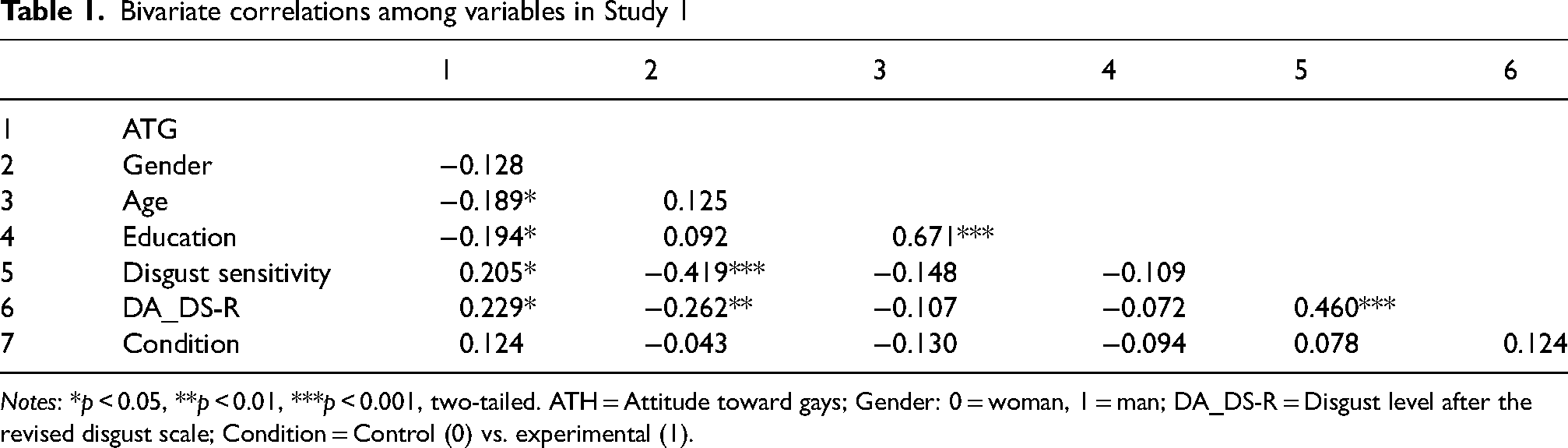
Notes: *p < 0.05, **p < 0.01, ***p < 0.001, two-tailed. ATH = Attitude toward gays; Gender: 0 = woman, 1 = man; DA_DS-R = Disgust level after the revised disgust scale; Condition = Control (0) vs. experimental (1).
A two-step hierarchical regression analysis was conducted where the grouping variable (i.e., experimental group vs. neutral group) was the focal predictor, and gender, age, education, DS-R scores, and disgust level after completing the DS-R form were included as control variables on attitudes toward homosexuals. In the first step, the control variables were included. As shown in Table 2, none of the variables significantly predicted attitudes toward homosexuals. In the second step, the grouping variable was included in the analysis; however, the findings remained statistically the same: none of the variables was associated with attitudes toward homosexual individuals (ps > .05).
Two-step hierarchical regression on attitudes toward gays
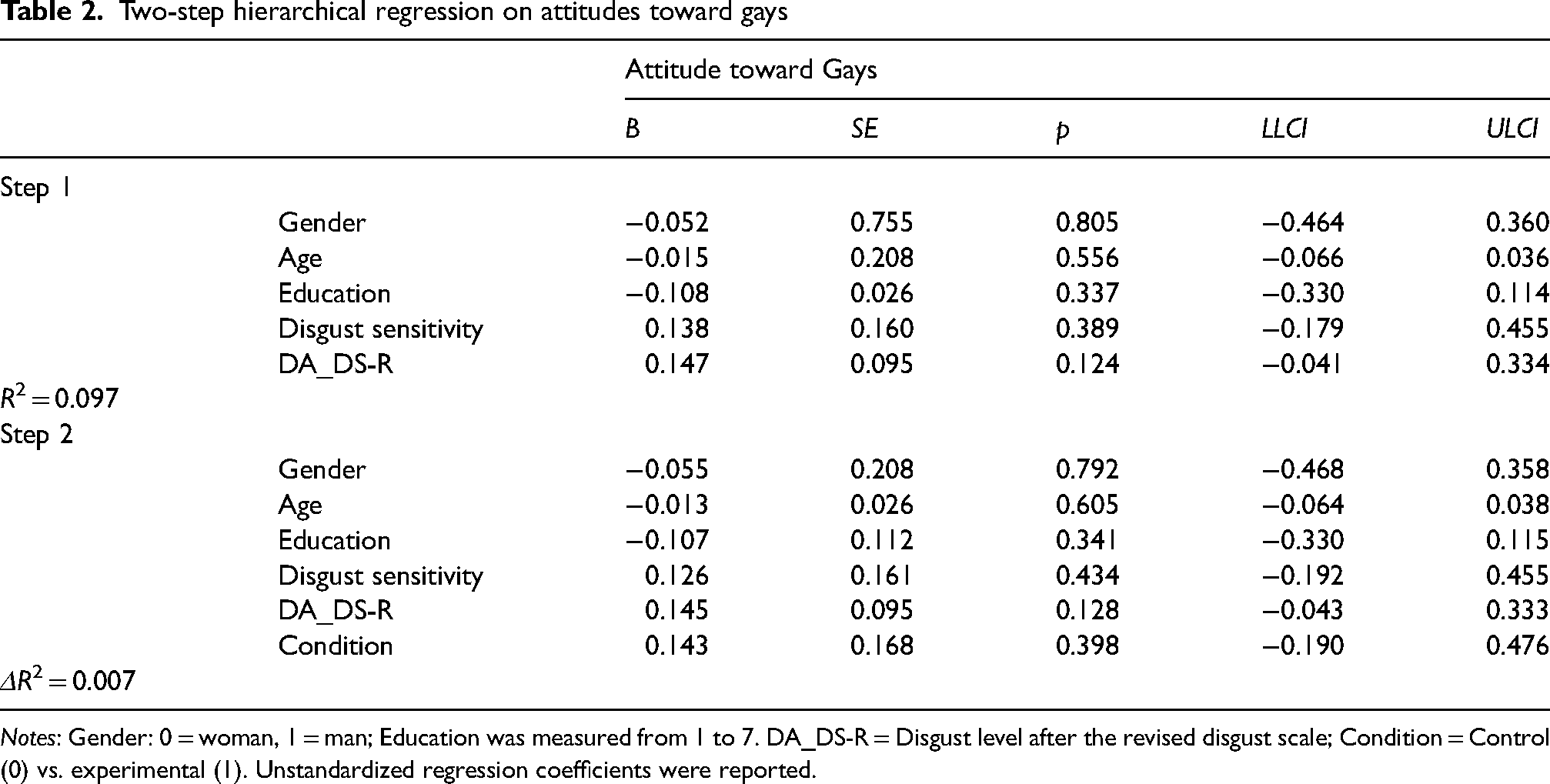
Notes: Gender: 0 = woman, 1 = man; Education was measured from 1 to 7. DA_DS-R = Disgust level after the revised disgust scale; Condition = Control (0) vs. experimental (1). Unstandardized regression coefficients were reported.
Study 2
Method
Participants
Relying on the commitment to the pre-registration, data collection ended when 100 participants for the current study were reached. Participants who quit the survey halfway through (N = 18) without completing the measures were excluded. Participants (N = 4) who failed to respond correctly to the attention check question were also excluded. The final sample consisted of 78 participants (Nwoman = 66; Nexperimental = 40; Ncontrol = 38) aged 18–41 (Mage = 20.92, SD = 2.80). The majority of participants were university students [1 = High school degree (12.8%), 2 = University student (%80.8), 3 = University degree (%2.6), 4 = Graduate student (%3.8)]. All participants were Turkish native speakers, and all questionnaires were prepared in Turkish (for more information on the method section, please see the Supplemental Materials).
Results
An independent samples t-test was conducted to examine whether the manipulation influenced the disgust level of the participants assigned to the disgust-induced group. Findings showed that the disgust level of participants in the experimental group (M = 3.75, SD = 0.62) was significantly higher than the participants in the control group (M = 1.21, SD = 1.34), t(55.69) = −13.72, p < .001. 3 Thus, it seems that the manipulation used in the study achieved its purpose. Bivariate relationships among the variables are shown in Table 3.
Bivariate correlations among variables in Study 2
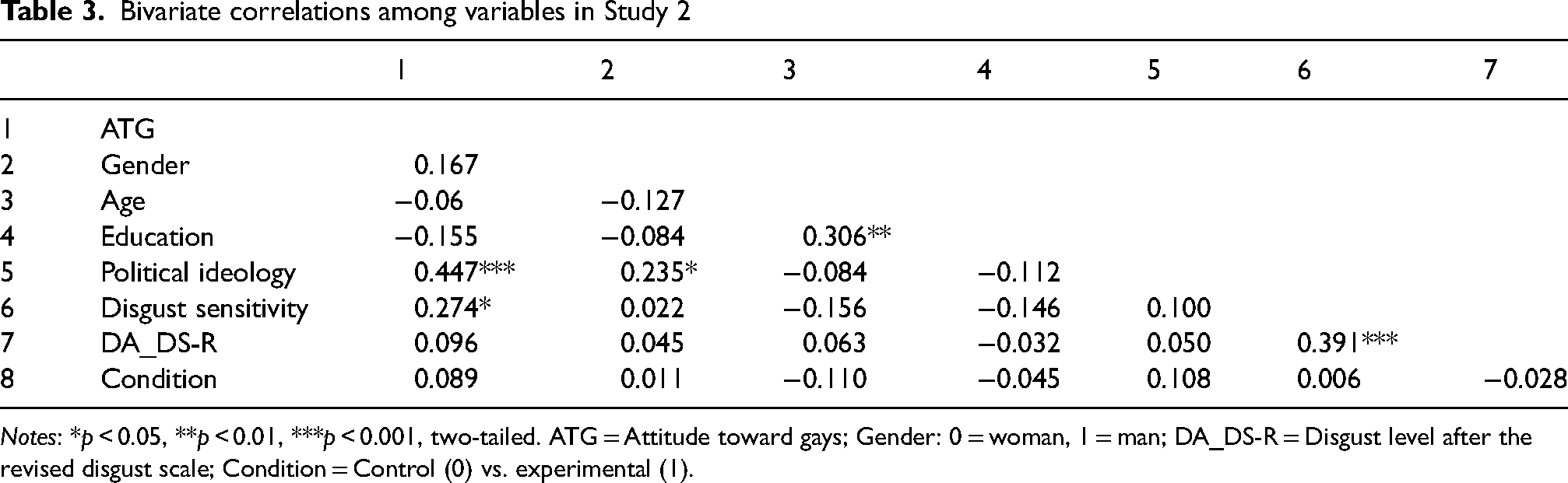
Notes: *p < 0.05, **p < 0.01, ***p < 0.001, two-tailed. ATG = Attitude toward gays; Gender: 0 = woman, 1 = man; DA_DS-R = Disgust level after the revised disgust scale; Condition = Control (0) vs. experimental (1).
To test the moderation hypothesis, a multiple regression analysis was conducted in a model where attitudes toward homosexual individuals were the outcome variable. The grouping variable, including the two conditions (i.e., experimental group vs. control group), was a focal predictor, and political ideology was included as the moderator. The same control variables were also included in the model. As seen from Table 4, disgust sensitivity significantly predicted negative attitudes toward gays (B = 0.567, SE = 0.279, 95% CI [0.010, 1.123], p = 0.046). Therefore, participants with more disgust sensitivity were likelier to have negative attitudes toward gays. Another significant finding showed an association between political ideology and attitudes toward gays (B = 0.592, SE = 0.240, 95% CI [0.113, 1.071], p = 0.016). Namely, participants scoring higher on right-wing ideology were more likely to report negative attitudes toward gays. However, the interaction effect between the grouping variable (i.e., experimental group vs. control group) and political ideology was not significant (p = 0.949).
Multiple regression on attitudes toward gays
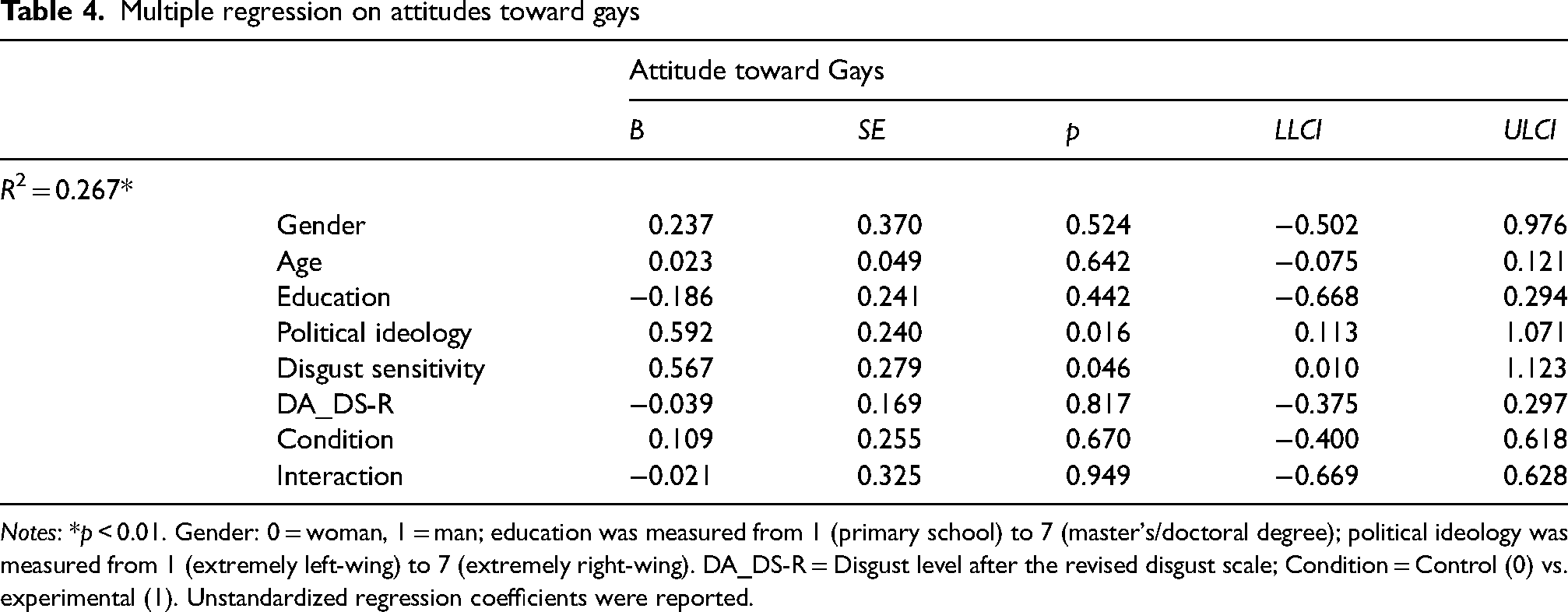
Notes: *p < 0.01. Gender: 0 = woman, 1 = man; education was measured from 1 (primary school) to 7 (master's/doctoral degree); political ideology was measured from 1 (extremely left-wing) to 7 (extremely right-wing). DA_DS-R = Disgust level after the revised disgust scale; Condition = Control (0) vs. experimental (1). Unstandardized regression coefficients were reported.
Sensitivity analyses were conducted for both studies to see minimum effect sizes that could be detected in the current samples. For the first study, the analysis with N = 112 had sensitivity power, at an 80% power level and alpha 0.05, to detect an effect size as low as f2 = 0.07 with G*Power's “Linear multiple regression: Fixed model, R2 increase” procedure (Faul et al., 2009). That finding was consistent with the meta-analytical finding reported by Kiss et al. (2020). They reported that the effect sizes in similar studies ranged from medium effect to large effect. It could be concluded that the sample size could be sensitive enough to detect the smallest effect size of interest in Study 1. For the second study, the analysis with N = 78 had sensitivity power, at an 80% power level and alpha 0.05, to detect an effect size as low as f2 = 0.10 with G*Power's “Linear multiple regression: Fixed model, R2 increase” procedure. We could not find a resource reflecting some insights regarding the expected effect size for the interaction effect in Study 2. At the least we argue that the current sample size was sensitive enough to detect even such small effects in Study 2. 4
Discussion
The main aim of the present research was to examine the causal role of disgust on explicit attitudes toward gay men in the Turkish cultural context throughout two experimental studies. We also investigated the moderator role of political orientation on the link between induced disgust and negative attitudes toward gays in the second study. Even though people reported greater disgust after watching a disgusting scene, the findings showed that induced disgust did not affect participants’ evaluations toward gays across two studies. Study 2 revealed significant relationships between conservatism, disgust sensitivity, and prejudice toward gay people; however, the moderator role of conservatism was nonsignificant.
There might be several reasons behind the nonsignificant impact of disgust on prejudice toward gays. First, the characteristics of the participant group were divergent from the previous research, revealing the significant impact of disgust on explicit negative attitudes toward gay men (Inbar et al., 2012). As a strength of this research, the information was gained from a non-Western culture, Turkey, which has a distinct cultural climate from the previously tested contexts, by including a predominantly Muslim population with the salient norms of traditional heteronormative sexual attitudes (Bakacak & Ōktem, 2014). In Turkey, gays reported that they experience a considerable amount of risk of minority stress and violence (Ayhan Balik & Bilgin, 2021). Recent research comparing Turkish and Belgian samples showed that Muslim Turkish participants were more sexist and homophobic than Belgians (Çetiner & Van Assche, 2021). The strict religious and traditional rules for homosexuality in Muslim populations might explain the discrepancy between our results and the previous findings. Further research is needed to examine this possibility.
Second, previous research documented the lack of the robust effect of disgust on socio-moral judgments. A meta-analysis obtained the weak effect sizes from induced-disgust experiments (Landy & Goodwin, 2015). Therefore, in the current study, the nonsignificant impact of disgust inducement in increasing negative judgments toward gay men was consistent with the previous research (Białek et al., 2021; Ghelfi et al., 2020; Landy & Goodwin, 2015). In addition, participants might have responded as if they were experiencing increased disgust sensitivity due to COVID-19 since they felt more vulnerable to diseases. Recent studies revealed that people were more sensitive to disgust during the COVID-19 pandemic (Miłkowska et al., 2021; Stevenson et al., 2021). The second study conducted a long time after the COVID-19 lockdown showed that disgust sensitivity and political conservatism positively correlated with prejudice toward gay men. Therefore, the results of Study 1, revealing no particular negative evaluations after experiencing disgust, might be related to the specific time of the data collection.
Confirming our expectations, Study 2 demonstrated a significant relationship between political orientation, disgust sensitivity, and negativity toward gays. However, the moderator role of political orientation on the link between increased disgust and negative attitudes toward gays was not significant. One of the reasons behind the lack of a significant impact of disgust inducement might be related to our methodology involving an explicit measurement to assess evaluations toward gay men. Previous research showed the importance of social desirability in explicit assessments of prejudice toward marginalized groups (Nederhof, 1985). For instance, Inbar et al. (2009a, 2009b) showed that implicit examinations led participants to judge homosexuality more negatively, comparing explicit measures. Inbar et al. (2012) did not find any effect of smelling a disgusting odor on implicit evaluations of gay men, whereas there was a significant increase in explicit negative evaluations. Considering the varying relationship between implicit and explicit attitudes, the impact of disgust may be related to measurement type (Nosek, 2007).
The present study has several limitations. First, participants were only asked to report their political self-positioning on a one-item Likert-type question rather than using a detailed measurement of their conservative values and belief systems. For instance, Terrizzi et al. (2010) found a significant moderator role of conservative values on disgust and prejudice relation on the “contact with homosexuals” subscale but not with the morality or stereotypes subscales. Second, we did not ask any questions regarding participants’ sexual orientation. Third, the current sample was a student group that was not representative of the Turkish population. Fourth, the second study could be viewed as underpowered to test the interaction hypothesis, requiring more participants than the main effects. In addition, the influence of disgust was only tested by using a visual manipulation, which has been previously evaluated as a weak elicitor (Sanyal et al., 2021). Finally, a significant limitation is that we did not account for the possibility that the manipulation might have triggered an increase in emotions other than disgust. Thus, our understanding of the impact of the emotion induction method is limited, as other emotions that were triggered may have diluted or influenced the effects of the manipulation. Considering all these limitations, further research should test the hypothesized relationships with more detailed questionnaires, representative samples, and various disgust-inducement methods.
The present results suggest that the previously established relationships between disgust sensitivity, conservatism, and prejudice toward gay men might be extended to a non-Western cultural context with a predominantly Muslim population. However, neither the influence of disgust in displaying greater negativity toward gay men nor the moderating role of conservatism in this relationship was evident in our data. In this regard, the present results failed to replicate the previously observed effects of disgust in group-directed evaluations (Inbar et al., 2012; Terrizzi et al., 2010). Therefore, whether the impact of disgust on homonegativity would be extended to non-WEIRD cultural contexts is still controversial and warrants further attention (Kiss et al., 2020; Landy & Goodwin, 2015).
Supplemental Material
sj-docx-1-pac-10.1177_18344909241254498 - Supplemental material for Sensitivity to disgust, but not increased disgust, is associated with disapproval of gays: Experimental evidence from Turkey
Supplemental material, sj-docx-1-pac-10.1177_18344909241254498 for Sensitivity to disgust, but not increased disgust, is associated with disapproval of gays: Experimental evidence from Turkey by Busra Eylem Aktas and Furkan Tosyali in Journal of Pacific Rim Psychology
Footnotes
Declaration of conflicting interests
The authors declared no potential conflicts of interest with respect to the research, authorship, and/or publication of this article.
Funding
The authors received no financial support for the research, authorship, and/or publication of this article.
Ethical approval
The study was approved by the Ethics Committee of Middle East Technical University and was conducted following the ethical standards of the 1964 Declaration of Helsinki.
Informed consent
Informed consent was presented for all participants.
Supplemental material
Supplemental material for this article is available online.

Notes
References
Supplementary Material
Please find the following supplemental material available below.
For Open Access articles published under a Creative Commons License, all supplemental material carries the same license as the article it is associated with.
For non-Open Access articles published, all supplemental material carries a non-exclusive license, and permission requests for re-use of supplemental material or any part of supplemental material shall be sent directly to the copyright owner as specified in the copyright notice associated with the article.
