



Abstract
Why is disgust sensitivity associated with socially conservative political views? Is it because socially conservative ideologies mitigate the risks of infectious disease, whether by promoting out-group avoidance or by reinforcing norms that sustain antipathogenic practices? Or might it be because socially conservative ideologies promote moral standards that advance a long-term, as opposed to a short-term, sexual strategy? Recent attempts to test these two explanations have yielded differing results and conflicting interpretations. Here, we contribute to the literature by examining the relationship between disgust sensitivity and political orientation, political party affiliation, and an often overlooked outcome—actual voter behavior. We focus on voter behavior and affiliation for the 2016 U.S. presidential election to determine whether pathogen or sexual disgust better predicts socially conservative ideology. Although many prominent aspects of Donald Trump’s campaign—particularly his anti-foreign message—align with the pathogen-avoidance model of conservatism, we found that pathogen-related disgust sensitivity exerted no influence on political ideology, political party affiliation, or voter behavior, after controlling for sexual disgust sensitivity. In contrast, sexual disgust sensitivity was associated with increased odds of voting for Donald Trump versus each other major presidential candidate, as well as with increased odds of affiliating with the Republican versus the Democratic or Libertarian parties. In fact, for every unit increase in sexual disgust sensitivity, the odds of a participant voting for Trump versus Clinton increased by approximately 30%. It seems, then, that sexual disgust trumps pathogen disgust in predicting socially conservative voting behavior.
Introduction
In the wake of the divisive 2016 American presidential election and the Brexit vote, the results of which surprised many political prognosticators, research into the drivers of political attitudes and behaviors has gained urgency. Although financial self-interest predicts political preferences (despite some protestations to the contrary), models grounded solely on short-term financial gains do not fully account for political attitudes and voter behavior (Petersen, 2016; Weeden & Kurzban, 2014). Many other factors likely determine expressed political preferences (Graham, Haidt, & Nosek, 2009; Petersen, 2016). Disgust sensitivity—an individual propensity to react more strongly to typical disgust elicitors (Haidt, McCauley, & Rozin, 1994)—is one factor that has received substantial attention of late. Indeed, researchers have marshaled support—both empirical and theoretical—for the proposition that increased disgust sensitivity is associated with increased political conservatism.
In what follows, we briefly review research that documents and attempts to explain the association between disgust sensitivity and political conservatism. We present two pathways by which disgust sensitivity is theorized to lead to political conservatism—via pathogen avoidance and via sexual strategies—and we summarize recent work that has begun to test the merits and relative strength of each pathway. We then report results from a new study designed to replicate this work and extend its reach into the underexamined domain of voter behavior. We argue that prominent aspects of Trump’s presidential campaign—his anti-foreign message, in particular—align especially well with the pathogen-avoidance pathway, making the American presidential election an interesting test case for the model. Our goals are three-fold: To determine whether disgust sensitivity explains, in part, whether participants voted for Donald Trump in the 2016 election, to ascertain whether particular domains of disgust predicted 2016 presidential voting behavior more strongly than others, and finally to test whether a pathogen-avoidance account or a sexual strategies account better explains the link between disgust sensitivity and political ideology.
Disgust Sensitivity and Political Ideology: A Brief Review
For more than a decade, research conducted across multiple disciplines has uncovered a growing body of empirical evidence that individual variation in disgust sensitivity correlates positively with aspects of political ideology (for a meta-analysis, see Terrizzi, Shook, & McDaniel, 2013). Inbar, Pizarro, and Bloom (2009), for instance, found that self-report measures of disgust sensitivity were positively associated with political conservatism in both a sample of U.S. adults recruited from swing states in the 2004 presidential election and in U.S. undergraduates, consistent with a range of studies suggesting that disgust forms a more important component of moral judgment for conservatives than for liberals (e.g., Graham et al., 2009; Haidt & Graham, 2007; see also Hatemi & McDermott, 2012). The relationship between disgust sensitivity and political orientation is not restricted to the United States: In a large Internet sample of adults born and raised outside the United States, greater disgust sensitivity predicted social conservatism, and it did so when analyzed separately in 10 distinct world regions and nations (Inbar, Pizarro, Iyer, & Haidt, 2012; see also Brenner & Inbar, 2015). Nor is this relationship restricted to self-report measures of disgust sensitivity: Smith, Oxley, Hibbing, Alford, and Hibbing (2011; see also Hibbing & Smith, 2014) found that neurophysiological responses to disgust-eliciting images were associated with self-described conservative political orientation—particularly for social issues pertaining to sexuality—even after controlling for self-reported disgust sensitivity.
Together, these findings complement prior work of evolution-minded researchers, who suggested that disgust sensitivity relates to out-group avoidance, in-group attraction, and xenophobic opposition to foreign immigrants (Faulkner, Schaller, Park, & Duncan, 2004; Navarette & Fessler, 2006), each of which underlies conservative political values (Terrizzi et al., 2013). Although not all studies support the claim that disgust sensitivity predicts political orientation (e.g., Tybur, Merriman, Hooper, McDonald, & Navarrete, 2010), a meta-analysis of 24 studies indicated that disgust sensitivity relates to ideological conservatism (specifically, social conservatism) with a moderate effect size estimated to be r = .25 after correcting for publication bias (Terrizzi et al., 2013). Thus, converging evidence attests to a robust association of disgust sensitivity with a socially conservative political orientation. Researchers have yet to determine, however, why this association exists and what it might mean.
Explaining the association: The pathogen-avoidance model
One hypothesis to explain the correlation between disgust sensitivity and a conservative political orientation suggests that disgust sensitivity reflects investment in pathogen avoidance: Social conservatism functions as a strategy for mitigating the threats posed by infectious disease (Terrizzi et al., 2013). The logic behind this pathogen-avoidance model derives from considerations of the fitness costs that pathogens and parasites impose upon their hosts (Tybur et al., 2010). This intense and enduring selection pressure has led to the evolution of elaborate innate and adaptive immune systems that are metabolically expensive to maintain, as well as to the evolution of sexual reproduction, which levies costs in the form of mate search, specialized systems for mating, and sexual recombination (Tooby, 1982; Van Valen, 1973).
But the innate and adaptive immune systems and sexual reproduction are not the only evolved defenses against the threat of pathogens. Evolutionary theorists point to a suite of psychological and behavioral responses that function to avoid or reduce pathogen threat, an adaptive nexus termed the “behavioral immune system” (Schaller, 2006, 2011). Many evolutionary-minded emotion researchers agree that disgust serves as a key component of the behavioral immune system; disgust motivates the avoidance of cues that inform the probability that pathogens are present (Haidt et al., 1994; Oaten, Stevenson, & Case, 2009; Schaller, 2006, 2011; Tybur, Lieberman, & Griskevicius, 2009; Tybur, Lieberman, Kurzban, & DeScioli, 2013). Such cues include visual and olfactory indicators of spoiled food, feces, sores or pus on the human body, and animals linked to the spread of disease such as cockroaches and rats (Tybur et al., 2009). Of particular relevance here, other individuals are also sources of infectious disease.
The pathogen-avoidance account of ideology rests atop three propositions: (1) individuals who are more easily disgusted are more heavily invested in pathogen avoidance, (2) individuals who are more heavily invested in pathogen avoidance will be more readily drawn to social and political ideologies that reinforce this investment, and (3) socially conservative ideologies most strongly endorse and reinforce investment in pathogen avoidance. In explaining why more pathogen-avoidant individuals might be drawn toward socially conservative political positions, researchers distinguish between the pathogen risks that originate outside one’s social group and the pathogen risks endemic to group living (Inbar & Pizarro, 2016; Tybur et al., 2016; Tybur, Inbar, Güler, & Molho, 2015a).
Researchers who focus on external pathogen threats argue that the disgust system is activated by superficial visible markers of ethnically and culturally unfamiliar out-groups (Faulkner et al., 2004; Navarrete & Fessler, 2006). These arguments imply that individuals more highly invested in pathogen avoidance tend toward social conservatism by way of disgust-mediated out-group avoidance. Researchers have thus referred to this path to conservatism as the out-group avoidance pathway (Inbar & Pizarro, 2016; Tybur et al., 2015a, 2016).
The question of why cues to unfamiliar out-groups elicit disgust remains a matter of debate (Aarøe, Petersen, & Arceneaux, 2017). Some researchers emphasize that variation in immunity to infectious disease is highly group-dependent and that exposure to other groups poses a pathogen threat (Faulkner et al., 2004), as the recent historical record demonstrates (Diamond, 1997). On this view, ancestral intergroup contact was associated with heightened pathogen threat, promoting a selection for psychological and behavioral mechanisms to mitigate that threat by identifying and responding adaptively via disgust-mediated aversion (Faulkner et al., 2004; Fincher & Thornhill, 2012). That is, disgust-mediated out-group avoidance might be an evolved adaptation.
Alternatively, however, cues to unfamiliar out-groups might activate the disgust system as a by-product of the disgust system’s “hypervigilance” (Aarøe et al., 2017). Because pathogens pose high risks to fitness (e.g., illness and death), the costs of the disgust system producing a false negative (inferring pathogens are not present when in fact they are) likely outweigh the costs of the system producing a false positive (inferring pathogens are present when in fact they are not; Tybur & Lieberman, 2016). The asymmetric costs of error imply that the disgust system should respond to an overly inclusive range of cues—some of which may not reliably indicate a disease threat—rather than to a smaller set of perfectly accurate markers (Tybur & Lieberman, 2016). A by-product view, then, suggests that the physical (and perhaps cultural) markers of unfamiliar out-groups are among these “overinclusive” cues taken as an input by a system erring on the side of caution (Aarøe et al., 2017; see also Petersen, 2017; van Leeuwen & Petersen, 2018).
Regardless of whether the disgust system responds to unfamiliar out-groups as an adaptive feature or as a by-product of one, a variety of studies have shown that such a link does indeed exist. For instance, in an online sample of U.S. citizens, Navarrete and Fessler (2006) found that greater perceived vulnerability to infectious disease was associated with increased ethnocentrism and that increased disgust sensitivity was associated with elevated negativity toward foreigners. Across four studies on Canadian undergraduates, Faulkner et al. (2004) found that self-reported vulnerability to infectious disease correlated negatively with various measures of xenophobia and opposition to foreigners including attitudes toward immigration in general, implicit associations of Africans with danger, opposition to the immigration of Africans to Canada, and opposition to the immigration of out-groups with foreign and unfamiliar culinary and hygienic practices. Two additional studies drawn from the same population reported that increased disease salience (as manipulated via a photo prime) was associated with more negative attitudes toward foreign (vs. familiar) out-groups (see also Hodson et al., 2013; Huang, Sedlovskaya, Ackerman, & Bargh, 2011, but see van Leeuwen & Petersen, 2018).
Studies that examine the association between degree of pathogen threat in the local ecology and attitudes toward out-group members provide corroborating evidence at the level of culture and nation-state (Fincher & Thornhill, 2008; Fincher, Thornhill, Murray, & Schaller, 2008; Thornhill, Fincher, & Aran, 2009; Thornhill, Fincher, Murray, & Schaller, 2010). In a worldwide survey of 98 culturally distinct geopolitical regions, for instance, Fincher et al. (2008) showed that the regional prevalence of pathogens correlated positively with collectivism (vs. individualism), a construct that blends a propensity toward ethnocentrism, a tendency to strongly distinguish coalitional in-group members from out-group members, and an overall favoritism displayed toward the in-group.
As mentioned above, pathogen-avoidant individuals might also be drawn toward socially conservative political positions due to threats internal to the group (Tybur et al., 2016). On this view, which researchers have termed the traditional norms pathway, cultural and societal norms function in part to mitigate infectious disease threat by reinforcing specific practices (Murray & Schaller, 2012; Schaller & Murray, 2008; Tybur et al., 2015a; Van Leeuwen, Park, Koenig, & Graham, 2012). Cultural norms may promote, for instance, practices that reduce food spoilage (e.g., Billing & Sherman, 1998) or that improve interpersonal hygiene, thereby reducing exposure to pathogens. In contrast to the out-group avoidance account, the traditional norms view is fundamentally an intragroup rather than an intergroup model: Defense of group norms guards against the emergence of behaviors that risk pathogen transmission (Tybur et al., 2016).
The traditional norms model may predict opposition to some out-group members, but in contrast to the out-group avoidance model, such opposition is not predicated upon cues to a foreign origin per se. Instead, the traditional norms pathway predicts that social conservatives oppose out-group members who refuse to adopt existing cultural norms (e.g., common pathogen transmission mitigation practices), as well as in-group members who violate traditional norms (Tybur et al., 2016). By way of contrast, social conservatives focused on out-group avoidance are predicted to express even greater hostility and avoidance toward those immigrants who assimilate, precisely because assimilation would increase intergroup contact and raise the risk of exposure to novel pathogens. Consistent with predictions of the traditional norms pathway, multiple studies (e.g., Olatunji et al., 2007; Terrizzi, Shook, & Ventis, 2010; see Terrizzi et al., 2013) report that disgust sensitivity relates to religiosity, a variable tied strongly to traditionalism but only weakly to standard measures of out-group avoidance (Duckitt, Bizumic, Krauss, & Heled, 2010; Tybur et al., 2016).
Numerous studies have documented an association of various measures of social conservatism specifically with pathogen-related disgust (i.e., disgust reported in response to those elicitors that are most closely associated with pathogen exposure), thus providing evidence consistent with the pathogen-avoidance model overall (Terrizzi et al., 2013). But researchers have recently begun to pit the two potential pathways—out-group avoidance and traditional norms—against one another. Tybur et al. (2016), for instance, argued that the two pathways yield different predictions regarding which domains of social conservatism should be most strongly associated with pathogen-related disgust. The out-group avoidance pathway, they suggest, should result in a stronger association of pathogen-related disgust with social dominance orientation (SDO), a measure of the extent to which the individual endorses differences in intergroup equality (Pratto, Sidanius, Stallworth, & Malle, 1994), than with traditionalism, as assessed by the traditionalist facet of the Authoritarianism–Conservatism–Traditionalism Scale (Duckitt et al., 2010). The traditionalist pathway, conversely, should yield a stronger association of pathogen-related disgust with traditionalism than with SDO. In a large cross-cultural sample ranging across 30 nations, Tybur et al. (2016) found greater support for the traditionalist pathway: Pathogen-related disgust sensitivity at the individual level was more strongly related to traditionalism than to SDO. Thus, pathogen disgust appears to be related to conservative ideology via intragroup, not intergroup, processes.
Explaining the association: Sexual strategies
Another hypothesis for explaining the relationship between disgust sensitivity and socially conservative political orientation emphasizes how individual dispositions toward sexual activity may become elaborated into a broader reproductive strategy with major implications for political orientation (Tybur et al., 2010, 2015a). The account highlights the fact that sexual acts expose individuals to both sexually transmitted diseases and to pathogens transmitted through close but nonsexual contact (Tybur et al., 2015a). Increased investment in pathogen avoidance should, therefore, manifest itself in reduced sexual promiscuity and, hence, greater inclination toward monogamy (Tybur et al., 2015a). Evidence of an association between pathogen avoidance and sexual promiscuity was provided by Murray, Jones, and Schaller (2013), who showed that under conditions of disease salience, stronger germ aversions predicted less of a desire to be sexually promiscuous in the future, a disinclination toward short-term mating behaviors, and an inclination toward long-term mating behavior. Tybur et al. (2009) furnished further evidence, showing that the Pathogen Disgust subscale of the Three Domain Disgust Scale (TDDS) positively correlated with the Sexual Disgust subscale of that instrument: The greater the disgust toward contact with cues to disease-causing organisms, the greater the disgust toward various sexual behaviors. These and other findings (e.g., Duncan, Schaller, & Park, 2009) are consistent with the suggestion that more pathogen-avoidant individuals may gravitate toward more monogamous, long-term sexual relationships, and away from short-term promiscuity.
Given that support of monogamy and opposition to sexual promiscuity are pillars of conservative ideology (Weeden & Kurzban, 2014), these findings suggest a clear avenue by which disgust sensitivity may develop into a more socially conservative political orientation. But the linkage between sexual disgust and social conservatism may be even more powerful than that: Recent accounts connect conservative moral positions to sexual strategies for reasons that are not directly related to pathogen avoidance but instead follow from strategic moralizing (Kurzban, Dukes, & Weeden, 2010; Weeden, Cohen, & Kenrick, 2008; Weeden & Kurzban, 2013, 2014). These proposals note that moral rules concerning permissible sexual behavior will differentially impact the reproductive interests of the individuals endorsing (and enforcing) those rules, depending on whether the individuals are pursuing a short-term or a long-term sexual strategy themselves (Weeden et al., 2008; Weeden & Kurzban, 2013, 2014). Specifically, the reproductive interests of long-term sexual strategists are threatened by moral norms permitting or encouraging sex outside the context of the pair bond, including norms that may indirectly promote promiscuous sex through, for instance, drug and alcohol use (Kurzban et al., 2010; Quintelier, Ishii, Weeden, Kurzban, & Braeckman, 2013). Men committed to a monogamous relationship face increased risk of cuckoldry when female sexual promiscuity is allowed or encouraged. Conversely, when male promiscuity is allowed or encouraged, monogamous women confront heightened risks that the emotional and financial resources of their mate could be directed elsewhere. On this view, conservative political ideology reflects the defense of a set of moral norms that advances the reproductive interests inherent in a long-term mating strategy.
Although sexual strategies theorists have emphasized within-group contention of sex-related norms, motivations related to sexual strategies might also influence aspects of out-group-directed attitudes. Specifically, an interest in protecting mating opportunities might spur opposition to foreign immigration and the promulgation of policies that defend in-group reproductive interests against out-group threat. 1 Anti-miscegenation laws, for instance, have been interpreted in this light (Kovel, 1984; Myrdal, 1944; but see Cox, 1948). Notably, the defense of anti-miscegenation laws in the United States drew upon disgust-related concerns (Lieberman & Patrick, 2018)—especially disgust at the thought of intermixing categories presumed to be naturally distinct (termed “liminality disgust” by Lupton, 2014, p. 6) and explicated in detail by disgust theorist Mary Douglas (1969).
Evidence for the sexual strategies account of ideology includes findings that key correlates of social conservatism—such as religious attendance and opposition to recreational drug use—are most strongly predicted by sexuality-related factors, even when controlling for other factors ostensibly related to ideology including indicators of cooperative morality (Kurzban et al., 2010; Quintelier et al., 2013; Weeden & Kurzban, 2013). Such findings provide grounds to suspect that sexual strategies exert a causal influence upon the components of social conservatism (Weeden et al., 2008) and that, as a result, the observed association between pathogen avoidance and social conservatism may be explained, whether in part or in full, as a function of individual differences in endorsements of particular sexual strategies.
In a set of three studies, Tybur et al. (2015a) employed path analysis to test the possibility that sexual strategy mediates associations between pathogen avoidance and social conservatism. In these studies, pathogen avoidance, sexual strategy, and political orientation were each assessed with multiple measures. Across all tested combinations of measures, sexual strategy not only mediated the association between pathogen avoidance and political orientation but did so fully: All covariation between pathogen avoidance and social conservatism was accounted for by sexual strategy. Shook, Terrizzi, Clay, and Oosterhoff (2015), however, critiqued these findings on multiple grounds—statistical, methodological, and theoretical (for response, see Tybur, Inbar, Güler, & Molho, 2015b). In a study designed to address the putative shortcomings of Tybur et al. (2015a), Shook et al. (2015) employed latent variable modeling to operationalize the key constructs and found that sexual strategies only partially mediated the effect of pathogen avoidance upon conservatism: After controlling for sexual strategy, a direct association of pathogen avoidance with conservatism remained. The relative contributions of sexual strategy and pathogen avoidance toward explaining the association of disgust sensitivity with political orientation thus continue to be debated.
The Current Research
With the current research, we pursued multiple objectives concerning the association of disgust sensitivity with political orientation. First, we undertook to replicate and extend prior findings that disgust sensitivity relates to a more conservative political orientation toward social issues. Toward this end, we assessed not only participants’ location on a liberal/conservative spectrum and their party affiliation but also a crucial aspect of political behavior—their vote in the 2016 American presidential election.
Despite the importance of voting in shaping the political landscape, much disgust sensitivity research has examined political attitudes, with relatively little attention given to political behavior, and actual voting in particular—as Terrizzi, Shook, and McDaniel’s meta-analysis (2013) reveals. In a rare exception, Inbar et al. (2012) reported that in a large sample of Americans who visited YourMorals.org prior to the 2008 U.S. presidential election, greater disgust sensitivity predicted reduced intent to vote for Barack Obama. Greater disgust sensitivity also predicted participants’ overall political orientation and self-reported conservatism. The relationship between disgust sensitivity and voting behavior is again not limited to the United States, although the relevant data are sparse: In a sample of 304 eligible Dutch voters, increased disgust sensitivity predicted increased likelihood of voting for the socially conservative Freedom Party (Brenner & Inbar, 2015). Our goal here is to determine whether sensitivity to specific domains of disgust predicts voting for any of the four major American 2016 presidential candidates—Donald Trump, Hillary Clinton, Gary Johnson, or Jill Stein—as well as affiliation with four of America’s political parties.
The second major goal of the current research is to further examine the relative strengths of the pathogen-avoidance model versus the sexual strategies model in accounting for the relationship between disgust sensitivity and political orientation. Following Tybur et al. (2015a), we ascertain whether sexual strategy mediates—partially or in full—the link between pathogen-related disgust sensitivity and political conservatism. In doing so, however, we go beyond prior work by measuring participants’ vote for a presidential candidate. We suggest that a participant’s vote in the 2016 American election is particularly informative for this purpose, given Donald Trump’s unique candidacy. We base this suggestion on the grounds that at least two aspects of Trump’s campaign arguably align more strongly with the pathogen-avoidance model than with the sexual strategies model. First, relative to past Republican candidates such as Mitt Romney and John McCain, Trump’s campaign strongly, and controversially, emphasized opposition to immigration: Trump advocated travel bans for certain geographical regions and groups, and the construction of a wall on the U.S.–Mexico border. Anti-foreign sentiment and strong opposition to immigration of this sort should, if the pathogen-avoidance model has merit, tend to promote an association of pathogen disgust (whether motivated solely by out-group avoidance or by maintenance of traditional norms as well) with support for Trump, even after controlling for sexual strategies.
The second aspect of Trump’s campaign that may be especially relevant to the link between pathogen-related disgust sensitivity and conservative politics was his use of disgust-tinged rhetoric to attack political enemies, a tactic that garnered widespread media attention (Bruni, 2015; Hurst, 2015; Lieberman & Patrick, 2018). Among the most striking examples were Trump’s assertion during a campaign rally that Hillary Clinton’s bathroom break during a debate was “too disgusting” to talk about, and his statement regarding Fox News commentator Megyn Kelly that “there was blood coming out of her wherever”—note that blood and bathrooms are prototypical elicitors of pathogen disgust (Curtis & Biran, 2001; Tybur et al., 2009). Other noteworthy examples include Trump’s repeated allusions to Marco Rubio’s sweat during the Republican primaries, his characterization of Mexican President Vincente Fox’s word choice as “filthy, disgusting” (Schubert, 2017), and his reference to Hillary Clinton as a “nasty woman.” As recently as July 1, 2017, Trump was embroiled in another controversy, concerning a tweet in which he stated that MSNBC anchor Mika Brzezinski once attempted to join him at Mar-a-Lago over New Year’s Eve while she was “bleeding from her face-lift.” Trump’s disgust-tinged political rhetoric may resonate well with socially conservative supporters precisely because they are more responsive to disgust-eliciting cues.
Of course, many factors contribute to presidential preference. Here, we suggest simply that prominent features of Trump’s campaign should, if anything, align with those pathways most strongly related to pathogen avoidance rather than to sexual strategies, in explaining the association of disgust sensitivity with political conservatism. If we find, as Tybur et al. (2015a) did, that sexual strategies account for all of the covariation between disgust sensitivity and political orientation—even covariation between disgust sensitivity and support for Trump—such a result would complement the findings of Tybur et al. (2015a) and bolster the sexual strategies model. If we do not, such findings would bolster the pathogen-avoidance model favored by Shook et al. (2015).
In summary, here we (1) test whether disgust sensitivity relates to a more socially conservative political orientation, particularly as expressed in voter behavior and (2) examine the relative strengths of the pathogen-avoidance model versus the sexual strategies model in accounting for the relationship of disgust sensitivity with political orientation (Data are publicly available at https://osf.io/z84a9/).
Method
Participants
Six hundred participants were recruited from Amazon’s Mechanical Turk (MTurk) population. Participants were required to be at least 18 years of age, to reside in the United States, and to have an approval rate of at least 90% for previously performed tasks. Prospective participants were informed that they would be compensated a base payment of US$1.00, plus a bonus payment of US$1.00, for completing a survey lasting approximately 20 min and pertaining to their attitudes, feelings, and beliefs on a variety of topics of personal and social interest. Responses from 15 participants who abandoned the survey well before completion or who reported an age of less than 18 were omitted from consideration, yielding a final sample of 585 (43.5% female). Mean participant age was 35.5 years (standard deviation [SD] = 11.4). Sample data were collected in February 2017 and are not necessarily representative of registered voters, likely voters, actual voters, or the U.S. population at large. Clifford, Jewell, and Waggoner (2015), however, report that MTurk respondents tend to resemble their counterparts in nationally representative samples in terms of psychological traits and how those traits relate to political preferences. The study was approved by the institutional review board of the University of Miami. All participants provided informed consent online.
Procedure
Participants completed a web-based survey. After electing to proceed with the study and providing informed consent, they completed a series of questionnaire items including basic demographic information, two measures of disgust sensitivity, an assessment of political party affiliation and presidential candidate preference, and other items not relevant to the current research.
Measures
Disgust Scale—Revised (DS-R)
To replicate prior research suggesting an association of political conservatism with disgust sensitivity, we first employed the DS-R (Olatunji et al., 2007), a 25-item measure based upon the earlier 32-item instrument developed by Haidt et al. (1994). The instrument contains items pertaining to a range of disgust elicitors but is generally regarded primarily as a gauge specifically of pathogen avoidance (Terrizzi et al., 2013; Tybur et al., 2015a). The scale consists of two sections. The first section contained 13 items in which participants were asked to indicate their agreement with various statements or how true the statement was about them. Sample items included the following: (1) “It bothers me to hear someone clear a throat full of mucous” and (2) “I would go out of my way to avoid walking through a graveyard.” Items from this section were scored on a 1–5 scale, ranging from strongly disagree to strongly agree. The second section contained 12 experiences often regarded as disgusting and asked participants to indicate “how disgusting” they would find each one. Sample items included the following: (1) “A friend offers you a piece of chocolate shaped like dog doo” and (2) “You accidentally touch the ashes of a person who has been cremated.” These items were also evaluated on a 1–5 scale, with 1 indicating not disgusting at all and 5 indicating extremely disgusting. Item scores were averaged to create the variable disgust sensitivity. Possible scores ranged from 1 to 5, while the observed range was 1.16–4.80, with higher scores indicating greater disgust sensitivity, M = 3.02, SD = 0.67, N = 584. Reliability in original validation work on the scale was .84 (Olatunji et al., 2007) and in this sample was .89.
TDDS
Given recent concerns about the DS-R’s validity (Tybur et al., 2009, 2010, 2013), we also included the 21-item TDDS (Tybur et al., 2009). Based upon a model in which disgust is theorized to serve three evolved functions, the scale consists of three subscales, corresponding to pathogen disgust, sexual disgust, and moral disgust, respectively. Each subscale contained 7 items scored on a 0–6 scale. Items presented participants with “a variety of concepts” and asked them to rate “how disgusting” the concepts were to them. As detailed below, each subscale was scored separately, providing a distinct variable for each domain of disgust sensitivity.
Pathogen disgust
This variable was formed from items pertaining to spoiled food, disease, excrement, and other disgust elicitors associated with threat of pathogens or parasites. Sample items included (1) “sitting next to someone who has red sores on their arm,” (2) “seeing some mold on old leftovers in your refrigerator,” and (3) “seeing a cockroach run across the floor.” Scores of all 7 subscale items were summed, yielding a possible (and observed) range of 0–6, M = 3.26, SD = 1.25, N = 584. Reliability of this subscale in the original validation study was .84 (Tybur et al., 2009) and in this sample was .87.
Sexual disgust
This variable was the sum of the 7 items presenting concepts explicitly linked to forms of sexual behavior. Items included (1) “performing oral sex,” (2) “watching a pornographic video,” and (3) “bringing someone you just met back to your room to have sex.” Possible (and observed) scores ranged from 0 to 6, M = 2.18, SD = 1.51, N = 584. Reliability in the original validation study was .87 (Tybur et al., 2009) and in this sample was .88.
Moral disgust
This variable was formed from 7 items presenting concepts linked to violations of cooperative moral norms. Sample items included (1) “stealing from a neighbor,” (2) “deceiving a friend,” and (3) “forging someone’s signature on a legal document.” Item scores were summed, with possible (and observed) composite scores ranging from 0 to 6, M = 2.97, SD = 1.68, N = 584. Reliability in the original validation sample was .84 (Tybur et al., 2009) and in this sample was .94.
Consistent with prior work, particularly the original validation study for the TDDS (Tybur et al., 2009), scores for three disgust domains were moderately correlated. Pathogen disgust correlated with sexual disgust at .56 (p < .001) and with moral disgust at .34 (p < .001); moral disgust correlated with sexual disgust at .38 (p < .001). We also note that pathogen disgust was strongly correlated with DS-R scores (r = .72, p < .001), confirming that the DS-R largely reflects pathogen disgust.
Political orientation
Political orientation was primarily assessed in two ways: vote in the 2016 American presidential election and political party affiliation. Additional measures evaluated participants on a spectrum from liberal to conservative.
Vote in the 2016 American presidential election
Participants were asked to select the presidential candidate they voted for in the recently completed 2016 election. Choices were Hillary Clinton (44.7%), Donald Trump (25.2%), Gary Johnson (5.7%), Jill Stein (4.5%), Some Other Candidate (2.7%), and Did Not Vote (17.3%).
Party affiliation
Participants were asked to select which political party they identified with, choosing one of the five options: Democratic (51.4%), Republican (22.3%), Libertarian (8.0%), Green (4.1%), or Other (14.2%). Visual inspection of written responses from participants identifying as “Other” suggested that a diverse array of political attitudes and preferences characterized this grouping. Thus, in the analyses that follow, participants reporting their affiliation as “Other” are not included.
Political orientation, social issues
Participants were asked to select from among the following responses to characterize their views “when it comes to social issues in politics”: “very liberal,” “liberal,” “slightly liberal,” “moderate/middle of the road,” “slightly conservative,” “conservative,” and “very conservative.” Response categories were coded 1–7, respectively. Mean social–political orientation was 3.09 (SD = 1.79), which is half an SD below the scale midpoint (i.e., the sample was, on average, liberal on social issues).
Political orientation, economic issues
Participants were asked to select from among the following responses to characterize their views “when it comes to economic issues in politics”: “very liberal,” “liberal,” slightly liberal,” “moderate/middle of the road,” “slightly conservative,” “conservative,” and “very conservative.” Response categories were coded 1–7, respectively. Mean economic political orientation on this scale was 3.65 (SD = 1.85), indicating that the sample was slightly liberal to moderate/middle of the road on economic issues.
Age
Participants reported their age, in years, with responses ranging from 19 to 72. M = 35.54, SD = 11.41.
Income
Participants selected their annual household income in increments of US$10,000, ranging from US$0–US$10,000 up to US$80,000+. Responses were converted to a 1–9 scale. Mean household income range using this scale was 5.01, SD = 2.60, indicating an average household income range of about US$40,000 to US$50,000.
Data Analyses
Logistic regression analyses were performed using SPSS version 23. Mediation analyses and model comparisons were conducted with Mplus 7.0 (Muthén & Muthén, 2012). Note that when we conducted multinomial logistic regression, we designated either Donald Trump voters or Republican Party affiliates as the reference category, because these groups were likely to be the most socially conservative. This choice of reference category, therefore, enabled us to test all relevant contrasts in the same multinomial logistic regression, and as a result, all reported parameter estimates reflect this decision. But when we interpreted results, we consistently reframed the interpretation of parameter estimates slightly, in keeping with the idea that increased disgust sensitivity is associated with increased odds of being in the more socially conservative category—that is, with increased odds of voting for Donald Trump or of affiliating with the Republican Party.
Results
Is Pathogen Disgust Associated With Political Orientation, Voter Behavior in the 2016 Presidential Election, or Political Party Affiliation?
To address these questions, we conducted separate analyses, using either the pathogen domain of the TDDS or DS-R scores as our measure of pathogen disgust. Results were similar regardless of the measure of pathogen disgust used, with the exception of a possible interaction effect involving participant sex, which is described below. In the interest of brevity, we focus on findings using the pathogen domain of the TDDS, and we comment on DS-R results only when the two differ (see Online Supplemental Material for complete analyses with the DS-R).
Political orientation
We begin by replicating prior findings that increased pathogen disgust significantly predicts increased social conservatism. The bivariate correlation between pathogen disgust and social–political orientation was in the expected direction, r = .14, p = .001, indicating that increased pathogen disgust sensitivity was associated with increased social conservatism. The effect size was smaller than that estimated by Terrizzi et al.’s (2013) meta-analysis, but it is comfortably in the range of meta-analyses reported in other work (Tybur et al., 2015a: r = .16, 95% confidence interval (CI) = [.11, .21]; Tybur et al., 2016: r = .10, 95% CI [.07, .12] for traditionalism, the strongest domain of social conservatism in that study). The significant relationship we found between pathogen disgust and social–political orientation held in a linear regression analysis when controlling for age, sex, and income (see Table 1). For results using our measure of political orientation toward economic issues, see Online Supplemental Material S1.
Bivariate Correlations and Standardized Multiple Regression Coefficients Predicting Social Conservatism.

Note. TDDS = Three Domain Disgust Scale.
Presidential vote
To test the hypothesis that pathogen disgust is associated with voter behavior, we conducted logistic regression, using pathogen disgust to predict participants’ vote in the 2016 presidential election, controlling for age, sex, and income. For presidential vote, we focused solely on Trump versus Clinton. With the sample restricted accordingly and using the pathogen disgust domain of the TDDS, each unit increase in pathogen disgust sensitivity was associated with an approximately 20% increase in the odds of voting for Trump versus Clinton, b = .19, SE = .09, p = .034, odds ratio (OR) = 1.20, 95% CI [1.01, 1.43]. The resulting model (Table 2) was a significant improvement over a model containing only the control variables, χ 2(1) = 4.57, p = .033, and improved overall classification accuracy by 2.2%.
Logistic Regression of Presidential Vote on Pathogen Disgust Sensitivity. Parameter estimates are unstandardized.

Note. CI = confidence interval. ***p < .001. **p < .01. *p < .05.
In light of empirical findings that women exhibit higher pathogen disgust than men (Curtis, Aunger & Rabie, 2004; Haidt et al., 1994; Tybur et al., 2009), we tested for an interaction between participant sex and pathogen disgust but found no effect (p = .384), again using the pathogen domain of the TDDS. We note that when we conducted logistic regression using DS-R scores (see Online Supplemental Material S2), there was no significant main effect of pathogen-related disgust (p = .155). In a separate model, however, there was a significant interaction between sex and DS-R score, b = .66, SE = .32, p = .037. Probing the interaction, we found that, among men, DS-R score had no effect on the odds of voting for Trump versus Clinton, b = −08. SE = .21, p = .715, but that, among women, each unit increase in DS-R score increased the odds of voting for Trump versus for Clinton by 79%, b = .58, SE = .24, p = .014. Overall, our results suggest that pathogen-related disgust increases the odds of voting for Trump versus for Clinton, with the possibility that the effect is driven largely by female voters.
Party affiliation
We performed a logistic regression to test whether pathogen disgust predicted the odds of affiliating with the Republican versus the Democratic Party, controlling for age, income, and sex. With the sample restricted to members of the two major parties, we found that pathogen disgust only marginally predicted affiliation with the Republicans versus the Democrats, b = .154, SE = .09, p = .089. Given the interaction with sex found for voting behavior, we ran a separate model but did not find any evidence suggesting an interaction between sex and pathogen disgust, b = .23, SE = .18, p = .220. When we expanded the sample to include members of all four major parties and conducted multinomial logical regression, pathogen disgust did not significantly improve prediction of party affiliation compared to a model that included only control variables, χ 2(3) = 5.20, p = .158, nor did an interaction between sex and pathogen disgust significantly improve model fit, χ 2(3) = 1.62, p = .654. Using the DS-R, however, we found a significant interaction between sex and DS-R score to predict Republican versus Democratic affiliation, b = .65, SE = .33, p = .049, such that DS-R score did not affect party affiliation for men (p = .949), but for women, each unit increase in DS-R was associated with a 93% increase in the odds of affiliating with the Republicans versus the Democrats, b = .66, SE = .25, p = .008; see Online Supplemental Material S3.
These results replicate prior findings suggesting a link between pathogen disgust and social conservatism and newly demonstrate that pathogen disgust is associated with voting for Donald Trump versus for Hillary Clinton in the 2016 American presidential election. To the extent that Trump’s vocal opposition to immigrants exemplifies out-group avoidance, these findings may be interpreted as consistent with the out-group avoidance pathway linking pathogen avoidance to social conservatism. As prior research has demonstrated, however, pathogen disgust itself typically correlates with other domains of disgust, particularly sexual disgust (Tybur et al., 2015a). This web of correlations raises the possibility that the association of pathogen disgust with voting for Trump or with self-reported social conservatism is spurious and masks a stronger relationship between sexual disgust and political ideology (Tybur et al., 2015a).
Are Different Domains of Disgust Sensitivity Associated With Political Orientation, Voter Behavior in the 2016 Presidential Election, or Political Party?
To test the robustness of the association between pathogen disgust and social conservatism, we examined the sexual and moral domains of the TDDS (Tybur et al., 2009) in conjunction with the pathogen domain. As above, we conducted analyses using the DS-R as an additional measure of pathogen disgust but focus here on results using the TDDS Pathogen subscale; see Online Supplemental Material S4–S6 for analyses using the DS-R. This approach follows that of Tybur et al. (2010), but here, we include as an outcome measure voter behavior in the 2016 presidential election. Thus, we sought to determine whether distinct domains of disgust sensitivity independently predict differences in political orientation, presidential voting behavior, and political party.
Political orientation
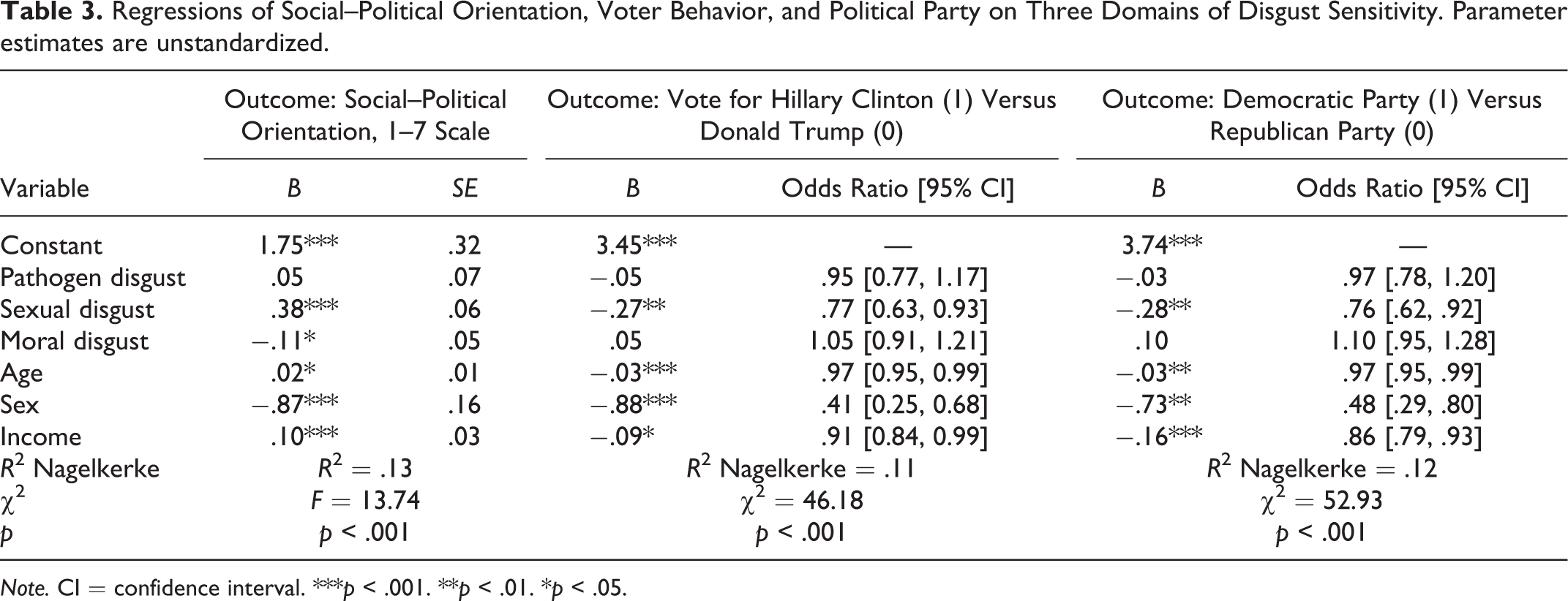
In addition to being associated with pathogen disgust, social conservatism was also associated with sexual disgust (r = .22, p < .001), but not with moral disgust (r = .03, p = .438). This pattern held for each disgust domain when controlling for age, income, and sex (for sexual disgust, b = .36, SE = .05, p < .001; for pathogen disgust, b = .23, SE = .06, p < .001; for moral disgust, b = .01, SE = .05, p = .831). We then entered all three disgust domain scores into a regression model simultaneously with controls (Table 3). Pathogen disgust was no longer a significant predictor of social conservatism, b = .05, SE = .07, p = .447, but sexual disgust was, b = .38, SE = .06, p < .001. Further, moral disgust related to more liberal social ideology (b = −.11, SE = .05, p = .019). Given that the moral domain of the TDDS assesses cooperative morality, this latter finding is consistent with some prior research suggesting that liberals score a bit higher than conservatives on moral foundations linked to fairness, harm, and reciprocity (Graham et al., 2009; Haidt, 2012).
Regressions of Social–Political Orientation, Voter Behavior, and Political Party on Three Domains of Disgust Sensitivity. Parameter estimates are unstandardized.
Note. CI = confidence interval. ***p < .001. **p < .01. *p < .05.
Of greater interest here, however, is the finding that increased pathogen disgust was not associated with increased social conservatism after controlling for sexual disgust. Such a result is consistent with the sexual strategies model, not the pathogen-avoidance model (cf. Tybur et al., 2015a). Indeed, of the predictors examined in this model, sexual disgust appears to be the strongest: Every SD increase in sexual disgust predicted an increase in social conservative orientation by nearly one third of an SD, holding other factors constant (see Online Supplemental Material S4 for results pertaining to the DS-R).
Presidential vote
To assess the strength of the effect of different disgust domains on presidential vote, we performed multinomial logistic regression. For this analysis, we restricted the sample to participants who voted for Donald Trump, Hillary Clinton, Gary Johnson, or Jill Stein. The reference category for this analysis was Donald Trump. Age, income, sex, pathogen disgust, sexual disgust, and moral disgust were entered simultaneously. The resulting model (Table 3) was a significant improvement over an intercept-only baseline, χ 2(18) = 46.18, p < .001, Nagelkerke R 2 = .11. Among the disgust domains, only sexual disgust significantly improved the final model relative to one in which the effect was excluded, χ 2(3) = 9.01, p = .029. Pathogen disgust did not improve the model, χ 2(3) = .273, p = .965, nor did moral disgust, χ 2(3) = 1.91, p = .592.
Considering the effects of disgust domains on presidential vote more closely, sexual disgust predicted voting for Trump versus Clinton, b = −.27, χ 2(1) = 7.47, p = .006, OR = .77, 95% CI [.63, .93]; by contrast, neither pathogen disgust nor moral disgust was associated with the odds of voting for Trump versus Clinton (ps > .53). Reframed slightly, these results indicate that for every unit increase in sexual disgust sensitivity, the odds of a participant voting for Trump versus Clinton increased by approximately 30%, controlling for other disgust domains, age, income, and sex. The odds of a participant voting for Trump versus Johnson or for Trump versus Stein were marginally predicted by sexual disgust (p = .099 and p = .091, respectively), but not by pathogen disgust (ps > .754) or by moral disgust (ps > .278), again controlling for other disgust domains, age, income, and sex (see Online Supplemental Material S5 for analyses using DS-R score).
Political party
We conducted multinomial logistic regression to determine how strongly the various domains of disgust predicted political party affiliation, entering age, income, sex, pathogen disgust, sexual disgust, and moral disgust simultaneously (Table 3). The model was a significant improvement over an intercept-only baseline, χ 2(18) = 52.93, p < .001, Nagelkerke R 2 = .12. Of the disgust domains, only sexual disgust significantly improved the final model relative to one in which the effect was excluded, χ 2(3) = 9.91, p = .019. Sexual disgust predicted being a Democrat versus a Republican, b = −.28, χ 2(1) = 8.05, p = .005, OR = .76, 95% CI [.62, .92], controlling for other disgust domains, age, income, and sex. Reframed slightly, these results indicate that for every unit increase in sexual disgust sensitivity, the odds of a participant affiliating with the Republican Party versus the Democratic Party increased by more than 30%. Sexual disgust also predicted being a Libertarian versus a Republican, b = −.37, χ 2(1) = 5.27, p = .022, OR = .69, 95% CI [.50, .95]. These results indicate that for every unit increase in sexual disgust, the odds of a participant affiliating with the Republican Party versus the Libertarian Party increased by approximately 45%, again controlling for other disgust domains, age, income, and sex. No other effects for disgust domains were found including for pathogen disgust (all ps > .14; see Online Supplemental Material S6 for analyses using the DS-R).
Does Sexual Disgust Mediate the Effect of Pathogen Disgust Upon Political Orientation, Voter Behavior in the 2016 Presidential Election, and Party Affiliation?
To further evaluate the sexual strategies versus pathogen-avoidance models, we used Mplus 7.0 to conduct path analysis in which we tested whether any influence of pathogen disgust on conservatism exists only via intermediate effects on sexual disgust. As with previous analyses, we focus in the main text upon results using the pathogen domain of the TDDS; see Online Supplemental Material S7 for analyses using the DS-R. Like Tybur et al. (2015a), we controlled for sex; we also controlled for age and income. We also note that two of our measures of conservatism were nominal rather than continuous—party affiliation and presidential vote; only social–political orientation (measured on a 1–7 scale) was treated as a continuous variable.
Social–political orientation
Our first mediation model, Model 1, used social–political orientation as the sole outcome measure. We restricted the sample to participants who voted for one of the four major presidential candidates and who affiliated with one of the four major political parties (N = 417). Indirect effects and their 95% CIs were computed in Mplus using bootstrapping with 2,000 iterations. Results are displayed in Figure 1. Overall fit for Model 1 was good by all major criteria: χ 2(4) = 4.31, p = .366; RMSEA = .014; CFI = .999; SRMR = .020. There was a significant effect of pathogen disgust on sexual disgust, controlling for sex and age, b = .63, SE = .047, p < .001. There was also a significant effect of sexual disgust on social–political orientation, controlling for sex, age, income, and pathogen disgust, b = .34, SE = .08, p < .001. The indirect effect of pathogen disgust on social– political orientation via sexual disgust was likewise significant, b = .21, SE = .05, p < .001, 95% CI [.11, .32]. When controlling for sexual disgust (along with sex, age, and income), however, there was no direct effect of pathogen disgust on social–political orientation, b = .01, SE = .09, p = .912. This result indicates that sexual disgust fully mediates the effect of pathogen disgust upon social–political orientation, a finding consistent with that reported by Tybur et al. (2015a).
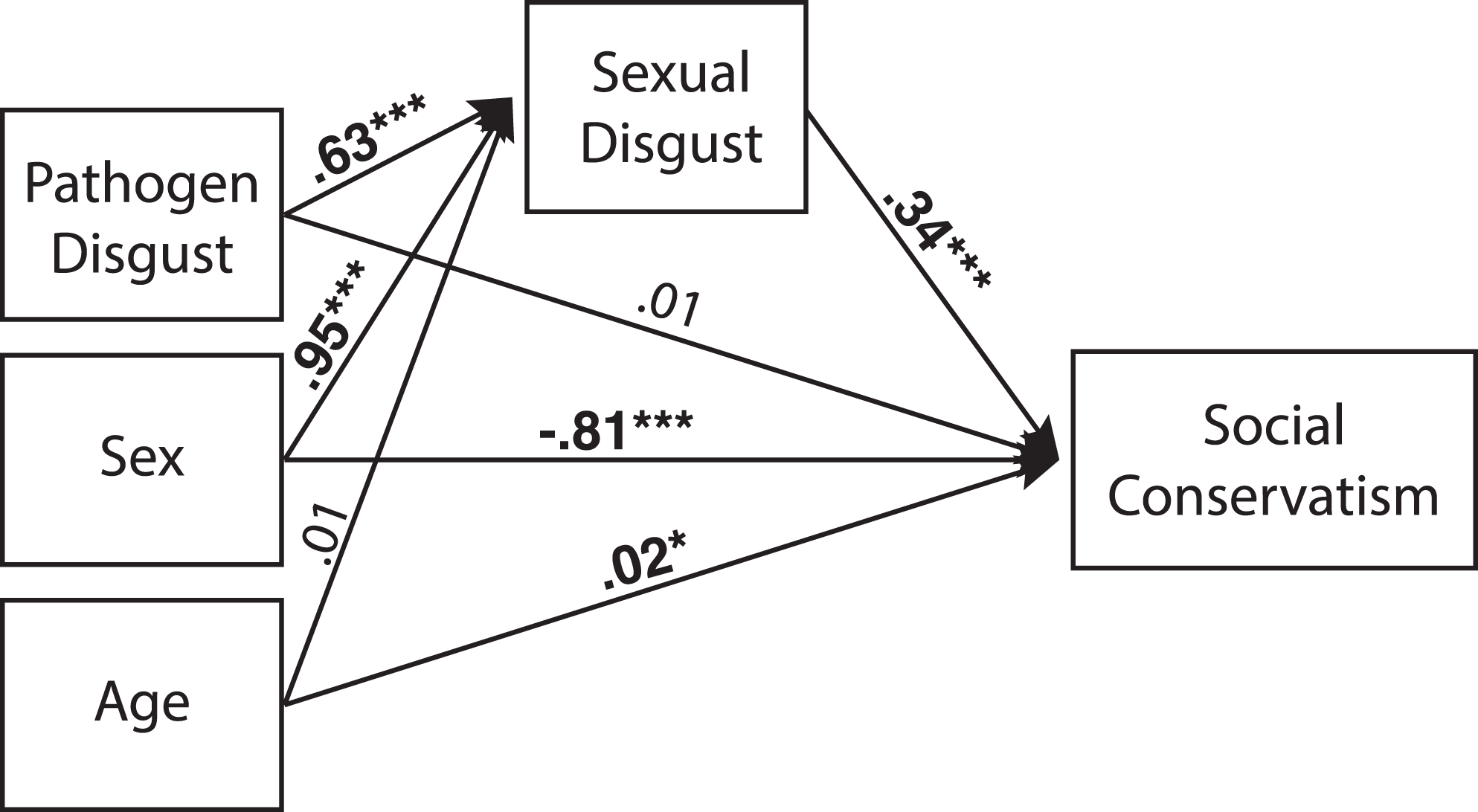
Model 1, depicted above, presents the hypothesis that sexual disgust only partially mediates the effect of pathogen disgust upon social conservatism and tests the significance of indirect effects using bootstrapped 95% confidence intervals—a technique unavailable for the full model depicted in Figure 2. Social conservatism was treated as a continuous variable. Results control for the effect of income on social conservatism, not shown; age, sex, and pathogen disgust were allowed to covary.
Presidential vote and party affiliation
Our second approach to testing the hypothesis of full mediation involved constructing two models in Mplus—Model 2 and Model 3—that incorporated all measures of social conservatism simultaneously. Model 2, depicted in Figure 2, tests the hypothesis that sexual disgust fully mediates the effects of pathogen disgust. Model 3 tests the hypothesis that sexual disgust only partially mediates the effect of pathogen disgust sensitivity upon presidential vote and party affiliation, if it does so at all. In both these models, party affiliation and presidential vote were treated as nominal variables in Mplus, which resulted in a set of multinomial regressions. In the case of party affiliation, Republican was the reference category; in the case of the presidential vote, the reference category was Donald Trump.

Model 2, depicted above, presents the hypothesis that sexual disgust fully mediates the effect of pathogen disgust upon presidential vote, party affiliation, and social conservatism. The resulting model exhibited substantially better fit than a model depicting partial mediation (see text). Outcomes pertaining to presidential vote and party affiliation were each created from a nominal variable, with Trump and the Republican party designated as reference categories. Direct paths from sex and age, as well as from income, to all seven outcomes were estimated but are not shown.
First, we consider the three relative fit statistics available for the two models: Akaike information criterion (AIC), Bayesian information criterion (BIC), and adjusted BIC. Each statistic suggested that Model 2—and thus the hypothesis of full mediation—was the better-fitting model. We focus here on BIC and use the interpretive guidelines offered by Kass and Raftery (1995), who suggests that a change in BIC (ΔBIC) of 10 or more constitutes very strong evidence. Here, ΔBIC was 41.71 in favor of Model 2, providing extremely strong evidence in favor of full mediation (AIC was 4576.93 vs. 4590.41 in favor of Model 2; Adjusted BIC was 4612.18 vs. 4631.68 in favor of Model 2).
We now examine Model 2 in more detail. As shown in Figure 2, sexual disgust had an array of significant direct effects on these categorical outcomes. Controlling for age, income, and sex, and reframing the interpretation of parameter estimates, increased sexual disgust was associated with increased odds of voting for Trump versus Clinton (b = −.24, SE = .09, p = .007, OR = .79). Controlling for the same factors, increased sexual disgust also predicted increased chances of voting for Trump versus Johnson (b = −.35, SE = .13, p = .008, OR = .71) and for Trump versus Stein (b = −.33, SE = .16, p = .035, OR = .72). The effect of sexual disgust on political affiliation was similar. Reframing interpretations of the parameter estimates, increased sexual disgust was associated with increased probability of being a Republican versus a Democrat (b = −.22, SE = .09, p = .015, OR = .80) and of being a Republican versus a Libertarian (b = −.38, SE = .15, p = .011, OR = .68). However, sexual disgust was not associated with being a Republican versus affiliating with the Green party (b = −.15, SE = .16, p = .351). Results from mediation models thus indicate that each unit increase in sexual disgust was associated with anywhere from a 25% to 45% increase in the odds of voting for Trump versus for one of Trump’s three major opponents or of affiliating with the Republican Party versus with the Democratic or Libertarian parties.
Next, we tested for indirect effects of pathogen disgust on these categorical outcomes, via sexual disgust. Results using the approach of Iacobucci (2012) are summarized in Online Supplemental Material S8 (along with details regarding method) and indicate that pathogen disgust related, via sexual disgust, to voting for Trump versus Clinton (p = .044), voting for Trump versus Johnson (p = .035), and affiliating with the Republican versus the Libertarian party (p = .031). Altogether, these results indicate that each unit increase in pathogen disgust is associated with an increase in the odds of voting for Trump versus for Clinton or for Johnson, but this influence occurs by way of intermediate relationships with sexual disgust.
Finally, we more closely examined Model 3, which depicts the hypothesis of partial or no mediation of the effect of pathogen disgust on presidential vote, party affiliation, or social–political orientation. Results show that when controlling for sexual disgust along with age, sex and income, pathogen disgust was not a significant predictor of any outcome. It did not significantly influence the odds of voting for Trump versus Clinton (p = .672), for Trump versus Johnson (p = .940), or for Trump versus Stein (p = .949). Nor did it relate to the odds of affiliating with the Republicans versus Democrats (p = .620), the Republicans versus the Libertarians (p = .897), or the Republicans versus the Greens (p = .914).
Together, a host of findings thus converges on the conclusion that sexual disgust is more strongly associated with the measures of political conservatism examined here than is pathogen-related disgust, which has no unique relationship with conservatism independent of sexual disgust. These findings include the nonsignificant effects of pathogen disgust when controlling for sexual disgust in Model 3, the overall better fit of Model 2 relative to Models 3, and the many significant effects of sexual disgust in Model 2. Collectively, these analyses suggest that any pathogen disgust influences on presidential vote, party affiliation, and social–political orientation operate only indirectly via sexual disgust.
Discussion
In the current study, we sought to extend prior research on the association between disgust sensitivity and political orientation by considering the underexamined arena of actual voting behavior. In doing so, we took advantage of a presidential election in which one candidate, Donald Trump, strongly endorsed anti-foreign sentiments and anti-immigration policies including a proposed wall to be constructed along the U.S.–Mexico border. In our view, the prominence of Trump’s opposition to immigrants and foreigners made him an interesting test case for one of the major accounts put forth to explain the empirical association of disgust sensitivity with social conservatism—the out-group avoidance pathway. The out-group avoidance pathway suggests that disgust sensitivity relates to social conservatism due to its putative anti-pathogen function. On this view, conservative ideologies are appealing partially because they minimize exposure to the novel pathogens presented by foreigners. Much empirical evidence, as we noted in our Introduction section, has been understood to be consistent with the hypothesis that social conservatism is a culturally elaborated defense against pathogens. Together with Trump’s strong anti-foreign sentiment and immigration policies, as well as his conspicuous use of political rhetoric marked by cues to pathogen disgust, this evidence suggested the possibility that pathogen disgust sensitivity might be associated with voting for Donald Trump versus Hillary Clinton, as well as with other measures of social conservatism.
Although we found that increased pathogen disgust sensitivity was associated with increased odds of voting for Trump versus Clinton, as well as with increased self-reported social conservatism, these relationships disappeared in tests that controlled for sexual disgust. In stark contrast, sexual disgust predicted an array of outcomes, even when accounting for pathogen disgust, moral disgust, and other factors. Of the three disgust domains, only sexual disgust affected the likelihood of voting for Trump versus Clinton. Only sexual disgust was associated with the odds of affiliating with the Republicans versus the Democrats or the Libertarians. And only sexual disgust predicted social–political orientation (as measured on a 1–7 scale). Finally, we found that sexual disgust sensitivity fully mediated all effects of the relationship between pathogen disgust sensitivity and social–political orientation, voting behavior, and party affiliation. Altogether, these results are most consistent with the sexual strategies model and sit uneasily with the pathogen-avoidance model. We found no evidence that pathogen disgust predicted any of the three outcome measures used here, independently of sexual disgust.
One aspect of our results merits special emphasis. Prior research has often treated political orientation largely in terms of the opposition between Democrats and Republicans (e.g., Inbar et al., 2009). In multiple analyses, we expanded our measures to include third parties and third-party presidential candidates. Even though relatively few survey respondents endorsed third parties (12.1%), our study uncovered evidence that greater sexual disgust increased the odds of affiliating with the Republican Party rather than with the Libertarian Party and of voting for Donald Trump rather than Libertarian presidential candidate Gary Johnson (indeed, inspections of group means for each political party suggest that Libertarians report the least sensitivity to both pathogen and sexual disgust). Our results provide grounds to suspect that individual differences in sensitivity to disgust—especially sexual disgust—may be an important factor relating to preferences for Republican versus Libertarian policies and affiliation.
Limitations
Altogether, the findings from this study tend to support the sexual strategies model rather than the pathogen-avoidance model as an explanation for disgust sensitivity’s relation to social conservatism: Using two measures of pathogen disgust and three measures of political orientation, we consistently found evidence that sexual disgust, but not pathogen disgust, independently explained variation in the relevant political outcomes. Such a conclusion is qualified, however, by a number of limitations.
First, our sample derives from MTurk and is therefore not a representative sample of registered voters, likely voters, actual voters, or the U.S. population at large—raising the possibility that our conclusions regarding the effects of pathogen-related and sexual disgust upon the 2016 presidential vote may not apply to these broader populations. Consistent with prior research that has investigated the characteristics of the MTurk population (e.g., Berinsky, Huber, & Linz, 2012; Huff & Tingley, 2015), our sample leaned toward the liberal end of the political spectrum, and only 30.5% of the respondents who voted reported that they voted for Trump. Nonetheless, the use of an MTurk sample need not entail that the relevant psychological characteristics and processes motivating the liberals and conservatives in our online sample differ substantively from those motivating the liberals and conservatives in more representative national samples such as the American National Election Studies (ANES). Indeed, Clifford, Jewell, and Waggoner (2015) conducted systematic comparisons of a large MTurk sample with both face-to-face and online respondents to the ANES and found that results regarding the association of psychological traits with political ideology were “substantively nearly identical” across samples (p. 6)—leading them to conclude that overall “MTurk is a valid recruitment tool for psychological research on political ideology” (p. 2).
Second, although we have argued that prominent aspects of Trump’s campaign align well with the pathogen-avoidance model and the out-group aversion pathway specifically, we did not include a measure of traditionalism that might enable us to tease apart the relative influences of out-group avoidance and traditionalism. Third, we used only one measure of sexual strategies, the Sexual Disgust subscale of the TDDS (cf. Aarøe et al., 2017; Shook, Terrizzi, Clay, & Oosterhoff, 2015; Tybur et al., 2015a; all of whom additionally used the Sociosexual Orientation Inventory [SOI]). Had we used the SOI, we might have observed a unique effect of pathogen disgust upon social conservatism—although as Tybur et al. (2015b) point out, the sexual domain of the TDDS and the SOI relate similarly to a number of personality measures and are strongly correlated. Finally, and perhaps most crucially, we employed only a few measures of conservatism. We did not, for instance, assess such constructs as SDO (Pratto et al., 1994), right-wing authoritarianism (Altemeyer, 1998), or religious fundamentalism—constructs used in other studies to operationalize various facets of social conservatism (Terrizzi et al., 2013). Our emphasis in this study was on measures of political orientation that reflect the practical choices people actually make in contemporary mass politics.
Because we sought to emphasize the macrolevel of political behavior, we did not assess participants regarding their attitudes toward specific policy issues. Research involving assessments across a wide range of specific issues might reinforce the possibility that the associations we describe regarding pathogen-related and sexual disgust operate more strongly in regard to sex-related issues such as gay rights, abortion, and extramarital sex versus the death penalty or military spending, as existing work has begun to suggest (see, for instance, Inbar et al., 2009; Smith et al. 2011).
The broad view taken in this study necessarily overlooked the possibility that socially conservative positions on specific issues may very well function to mitigate exposure to pathogens but that these socially conservative preferences on particular issues are ultimately obscured, lost in the large-scale levels of party affiliation and candidate choice where individuals must reconcile conflicting personal interests. As Weeden and Kurzban (2014) have argued, individuals tend to adopt complex sets of views that vary from the liberal to the conservative on an issue-by-issue basis, typically shifting as their personal interests fluctuate between contexts. This mélange of views, Weeden and Kurzban argue, is poorly approximated by simplistic labels such as “liberal” and “conservative” and might best reward those researchers who seek the determinants of political identity and behavior one issue at a time. We acknowledge this caveat and note the recent work by Aarøe et al. (2017) that links the specific political issue of immigration to a pathogen-avoidance function via differences in individual disgust sensitivity, as well as the work of Kam and Estes (2016), which suggests that the relationship between disgust sensitivity and political issues pertaining to out-groups is highly nuanced and dependent upon the content of specific policies. For these reasons, we certainly would not rule out a role of pathogen avoidance in the formation of some socially conservative positions, immigration foremost among them. Nonetheless, if the complex processes underlying individual political identity have prevented us from discerning the workings of pathogen disgust at the macrolevel of party affiliation and the presidential vote in the 2016 election—even when that vote involved Donald Trump, whose staunch opposition to immigration has been very vocal indeed—then it is perhaps all the more noteworthy that the effects of sexual disgust were evident at that same scale.
Conclusion
Whatever the influence of pathogen disgust on particular social issues might turn out to be, the current results suggest that sexual disgust can influence individual political positions strongly enough to affect two of the most crucial political outcomes in our society: the party we align with and the president we vote for.
Supplemental Material
Supplemental Material, Supplemental_Information_Revised - Sexual Disgust Trumps Pathogen Disgust in Predicting Voter Behavior During the 2016 U.S. Presidential Election
Supplemental Material, Supplemental_Information_Revised for Sexual Disgust Trumps Pathogen Disgust in Predicting Voter Behavior During the 2016 U.S. Presidential Election by Joseph Billingsley, Debra Lieberman, and Joshua M. Tybur in Evolutionary Psychology
Footnotes
Acknowledgments
The authors would like to thank Vince Panvini for his assistance with data collection and preparation and an anonymous reviewer for these suggestions.
Declaration of Conflicting Interests
The author(s) declared no potential conflicts of interest with respect to the research, authorship, and/or publication of this article.
Funding
The author(s) disclosed receipt of the following financial support for the research, authorship, and/or publication of this article: Joshua Tybur is supported by funding from the European Research Council (ERC) under the European Union’s Horizon 2020 research and innovation programme under grant agreement numbers StG-2015 680002 and ERC StG-2014-635356.
Supplemental Material
Supplementary material for this article is available online.
References
Supplementary Material
Please find the following supplemental material available below.
For Open Access articles published under a Creative Commons License, all supplemental material carries the same license as the article it is associated with.
For non-Open Access articles published, all supplemental material carries a non-exclusive license, and permission requests for re-use of supplemental material or any part of supplemental material shall be sent directly to the copyright owner as specified in the copyright notice associated with the article.
