




Abstract
For three years, COVID-19 has significantly impacted people's need satisfaction worldwide, resulting in changes in compliance with COVID-19 protocols. This study aimed to examine the change in Chinese people's need satisfaction, compliance behaviors, and their relationship and mechanisms during two periods of the pandemic. Two studies were conducted using data from two rounds of a nationwide serial survey—the Chinese Social Mentality Survey (Study 1: March 2020, 8,717 participants; Study 2: April 2022, 6,118 participants). The relationship between need satisfaction and compliance behaviors was analyzed by constructing a multiple mediations model. The model highlights two relationship pathways: one draws from the health belief model and takes an individual perspective, with negative emotions and risk perception as the mediators; the other utilizes social identity theory and takes a social perspective, with social satisfaction and risk perception as the mediators. The results showed that Chinese people's living needs changed over time, from masks to food and medicine supply, and their development needs satisfaction decreased. However, the participants still displayed high compliance toward recommended behaviors and local policies, despite being less compliant with local policies than recommended individual behaviors. In Studies 1 and 2, respectively, negative emotions had a significant indirect effect on non-recommended behaviors and individual behaviors, but an insignificant indirect effect on recommended behaviors and compliance to local policies. The indirect effects of social satisfaction were significantly stronger and positive on all kinds of behaviors in Study 2, which buffered the negative indirect effects of negative emotions and risk perception. Therefore, using exaggeration to trigger negative emotions may be ineffective in promoting behavioral compliance in China. Improving government performance is crucial, especially when a pandemic has lasted for a long time.
The COVID-19 pandemic, which lasted for more than three years, has been one of the most significant challenges faced by countries and individuals in the twenty-first century. On March 11, 2020, the World Health Organization (WHO) declared it a global pandemic (World Health Organization, 2020). Although the WHO Director-General determined on May 5, 2023 that COVID-19 no longer constitutes a public health emergency of international concern, it remains an established and ongoing health issue, with SARS-CoV-2 continuing to circulate widely and evolve (World Health Organization, 2023b). Studies conducted during the pandemic can prepare us for future changes in COVID-19 and other major public health events.
The COVID-19 pandemic has affected more than 765 million people, resulting in over 6.9 million deaths, and has had a significant impact on people's lives (World Health Organization, 2023a). A study in the United States found that, on average, 1,574 (95% UI 884-7107) additional infections per 10,000 population were associated with a one percentage point increase in employment rate (Bollyky et al., 2023). It was also estimated that the catering industry may have lost 500 billion yuan in seven days' lockdown (Ren, 2020). The continuous adjustment of epidemic prevention and control policies was mainly based on finding a balance between the needs of epidemic prevention and the needs of daily life. However, the disruption caused by the pandemic-related policies has led to non-adherence to COVID-19 protocols and triggered adverse health consequences (Kajiita & Kang’ethe, 2021).
Therefore, this study aimed to explore the mechanism between need satisfaction and compliance behaviors by analyzing data from a national serial survey in China during two COVID-19 time periods (March 2020 and April 2022). Comparing the results of the two periods is of interest because it enables us to compare behavior responses as the virus mutated and infection risks changed.
During the two study periods, the Omicron variant replaced the D614G variant as the dominant strain of COVID-19 in China and globally (Khatri et al., 2023). This change in the virus strain led to a shift in risk perception and compliance behavior among the public, resulting in social contradictions and increased difficulties in epidemic prevention and control. In response, many countries adjusted their policies and citizens' behaviors to address the evolving situation (Gollwitzer et al., 2020; Milani, 2021).
China was one of the few countries that maintained strict control measures, including mandatory mask-wearing in public transportation, entry quarantine, and regional lockdowns, during both study periods. This stability provided a unique opportunity to explore the factors affecting compliance behaviors when the requirements for compliance remained relatively constant.
Furthermore, the two study periods were comparable and served the study's purpose in two ways. First, both periods were critical points in the pandemic, where compliance with preventive measures was essential for limiting the spread of the virus. In March 2020, to end the first wave of the pandemic, Wuhan was locked down. In April 2022, the Omicron variant led to China's largest COVID-19 outbreak since March 2020, resulting in the first lockdown of Shanghai. Second, need satisfaction was significantly impacted during both study periods. In March 2020, after three months of lockdown, Chinese people faced unprecedented challenges in their daily lives, including work, study, and production. In April 2022, after two years of living with COVID-19, many people were eager to return to normal life and may have been more willing to prioritize their own needs over infection risks. Additionally, the less severe Omicron variant became the dominant strain globally, and the global economic downturn further complicated the situation. As a result, compliance with quarantine policies was more challenging in April 2022 than at the start of the pandemic in 2020. Therefore, by comparing the two periods, the study could understand the changes in need satisfaction and compliance behaviors during different phases of the pandemic and explore how the mechanism between need satisfaction and compliance behaviors would change under different risk conditions.
The study had three innovations. First, during the COVID-19 pandemic, many people's needs were largely unsatisfied. Nevertheless, the contradiction between need dissatisfaction and compliance with protective behaviors has not received sufficient research attention. The study was a supplement. Second, how need satisfaction during the pandemic affected behavioral compliance remained unclear. Several theories provided different explanations, which lead to inconsistent relationships between need satisfaction and behavioral compliance. From the individual perspective of the health belief model (Weinstein & Nicolich, 1993), need satisfaction may decrease compliance of behaviors via decreasing negative emotion and risk perception. From the social perspective of social identity theory (Tajfel, 1972), need satisfaction may foster social identity, which then leads to compliance of behaviors. However, the social identity model of risk taking (Cruwys et al., 2020a, 2020b, 2021) considers that social identity may leads to noncompliance of behaviors. The study integrated these theories to provide a more comprehensive understanding of the relationship between need satisfaction and compliance. Finally, most studies lacked a dynamic perspective, but the study considered the time factor and assumed that the factors and mechanisms affecting behavioral compliance are changeable, rather than static.
Overall, the study contributes to the theoretical understanding of factors and conditions affecting compliance behaviors during a major public health event. It highlights the importance of considering changing perceptions and behaviors along with changes in the virus and the need to develop effective strategies for increasing compliance behaviors in different phases of a pandemic, using COVID-19 as an example.
Need satisfaction and compliance of behaviors
Needs have been conceptualized in various ways in different subdisciplines of psychology and at distinct points in time, such as Maslow's hierarchy of needs, and Deci and Ryan's basic psychological needs (Deci & Ryan, 2002; Maslow, 1964; Williams, 2009). Nese et al. (2022) studied basic psychological needs and found that outdoor sports need dissatisfaction associated with a reduction in compliance with protective behaviors. Vermote et al. (2022) claimed that the satisfaction of psychological needs is not just a 'luxury good', it is important in times of insecurity when need frustration represents a risk factor of maladjustment during a pandemic.
The study did not intend to explore psychological need satisfaction, but real-life need satisfaction. Cerbara et al. (2020) found that many people have been sucked into the bottom layers of Maslow's pyramid of needs since people have been exposed to the risk of not being able to meet subsistence needs and lack economic security. However, besides living needs, the higher layers of Maslow's pyramid of needs, that is development needs, may also be affected by the pandemic. At a time when many cities in China are tightening measures to fight the new outbreak of novel coronavirus infections, the difficulties enterprises face, especially small and micro-sized ones that cannot deal with risks, are evident. Small and micro-sized enterprises account for a majority of domestic jobs, so when they shut down, many jobs are lost (China Daily, 2022).
Therefore, in the frame of Maslow's hierarchical need theory and the special situation of the pandemic, the study explored the satisfaction of two needs: living and development. We referred living needs as the basic needs for living, namely food, clothing, shelter and travel; and development needs as the needs for a better life, namely work, business, or a job. The two needs correlate with each other, for example, when a person is unable to buy enough food or seek medical help, they may be unable to focus on work, which then results in the inability to pay for rent or necessities.
Though there is not yet direct evidence of the relationship of living and development need satisfaction with compliance of behaviors, based on the relevant research above and news reports, dissatisfaction of the two needs may lead to more noncompliance with protective behaviors. However, as to why need satisfaction affects compliance behaviors, theories that have tried to explain the mechanism are somewhat contradictory, resulting in inconsistent relationships between need satisfaction and compliance behaviors. We discuss these theories from two perspectives below, but so far, the study makes an open hypothesis:
An individual perspective: The health belief model
From an individual perspective, need satisfaction affected behaviors via emotion and risk perception. A lot of the research done during the pandemic found that basic psychological need satisfaction is crucial for well-being, positive emotion, and positive effect and could decrease negative emotions, such as fear, anxiety, anger, and worry (Avsec et al., 2021; Bentzen et al., 2021; Carmignola et al., 2021; Dasinger & Gibson, 2022; Schade et al., 2021; Vermote et al., 2022). Research conducted during SARS (Leung et al., 2005) and COVID-19 (Ben-Ezra et al., 2020; Mertens et al., 2023; Szczuka et al., 2023) positively associated distress with internationally recommended health behaviors.
According to the health belief model, negative emotions related with risk may motivate people to adopt preventive measures during a pandemic (Weinstein & Nicolich, 1993); yet it is risk perception rather than the actual risk that influences protective behaviors (Joop, 1996). Higher perceived threat (a combination of perceived severity and perceived susceptibility) leads to a higher likelihood of engagement in health-promoting behaviors (Rosenstock, 1974, 1977).
Notably, negative emotion and risk perception may not only increase recommended behaviors, but also non-recommended behaviors. Anxiety and distress may encourage non-recommended behaviors such as taking vitamins during H1N1 (Rubin et al., 2009) and COVID-19 (Ben-Ezra et al., 2020). Maddux and Rogers (1983) found that if people believed that they were vulnerable to a danger, they may use a hyperdefensiveness strategy regardless of whether or not they thought the response would be effective.
Therefore, based on the health belief model and related researches, we hypothesized:
A social perspective: The social identity theory and others
From a social perspective, need satisfaction may foster social identity, which then leads to compliance of behaviors. Social identity is defined as "the individual's knowledge that he [or she] belongs to certain social groups together with some emotional and value significance to him [or her] of this group membership" (Tajfel, 1972). According to Häusser et al. (2020), shared social identity might facilitate beliefs of collective efficacy in "fighting the pandemic together". National identification was positively associated with self-reported compliance to public health guidelines during the pandemic (van Bavel et al., 2022).
Moreover, people identifying with a group will appraise events in terms of their implications for the group as a whole, rather than simply for the individual (Shahrabani et al., 2019). These group-based appraisals lead to experiencing group-based emotion, such as trust and social satisfaction. A lot of research has found a positive relationship between trust and compliance behaviors (Burton et al., 2023; Ehrke et al., 2023; Lalot et al., 2023; Miao et al., 2023; Ridenhour et al., 2022; Rudert et al., 2021; Scandurra et al., 2023; Shi et al., 2021).
This study focuses on social satisfaction as a potential predictor of compliance behaviors during the COVID-19 pandemic. However, the importance of social evaluation, such as social satisfaction, has been largely overlooked in previous research. The theory of psychological reactance suggests that devaluation of policymakers may lead to noncompliance (Brehm, 1966; Díaz & Cova, 2022; Kavvouris et al., 2020; Zhang, 2020). Jaschke et al. (2023) found that a one-unit increase in subjective satisfaction (on a 0–10 scale) improves protective behaviors by 2–4 percentage points.
The social identity model of risk taking integrates risk perception into the social identity approach (Cruwys et al., 2020a, 2020b, 2021) and regards social identity to be a double-edged sword because shared group membership is a psychological proxy for "safe" (i.e., without risk), so that people who share group membership with others in risky situations will perceive less risk and engage in more risky behavior. The model has been verified during the pandemic; while social trust decreases risk perception it increases risk behaviors (Bergeot & Jusot, 2023). However, will social satisfaction also work as a double-edged sword? We proposed two competing hypotheses:
The conceptual model
To summarize, we developed a conceptual model (Figure 1) that includes negative emotion as an important mediator in the individual perspective and social satisfaction as an important mediator in the social perspective. Both of these factors affect compliance behaviors via risk perception. Huang et al. (2023) divided individual's compliance motivation into calculated motivation (including the fear of being infected or punished, etc.) and normative motivation (including the sense of social responsibility, trust in government, etc.). The path through negative emotion and social satisfaction may belong to different mechanisms, but they can interact with each other. For example, while some studies found that trust affected emotions (e.g., Ahn et al., 2021; Shi et al., 2021), others found that emotions affected trustworthiness perception (e.g., Lu et al., 2021a, 2021b; Slaughter et al., 2021). Therefore, we established a correlation between them in the model.
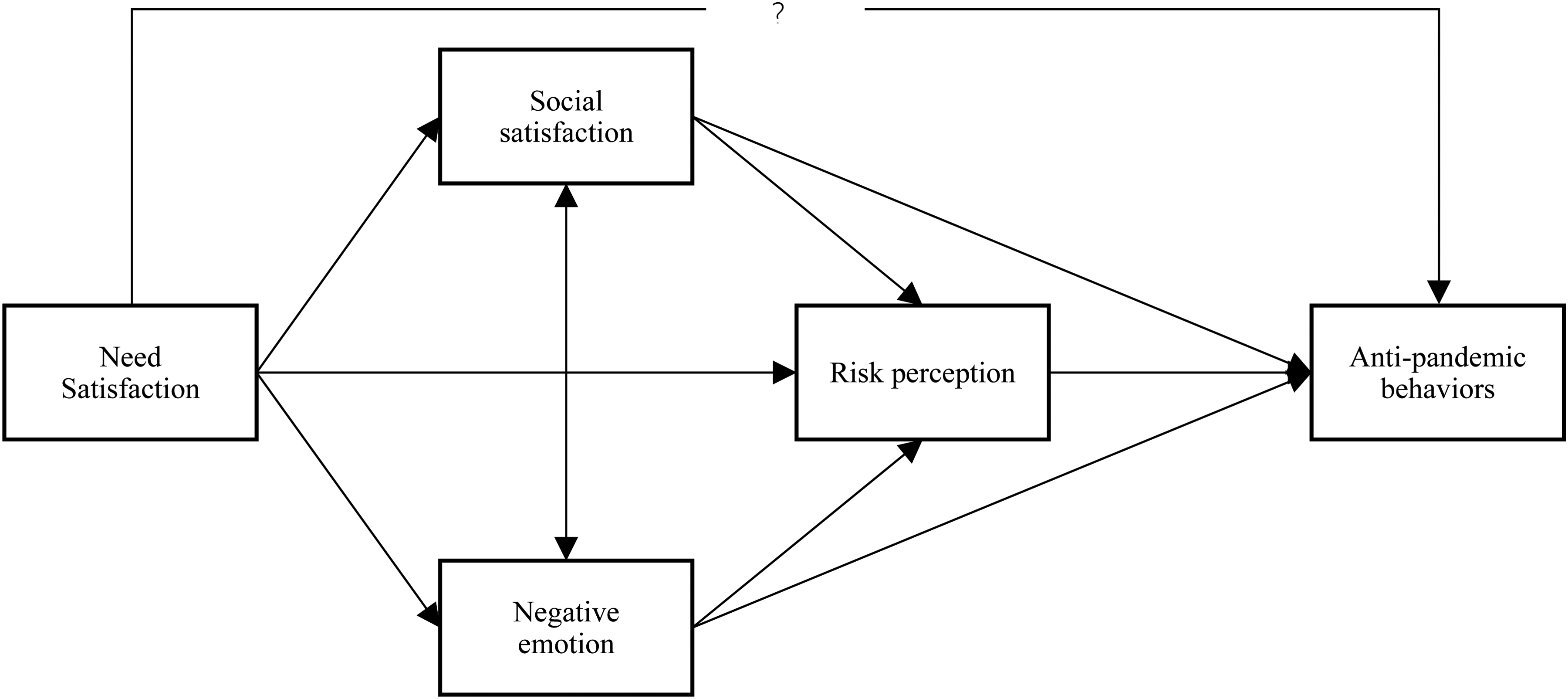
Conceptual model.
Study 1
Methods
Recruitment of participants
The study used data from a nationwide serial survey—the Chinese Social Mentality Survey (CSMS)—which is conducted by the Center of Social Psychology, Institute of Sociology, Chinese Academy of Social Sciences. 2 It is one of the most representative surveys in China. During COVID-19, the CSMS was conducted in several rounds. For research purposes, in Study 1 we used data collected in the earliest survey round in March 2020.
Participants were recruited through a large online survey platform in China from March 20 to March 30 for CNY 6. According to Feng and Long's (2016) formula to calculate the sample size,
Participants characteristics of Study 1

Measures
Independent variable: Need satisfaction
We studied living need satisfaction and development need satisfaction. In the CSMS, living need satisfaction was measured by asking participants how satisfied they were with the following seven aspects: buying masks, buying disinfectant, buying ethanol, buying food such as vegetables, buying daily essential medicines, seeking medical advice, seeking psychological counselling. Participants selected ratings from not satisfied at all ( = 1) to totally satisfied ( = 4), а = 0.839. A higher score means more satisfaction with living needs.
Development need satisfaction was measured by asking participants the likelihood of these four kinds of development difficulties falling on them in this year: income reduction, business problems, employment problems, and personal development problems. Participants selected ratings from not at all ( = 1) to largely ( = 5), а = 0.906. Scores were reversed so that a higher score means more satisfaction with development needs.
Dependent variable: Compliance of behaviors
We divided protective behaviors measured in the CSMS into recommended and non-recommended protective behaviors. They were measured by asking whether participants performed these behaviors ( = 1) or not ( = 0). The recommended protective behaviors included seven kinds of protective behaviors recommended by WHO and the Chinese central government, including wearing masks when going out, reducing the frequency of going out, and washing hands, а = 0.404. The lack of high internal consistency reliability may be that compliance of these recommended behaviors varied (see results below). However, we did not delete some of the behaviors in the follow-up analysis to improve the consistency, because theoretically, all these protective behaviors were important measures against the pandemic at the time.
The non-recommended protective behaviors were three behaviors that were not useful for protection but were popular among Chinese people: taking antibiotics, gargling with salt water, and using vinegar to disinfect the air at home every day, а = 0.813. The higher the score, the more recommended or non-recommended behaviors.
Mediating variables: Social satisfaction, negative emotion, and risk perception
Social satisfaction was measured by asking how satisfied the participants were with a number of social groups: the central government, local governments, the disease control and prevention center, the national health commission, public service organizations, charitable organizations, volunteer organizations, community organizations, doctors and nurses, medical researchers, large online platforms, and the general public. Participants rated from not at all ( = 1) to very much ( = 5), а = 0.903. The higher the score, the more satisfied with society.
Risk perception of infection likelihood, safety, and spread was measured by three items: "how likely do you think you might be infected by the COVID-19?", "how likely do you think the COVID-19 will spread in your community?", and "do you feel safe now?" Items were measured from very much unlikely/unsafe ( = 1) to very much likely/safe ( = 4), а = 0.575. The score of safety was reversed so that a higher score means higher risk perception.
Negative emotions included sadness, worry, anger, fear, and helplessness. They were elicited by the question "many people experienced the emotions below during the pandemic, to what extent do you have them?"Items were measured from not at all ( = 1) to very much ( = 5), а = 0.827. The higher the score, the more negative the emotion.
Control variables
The control variables were sociodemographic and related to the pandemic. Sociodemographic variables were age, gender, education level, employment status, monthly household income, and subjective social status. Variables related to the pandemic included present province in order to control for the impact of provincial confirmed cases. Whether there is any child or senior aged 60 years old in the family was also controlled, since children and seniors were considered to be vulnerable to infection by SARS-CoV-2. Other variables related with the pandemic were having relatives or friends who were infected or not, having family members who were infected or not, having self-quarantined for at least 14 days or not, and self/family member/friend has been to Wuhan recently or not.
Results and discussion
Descriptive analysis of need satisfaction and compliance of behaviors
Participants were basically satisfied with their living needs (M = 3.09, SD = 0.56), higher than the scales' median score of 2.5. The most satisfied to least satisfied living needs were: buying food such as vegetables, buying daily essential medicines, seeking medical advice, seeking psychological counselling, buying disinfectant, buying ethanol, buying masks. This was consistent with the situation in China at the time when masks were the most in need while people seldom lacked food.
However, participants were not very satisfied with their development needs (M = 2.87, SD = 1.02), lower than the scale's median score of 3. The most satisfied to least satisfied development needs were: employment, business, personal development, and income, which reflected that people worried about development, especially income reduction.
The mean score of recommended behaviors was 0.93 (SD = 0.11) and the mean score of non-recommended behaviors was 0.32 (SD = 0.39). This showed that the majority of participants did perform recommended behaviors, from most to least: wearing masks (99.5%); washing hands when returning home (99.1%); staying away from crowds (99.0%); reducing the frequency of going outside (98.9%); taking less public transportation (98.8%); changing clothes when returning home (86.3%); and using ethanol to disinfect (72.4%). On the contrary, many participants did not take non-recommended behaviors, from most to least were: gargling with salt water (37.6%); using vinegar to disinfect the air at home (36.5%); and taking antibiotics (21.5%).
Multiple mediation models
Before the multiple mediation analysis, we did a preliminary analysis of partial correlation (Table 2). The correlations between most key variables were significant (p < .05), except for the correlation between negative emotion and recommended behaviors. However, when sample size was large, p-value usually becomes significant. For this reason, we focused on the r-value. Cohen (1988) regarded |r| < 0.1 as no correlation, |r| > 0.10 as small correlation, |r| > 0.30 as medium correlation, and |r| > 0.5 as large correlation.
Correlation of key variables in Study 1

* p < 0.05; ** p < 0.01; *** p < 0.001.
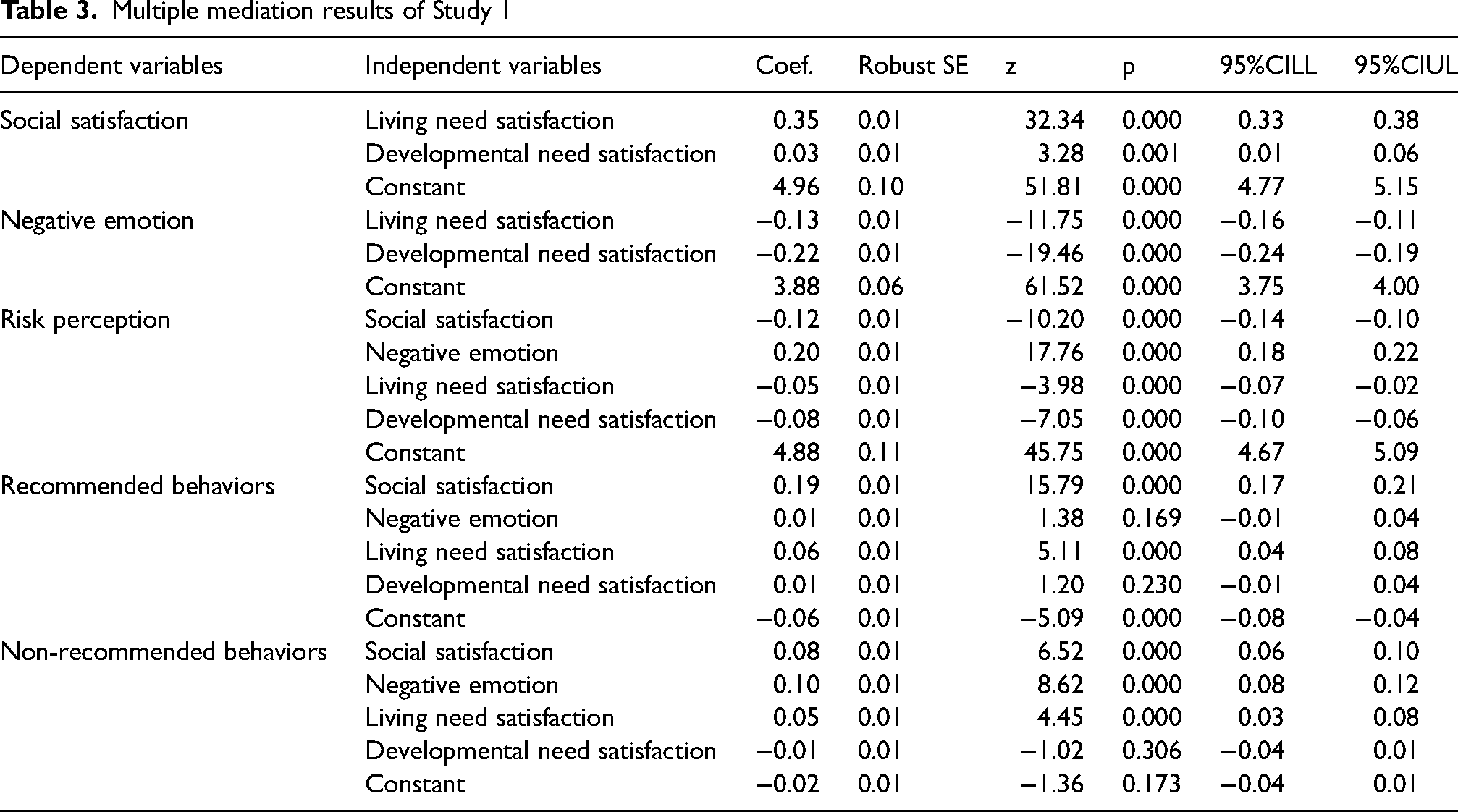
As shown in Table 2, living and development need satisfaction had very little correlation effect with recommended and non-recommended behaviors. Although some researchers claim that independent variables should have significant correlation with dependent variables before mediating analysis, Hayes (2009) said that mediation analysis does not impose the requirement that there be evidence of a simple association between independent and dependent variables. Given that living and development need satisfaction had correlation effects larger than 0.10 with the mediating variables, it may be that living difficulties affect protective behaviors through mediating variables. We then tested the multiple mediating model. Results are shown in Table 3 and Figure 2.
Multiple mediation results of Study 1

Multiple mediation results of Study 1.
When covariates were controlled, negative emotion could not significantly predict recommended behaviors. The total indirect effect of living need satisfaction on recommended behaviors via the mediation of social satisfaction was 0.067, 95% CI = [0.058, 0.076], about 82.9% of the total effect; via the mediation of negative emotion was insignificant (β = −0.002, 95% CI = [ − 0.005, 0.001]). The total indirect effect of living need satisfaction on non-recommended behaviors via the mediation of social satisfaction was 0.028, 95% CI = [0.019, 0.037], about 70.00% of the total effect; via the mediation of negative emotion was insignificant ( − 0.014, 95% CI = [ − 0.017, − 0.010]), about 52.5% of the total effect.
As for development need satisfaction, the total indirect effect of it on recommended behaviors via the mediation of social satisfaction was 0.007, 95% CI = [0.003, 0.011], about 10.7% of the total effect; via the mediation of negative emotion was insignificant (β = −0.003, 95% CI = [ − 0.008, 0.001]). The total indirect effect of development need satisfaction on non-recommended behaviors via the mediation of social satisfaction was 0.003, 95% CI = [0.001, 0.005], about 15.8% of the total effect; via the mediation of negative emotion was − 0.022, 95% CI = [ − 0.027, − 0.016], about 58.2% of the total effect.
In conclusion, social satisfaction and negative emotion both mediated the relationship between need satisfaction and non-recommended behaviors; while only social satisfaction was seen to positively mediate the relationship between need satisfaction and recommended behaviors, which buffered the negative indirect effect of negative emotion and risk perception. Moreover, development need satisfaction could only predict social satisfaction by 0.03; the indirect effect of developmental need satisfaction via social identity is smaller than via negative emotion. It may be at the time of Study 1, people were not inclined to attribute development difficulties to society. The result of the different indirect effects between the two paths was that when development needs were not satisfied, recommended behaviors may have decreased, while non-recommended behaviors may have increased.
Study 1 has several limitations. First, there is no quota for sampling sources, so the sampling distribution of provinces and cities is unbalanced, which may lead to result bias. Second, more than two years has passed, and the virus, the world economy, and epidemic prevention and control policies has changed. Would the relationship between need satisfaction and compliance of behaviors as well as the mechanisms also change? Study 2 was done to answer this question.
Study 2
In Study 2, we used data collected from the latest CSMS survey round conducted in April 2022 before the start of this study. Some details of the research design were modified in accordance with the characteristics of this study period. First, since protective behaviors become a routine and are strongly influenced by policy requirements, we changed our focus from actual behaviors to perception of behavioral necessities. If a participant regarded a behavior as necessary, he or she may be more likely to comply with the behavior. Second, since people started to question the epidemic prevention and control policies, in addition to compliance of individual behaviors, we studied local policies. Third, the questions about need satisfaction in the CSMS were changed slightly to better reflect the current special needs of people.
Methods
Recruitment of participants
Participants were recruited through a large online survey platform in China from April 21, 2022 to May 6, 2022 for CNY 10 from 29 provinces of Mainland China. However, this time, to increase the representativeness of the sample, the CSMS used a modified sampling technique. First, it did not include participants from Tibet and Xinjiang because of their low population. Second, it had limited number of participants recruited at municipal levels. For cities with large COVID-19 spread, such as Shanghai, Beijing, Xi'an and Wuhan, the quota of recruit numbers was 300; for other principal cities that did not have large COVID-19 spread but had high risk due to high mobility, the quota of recruit numbers was 100. In the questionnaires, trap questions and logic test questions were set to ensure the quality of data. After eliminating abnormal responses and data, 6,118 questionnaires were obtained. Participants were aged from 18 to 70 years old (M = 32.31; SD = 8.80), including 2,857 men (46.70%). Sample characteristics are presented in Table 4.
Participants characteristics of Study 2

Measures
Independent variable: Need satisfaction
Since more living problems arose during this period, the CSMS enriched the questions about living need satisfaction. Participants were asked to choose whether they had encountered 15 living problems, such as inability to pay the rent, difficulty buying food, difficulty buying masks, inability to go to hospital for emergency treatment, and inability to go to hospital for treatment of chronic diseases, from no ( = 0) and yes ( = 1). Then we summed up the score and reserved it, so that a higher score means living needs were more satisfied. Development need satisfaction was measured as in Study 1 with а = 0.879.
Independent variable: Compliance of behaviors
Participants' compliance to recommended individual behaviors and the present local policies were measured by asking them "to cope with the COVID-19, how necessary do you think the behavior is?" from very much unnecessary ( = 1) to very much necessary ( = 5). Individual behaviors included six aspects, including wearing masks indoors, wearing masks outdoors, and washing hands frequently, а = 0.868. Local policies included 14 aspects, such as school closure, shops shut down, working from home, public transportation shut down, nucleic acid test for all citizens, locking down the city, and dynamic zero-COVID policy, а = 0.925.
Mediating variables: Social satisfaction, negative emotion and risk perception
Social satisfaction was measured by asking how satisfied participants were with 17 aspects. The CSMS did not asked participants their satisfaction toward social groups because in the new pandemic stage, specific governance performance was more important in epidemic prevention and control. Therefore, the participants were asked about their satisfaction with local governments’ performance on ten items of epidemic prevention and control, such as daily necessities guaranteed, taking care of seniors and children, and emergency management; and seven items on guaranteeing the living quality of people, such as employment promotion, public services, and helping the disadvantaged. Participants rated from not at all ( = 1) to very much ( = 5), а = 0.947. Negative emotion and risk perception were measured as in Study 1. Their Cronbach's а was 0.828 and 0.680, respectively.
Control variables
The control variables also included sociodemographic variables and variables related to the pandemic. Sociodemographic variables were the same as in Study 1. Variables related to the pandemic were changed to better suit the study period, which include present province, whether there are any children under 12 years old or seniors over 60 years old in the family, have family members/relatives/friends been infected or not, have acquaintances been infected or not, have they been quarantined or not, has there been secondary contact/indirect contact/infection or not.
Results and discussion
Descriptive analysis of need satisfaction and compliance of behaviors
Participants were satisfied with their living needs (M = 13.12, SD = 2.32). Most people (40.45%) did not encounter any of the 15 problems, 15.53% encountered only one problem, 12.99% two problems and 10.85% three problems. Specifically, the five most frequent problems were the price of food being too high, food being stale, inability to pay rent, difficulty buying basic medicine, and difficulty buying necessary medicine. Therefore, at the time of Study 2, living needs were almost satisfied but food and medicine supply did not meet with the need.
As for development need satisfaction, participants were less satisfied this year than in Study 1 (M = 2.73, SD = 0.98); but similar to Study 1, the most satisfied to least satisfied development needs were: employment, business, personal development, and income. Therefore, the pandemic lasting for more than two years affected the future development of people.
The mean score of compliance of individual behaviors (M = 4.45, SD = 0.63) and local policies (M = 3.91, SD = 0.79) were both higher than the scale's median score of 3. These indicate that Chinese people were supportive of the recommended individual protective behaviors, and current local epidemic prevention and control policies; but participants regarded individual behaviors as more necessary than local policies. The three most supported individual behaviors were wearing masks outdoors, washing hands frequently, and wearing masks indoors. The three most supported local policies were quarantining asymptomatic infected people, quarantining close contacts, and canceling performances, sporting events, exhibitions, and other gatherings.
Multiple mediation models
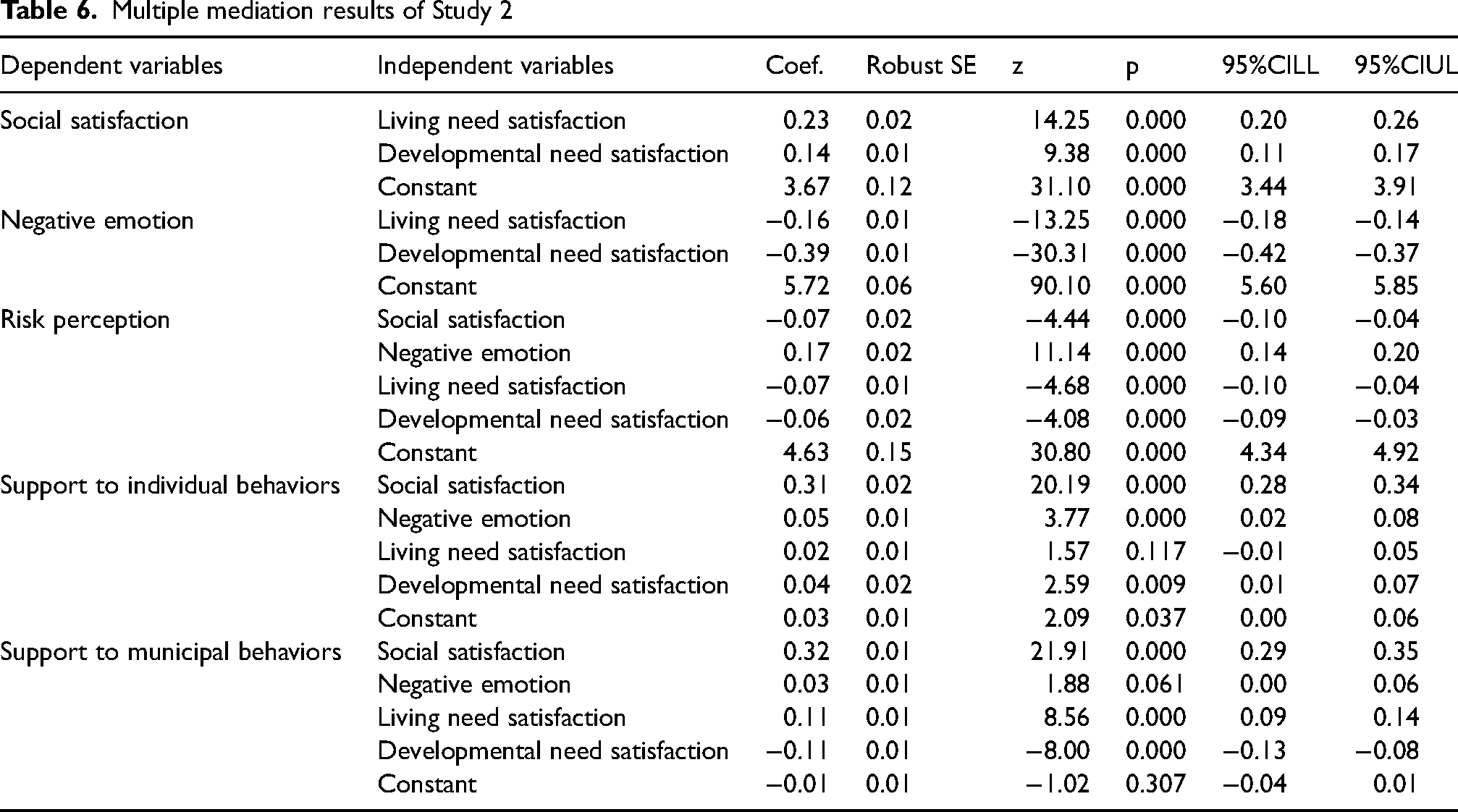
Before the multiple mediation analysis, we did a preliminary analysis of correlation (Table 5). The correlations between most key variables were significant (p < .05). However, the r-values between need satisfaction and behaviors, negative emotion and behaviors, and risk perception and behaviors were very small. These suggest that need satisfaction may affect behaviors mainly through the mediation of social identity. We then tested the multiple mediating model. Results are shown in Table 6 and Figure 3.
Correlation of key variables in Study 2

* p < 0.05; ** p < 0.01; *** p < 0.001.
Multiple mediation results of Study 2

Multiple mediation results of Study 2.
When covariates were controlled, risk perception could not significantly predict compliance to individual behaviors while negative emotion could not significantly predict compliance to local policies. The total indirect effect of living need satisfaction on compliance to individual behaviors via the mediation of social satisfaction was 0.070, 95% CI = [0.058, 0.082], about 63.6% of the total effect; via the mediation of negative emotion was − 0.008, 95% CI = [− 0.013, − 0.004], about 16.67% of the total effect. The total indirect effect of living need satisfaction on compliance to local policies via the mediation of social satisfaction was 0.073, 95% CI = [0.061, 0.085], about 40.78% of the total effect; via the mediation of negative emotion was insignificant (β = −0.004, 95% CI = [− 0.009, 0.000]).
As for development need satisfaction, the total indirect effect of it on compliance to individual behaviors via the mediation of social satisfaction was 0.042, 95% CI = [0.033, 0.052], about 59.1% of the total effect; via the mediation of negative emotion was − 0.020, 95% CI = [− 0.031, − 0.010], about 40.81% of the total effect. The total indirect effect of development need satisfaction on compliance to local policies via the mediation of social satisfaction was 0.044, 95% CI = [0.034, 0.054], about 74.6% of the total effect; via the mediation of negative emotion was insignificant (β = −0.011, 95% CI = [− 0.022, 0.001]).
In conclusion, social satisfaction and negative emotion both mediated the relationship between need satisfaction and compliance to individual behaviors; while only social satisfaction could mediate the relationship between need satisfaction and compliance to local policies. In addition, the prediction of development need satisfaction on social satisfaction enlarged from 0.03 in Study 1 to 0.14 in Study 2. Therefore, social satisfaction buffered more of the negative indirect effect of negative emotion and risk perception in Study 2 than in Study 1. These also suggest that people seemed to be more inclined to attribute development difficulties to society. To improve people's compliance to present pandemic-prevention local policies, it is important to increase social satisfaction toward governance performance.
General discussion
Change of need satisfaction and compliance of behaviors over two years
We did two studies, the one in March 2020, the other in April 2022. Over the two-year period, COVID-19 has gone through several variants with changes in transmissibility, severity, and consequences. On one hand, protective behaviors were still essential for limiting the spread; on the other hand, the downward pressure on the economy brought about by long-term control made people and countries consider behavior and policy changes. By comparing the results of the two studies, we could see that participants were satisfied with their living needs in 2020 and 2022, but the specific aspects of satisfaction differed. In 2020, masks were most in need while people seldom lacked food and medicine. However, in 2022, there was a good supply of masks, but food and medicine supplies did not meet the need. Therefore, living needs changed from the need for protective personal protection equipment to the need for daily necessities. This has to do with the change in material supply over the two-year period when many enterprises started to engage in the production of masks and other protective items, while the supply of basic necessities encountered problems.
With the aspect of development needs, participants were less satisfied with this than with living needs. Moreover, participants were less satisfied in 2022 than in 2020. These results were evidence that the pandemic lasting for more than two years greatly affected the future development of people. Need dissatisfaction is one reason people discussed easing pandemic prevention policies. The WHO Director-General Tedros Adhanom Ghebreyesus remarked that China's zero-COVID strategy is "unsustainable" (Ministry of Foreign Affairs, 2022). However, a key question may be whether easing policies would help with meeting people's needs? For example, the United States held less strict pandemic prevention policies than China, but its businesses have been impacted greatly by the Omicron variant (Xinhua, 2022). But this does at least suggest that we should try to strike a balance between COVID prevention and economic and social operation in a major public health event. On December 7, 2022, the Chinese State Council's Joint Prevention and Control Mechanism released the "10 new measures," relaxed the pandemic prevention and control policies. In January, 2023, China's management of COVID was downgraded to the less strict Category B from the top-level Category A, as the disease has become less virulent and will gradually evolve into a common respiratory infection. The adjustment of policy is a comprehensive consideration of various risks and needs.
Regardless of changes in need satisfaction, Chinese people were highly compliant with recommended behaviors and local policies. Some research attributed the high compliance of Chinese people to collectivism. Lu et al. (2021a, 2021b) found that collectivism predicts mask use during COVID-19. However, Ayran et al. (2023) found a high level of compliance in all included countries. Studies conducted in other countries also found high compliance with pandemic prevention behaviors (e.g., Armitage et al., 2021; Czeisler et al., 2021; Gallè et al., 2021). Nevertheless, cultural differences may exist in the results. For example, in a collectivistic culture like China, social identity may play a larger role in compliance behaviors than in an individualistic culture. In contrast, in individualistic cultures, individual perspective paths, such as helping people realize the risk of the pandemic, may have a larger impact on compliance behaviors than social perspective paths. However, this does not mean that improving government performance is not important. As Kitayama et al. (2022) suggested, in an individualistic culture like the United States, a certain policy was more effective than an uncertain policy; and it can be even more effective when combined with monetary incentives. Therefore, the interpretation of the results may be limited to China, and more cross-cultural research is needed to determine the extent of the results’ cross-cultural universality.
The role of social satisfaction and negative emotion
We analyzed the two pathways through which need satisfaction affected compliance behaviors. The one is from an individual perspective, via negative emotion and risk perception; the other is from a social perspective, via social satisfaction and risk perception. In Study 1, negative emotion only mediated the relationship between need satisfaction and non-recommended behaviors, but did not mediate the relationship between need satisfaction and recommended behaviors. In Study 2, negative emotion mediated the relationship between need satisfaction and individual recommended behaviors, but not between need satisfaction and compliance to local policies. Even though the health belief model and some research found that negative emotion positively related with protective behaviors (Ben-Ezra et al., 2020; Joop, 1996; Rosenstock, 1974, 1977; Shi et al., 2021; Weinstein, 2004), our study did not support this. At least in the post-COVID period in China, increasing people's negative emotions, such as fear and anxiety, may not be feasible for promoting recommended protective behaviors and compliance with policies, but only for promoting non-recommended or ineffective protective behaviors.
As to social satisfaction, just like trust is a double-edged sword (Cruwys et al., 2020a, 2020b, 2021), the same goes with social satisfaction. On one hand, social satisfaction increases compliance behaviors; on the other hand, it decreases compliance by decreasing risk perception. Fortunately, the effect of risk perception is small; therefore, social satisfaction has a larger positive effect on compliance of behaviors than its negative effect, and it buffers the negative indirect effect of negative emotion and risk perception.
More importantly, the prediction of development need satisfaction on social satisfaction enlarged from 0.03 in Study 1 to 0.14 in Study 2. In other words, the decline in development satisfaction had a more severe impact on social satisfaction in 2022 in China. Therefore, ensuring people's living and development needs, as well as improving government performance became more crucial for promoting behavioral compliance when a pandemic has lasted for a long time.
Implications
The study has several theoretical implications. First, it provided empirical evidence for the double-edged sword effect of social satisfaction. Second, it revealed a limitation of the health belief model (Rosenstock, 1974, 1977): negative emotion may only promote non-recommended behaviors, but not recommended behaviors, suggesting a hyperdefensiveness strategy. Third, the study integrated the social perspective of social satisfaction of social identity theory and the social identity model of risk taking with the individual perspective of negative emotion of the health belief model and further extended the model to include need satisfaction.
The study also provides practical insights on effectively increasing compliance of behaviors in large public health events, emphasizing the importance of creating a strong "we" social identity. New York's Governor, Andrew Cuomo, stated during the early stage of the COVID-19 pandemic, "It's not about me, it's about we" (Jetten et al., 2020). This underscores the significance of collective action and compliance behaviors in protecting the public from infection.
To achieve this, it is crucial to prioritize meeting different needs at various stages of a pandemic. The study revealed that during the two stages of COVID-19, there was a shift in requirements from medical supplies to daily necessities. This highlights the necessity of proactive preparation by ensuring an adequate supply of medical resources in the early stages of a pandemic and maintaining a continuous provision of essential items throughout. Close monitoring of evolving needs, particularly those arising from the unique circumstances of a pandemic, is essential to adapt our response accordingly.
Furthermore, effective information communication plays a pivotal role in shaping public behavior and fostering compliance. While media can be utilized to stimulate emotional responses and risk perception when compliance is low, the study suggested that it is not a sustainable solution as it may inadvertently promote non-recommended behaviors. Therefore, it is imperative to prioritize the dissemination of reasonable and accurate information. By providing the public with a clear understanding of the pandemic's stage, the rationale behind behavioral compliance, and the consequences of noncompliance, we can strengthen social identity and encourage widespread adherence to recommended behaviors.
Additionally, enhancing government performance is crucial to increase citizens' satisfaction and support. Governments should focus on improving emergency management capabilities, enhancing the level of modern social governance, and striking a balance between epidemic prevention measures and people's normal lives. This comprehensive approach ensures that the government is well equipped to effectively and efficiently handle public health crises while addressing the needs and concerns of its citizens.
In conclusion, by prioritizing the satisfaction of diverse needs, implementing effective information communication strategies, and enhancing government performance, we can foster a "we-feeling" and subsequently promote compliance with behaviors in major public health events.
Limitations
The study had several limitations. First, as this study was centered in China, the applicability of the results in other countries or cultures should be investigated as there are many differences in cognition, attitudes, and behaviors between individualistic and collectivistic cultures (Gallè et al., 2021; Leong et al., 2022; Lu et al., 2021a, 2021b), and now-oriented and future-oriented cultures (Goldberg, 1976). Cultural differences in the relationship and mechanism between need dissatisfaction and compliance as well as cultural factors affecting compliance behaviors (Kitayama et al., 2022) should be considered and explored in future studies.
Second, to test the replicability of this study, future studies should incorporate other data, and research designs. For example, this study used data from two online survey rounds of CSMS; once feasible, scholars could use random sampling and include data from an offline survey round. Furthermore, limited by survey data and research aim, this study could not utilize well-established instruments for analysis. Hence, future researchers could develop more mature scales to capture citizens' behaviors during the pandemic situation. In addition, this study used self-report data, which involves the risk of a social desirability bias. Hence, when feasible, scholars should consider including data from other sources, such as implicit measurement.
Third, with the changing situation of the pandemic, needs, behaviors, and policies are changing too. The study only included two time periods; however, more longitudinal research could be added to examine changes in need satisfaction. In the future, a cross-lagged panel model should also be used to clarify the mechanisms of variables.
Ethical issues
The CSMS and the present study were approved by the academic board of the Institute of Sociology, the Chinese Academy of Social Sciences. No identifiable personal information was collected during the survey and used in the study. Before filling the questionnaire, the participants read about the aims of the survey and the benefits and potential harms from participating, and then agreed to participate by clicking on the "next" button. The participants could stop at any time during the questionnaire. Those who completed the questionnaire were rewarded CNY 6 and CNY 10 in the first and second rounds of the CSMS, respectively.
Supplemental Material
sj-docx-1-pac-10.1177_18344909231190305 - Supplemental material for Need satisfaction and compliance behaviors in two different phases of COVID-19 in China: Multiple mediation of social satisfaction, negative emotions, and risk perception
Supplemental material, sj-docx-1-pac-10.1177_18344909231190305 for Need satisfaction and compliance behaviors in two different phases of COVID-19 in China: Multiple mediation of social satisfaction, negative emotions, and risk perception by Yan Zhang and Junxiu Wang in Journal of Pacific Rim Psychology
Footnotes
Author's note
Junxiu Wang, Institute of Sociology, Chinese Academy of Social Science, Beijing, China.
Declaration of conflicting interests
The authors declared no potential conflicts of interest with respect to the research, authorship, and/or publication of this article.
Funding
The authors disclosed receipt of the following financial support for the research, authorship, and/or publication of this article: This work was supported by the Key Projects of Philosophy and Social Sciences Research, Ministry of Education (grant number 21JZD038).
Supplemental material
Supplemental material for this article is available online.
Notes
References
Supplementary Material
Please find the following supplemental material available below.
For Open Access articles published under a Creative Commons License, all supplemental material carries the same license as the article it is associated with.
For non-Open Access articles published, all supplemental material carries a non-exclusive license, and permission requests for re-use of supplemental material or any part of supplemental material shall be sent directly to the copyright owner as specified in the copyright notice associated with the article.
