




Abstract
Increasing the level of correspondence between measures of growth mindset and their related outcomes could afford more precise prediction of the relationships between growth mindset and social-emotional outcomes. To illustrate the value of measurement correspondence, two studies were conducted in Hong Kong. Study 1 showed that an agent-correspondent growth mindset measure (parents’ perception of the malleability of their children's personal qualities), compared to an agent-non-correspondent one (parents’ belief in the malleability of personal qualities of a generalized other), had stronger predictive relationship with children's likelihood of displaying difficult behaviors. Study 2 found that children's self-theories about the malleability of their intelligence (an intrapersonal construct) had stronger predictive relationship with academic engagement (an intrapersonal outcome) than did their perception of growth mindset norm (a normative construct). However, perceived growth mindset norm regarding personal qualities had stronger predictive relationship with peer relationship quality (an interpersonal outcome). Together these results demonstrated that when corresponding measures of growth mindset were used to predict an outcome, more reliable growth mindset effects would emerge.
Keywords
Growth mindset refers to the belief in the malleability of valued attributes through application of effective strategies and effort (Dweck, 2006). Research scientists and practitioners are excited about this construct because of its demonstrated beneficial effects on learning motivation, performance, achievement, relationship, resilience, and psychological well-being (Dweck, 1999; Gouëdard, 2021; Hong et al., 1999; Yeager et al., 2019).
However, recently published meta-analyses show that the impact of the growth mindset on achievement and social-emotional outcomes is inconsistent across studies (Burnette et al., 2020, 2022; Macnamara & Burgoyne, 2022; Sisk et al., 2018). For example, Burnette et al. (2020) reported that the average correlations of growth mindset with psychological distress, treatment value, and active coping were −.22, .14, and .21, respectively. Two approaches have been suggested to improve the predictive strength of growth mindset. The first one is to look for moderators of the growth mindset effects (Burnette et al., 2022; Hecht et al., 2021; Sisk et al., 2018; Yeager et al., 2022). The second one is to improve the research design to increase the precision and sensitivity of the measurement (Macnamara & Burgoyne, 2022). In the present article, in response to the call for study design improvements to make the measurement more precise and sensitive, we propose to increase the level of correspondence between measures of mindset and the outcome variables, and will present the results of two studies that illustrate the importance of correspondence between measures of mindset and the outcome variables.
The correspondence principle and its extension
The correspondence principle (Ajzen & Fishbein, 1977) was proposed to explain the low level of consistency between attitudes and behaviors. According to the principle, the predictive relationship between attitude or belief and behavior is stronger when both the predictor and attitude/belief and behavior are measured at the same level of specificity versus generality. For example, people's reports of how strongly they believe that eating green vegetables is good for health predict how frequently they consume green vegetables (a behavioral measure that matches the belief measure in the level of specificity), but may not predict how often they eat broccoli (a more specific behavior) or vegetables (a more general behavior). In short, the correspondence principle prescribes that to improve prediction of an outcome, the predictor and criterion variables should be measured at the same level of specificity. Evidence supporting the correspondence principle abounds (see Irving & Smith, 2020; Kraus, 1995 for reviews). Individual differences psychology research also shows that, consistent with the correspondence principle, compared to each other, global measures of a trait (e.g., trait anxiety) perform better in predicting an individual's general behavior tendencies over time, whereas context-sensitive measures (e.g., state anxiety) of the same trait perform better in predicting the individual's specific behavior in concrete situations (Pacheco-Unguetti et al., 2010). In short, the correspondence principle invites and challenges researchers to use correspondent measures in their study for the sake of revealing the true strength of association between the predictor and outcome variables.
The correspondence principle can be extended and applied to growth mindset measurement. One extension concerns the domain-specificity of growth mindset prediction. The domain-specificity of growth mindset effects is well documented (Dweck et al., 1993, 1995). First, a person can have a growth mindset about one attribute (e.g., intelligence) and fixed mindset about another attribute (e.g., personality; Zhu et al., 2020). Second, measures of mindset regarding an attribute in a certain domain (e.g., creativity) should predict behaviors and outcomes in the same domain (e.g., creative performance) but not necessarily those in other domains (e.g., moral decision-making). Consistent with this idea, past research shows that the belief in malleable intelligence excels at predicting academic performance and achievement motivation (Hong et al., 1999; Yeager et al., 2019). Likewise, the belief that relationship can grow excels at predicting quality of intimate relationship and recovery from breakups (Knee, 1998), and the belief in mutable personality and morality excels at predicting the tendency to refrain from making sweeping personality and moral judgments from sparse behavioral observations (Chiu et al., 1997; Gervey et al., 1999). Romero et al. (2014) measured the growth mindset regarding intelligence and that regarding emotionality. They found that only the intelligence mindset was related to academic performance and only the emotionality mindset was related to depression. In contrast, the relationship between intelligence mindset and depression was not significant, and emotionality mindset was not related to academic performance as well. In these examples, the outcome variables in a certain domain were significantly predicted from the growth mindset in the same domain. We refer to this phenomenon as the domain-correspondence effect.
Agent-correspondence effect of mindset predictions
Although the studies included in the previously mentioned meta-analyses typically used domain-correspondent measures (using intelligence mindset to predict academic performance and achievements), some might have overlooked other issues of measurement correspondence, such as agent-correspondence.
Agent-correspondence in mindset measurement refers to the use of belief about the malleability of a particular agent's personal qualities to predict this agent's behaviors. People develop representation of a particular other as they pay attention to this person's thoughts, feelings, or expectations. This representation is different from people's abstract representation of the generalized other, which is abstracted from people's observations of other people's behaviors in diverse social contexts (Mead, 1934). These two types of representations are associated with different outcomes. For example, representation of the generalized other is linked to general social trust and representation of the particular other is linked to trust in particularistic relationships (Newton & Zmerli, 2011).
Despite the obvious distinction between the representation of the particular other and that of the generalized other, this distinction is often overlooked in mindset research. The most widely used measures of mindset about personal qualities have been measures of the mindset of the generalized other. Some sample items of these measures are: “The kind of person someone is, is something very basic about them and it can’t be changed very much,” and “People can do things differently, but the important parts of who they are can’t really be changed” (Chiu et al., 1997). Using these measures could lead to underestimation of the true strength of association between mindset and the particular other's behaviors because of the lack of agent-correspondence between the mindset measure and the outcome variable. Departing from this common practice, some researchers (e.g., Moorman & Pomerantz, 2010) had measured and predicted children's learning outcomes from the mothers’ views of the malleability of their children's ability
In the present study, we propose another extension of the correspondence principle, which concerns the agent-specificity of growth mindset predictions. Specifically, we contend that the estimation of the true effects of growth mindset can be more accurate when researchers predict a particular agent's behaviors from the perceived malleability of the same agent's pertinent personal quality, compared to predicting them from that of the generalized other.
We tested this contention in the prediction of parent–child relationship. Past studies have shown that when parents have the growth mindset, parent–child relationship improves: the adverse effect of maternal stress on infant's development is attenuated (Elansary et al., 2022), and adaptive parental involvement increases (Moorman & Pomerantz, 2010). However, in these past studies (Elansary et al., 2022; Schleider et al., 2016), the predictor was parents’ own mindset instead of parents’ mindset of children's mutability. Based on the correspondence principle, we propose to predict children's outcomes from their parents’ perception of their children's malleability regarding a pertinent attribute (agent-correspondent mindset) rather than from their parents’ belief in the malleability of the same attribute of the generalized other (agent-non-correspondent mindset). We hypothesize that using agent-correspondent (vs. agent-non-correspondent) mindset measure will correct the attenuation of theoretically meaningful mindset-outcome relationships (H1). We refer to this phenomenon as the agent-correspondence effect.
Level-correspondence effect of mindset predictions
Another type of measurement correspondence is level-correspondence. The growth mindset theory has been applied to predict behaviors and outcomes at both the intrapersonal and interpersonal levels. In the present article, we propose that the accuracy of mindset predictions can be enhanced when mindsets are measured at the correspondent level of analysis as the outcome variables. We refer to this phenomenon as the level-correspondence effect of mindset measurement.
Mindset can be a personal preference (I believe that …) or a subjective norm (Morris et al., 2015). Personal preferences and subjective norms offer different levels of explanations of human behaviors (Ajzen, 1991; Zou et al., 2009). Personal preferences explain human behaviors in terms of an individual's feelings, thoughts, and behaviors, whereas subjective norms do so in terms of the perceived reality shared by a pertinent social group (Dijksterhuis & Bargh, 2001; Wan et al., 2010). Individuals form perceptions of what the others in the group believe in and act on these perceptions, even when they are different from their own beliefs (Chiu et al., 2010). For example, many American university students perceive that their peers like to drink a lot in social gatherings. Although they personally do not like excessive drinking, they nonetheless tend to drink excessively in social gatherings (Prentice & Miller, 1993).
The relative contribution of personal preferences versus subjective norms to predicting behaviors and outcomes depends on the nature of the behaviors or outcomes. Personal preferences outperform subjective norms in predicting intrapersonal behaviors and outcomes (e.g., private behaviors, engagement in personal goals, one's cognitive performance). In contrast, subjective norms outperform personal preferences in predicting interpersonal behaviors and outcomes (e.g., public behaviors, engagement in interdependent tasks, and one's social performance; Fischer, 2006). In the excessive drinking example above, the perceived campus drinking norms would outperform students’ personal preferences when predicting the amount of alcohol students would consume in social gatherings (an interpersonal behavior), whereas students’ personal drinking preferences would outperform perceived campus norms when predicting the amount of alcohol students would consume when having dinner alone (an intrapersonal behavior).
Applying this idea to growth mindset research, we propose that to predict intrapersonal outcomes more accurately from growth mindset, self-theories (a kind of personal preferences) should be measured. As an illustration, academic engagement, or the amount of effort a student would spend on schoolwork, is largely an intrapersonal outcome. Therefore, self-theories about the malleability of intelligence should outperform subjective norms regarding the malleability of intelligence when predicting students’ academic engagement (H2). On the contrary, to predict interpersonal outcomes more accurately from growth mindset, subjective norms about the malleability of personal qualities should be measured. Peer relationship is a quintessential example of interpersonal outcomes. Therefore, we hypothesize that subjective norm regarding the malleability of personality would outperform the correspondent self-theories when predicting peer relationship (H3).
In summary, to apply the correspondence principle in growth mindset research, we propose that the accuracy of growth mindset predictions can be enhanced by choosing mindset measures that correspond to the outcome variables in the domain of personal qualities (domain-correspondence), agent of the predicted behaviors and outcomes (agent-correspondence), and the level of analysis (level-correspondence). Because the domain-correspondence effect is well documented in the research literature, the present research will focus on the agent-correspondence effect (Study 1) and level-correspondence effects (Study 2). Study 1 aims to show that a stronger prediction on children's behaviors would emerge when we measured parents’ belief about their children's malleability (agent-correspondent mindset) versus parents’ belief about the malleability of generalized others (agent-non-correspondent mindset). Study 2 aims to show that a stronger predictive relationship would be found when we used children's self-theories to predict academic engagement (an intrapersonal outcome) and children's subjective norms to predict quality of peer relationship (an interpersonal outcome). If our hypotheses are supported, our findings will offer insights on how to correct the underestimations of the true association strength between mindset and its theoretically meaningful outcomes by taking serious consideration of relevant contextual factors (the outcome domain, the agent and the level of analysis) in the design of mindset measurement (Burnette et al., 2022; Gouëdard, 2021).
In growth mindset research, with a few exceptions (e.g., Chan et al., 2020), the measured mindset is typically the participants’ personal belief regarding the malleability of a valued attribute (self-theories; e.g., “I agree that people can change their levels of basic intelligence”), not the participants’ perception of what the generalized other's belief in the malleability of the attribute in the pertinent social group (subjective norm; e.g., “Most of my classmates believe that one's levels of basic intelligence can be changed”). Another novel contribution of the present research will extend growth mindset research to perceived mindset norms. This extension will enrich our understanding of the Mindset X Context perspective recently proposed by Hecht et al. (2021). We shall further exploit this idea in the General discussion.
Study 1
Hypothesis 1 states that the agent-correspondent (vs. agent-non-correspondent) mindset has stronger predictive relationship with the agent's behaviors. To test this hypothesis, the present study assessed the association strength of parents’ mindset of the mutability of their children's personal qualities (vs. parents’ mindset of the generalized other) with the quality of parent–child relationship.
The present study was conducted in the following context. In year 2020, under the threat of the COVID-19 pandemic, Hong Kong suspended face-to-face teaching in schools. All primary schools were locked down for over four months, starting from the end of January. Face-to-face teaching resumed in mid-June and was suspended again in mid-July until the end of September. During the lockdowns, students stayed at home. Parent–child interactions increased in quantity and their quality also changed (Chung et al., 2020).
Method
Participants
The participants were 545 Chinese parents of students from four primary schools in Hong Kong. They received an online invitation from their children's schools to participate in a survey. They completed the survey voluntarily between July and September 2020. Some participants (N = 163, 29.9%) did not answer the items included in the present study, leaving a total of 382 valid cases (70.1%) in the analysis.
Most participants were female (82.2%), and about half of them (49.7%) had finished secondary school. The percentages who had a postsecondary diploma, undergraduate degree, and postgraduate degree were 26.2%, 16%, and 4.5%, respectively. Most of them were middle-aged: 49.5% aged between 31 and 40 and 42.9% were between 41 and 50. The remaining ones were 30 or younger (2.9%), or over 50 (4.7%).
Measures
All measures were presented in the Chinese language. Two items from Dweck (1999) were used to measure parents’ mindset about the mutability of the generalized other's personal qualities: “The kind of person someone is, is something very basic about them and it can’t be changed very much,” and “People can do things differently, but the important parts of who they are can’t really be changed.” The items were measured by a 7-point Likert scale, from 1 (strongly disagree) to 7 (strongly agree), and they were reverse scored so that higher scores indicated stronger agent-non-correspondent belief in the mutability of personal qualities (α = .79). 1
To measure parents’ agent-correspondent mindset about the mutability of their children's personal qualities, we replaced “person” or “people” in the items in the measure of the generalized other's mindset with “your child” or “your children,” respectively. It was also measured by a 7-point Likert scale, from 1 (strongly disagree) to 7 (strongly agree). Again, the items were reverse scored, so that higher scores indicated stronger perceived malleability of children's personal qualities (α = .82).
Our dependent measure was parents’ evaluation of their children's behaviors during school lockdowns. Three items from the Difficult Child Subscale of the Parenting Stress Index were adopted (Abidin, 1995). This subscale captured how troublesome the children were from their parents’ perspective, an indicator of the quality of parent–child relationship. The items were “I felt that this child was very moody and easily upset,” “this child did something which always bothered me a great deal,” and “this child exhibited many behavioral problems.” The parents were instructed to recall the children's behaviors during school lockdowns and rate these behaviors using a 5-point Likert scale from 1 (strongly disagree) to 5 (strongly agree). The items were reverse scored, with higher scores indicating a more favorable evaluation of their children (α = .83).
To control for the baseline level of parent–child relationship before school lockdowns (Donker et al., 2021), we asked the participants to rate the overall parent–child relationship (range from 0 to 10, with higher scores indicating a better relationship) before school lockdowns.
Analysis
Linear regression analysis (SPSS version 28) was performed on parents’ evaluations of children's behaviors with parents’ mindset of the generalized other (agent-non-correspondent) and their mindset of their children's mutability (agent-correspondent) as predictors. In the first model, only agent-non-correspondent mindset was included as the predictor. Next, only agent-correspondent mindset was included in the model. Finally, both agent-non-correspondent and agent-correspondent mindsets were included in the model. The independent variables were mean-centered. Parent–child relationship before school closure, parents’ sex, education level, and age were included as control variables.
Results and discussion
To check if the common method bias presented a threat to the validity of our results, Harman's one-factor test was used. Specifically, we performed principal component analysis with one factor and no rotation on all measured variables. The total variance extracted by the first factor was smaller than 50% (40.35%). In short, the common method bias did not present a significant threat to the validity of the results reported below (Fuller et al., 2016).
Table 1 presents the descriptive statistics and the correlations of the measured variables. The correlation between agent-non-correspondent mindset and agent-correspondent mindset was .71 (p < .001); the amount of shared variance between the two measures was 50.4%. Parents who believed more strongly in the malleability of the generalized other's personal qualities also perceived their children's personal qualities to be changeable.
Mean, standard deviation, and correlation of measured variables in Study 1
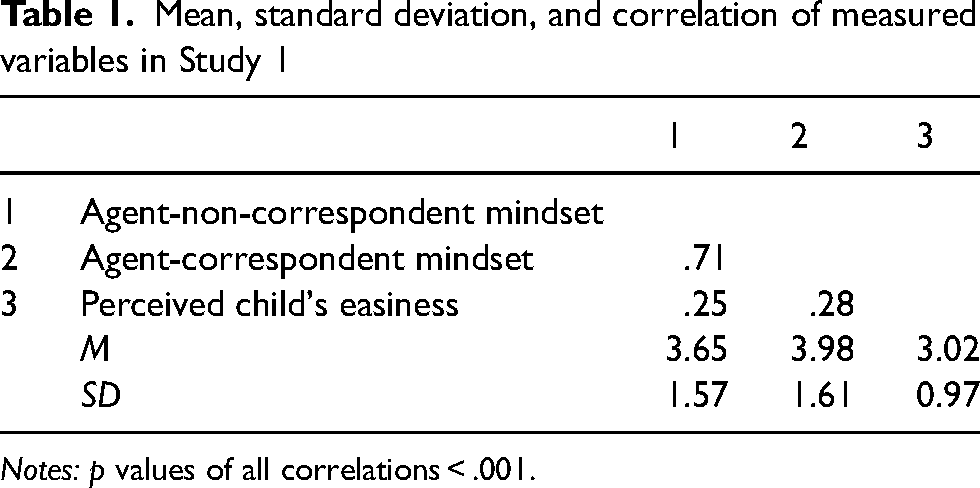
Notes: p values of all correlations < .001.
Evaluation of children was positively correlated with both agent-non-correspondent mindset (r = .25, p < .001) and agent-correspondent mindset (r = .28, p < .001). Agent-non-correspondent mindset predicted more favorable evaluation of children's behaviors when agent-correspondent mindset was not included in the model (β = 0.19, t = 3.77, p < .001, η2 = .04). Agent-correspondent mindset also predicted more favorable evaluation of children's behaviors when agent-non-correspondent mindset was not included in the model (β = 0.24, t = 4.84, p < .001, η2 = .06). When both agent-non-correspondent and agent-correspondent mindsets were included in the model, agent-non-correspondent mindset was unrelated to favorable evaluation of children's behavior (β = 0.04, t = 0.54, p = .59, η2 = .001). The positive relationship between agent-correspondent mindset and evaluation of children's behaviors remained significant (β = 0.21, t = 3.02, p = .003, η2 = .02). Parents who more strongly perceived their children's personal qualities to be changeable found their children to be less troublesome during school lockdowns.
Although confirmatory factor analysis results provided evidence for the empirical distinction of the mindset measures, given their high correlation, we further assessed the potential threat of multicollinearity to the validity of our results. The variance inflation factor (VIF) of both variables were lower than 5 (agent-non-correspondent mindset: VIF = 2.12; agent-correspondent mindset: VIF = 2.10). Thus, multicollinearity did not significantly threaten the validity of our results (Akinwande et al., 2015).
In summary, the result supported the extended correspondence principle. When the outcome variable was the behavior of a specific agent (favorable evaluation of their children's behaviors), the agent-correspondent measure of mindset (measure of parents’ perception of the malleability of their children's personal qualities) was more predictive of the outcome variable than the agent-non-correspondent one (a measure of parents’ belief in the malleability of the generalized other's personal qualities).
Study 2
In the present study, we further tested the extended correspondence principle. Consistent with the correspondence principle, past research has shown that, compared to each other, measures of self-beliefs are more predictive of intrapersonal outcomes, whereas measures of subjective norms are more predictive of interpersonal outcomes (Fischer et al., 2009). Specifically, we measured primary school children's enjoyment of learning (an intrapersonal criterion) and enjoyment of social relationship in school (an interpersonal criterion) in Hong Kong. The predictors were children's self-theories (personal beliefs) as well as their subjective norms regarding the malleability of intelligence (an attribute in the intellectual domain) and personal qualities. We hypothesized that for learning enjoyment (an intrapersonal outcome), children's self-theories about intelligence would have higher predictive power than do their subjective norms. In contrast, for relationship enjoyment (an interpersonal outcome), children's subjective norms regarding personal qualities would have higher predictive power than do their self-theories.
Method
Participants
A total of 1,027 primary students of different grades, from grade 1 to grade 6, from 5 schools in Hong Kong participated in the study with parental consent. Data from 13 students (1.3%) were excluded from the analysis because of incomplete data, leaving 1,014 valid cases in the final analysis. Nearly 60% (58.6%) of the students were in junior grades (Grade 1 to 3). About half of them (49.3%) were female. Most students were Chinese (88.1%), and the remaining ones were mostly Pakistanis or Nepalese.
Measures
Five items adopted from Dweck (1999) were used to measure the participants’ self-theories about the malleability of personal qualities and intelligence. The items were: “The kind of person someone is, is something very basic about them and it can’t be changed very much” (personal qualities; reverse scored), “All people can change even their most basic qualities” (personal qualities), “You can learn new things, but you can’t really change your basic intelligence” (intelligence, reverse scored), “You have a certain amount of intelligence, and you really can’t do much to change it” (intelligence, reverse scored), and “You can substantially change how intelligent you are” (intelligence). Taking into consideration young children's limited cognitive capacity, we changed the scale from a 6-point Likert scale to a 4-point scale (1 = completely disagree, 4 = completely agree). After reporting their self-theories, participants were asked to estimate how most of their classmates would answer each of these 5 items along the same scale. These estimates were used to form the subjective norm measures of intelligence and personal qualities mindsets.
To measure enjoyment of social relationship, the participants were asked to rate on a 5-point item (from 1 = completely do not enjoy to 5 = enjoy very much) how much they enjoyed playing with their classmates during the week. We used a single-item measure because the respondents were young and the measured construct (relationship enjoyment) is simple. Repeating the same question multiple times in slightly different wordings might create fatigue and confused the participants. Past studies have used single-item measures to assess constructs of a similar nature (e.g., life satisfaction) and found them to have adequate criterion-referenced validity (Cheung & Lucas, 2014).
Enjoyment of learning was measured by six items (Fredricks et al., 2005). The items were “I pay attention in class,” “I follow the rules at school,” “I feel happy in school,” “I am interested in the work at school,” “I check my homework for mistakes,” and “I read extra books to learn more about things we do in school.” Participants used a 5-point Likert scale, from 1 (never) to 5 (all of the time), to respond to each of these items (α = .80).
The non-Chinese students completed the English version of the survey, and the Chinese students completed the translated Chinese version. The researchers slightly edited the original English items to make sure they could be understood by the children. A bilingual researcher then translated the edited items into Chinese. A primary school teacher reviewed the measures and confirmed that they were comprehensible to the children.
Analysis
Multilevel analysis was conducted to test H2 and H3, which concerns the relative strength of association of self-theories versus subjective norms in predicting the two outcome variables. Two-level fixed effect models were tested in the analysis: individual data (level 1) were nested within class (level 2). The independent variables were mean-centered. Grade, gender, and race (Chinese or non-Chinese) were included as control variables. The package “lmer” in the software R was used for data modelling.
Results and discussion
To address the threat of common method bias, principal component analysis with one factor and no rotation was performed on all measured variables and the total variance extracted by the first factor was less than 50% (20.89%). Common method variance did not present a threat to the validity of our results (Fuller et al., 2016).
Table 2 presents the descriptive statistics and the correlations of the measured variables. The correlations between self-theories and perceived norms were moderate (r = .40, p < .001 for personal qualities and r = .43, p < .001 for intelligence). Both self-theory and perceived norm of personal qualities were positively correlated with relationship enjoyment (r = .11, p < .001 for self-theory and r = .16, p < .001 for perceived norm). Self-theory of intelligence was positively correlated with learning enjoyment relationship (r = .09, p = .003). Correlation between perceived norm of intelligence and learning enjoyment was not significant (r = .06, p = .06).
Mean, standard deviation, and correlation of measured variables in Study 2

Notes: * p < .05, ** p < .01, *** p < .001.
Relationship enjoyment
Because peer relationship was an outcome variable in the social-personality domain, we used mindsets regarding personal qualities as the predictors. The multilevel analysis results presented in Table 3a show that peer relationship enjoyment was more strongly related to subjective norm (vs. self-theory). Self-theory regarding the malleability of personal qualities was significantly related to peer relationship enjoyment (β = 0.09, t = 2.93, p = .003, η2 = .008), and so was subjective norm regarding the malleability of personal qualities (β = 0.15, t = 4.78, p < .001, η2 = .02). However, when both self-theory and subjective norm were added to the model (Model 1c), subjective norm was positively related to the enjoyment of peer relationship (β = 0.13, t = 3.97, p < .001, η2 = .02), whereas self-theory was not (β = 0.04, t = 1.04, p = .30, η2 = .001). As subjective norm and self-theory were related within classes, we added class mean of self-theory to the model as a control variable. The effect of subjective norm remained significant (β = 0.13, t = 3.87, p < .001, η2 = 0.01) and that of self-theory was not (β = 0.02, t = 0.59, p = .55, η2 = 0.0003). Students who perceived the malleable belief about personal qualities to be popular among their peers enjoyed peer relationship more.
Enjoyment of peer relationship as a function of self-beliefs and perceived norms of personal qualities: Study 2

Notes. * p < .05, ** p < .01, *** p < .001
female = 0; male = 1.
Chinese = 0; non-Chinese = 1
Learning enjoyment
Because learning enjoyment is an outcome in the intellectual domain, we used mindsets regarding the malleability of intelligence as predictors in the prediction model. Multilevel analysis results presented inTable 3b show that learning enjoyment was more strongly related to self-theory (vs. subjective norm). Self-theory regarding the malleability of intelligence was significantly related to learning enjoyment (β = 0.12, t = 3.95, p < .001, η2 = .02), and so was subjective norm regarding the malleability of intelligence (β = 0.07, t = 2.18, p = .03, η2 = .005). When both self-theory and subjective norm were added to the model, self-theory was positively related to the enjoyment of learning (β = 0.11, t = 3.38, p < .001, η2 = .01), whereas subjective norm was not (β = 0.02, t = 0.60, p = .55, η2 = 0.0003). After the class mean of self-theory was added to the model, the effect of self-theory remained significant (β = 0.12, t = 3.41, p < .001, η2 = .01), whereas that of subjective norm was not (β = 0.02, t = 0.65, p = .52, η2 = 0.0004). Students who believed more strongly in malleable intelligence enjoyed their learning experiences more.
Enjoyment of learning as a function of self-beliefs and perceived norms of intelligence: Study 2

Notes: * p < .05, ** p < .01, *** p < .001
female = 0; male = 1.
Chinese = 0; non-Chinese = 1.
In summary, the results support the correspondence principle. When the outcome variable is an interpersonal outcome, subjective norm (vs. self-theory) regarding the mutability of personal qualities is more strongly associated with the outcome variable. In contrast, when the outcome variable is an intrapersonal outcome, self-theory (vs. subjective norm) regarding the mutability of intelligence is more strongly associated with the outcome.
General discussion
Two studies provided support for the advantage of following the extended correspondence principle in growth mindset research. In many past studies, researchers have measured growth mindset as self-theories about the malleability of the valued attributes of the generalized other. A typical item in a growth mindset measure captures the respondent's extent of agreement with statements like “All people can change even their most basic qualities” (Dweck, 1999). Study 1 shows that using an agent-correspondent growth mindset measure (parents’ perception of their children's malleability), compared to using an agent-non-correspondent one (parents’ belief in the malleability of the generalized other's personal qualities), yielded stronger predictive relationship with the quality of parent–child relationship.
In Study 2, children's self-theories about the malleability of their intelligence excelled at predicting their enjoyment of learning (an intrapersonal outcome). In contrast, children's perception of the growth mindset norm regarding personal qualities among their classmates excelled at predicting enjoyment of social relationship (an interpersonal outcome). This finding coheres with the past findings that self-theories have a stronger predictive relationship with self-directed behaviors and intrapersonal outcomes, whereas subjective norms have a stronger predictive relationship with interpersonal outcomes (Chiu et al., 2010; Fischer et al., 2009). These results support the advantage of measuring level-correspondent growth mindset in future mindset research.
Although we did not carry out a cross-cultural study, our results may explain why the associations of growth mindset with performance tend to be low in collectivist Chinese cultures (Gouëdard, 2021). For example, self-theories of intelligence consistently predict academic performance in Western contexts but not in Chinese contexts (Gouëdard, 2021). Although academic achievement is culturally construed to be a personal outcome in Western contexts, past research has shown that Chinese students often view attaining good academic results as a reflection of one's ability to meet family obligations (Tao & Hong, 2000). According to the extended correspondence principle, subjective norms regarding the malleability of personality qualities should reliably predict socially oriented adjustment and achievement outcomes in Chinese contexts. More generally, if subjective mindset norms are more predictive of outcomes in collectivist cultures (Cialdini et al., 1999), the predictive relationship would be strengthened when conventional measures of growth mindset as self-theories are replaced by subjective norm measures. This prediction coheres with the past finding that subjective norms outperform personal preferences in the prediction of pertinent criterion outcomes in collectivist cultures (Briley et al., 2000; Chiu et al., 2010; Morris et al., 2015).
Nevertheless, the foregoing analysis does not imply that self-theories do not matter in Chinese contexts. As shown in Study 2, in Hong Kong, which is a Chinese society, the association between growth mindset measured as a self-theory and academic performance was weak (Gouëdard, 2021). Nonetheless, when the outcome measure was framed explicitly as an intrapersonal outcome (personal enjoyment of learning as opposed to socially approved achievement), self-theories regarding the malleability of intelligence outperformed subjective norms of intelligence malleability in predicting learning enjoyment.
In short, the primary goal of the present research is to encourage researchers to follow the extended correspondence principle when deciding how to measure growth mindset in their study in a meaningful and precise way. When correspondent mindset measures are used, growth mindset reliably predicts diverse outcomes (absence of difficult behaviors, learning engagement, and quality of peer relationship). Thus, the seemingly weaker and inconsistent growth mindset effects in Chinese contexts in past studies should not lead to the premature conclusion that growth mindset has limited relevance in Chinese culture. Instead, we urge researchers to consider the contextual factors that may affect the appropriateness of conventional growth mindset measures when they are used to predict different kinds of outcomes of different agents in changing cultural contexts (see Hecht et al., 2021).
The present studies had limitations. To keep the survey within manageable length for the participants, we used abridged versions of standard scales in the present studies. For example, in Study 1, we shortened the Dweck (1999) mindset measure to two items. In addition, in Study 2, we used a single-item measure to assess enjoyment of peer relationship. The use of shortened scales and single-item measure might have lowered the reliability of our measures. The reduced reliabilities of the measures may explain why the sizes of the mindset effects were small. In addition to this measurement issue, the small sizes of mindset effects could be attributed to the fact that many factors other than mindsets also influence quality of parent–child relationship, peer relationship, and learning enjoyment. Nevertheless, as mentioned in the previous paragraph, the present research did not aim to identify all the major determinants of these outcome variables. Instead, our goal was to demonstrate the utility of adopting correspondent measures of mindset to predict these outcomes.
In summary, our findings suggest the effect of growth mindset in past research might have been underestimated because the predictive relationships between growth mindset and its hypothesized psychological effects could have been stronger if correspondent measures of growth mindset had been used. The extended correspondence principle can be used to guide the choice of growth mindset measures in future research.
Supplemental Material
sj-docx-1-pac-10.1177_18344909231166964 - Supplemental material for Improving the predictor-criterion consistency of mindset measures: Application of the correspondence principle
Supplemental material, sj-docx-1-pac-10.1177_18344909231166964 for Improving the predictor-criterion consistency of mindset measures: Application of the correspondence principle by Hiu-Sze Chan, Chi-Yue Chiu, Sau-Lai Lee and Yuk-Yue Tong, Iris Tsz-Ching Leung, Angel Hiu-Tung Chan in Journal of Pacific Rim Psychology
Footnotes

Declaration of conflicting interests
The authors declared no potential conflicts of interest with respect to the research, authorship, and/or publication of this article.
Funding
The author(s) disclosed receipt of the following financial support for the research, authorship, and/or publication of this article: This work was supported by the Hong Kong Jockey Club Charities Trust.
Supplemental material
Supplemental material for this article is available online.
Note
1. The original scale used a 6-point response format. In order not to force the participants to either agree or disagree with the items, we added a neutral mid-point (4) to the original scale. As a robust test, we treated all neutral mid-point (4) responses as missing values and replaced them with the imputed item means. The results did not change with this data treatment (see Supplementary Material 1).
References
Supplementary Material
Please find the following supplemental material available below.
For Open Access articles published under a Creative Commons License, all supplemental material carries the same license as the article it is associated with.
For non-Open Access articles published, all supplemental material carries a non-exclusive license, and permission requests for re-use of supplemental material or any part of supplemental material shall be sent directly to the copyright owner as specified in the copyright notice associated with the article.
