




Abstract
Guided by the implicit theories of intelligence (ITI) and the cognitive–motivational–relational theory of emotion and coping, the current cross-sectional study aimed to test the effects of students’ incremental view of intelligence (i.e., growth mindset) in coping with academic underachievement and the potential mediating role of the fear of failure (FOF). A total of 444 Chinese undergraduate students, aged 18 to 25 years old (M = 19.76, SD = 1.48, 53.4% were female), voluntarily completed the paper-and-pencil questionnaire. A partial mediational model showed good fit with the survey data. Growth mindset had a positive direct effect on problem-focused coping (PFC) and a negative effect on FOF. FOF had a positive effect on emotion-focused coping (EFC) but not PFC. The bootstrapping results showed that growth mindset had an indirect negative effect on EFC via FOF. Our findings provide further evidence that ITI can affect different coping styles, specifically in the domain of academic failure. Growth mindset directly promoted remedial coping and prevented disengagement-oriented coping in the context of negative academic outcomes through lessening the fear of subsequent aversive consequences of failure.
Introduction
Academic coping refers to any efforts utilized by students to deal with specific academic stressors, such as academic obstacles, interferences, and failures they encounter in the school context (Skinner & Saxton, 2019; Sullivan, 2010). Academic coping has been shown to have a direct impact on students’ quality of school life (Thien & Razak, 2013), self-regulated learning (Hsieh et al., 2012), academic engagement (Skinner et al., 2013), academic performance (Kirikkanat & Soyer, 2018), and school retention (Devonport & Lane, 2006). In particular, coping with academic failure is critical to sustaining students’ learning motivation, psychological resilience, and in preventing them from disengaging or dropping out of specific courses or school altogether (e.g., Brdar et al., 2006; Rijavec & Brdar, 2002; Santor et al., 2020). Based on an implicit theories of intelligence (ITI) framework (Dweck & Leggett, 1988), this research aims to examine the roles of incremental intelligence mindset and fear of failure (FOF) when students encounter, and subsequently must cope with, academic failure. Specifically, we aimed to investigate the opposing relationships of both incremental intelligence mindset and FOF with problem-focused coping (PFC) and emotion-focused coping (EFC), and the potential mediating role of FOF in the associations between incremental intelligence mindset and coping in the context of academic failure/underachievement, as depicted in our conceptual model of the proposed relationships (see Figure 1).

The proposed partial mediation model.
Coping with academic failure
Regardless of setting, coping styles can be broadly categorized into PFC and EFC strategies (Baker & Berenbaum, 2007). Individuals who use PFC exert direct efforts to alter or manage the source of a stressful event. In academic settings, individuals use PFC by looking for possible resources and ways to constructively reengage with challenging academic situations (Skinner et al., 2013). They do so by utilizing any means to promote persistent engaged behaviors (Skinner et al., 2008), as well as encouraging themselves to sustain their efforts and commitment (Skinner & Pitzer, 2012). On the other hand, individuals use EFC with an aim to palliate and diminish the resultant emotional pain and distress associated with the event by escaping from the problems through denial and withdrawal (Folkman & Lazarus, 1985). Moreover, in the context of academic coping, using EFC in an attempt to regulate emotions may lead to disaffection from learning endeavors and academic disengagement, followed by problem behaviors, delinquency, depression, and school dropout (Li & Lerner, 2011; Wang & Fredricks, 2014). Students’ coping responses may play a key role in sustaining their motivation, resilience, and academic achievement in the long run and help determine school retention and course attrition in tertiary education in particular (Ajjawi et al., 2020; Li & Carroll, 2017). Prior studies have generally found that PFC is more apt to increase students’ positive affect (MacCann et al., 2012), well-being (Siu et al., 2021), and academic performance (Meneghel et al., 2019) than EFC, which may lead to individuals experiencing increased negative affect (Chen, 2016).
In school settings, one of the very specific yet common sources of stress encountered regularly by students is academic failure (e.g., low grades or grades lower than expected; Haimovitz & Dweck, 2016). Encountering academic failure is an integral part of school life, particularly in high school and tertiary education (Ajjawi et al., 2019; Santor et al., 2020). Hence, coping with actual and/or perceived failure is inevitable for students. In the context of academic failure, coping strategies such as PFC and EFC are defined as thoughts, actions, and strategies employed by students to mitigate the effects of negative academic outcomes (Struthers et al., 2000). In the face of academic failure, PFC is characterized by improvement through correcting one's mistakes, continued engagement/reengagement, active academic planning with reflective learning and extra effort, and high expectancy of success. EFC refers to responses in which the focus is on negative emotions (e.g., shame and embarrassment) rather than the problem, turning away from the situation, and with cognitive and behavioral disengagement, such as reduction in effort, academic withdrawal, and intention to quit or drop-out of school or courses (Struthers et al., 2000). Moreover, because EFC involves disaffection and disengagement from academic work, preempting students from approaching the problem with reengagement and active learning, the potential harms embedded in EFC to students’ academic resilience are important to note (Skinner & Pitzer, 2012; Skinner et al., 2013). The corresponding coping responses to failure can therefore shape students’ overall attitude toward failure and set up impediments for future academic success, as well as predict ongoing encounters of difficulties or subsequent failures (Oaten & Cheng, 2005). However, there is a paucity of research on the leading forces that shape the ways students cope with academic failure.
Implicit theories of intelligence
Coping styles may vary according to people's beliefs within a specific setting (Lazarus, 1999). Within the specific context of academic failure, the beliefs of the entity or the incremental view of intelligence/ability may direct students’ adoption of EFC and/or PFC when facing such failure. Based on Dweck's social-cognitive model of achievement motivation, ITI refers to beliefs about the nature of intelligence, and specifically whether it is regarded as fixed or malleable. Such core beliefs contribute to the interpretation of event outcomes, one's response to those outcomes, and one's ability to regulate learning behaviors. Specifically, they have an impact on the coping and learning strategies students may adopt after academic failure (Dweck, 2006). The entity view of intelligence has been found to be closely tied to performance-approach and performance-avoidance goals, which aim to adjust the outcome of learning by outperforming others and avoiding looking incompetent in comparison to others, respectively. The incremental view of intelligence or growth mindset is congruent with mastery goals, which are concerned with developing competence through mastering skills in the processing of learning (Burnette et al., 2013; Chen & Wong, 2015; Magno, 2012; Robins & Pals, 2002). In view of the social cognitive perspective, ITI provides a meaning framework to better understand how students account for, interpret, and understand event outcomes (Baird et al., 2009; Dweck et al., 1995; Hong et al., 1999). ITI, then, can serve as a lens through which to understand how students view academic failure and whether they attribute their failure to lack of ability or lack of effort (Weiner, 1994). Furthermore, the attributions students make for an event or outcome may also serve as the basis for their expectations regarding future outcomes.
The cognitive-relational theory (Lazarus & Folkman, 1984) is used as a conceptual framework for linking ITI to coping with academic failure. This transactional model postulates that coping responses are determined by appraisal processes, which concern the relevance and congruence of the event to personal goals, level of ego involvement in the external situation/event, and coping potential. Students with incremental intelligence mindsets tend to believe that ability is malleable, and they value mastery goals in learning. They view ability as having a dynamic function that can be improved by increased effort and mastery of skills (Dweck & Leggett, 1988; Hong et al., 1999; Post & van der Molen, 2021; Wang et al., 2010). When faced with failure to achieve a good, expected performance, they tend to attribute failure to a lack of effort rather than inability. Moreover, they view poor performance as irrelevant to, rather than disproving, the mastery goals they pursue. Hence, they experience no negative self-evaluation because they do not view failure as disproving their ability but rather as a motivation to surmount what they need to master in order to develop their ability. Believing intelligence can be developed tends to direct students’ focus away from the negative outcome and negative self-evaluation and instead on efforts to overcome setbacks and alter/restore the situation by adopting a remediating PFC approach characterized by continued engagement or reengagement. Incremental intelligence (i.e., growth) mindset is likely to contribute to greater resilience following academic failure as it has been found to direct students’ mental attention toward focusing on correcting their errors or corrective solutions in neuroscience studies (Mangels et al., 2006; Moser et al., 2011). Previous studies have shown that students who believe in incremental intelligence make a greater effort to remediate errors or mistakes (Nussbaum & Dweck, 2008; Schroder et al., 2014; Yan et al., 2014) than students with a fixed mindset. Therefore, it is hypothesized that the endorsement of incremental intelligence mindset is positively associated with PFC in response to failure in academic performance (Hypothesis 1 [H1]).
Students who hold an entity view of intelligence (i.e., fixed mindset) often focus on performance goals (e.g., Burnette et al., 2013), and hence they are likely to perceive academic failures (e.g., poor performance) as highly relevant but incongruent to their goals. Academic failure shows that their initial appraisal—that they could accomplish their performance goals—has been disproven. They may attribute the failure and associated negative outcome(s) to a lack of ability rather than a lack of effort (Tao et al., 2021; Tempelaar et al., 2015; Wang et al., 2021) because they focus on demonstrating ability and believe that ability is proven by performance. When students perceive the failure as instantiating their ineptitude, and disproving their ability, which they believe cannot be altered or modified, they may assess the situational demand as unreachable and uncontrollable compared to their limitedly fixed personal resources. When the effect of effort is appraised as having no value, negative emotions, such as self-doubt, hopelessness, and helplessness (e.g., Au et al., 2010), are common. Thus EFC may be sought for emotion regulation. Therefore, it is hypothesized that the endorsement of incremental intelligence mindset is negatively associated with EFC in response to failure in academic performance (Hypothesis 2 [H2]).
Fear of failure
According to Lazarus’s (1991) cognitive–motivational–relational theory of emotion, individuals’ emotional reaction to a situation is evoked by their cognitive appraisal of the situation and the antecedent conditions of the appraisal. If the situation is evaluated as a threat, individuals are prone to feel ashamed for not living up to their ego ideal and they may become fearful about the worst happening. In academic settings, students’ beliefs about the nature of intelligence, whether it is fixed or malleable, may act as a powerful determinant for how they interpret academic outcomes. These beliefs may filter and frame incoming information about negative academic outcomes or failure, which may lead to diverse (negative or positive) appraisals of failure, as well as determine the level of fearful emotion that is evoked by the failure. The emotional response in turn can bias students to favor one coping response over another (PFC or EFC) to academic failure.
FOF is conceptualized by contemporary theorists as fear that results from a tendency to associate failure with aversive consequences (Conroy, 2001; Sagar & Stoeber, 2009). FOF covers a wide range of aspects of fear regarding the aversive consequences of failure. Conroy and colleagues (2002) suggested that fear of anticipated consequences associated with failure includes the demonstration of poor ability (i.e., devaluing of one's estimation of self; Bartels & Ryan, 2013), experience of shame and embarrassment (McGregor & Elliot, 2005), having an uncertain future, upsetting and disappointing important others, and losing the interest of important others.
Levels of FOF experienced by students can be determined by their views of the nature of intelligence through the meaning ascribed to the negative academic outcomes, as students with fixed mindsets were found reporting more FOF than those with an incremental mindset (Organisation for Economic Co-operation and Development [OECD], 2021). Longitudinal findings also indicated that the more the students viewed intelligence as fixed, the more they perceived failure as debilitating (vs. facilitating; Tao et al., 2022).
An entity view of intelligence may lead students to focus on the failure, which is incongruent with and disproves their capacity to meet performance goals, resulting in perceptions of incompetence. The fixed beliefs of intelligence may also magnify the significance of the failure outcome because it appears to disprove one's own ability to meet a goal. Such self-defeating/denotation associated with the event of failure can lead to perceiving failure as even more ego-threatening and devastating than it would otherwise be (Burnette et al., 2013). Thus, the less inclined students are to view intelligence as able to be improved upon, the more fearful and anxious they will feel about the failure and expectations of its aversive consequences. The feeling of fear towards failure would bias students to focus on reducing the distressful emotion by reacting with emotion-focused responses. Given their propensity to contemplate aversive consequences related to failure and the emotional disturbance of FOF, these students would direct their efforts into regulating their emotions. Students who experience high FOF would have less mental capacity to be mindful of remedial solutions. In other words, it is predicted that the more the students view intelligence as incremental, the less likely they will have FOF (Hypothesis 3 [H3]), and the level of FOF will correlate positively with EFC (Hypothesis 4 [H4]) and negatively with PFC (Hypothesis 5 [H5]) adopted by students in response to failure in academic performance.
The belief in incremental intelligence may prevent students from catastrophizing failure and severely underestimating their own academic abilities. Poor grades or failure to perform on a given task is viewed as a surmountable challenge that can be mastered and as part of the process of learning to develop competence. With low levels or no fearful emotion to manage, more mental resources can be available for engaging in mastery strategies by adopting a remediating PFC approach. Cognitively, FOF may overload students with a bias to prefer EFC over PFC to alleviate their distress. As a consequence, they may not exert cognitive and behavioral efforts toward solving a problem itself. Results of previous studies support the premise that FOF may keep students from engaging in future challenging learning activities (Kaye et al., 2008). Therefore, in the current study it is hypothesized that the greater students’ endorsement of an incremental view of intelligence, the less likely they are to report FOF. Moreover, with less FOF, students with incremental intelligence mindsets are less likely to adopt EFC (Hypothesis 6a [H6a]) and more likely to adopt PFC (Hypothesis 6b [H6b]).
The present study
Overall, the objectives of the current study were twofold: first, to examine ITI in relation to coping with academic failure, and second, to test the mediating role played by FOF. Asian students, in the context of collectivistic cultures with high parental expectations on academic success and the core value of filial piety, often view academic achievement as a social endeavor as well as an obligation to be fulfilled for social approval/acceptance (Tao, 2016; Tao & Hong, 2014), thus they can be particularly vulnerable to the fear of failing. For instance, as evident in the data from the OECD's Programme for International Student Assessment (PISA), more than 70 percent of Singaporean students were found to be fearful of failure, which may cause both motivational impediments on learning and emotional burdens (Lim, 2019). Given such cultural vulnerability, we aimed to identify the potential role of FOF in mediating the relationships between implicit beliefs about intelligence and coping in response to academic failure in the Asian context. There appears to be no empirical research to date investigating these relationships. In order to fill in, at least partially, this knowledge gap, this study therefore adopted a cross-sectional design for a preliminary investigation of the co-relations among these constructs. To be specific, we aimed to examine whether students’ endorsement of an incremental view of intelligence would be associated with their higher tendency to use PFC over EFC to deal with failure, and whether the relationships between views of intelligence and coping strategies would be mediated by FOF. Accordingly, the following seven hypotheses were tested in the partial mediation model (Figure 1):
H1: Incremental view of intelligence is positively associated with PFC. H2: Incremental view of intelligence is negatively correlated with EFC. H3: Incremental view of intelligence is negatively associated with FOF. H4: FOF is positively correlated with EFC. H5: FOF is negatively associated with PFC. H6a: FOF mediates the negative relationship between the incremental view of intelligence and EFC. H6b: FOF mediates the positive relationship between the incremental view of intelligence and PFC.
Method
Participants and procedures
The participants were 444 Chinese undergraduate students recruited from a public university in Macao, China. With consideration of the suggested N:q rule (the ratio of sample size to the number of parameters estimates) (Jackson, 2003; Kline, 2016), the present sample size was adequate. The age of participants ranged from 18 to 25 years (M = 19.76, SD = 1.48, with one missing value), and 53.4% were female (with one missing value). This study was approved by the Research Ethics Committee of the university with which the first author was affiliated. The written consent of each participant was obtained before data were collected. Participants voluntarily completed the paper-and-pencil questionnaire during their free time and received course credits for their participation. The items used in the survey questionnaire can be found in the supplementary materials.
Measures
Incremental mindset of intelligence
The incremental intelligence mindset was assessed by the 8-item Theories of Intelligence Scale (Dweck, 2000). A sample item was “No matter who you are, you can significantly change your intelligence level.” Participants were asked to respond on a 6-point Likert scale in which 1 = strongly disagree and 6 = strongly agree. A higher score suggested a stronger belief in incremental intelligence.
Fear of failure
The 5-item short version of the Performance Failure Appraisal Inventory (Conroy et al., 2002) was used to assess fear resulting from the expected aversive consequences following failure, such as shame and embarrassment, self-devaluation, future uncertainty, and upsetting significant others. A sample item was “When I am failing, I worry about what others think about me.” Participants responded on a 5-point Likert scale, in which 1 = do not believe at all, 0% and 5 = believe 100% of the time. Higher scores indicated higher levels of fear.
Academic coping
The 30-item Student Coping Instrument (Struthers et al., 2000) assesses PFC and EFC and was used in this study to measure academic coping strategies. Participants were asked how they would usually respond to a crucial poor test performance with the prompt, “When I do poorly on an important test at school/university, typically....” Samples items that complete the prompt are, “I think hard about what steps to take” (PFC) and “I act as though it hasn't happened” (EFC). Participants responded to items on a 6-point Likert response scale, in which 1 = not at all true of me and 6 = very true of me. High scores indicated that participants were more likely to adopt these coping strategies.
Analysis plan
This study was not pre-registered. Descriptive and correlation statistics were conducted using SPSS 26. Path analysis was employed to test the proposed model using lavaan package in R (Rosseel, 2012). The full information maximum likelihood estimation was used to deal with missing values (Enders & Bandalos, 2001; Graham, 2009). The bootstrapping approach was used to examine the significance of indirect effects. Five thousand bootstrap samples were first generated from the original dataset. Then the proposed mediation model was fit to each of these bootstrap samples. Additional post-hoc power analysis for the indirect effects (Schoemann et al., 2017) can be found in the supplementary materials.
Results
Preliminary analysis
The means, standard deviations, internal reliability coefficients, and inter-correlation among variables are presented in Table 1. The correlation analysis showed that among the demographic variables only age was statistically significantly correlated with a psychological variable (i.e., FOF, r = .11, p < .05). Hence, the effect of age was controlled for by linking it with FOF in the model testing. Incremental intelligence mindset had a statistically significant, positive correlation with PFC (r = .20, p < .01) but not with EFC (r = −.03, p > .05). Moreover, incremental mindset had a statistically significant negative correlation with FOF (r = −.18, p < .01). FOF was statistically significantly and positively correlated with EFC (r = .30, p < .01) but not PFC (r = −.07, p > .05).
Descriptive statistics, internal reliability, and intercorrelation matrix of all variables
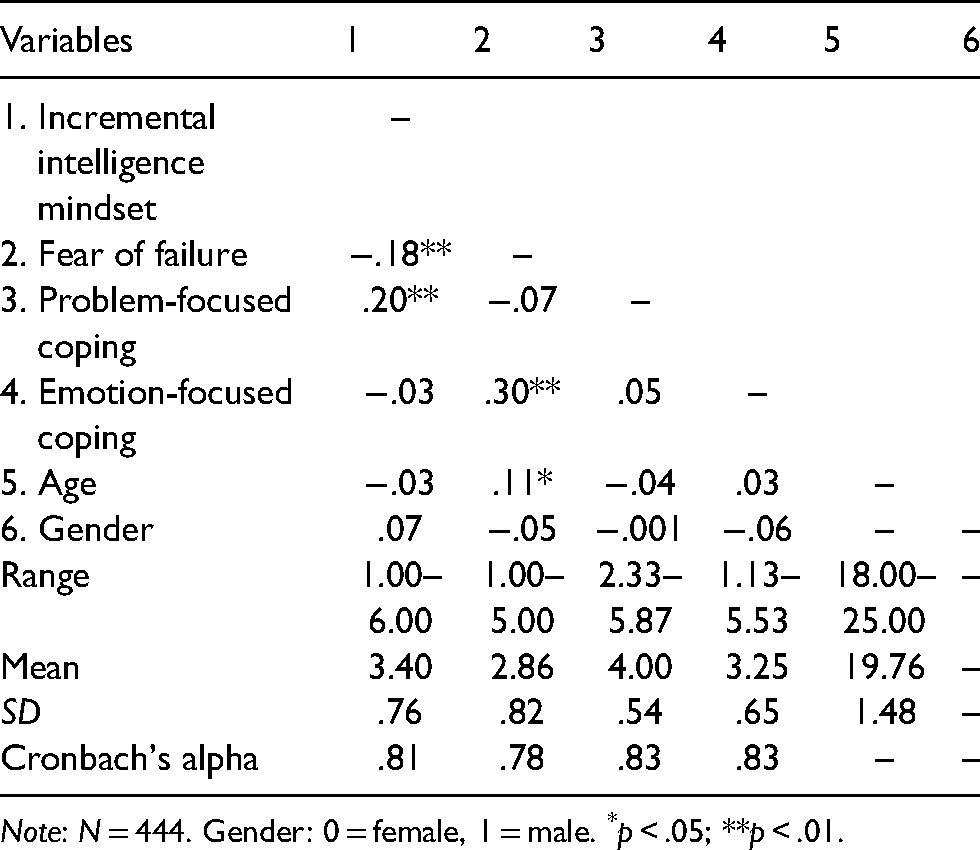
Note: N = 444. Gender: 0 = female, 1 = male. *p < .05; **p < .01.
Path analysis
Results of the path analysis showed that the proposed model fit the data well, χ2(3) = .83, p = .84, CFI = 1.00, RMSEA = .000 with 90% CI [.000,.045], SRMR = .01. The standardized path coefficients of this mediation model are shown in Figure 2. Consistent with the correlation results, incremental mindset had a statistically significant and positive direct effect on PFC (β = .20, p < .001, 95%CI [.074,.208]), a statistically nonsignificant direct effect on EFC (β = .02, p > .05, 95%CI [−.057,.098]), and a statistically significant negative effect on FOF (β = −.18, p < .001, 95%CI [−.291,−.092]). Hence, H1 and H3 were supported, but not H2. Moreover, FOF had a statistically significant, positive effect on EFC (β = .31, p < .001, 95%CI [.170,.314]) but not on PFC (β = −.02, p > .05, 95%CI [−.077,.048]). Hence, H4 but not H5 was supported. The indirect effect of incremental mindset on EFC through FOF was statistically significant (β = −.06, 95%CI [−.098,−.019]), but not on PFC (β = .004, 95% CI [−.016,.025]). Hence, the findings supported H6a but not H6b.

The tested partial mediation model with standardized path coefficients.
Discussion
Experiences of academic failure are an inevitable part of school life, and yet coping with such failure is an essential part of learning and growth. Guided by the framework of socio-cognitive theory, we aimed to unlock the full potential of the ITI based on the model of achievement motivation (Dweck, 1986; Dweck & Leggett, 1988) by linking it to the transactional model of stress and coping (Lazarus & Folkman, 1987), specifically in the context of academic failure. Our findings showed that an incremental intelligence mindset has a direct effect on PFC and an indirect effect on EFC through FOF. Converging with the prospective effect of ITI on students’ views of failure (i.e., facilitating or debilitating), which was reported in an earlier study (Tao et al., 2022), these research findings provide further evidence to support the potential antecedent role of ITI in students’ FOF and their corresponding coping responses to failure. The entity view of intelligence may contribute to a negative view of failure, thus heightening FOF, which in turn leads to the consequential EFC. The incremental view of intelligence may contribute to a more positive view of failure, in which one sees an academic setback as a challenge to meet, and thus leads to less FOF and a more likely engagement with PFC.
Results highlighted the potential predictive role of growth mindset as a powerful cognitive motivational catalyst, increasing students’ inclination to persevere and sustain their engagement in academic pursuits using PFC despite failures. Employing PFC to deal with academic failure may empower students to take full advantage of failure and apply persistence to prevent future failures, which is crucial to their developing self-regulation as they apply themselves to learning and increasing their motivational resilience as well. Also, growth mindset may lessen students’ fear about the detrimental consequences of failure, which in turn may discourage the use of EFC in dealing with emotional distress. EFC can be effective in the short run to relieve an individual from emotional distress. However, overusing EFC can be destructive due to one's habitual disengagement and chronic disaffection from learning or academic work. Frequent use of EFC in the face of academic failure may exacerbate students’ distress or provoke further negative emotions, which may lead them to perceive academic work as more threatening. It is concerning that academic disengagement resulting from frequent use of EFC can be potentially destructive in the long run as it can be followed by heavy, excessive, or problematic participation/engagement in other stress-relieving activities. Previous studies have shown that students’ use of EFC is associated with prevalent addictions, such as Facebook addiction (Fowler et al., 2020), Internet addiction (Zhou et al., 2017), and smartphone addiction (Sun et al., 2019) among students. Therefore, it is not surprising to find that students who use PFC are more motivated and display higher academic performance than those who use EFC (e.g., Vizoso et al., 2018).
The lack of association between FOF and PFC may be explained by relevant findings in previous studies. FOF was found to associate with and prospectively predict performance-approach goals and performance-avoidance goals but not mastery goals (Conroy & Elliot, 2004; Elliot & Murayama, 2008). The pursuit of performance-avoidance goals (in which one tries to avoid failure and looking bad) may contribute to the negative relationship between FOF and PFC because individuals who magnify the threat of failure do not confront and directly cope with the situation that led to failure. However, whereas students use avoidance to push the situation away from their minds, this tendency can be offset by the motivating nature of performance-approach goals in propelling students to strive to achieve better grades by using PFC, which may in part account for the nonsignificant effect of FOF on PFC. Furthermore, mastery goals, which concern the improvement of skills, developing competence, and attainting mastery in learning, are conceptually similar to PFC. Both mastery goals and PFC have a focus on the process of developing skills and improving one's performance by exerting effort. Previous results have shown that mastery goals are associated with incremental intelligence mindset (e.g., Burnette et al., 2013; Chen & Wong, 2015) but not with FOF (Conroy & Elliot, 2004; Elliot & Murayama, 2008). This may explain why only the incremental mindset had an effect on PFC, whereas FOF had no effect on PFC.
A body of research has shown the effects of incremental intelligence mindset and the effectiveness of specific interventions to encourage such mindsets in order to promote students’ motivation and ability to achieve at greater levels (Aronson et al., 2002; Blackwell et al., 2007; Good et al., 2003; OECD, 2021; Yeager & Walton, 2011; Yeager et al., 2019). The findings of this study provide us a more in-depth understanding of the possible mechanisms underlying the catalyzing influence of a growth mindset on academic motivation and achievement (Chen & Wong, 2015; Wang et al., 2021). First, when faced with academic failure, individuals with growth mindsets, as opposed to fixed mindsets, have a much greater propensity to engage in PFC through sustained proactive academic engagement, which has been shown to be positively associated with academic performance (Martínez et al., 2019; Vizoso et al., 2018). Second, growth mindset has also been shown to inhibit the tendency to fear failure, thus a less frequent use of or overdependence on EFC, which is characterized by academic disengagement. Students who make desperate attempts to avoid confronting their failure on a test or a course with EFC may miss opportunities to learn from their mistakes. In the context of an academic performance or setting, EFC is characterized by cognitive and behavioral disengagement, which may exacerbate the distressing effects of the failure outcomes, setting students up for more subsequent failure in the future (Ajjawi et al., 2020) and creating obstacles for potential positive outcomes. Therefore, cognitive and behavioral disengagement and EFC may set students on a downward spiral path in their journey of learning and keep them from experiencing any possible success at all.
However, it is important to note that EFC is not necessarily maladaptive in other domains. EFC can be adaptive for patients in terms of lowering their negative perceptions of uncontrollable health conditions and thus promote the perception of psychological and physical health through mental disengagement (Austenfeld & Stanton, 2004). For instance, EFC was found to be related to reduced perception of sensory and affective pain of health conditions such as breast cancer (e.g., Stanton et al., 2000).
Implications
Our findings suggest that screening students to determine whether they have an entity view of intelligence might be the most effective way to target services for students who may be vulnerable to academic disengagement. Such screening could be done while providing counselling services on campus. Students with an entity view of intelligence may have a greater vulnerability to experience emotional turmoil in the face of continuous performance evaluations. They may have FOF and therefore a tendency to use EFC, characterized by academic disaffection and disengagement, which may be demotivating to them and lead to academic underachievement and failure in the long run. Students with a fixed view of intelligence may have a greater need for assistance in processing their emotions, and may have a high risk of disengagement and withdrawal from school. The targeting of these students through counselling and early intervention services may be cost-effective, benefit them by improving their psychological and mental health functioning, help them to improve their academic standing, and prevent them from quitting a course or school. Also, we suggest that interventions should aim to help students develop positive coping skills to deal with academic stress. Such efforts could be further enhanced by incorporating them into interventions designed to encourage incremental intelligence mindsets and attributional retraining programs. Future intervention research can be conducted to empirically test the effectiveness of this plausibly synergistic combination.
Future research may also focus on identifying potential moderators of the relationships among ITI, FOF, and EFC. Both personal and interpersonal resources, such as perceived competence and social support, respectively, may either strengthen or alternatively serve as buffers to mitigate the effects of the entity view of intelligence on FOF and the effects of these two on EFC. Students who perceive their competence level as low may see no cost in failure or may further catastrophize failure and devalue themselves (Conroy et al., 2002). Students with lower levels of social support may be more vulnerable to distress and in need of support in processing their emotions in the face of academic failure. On the other hand, students with strong social support may focus on emotional venting and support by engaging in social activities or media, given their greater access to social ties (Dwyer & Cummings, 2001).
Limitations
There are a number of limitations worth noting in the current research. Given the cross-sectional design of this study, the statistically significant associations found do not imply causation. Future research is warranted to test not only the directional but also the mediation relationships of our model with an experimental design (Pirlott & MacKinnon, 2016). Experiments can examine the effects of independent manipulations of mindsets by priming and fear salience by varying levels (high/low) of the aversive subsequent consequences of failing an academically relevant task, on the post-failure coping strategies measured or selected. The generalizability of these research findings is limited by the convenient sampling of Chinese university students. Future research would benefit from targeting samples with different demographics with respect to age and culture. Coping responses were measured for a single episode of failure (i.e., a poor performance of an important exam) in the current study. For further study, it is worth considering students’ coping responses to a series of academic failures because different coping responses may vary with the frequency of failure (Santor et al., 2020).
Conclusion
Encounters with academic failure and individuals’ subsequent strategies to cope with such failure can either set students on a path to ongoing failures or serve as opportunities to learn from mistakes and increase the skills and motivation needed to meet with future success in their educational journey. The tendency to disengage defensively with EFC or keep engaged with their academic pursuits with PFC following failure can be influenced by their fixed or incremental view of intelligence, respectively. An incremental intelligence mindset may act as critical psychological capital with powerful cognitive resources in promoting students’ use of PFC following academic failure. Experiences of coping based on problem-solving strategies can be beneficial to students’ motivational and learning trajectory despite failures in terms of developing their academic resilience and self-regulation in learning over time.
Supplemental Material
sj-docx-1-pac-10.1177_18344909221144703 - Supplemental material for Incremental intelligence mindset, fear of failure, and academic coping
Supplemental material, sj-docx-1-pac-10.1177_18344909221144703 for Incremental intelligence mindset, fear of failure, and academic coping by Vivienne Y. K. Tao, Yun Li and Anise M. S. Wu in Journal of Pacific Rim Psychology
Footnotes
Pre-registration
This study was not pre-registered.
Ethics approval
Ethics approval was obtained from the Research Ethics Committee of the University of Macau (2016-15).

Declaration of conflicting interests
The author(s) declared no potential conflicts of interest with respect to the research, authorship, and/or publication of this article.
Funding
The authors disclosed receipt of the following financial support for the research, authorship, and/or publication of this article: This work was supported by the University of Macau (grant number MYRG2015-00197-FSS).
Supplemental material
Supplemental material for this article is available online.
References
Supplementary Material
Please find the following supplemental material available below.
For Open Access articles published under a Creative Commons License, all supplemental material carries the same license as the article it is associated with.
For non-Open Access articles published, all supplemental material carries a non-exclusive license, and permission requests for re-use of supplemental material or any part of supplemental material shall be sent directly to the copyright owner as specified in the copyright notice associated with the article.
