




Abstract
The existing research has explored the effects of growth mindset intervention on individuals in Western culture. This study sought to determine whether growth mindset intervention has a positive impact on adolescents in economically disadvantaged areas of China. Participants in this study were 324 junior high school students who were randomly divided into the intervention group and the control group. The intervention group received six weeks of intervention classes designed to help students learn, internalize, and reinforce the concept of growth mindset. The aims of intervention were to build students’ beliefs that the brain is plastic and that individuals can change by their efforts and help students acquire the strategies to cope with the difficulties. The control group was given six classes on mental health, including time management, habit formation, and memory strategies, which were unrelated to growth mindset. All participants’ implicit theory of intelligence, fixed-trait attributions, grit, and state anxiety were assessed in the pre-test and post-test. The results showed that compared with the control group, the intervention group had a significant increase in growth mindset, the level of grit, and decrease in fixed-trait attributions. That is, for students in the intervention group, strengthening of growth mindset was accompanied by more frequent use of process-focused attribution styles, more perseverance, and greater efforts when faced with challenges and setbacks. Collectively, the results suggested that having a strong growth mindset of intelligence may help students adopt more proactive coping strategies and protect them from the deleterious effects of poverty on student development.
A student's academic success is influenced not only by his or her cognitive abilities and content knowledge, but also by non-cognitive factors, such as their beliefs, attitudes, and values. One influential non-cognitive factor is the degree to which the student considers intelligence to be a stable trait, termed “mindset” (Limeri et al., 2020). Mindsets refer to a person's attitudes and beliefs about basic human attributes, such as their intelligence, abilities, personality, and even morality (Dweck, 2006; Dweck & Yeager, 2019). Implicit theory holds that individuals who present a growth mindset believe that people can enhance their intelligence, sociability, and morality through personal effort, effective learning strategies, and support from others. However, individuals who present a fixed mindset view human intelligence as a fixed, unchangeable trait (Dweck & Leggett, 1988; Dweck, 2006; Gunderson et al., 2013). More than just simple beliefs, growth mindset is at the center of a meaning system that provides an interpretative framework of active learning behavior. It prioritizes the development of abilities, ascribes positive beliefs about effort, and embraces setbacks as information about the learning process rather than signals of ineptitude (Hong et al., 1999; Molden & Dweck, 2006).
Mindsets have multiple effects on an individual’
In terms of behavior, individuals with a growth mindset tend to pursue “long-term goals” and have strong perseverance. They believe that setbacks can be overcome through constant effort and are opportunities to learn (Blackwell et al., 2007; Robins & Pals, 2002; Yeager et al., 2016; Zeeb et al., 2020). In contrast, individuals with a fixed mindset tend to abandon long-term goals when faced with challenges, believing that setbacks are insurmountable and manifestations of their own inadequacies.
Emotionally, growth mindset helps a person break the loop of anxiety and poor academic performance that comes from self-identifying as a failing student (Gandhi et al., 2020). Embracing a fixed mindset predicts higher depression and anxiety in individuals, especially in adolescent groups (Romero et al., 2014; Schleider et al., 2015; Schleider & Weisz, 2016). Even though students with a growth mindset or a fixed mindset perform equally well, students with a fixed one tend to feel more distressed about their academic performance and are less likely to experience positive emotions.
Existing growth mindset intervention studies have obtained some positive and promising results (Gábor et al., 2017). For example, the promotion of a growth mindset reduces the threat of African American college students accepting negative stereotypes about their academic abilities and increases their satisfaction with school and academic performance (Aronson et al., 2002). In addition, mindset interventions improve the academic performance of students at risk of dropping out of high school (Paunesku et al., 2015), change students’ performance in challenge-seeking, grit, fixed-trait attributions, performance avoidance, and lead to greater academic achievement (Yeager et al., 2016). Such interventions also increase internal attributions and challenge-approach motivation (Burgoyne et al., 2018).
The existing research showed a negative relationship between fixed mindset and family income (Claro et al., 2016). Adolescents from low-income families have less access to educational resources, and may achieve lower academic achievement (Evans & Schamberg, 2009; McLoyd, 1998), and are more likely to avoid failure or challenge (Blackwell et al., 2007). Students with low socioeconomic status also tended to report a lower sense of purpose and positive self-concept (Bernardo, 2021). However, the idea of brain plasticity conveys that people's characteristics have the potential to be developed (Yeager & Dweck, 2012), and may offer a self-protective shield against the intelligence stereotype as well as the inclination to underperform (Aronson, 2002).
After 2020, the Chinese government has eliminated absolute poverty in rural areas and
Method
Participants
In total, 324 students (150 boys, 174 girls) from the same junior high school participated in this study. This junior high school belonged to 11 concentrated contiguous special hardship areas classified by the China Rural Poverty Alleviation and Development Program (2011–2020). The participants were from four parallel classes. Two classes were randomly assigned to the intervention group and the other two classes to the control group. The intervention group consisted of 163 students (Mage = 13.49, SD = 0.75, 76 boys, 87 girls) and the control group consisted of 161 students (Mage = 13.42, SD = 0.71, 74 boys, 87 girls). All participants had normal hearing and normal or corrected vision, and had never participated in similar research. The experiment was conducted in accordance with the Declaration of Helsinki. The scientific and research ethics committee of the first author's institution approved the training protocol, and prior informed consent was obtained from all participants.
Psychological measures
Implicit theory of intelligence
Implicit theory of intelligence was measured using the Chinese Version of the Mindset Scale revised by Xing et al. (2011), which was based on the Implicit Theory of Intelligence Scale developed by Dweck et al. (1995). This scale includes two items: (1) “Intelligence is difficult to change” and (2) “We can learn new knowledge, but it can’t change your basic intelligence” (α = 0.92; Dweck et al., 1995). Items were scored on a 6-point Likert scale (1 = “completely disagree,” 2 = “disagree,” 3 = “mostly disagree,” 4 = “mostly agree,” 5 = “agree,” 6 = “completely agree”). After reverse scoring, the higher the score, the more the individual emphasizes the plasticity of intelligence. The internal consistency coefficient of the scale in the present study was 0.87.
Fixed-trait attributions
Fixed-trait attributions were measured with the scale developed by Yeager et al. (2016). Participants read this scenario: “Pretend that, later today or tomorrow, you got a bad grade on a very important math assignment. Honestly, if that happened, how likely would you be to think these thoughts?” (1) “This means I’m probably not very smart at math” (fixed-trait, personal-focused). (2) “I can get a higher score next time if I find a better way to study (reverse-scored)” (malleable, process-focused) (response options: 1 = “not at all likely,” 2 = “slightly likely,” 3 = “somewhat likely,” 4 = “very likely,” 5 = “extremely likely”). The two items were averaged into a single composite, with higher values corresponding to more fixed-trait, person-focused attributional responses.
The Chinese version of the scale was obtained through the following process: first, the original scale was translated into Chinese by psychological experts. Next, English–Chinese bilingual professionals were invited to make critical modifications to the Chinese version as the final scale. Lastly, 50 junior high school students were selected to test the scale. The internal consistency coefficient of the scale in the present study was 0.88.
Short version of the Grit Scale
Grit was measured with the Chinese version of the Short Grit Scale (Grit-S) revised by Liang et al. (2016), which was based on the Short Grit Scale (Grit-S) developed by Duckworth and Quinn (2009). Items are scored on a 5-point Likert scale (1 = “completely agree,” 2 = “mostly agree,” 3 = “agree or disagree,” 4 = “mostly disagree,” 5 = “completely disagree”). The Grit-S consists of eight items and two dimensions: consistency of interest (“I often set a goal but later choose to pursue a different one”) with internal consistency coefficient 0.69, and persistence of effort (“I am a hard worker”) with 0.72. The higher score indicates that participants possess more perseverance. The entire internal consistency coefficient of the Short Grit Scale was 0.68 in the present study.
State anxiety scale
State anxiety was measured using the Chinese version of State Anxiety Scale (S-AI) revised by Ye and Rocklin (1988). The revised scale, which is suitable for Chinese middle school students, consists of 20 items, half of which describe negative emotions (“I was tense”) and half of which describe positive emotions (“I felt calm”). Each item of the S-AI was graded on a scale of 1 to 4 (1 = “none,” 2 = “some,” 3 = “medium,” and 4 = “obvious”). Participants selected the most appropriate statement according to their own experience. A higher score indicates a higher level of state anxiety, with 10 positive emotion items reversed. The scale's alpha coefficient in the present study was 0.87.
Procedure
All participants completed a pre-test task by filling in the questionnaires on implicit theory of intelligence, fixed-trait attributes, grit, and state anxiety. Then, all participants were asked to take part in regular mental health classes. Every class was 40 min. long and held once per week for six weeks. We implemented all classes in the students’ classroom during school hours. Interventions consisted of three elements: a growth mindset message, a coping with setbacks message, and a writing task. First, students read some scientific articles with vivid analogies (e.g., of muscles becoming stronger) and examples (e.g., of relatively ignorant babies becoming smarter as they learned). After that, we led students in guided discussions (e.g., how to use the knowledge of growth mindset to learning and getting smarter). Through readings and discussions, students were taught that intelligence is malleable and can be developed. Second, the fact that struggle and setbacks in school do not indicate limited ability was highlighted for students. Rather, they provide students with opportunities to learn. Third, through writing exercises, messages of growth mindset and how to deal with setbacks were reinforced. Participants read about a hypothetical future self who was becoming discouraged because of setbacks and beginning to think of themselves as not smart enough to do well in school, and they were asked to use what they have learned from mental health classes to provide suggestions for themselves in the future. In contrast, the control activity was unrelated to growth mindset. It, too, was framed as providing helpful information about the transition to junior high school (e.g., time management, habit formation, and memory strategies). Participants needed to follow the teacher in class to learn and preserve some helpful information and to write down their opinions about this information, thus facilitating the adaptation to junior high school learning. All participants were administered the post-intervention test when all classes were completed.
Results
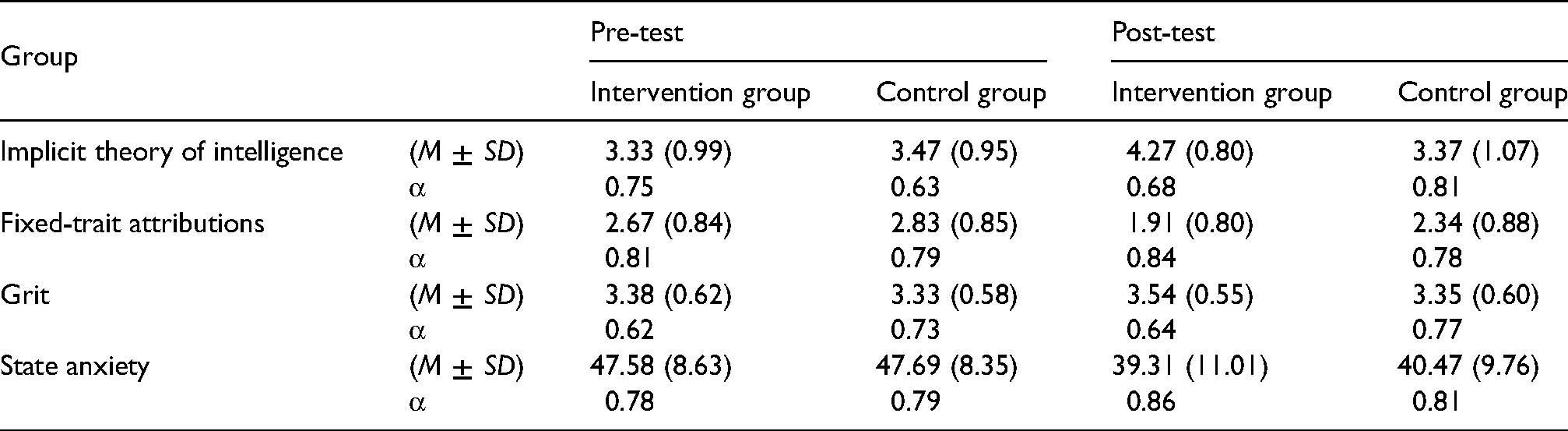
The scores on implicit theory of intelligence, fixed-trait attributions, grit, and state anxiety were submitted to 2 (test phase: pre-test, post-test) × 2 (group: intervention group, control group) two-way repeated analysis of variance (ANOVA). The descriptive statistics are shown in Table 1 and the differences between pre-test and post-test are shown in Figure 1.
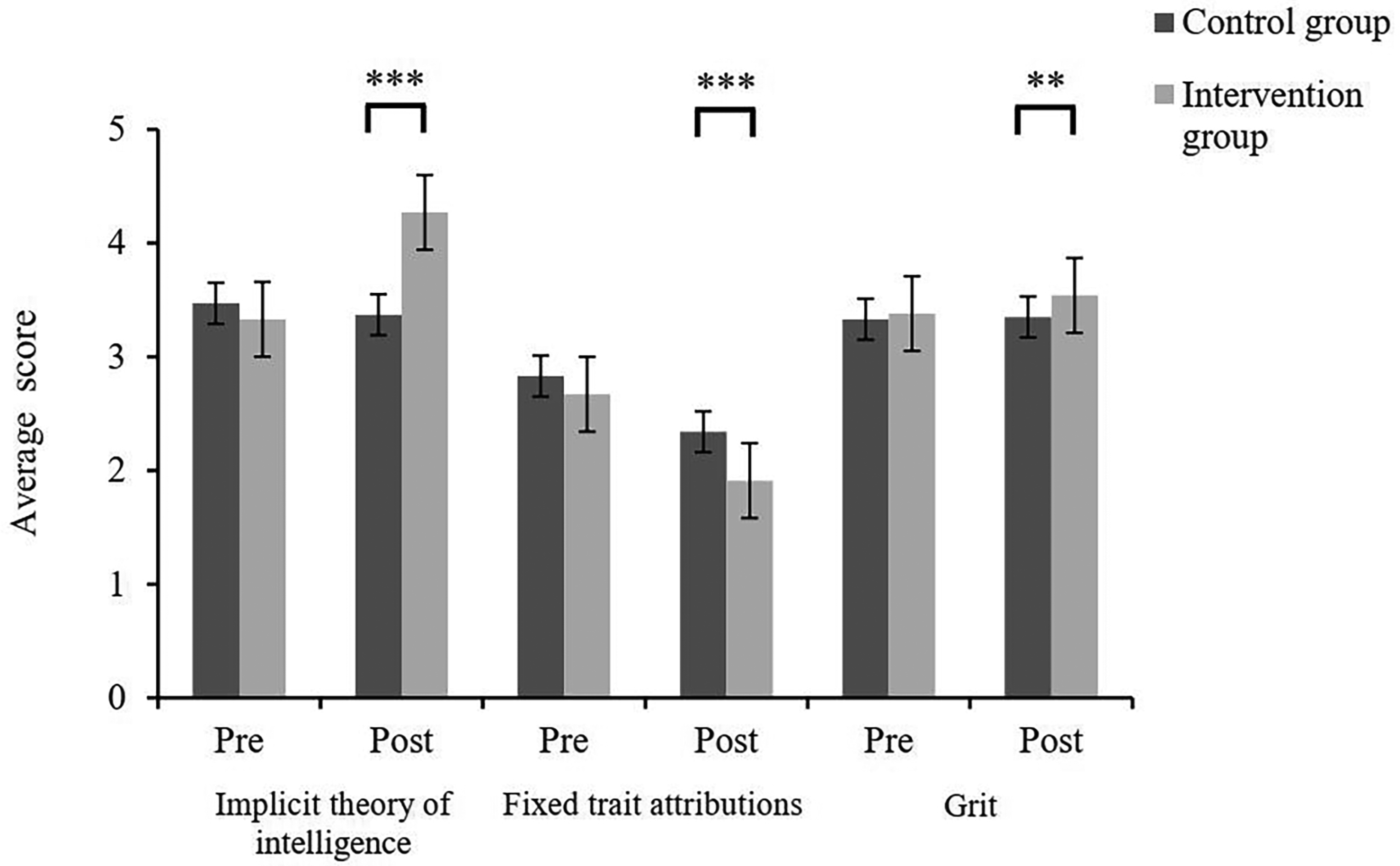
Differences in pre-test and post-test scores between the intervention group and the control group.
Mean, standard deviation, and Cronbach's alpha of measures (M±SD, α)
Implicit theory of intelligence
For implicit theory of intelligence, there was a significant main effect of test phase [F(1, 322) = 50.20, p < 0.001, η2 = 0.14] and group [F(1, 322) = 18.57, p < 0.001, η2 = 0.05], as well as a significant interaction between test phase and group [F(1, 322) = 77.63, p < 0.001, η2 = 0.19]. The simple effect analysis showed that there was no significant difference between the intervention and control groups in the pre-test, p = 0.182. Participants after the intervention showed higher scores on growth mindset than participants in the control group in the post-test, p < 0.001.
Fixed-trait attributions
For fixed-trait attributions, there was a significant main effect of the test phase [F(1, 322) = 101.65, p < 0.001, η2 = 0.24] and group [F(1, 322) = 17.47, p < 0.001, η2 = 0.05], as well as a significant interaction between the test phase and group [F(1, 322) = 4.48, p = 0.035, η2 = 0.01]. The simple effect analysis showed that there was no significant difference between the intervention and control groups in the pre-test, p = 0.088. Participants in the intervention group confirmed fewer fixed-trait attributions than participants in the control group in the post-test, p < 0.001.
Grit
There was a significant main effect of test phase [F(1, 322) = 6.78, p =0.010, η2 = 0.02] and group [F(1, 322) = 4.71, p =0.031, η2 = 0.01], as well as a significant interaction between test phase and group [F(1, 322) = 4.78, p = 0.030, η2 = 0.02]. The simple effect analysis showed that there was no significant difference between the intervention and control groups in the pre-test, p = 0.494. Participants in the intervention group showed higher scores on grit than the participants in the control group in the post-test, p = 0.002.
State anxiety
The results showed that there was a significant main effect of the test phase [F(1, 322) = 122.50, p < 0.001, η2 = 0.28]. However, neither the main effect of the group or the interaction between the test phase and group were significant [Fs < 0.644, ps > 0.423].
Discussion
This study explored the effect of a growth mindset of intelligence intervention on adolescents living in economically disadvantaged areas of China. The intervention group completed six classes of growth mindset intervention. In the pre-test and post-test, the implicit theory of intelligence, fixed-trait attributions, grit, and state anxiety were measured.
After the intervention, participants in intervention conditions had a stronger growth mindset. In addition, they made more process-focused attributions instead of fixed-trait attributions, and they were rendered as grittier and more persistent when faced with challenges and setbacks. However, the intervention did not lower students’ state anxiety. In short, growth mindset intervention conferred psychological benefits to adolescents in economically disadvantaged areas of China.
Significant improvement in growth mindset
Compared with the students in the control group, the students who participated in the six-week growth mindset intervention program showed significant improvement in growth mindset. This finding was consistent with those of previous research (Aronson et al., 2002; Burke & Williams, 2012; Chiu et al., 1997; Molden & Dweck, 2006; Sriram, 2014; Xu et al., 2021). One difference of this study from the existing studies is that participants in the present study were economically disadvantaged adolescents. Therefore, growth mindset intervention may also bring positive impact on adolescents in economically disadvantaged areas.
Significant change in fixed-trait attributions and perseverance
The existing research proved that after growth mindset intervention, the adolescents hold more positive beliefs about effort, and choose more positive, effort-based strategies in response to failure (Blackwell et al., 2007). Moreover, growth mindset intervention changes how students view challenges. Instead of making students feel “dumb,” challenges are considered a way to be smarter (Yeager & Dweck, 2012). Furthermore, growth mindset stimulates perseverance in the face of challenges and setbacks (Burnette et al., 2013), and increases the willingness to attempt challenging tasks and the perseverance in a task required to be completed (Mrazek et al., 2018). Individuals with a growth mindset hold the belief that one's abilities and talents can be developed, as opposed to fixed, which stimulates long-term learning and perseverance (Jia et al., 2021). In the present study, growth mindset intervention was adhered to by a process of conceptual learning, internalizing the concept, and reinforcing the concept. To be specific, conceptual learning conveyed that the brain is malleable. Students were guided to learn how to deal with setbacks and difficulties for the purpose of internalizing concepts, and were also asked to recall and find their own successful problem-solving experiences in the end to strengthen the concepts. The interventions of the present study meet the aim to increase students’ strategies to take on challenges, by forestalling fixed-trait attributions that struggles and setbacks mean one is “not smart.” Therefore, adolescents changed their perception of “mental retardation,” and accepted the opinion that intelligence is malleable. The perseverance in their efforts improved as well. All these results suggested that after growth mindset intervention, disadvantaged adolescents adopted more proactive coping strategies, which might buffer the deleterious effects of economically disadvantaged backgrounds on adolescents.
Insignificant change in state anxiety
Previous research has shown that adolescents experience less negative emotion after growth mindset intervention. Compared with adolescents in the control group, adolescents in the intervention condition were less likely to use negative emotions and trait words in their self-descriptions (Miu & Yeager, 2015). In addition, after intervention, the scores on stress, anxiety, and overall negative feelings about the self were significantly lower than those in the control condition (Yeager et al., 2014). However, students are motivated by a long-term goal only when they think that the outcome is personally attainable through efforts (Destin & Oyserman, 2009). According to local official data, the annual per capita disposable income of the participants’ regions of the present study was 9,072 Chinese Yuan (approximately 1,345 US dollars in 2020). Compared with the economic resources of developed areas in China, there is a big gap. Therefore, adolescents in economically disadvantaged areas may think the long-term goal is unreachable due to limited economic resources, low social mobility, and support, which makes them more frustrated after growth mindset intervention (Gandhi et al., 2020). This may explain why the level of state anxiety did not significantly decrease in the present study.
The present study verified the applicability of growth mindset intervention in economically disadvantaged areas of China. As mentioned above, growth mindset intervention could consolidate the belief that people can change, and meanwhile teach adolescents strategies for dealing with setbacks and difficulties. After intervention, adolescents tend to study harder and persist longer. These newly gained characters are similar to the concept of diligence advocated by traditional Chinese culture and are also of importance to ensure a bright future for themselves, especially in economically disadvantaged areas of China.
However, this research had some limitations that should be addressed. First, all the results of the present study are from the participants’ self-report, and the study has not addressed how the growth mindset shapes students’ behavior in learning situations—such as persistence, efforts devoted to their learning, and academic achievement. So further researches may validate the intervention effect by measuring the change in students’ behavior in real situations. Second, all the participants were from economically disadvantaged areas, so we could not confirm the effect of growth mindset intervention on adolescents in economically advantaged areas. Lastly, growth mindset intervention did not significantly change the adolescents’ level of state anxiety. There are also studies suggesting that the effects of mindset interventions are heterogeneous. Some studies (Li & Bates, 2019; Macnamara, 2018; Shpancer, 2020; Warne, 2020) insisted mindset interventions do not work or are unimportant, whereas others concluded that the effects are meaningful and replicable, but they are likely to be stronger or weaker for different people in different contexts (Gelman, 2018; Tipton et al., 2019). Therefore, future research should use longitudinal, multi-measurement strategies and enroll various student groups to validate the benefits of growth mindset intervention.
Supplemental Material
sj-docx-1-pac-10.1177_18344909221142368 - Supplemental material for The beneficial effect of growth mindset intervention for adolescents in economically disadvantaged areas of China
Supplemental material, sj-docx-1-pac-10.1177_18344909221142368 for The beneficial effect of growth mindset intervention for adolescents in economically disadvantaged areas of China by Ruixue Xia, Peiying Zhang, Ruiyang Liu, Junwei Xue, Huijing Zhu, Guaiguai Guo, Min Zhang and Yang Liu in Journal of Pacific Rim Psychology
Footnotes

Declaration of conflicting interests
The author(s) declared no potential conflicts of interest with respect to the research, authorship, and/or publication of this article.
Funding
This research was supported by the Science and Technology Project of Gansu Province (18JR3RA082).
Supplemental material
Supplemental material for this article is available online.
Correction (January,2023):
The link has been updated in the reference list for Li, Y. & Bates, T. C. (2019).
References
Supplementary Material
Please find the following supplemental material available below.
For Open Access articles published under a Creative Commons License, all supplemental material carries the same license as the article it is associated with.
For non-Open Access articles published, all supplemental material carries a non-exclusive license, and permission requests for re-use of supplemental material or any part of supplemental material shall be sent directly to the copyright owner as specified in the copyright notice associated with the article.
