




Abstract
The study aims to extend knowledge on interreligious conflicts in Indonesia by investigating the extent to which perceived threat, outgroup distrust, and interreligious contact mediate the relationship between majority–minority affiliation and support for interreligious conflict in Indonesia. We employed two modes of support, lawful and violent protests, to represent support for interreligious conflict. We collected survey data, covering random samples of ordinary citizens (N = 2,055, Muslims and Christians) across the archipelago. Our results reveal that perceived threat is the strongest mediator in the relationship between majority–minority affiliation and support for interreligious conflict. In contrast, interreligious contact shows no significance in explaining the relationship of interest. Overall, our study highlights the importance of focusing on support for both lawful and violent protests to describe and explain latent interreligious conflict in Indonesia, while taking into account relevant concepts resulting from prolonged interreligious conflict (namely perceived threat and outgroup distrust) on the one hand and different traits of interreligious contact as highly potential solutions on the other.
Keywords
Introduction
The collapse of the New Order government (1966–1998) brought anomie in Indonesia for several years to come (Braithwaite et al., 2010). Interreligious conflicts that were formerly rare in the New Order era suddenly became prevalent across the country. This study specifically investigates interreligious conflicts in six areas across Indonesia in which such conflicts have occurred: Aceh Singkil, South Lampung, Bekasi, Sampang Madura, Poso, and Kupang. Interreligious conflict is evaluated through the lens of supporting lawful and violent protests. Employing these two modes of collective action is vital due to a high possibility of activism being transformed into radicalism (see Moskalenko & McCauley, 2009).
Before going any further, we recognize that social conflicts may be dysfunctional or functional for social cohesion and social changes (Coser, 1956). However, considering the context of religious conflicts in our research localities, this study focuses on the dysfunctional aspects of interreligious conflicts which negatively impact intergroup relations, religious liberties of minority groups, and the progress of democracy in Indonesia overall (see reports from Hadiz, 2017; Human Rights Watch, 2013).
The seeds of many interreligious conflicts in Indonesia were sown in the first period of the New Order regime (1969–1979). During that period, President Suharto developed a transmigration program (transmigrasi), including stimuli (e.g. housing, free land, and food supplies) to move people, often with different ethnic and religious backgrounds, from more dense areas (i.e. Java, Madura and Bali islands) to less populated areas, e.g., South Lampung, Aceh, Palu, Poso (Bazzi et al., 2017). The purpose of the program was twofold: economic enhancement of the receiving peripheral regions and the pursuit of a single national identity.
In turn, the demographic balance in many of the receiving areas eventually shifted. For instance, the Muslim minority in Poso in the 1950s became the majority by the 1980s (Mcrae, 2013). With the support of the transmigration program stimuli, migrants gradually became the dominant economic force and, in some parts, increasingly controlled government administration and political institutions. According to Olzak (2013), the overlap or even take-over of economic niches by migrants intensifies the competition over scarce resources between migrants and the original population. The growing size of migrants belonging to the religious outgroup is expected to induce the ingroup’s perceived threat towards this migrant outgroup (Schlueter & Scheepers, 2010). Similarly, intergroup threat theory posits that intergroup threat rises according to the size of the outgroup when the ingroup’s material and symbolic resources are at stake (Stephan et al., 2000). Moreover, political rhetoric in blaming the outgroup usually stimulates outgroup distrust (Croucher, 2013).
In Indonesia, internal migration has often resulted in protests of the original religious majority to contain the growth in size and power of the religious minority. In many localities, lawful protests swiftly transformed into violent clashes between the religious groups involved. For example, protests in 2010 demanding Christian congregations in Bekasi to stop their religious services, transformed into physical clashes between members of the Islamic Defenders Front and Christian congregations. Similarly, a group of local Christians launched a physical attack on a Muslim congregation in 2015 during their Eid al-Fitr praying in Tolikara, Papua, demanding the immediate ending of the praying (Halili, 2016; Human Rights Watch, 2013).
Notwithstanding its risks, transmigration has also led to improved economic conditions and allowed for more personal interreligious contact. Through positive intergroup contact, people potentially reduce negative attitudes towards each other, improving mutual relationships (Allport, 1979; Pettigrew & Tropp, 2006). Although more interreligious contact did not always prevent violent escalation (see Aragon, 2001 and Wilson, 2008 for the cases of Poso and Maluku), it unquestionably provides an opportunity for different religious groups to reconcile after the conflict subsides (Gaertner et al., 1996; Tam et al., 2009).
Perceptions of interreligious threat, outgroup distrust and actual interreligious contact have been shown to play significant roles in the development of interreligious conflict. Yet, we have little empirical insight as to how these phenomena prevail in the Indonesian context. The study by Kanas, Scheepers, and Sterkens (2015) is a rare exception, providing fruitful empirical insights on the relation between interreligious contact and negative attitudes among Muslims and Christians in Indonesia. However, their study is limited to university students.
We contribute to this ongoing discussion in four different ways. First, by looking specifically at support for lawful and violent protest against religious outgroups (together labelled as “support for interreligious conflict”). Doing so, we do not only capture individuals’ attitudes towards religious outgroups, but also explain the extent to which individuals are willing to go beyond mere public demonstrations. Second, we employ samples of the general adult population across the Indonesian archipelago to focus on support for interreligious conflict, while previous studies mostly relied on student populations (e.g., Pamungkas, 2015; Subagya, 2015). Third, we employ separate measures for different traits of quality of contact (i.e. closeness and cooperation, evaluation) in relationship to support for interreligious conflict, while previous studies relied on composite measures of quality of contact (Brown et al., 2007; Kanas et al., 2015). Fourth, we add outgroup distrust as another relevant determinant of support for interreligious conflict, in addition to perceived threat and (quantity and quality of) intergroup contact (Allport, 1979; Blalock, 1967; Blumer, 1958; Stephan et al., 1999). In short, we investigate to what extent the relationship between religious affiliation and support for interreligious conflict is mediated by perceived threat, outgroup distrust, and intergroup contact.
Theories and hypotheses
We start with theoretical propositions predominantly based on studies in Western societies to explain support for intergroup conflict in order to derive testable, complementary hypotheses for the Indonesian context.
Group position and intergroup competition theory
Religious affiliation has recently (re)gained importance in different life domains in Indonesia. For most Indonesians, religion is qualified as one of the most important factors in their life, both privately and publicly (Mulia, 2011). Religious affiliation does not only indicate identification with a particular religious tradition, but also implies group belonging and sways social position (Blumer, 1958). In terms of power, the religious majority is often the dominant group, while the religious minority is more likely to be the subordinate group (Tajfel, 1981). Consequently, it is often the case that religious majority members feel entitled to proprietary claims over scarce resources, e.g., more access to jobs, political power, and natural resources, while religious minority members feel deprived of necessary means (Smith & Pettigrew, 2015).
Identifying with a specific religious tradition in a plural context makes individuals aware of differences between (religious) groups and induces positive evaluations of the religious ingroup in combination with negative evaluations of religious outgroups (Tajfel, 1974). Subsequently, both religious majority and minority members tend to increase their relatedness to the ingroup while distancing from the outgroup (Croucher, 2017). Croucher (2013) adds that when the religious minority is perceived as becoming more dominant and their value system is perceived as becoming more influential, religious majority members will usually take measures to restrict it.
Such restricting measures are launched by the religious majority to protect their proprietary claims at the expense of the religious minority. Lawful and violent protests from the religious majority against the expansion of the religious minority, for instance, took place in Bekasi (2010) and Aceh Singkil (2015), to name only two (Halili, 2016; Human Rights Watch, 2013). Therefore, in a country where economic contraction is easily felt and the interreligious competition involves scarce resources (Croucher, 2017; Olzak, 2013), we expect that the religious majority, on average, is more inclined to support interreligious conflict than the religious minority (H1).
Perceived threat
Perceived threat is defined as a sense of awareness of the challenge brought by outgroups in intergroup competition (Blalock, 1967; Olzak, 2013). According to intergroup threat theory, perceived threat can be related to realistic threat (related to economic, physical, and political resources) and/or symbolic threat (related to differences in values, beliefs, and norms) (Stephan et al., 1999; Stephan & Stephan, 1985). When group members feel threatened, they are likely to have negative stereotypes about outgroup members and feel anxious when interacting with these outgroup members (Croucher, 2017). This, in turn, induces exclusionary measures against the outgroup.
Further, perception of threat increases among majority members as soon as minority groups improve their economic situation and gain access to the labor market of the majority (Olzak, 2013; Scheepers et al., 2002). In the Indonesian context, the Muslim majority started to strengthen their political and legislative influence after a long repression from the 1990s onwards (Mulia, 2011; Sterkens & Hadiwitanto, 2016). But the religious minorities (mostly Christians) managed to continue being a political power in the emerging democracy (Gudorf, 2012; Hoon, 2013). Specifically in migration areas, Muslims and Christians are not only perceived as competitors with regard to realistic resources (e.g., jobs, land, political votes), but also as threatening each other’s’ values and norms.
Responding to this perceived threat, the Indonesian Council of Muslim Ulama (Majelis Ulama Indonesia, MUI) has occasionally shown exclusionary reactions, such as releasing a fatwa that requires Muslims to vote for Muslim electoral candidates; by supporting the Ministerial decree (2006) that complicates the construction of houses of worship for non-Muslims (Hadiz, 2017; Human Rights Watch, 2013); or by prohibiting Muslims from joining Christmas celebrations (Mujiburrahman, 2006). Any intergroup competition seems to be intensified by perceived threat, resulting even exclusionary measures against the religious outgroup. Therefore, we expect that the relationship between majority–minority affiliation and support for interreligious conflict is mediated by perceived threat (H2).
Outgroup distrust
Allport (1966) has long pointed out that religion may either be an integrative or a divisive force in a society. The inherent nature of religion in promoting affiliation provides a sense of communal identity among the ingroup members. But ingroup identification comes automatically with the exclusion of, or at least the distinction with, those who have a different religious affiliation (Allport, 1979). Distinction along religious lines may result in outgroup distrust. Olson and Li (2016) have shown that religious heterogeneity, especially in more religious countries, is related to higher outgroup distrust. In other words, people tend to be susceptible to negative bias towards religious outgroup members (Kenworthy et al., 2015).
In protracted interreligious conflicts, such as between Muslims and Christians in Indonesia, outgroup distrust is likely to prevail over trust (Bar-tal, 1998; Tam et al., 2009). This can easily be explained. First, previous interreligious conflicts enforce individuals to see their neighbors as a source of threat rather than support. Second, it is more likely that religious leaders develop a public rhetoric that blames the outgroup, and such rhetoric increases mutual suspicion (Croucher, 2013). We therefore expect that the relationship between majority–minority affiliation and support for interreligious conflict is mediated by outgroup distrust (H3).
Intergroup contact
Allport (1979) argues that intergroup contact must contain four conditions to reduce negative attitudes towards the outgroup: equal status; common goals; cooperation and support of authorities. Recent advancements, however, show that these four conditions should rather be considered as facilitating characteristics and not strictly as necessary conditions for reducing exclusionary behavior (Pettigrew & Tropp, 2006). Brown et al. (2007) find in a longitudinal study that quantity of contact (i.e. how often an outgroup member is seen) is related to more desired closeness and less negative outgroup evaluations, while quality of contact (a combination of closeness, equality and cooperativeness) is not. A cross-sectional study by Kanas et al. (2015), however, shows that quality of contact reduces levels of negative outgroup attitudes more than quantity of contact.
In relation to majority–minority affiliation in our research localities, Muslims and Christians are expected to perceive their interreligious relations differently. It has long been pointed out that majority group members are more likely to be perceived as prejudiced towards a minority group, whereas minority group members tend to be concerned with being the target of prejudice from majority group members (Stephan & Stephan, 1985; Tropp & Pettigrew, 2005). Although the facilitating conditions, as proposed by Allport (1979) have been shown to improve intergroup relations (Pettigrew et al., 2011; Pettigrew & Tropp, 2006), holding a different status may affect the efficacy of interreligious contact on the relations between Muslims and Christians. As Tropp and Pettigrew (2005) argue, the facilitating conditions may be more effective in promoting positive intergroup attitudes among majority group members, whereas minority group members, given the long history of status difference, may be less convinced by the facilitating conditions.
Nevertheless, intergroup contact is likely to reduce negative attitudes towards outgroup members. Quantity of contact allows a “mere exposure” effect that has repeatedly been shown to improve the appreciation of other religious groups (Pettigrew & Tropp, 2006; Zajonc & Rajecki, 1969), while quality of contact (i.e. closeness, equality, and cooperativeness) provides conditions for the improvement of favorable attitudes towards outgroup members (Kanas et al., 2015). Therefore, we expect that the relationship between majority–minority affiliation and support for interreligious conflict is mediated by interreligious contact (both quantity and quality) (H4).
Individual characteristics
We control for common individual characteristics that are assumed to be related to interreligious conflict. Beller and Kröger (2017) show that men support extremist violence more often than women. Moreover, people with lower levels of education and income are related to more local violent conflicts in Indonesia, either ethnic or religious conflicts (Barron et al., 2009).
Data and Methods
An extensive documentation of the process of data collection for this research is presented in Data Archiving and Networked Services (Setiawan et al., 2018), where all data have been deposited accessibly and made available for secondary analyses to the worldwide scientific community. As such, we will only provide a brief explanation of sampling procedures, followed by an explication of measurements.
Purposive sampling of locations
The selection of locations is based on three criteria. First, all locations are comprised of multiple religious groups. Second, all six locations have been documented as having large-scale manifest interreligious conflicts and mapped as potential conflict areas. Third, these six locations are spread all over the archipelago from West to East, as to cover an overarching view of interreligious conflicts in Indonesia.
Random sampling of household and respondent
The data collection in Indonesia was conducted from May until August 2017. There were two random sampling procedures to select a household in our data collection: the first based on the available regional population registry; the second based on a random walk when population registry was not available. These consistent random selection procedures were employed to avoid or at least reduce biases on the part of researchers and we propose that our samples constitute the best approximation of a representation of the full adult (17–65) populations in these areas (see Babbie, 1989, p.169). However, considering the inaccuracy in the Indonesian population registry as we observed during the random selection of respondents, we, unfortunately, cannot calculate to what extent our samples of respondents in different locations are actually representative of the full population.
Based on the household selection above, we aimed at collecting a random sample of adults (aged 17–65 years old) who have lived in the selected location for a minimum of five years. When there was more than one qualified person in the household, we randomly selected our respondent by simply asking which person (among others who were present) has the closest birthdate to the date of data collection. In collecting the data, we meticulously followed ethical considerations to make sure that the respondent was accurately informed about the study and had an option to voluntarily participate in the study or refuse. Those who agreed to participate were given a consent form and a small token of reward at the end of the study (approximate value €2).
The survey resulted in a total number of 2,356 respondents out of 2,622 respondents approached. For this study, we only selected Muslim and Christian respondents and removed those questionnaires with a substantial number of missing items. In total, we collected 2,055 (1,476 Muslims and 579 Christians) respondents.
Measurements
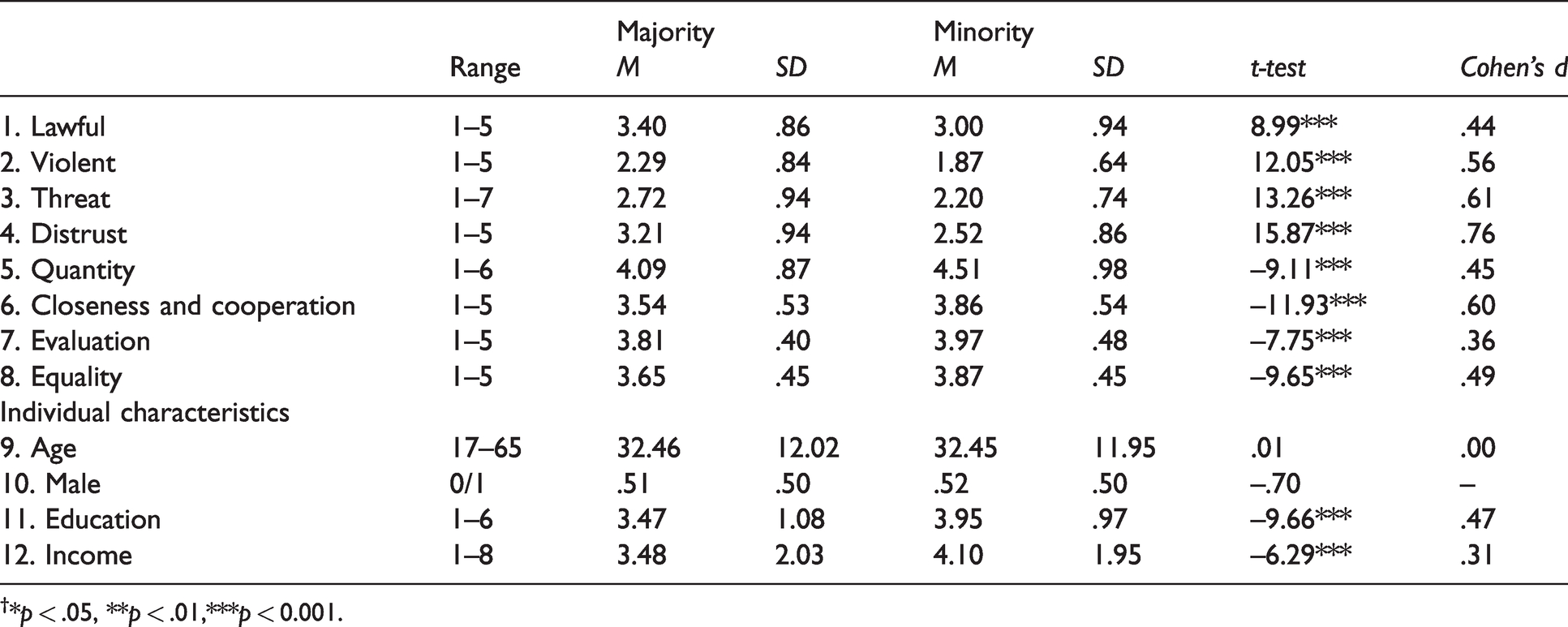
We employed 2,055 respondents to run factor analyses using Principal Axis Factoring (Paf) method with Oblimin rotation. Composite reliability (CR) and Cronbach’s alpha were used to show the qualities in each scale. Table 1 displays descriptive statistics of each variable along with its religious group difference.
Descriptive statistics by majority–minority affiliation and mean differences.
*p < .05, **p < .01,***p < 0.001.
Support for interreligious conflict
Our dependent variables are support for lawful and violent protests against religious outgroups, measured by respondents’ support for public criticism and demonstrations, versus support for damaging property of religious outgroups and harming of religious outgroup members. Each scale consists of six items and their contents were adopted from Subagya’s (2015) scales, who previously studied support for violence in Indonesia.
The items of both measurements were rated on a five-point Likert scale, with higher scores indicating stronger support for protests. Factor analyses demonstrated that every item loaded on its appropriate factor, with factor loadings ranging from .67 to .89. In terms of reliability, support for lawful protest (α = .88 and CR = .87 for Muslims and α = .90 and CR = .90 for Christians) is moderately high in both religious groups. Similar results were found for the scale of support for violent protest (α = .91 and CR = .91 for Muslims and α = .92 and CR = .92 for Christians). For full results, we refer to Appendix 1.
Perceived threat
We are interested in the individual level of perceived threat, which depends on the severity of competition as subjectively perceived by participating individuals (Blalock, 1967). This measurement was informed by previously tested measurements (see Scheepers et al., 2002). We measured perceived threat to collective interests, rather than personal interests. Statements that alluded to the way of life, unemployment, and insecurities were modified to suit the context and population in our study. Ethnic minority groups were replaced by religious groups.
The measurement contained four items. Respondents were asked questions such as “I am worried that job prospects for members of my group would decline due to the presence of other religious groups” and rated their disagreement or agreement on a five-point scale. Other items referred to religious institutions and social customs considered to be under threat, such as “I am worried that other religious groups will build more houses of worship in our neighborhood.” By this, the measurement covered both realistic and symbolic sources of threat, as proposed in intergroup threat theory. Higher scores indicated higher perceived threat. Factor analyses demonstrated one factor with factor loadings ranging from .70 to .86. The scale had high reliability indices for both groups (α = .85 and CR = .86 for Muslims and α = .86 and CR = .86 for Christians).
Outgroup distrust
We measured outgroup distrust using the outgroup trust scale from the German Socio-Economic Panel (SOEP) in 2003 (Naef & Schupp, 2009). The scale was initially used to measure the level of trust individuals have in institutions, strangers, and known people. For the purpose of this study, we used the subscale of trust in strangers and modified it to trust in other religious outgroup members (see Abanes et al., 2014).
The two-item scale asked whether, “On the whole, one can trust Muslims/Christians” and “On the whole, one can rely on Muslims/Christians.” The answer was indicated on a five-point Likert scale. Since we were interested in outgroup distrust, we reversely coded the answer categories, resulting in a higher score indicating more distrust. The two items showed strong correlation among Muslims (r = .70, p = .000) and Christians (r = .82, p = .000).
Interreligious contact
Two scales of interreligious contact were employed to serve the purpose of this study: quantity and quality of contact. For quantity of interreligious contact, respondents were asked questions such as “In the past year, how often did you have contact with Muslims/Christians as neighbours?” The same question was then repeated for close friends and relatives. The answer categories ranged from “Never” (1) to “Several times a day” (6). The answering category “Not applicable” (7) was imputed with the mean score of respondents. The factor analysis displayed moderate factor loadings for each item, varying from .55 to .72. Regarding the reliability, the scale demonstrated moderate level of reliability for Muslims (α = .65, CR =.66) and Christians (α = .65, CR = .66).
The second scale is quality of interreligious contact. The twelve-item scale measured the level of three conditions proposed by Allport (1979), namely closeness, equality, and cooperation, and a general level of evaluation of the contact. The items asked “How would you rate your contact with Muslims/Christians as neighbours?” on a scale ranging from “Very negative” (1) to “Very positive” (5), “How close are you with your neighbours from other religious groups?” ranging from “Not close at all” (1) to “Very close” (5), “How equal would you say you are with your neighbours from other religious groups?” on a scale ranging from “Not equal at all” (1) “Very equal” (5), and “How much do you cooperate with your neighbours from other religious groups?” ranging “Do not cooperate at all” (1) to “Cooperate a lot” (5). The same questions were then repeated to ask about respondents’ contact with their close friends and relatives. Each item also had an additional answer category “Not applicable” (6) for cases when they did not have a neighbor or close friend or relative from another religious group. The answering category “Not applicable” was imputed with the mean score of respondents. The factor analysis yielded three factors consisting of closeness and cooperation, evaluation and equality with factor loadings varying from .30 to .97. Further, each scale displays a moderately acceptable level of reliability across Muslims (α = .80 and CR = .75 for closeness and cooperation, α = .80 and CR = .81 for evaluation, and α = .80 and CR = .59 for equality) and Christians (α = .83 and CR = .80 for closeness and cooperation, α = .89 and CR = .87 for evaluation, and α = .87 and CR = .87 for equality).
Individual characteristics
We used straightforward questions to identify age and gender. To measure respondents’ level of education, we asked them to identify their completed highest level of education, ranging from “Did not go to school” (1) to “Master degree or higher” (6). Finally, we measured the level of income by asking respondents to estimate their monthly gross income of all the earnings in the household. The answer categories started from “Lower than Rp. 500,000” (1) to “Rp. 6,000,000 or more” (8).
Measurement invariance
We performed measurement invariance, specifically metric invariance, in order to test whether both religious groups responded in a similar manner to the given questionnaire. Following the guidelines given by Vandenberg and Lance (2000), we first created a baseline or configural model which allowed the factor loadings of each item to differ across religious groups. Afterwards, we created a restricted (metric) model which constrained the factor loadings to be equal across both religious groups. At the end, we calculated the change of CFI (ΔCFI) to determine whether the factor loadings are equal for both religious groups. They are considered equal if the change is less than < .01 (Cheung & Rensvold, 2002).
For support for lawful protest scales, both the baseline and metric model have CFI = .85. Therefore, the measurement invariance assumption is accepted. Next, we created a baseline model for support for violent protest scale which has CFI = .96. Then we created a metric model for the same scale, which produced CFI = .95. The ΔCFI between the two models is .003. Thus, the assumption of measurement invariance for the scale is also met. We continued with perceived threat scale. Its baseline model has CFI = .99 and the metric model has CFI = .99. Their difference is .001 and therefore, the assumption of measurement invariance is fulfilled. Subsequently, we performed measurement invariance on interreligious contacts scales. The difference of CFI between configural and metric models in quantity of contacts, closeness, and cooperation, and equality scales are in a range of .003–.005. Therefore, these scales are assumed to be invariant for both religious groups. The evaluation scale, however, has ΔCFI = .014. This indicates non-invariance of the construct for both groups. We freed the loading of the item on evaluation towards relatives to achieve partial invariance in the metric model, which makes comparison of the items across groups possible (Milfont & Fischer, 2010).
Strategy for analyses
We conducted preliminary tests by checking the linearity and multicollinearity between predictors and dependent variables. All scales turned out to be linearly related to the dependent variables. Additionally, the results of variance inflation factor (VIF) ranged from 1.09 to 2.15 for Muslims and from 1.06 to 1.84 for Christians and no overly strong correlation was found between variables (shown in Table 2), signaling no multicollinearity problems (Field, 2009). Next, we ran a structural equation modelling (SEM) to test our hypotheses (i.e. H2–H4). SEM enables us to test the relations between religious affiliation and support for interreligious conflict (i.e. support for lawful and violent protests) via multiple mediators simultaneously. We performed SEM analyses in R environment using lavaan package.
Bivariate correlations by religious group.

Maj = Majority; Min = Minority. † *p < .05, **p < .01, ***p < 0.001.
It is worth pointing out that we have a substantial number of respondents who answered “Not Applicable” (NA) in the interreligious contact scales, meaning they do not have friends or neighbours or relatives from the religious outgroup. This is caused by the fact that our respondents were randomly obtained from various locations, ranging from heterogeneous big cities to rather homogeneous communities in more rural areas, which either allowed them to have many friends or neighbours from a different religious group or none at all. To avoid removing a substantial number of respondents, as mentioned in the measurements sub-section, we imputed those with NA answer category with the mean score of the corresponding item and created a dummy variable containing those with answer categories other than “NA” coded 1 (meaning applicable) and those with “NA” coded 0. We purposefully selected single imputation rather than multiple imputation, because each item is specific to each interreligious contact type (i.e. with friends or neighbours or relatives). By this, we can check whether respondents with NA may mask real findings of interreligious contact or not. Finally, to ensure that we do not over or under estimate the results by imputation we performed the same analysis to a dataset which has all the missing cases removed (N = 1,495). These results are presented in Appendix 2.
Results
We start with the first hypothesis. We expected that the religious majority group, on average, is more inclined to support interreligious conflict than the religious minority group (H1). We find, in Table 1, that there are significant differences in support for interreligious conflict scales between the religious majority and minority groups, with the majority showing more support for lawful (t(975.73) = 8.99, p = .00) and violent (t(1377.60) = 12.05, p = .00) protests than the minority. Based on the Cohen’s effect size, the differences (d = .44 and d = .56, respectively) are worth to be taken into consideration. Similarly, path c’ in Table 3 shows that the religious majority, on average, shows more support for lawful (b = .30, p = .00) and violent protests (b = .19, p = .00) than the religious minority. Thus, these findings confirm H1.
The effect of majority–minority affiliation on support for interreligious conflict explained by perceived threat, outgroup distrust, and intergroup contact (standard error in parentheses).

Based on 1,000 bootstrap samples. Path a is a direct effect of independent variable on mediators, b is a direct effect of mediators on dependent variables, and c’ is a direct effect of independent variable on dependent variables. Bold indicates significance at p < .05.
Next, using SEM, Figure 1 displays the direct effects of religious affiliation and its indirect effects through perceived threat, outgroup distrust, quantity as well as quality of contacts on support for interreligious conflict. Parameters in Figure 1 are derived from Table 3.

Estimated effects of majority–minority affiliation on support for interreligious conflict through perceived threat, outgroup distrust and interreligious contacts.
First, as predicted by competition theories, the religious majority, on average, perceived more threat (b = .52, p = .00). This also goes for the level of outgroup distrust (b = .70, p = .00). Further evidence shows that perceived threat significantly mediates the relationship between majority–minority affiliation and support for interreligious conflict (b = .08, p = .00 for lawful protest and b = .12, p = .00 for violent protest). Whereas outgroup distrust is only found to significantly mediate the relationship between religious affiliation and support for violent protest (b = .04, p = .00). In sum, these findings fully confirm H2 and partly confirm H3.
Second, the religious majority, on average, has a significantly lower level of interreligious contacts, both in terms of quantity as well as quality (b = −.42, p = .00 for quantity, b = −.32, p = .00 for closeness and cooperation, b = −.16, p = .00 for evaluation, and b = −.21, p = .00 for equality). This is not surprising because the religious majority has less opportunity for interreligious contacts than a religious minority. Relying on contact theories, we predicted that both aspects of contacts would be negatively related to support for interreligious conflicts, which in turn would significantly mediate the relationship between majority–minority affiliation and support for interreligious conflict. The findings reveal that quantity of contact, closeness, and cooperation are found to be insignificantly related to support for interreligious conflict. Thus, they are also found to be a non-significant mediator in the relationship of interest.
A different relation is found on the effect of evaluation and equality. Both aspects of quality of contacts are found to be negatively related to support for violent protest (b = −.02, p = .01 for evaluation and b = −.03, p = .00 for equality). However, when we included a dummy variable to check whether those with NA answers might have overestimated the findings, we find no significant result (see Table 3). This is also consistent with results based on a dataset with missing cases removed (see Appendix 2). Therefore, we interpret these traits of contacts as having no significant relation with support for violent protest as well as no mediating effect on the relationship between majority–minority affiliation and support for interreligious conflict. Overall, this shows that our fourth hypothesis is predominantly rejected.
Further, we included a dummy variable containing all applicable respondents in interreligious contact scales (respondents with NA as the reference category) and find that there is a negative relationship with support for lawful protest (see Table 3: b = −.20, p = .00). Again, we have to interpret this carefully because the result is different from the ones obtained from dataset with missing cases removed (see Appendix 2). Therefore, we consider interreligious contact scales as having no significant relation with support for lawful protest.
The inclusion of individual characteristics in the model does not change previously established relationships. We can confidently rule out possibilities of spurious relationships. Specifically age is negatively related to support for interreligious conflict (b = .01, p = .00). Males are found to be more inclined to support interreligious conflict (b = .19, p = .00 for support for lawful protest and b = .12, p = .00 for support for violent protest). Furthermore, people with higher levels of education are more inclined to support lawful protest (b = .06, p = .00), but not to support violent protest. Finally, people with higher levels of income show more support for lawful protest (b = .02, p = .02), but less support for violent protest (b = −.03, p = .00) to the contrary.
Taken as a set, overall majority–minority affiliation relates to the levels of perceived threat, outgroup distrust, and interreligious contact, which in turn is related to support for interreligious conflict. However, no mediator is more decisive than perceived threat in determining the level of support.
Discussion and conclusion
The current study investigates the complementarity between hypotheses derived from grand theories on threat versus contact on support for interreligious conflict developed in Western societies and applied in Indonesia. These rigorous tests were run on random samples in well-chosen locations in the Indonesian society with measurements derived from previous studies and adapted to this particular context. Overall, the qualities of these measurements meet general methodological expectations.
First, in line with our first hypothesis (H1), we find that the religious majority, on average, is more inclined to support lawful and violent protests than the religious minority. This finding confirms the notion that affiliation to a majority group (here, a religious majority) implies an individuals’ dominant group position and their proprietary claims in society, which they will tend to protect from the religious minority reach (Blumer, 1958; Olzak, 2013). On the personal level, individuals belonging to the religious majority are more likely to highly identify with their group due to their perceived psychological distinctiveness which encourages them to positively evaluate their ingroup while negatively evaluating the outgroup (Tajfel, 1974). This bias is an attempt from the religious majority group members to maintain their perceived positive social identity, especially in interreligious competition where the religious minority is perceived as growing too strongly (Tajfel & Turner, 1979). Therefore, many if not most members of the religious majority are more likely to take exclusionary measures against the religious outgroup. Of course, there can be other mechanisms to explain this finding, but this study offers competition theory, which combines insights on group position (i.e., Blumer, 1958) and processes of social identity (i.e., Tajfel, 1974; Tajfel & Turner, 1979) to explain certain aspects of interreligious conflicts in Indonesia.
Second, we find evidence that perceived threat and outgroup distrust positively mediate the relationship between religious affiliation and support for interreligious conflict, particularly support for violent protest (H2 and H3). This finding provides supporting evidence to previous studies that religious group division implies competition which drives perceived threat and outgroup distrust that are related to maintaining social distance from outgroups (e.g. Abanes et al., 2014), increasing negative outgroup attitudes (e.g. Schlueter & Scheepers 2010) and conflict escalation (e.g. Bar-Tal, 2001). Moreover, it also provides evidence that perceived threat and outgroup distrust may increase support for indiscriminate acts of violence against religious outgroup members (Bobo & Hutchings, 1996; Olzak, 2013).
When looking closely at the above findings, we notice that higher perceived threat and outgroup distrust prevail more strongly among members of the religious majority. Combined with the first finding of the study, this concludes that a higher level of hostile stances among the religious majority group members towards the minority outgroup is largely due to their belief that the outgroup threatens access to scarce resources, i.e., jobs, land, as well as their social and religious values, such as religious institutions and social customs (Croucher, 2013; Stephan et al., 2000). Although this may not be a new finding in the current Western literature, it is a new insight into the interreligious relations between Muslims and Christians in the Indonesian context.
Third, interreligious contact shows no relation to support for interreligious conflict, which is in contradiction to previous studies (e.g., Brown et al., 2007; Kanas et al., 2015; Tam et al., 2009). We offer two explanations for this. First, Christians being perceived as gaining too much strength in political and economic domains (see Bruinessen, 2018 and Mujiburrahman, 2006), our finding is in line with a study by Wagner et al. (2006) that reveals positive effects of intergroup contact are only held true in cases of relatively small minorities. As the minority grows and further emancipates, its members become a threat to the majority. Second, in intergroup conflicts with a long violent history, such as between Muslims and Christians in Indonesia, threat of revenge or distrust related to injurious conduct by the religious outgroup is more likely to override the relationships of interreligious contact with support for interreligious conflict (Bar-Tal, 2001; Tam et al., 2009). These explanations are also supported by evidence from this study that, on average, the religious majority has less frequent contacts, less closeness and cooperation, less positive evaluation, and less equality in their interreligious contacts.
Altogether, the results provide novel findings to the current literature. By studying two different modes of support for interreligious conflict through different relevant mediators, we posit that perceived threat is the main driver in intensifying competition and escalating conflicts. Somewhat different from previous studies, we consider intergroup contacts to be less important in protracted conflicts, especially conflicts dealing with both realistic and symbolic resources. This is due to the fact that perceived threat has been heavily rooted since the beginning of intergroup competition and it has become so pervasive even in neutral intergroup contacts. For the majority, which has more options in selecting social contacts, this means less frequent intergroup contacts, less positive evaluation, less positivity towards closeness and cooperation, and less equality in contacts with outgroup members. Therefore, intergroup contacts should be conditioned to form a common identity which then facilitates the achievement of equal social position and closeness and cooperation (cf. Gaertner et al., 1996), not vice versa. With positive intergroup contacts, then, we can expect the narratives of outgroup threat to be gradually dissolved.
Furthermore, we acknowledge four limitations in this study. First, due to our cross-sectional data, we were not able to provide additional insights on whether current national events, such as the blasphemy lawsuit against the governor of Jakarta in 2017, have brought changes to individuals’ support. Second, since religious authority has now become vital in Indonesian society in general, elements of religiosity may have intertwined with the predictors. Thus, future studies that include religiosity need to provide a more nuanced explanation. Third, our sample was limited to Muslim and Christian participants, hence, we are not able to capture other interreligious conflicts in Indonesia, such as between Muslims and Hindus in South Lampung or between Sunni and Shia Muslims in Sampang, Madura. Finally, our data set comprised a large number of respondents who had no neighbours or friends or relatives from a religious outgroup. This affects our generalization, especially on the predictions of interreligious contacts. Therefore, future studies should consider an alternative sampling method to overcome this problem, for example a study using control and experimental groups which consist of ostensible counterparts from a religious outgroup.
With regard to practical implications, the findings of this study suggest that policymakers should organize an open and balanced conversation between Muslims and Christians on a more frequent basis, especially in the prone-to-conflict regions, to encourage both parties to acknowledge their negative perceptions towards each other. By doing so, each religious group has more knowledge about one another and consequently, they are more likely to be aware of their negative assumptions and stereotyping about the religious outgroup. As a result, they may perceive the religious outgroup as less threatening. At the same time, they may also develop interreligious contacts more positively, in which each party holds less prejudice towards one another and the presence of optimal conditions in their contacts (i.e., closeness and cooperation, positive evaluation, and equality) are more likely to be perceived as genuine.
To summarize, our study has employed three strategies to fill the caveats of previous research on perceived interreligious threat and interreligious contact in conflict regions. First, by looking at both support for lawful and violent protests as behavioral tendencies towards religious outgroups. Second, we have shown that different traits of quality of contact should be treated separately as they are shown to have psychometric qualities for research use. They may also provide differential effects on individuals’ behavioral tendencies towards outgroup members. Third, by employing a random sample of adult respondents from the general population, we have shown that latent interreligious conflicts are still present in former conflict regions of Indonesia and remain robustly marked by the rather strong relationships of perceived interreligious threat with support for interreligious conflict.
Footnotes
Replication data

Declaration of conflicting interests
The author(s) declared no potential conflicts of interest with respect to the research, authorship, and/or publication of this article.
Funding
The author(s) disclosed receipt of the following financial support for the research, authorship, and/or publication of this article: This research was supported by Indonesia Endowment Fund for Education (LPDP) (PRJ-44/LPDP.3/2016).
Authors’ note
Appendix 1 Factor analysis of support for interreligious conflict (Paf,Oblimin rotation),commonalities (h 2 ),the percentage of explained variance,and reliability (Cronbach’s alpha and composite reliability (CR)).
Appendix 2 The effect of majority–minority affiliation on support for interreligious conflict explained by perceived threat,outgroup distrust and intergroup contact,N = 1,495,missing cases removed (standard error in parentheses).