




Abstract
In this study, we explain differences in support for interreligious lawful and violent protests against the religious outgroup. Combining religiosity and social identity approaches, we take three dimensions of religiosity (namely, practices, beliefs and salience) into consideration related to support for interreligious conflict, next to relevant control characteristics. The analysis is based on survey data (N = 2026) collected among a random sample of Muslims (n = 1451) and Christians (n = 575) across the Indonesian archipelago. Our findings show that members of the Muslim community are, on average, more inclined to support interreligious conflict, both lawful and violent protests. Participation in rites of passage is a crucial aspect of religious practices found to be positively related to both kinds of protest. Religious beliefs show great importance but vary in their influence: particularistic views and intratextual fundamentalism are related to support for lawful protest, whereas religiocentrism is related to support both for lawful and violent protests. In contrast, salience reduces support for violent protest. As such, the findings offer a differentiated way to understand present-day interreligious conflicts among the general population in Indonesia.
Introduction
Indonesia has been witnessing a substantial number of interreligious conflicts since the turn of the century. From 2010 to 2015 alone, violent attacks on religious minorities accumulated to a staggering number of 1277 cases that mostly revolve around Muslims (87.2% of the country population) and Christians (9.8%, Protestants and Catholics combined) (Badan Pusat Statistik [BPS], 2011; Halili, 2016; Human Rights Watch, 2013). In many instances, these clashes started as lawful (non-violent) protests against or in favour of closing down a house of worship or related to the banning of religious sects (i.e. Ahmadiyya and Shia) and ended in violent acts. For good reasons, increasing attention has been paid to the transition from activism (lawful protest) to radicalism (violent protest) (see Moskalenko & McCauley, 2009). The former relies on legitimate and law-abiding action, while the latter relies on coercive force that violates legislation and social norms.
A common viewpoint in seeking to understand this phenomenon in the Indonesian context is the combination of weak law enforcement, late interventions, and laws 1 that allow the emergence of vigilantes under the banner of religion (Halili, 2016; Human Rights Watch, 2013). A complementary viewpoint holds that religion plays a pivotal role in driving protesters from non-violent protest to violent acts (Moskalenko & McCauley, 2009). As evidence for the latter viewpoint is scarce, we focus on the differential role of religion in interreligious conflict. Previous research found that for those who regard religious values as salient, religiosity reduces interreligious hostility (Scheepers, Gijsberts, & Hello, 2002). For others, religion provides convictions which may permeate life matters that yield extreme pro-group behaviours, including violence against religious outgroups (Neuberg et al., 2014). These mixed roles of religion echo Allport’s (1966) summary that ‘there is something about religion that makes prejudice, and something about it that unmakes prejudice’ (p. 447).
Moreover, previous research provides little explanation of religious dimensions related to individual support for lawful and violent protests, let alone in the Asian context. Even Moskalenko and McCauley’s (2009) valued study, which builds its argument on religious activism by introducing the Activism and Radicalism Intention Scales (ARIS), includes only a small number of religious measurements as predictors. When an empirical study with more religious predictors is available in the Asian context (e.g. Pamungkas, 2015; Subagya, 2015), its clarification of support for interreligious conflict is limited to a student sample. Our study contributes to fill this gap.
Specifically, we aim to expand our understanding of the relationship between religiosity and attitudes towards interreligious conflict through individual support for lawful and violent protests against the religious outgroup. For the sake of brevity, we use an umbrella term of support for interreligious conflict to refer to two distinct types of support, that is, lawful and violent protests. We set out to investigate this by using the following strategies.
First, theoretically, this study uses social identity framework to explore the relation between dimensions of religiosity and support for interreligious conflict. This framework has extensively described that personal religiosity and related attitudes and behaviours towards religious outgroups are driven by group categorizations, (contra-)identification and comparisons in relation to religious traditions (Ginges, Hansen, & Norenzayan, 2009; Scheepers, Gijsberts, & Hello, 2002; Tajfel & Turner, 1979; Wright & Young, 2017; Ysseldyk, Matheson, & Anisman, 2010). Second, methodologically, as an attempt to improve data quality this study uses a random sample of adult respondents from the general population in regions where interreligious conflicts have occurred in the past. Western-based studies have often provided knowledge on the relationship between religiosity and interreligious conflict from the perspective of the general public. In contrast, empirical research on interreligious conflict among the general population in the Asian context has been scarce, even though much interreligious violence in Indonesia involves the general population of laymen, both as perpetrators and victims (Halili, 2016). Third, we add a new perspective on interreligious conflicts from a social identity perspective by studying a context with a Muslim majority and Christian minority. Moreover, we set out to distinguish different dimensions of religiosity that may be differentially related to support for interreligious conflict, as Allport (1966) already suggested, in order to test rigorously and hence assess the nature of these relationships with support for interreligious conflict.
Overall, we are interested to answer the crucial question: to what extent are there relations between different dimensions of religiosity and support for interreligious conflict among the general population in Indonesia?
Theories and hypotheses
Religious group as group position
Based on social identity theory, identifying with a certain religious group means distinguishing one-self with other religious groups (Tajfel & Turner, 1979). This distinction applies not only to religious beliefs and rituals, but also to social division of majority and minority in terms of population. In the context of Indonesia, Muslims have a sense of being the majority religious group while Christians consider themselves as a minority religious group. Being the religious majority group, some members of Muslim community are often found to take preliminary actions to subdue the influence of minorities (Human Rights Watch, 2013). Among many other ways, some members of Muslim community usually start by claiming that Christians should uphold interreligious harmony by refraining from establishing churches in Muslim majority areas. In 2006, they successfully enforced the central government to release a joint regulation between the Ministry of Religious Affairs and the Home Ministry on houses of worship. In essence, the regulation prohibits Christians (or other religious minority groups) to build houses of worship in Muslim-populated areas. Following this regulation, at least 31 existing churches have been closed down, like in the notable case of the Christian church ‘Yasmin’ in Bogor. The regulation also results in an undocumented number of rejections on requests for construction of churches, some involving violent force as captured in the sustained protests against the Christian church ‘Filadelfia’ in Bekasi.
The context above can be further theorized using Blumer’s (1958) group position model. The theory posits that identification with any religious group provides individuals with ‘a sense of group position’ in relation to other religious groups. Embedded in social group position are the proprietary claims (i.e. land, jobs, prestige and power) held by the majority and generally less access to the same resources for a minority. As minority becomes more able to access the resources, the majority perceives it as a growing threat from members of the minority (Bobo & Hutchings, 1996). In that case, the majority group is expected to take collective action to maintain the status quo, for example, through mass mobilization or even condoning violence (Olzak, 2013). This reflects the current condition in Indonesia. As Christians start establishing more churches in Muslim-dominated areas, some members of Muslim community would demonstrate against the construction even when the permit has been granted (e.g. Santa Clara church in Bekasi) (Halili, 2016).
Of course, one can counter-argue that majorities would be less supportive for conflicts because they have other means to achieve their goals and that minorities would be more supportive for violence because their assumed deprivation would bring them more readily to their means of last resort. However, perception of threat from a minority is shown to be a more powerful drive for the majority to take an immediate preventive action (Bobo & Hutchings, 1996). Perceived threat positively affects anti-outgroup attitudes among majority ingroup members which may even motivate them to take hostile stances against a minority group (Schlueter & Scheepers, 2010). In addition, evidence demonstrates that both lawful and violent protests are effective and frequently used modes of collective action to maintain the majority’s privileged position (Olzak, 2013). Following this, we hypothesize that members of the Muslim community are, on average, more inclined to support interreligious conflict than Christians (H1).
Religiosity and social identity
While the relevance of religiosity in Western social identities may have decreased (Reitsma, Pelzer, Scheepers, & Schilderman, 2012; see also Fox, 2003 for religion’s importance in Western countries), it is still heavily pertinent in Indonesia. Religion is strongly immersed in individual’s social identity which allows it to be crucial in political (e.g. elections) and judicial matters (e.g. Sharia law). Recently, the race for the Jakarta governorship was strongly influenced by religious identity issues (Hadiz, 2017) and Islamic views influence contemporary legislation on topics that of themselves have little to do with religion (Sterkens & Hadiwitanto, 2016).
Individuals meaningfully identify themselves with a particular religious group and evaluate their group favourably vis-à-vis relevant outgroups (Spears, 2011; Tajfel & Turner, 1979). Religious identification is reflected in ingroup as well as outgroup attitudes and behaviours, which can be suitably conceptualized in notions of ingroup affect, ingroup ties, and centrality (Ashmore, Deaux, & McLaughlin-Volpe, 2004; Cameron, 2004). Previous studies have shown that these notions are relevant for (support for) interreligious conflicts: beliefs (ingroup affects), practices (ingroup ties) and salience (centrality) (cf. Ginges et al., 2009; Wright, 2016; Wright & Young, 2017). In drawing this relation, we acknowledge that each religious identification dimension is related to all others. The following paragraphs provide theoretical relations.
Religious beliefs
There are many definitions of religious beliefs, but for the purpose of this study we refer to religious beliefs as religious doctrines which are epitomized as the ‘heart of faith’ (Stark & Glock, 1968). This labelling suggests that these beliefs should be taken in absolute terms. In general, people embracing their religious identity identify themselves with the positive aspects that come with their religious beliefs. For this very reason, the social identity dimension of ingroup affect is more prominently related to subjective views on religious beliefs. As Cameron (2004) defines, ingroup affect refers to specific emotions resulting from individual’s group membership. Cameron further suggests that ingroup affect reflects the values ascribed to group membership.
We record there are at least three sets of religious beliefs that are found to be related to interreligious conflict. First, people tend to view their religious beliefs as the particular, exclusive religious truth (e.g. reaching salvation through the own religion only) (Stark & Glock, 1968). Second, people tend to approve religiocentrism, that is, the combination of positive attitudes towards the religious ingroup and negative attitudes towards religious outgroups (Brewer, 1999; Sterkens & Anthony, 2008). This view essentially resembles the classic two-factor structure of ethnocentrism, but now explicitly related to religious belonging. Third, believers may adopt fundamentalist views which are here understood as the commitment to intratextual principles or the tendency of rigid understandings of holy scriptures without allowing hermeneutic interpretations (Williamson, Hood, Ahmada, Sadiq, & Hilld, 2010). Intratextual fundamentalism has been shown to associate with outgroup aggression, especially when their religious beliefs are threatened, and high outgroup contra-identification (Ysseldyk et al., 2010). A study by Abanes, Kanas, and Scheepers (2015) shows a strong relation between intratextual fundamentalism and intergroup prejudice in the Philippines.
Under interreligious conflicts, individuals are more likely to strengthen identification with their religious group (Tajfel & Turner, 1979). This magnifies individuals’ views on particularism, religiocentrism and intratextual fundamentalism, which eventually evokes outgroup hostility (Ysseldyk et al., 2010). We therefore expect these dimensions of religious beliefs to be positively related to support for interreligious conflict (H2).
Religious practices
Religious practices can be defined as the extent to which adherents perform rites and liturgical acts regularly. Religious practices can be distinguished in the institutional mode of formal rituals (e.g. attendance to religious services) and a personal mode of devotional practices (e.g. praying privately) (Anthony, Hermans, & Sterkens, 2015; Stark & Glock, 1968). Performing religious practices are an appropriate reflection of ingroup ties (Cameron, 2004). During religious practices, especially institutional formal rituals, people are exposed to relatively similar (positive) views towards the religious ingroup, and potentially also relatively similar (negative) views towards the religious outgroup. Ginges and colleagues (2009) found that frequency of performing religious practices is linearly related to coalitional commitment (commitment to shared identity) and cooperative behaviours among ingroup members, which may also hold for support for interreligious conflict. Furthermore, certain religious rituals (e.g. weddings and funerals) are found to be related to extreme pro-group behaviours that go beyond coalitional commitment (Whitehouse & Lanman, 2014). More in general, people who frequently perform religious practices are more likely to display pro-group behaviour (Ginges et al., 2009; Tajfel & Turner, 1979).
In support of this conclusion, Scheepers and colleagues (2002) found in 15 European countries that the more frequently people go to church, the stronger their outgroup intolerance. This finding is supported by a more recent study of Beller and Kröger (2017) who found a positive relation between regular mosque attendance and support for intergroup extremist violence. In the Asian context, Abanes et al. (2015) showed that participation in religious ceremonies (e.g. Eid al-Fitr or Christmas) and rites of passage (e.g. weddings and funerals) is positively related with intergroup hostility in the Philippines. Muluk, Sumaktoyo, and Ruth (2013) study, however, found that religious practices negatively relate with violent jihad among Indonesian Muslims. Nevertheless, taken altogether, we expect that frequency of religious practices is positively related to support for interreligious conflict (H3).
Religious salience
We use the term religious salience to refer to the trans-situational importance of religious values that affect individuals’ daily life choices (Roof & Perkins, 1975; cf. Stryker & Serpe, 1994). In the words of social identity literature, this refers to Cameron’s (2004) notion of centrality. Religious salience supposes that benevolent religious values (e.g. the golden rule, mercy, honesty) are an influential factor in shaping religious adherents’ social behaviour which go beyond ingroup norms, for example, dominance over people and resources (Saroglou, Delpierre, & Dernelle, 2004).
Empirical evidence in support of this assumption demonstrates that salience deflates the common relation between religion and intergroup violence (Roof & Perkins, 1975). In a study involving 15 European countries, Scheepers and colleagues (2002) found a negative relation between religious salience and outgroup prejudice. Based on this, we hypothesize that religious salience is negatively related to support for interreligious conflict (H4), also in Indonesia.
Individual characteristics
We control for individual characteristics that are commonly found to be related to support for intergroup violence. Specifically, we control for age, gender, education and income. Age has been previously shown to be associated with decreased support for extremist violence (Beller & Kröger, 2017). In the same study, it was found that women show lower support for extremist intergroup violence, while Barron, Kaiser, and Pradhan (2009) found that social inequality in education and income plays a big role in ethnic and religious violent conflicts.
Method
An extensive documentation of the data collection for this research is presented in Data Archiving and Networked Services (DANS) (Authors, 2018), freely and publicly available for secondary analyses. As such, we will only provide a brief explanation of sampling procedures, followed by measures.
Respondents and sampling procedures
The data collection was conducted from May until August 2017. We aimed to collect a random sample of adults aged 17–65 years old, living a minimum of 5 years in Indonesian regions where religious hostilities have been prevalent: Aceh, Singkil, South Lampung, Bekasi, Poso, Kupang, and Sampang, covering a vast area of the whole Indonesian archipelago. A total of 2026 respondents (1032 males and 994 females) were included in this study. The number is made up of 1451 Muslims and 575 Christians.
There were two random sampling procedures employed in our data collection: the first based on the available regional population registry and the second based on a local random walk when population registry was incomplete or unreliable. This consistent random selection was employed to avoid or at least reduce biases on the part of researchers, and we propose that our samples constitute the best approximation of a representation of the full adult populations in these areas (see Babbie, 1989, p. 169ff). However, considering the inaccuracy in the Indonesian population registry that we observed during the random selection, we cannot calculate to what extent our sample is representative of the full population.
Measures
We conducted confirmatory factor analysis (CFA) on our dependent variables along with religious beliefs and salience using lavaan package in R to test and validate the model that was developed for each measure (Rosseel, 2012). Prior research was used to determine the factor structures in the employed measures. To assess reliability, we used Cronbach’s alpha and composite reliability (CR). As for discriminant validity, we used the square root of average variance extracted (AVE) wherein its value for every latent construct should be larger than any correlation between any pair of latent constructs (Fornell & Larcker, 1981).
Support for interreligious conflict
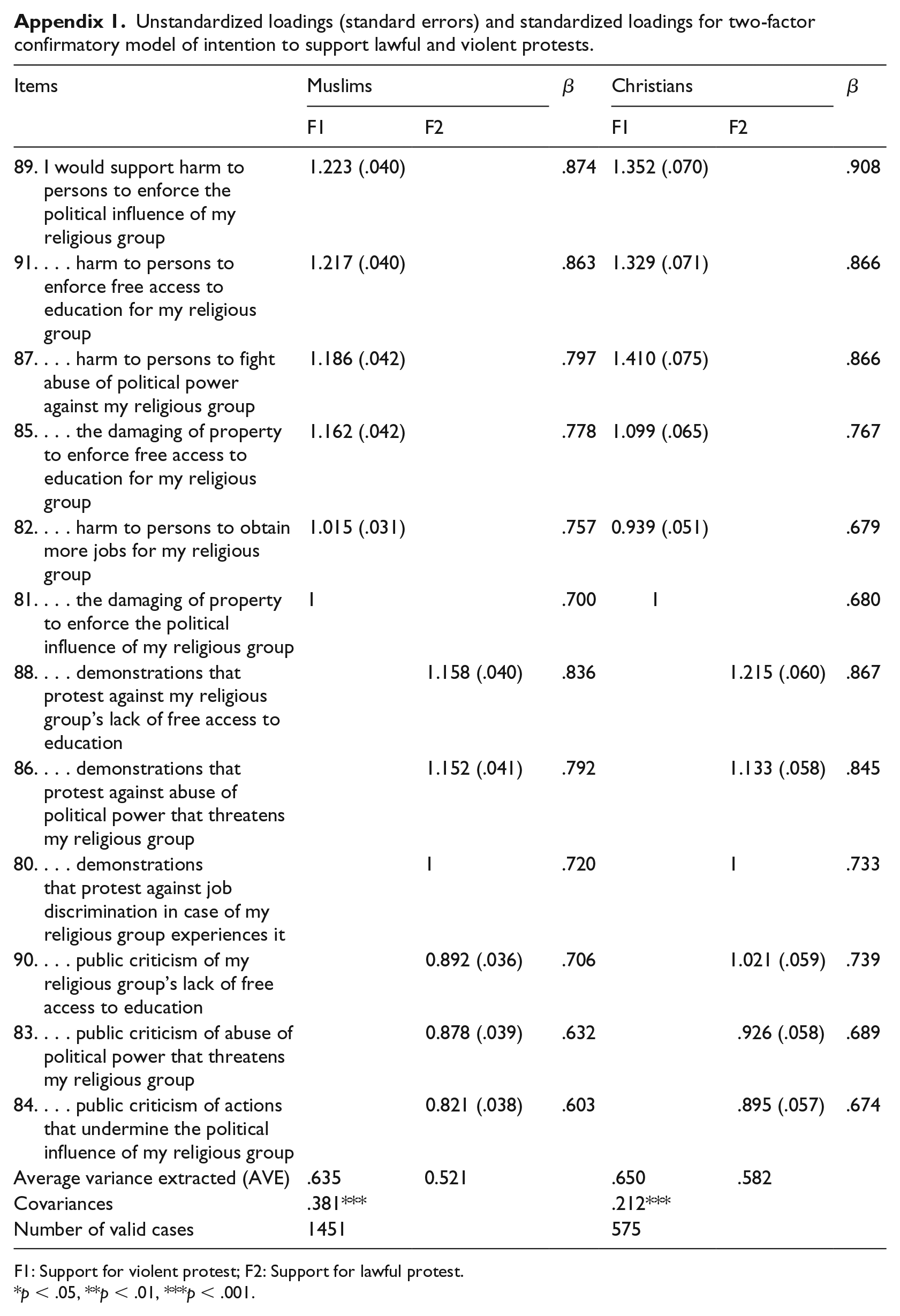
Our dependent variables are support for lawful and violent protests against the religious outgroup, adopted from Subagya’s (2015) study on support for violence in Indonesia. The two modes of support are measured by respondents’ support for public demonstrations versus support for the damaging of religious outgroup’s property and harming of religious outgroup members (full items are provided in Appendix 1). Each scale consists of six items and is rated on a five-point Likert-type scale, with higher scores indicating stronger support for lawful and violent protests.
We expected a two-factor model to be confirmed in the measurement. After associating the unique terms of two items from each mode of protest (item 2 and 3 from lawful protest, and item 1 and 2 from violent protest), the post hoc modification displays a good fit model, χ2 = 853.28, p < .001, confirmatory fit index (CFI) = .95, root mean square error of approximation (RMSEA) = .09, and the standardized root mean squared error (SRMR) = .05, although the RMSEA is slightly above the cut-off point of .08 (Hooper, Coughlan, & Mullen, 2008). The standardized parameter estimates indicate acceptable factor loadings for each item across both religious groups, ranging from .60 to .87 for Muslims and .67 to .91 for Christians (see Appendix 1). Finally, the scales of both modes of support for violence are highly reliable across religious groups (see Table 1 for bivariate correlations and reliability coefficients by religious group).
Bivariate correlations by religious group.
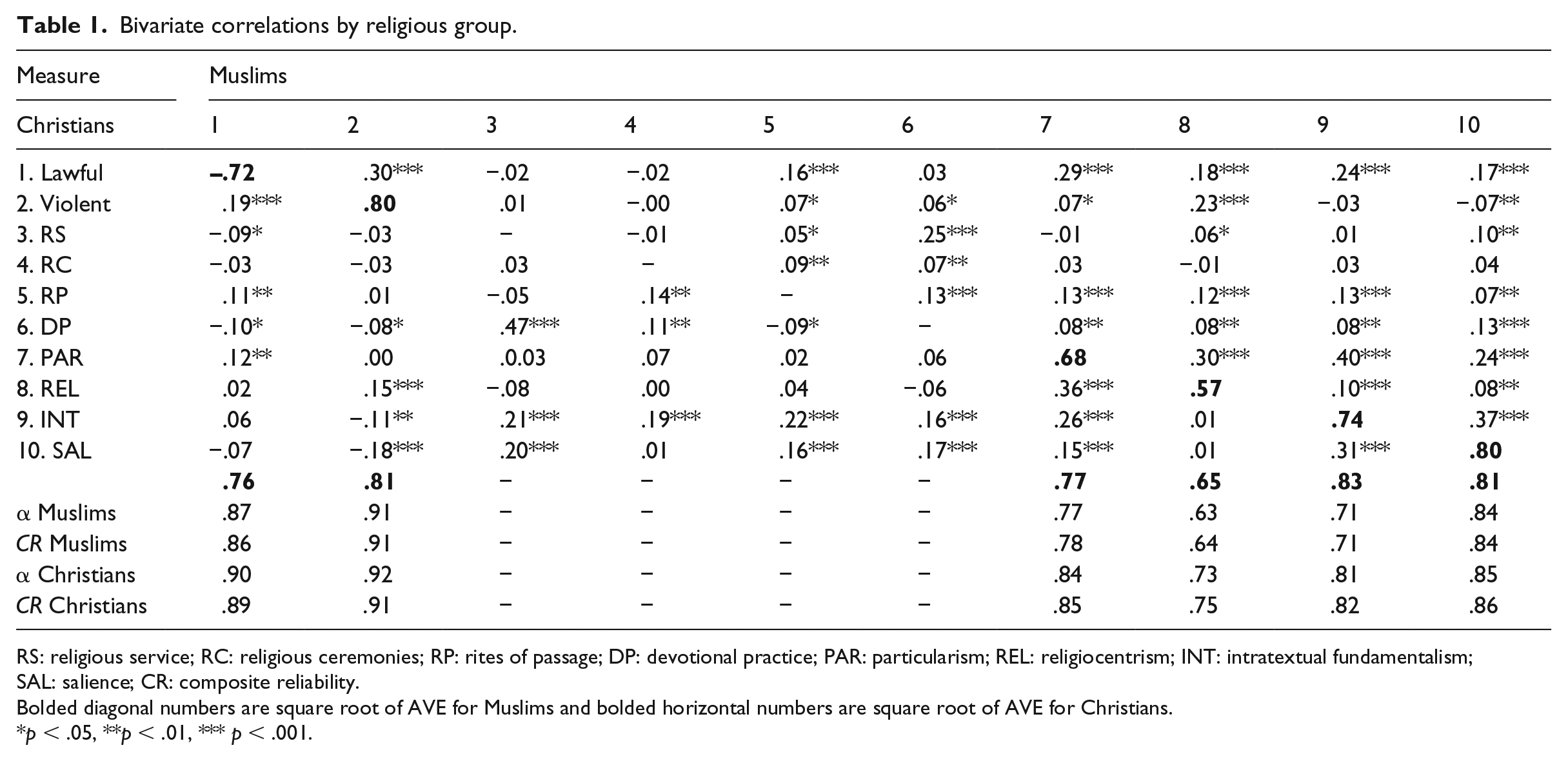
RS: religious service; RC: religious ceremonies; RP: rites of passage; DP: devotional practice; PAR: particularism; REL: religiocentrism; INT: intratextual fundamentalism; SAL: salience; CR: composite reliability.
Bolded diagonal numbers are square root of AVE for Muslims and bolded horizontal numbers are square root of AVE for Christians.
p < .05, **p < .01, *** p < .001.
Religious beliefs
We employ three measures to assess religious beliefs. First, we employ a three-item particularism scale to measure the tendency to view religious doctrines as the absolute truth. The scale is based on the study of interpreting religious plurality by Anthony et al. (2015) and has also been tested on Indonesian college students by Subagya (2015). Respondents rate themselves on items such as ‘The truth about God is found only in my religion’. Second, we employ a five-item religiocentrism scale to identify the extent of positive attitudes towards the religious ingroup and negative attitudes towards the religious outgroup (Sterkens & Anthony, 2008). Positive attitudes are operationalized as good characteristics of one’s own religion (e.g. ‘Thanks to our religion, most of us are good people’), and negative attitudes are operationalized as opposite characteristics of religious outgroups (e.g. ‘Other religions are often the cause of religious conflict’). Finally, we employ a three-item intratextual fundamentalism scale to assess respondents’ tendency to understand sacred text as the foundation of objective truth (Williamson et al., 2010). The scale asks statements such as ‘Everything in the Sacred writing is absolutely true without question’. All scales are rated on a five-point scale, with higher scores reflecting greater agreement to items.
Based on a total number of 11 items, we expected a three-factor model to represent religious beliefs. After post hoc modifications, where we removed one religiocentrism item ( ‘My religious group is best able to talk meaningfully about God’) thus N item becomes 10, the final model fit the data, χ2 = 400.05, p < .001, CFI = .94, RMSEA = .07 and SRMR = .05. All indicators show significant factor loadings, ranging from .55 to .76 for Muslims and .51 to .89 for Christians. As for reliability, the three scales are found to range from relatively acceptable to moderately high across religious groups (see Table 1).
Religious practices
We employ three ways of measuring religious practices. First, we ask respondents’ frequency of attending religious service which rates on a seven-point scale (ranging from never to several times a day). Second, we ask respondents’ participation in religious ceremonies (i.e. Eid al-Adha and Eid al-Fitr or Christmas and Easter) and religious rites of passage (i.e. wedding and funeral). All modes of participation were rated on a four-point scale, ranging from 1 (my family and I do not participate) to 4 (I participate for religious reasons). The answer categories of 2 (my family participates, but I do not) and 3 (I participate but not for religious reasons) were initially included to capture family participation, but apparently only a small number of participants answered 1 or 2, which made the distribution skewed. Thus, we converted the answer category to 0 (no participation and participation but not for religious reasons, which includes 1 thru 3) and 1 (participate for religious reasons, which includes 4). A total score is obtained by adding how many events (out of two for each scale) the respondents participate in. Third, we ask respondents’ frequency of devotional practices represented by praying and reading sacred writings on a seven-point scale. Both items are significantly correlated, r = .38, p < .001. The two items are averaged to get a total score of devotional practices. Correlations between measures of religious practices and other measures across religious groups are presented in Table 1.
Salience
We adapted a three-item salience of religion scale from Eisinga, Felling, and Peters (1991) to measure to what extent respondents agree that religion plays an important role in their daily life. Respondents rate themselves on a 5-point scale on statements such as ‘My religious beliefs have a great deal of influence on how I make important decisions’. Higher scores reflect greater religious salience.
The CFA demonstrates a good fit model, χ2 = 40.12, p < .001, CFI = .98, RMSEA = .14 and SRMR = .06. The standardized parameter estimates identify relatively high factor loadings, ranging from .72 to .92. Furthermore, the scale is moderately reliable across religious groups (see Table 1).
Measurement invariance
We conducted tests for measurement invariance (MI) as part of multi-group CFA to be able to look at meaningful differences and similarities across groups (Milfont & Fischer, 2010; Vandenberg & Lance, 2000). Specifically, we tested metric invariance to ensure that the meaning of constructs and items is identical to both groups (cf. Bagozzi & Edwards, 1998).
We began MI with our dependent variables scales. The configural or baseline model for both religious groups produced a good fit model, χ2 = 974.13, p < .001, CFI = .94. Using the same factor structures in both religious groups, we found no negative variance and thus, the model with good fit could be produced. Next, we tested metric invariance by constraining factor loadings to be equal across religious groups. The difference in CFI (ΔCFI) between the two models was .002, which is far below the cut-off point of .01 to confirm the assumption of metric invariance (Cheung & Rensvold, 2002).
Subsequently, we conducted MI on religious beliefs (configural model: χ2 = 410.18, p < .001, CFI = .94) and salience scales (configural model: of χ2 = 39.30, p < .001, CFI = .98). The ΔCFI with each corresponding metric invariance model were .000 and .001, respectively. All MI results demonstrate how similar Muslims and Christians are in conceptualizing the employed constructs and responding to all items (Milfont & Fischer, 2010; Vandenberg & Lance, 2000). As such, we were able to conduct further analysis of multi-group structural equation modelling (SEM).
Finally, we also acknowledged the degree of imbalance in our group sample sizes (the ratio of Muslim group to Christian group is approximately 2.5) in performing the metric invariance. Based on the simulation study using subsampling approach Yoon and Lai (2018), we can confidently claim that the ratio of our imbalance sample sizes would not significantly hamper our conclusion of metric invariance.
Individual characteristics
We use straightforward questions to measure age and gender. Next, we asked respondents to indicate their highest level of education completed, ranging from did not go to school (1) to Master degree or higher (6). Finally, we asked monthly gross household income, ranging from Lower than Rp. 500.000 (1) to Rp. 6.000.000, and over (8).
Strategy for analyses
We performed SEM using ‘lavaan’ package in R (Rosseel, 2012) to investigate our hypotheses. We conducted three preliminary tests by religious group using SPSS 25. First, most of the scales in both groups had values of skewness and kurtosis less than two, which approximate normality (Kim, 2013). Second, most scales were found to be linearly related to our dependent variables across groups. Finally, both religious groups had variance inflation factor (VIF) values that ranged from 1.10 to 1.31 with tolerance statistics all well above 0.2, which indicated no multicollinearity (Field, 2009). Based on these results, we used maximum likelihood (ML) estimation.
We first created a model with all the predictors, excluding control variables. Subsequently, we performed multi-group SEM using religious group (Muslims vs Christians) as a grouping variable and with the inclusion of control variables to test whether any relation found was spurious due to individual characteristics.
Results
Table 2 presents descriptive statistics and mean differences between Muslims and Christians in all variables.
Descriptive statistics by religious group and mean differences.
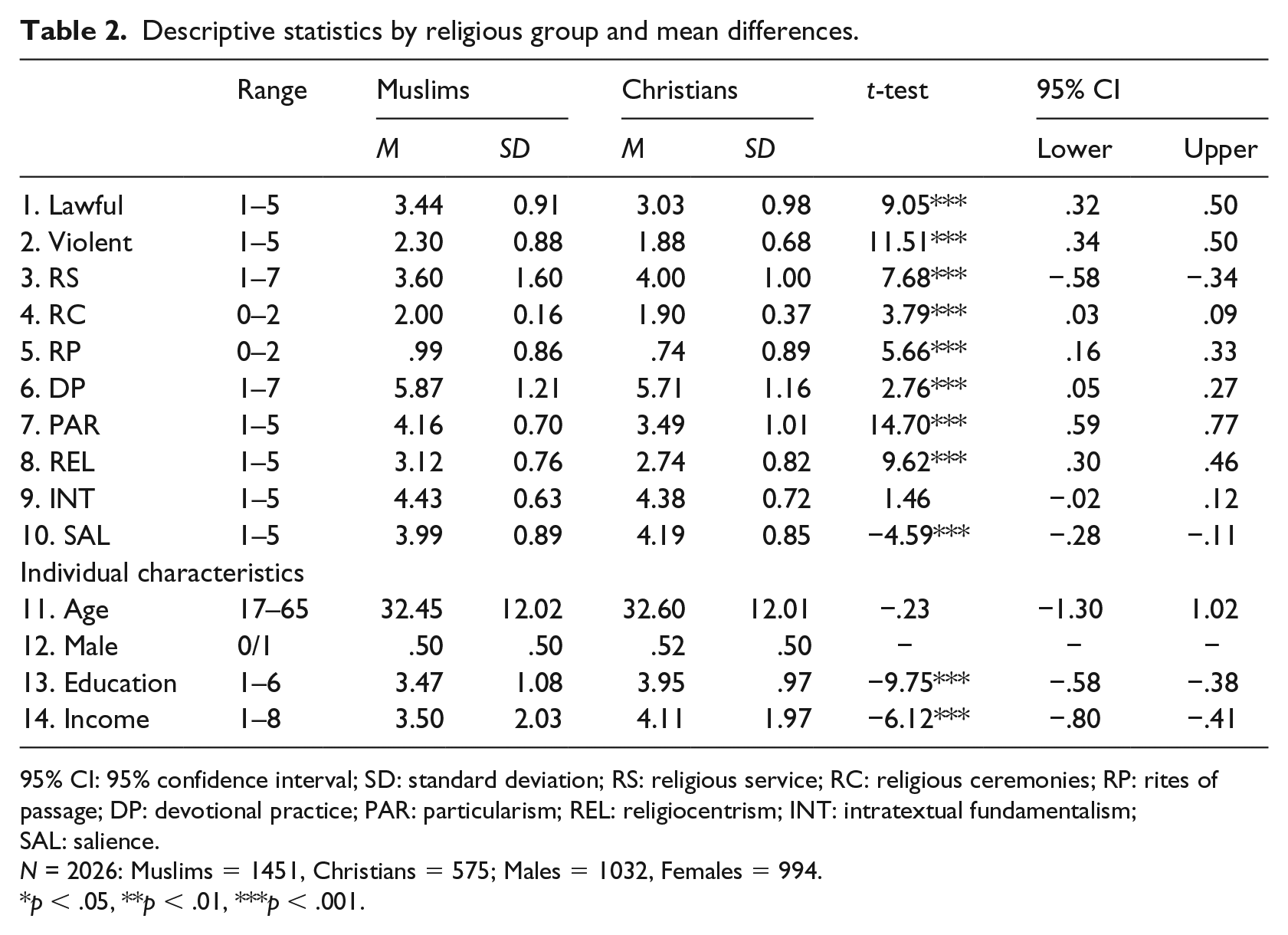
95% CI: 95% confidence interval; SD: standard deviation; RS: religious service; RC: religious ceremonies; RP: rites of passage; DP: devotional practice; PAR: particularism; REL: religiocentrism; INT: intratextual fundamentalism; SAL: salience.
N = 2026: Muslims = 1451, Christians = 575; Males = 1032, Females = 994.
p < .05, **p < .01, ***p < .001.
Regarding group differences, we find that Muslim respondents (M = 3.44, SD = .91 for lawful protest and M = 2.30, SD = .88 for violent protest) are on average more inclined to support interreligious conflict than Christians (M = 3.03, SD = .98 for lawful protest and M = 1.88, SD = .68 for violent protest); t(2024) = 9.05, p < .001 and t(1350) = 11.51, p < .001, respectively. Their mean differences differ almost by half a standard deviation for lawful protest (d = .43) and more than half a standard deviation for violent protest (d = .53). Hence, these differences are considered significantly medium. These results provide evidence for H1.
Subsequently, we performed SEM analyses based on the same 2026 respondents. The visual presentation is shown in Figure 1 with its path coefficients. For the purpose of clarity, we present the structural model only and omit the measurement model. Based on Hooper and colleagues (2008) guidelines for model fit, the hypothesized model appears to have an acceptable fit to the data, χ2 = 1988.24, p < .001, CFI = .94, RMSEA = .05 and SRMR = .04 (Figure 1).
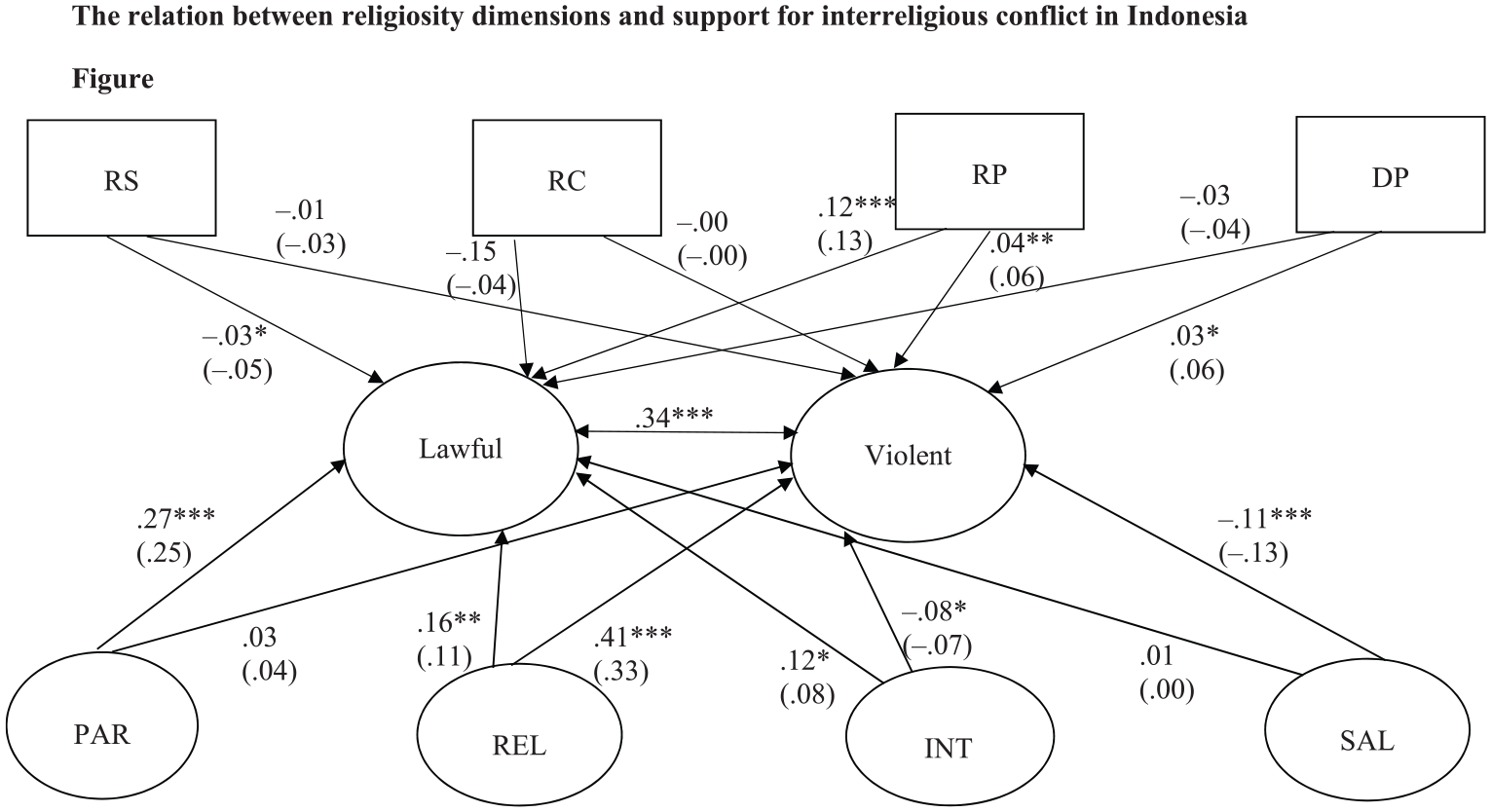
SEM for the hypothesized model.
First, we expected religious beliefs to be a driving force for support for interreligious conflict (H2). We find that particularistic views are positively related to support for lawful protest (b = .27, p = .015), but not to violent protest. Religiocentrism is, as expected, significantly related to support for lawful (b = .16, p = .001) and violent protests (b = .41, p = .000). Religiocentrism has the strongest relationship with support for violent protest compared to the other beliefs. Furthermore, we find that intratextual fundamentalism is positively related to support for lawful protest (b = .12, p = .018), but unexpectedly, negatively yet weakly related to support for violent protest (b = –.08, p = .043). In sum, these findings predominantly lend support to H2.
Next, we expected that religious practices enhance support for interreligious conflict (H3). Specifically, we find that participation in rites of passages is positively related to support for lawful (b = .12, p = .000) and violent protests (b = .04, p = .009), while devotional practices are positively related to support for violent protest only (b = .03, p = .015). All other relationships are non-significant or even weakly opposite when comparing support for lawful versus violent protest. Based on these findings, our H3 is predominantly rejected, with only the relationship between participation in rites of passage and support for interreligious conflict fully supported.
Finally, we expected that religious salience may decrease support for interreligious conflict (H4). Our results show that salience is not significantly related to support for lawful protest, but negatively related to support for violent protest (b = –.11, p = .000). Hence, these results partly confirm H4.
Multi-group SEM
We conducted multi-group SEM as a robustness check, specifically to test whether results still hold true when we consider the religious groups separately. We included control variables and the multi-group model fits the data acceptably, χ2 = 3177.27, p < .001, CFI = .91, RMSEA = .05 and SRMR = .05. Table 3 provides differences in significant relations when comparing Muslims and Christians. First, the positive relation between participation in rites of passage and support is consistently found for lawful protest among both Muslims (b = .11, p = .000) and Christians (b = .12, p = .003), but the weak and insignificant relation with support for violent protest is possibly due to reduced statistical power. Furthermore, a positive relation between devotional practices and support for violent protest is only found among Muslims (b = .06, p = .000).
Unstandardized parameter estimates from multi-group SEM.
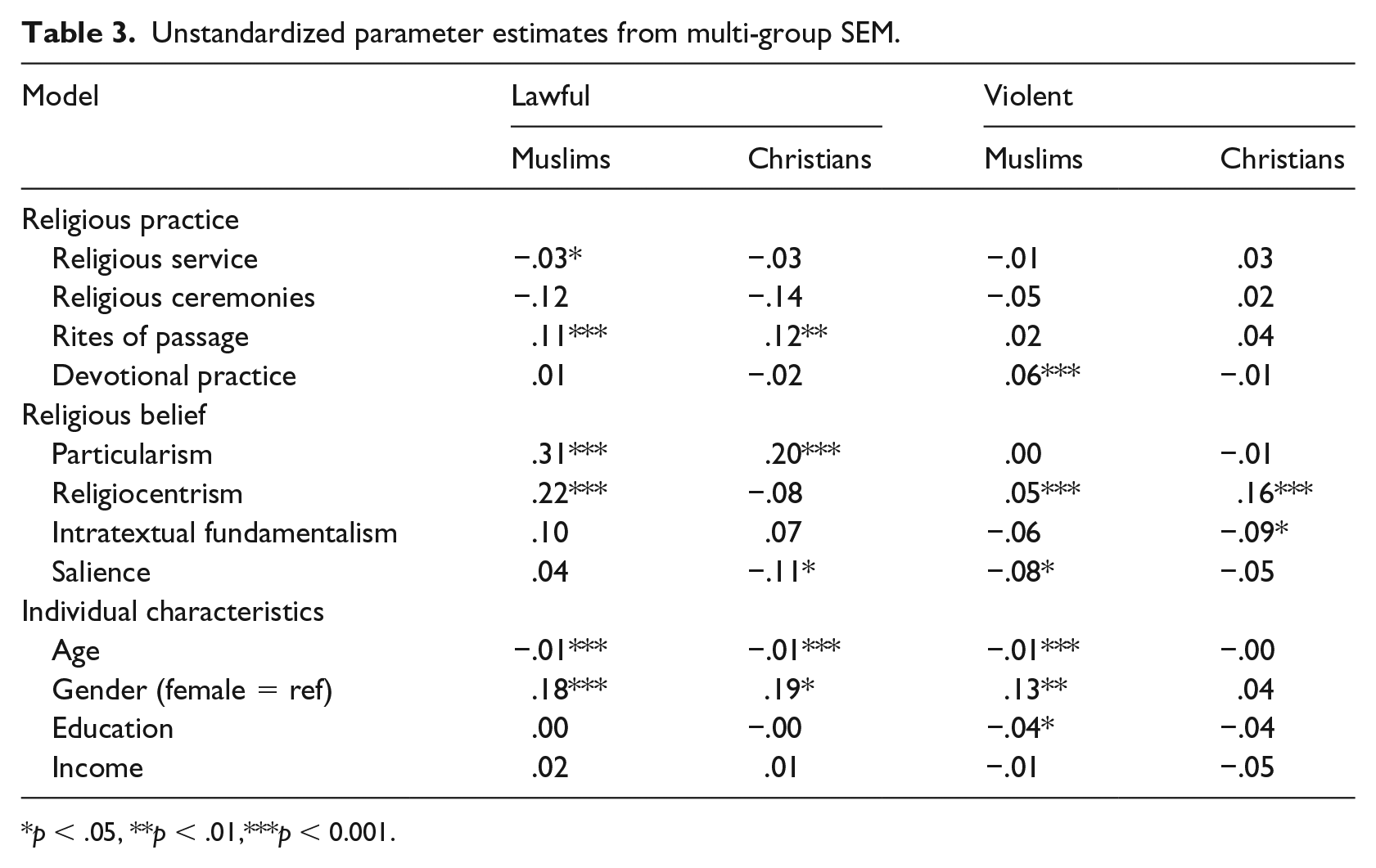
p < .05, **p < .01,***p < 0.001.
Particularism is consistently related to support for lawful protest for both Muslims (b = .31, p = .000) and Christians (b = .20, p = .000). Next, religiocentrism is found to be positively related to support for lawful protest only among Muslims (b = .22, p = .000), but is consistently related to support for violent protest in both groups (b = .05, p = .000 for Muslims and b = .16, p = .000 for Christians). A weak negative relation between intratextual fundamentalism and support for violent protest is found only among Christians (b = –.09, p = .021). Moreover, a negative relation between salience and support for lawful protest is discovered among Christians (b = –.11, p = .046), whereas a negative relation between salience and violent protest is found only among Muslims (b = –.08, p = .005). These differences are already suggested at a glance in Table 2 where Muslims are found to score higher than Christians on most of the measures (except salience).
The inclusion of individual characteristics does not significantly change the relations between religiosity dimensions and support for interreligious conflict. Specifically, older age and being female are significantly related to less support for lawful and violent (Muslims only) protests. Level of education shows minor importance for both modes of support, while level of income shows no importance at all.
Discussion
Inspired by Allport’s (1966) famous statement on the differential roles of religion for intergroup attitudes, we have provided valuable insights into individuals’ support for interreligious conflict in Indonesia. Some of our findings are consistent with previous research, while others interestingly contradict. We will discuss the findings according to the order of hypotheses.
Notably, we found that members of the Indonesian Muslim community are, on average, more inclined to support interreligious conflict than Christians. This finding may be a significant addition to the current trend that predominantly links extremist violence to Islam (cf. Wright, 2016). In this context, religious identity signals a sense of group position which begets social cleavages between a Muslim majority and a Christian minority (Blumer, 1958). Religious identification is a basic feature to enhance ingroup favouritism and outgroup hostility (Brewer, 1999; Tajfel & Turner, 1979). Under real conflicts, ingroup members are expected to boost their religious identification and to share similar (anti-outgroup) views towards the religious outgroup. Whether the majority religious group would translate their anti-outgroup attitudes into social mobilization or even hostile measures against the religious outgroup largely depends on the level of threat perceived from the religious outgroup (Olzak, 2013). In our study, it is rather unsurprising that the Muslim majority, on average, is more likely to support interreligious conflict as the Christians’ level of education and income are significantly higher than the Muslims’. However, this mechanism is only one of many possible mechanisms that can explain support for interreligious conflict. Recent research implies that ingroup identification may not always be sufficient to yield extreme pro-group behaviour, because the latter does not only require relational ties with ingroup members but also, more importantly, the fusion of social and personal identities that lead individuals to perceive intergroup conflict as a personal conflict and group continuity as an individual responsibility (Neuberg et al., 2014).
We explored the role of religious beliefs as related to support for interreligious conflict. As ‘the heart of faith’, we find most aspects of religious beliefs to be related to support for interreligious conflict. Specifically, our finding on particularism is in line with Beller and Kröger (2017) who found that absolutist views on religious truths are not necessarily related to support for violence. Particularism, however, is related to support for lawful protest. One plausible explanation of why particularism does not increase support for violent protest is that it explains only individuals’ tendency to reject religious plurality, but does not automatically imply negative attitudes towards the religious outgroup which may be translated into support for violence against the religious outgroup (Anthony et al., 2015). Similarly, intratextual fundamentalism is an extent of commitment to literal scriptural interpretations which also involves acknowledging the Sacred Writing as the words of God (Williamson et al., 2010). This, however, may only be related to militancy or aggressiveness when their ‘intratextually based absolute truths are experienced as being threatened’ (p. 741). Moreover, the finding on religiocentrism adds additional evidence that ingroup favouritism and outgroup derogation are related to respondents’ support for lawful demonstrations and violent acts against outgroups (Brewer, 1999). This selective perception towards ingroup and outgroup members is strengthened in interreligious conflict and is associated with ingroup members’ hostile stance against the religious outgroup as an attempt to maintain positive aspects of their identity (Tajfel & Turner, 1979).
Further, religious practices do not necessarily induce people’s support for interreligious conflict. Our finding on attending religious services and participation in religious ceremonies is contradictory to most previous research, such as Ginges and colleagues (2009) and Beller and Kröger (2017) who found a positive relation between mosque attendance and support for extremist violence. Our main suspect is that attending religious services and participating in religious ceremonies might have become a routine activity that fails to provoke a strong psychological kinship among ingroup members. Hence, there is no strong coalitional commitment for cooperation and coordination in a religious group (Ginges et al., 2009). In line with this, a notable finding on the participation in rites of passages might possibly explain the contradictory finding on religious services and ceremonies: the former dimension turns out to be positively related to support for lawful protests, both among Muslims and Christians. Participation in rites of passage is a collective experience with strong personal impact that may provide a sense of identity for individuals and enhances their relational ties, which in turn may increase (self-sacrificing and sometimes extreme) pro-group behaviour (Whitehouse & Lanman, 2014). Those who participate in rites of passage (i.e. weddings and funerals) for religious reasons are considered to actualize the meanings of religious concepts, signal strong group commitments and acclimatize social conventions (Kiper & Sosis, 2016). By these, they create a shared ethos with other religious ingroup fellows and adhere to cooperation and social coordination of the group. Rites of passage may therefore be more related to support for interreligious conflict than ordinary attendance at services.
In contrast, our findings suggest that religious salience decreases support for interreligious conflict. Although the effect is found only regarding support for violent protest, this finding sheds soothing evidence on religious identity’s role in interreligious violence. This finding also supports a previous study by Scheepers and colleagues (2002) who found that religiously salient people are more likely to associate themselves with benevolent traits (e.g. mercy and forgiveness). In the words of Allport and Ross (1967), these people take their religious identity intrinsically and move beyond the border of group membership, while taking benevolent traits as guidelines for their daily life. Therefore, in times of conflict these people are more likely to be able to distinguish between religious values and their politicized trappings in order to disassociate themselves from hostility against the religious outgroup (Roof & Perkins, 1975).
Furthermore, control variables show minor importance in support for interreligious conflict. With the inclusion of control variables, religiosity effects mostly remain substantially unchanged. This finding confirms the previously found relations between religiosity dimensions and support for interreligious conflict.
Finally, our sample of ordinary citizens in conflict regions provides empirical evidence on latent conflicts that exist in the general population within different religious groups. The assessment of MI demonstrates that Muslims and Christians relate to the employed constructs similarly (Milfont & Fischer, 2010).
Limitations
There are, at least, five limitations that are worth noting in this study. First, at the time we started collecting data, religious issues were heavily used in the race for governorship in Jakarta. The incident increased Islam ingroup homogenization in many parts of the nation, which may have influenced the portraits of support for interreligious conflict that we have captured. This call for homogenization was clearly illustrated in a series of mass demonstrations involving several hundred thousand protesters from Jakarta and its nearby areas to imprison Jakarta governor Basuki Tjahaja Purnama (popularly known as Ahok) for blasphemy on Islam (Hadiz, 2017). Islam homogenization is also shown in Pamungkas’ (2015) study, where he found that many Muslim college students in Yogyakarta believe Muslims should only select a leader of the same religious conviction. Second, our cross-sectional data limit us to see changes in individuals’ support, especially after the national event mentioned earlier. Third, some of the non-significant effects of religiosity dimensions raise a compelling need to consider other plausible mechanisms inducing support for interreligious conflict. For example, intergroup conflicts are inevitably shaped by power and economic distributions (cf. Olzak, 2013). Perceptions surrounding these conflicts (e.g. injustice and threat) may also play roles in the relationship between religiosity dimensions and support for interreligious conflict. Thus, future work that takes into account these theoretical considerations is needed. Fourth, although we have taken all the necessary steps in performing the statistical analysis meticulously, we acknowledge that the imbalance in our group sample sizes might have slightly affected the findings. Therefore, future work should pursue a more balance group sample sizes when possible. Finally, our sample was limited to Muslim and Christian participants; hence, we are not able to generalize these findings to other interreligious conflicts that have occurred in Indonesia, such as between Muslims and Hindus in South Lampung or between Sunni and Shia Muslims in Madura.
Conclusion
Three concluding points are raised in this study. First, religious identification provides a sense of group position related to individuals’ attitudes towards the religious outgroup (Blumer, 1958; Tajfel & Turner, 1979). Second, religiocentrism is the strongest predictor to support for interreligious conflict, which adds other evidence to the link of ingroup attitudes and outgroup hostility (Brewer, 1999). Third, religious salience is negatively related to support for violent hostility against the outgroup, just like in European countries (Scheepers, Gijsberts, & Hello, 2002). All combined, although there are insignificant roles of some religiosity dimensions, religion serves to distinguish ingroup and outgroup members and further emphasizes group interests. Therefore, religiosity plays an important yet differential role in the relationship with support for interreligious conflict, also in Indonesia.
Footnotes
Appendix
Unstandardized loadings (standard errors) and standardized loadings for two-factor confirmatory model of intention to support lawful and violent protests.
| Items | Muslims |
β | Christians |
β | ||
|---|---|---|---|---|---|---|
| F1 | F2 | F1 | F2 | |||
| 89. I would support harm to persons to enforce the political influence of my religious group | 1.223 (.040) | .874 | 1.352 (.070) | .908 | ||
| 91. . . . harm to persons to enforce free access to education for my religious group | 1.217 (.040) | .863 | 1.329 (.071) | .866 | ||
| 87. . . . harm to persons to fight abuse of political power against my religious group | 1.186 (.042) | .797 | 1.410 (.075) | .866 | ||
| 85. . . . the damaging of property to enforce free access to education for my religious group | 1.162 (.042) | .778 | 1.099 (.065) | .767 | ||
| 82. . . . harm to persons to obtain more jobs for my religious group | 1.015 (.031) | .757 | 0.939 (.051) | .679 | ||
| 81. . . . the damaging of property to enforce the political influence of my religious group | 1 | .700 | 1 | .680 | ||
| 88. . . . demonstrations that protest against my religious group’s lack of free access to education | 1.158 (.040) | .836 | 1.215 (.060) | .867 | ||
| 86. . . . demonstrations that protest against abuse of political power that threatens my religious group | 1.152 (.041) | .792 | 1.133 (.058) | .845 | ||
| 80. . . . demonstrations that protest against job discrimination in case of my religious group experiences it | 1 | .720 | 1 | .733 | ||
| 90. . . . public criticism of my religious group’s lack of free access to education | 0.892 (.036) | .706 | 1.021 (.059) | .739 | ||
| 83. . . . public criticism of abuse of political power that threatens my religious group | 0.878 (.039) | .632 | .926 (.058) | .689 | ||
| 84. . . . public criticism of actions that undermine the political influence of my religious group | 0.821 (.038) | .603 | .895 (.057) | .674 | ||
| Average variance extracted (AVE) | .635 | 0.521 | .650 | .582 | ||
| Covariances | .381*** | .212*** | ||||
| Number of valid cases | 1451 | 575 | ||||
F1: Support for violent protest; F2: Support for lawful protest.
p < .05, **p < .01, ***p < .001.

Funding
The author(s) disclosed receipt of the following financial support for the research, authorship, and/or publication of this article: This research was supported by Indonesia Endowment Fund for Education (LPDP) (PRJ-44 /LPDP.3/2016).