




Abstract
Since late 2019, the coronavirus SARS-COV-2 responsible for the COVID-19 disease has continued to spread across different regions of the world. As a result, governments have been implementing measures for controlling the disease which rely on people's cooperation. In this research, we considered predictors and implications of people's beliefs that they “haven’t been told the ‘whole story’ about COVID-19.” Specifically, we examined the role of disgust towards the political system in predicting conspiratorial tendencies across four countries, in Europe (Italy and the UK), North America (the USA), and Asia (South Korea). In addition, we investigated the implications of conspiratorial beliefs for individuals’ intentions to engage in prosocial cooperative behavior. In line with the idea that feelings of disgust towards the political system may indicate that people perceive the system as violating core norms, results showed that disgust was associated with stronger conspiratorial tendencies. Individuals’ conspiratorial tendencies were in turn associated with lower intentions to help others during the pandemic. Results were broadly consistent across the countries tested. Directions for future research are discussed.
Since late 2019, the coronavirus SARS-COV-2 responsible for the COVID-19 disease has been spreading worldwide. As a result, governments have been implementing measures for preventing the transmission of the disease, including recommending handwashing, wearing face masks, and self-isolation (Chu et al., 2020; World Health Organization, 2020). Despite these efforts, the speed of viral propagation has been decreasing slowly, especially in Europe and the USA. Governments’ efforts have been hampered, at least in part, by public suspicion towards the official account of events (Oleksy et al., 2021), and lack of cooperation among people. On August 25, the Director-General of the World Health Organization (WHO) stated that “We’re not just battling the virus. We’re also battling the trolls and conspiracy theorists that push misinformation and undermine the outbreak response” (WHO, 2020). In support of his word, data from a survey conducted in the United States in mid-March indicated that 48% of US American adults reported that they have seen some news and information about the COVID-19 disease which appeared to be a complete fabrication (Mitchell & Oliphant, 2020).
People's skepticism towards the authorities’ ‘official account’ is therefore a crucial problem that may become particularly acute as vaccination programs to fight the disease are rolled out across countries. In the present research, we consider predictors and implications of people's beliefs that they “haven’t been told the ‘whole story’ about COVID-19.” Specifically, we examine the role of emotional processes of disgust towards the political system in predicting conspiratorial tendencies. We also test the implications of conspiratorial beliefs for individuals’ intentions to engage in prosocial behavior. We compare results from four different countries in Europe (Italy and the UK), North America (the USA), and Asia (Korea) to examine differences and similarities across regions.
Disgust towards the system and conspiratorial tendencies
People's perceptions of the system, authorities, and the government play a crucial role in shaping their responses to the pandemic. For instance, individuals who report more trust towards the government are also more likely to comply with official recommendations aimed at stopping the spread of the disease (Bargain & Aminjonov, 2020; Han et al., 2021; Kim & Kim, 2021; Morse et al., 2016; Olsen & Hjorth, 2020; Pagliaro et al., 2021; Prati et al., 2011; Rubin et al., 2009; San Lau et al., 2020; Tang & Wong, 2003; Travaglino & Moon, 2021).
People's perception of the system has also been linked to the emergence of conspiratorial thinking (Bruder & Kunert, 2021; Einstein & Glick, 2013; Kim & Kim, 2021; van Mulukom et al., 2021). Conspiracy theories describe the ultimate cause of important events as the secret action of a powerful group concealing information to further its own interests (Brotherton, 2015; Douglas et al., 2017). Conspiratorial thinking tends to increase substantially in times of crisis due to perceived lack of control in relation to novel, unexpected, or threatening events (Douglas et al., 2017; Van Prooijen & Acker, 2015; Van Prooijen & Jostmann, 2013; Whitson & Galinsky, 2008). It may hamper authorities’ efforts to elicit cooperative behavior by people. The current global pandemic is a fertile ground for the proliferation of conspiratorial beliefs, due to the objective lack of clear information about the COVID-19 disease. Indeed, during the COVID-19 pandemic, individuals’ beliefs in conspiracy theory have increased significantly as false information has been spreading on social media and in the news (Shahsavari et al., 2020).
Research has so far focused on beliefs about the system’s trustworthiness in the emergence of conspiratorial thinking (e.g., Kim and Kim, 2021; Pagliaro et al., 2021). Relatively less research has investigated the role played by emotions towards the system in people's responses to authorities’ “official accounts” of the events. Research indicates that emotional processes play a crucial role in shaping how individuals process and appraise information (Martel et al., 2020). For instance, anger promotes stronger reliance on heuristics (Bodenhausen et al., 1994) and encourages partisanship in the appraisals of (inaccurate) political information (e.g., Weeks, 2015). Conversely, negative emotions such as anxiety may motivate individuals to probe information more critically (Forgas, 2019; Weeks, 2015), increasing skepticism.
However, the specific role of positive or negative emotional processes will likely depend on where (or towards what) they are directed. Emotions directed at the political system represent a crucial constitutive component of individuals’ experience of the social order in which they live, influencing and shaping people's understanding of institutions and social structures in distinctive ways (Goodwin et al., 2001; Gordon, 1990; Marcus, 2002; Weeks, 2015). System-level emotions have important implications for individuals’ behavior and actions across a variety of different domains (Solak et al., 2012). Yet, very little work has investigated their effects (cf. Travaglino and Moon, 2021), and none in the context of the current pandemic.
In the present research, we focus for the first time on individuals’ feelings of disgust towards the system. Disgust refers to an unpleasant emotion felt against harmful objects or ideas that evoke a sickening reaction (e.g., Rozin et al., 2008). As the definition implies, feelings of disgust are functional in protecting oneself from dangerous or contaminating objects (Lazarus, 1991) that may threaten one's health (e.g., foods, animals, body products, injuries, sexual behaviors, death, and decay). Individuals who experience disgust feel nauseous or queasy and, in turn, are motivated to avoid the objects of disgust (Shook et al., 2019).
In the context of exposure to pathogens, feelings of disgust may be adaptive and have positive behavioral implications (e.g., Díaz & Cova, 2020; Fleischman & Fessler, 2011; Rozin et al., 2008; Tybur et al., 2010; Tybur et al., 2011). For instance, recent research shows that stronger feelings of disgust against pathogens are associated not only with greater concern about COVID-19, but also with stronger intentions to engage in behaviors such as social distancing, handwashing, and cleaning/disinfecting (Shook et al., 2020).
Disgust is an especially crucial emotion because it may function as an output of moral cognition. Individuals report and display disgust towards actions that they view as moral violations, even when such actions are irrelevant to pathogens or sexual contents (see Tybur et al., 2013 for a review). According to the Moral Foundations Theory (Graham et al., 2009; Haidt, 2012; Haidt & Joseph, 2004), purity/sanctity is a fundamental moral foundation “based on the emotion of disgust in response to biological contaminants (e.g., feces or rotten food), and to various social contaminants like spiritual corruption, or the inability to control one's base impulses” (Koleva et al., 2012, p. 185). For example, individuals are likely to assess certain behaviors (e.g., stealing a purse from a blind person) as morally disgusting (Hutcherson & Gross, 2011; Nabi, 2002), and people often recall moral violations related to fairness or harm as disgusting (Curtis & Biran, 2001; Haidt et al., 1997; Tybur et al., 2009).
Thus, actions or objects that elicit disgust may be seen as violating moral norms (cf. Kupfer and Giner-Sorolla, 2017; Russell and Giner-Sorolla, 2013). In the context of people's perception of the system, disgust may play a crucial function because it may signal that the system is not aligned to core moral beliefs. Specifically, we contend that those who feel disgust towards the political system may be motivated to avoid a system that is perceived as threatening, dangerous, or as violating core moral principles. A potential implication of this particularly strong form of system avoidance may be increased skepticism towards authorities’ “official versions” of events and, thus, stronger engagement in conspiratorial thinking. Conspiratorial thinking may, in turn, prevent individuals from engaging in the type of coordinate prosocial and cooperative behaviors which enable groups to overcome collective hardships, such as the pandemic. We test this reasoning in the present study by examining whether feelings of disgust towards the system predict stronger conspiratorial tendencies. Conspiratorial tendencies should, in turn, be associated with lower tendency to engage in prosocial and cooperative behavior. To examine the generalizability of these findings across contexts, we test our model in four different countries.
Conspiracy beliefs and prosociality
Previous research has demonstrated that beliefs in conspiracy theories have negative implications across various domains (see Douglas et al., 2017, 2019 for reviews). In particular, individuals’ willingness to cooperate with others may be hampered by the emergence of conspiratorial tendencies. For example, research has demonstrated that a generalized conspiracy belief that powerful forces work secretly to dominate the world (Imhoff & Bruder, 2014) can weaken prosocial behavior (Imhoff et al., 2018; Jolley & Douglas, 2014a, 2014b). In the context of global warming, Van der Linden (2015) showed that briefly exposing the public to a conspiracy theory may reduce general prosocial tendencies (e.g., donate or volunteer for a charity). Moreover, previous research has demonstrated the existence of an association between medical-related conspiracy theories and health-risk behaviors, including refusing to vaccinate, rejecting conventional medicine, and seeking alternative medicine (e.g., Bogart et al., 2010; Georgiou et al., 2020; Jolley and Douglas, 2014a; Lamberty and Imhoff, 2018; Setbon and Raude, 2010).
Individuals’ intentions to act prosocially are important for controlling the spread of COVID-19 effectively (Anderson et al., 2020). Thus, in the present research we investigate the association between individuals’ beliefs across conspiracy theories and their intentions to act prosocially in the context of the pandemic. Recent research indicated that conspiracy beliefs describing the current pandemic as a hoax were strongly (and negatively) linked to lower intentions to engage in behavior aimed at containing the virus (e.g., avoiding crowd, staying at home in quarantine; Imhoff and Lamberty, 2020). Furthermore, a large survey conducted in eight countries (including the UK, USA, and Italy) showed that individuals with high conspiracy beliefs were relatively more concerned about their own well-being and less concerned about the well-being of others. The latter study also showed a relatively higher intention among those who believed in conspiracy theories to engage in self-interested behavior such as stockpiling, but a relatively lower intention to engage in actions that would be useful in protecting others (e.g., social distancing; Hornsey et al., 2021). Taken together, previous findings lend support to the idea that individuals who have a conspiratorial mindset may be less likely to enact behavior that helps others fight the virus.
Overview of the present study
In the present study, for the first time, we tested the idea that feelings of disgust towards the political system may be associated with stronger conspiratorial tendencies. In addition, we tested the idea that such conspiratorial tendencies would, in turn, be associated with lower intentions to act prosocially and help control the spread of the disease (Hornsey et al., 2021; Imhoff & Lamberty, 2020). We expected these linkages should create an indirect effect of perceived disgust towards the system on lower prosocial behavior via increased conspiratorial thinking, reflecting individuals’ lower intentions to cooperate in response to a public crisis they appraise skeptically.
Finally, the present research also tested the generalizability of our prediction in four large samples from different countries, in Europe (Italy and the UK), America (the USA), and Asia (Korea). Although the emotion of disgust can be recognized cross-culturally, it is important to test the generalizability of the findings across different countries and regions of the world. To this purpose, we selected countries characterized by different overall cultural profiles. In line with Hofstede's cultural framework and country-level cultural indices (see Hofstede et al., 2010), Korea and Italy are characterized by a higher acceptance of power inequality and hierarchies than the UK and the USA. People in South Korea and Italy tend to dislike ambiguity and uncertainty more than the other two countries. In Italy, the USA, and the UK, people emphasize individuality more strongly than in Korea, which instead highlights the value of group harmony. Conversely, on average, Koreans tend to report a stronger focus on the future and the long term than the other countries. Such variability in the nations’ overall cultural outlines enables us to explore the generalizability of our hypotheses broadly.
Method
Participants
Participants from Italy (N = 606; 294 female, 301 male, 11 unreported; Mage = 26.94, SDage = 7.72), the UK (N = 606; 298 female, 305 male, 3 unreported; Mage = 34.03, SDage = 11.28), the USA (N = 597; 291 female, 296 male, 10 unreported; Mage = 39.35, SDage = 13.16), and South Korea (N = 693; 346 female, 342 male, 5 unreported; Mage = 44.46, SDage = 13.15) took part in an online survey on “cultural value and political action,” which included a COVID-19-related module (see Travaglino and Moon, 2021). Data were collected in April 2020 using Qualtrics via Prolific Academic© for Italy, the UK, and the USA and a large local research panel for South Korea. All participants were compensated with a small amount of money (2.75 USD for Italy, the UK, and the USA and 3.09 USD for South Korea) in exchange for their participation. All scales included for the present research were originally developed in English, and subsequently translated into Italian and Korean. Equivalent meanings in the two languages were achieved through the back-translation procedure, for which guidelines by Brislin (1986) were followed. 1
Measures
Feelings of disgust towards the political system
Participants reported their feelings of disgust towards the political system in their country using four items (disgusted/ repulsed/ sickened/ grossed-out; 1 = not at all, 7 = completely; αtot = .96, αIT = .96, αUK = .96 αUS = .95, αKOR = .97) (Russell & Giner-Sorolla, 2013). Higher scores indicate higher levels of disgust.
Conspiratorial tendencies about COVID-19
Conspiratorial tendencies about COVID-19 were measured using a single item. We adapted a single-item measure of conspiratorial tendencies previously used in other contexts (Lantian et al., 2016) to the context of COVID-19. Participants were asked to indicate their opinion about the falsity/truth of the official version of events about COVID-19 given by the authorities (1 = completely false, 9 = completely true). Lower scores indicate higher levels of conspiratorial tendencies.
The item was preceded by the following statement: Some political and social events are debated in society. For example, the world is currently debating about the virus COVID-19. Specifically, it is being debated what the virus COVID-19 is, where it comes from and what are its effects. It is sometimes said that the “official account” of this event could be an attempt to hide the truth from the public about what COVID-19 really is.
Prosocial tendencies
Participants indicated how likely or unlikely they were to do in the following four prosocial acts which could help control spread of the coronavirus disease (1 = extremely unlikely, 7 = extremely likely; αtot = .72, αIT = .64, αUK = .72 αUS = .69, αKOR = .85): “Donate money to associations at the national level that are fighting the spread of the virus (e.g., national red cross, civil protection)”; “Offer support to neighbors who may need some assistance”; “Engage with local groups of volunteers to help assisting people in need”; and “Use social media to encourage people to practice social distancing (e.g., encourage them to not leave their house).” Higher scores indicate higher prosocial tendencies.
Control variables
Gender, age, and political orientation (1 item; “Considering the current political context in [Country], how would you describe yourself?”; 0 = I am a left-winger, 100 = I am a right-winger) were added as covariates to the model to control for their effects on prosocial tendencies.
Results
Data were analyzed using multi-group structural equation models with latent and observed variables. Analyses were performed using R with the lavaan (Rosseel, 2012) and ccpsych (Fischer & Karl, 2019) packages. Across models, fit was evaluated using CFI (> .90), RMSEA (< .10) and SRMR (< .10) indices (Hu & Bentler, 1998). Model comparisons were carried out using the scaled difference chi-square tests (Satorra & Bentler, 2001). Invariance was determined by examining the difference in CFI between constrained nested models (Cheung & Rensvold, 2002).
Measurement invariance
We first sought to establish measurement invariance across countries for the latent measures with multiple indicators included in the model (i.e., disgust and prosocial tendencies). Testing for invariance is crucial to ensure that measures are interpreted and used similarly by participants in different (national, cultural) contexts and, thus, that results are meaningfully comparable. For each of the two measures separately, we first tested for the configural invariance model (establishing that items load on the designated factor across countries). Next, we tested for metric invariance by constraining factor loadings to be equal across countries. Finally, we tested for scalar invariance by fixing the intercepts to be equal across countries. If a model did not achieve full invariance, we sought to establish partial invariance by freeing the indicator (either loading or intercepts) responsible for a misfit to vary freely across countries.
Multigroup confirmatory factor analysis revealed that the measure of disgust had good fit across countries,
Similarly, the measure of individuals’ prosocial tendencies achieved configural,
Main analyses
Zero-order correlations, means, and standard deviations across countries are summarized in Table 1. We tested a structural model in which individuals’ disgust against the political system predicted conspiratorial tendencies. In turn, individuals’ prosocial tendencies were predicted by both disgust and conspiratorial tendencies. The model fit the data adequately,
Correlations, means, and standard deviations between study variables separately for each country

Note. Correlations between variables for the entire sample (N = 2502), Italian (N = 606), British (N = 606), American (N = 597), and Korean (N = 693) participants are presented in order. Correlations for Italian and American participants are presented in parenthesis. For all scales, higher scores are indicative of more extreme responding in the direction of the construct assessed. ***p < .001, **p < .01, *p < .05.
Next, we proceeded by systematically constraining one path at a time to identify which paths differ across countries. Constraining the paths from disgust to conspiratorial tendency, Δ
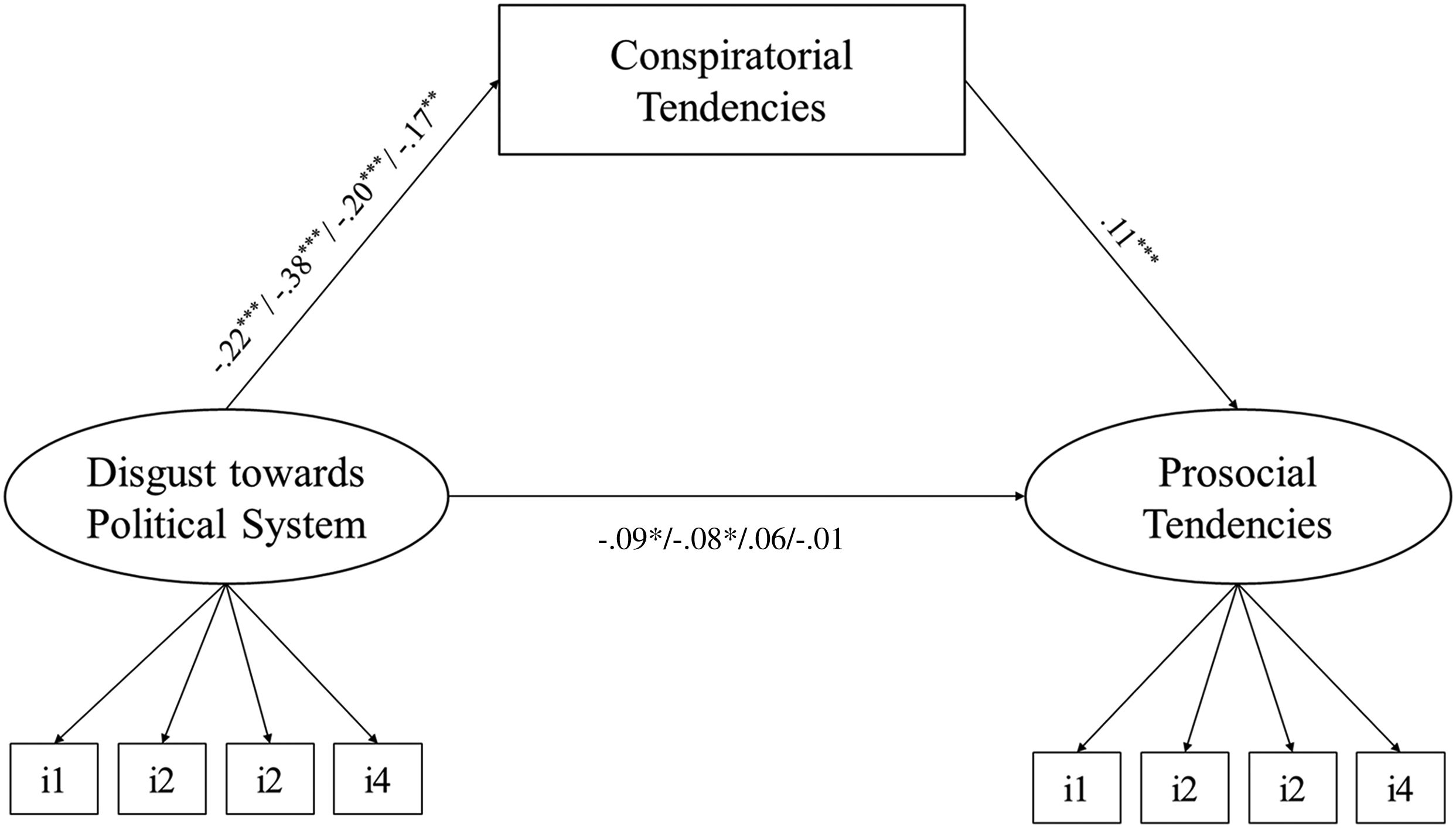
Structural equation model showing unstandardized coefficients. Note. Multiple coefficients indicate an unconstrained path and are reported as IT/UK/US/KOR. Gender, age, and political orientation are covariates in the model. ***p < .001, **p < .01, *p < .05.
The association between individuals’ feelings of disgust towards the political system and individuals’ conspiratorial tendencies was significant in the USA, b = −0.20, p < 0.001, Italy, b = −0.22, p < 0.001, Korea, b = −0.17, p = 0.002, and the UK, b = −0.38, p < 0.001. Across all countries stronger feelings of disgust towards the political system were associated with stronger doubts about the authorities’ official version of the events about COVID-19. The association was stronger in the UK and weaker in Korea. In addition, disgust was not significantly associated with prosocial tendencies in the USA, b = 0.06, p = 0.151 or Korea, b = −0.01, p = 0.846, but the association was significant in Italy, b = −0.09, p = 0.025, and the UK, b = -0.08, p = 0.039. Finally, prosocial tendencies were predicted by conspiratorial tendencies across all countries, b = 0.11, p < 0.001. The indirect effect of disgust on prosocial tendencies via conspiratorial beliefs was significant in the USA, b = −0.02, SE = 0.01, CI95% (−0.04 to −0.01), Italy, b = −0.03, SE = 0.01, CI95% (−0.04 to −0.01), Korea, b = −0.02, SE = 0.01, CI95% (−0.03 to −0.01), and the UK, b = −0.04, SE = 0.01, CI95% (−0.06 to −0.03).
Discussion
In the present study, for the first time, we examined whether feelings of disgust towards the political system are associated with stronger conspiratorial tendencies. In addition, we tested the proposition that stronger conspiratorial tendencies are linked to lower prosocial behavior to tackle the pandemic. Finally, we investigated whether there was a negative indirect effect from disgust towards the political system to lower prosocial behavior via stronger conspiratorial thinking. These hypotheses were examined in four large samples from the USA, Italy, Korea, and the UK.
Results showed the existence of a significant association between disgust and conspiratorial thinking across countries. Individuals who reported more disgust towards the political system were also less likely to believe to the authorities’ “official version” of the events concerning the pandemic. Not unlike other emotions, feelings of disgust may have an adaptive function. Specifically, disgust may motivate individuals to avoid diseases and other threatening pathogens in the environment. Disgust may also signal moral disapproval, leading individuals to reject perpetrators of (perceived or real) moral violations (e.g., Kupfer and Giner-Sorolla, 2017).
Here, we extend this research by showing for the first time that system-level feelings of disgust (i.e., disgust directed at the political system) may be linked to the rejection of information issued by official authorities, that is, more conspiratorial thinking. In the context of the current pandemic, lower reliance on official sources of information may put individuals at risk of contracting the disease. This form of “system-avoidance” could have, therefore, negative and paradoxical implications for individuals, and even increase the susceptibility to the disease in some social groups.
Interestingly, cross-country comparisons showed that the association between disgust against the political system and conspiratorial tendency was significantly stronger in the UK compared to the other countries (although the association remained significant across all countries). This difference indicates that in the UK, individuals who reported stronger disgust were also more likely to engage in conspiratorial thinking. Future research should examine whether the stronger association in the UK also persists in other circumstances—for instance, during the vaccine roll-out. Future research should also test why such association is larger in the UK compared to the other countries. An interesting possibility is that, in the British context, the perceived morality and legitimacy of the system are considered more central features of the political system (cf. Jackson et al., 2012). Thus, in the UK, people who report stronger disgust towards the system (signaling their concern with the system's stance) are also less likely to believe the authorities’ official version of the events. Additional comparative studies are needed to examine this speculation empirically.
Furthermore, consistent with findings from the previous studies (Hornsey et al., 2021; Imhoff & Lamberty, 2020) conspiratorial tendencies were significantly and negatively associated with prosocial tendencies. People who believed in conspiracy theories were less likely to express the intentions to engage in cooperative and prosocial actions that would be useful in keeping others safe during the COVID-19 pandemic. Further, results indicated the existence of a significant indirect effect of disgust towards the political system on intentions to act prosocially and help control the spread of the virus via conspiratorial tendencies. This set of results highlight the importance of considering system-level emotional processes in individuals’ appraisal of social systems and authorities. Indeed, individuals’ emotional responses towards the system may contribute to orient their behavioral intentions by shaping the way they respond to the system.
Importantly, results concerning this model were broadly consistent across the four countries included in this research (Italy, the UK, the USA, and South Korea), a finding that highlights the generalizability of the results across different cultural groups, cultural profiles, and world regions. Notably, however, in the present study, the direct association between disgust and prosocial intentions varied across countries. Future studies should examine this association further by including additional measures of cultural values such as tightness/looseness (Gelfand et al., 2021) or individualism/collectivism (Triandis & Singelis, 1998) and investigating their potential effect in moderating the relationship between disgust and prosociality.
Limitations and future directions
The present research supported the idea that across countries conspiratorial tendencies are an important explanatory variable of the association between disgust towards the political system and the intentions to act prosocially. Interestingly, according to recent evidence (Biddlestone et al., 2020), individuals’ conspiratorial tendencies may be associated with cultural values. Biddlestone et al. (2020) found that individuals’ beliefs in COVID-19 conspiracy theory were positively associated with vertical individualism and horizontal individualism, but negatively associated with horizontal collectivism. The model tested here could be extended by considering the association between disgust and cultural values.
Although we found a significant indirect effect across samples from four different countries, it is important to note that the cross-sectional nature of the current study may limit our ability to draw causal inferences among variables. For example, it may be possible that there is a reciprocal relationship between disgust towards political systems and prosocial behavioral intention. It is also plausible that exposure to, and acceptance of, conspiracy theories may result in stronger feelings of disgust towards the system, especially when the system is portrayed as sinister, immoral, or threatening. Future studies should make use of longitudinal designs to examine how reciprocal relationships between such variables unfold over time.
Another limitation of this research is that the conspiratorial tendency was measured using a scenario-based single item tapping into people's beliefs about the authorities’ official version about COVID-19. Although we adapted a validated single-item measure of conspiratorial tendencies (Lantian et al., 2016) to the context of COVID-19, it would be helpful to measure conspiratorial tendencies using a broader array of items and measures (Jolley & Paterson, 2020; Van Bavel et al., 2020). In a similar vein, it is important to notice we assessed individuals’ intentions to engage in collective prosocial action aimed at controlling the spread of the disease, rather than actual behavior. Future research should extend this work by testing the association between individuals’ conspiratorial tendencies and their actual behavioral responses in the context of the pandemic.
A crucial task for future research is also to investigate the antecedents of disgust towards the political system. Despite their enormous relevance (Goodwin et al., 2001), very little research has so far examined the roots of system-level emotional processes (Solak et al., 2012). Both individual-level (e.g., endorsement of specific ideologies) or system-level (e.g., degree of system openness) characteristics may impact on individuals’ propensity to feel disgust towards the political system.
Finally, research should examine the association between other negative emotions and individuals’ conspiratorial beliefs across domains (cf. Martel et al., 2020). According to Nabi (2002), disgust not only signals that individuals feel repelled by something but can also reflect annoyance or irritation. It has been suggested that moral disgust may largely be a metaphor for anger (Bloom, 2004). Therefore, more studies are needed that include measures of these emotions and examine their links with disgust. Interestingly, although the present study is consistent with research showing that negative emotions are linked to increased skepticism (e.g., Forgas, 2019), results also suggest that such skepticism may not always have positive correlates. Skepticism towards authorities’ “official version” was in turn associated with lower cooperative and prosocial tendencies. This finding highlights the importance of examining emotional processes directed towards concrete objects, in addition to work conducted on more general emotional states (cf. Martel et al., 2020).
Conclusion
The findings from the present study suggest that feeling disgust towards a political system may play a central role in people's intentions to act prosocially via individuals’ conspiratorial tendencies regarding the authorities’ version of the events. Importantly, this pattern was broadly similar and generalizable across four different countries. It is important that governments and authorities attempt to increase the transparency and trustworthiness of their actions to tackle the current COVID-19 pandemic and increase public engagement in prosocial behaviors.
Footnotes
Declaration of conflicting interests
The author(s) declared no potential conflicts of interest with respect to the research, authorship, and/or publication of this article.
Funding
The author(s) disclosed receipt of the following financial support for the research, authorship, and/or publication of this article: This work was supported by the Centre for Psychological Research at Leeds Beckett University
