




Abstract
The COVID-19 pandemic and associated “lockdown” measures spurred adverse employment changes and economic insecurity in U.S. families. Paradoxically, there was a surge in prosocial behavior. Chronically lower socioeconomic status has been associated with adults’ greater prosociality, a counterintuitive phenomenon attributed to heightened sensitivity to others’ needs. It is unclear whether experiencing an acute financial stressor—like the pandemic—would similarly promote prosociality. Following the “tend-and-befriend” theory, pandemic-induced financial stress may have motivated parents to engage their children in prosocial behaviors as a means of coping with the pandemic. Thus, we examined the associations of both pandemic-induced employment and economic stress with parents engaging their children in helping activities during shelter-in-place and whether this supported parents’ coping. A total of 492 parents (443 women; 72% White; income-per-capita range: $833–$87,500) with children ages 2–18 years completed an online survey during May–June 2020, assessing negative employment changes, pandemic-induced economic stress, families’ engagement in helping activities, and parent’s coping. Controlling for demographics and pre-pandemic income, our indirect effects model found that more negative employment changes predicted greater economic stress, which in turn predicted more helping activities with children. Parents who reported more helping activities also had better coping skills. Our findings demonstrate that acute financial stress directly resulting from COVID-19 spurred parents to engage their children in other-oriented, prosocial acts, perhaps as a means of enhancing social support with others experiencing pandemic stress. Moreover, helping others bolstered parents’ overall coping, revealing avenues for promoting well-being during a health crisis.
The COVID-19 pandemic created both a public health and an economic threat (Brodeur et al., 2021), introducing multiple stressors that undermined family functioning (S. M. Brown et al., 2020; Partington et al., 2022; Prime et al., 2022). On March 13, 2020, the U.S. federal government declared COVID-19 to be a national health emergency, and in the following month, more than 22 million people in the U.S. lost their jobs (Long, 2020), and unemployment claims soared (U.S. Bureau of Labor Statistics, 2020). Acute economic stress, spurred by closures of non-essential businesses and public health regulations limiting work, was particularly detrimental to U.S. families, undermining their functioning and well-being (Gassman-Pines et al., 2020). During shelter-in-place, both parents and children reported poor mental health and overall worse family adjustment (Feinberg et al., 2021; Racine et al., 2021), particularly for families who experienced economic stress (Gassman-Pines et al., 2020; Partington et al., 2022; Prime et al., 2022). While financial stress was exacerbated in families who were economically disadvantaged prior to the pandemic, there was heightened financial worry even in economically secure families (Chen et al., 2021). Media coverage concerning job loss, supply chain disruptions, and “lockdown” measures may have amplified a need to prioritize self-interests (Roux et al., 2015); however, there was an unprecedented surge in volunteerism and prosociality in response to the pandemic (Butler, 2020; Tse et al., 2022).
Early in the pandemic, news reports emphasized how communities supported each other during the crisis via acts of kindness, such as thanking frontline workers, sewing masks, and collecting and donating supplies (Butler, 2020; Enrich et al., 2020). Prosocial behavior—behaviors intended to help others and promote their welfare (Eisenberg et al., 2006)—effectively alleviates acute stress (Taylor, 2006; von Dawans et al., 2012), thereby promoting psychological and physical well-being (S. L. Brown et al., 2003; Curry et al., 2018; Hui et al., 2020) while maintaining social connection (Taylor, 2006). That is, prosocial behavior may facilitate coping with acute stress. Adults who acted prosocially during the early stages of the pandemic also reported greater life satisfaction, positive affect, and social connectedness, as well as fewer negative emotions, suggesting that prosocial behavior facilitates adults’ coping during an unprecedented crisis (Espinosa et al., 2022; Varma et al., 2023).
Extensive media coverage and public discourse surrounding compassionate, helpful acts during shelter-in-place may have inspired parents to encourage similar prosocial behavior in their children as a means of coping, to promote family bonding, and to instill prosocial group values in their children. Research outside of the pandemic context has found that parents effectively model prosocial behavior by participating in prosocial activities with their children (Spinrad et al., 2019). Modeling prosociality conveys that helping others is a valued social custom in their group. In turn, children are more likely to internalize prosocial values and may be more motivated to behave prosocially as a means of meeting group norms (Davidov & Grusec, 2023).
Caring and supportive family environments likely model, promote, and reinforce children’s prosocial behavior (Hastings et al., 2015; Spinrad et al., 2019), which has been reflected in emerging pandemic studies. Parents’ greater affective empathy, better coping skills, and parent-child attachment security have all been positively associated with children’s prosocial behavior during the pandemic (Coulombe & Yates, 2022; Mullins et al., 2023). However, families’ experiences of distinct pandemic stressors have differentially impacted both parenting behavior and children’s prosociality (He et al., 2021). In May through August 2020, parents’ experiences of greater pandemic-induced social stress (i.e., virus exposure and child care disruptions) were concurrently associated with their preschoolers’ lower prosocial behavior. Conversely, parents’ experiences of greater pandemic-induced economic stress (i.e., job loss and inability to make ends meet) were concurrently associated with their preschoolers’ greater prosocial behavior. In addition, He and colleagues (2021) found that parents’ positive outlook on the future—a form of coping—was positively associated with their children’s prosocial behavior, and parents who reported a more positive outlook were better able to meaningfully interact with their children early in the pandemic despite experiencing acute financial strain.
Parents experiencing financial stress may have engaged their children in prosocial acts to bolster their family’s ability to cope with the stressful pandemic conditions and to garner social support. While seemingly counterintuitive, extant literature has demonstrated that individuals with lower socioeconomic status (SES) display greater prosociality (Keltner et al., 2014; Piff & Robinson, 2017). Notably, prosocial behavior can be costly to an individual in terms of financial resources and time. Despite this personal cost, adults and children with lower SES consistently exhibit greater prosocial behavior (Keltner et al., 2014; Miller et al., 2015; Piff & Robinson, 2017), especially when they perceive there to be greater economic inequality (Côté et al., 2015; cf. Schmukle et al., 2019). It is possible that individuals with greater access to material resources may not feel the need to rely on others for help and support, such that they are more motivated to pursue self-beneficial behavior and have relatively weaker interpersonal sensitivity. Conversely, those with less access to financial resources may rely more on community support and other informal or non-economic means of managing; being on the receiving end of such assistance may lead them to be more attuned to others’ needs, which could facilitate prosocial behavior (Kraus et al., 2011; Piff & Robinson, 2017).
However, previous research on SES and prosocial behavior has primarily studied the chronic, more stable economic conditions of individuals. It is unclear the extent to which experiencing an acute financial stressor, like the pandemic, would have the same promotive effect on prosocial behavior as has been seen for chronic economic disadvantage. From a tend-and-befriend perspective, experiencing an acute stressor may prompt a person to “reach out” to others to promote social affiliation as a buffer against threat (Taylor, 2006). The tend-and-befriend framework suggests that individuals may exhibit increased empathy and other-oriented, prosocial behaviors when experiencing acute stress, as a means of strengthening their social connections with others, which in turn would promote their own well-being. Specifically, individuals may engage in “tending” behaviors (e.g., helping others) or “befriending” behaviors (e.g., creating new or re-affirming established social relationships) as a means of coping. These “tend-and-befriend” strategies facilitate coping by strengthening an individual’s social connections via increased prosocial tendencies (von Dawans et al., 2021). The pandemic’s pervasive deleterious impacts on society may have elicited a sense of “togetherness” with compatriots, motivating individuals to help others as a show of solidarity and shared identity (Drury et al., 2009). Early in the pandemic, solidarity—but not sympathy—mediated associations between adults’ compassion goals and their monetary donations to pandemic-specific charitable causes (Yue & Yang, 2022). Thus, other-oriented, “tending” stress response strategies may be one mechanism for adults to both maintain social alliance and to cope during a global health disaster.
Parents experiencing acute economic shock may have been particularly motivated to engage their families in prosocial behaviors to maintain solidarity with others experiencing pandemic stress. Anecdotally, many families jointly performed pandemic-specific prosocial activities that provided others with instrumental help and emotional support (e.g., sewing masks, writing encouraging messages; Enrich et al., 2020). These prosocial activities may have facilitated family connections and parental coping despite the stressful pandemic conditions. Following the tend-and-befriend framework, parents experiencing acute financial stress may have engaged their children in prosocial acts to bolster their family’s ability to cope with the stressful pandemic conditions and to garner social support; however, this has yet to be explored.
Thus, the purpose of the current investigation was to examine the effects of pandemic-induced employment and economic stress on parents’ socialization of children’s prosociality during shelter-in-place, and whether this supported parents’ ability to cope. As illustrated in Figure 1A, we expected that greater pandemic-induced economic stress would function as the mechanism by which the number of negative changes to parents’ employment would be associated with greater engagement in family helping activities (H1). In turn, we predicted that the extent to which parents engaged their children in helping activities would support parents’ feelings that they were able to cope with pandemic conditions (H2).
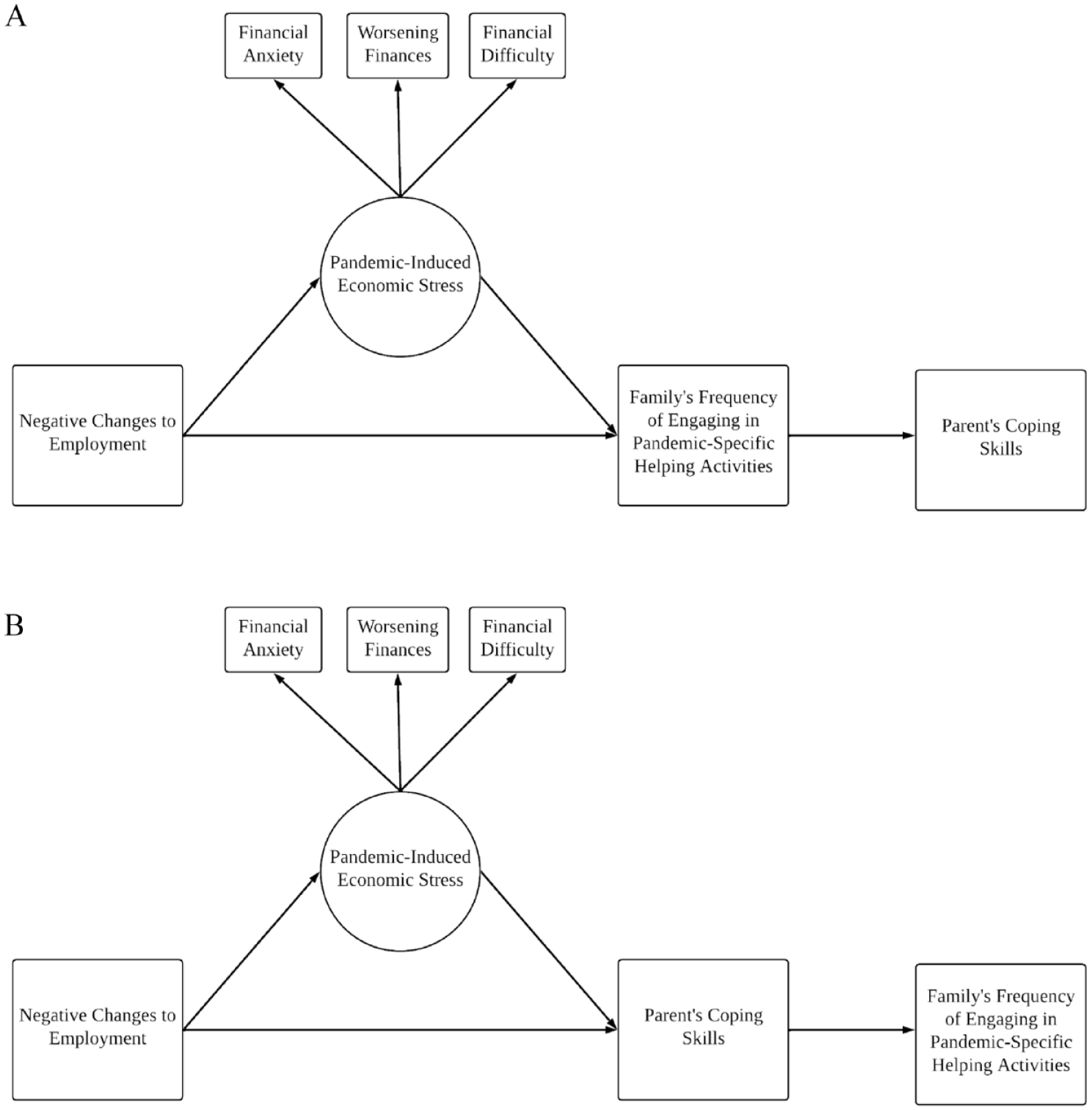
Conceptual Figure of Study Hypotheses and a Theoretical Alternative. Model A presents our hypothesized associations between key study variables, with pandemic-induced economic stress functioning as the mechanism by which the number of negative changes to parents’ employment relates to greater engagement in family helping activities and subsequently facilitating parent’s coping skills. Model B presents a plausible alternative model wherein parent’s coping skills facilitate family engagement in helping activities.
Method
Participants
We used convenience sampling to recruit parents. From 26 May through 18 June 2020, we advertised for an online study examining family functioning during the pandemic on social media (e.g., Facebook parenting groups), university newsletters, and participant recruitment webpage venues in the United States. Additional recruitment advertisements were targeted to communities with highly diverse populations to increase sample diversity, but with very limited effectiveness. To be eligible, the parent had to be 18 years of age or older, have at least one child between the ages of 2 and 18 years who was living at home, have access to a device with internet capabilities, and be able to read and write in English. A total of 492 parents participated (92% living with partner, 30% annual income >$150,000). The sample was predominantly highly educated (48% participating parents had a post-graduate degree, 33% of partners had a post-graduate degree), White mothers (89% female, 11% male, 0% nonbinary, 72% White) in their late 30s (M = 38.18 years, SD = 6.35 years) living in 2-child households (M = 2.00 children, SD = .92 children, range: 1–6 children) with a median income-per-capita of $31,250 (range: $833–$87,500). Almost half (49%) of families reported an essential worker living in the house, of which 11% were health care workers. Our sample had a higher proportion of adults with a post-graduate degree and higher household income in comparison to 2019 national U.S. demographics (McElrath & Martin, 2021; Shrider et al., 2021), such that this constituted an economically low-risk sample, at least prior to pandemic-related employment changes.
Procedure
The University of California, Davis, IRB Administration approved all procedures (study ID: 1604542). Participants completed the study using Qualtrics, an online data-collection tool. Prior to completing the survey, participants viewed an online informed consent page describing the purpose of the survey and the approximate duration of the survey. Consenting participants were then directed to the online survey and reported on their demographics, changes to their own and their partner’s (if applicable) employment, pandemic-induced economic stress, activities that the family had done during shelter-in-place, and parent’s coping skills. Parents received a $15 Amazon gift card as compensation. The survey took approximately 45 minutes to complete.
Measures
Data for the present study came from an online survey of family functioning in the wake of the COVID-19 pandemic that comprehensively assessed multidimensional measures of family adjustment and novel experiences during shelter-in-place. Thus, to minimize participant burden while capturing a wide breadth of variables, some measures were reduced to only contain key items with high face validity and direct relevance to the pandemic context (Allen et al., 2022; Wanous et al., 1997). This decision impacted the following variables: financial anxiety, worsening finances, and family helping activities.
Demographics
Income Per Capita
Income per capita was calculated by dividing self-reported annual household income from 2019 by the reported number of people living in the household. Next, we divided the resulting number by 10,000 to create values on a comparable scale to other measures.
Race and Ethnicity
Parents were asked to report their race and ethnicity. Because of the preponderance of parents identifying as “White/Caucasian,” this was treated as a bivariate (0/1) measure, while recognizing the inherent assumptions and limitations of this approach.
Educational Level
Parents were asked to report the highest level of education that they had completed, with higher values representing higher education level.
Parent Gender
Parents’ gender was measured as their response to the following question, “What gender do you most identify with?”
Essential Worker Living in Household
Parents reported on whether any adults living in the household were essential workers (e.g., health care workers). Responses included “yes” and “no,” which were dummy-coded into 1 and 0, respectively.
Partner
Parents reported on whether they resided with a spouse or partner in their household. Responses included “yes” and “no,” which were dummy-coded into 1 and 0, respectively.
Negative Changes to Employment
We measured negative changes to employment by participants’ responses to the item, “Please indicate any changes to your employment since the pandemic began. Please check all that apply.” Participants were asked to complete this item for their partner as well (if applicable). We used a sum score for all reported changes that would negatively impact family finances (e.g., “been laid off or lost job”) for both participant and partner (if applicable) as reflective of total negative changes to employment in the household.
Pandemic-Induced Economic Stress
Financial Anxiety
We adapted 1 item from the Financial Anxiety Scale (Archuleta et al., 2013). Parents rated how anxious they felt about their financial situation during the pandemic using a 5-point scale (1 = Not at all, 5 = Extremely).
Financial Difficulty
Parents rated how difficult it had been to afford basic goods and necessities using a 5-point scale (1 = Not at all difficult, 5 = Extremely difficult). Parents rated difficulty for affording food, clothing, rent or mortgage, utilities and bills, things needed for children, medical care, and other items not specified. Due to low response variability on some items, we computed a mean score for responses for 3 items: difficulty affording food, difficulty affording rent or mortgage, and difficulty affording utilities and bills (α = .924).
Worsening Finances
Parents rated the extent to which the item “since the pandemic began, your financial situation is worse now than it was before the pandemic” was reflective of their finances using a 5-point scale (1 = Not at all true, 5 = Extremely true).
Family Helping Activities
Engagement in Helping Activities
Participants were asked, “Since the pandemic began, have you and your child/ren spent time helping others (e.g., writing encouraging things on the sidewalk, helping spread awareness of resources, sewing masks)?” Participants answered either “yes” or “no.” Participants who answered “no” were assigned values of 0 for both frequency of family helping activities and enjoyment of family helping activities.
Frequency of Helping Activities
Participants who answered “yes” to their family engaging in helping activities subsequently rated how frequently they had done these activities using a 5-point scale (1 = Every once in a while, 5 = Multiple times a day).
Enjoyment of Helping Activities
Participants who answered “yes” to their family engaging in helping activities subsequently rated the extent to which the family enjoyed doing these activities (1 = Not at all, 5 = Extremely).
Parents’ Coping Skills
We measured parents’ coping skills using the Brief Resilient Coping Scale (BRCS; Sinclaire & Wallston, 2004). Using a 5-point scale, parents rated the extent to which statements accurately described their behavior on four items (e.g., “I look for creative ways to alter difficult situations,” 1 = Does not describe me at all, 5 = Describes me very well). We computed a mean score, with higher scores reflecting better coping skills (α = .669). The Cronbach’s alpha for the BRCS was below the recommended .70 cutoff (Nunnally, 1978). This may have been due to the brevity of the measure, as scales with fewer items are susceptible to lower values (Cortina, 1993; Streiner, 2003). The scale’s mean inter-item correlation (r = .339) exceeded the recommended cutoff of .15–.20 (Clark & Watson, 2016), suggesting the BRCS was a reliable measure.
Data Analytic Plan
Data Pre-Processing
Data pre-processing and preliminary analyses were performed in SPSS Statistics, version 28. Variables were reviewed for univariate normality, transforming univariate outliers, and assessing for systematic missingness. Our data pre-processing steps can be found in Supplemental Materials.
Covariates
Previous research demonstrates that sociodemographic factors impacted parents’ adjustment at the pandemic’s start (Hawkins, 2020; Hooper et al., 2020); thus, we controlled for parent’s gender, age, race, and ethnicity; household’s 2019 income-per-capita; presence of an essential worker living in the household; and if the parent lived with a partner. In addition, we controlled for family enjoyment of helping activities to examine if effects were specific to frequency of family helping activities.
Hypothesis Testing
We used structural equation modeling (SEM) with the R lavaan package to fit an indirect effects model that tested if negative changes to employment were related to greater frequency of family helping activities (direct effect) via increased pandemic-induced economic stress (indirect effect) (H1). The model also included the direct association of frequency of family helping activities with parent’s coping. In this model, negative changes to employment, frequency of family helping activities, and parent’s coping were manifest variables. Pandemic-induced economic stress was a latent variable comprised of financial anxiety, worsening finances, and financial difficulties’ scores.
We fit all models using maximum likelihood (ML) estimation with bootstrapping (1,000 iterations) to estimate the direct, indirect, and total effects with bias-corrected accelerated 95% confidence intervals (BCA CIs) and to derive standard errors and model fit. Bias-corrected bootstrapping with ML estimation is a robust approach for indirect effects analyses with non-normal data, which were present in our data, and it is robust against non-normality of the sampling distribution of the indirect effect (MacKinnon et al., 2004). For the tested indirect effect, BCA CIs that did not include 0 were determined to meet mediation criteria, whether or not the total or direct effects were significant (Hayes, 2015). We assessed model fit with the chi-square likelihood-ratio statistic, and these fit index criteria include Root Mean Square of Approximation (RMSEA) < .08, Standardized Root Mean Square Residual (SRMR) < .08, Comparative Fit Index (CFI) > .90, and Tucker-Lewis Index (TLI) > .90.
Latent Construct Validity of Pandemic-Induced Economic Stress
We selected families’ financial anxiety, worsening finances, and financial difficulties scores as indicators of pandemic-induced economic stress as they reflect subjective and objective measures of economic stress. Extant theory and empirical research demonstrate that a family’s experience of economic stress is a multidimensional construct that includes both objective and subjective elements (Conger et al., 2010; Diemer et al., 2013). Thus, we selected indicators that reflected subjective (i.e., financial anxiety) and objective measures of financial stress (i.e., worsening finances, difficulty affording basic needs). In addition, we reviewed bivariate correlations as we expected high correlations among the indicators, which is expected for a latent variable (Kline, 2015), and to ensure there were no redundant indicators (i.e., all r’s should be <.70; Tabachnick & Fidell, 2013). Finally, we assessed each indicator’s standardized factor loading with the following thresholds: >0.70 suggests a strong indicator, 0.40–0.70 suggests an acceptable indicator, and <0.40 suggests a weak indicator (Kline, 2015).
Post hoc Confirmatory Tests—Additional Models
We fit three additional models to test robustness (robustness check model), alternative directions for associations (alternative model), and sensitivity (sensitivity analysis model). The robustness check model was identical to our hypothesized model; however, we removed families’ enjoyment of helping activities as a covariate to see if the hypothesized associations were robust to the presence of this covariate. Next, it is possible that parents with better coping skills are better equipped to engage their children in helping activities (Mullins et al., 2023). Thus, we fit the alternative model (see Figure 1B) that examined if negative changes to employment were associated with parents’ coping skills via pandemic-induced stress, and if parents’ coping skills were subsequently associated with greater frequency of family helping activities. The sensitivity analysis model was identical to our hypothesized indirect effects model, and only included parents who answered “yes” to spending time with their children engaged in pandemic-specific helping activities (n = 199).
Post Hoc Confirmatory Tests—Multigroup Comparison
Recognizing the disproportionate representation of mothers (n = 442) and fathers (n = 49) in the sample, post hoc multigroup comparison was used to determine whether the paths of interest in the hypothesized model were comparable for mothers and fathers. First, a model where all parameters were estimated freely was fit for each gender. Next, a second model was fit that constrained all key paths to be equal across gender (i.e., direct effect, indirect effect, total effect, and frequency of family helping activities → parent’s coping skills). We performed the chi-square goodness of fit test to determine if the constrained model significantly worsened model fit.
Missing Data
Missing data occurred at a low frequency (7.5%). Little’s Missing Completely at Random test suggested that data could be treated as missing completely at random, χ2(23) = 30.784, p = .128. Missing values were estimated with full information maximum likelihood (FIML).
Results
Preliminary Analysis
Table 1 contains means, standard deviations, and zero-order correlations. On average, parents reported low levels of negative changes to employment and pandemic-induced economic stress, as well as moderately high coping skills. More negative changes to employment were correlated with worsening finances, greater financial anxiety, and greater financial difficulty (p’s < .001) and marginally correlated with families’ greater frequency of helping activities (p = .069). All pandemic-induced economic stress variables were positively correlated with frequency of helping activities (p’s < .01) but were not correlated with enjoyment of helping activities (p’s > .259). As expected, parents’ better coping skills were correlated with greater frequency and enjoyment of helping activities (p’s < .01). As expected, all pandemic-induced economic stress variables (worsening finances, financial anxiety, and financial difficulty) were positively and strongly correlated with one another (r’s: .66–.70, p’s < .001), suggesting they reflect an underlying latent variable without redundancy. In addition, the variance inflation factor scores were <5 for the pandemic-induced stress indicators, suggesting that multicollinearity is not a concern and would not impact parameter estimates (Kline, 2015).
Descriptive Statistics and Zero-Order Correlations.
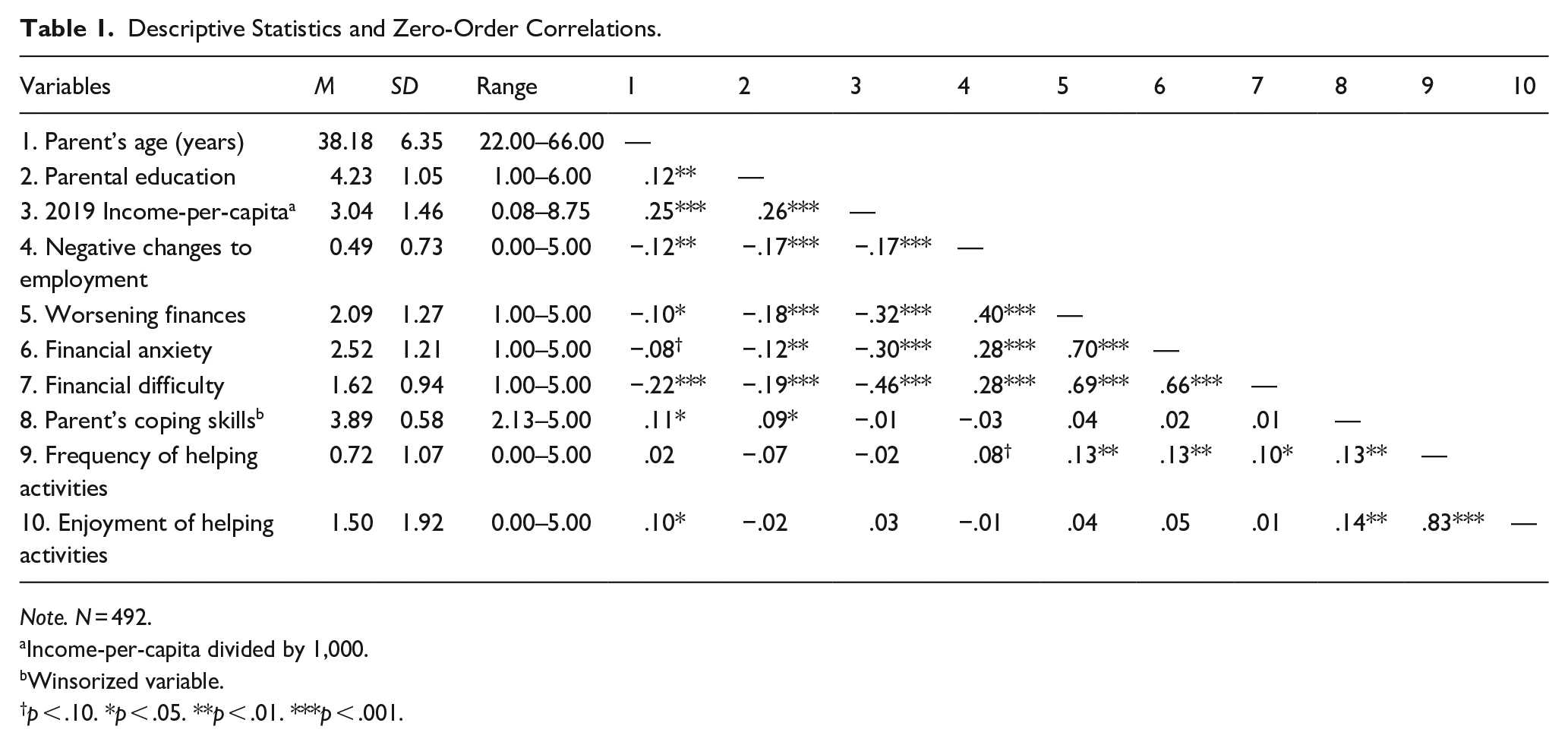
Note. N = 492.
Income-per-capita divided by 1,000.
Winsorized variable.
p < .10. *p < .05. **p < .01. ***p < .001.
Of all participating parents, 40.4% reported that their families were engaged in some type of pandemic-specific helping activity (n = 199). Within that subset, families did a helping activity once a week, on average (M = 1.780, SD = 0.970), and moderately to greatly enjoyed the activity (M = 3.720, SD = 0.922). Families who did not do any helping activities had significantly greater financial difficulties (M = 1.732, SD = 0.978) than families who did engage in helping activities (M = 1.530, SD = 0.912), t(465) = −2.087, p = .037.
We performed independent t-tests to see if key study variables differed by parent’s gender, parent’s race, living with a partner, and presence of an essential worker in the household (Table 2). We found significant differences between sociodemographic characteristics on several key study variables, further justifying their inclusion as covariates.
Differences Between Sociodemographic Characteristics on Key Study Variables.
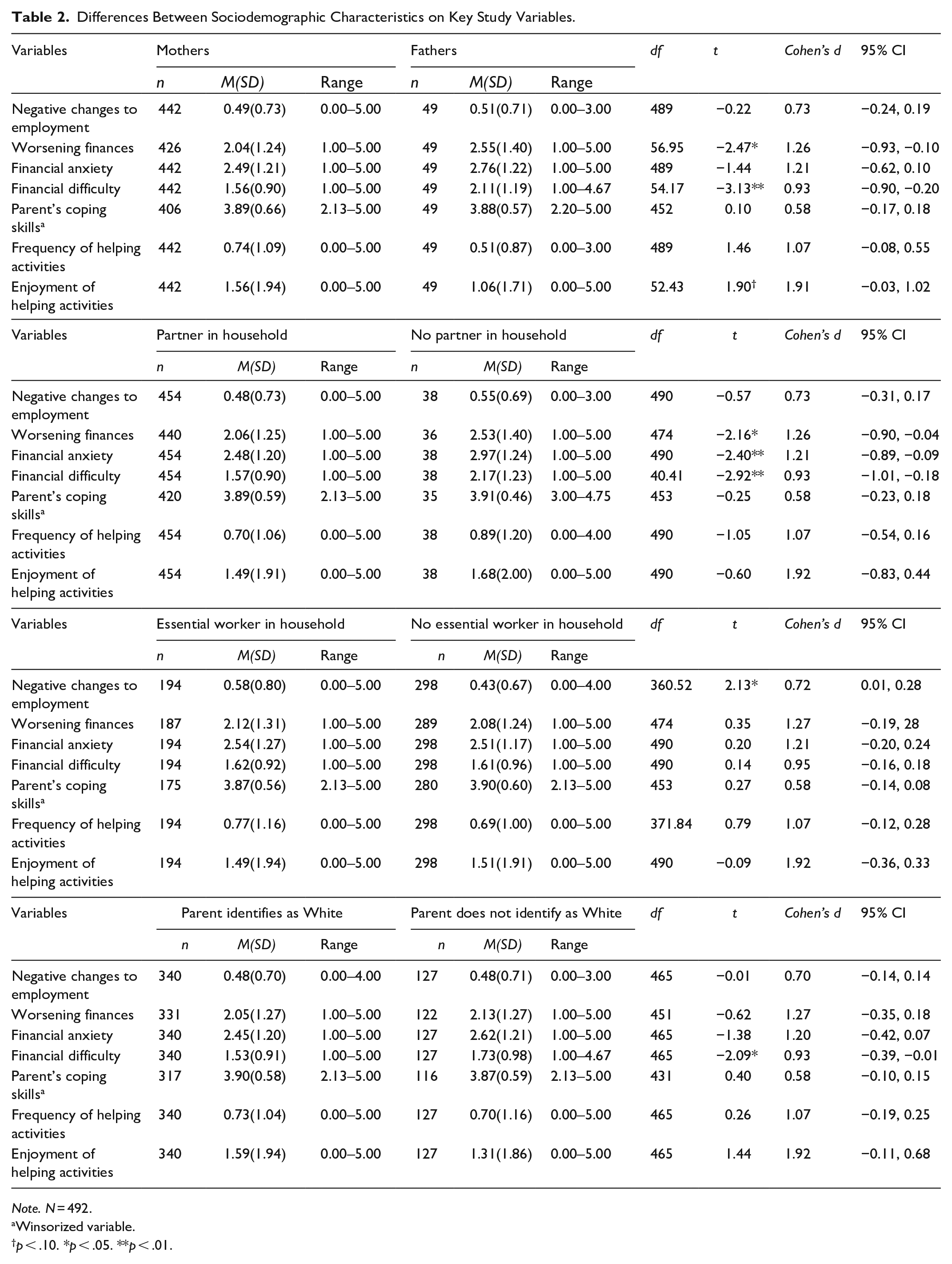
Note. N = 492.
Winsorized variable.
p < .10. *p < .05. **p < .01.
Hypothesis Testing
The hypothesized model had good fit, χ2(64) = 134.712, p < .001, CFI = 0.957, TLI = 0.939, RMSEA = .047 (90% CI [.036, .059]), SRMR = .046. The standardized factor loadings for the pandemic-induced economic stress indicators were all above .70, suggesting they strongly reflected the latent construct. The significant likelihood-ratio test suggests that our model-implied covariance matrix was not exact to the population (Bentler & Bonett, 1980). SEM analyses with large sample sizes yield the smallest confidence intervals around parameter estimates; subsequently, the likelihood-ratio test becomes overpowered and more likely to reject models due to small differences in residuals despite the tested model being well-specified (Satorra & Saris, 1985). As a robustness check, we performed the RMSEA test of close fit and of not-close fit (see Supplemental Materials). Holistically, the comparative and absolute fit indices indicate that our model has good fit despite the significant likelihood-ratio test. We report both the standardized (Table 3) and unstandardized coefficients (Figure 2) for the full model.
Path Estimates for Hypothesized Model of Indirect Associations of Pandemic-Induced Economic Stress Predicting Families’ Helping Activities and Parents’ Coping Skills.
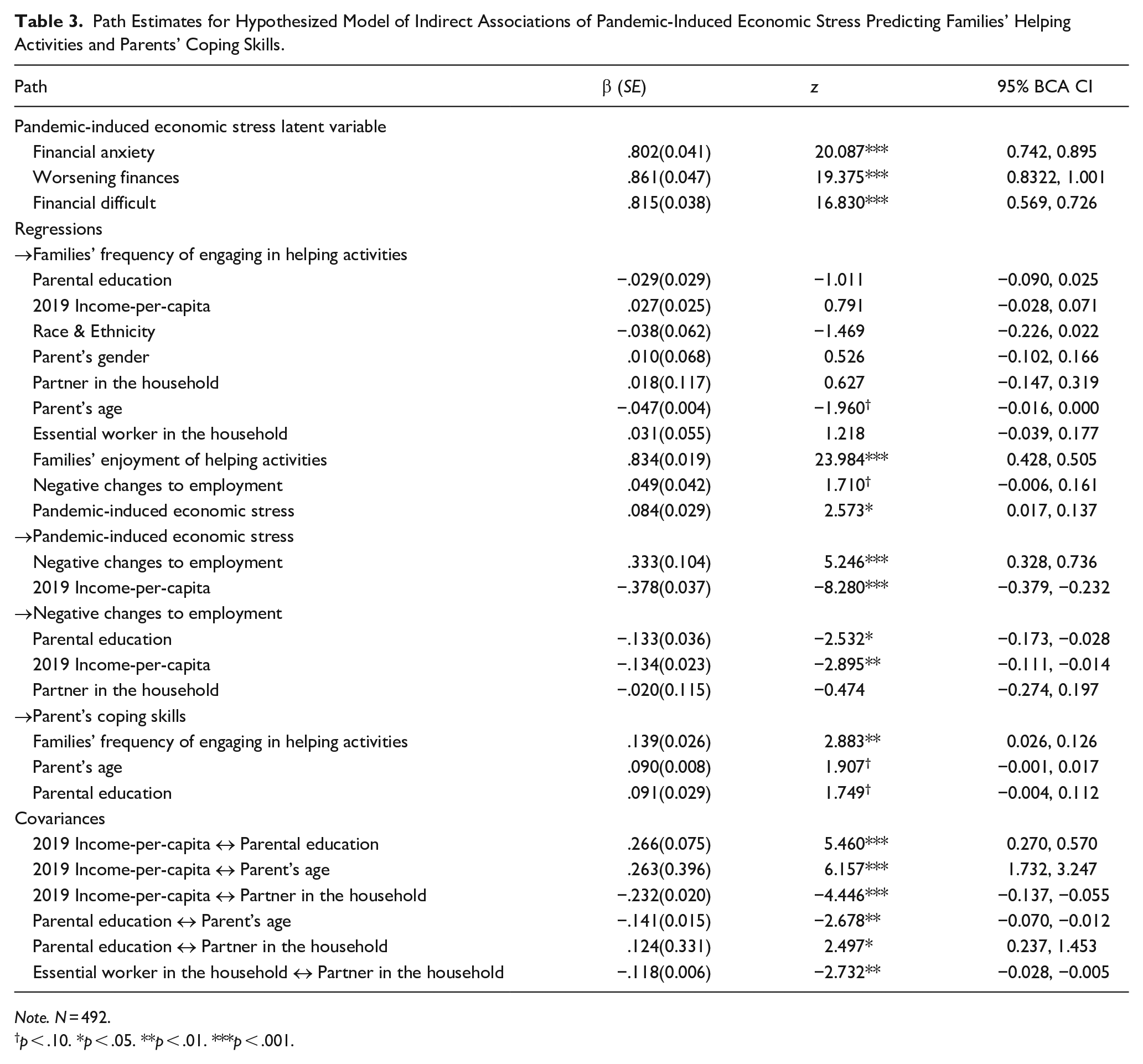
Note. N = 492.
p < .10. *p < .05. **p < .01. ***p < .001.
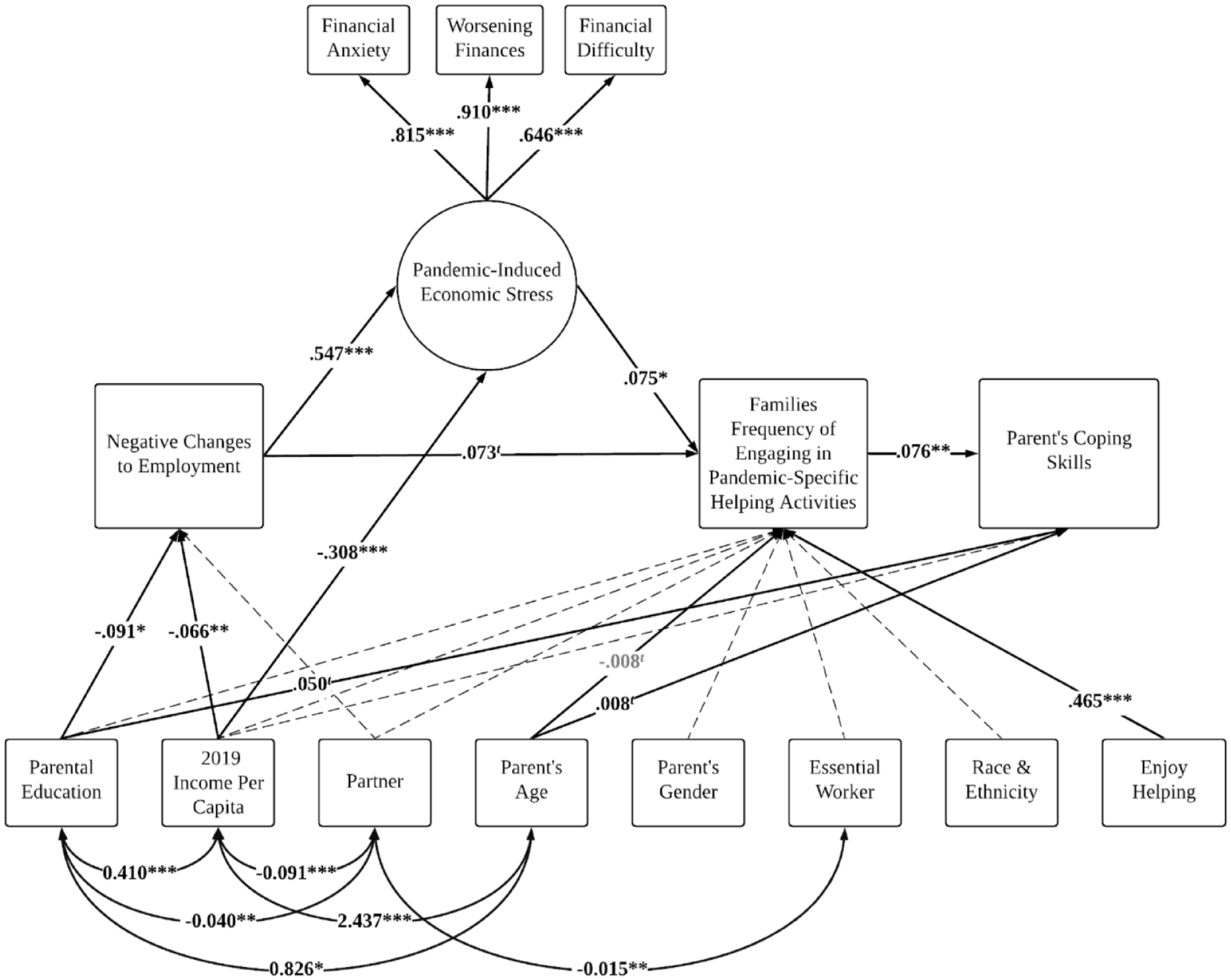
Path Estimates for the Hypothesized Model of Indirect Effects (N = 492). Structural equation model of indirect associations of pandemic-induced economic stress predicting frequency of families’ helping activities with subsequent associations to parents’ coping skills. Values are unstandardized coefficients, with dark lines displaying significant paths, and dashed lines displaying non-significant paths. Missing data are estimated with Full Information Maximum Likelihood. Model has good fit: χ2(64) = 134.712, p < .001, CFI = 0.957, TLI = 0.939, RMSEA = .047, SRMR = .046.
The tests of indirect effects supported H1 (Table 4). While negative employment changes were not associated with frequency of family helping activities, ß = .049, p = .087, 95% BCA CI [−0.006, 0.161], more negative employment changes were associated with greater pandemic-induced economic stress, ß = .333, p < .001, 95% BCA CI [0.328, 0.736]. In addition, greater pandemic-induced economic stress was associated with greater frequency of family helping activities, ß = .084, p = .010, 95% BCA CI [0.017, 0.137]. As expected, the total effect for the model was significant, ß = .077, p = .007, 95% BCA CI [0.031, 0.199]. We found that the direct effect of negative changes to family employment on frequency of family helping activities was not significant, ß = .049, p = .087, 95% BCA CI [−0.006, 0.161]. That is, negative changes in employment were not directly associated with how frequently parents engaged their children in helping activities. As expected, we found a significant indirect effect for greater negative employment changes in a family being associated with greater frequency of family helping activities through greater pandemic-induced economic stress, ß = .028, p = .021, 95% BCA CI [0.010, 0.082]. Supporting H2, greater frequency of family helping activities predicted parents’ greater coping skills, ß = .139, p = .004, 95% BCA CI [0.026, 0.126]. These findings indicate that more negative employment changes predicted greater pandemic-induced economic stress, which in turn predicted families’ engaging in more helping activities. Furthermore, parents who reported engaging in more helping activities with their children also reported having better coping skills.
Parameter Estimates for the Indirect Effects Tests for all Models.
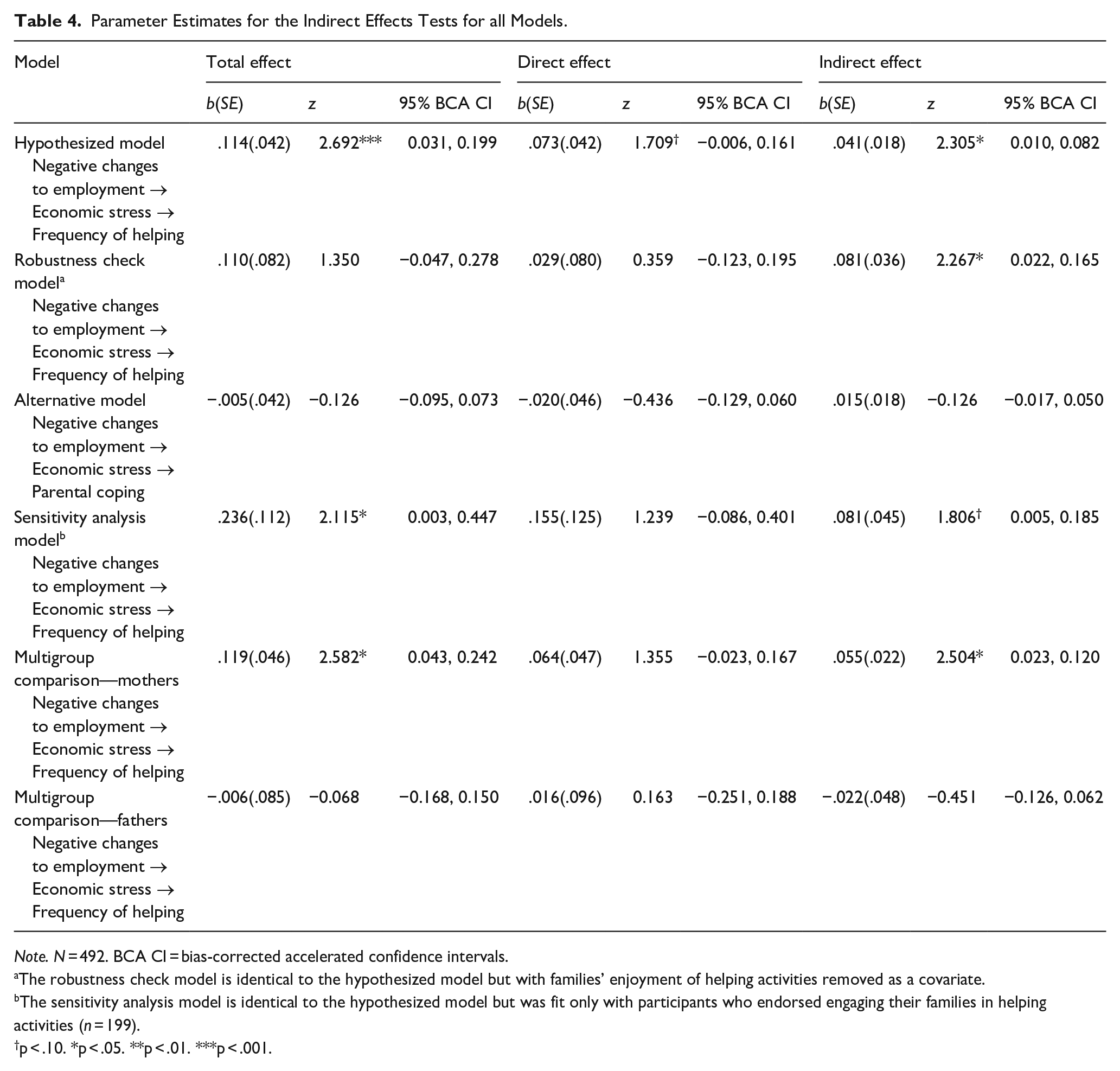
Note. N = 492. BCA CI = bias-corrected accelerated confidence intervals.
The robustness check model is identical to the hypothesized model but with families’ enjoyment of helping activities removed as a covariate.
The sensitivity analysis model is identical to the hypothesized model but was fit only with participants who endorsed engaging their families in helping activities (n = 199).
p < .10. *p < .05. **p < .01. ***p < .001.
Post Hoc Confirmatory Tests
Additional Models
The robustness check model, excluding the enjoyment of helping activities measure, had good model fit: χ2(52) = 121.281, p < .001, CFI = 0.934, TLI = 0.900, RMSEA = .052, 90% CI [.040, .064], SRMR = .045. However, tests for indirect effects only partially replicated findings from the hypothesized model (Table 4). The direct effect of negative changes to family employment on frequency of family helping activities was not significant, ß = .020, p = .719, 95% BCA CI [−0.123, 0.195]. Like the hypothesized model, we found a significant indirect effect for greater negative employment changes in a family being associated with greater frequency of family helping activities through greater pandemic-induced economic stress, ß = .055, p = .023, 95% BCA CI [0.022, 0.165]. Unlike the hypothesized model, the total effect was non-significant for the robustness check model, ß = .075, p = .277, 95% BCA CI [−0.047, 0.278]. These results suggest that our hypothesized, indirect associations between negative employment changes, pandemic-induced economic stress, and frequency of helping activities do not depend on whether a family enjoyed doing the helping activities.
The alternative model, reversing the hypothesized direction of association between helping and coping, had good fit: χ2(64) = 161.420, p < .001, CFI = 0.941, TLI = 0.916, RMSEA = .056 (90% CI [.045, .066]), SRMR = .052. However, tests for indirect effects were all non-significant (Table 4). Parents’ coping skills did not predict frequency of family helping activities, ß = .023, p = .293, 95% BCA CI [−0.032, 0.134]. Our hypothesized model and the alternative model were not nested but were fit to the same data; thus, we compared model fit using Akaike information criterion (AIC), with the smaller AIC value suggesting better fit (Symonds & Moussalli, 2011). The alternative model’s AIC was 16,297.146, which is higher than the hypothesized model’s AIC of 16270.438, suggesting that helping activities predicted parents’ coping and not vice versa. Supplemental Materials contain the AIC evidence ratio results.
For our sensitivity analysis (i.e., excluding parents who reported not engaging in any pandemic-related prosocial activities with their children), the model with the limited subsample had worse but acceptable fit: χ2(64) = 142.025, p < .001, CFI = 0.928, TLI = 0.897, RMSEA = .050, 90% CI [0.039, 0.061], SRMR = .054. The parameter estimates and the tests of total, direct, and indirect effects were weaker but largely replicated the key results from the full sample model (Table 4). Negative employment changes were not associated with frequency of family helping activities, ß = .118, p = .215, 95% BCA CI [−0.086, 0.401]; however, more negative employment changes were associated with greater pandemic-induced economic stress, ß = .333, p < .001, 95% BCA CI [0.320, 0.769]. In addition, greater pandemic-induced economic stress was associated with greater frequency of family helping activities, ß = .185, p = .045, 95% BCA CI [0.010, 0.299]. Like the full sample model, the total effect was significant, ß = .179, p = .034, 95% BCA CI [0.003, 0.447], and the direct effect was not significant, ß = .118, p = .215, 95% BCA CI [−0.086, 0.401]. In addition, despite having a marginal p-value, the indirect effect met mediation criteria in the 95% BCA CIs, ß = .062, p = .071, 95% BCA CI [0.005, 0.185], replicating the significant indirect effect found in the full sample model. Overall, the results of the post hoc confirmatory tests support the robustness of our hypothesized model and associated findings.
Multigroup Comparison
Allowing all parameters to vary between gender significantly improved model fit relative to constraining the key paths to be equal for both groups, χ2(4) = 9.892, p = .042. The tests of indirect effects were significant for mothers only (Table 4). For mothers, more negative employment changes predicted mothers’ greater pandemic-induced economic stress, ß = .353, p < .001, 95% BCA CI [0.354, 0.839], which in turn predicted engaging in more helping activities, ß = .105, p = .003, 95% BCA CI [0.037, 0.159]. However, this was not observed in fathers (p’s > .057). Greater frequency of family helping activities predicted greater coping skills for both mothers, ß = .116, p = .027, 95% BCA CI [0.007, 0.120], and for fathers, ß = .358, p = .035, 95% BCA CI [0.045, 0.438]. For both mothers and fathers, engaging their children in more helping activities related to parents’ better coping skills, but this association was stronger for fathers. The complete model results by gender are in Supplemental Materials (Table S1).
Discussion
During the pandemic, we found that a sample of mostly well-resourced parents responded to acute financial stress with behaviors typically seen in more chronically under-resourced communities. In support of H1, when families experienced greater negative employment changes, parents reported feeling greater pandemic-induced economic stress, which in turn predicted parents and their children engaging in more activities to help others. Parents who reported doing more helping activities with their children also had better coping skills, as expected in H2. Families’ engagement in prosocial activities uniquely predicted parents’ coping skills, whereas parents’ coping skills did not predict their engagement in helping activities. These findings were robust to post hoc confirmatory tests assessing sensitivity and directionality. Financial stress directly resulting from COVID-19 spurred parents to engage their children in other-oriented, prosocial acts, perhaps as a means of enhancing social connection while supporting others. Moreover, helping appeared to bolster parents’ overall coping, elucidating avenues for promoting well-being as COVID-19 continues.
Notably, we found that acute experiences of financial stress during the early stages of the pandemic elicited other-oriented responses like those seen in chronically lower-income contexts, even though our sampled families were more economically secure than national sociodemographics (Shrider et al., 2021). It is well-documented that individuals from chronically lower socioeconomic contexts exhibit greater prosociality (Keltner et al., 2014; Miller et al., 2015; Piff & Robinson, 2017). Perceived social strata may influence individuals’ expectations surrounding how and when to help others, with higher SES being associated with sociocultural norms of self-reliance and independence, and lower SES being associated with sociocultural norms of collective support as a means of ensuring community survival (Kraus et al., 2011). Thus, in under-resourced communities, prosocial behavior may be beneficial to an individual as it maintains social support and interdependence, whereas an individual’s self-focused behavior may be more “costly” as it could lead to alienation. Accordingly, it is less expected for economically advantaged individuals to show the same level of prosociality, given the sociocultural norms of self-reliance (Keltner et al., 2014). Yet, we found that parents’ acute experiences of economic stress prompted them to engage their children in prosocial activities, despite their generally high SES.
In showing that even for a well-resourced sample of families, parents’ acute feelings of financial stress prompted compassionate behavior that in turn bolstered their coping skills, our findings conformed to the tenets of the tend-and-befriend model of stress responses (Taylor, 2006). To our knowledge, this is the first evidence for tend-and-befriend responses (i.e., other-oriented, helping activities) during the COVID-19 pandemic being triggered by acute, pandemic-induced financial stress. This builds on evidence that more feelings of generalized COVID-19 threat were related to increased altruistic behaviors (Vieira et al., 2022) and social cohesion during shelter-in-place (Silveira et al., 2023). Notably, previous work has largely focused on individual use of tend-and-befriend strategies to alleviate acute stress (von Dawans et al., 2021). Our study demonstrates that parents also engage their children in these tend-and-befriend strategies, which may be an important context for the socialization of prosociality (Hastings et al., 2015). Furthermore, as hypothesized by Taylor (2006), parents engaging their children in collaborative other-oriented helping activities also appeared to benefit parents themselves, as they reported greater coping skills that could better equip them to handle pandemic stressors. Parents’ coping skills also may have provided a unique strength for supporting the overall well-being of the family system during shelter-in-place (Partington et al., 2022; Prime et al., 2022).
Our findings indicate that when faced with sudden and unexpected economic stress, economically advantaged individuals who, under more typical circumstances, would be expected to be less reliant on community support (Keltner et al., 2014) exhibit prosocial tendencies like those observed in chronically lower socioeconomic contexts (Piff & Robinson, 2017), providing insight into the mutability of socioeconomic differences in prosociality. The ubiquitous nature of the pandemic may have triggered feelings of solidarity and collective suffering (Yue & Yang, 2022), motivating even economically advantaged individuals to provide help to others as a way of maximizing society’s welfare. Previous research demonstrates that individuals with higher SES are significantly more likely to adopt a utilitarian moral approach that prioritizes actions that maximize the greatest good for the greatest number of people (Côté et al., 2013), and the pandemic may have prompted similar moral motivations in our sample when they experienced acute financial stress. Future research with a more diverse socioeconomic sample and longitudinal data could both disentangle the contributions of acute versus chronic economic stress in influencing prosocial behavior as well as further probe into the directionality of the indirect effects that we observed. In addition, future research would benefit from examining the motivations underlying parents’ decisions to engage their children in helping activities during a crisis as well as from examining potential individual difference factors (e.g., personality traits, empathy) to better understand the conditions in which economic stress influences prosociality.
Our post hoc multigroup comparison suggests that the indirect effect predicting family helping activities may be unique to mothers. Specifically, negative employment changes were significantly associated with mothers’ increased pandemic-induced economic stress, which related to greater engagement in helping activities with their children. This indirect effect was not evident for fathers. This aligns with the tend-and-befriend framework, which Taylor (2006) originally created as a theoretical alternative to describe female responses to acute stress. While findings for gender differences in tend-and-befriend strategies are mixed (von Dawans et al., 2021), our results support research finding that women exhibit cooperative and other-oriented behavior more consistently than men (Nickels et al., 2017; Turton & Campbell, 2005), even during the pandemic (Silveira et al., 2023). Of note, the much smaller number of fathers in our sample limits our power to detect significant indirect effects in this group, such that this possible gender difference in the pattern of associations warrants replication with a larger sample of fathers. Notably, frequency of family helping activities predicted coping skills more strongly for fathers than for mothers. This could suggest that active participation in helping activities during the pandemic may have served as a form of agency-driven coping for fathers. In line with traditional masculine norms, which emphasize action and instrumental help (Eagly, 2009; Hsu et al., 2021), fathers who engaged their children in prosocial activities aimed at helping others may have derived a sense of control and efficacy through these concrete actions. It is also possible that mothers and fathers engaged in different types of helping activities with their children, leading to different impacts on their coping skills. Given the post hoc nature of these findings and the small sample size of fathers, future research with larger, more balanced samples is needed to replicate these results.
Our findings suggest that parents who engaged their children in constructive activities aimed at helping others also enabled parents to feel like they were better managing their stress. Helping others may bolster parents’ efficacy, especially when their children jointly participate. This is noteworthy when considering reports of parents’ increased frustration due to their children engaging in non-productive activities (e.g., screen time) during pandemic-related school closures. Pandemic research has found that high levels of parenting stress are associated with children’s increased screen time and decreased family play (Seguin et al., 2021; Stienwandt et al., 2022). In contrast, our results suggest that participating in prosocial activities with their children may have helped parents feel more competent in managing their stress while also contributing to community well-being. Future research should further explore the ways in which family-based prosocial activities foster parental efficacy and competence as a tractable intervention target. Moreover, pandemic research that incorporates parents’ qualitative descriptions of their experiences with pandemic-induced economic stress and parenting may provide a more nuanced understanding of how acute changes in family finances influence parenting practices and coping strategies.
Our results suggest that it might not be the direct experience of chronic economic stress that elicits children’s prosociality, but that these children are being raised in family environments that model and teach the value of helping others. In pre-pandemic research, preschool-aged children from lower-income families were more generous and altruistic than their wealthier peers (Miller et al., 2015). Similarly, during the pandemic, parents reporting greater financial strain also reported that their children were more affectionate and helpful with household chores (He et al., 2021). Experiencing financial stress as a direct result of the pandemic may prompt parents to reflect upon not just their own situation but also the plight of others, motivating them to engage their children in helpful, other-oriented behaviors. By engaging their children in activities intended to help and support others, parents are modeling other-oriented responses in their children. Moreover, our study suggests that prosocial socialization may be an adaptive behavioral response for parents, as families’ increased frequency of helping activities was uniquely associated with parents’ greater coping skills, whereas the reverse was not evident.
Children’s engagement in other-oriented, prosocial activities promotes their psychosocial and physical health (Hastings, 2025); thus, encouraging prosocial behavior during a global health crisis may be a particularly beneficial health-promoting behavior. Children can develop prosocial behavior through their parents’ efforts to socialize helpful, other-oriented behaviors (Dahl & Brownell, 2019; Hintsanen et al., 2019). Within everyday interactions, parents can communicate both explicit and implicit messages regarding their expectations for their child’s prosocial behavior (Hastings et al., 2015). During shelter-in-place, parent-child interactions may have been particularly salient for children’s prosocial development as pandemic regulations drastically limited children’s social landscapes (Cameron & Tenenbaum, 2021). Indeed, emerging empirical evidence suggests that parenting and family climate influenced children’s prosocial behavior during this time (Coulombe & Yates, 2022; He et al., 2021; Hughes et al., 2023; Mullins et al., 2023; Shakiba et al., 2023).
Throughout the pandemic, there was widespread messaging about how individuals could support their community (Butler, 2020; Enrich et al., 2020; Tse et al., 2022), including public health authorities adopting community-oriented messaging to promote adherence to restrictive containment measures (e.g., “stay home, save lives”). Community-oriented public health messaging promotes compliance with public health guidelines (Jordan et al., 2020; Knapp et al., 2021), and messages priming prosocial emotions are particularly persuasive in promoting adherence to health regulations (Mourali et al., 2023; Pfattheicher et al., 2020). While not directly tested, our findings suggest that other-oriented messaging may not only help facilitate greater cooperation with public health guidelines but may also protect mental health and facilitate better coping via prosocial behavior. Future research should examine how community-oriented or empathy-inducing public health campaigns promote both health regulation compliance and prosocial behavior more broadly.
This study has its limitations. We relied on a single-parent reporter for all measures, which may lead to shared method variance and inflated associations. Given that our data came from a comprehensive study of parenting in the pandemic, we relied on single-item measures for some key constructs, which may limit their internal reliability and validity. While single-item measures are appropriate for well-defined constructs (Allen et al., 2022; Wanous et al., 1997) and have been used widely in epidemiological research to reduce participant burden and increase response rate when measuring complex psychological constructs like stress during time-sensitive or emergency contexts (Littman et al., 2006; Stubbs & Achat, 2023), we encourage future research to replicate and extend our findings with multidimensional measures of economic stress and prosocial behavior.
In addition, we do not have data prior to COVID-19, limiting our ability to assess the full extent to which pandemic conditions impacted pre-existing family dynamics or elicited changes in possible confounding factors (e.g., pre-existing social support networks, pre-pandemic prosocial behaviors). Some parents may have had poor mental health that diminished their coping skills prior to and independent of the pandemic. In addition, some parents may have had limited involvement in their children’s activities, and these pre-existing dynamics were maintained during shelter-in-place. Despite our efforts to recruit a socioeconomically diverse sample, our convenience sample was quite homogeneous, relatively financially secure, and not reporting high amounts of negative economic changes, all of which limit the generalizability of our findings. Our preliminary analyses found that families who did not engage in any prosocial activities also had greater financial difficulty than families who did engage in prosocial activities, suggesting that the associations between job loss, economic stress, prosocial behavior, and parent’s coping skills may unfold differently in a more socioeconomically diverse sample. Future research should aim to examine larger, more socioeconomically diverse samples that better reflect U.S. demographics to explore if our findings are consistent across different economic levels.
Our indirect effects analyses used variables collected from a single timepoint, which may artificially inflate observed indirect effects (Maxwell et al., 2011). Although we probed for alternative path directionality in our post hoc confirmatory tests, cross-sectional data inherently limit the ability to definitively establish directionality. Finally, our sample size was relatively small. Following guidance from Wang and Rhemtulla (2021), we conducted a post hoc SEM power analysis to assess the ability to detect non-zero parameters within the model for the key hypothesized parameters. The power estimates ranged from 0.85 to 0.88, suggesting we had adequate power despite the relatively small sample. Nevertheless, future research should strive to examine larger, more diverse samples in a longitudinal, repeated-measures framework to see if our findings replicate and extend beyond single timepoint measurements.
Notably, our study offers a novel contribution to stress and coping research by demonstrating that acute experiences of economic stress prompt families to engage in prosocial behavior, suggesting that parents may be engaging in tend-and-befriend stress-management strategies to cope with economic and pandemic stress. In addition, our study provides insight into why individuals experiencing financial stress engage in costly prosocial behavior. Prosocial values—kindness and compassion toward others—are likely being modeled and reinforced in family environments. Initiatives and resources that help parents to identify family-based prosocial activities may serve to help parents cope, promote children’s positive development, and contribute to community welfare.
Supplemental Material
sj-docx-1-jbd-10.1177_01650254241293996 – Supplemental material for Pandemic-induced economic stress in an otherwise-privileged sample predicts parents’ socialization of child prosociality and parent coping
Supplemental material, sj-docx-1-jbd-10.1177_01650254241293996 for Pandemic-induced economic stress in an otherwise-privileged sample predicts parents’ socialization of child prosociality and parent coping by Lindsey C. Partington, Meital Mashash and Paul D. Hastings in International Journal of Behavioral Development
Footnotes
Acknowledgements
The authors thank the families who participated in this study, and the members of the Healthy Emotions, Relationships, and Development Laboratory for their hard work on this project.
Funding
The author(s) disclosed receipt of the following financial support for the research, authorship, and/or publication of this article: This study was supported by the UC Davis Behavioral Health Center of Excellence, Intramural Grant. Title: Parenting during the COVID-19 pandemic: Implications for parent and child mental health and well-being, 05/2020-11/2021. Principal investigator: Paul Hastings. Co-Investigator: Camelia Hostinar. The participation of Meital Mashash was supported by the UCSF Osher Center research training fellowship program (NCCIH T32 AT003997 Hecht and Adler, PIs).

Supplemental material
Supplemental material for this article is available online.
References
Supplementary Material
Please find the following supplemental material available below.
For Open Access articles published under a Creative Commons License, all supplemental material carries the same license as the article it is associated with.
For non-Open Access articles published, all supplemental material carries a non-exclusive license, and permission requests for re-use of supplemental material or any part of supplemental material shall be sent directly to the copyright owner as specified in the copyright notice associated with the article.
