




Abstract
During the coronavirus pandemic, this study aimed to investigate the impact of conspiracy beliefs on Finnish attitudes toward vaccinations in general and COVID-19 vaccinations in particular. This study was a conceptual replication in Finland of a study by Pivetti et al. (2021). Some 529 Finnish participants responded to a self-report questionnaire during the partial lockdown in Finland in spring 2020. The hypothesized relationships between variables of interest were integrated in a serial multiple mediation model via structural equation modelling. Results showed that endorsing general conspiracy beliefs directly predicted (1) general attitudes toward vaccines and (2) COVID-19 conspiracy beliefs, and indirectly predicted (3) attitudes toward COVID-19 vaccines via the serial mediation of COVID-19 conspiracy beliefs and general attitudes toward vaccines. As for the antecedents of beliefs in conspiracy theories, political orientation and moral purity predicted beliefs in COVID-19 conspiracy theories. Trust in science was inversely related to general conspiracy beliefs. As for the consequences of conspiracy beliefs, COVID-19 conspiracy beliefs directly predicted support for governmental restrictions (negatively) and the perception of informational contamination (positively).
Introduction
“Vaccines are a medical marvel. They are credited with saving more lives than any other human innovation after clean water. … And yet many Europeans are shunning the shots” (Cendrowic, 2021, para. 1). Many are concerned that having a vaccine does not automatically imply it will be used (e.g., Detoc et al., 2020; Neumann-Böhme et al., 2020; Robertson et al., 2021; Robinson et al., 2021; Sallam et al., 2021). Nevertheless, to bring the novel coronavirus under control, the widespread use of preventive measures such as vaccination is required. Since the success of the COVID-19 vaccination program will have major health and economic consequences, it is important to understand the factors predicting people’s attitudes toward COVID-19 vaccinations. Among these factors, conspiracy beliefs are related to reduced compliance with health protective behaviors such as frequent hand-washing and social distancing (e.g., Allington et al., 2020; Bierwiaczonek et al., 2020; Imhoff & Lamberty, 2020; Swami & Barron, 2020), and to COVID-19 vaccination hesitancy (e.g., Bertin et al., 2020; Earnshaw et al., 2020; Romer & Jamieson, 2020; Ruiz & Bell, 2021). However, empirical evidence on the antecedents and consequences of conspiracy beliefs is scattered throughout the literature.
During the first Italian lockdown in April–May 2020, Pivetti and colleagues (2021) explored, via structural equation modelling (SEM), both the antecedents of COVID-19 conspiracy beliefs, such as the role of political ideology and the endorsement of moral purity values, and their consequences, such as the acceptance of a COVID-19 vaccine. Results showed that the attitudes toward the vaccines mediated the relationship between COVID conspiracy beliefs and attitudes toward the COVID-19 vaccine. In the current study, we aimed to conceptually replicate the study by Pivetti et al. (2021) to confirm prior hypotheses, using established measures and analytical models (Morrison et al., 2010; Stroebe & Strack, 2014; Troyer et al., 2019), drawing together existing findings on the antecedents and consequences of conspiracy beliefs in a comprehensive model. Furthermore, extending Pivetti et al.’s work (2021), the relationships between variables of interest were examined in a new setting, that is Finland. The hypothesized relationships between variables were integrated in a serial multiple mediation model, explored via SEM.
In Finland, the different factors behind vaccine hesitancy sparked public concern. Even though Finns generally have strong confidence in the safety of vaccines, the vaccination attitudes of the Finnish public have been studied little in the past (e.g., Väliverronen et al., 2019). Recently, Hammer et al. (2021) noted how vaccine acceptance in Finland declined slightly just before the COVID-19 vaccinations began. Hammer et al. (2021), as well as Karlsson et al. (2021), emphasized the role of perceived vaccine safety as a predictor of Finnish vaccination intentions. Soveri et al. (2021) emphasized the association between trust in information sources and the response to official guidelines during the pandemic by the Finnish public. This present study extended these results by analyzing attitudes and conspiracy beliefs in Finland in the early stages of the pandemic. Data collection in Italy and in Finland was run in approximately the same period in spring 2020, during the first lockdown, when the European public had no information about when and whether a safe COVID-19 vaccine would be available.
Impact of conspiracy beliefs on attitudes and behaviors
In recent years, the proliferation of beliefs in conspiracy theories has grown, as well as the number of studies on this topic in the field of psychology (e.g., Douglas et al., 2019; Goreis & Voracek, 2019). Beliefs in conspiracy theories can be defined as beliefs in the presence of a “vast, insidious, preternaturally effective international conspiratorial network designed to perpetrate acts of a most fiendish character” (Hofstadter, 1966, p. 14). These beliefs can be also defined as an attempt to explain events that are threatening or inconsistent with personal expectations for producing some short-term benefits such as uncertainty reduction (Miller, 2020). Indeed, conspiracy beliefs tend to be more prevalent in social crisis situations dominated by collective uncertainty and fear (van Prooijen & Douglas, 2017), as in the case of the COVID-19 pandemic. Furthermore, some conspiracy belief typologies are strongly associated with the endorsement of other conspiracy beliefs, even when they seem unrelated (e.g., Goertzel, 1994; Swami et al., 2011).
Evidence suggests that belief in general conspiracy theories unrelated to the health domain (e.g., Moon landings never happened and any evidence has been fabricated by NASA and the US government) weakens engagement in pro-health behaviors and support for public health policies (e.g., Oliver & Wood, 2014). Conspiracy beliefs have been associated with the rejection of scientific consensus around topics of health (Douglas et al., 2019) and with both vaccination hesitancy and negative attitudes toward vaccinations (Dunn et al., 2017; Hornsey et al., 2020; Jolley & Douglas, 2014; Tomljenovic et al., 2020).
As for COVID-19 conspiracy beliefs, Grimes (2021) argued that COVID-19 conspiracy theories, arising from existing conspiracy theories, have propagated heavily across social media. A non-exhaustive list of common themes has included the following: (1) COVID-19 is a hoax or, alternatively, deliberately engineered (e.g., Sutton & Douglas, 2020a); (2) COVID-19 is a pretext for a mass vaccination program as a means to microchip people with vaccines (e.g., Miller, 2020); and (3) COVID-19 is caused by 5G electromagnetic radiation (e.g., Bruns et al., 2020). According to a recent poll, three in ten American people believe that COVID-19 was created in a lab (Pew Research Center, 2020). Relatedly, many also believe that Bill Gates created the virus to either use the vaccines to implant tracking devices in people or to capitalize on the vaccination (Lovelace, 2020); some have also asserted that the pandemic is part of Gates’s depopulation plans (Kelion, 2020). In the United States, Romer and Jamieson (2020) argued that beliefs prevalent early in the pandemic concerned suspicions that the pandemic was the result of malign actions by either the Chinese government or the pharmaceutical industry, or that some in the US government were exaggerating the danger of COVID-19 to undermine the President of the United States.
Furthermore, beliefs in conspiracy theories have been associated with distrust toward authorities (Freed et al., 2011; Darwin et al., 2011; Swami et al., 2011). COVID-19 conspiracy beliefs have also been associated with a lower rate of compliance with public health guidance (Imhoff & Lamberty, 2020; Stecula & Pickup, 2021) and health protective behaviors (Bierwiaczonek et al., 2020; Swami & Barron, 2020). Indeed, conspiracy beliefs were associated with mistaken fears about the nature and effects of COVID-19 vaccinations and an unwillingness to vaccinate (e.g., Earnshaw et al.,2020; Hornsey et al., 2020; Romer & Jamieson, 2020). In a national probability survey of US adults, Romer and Jamieson (2020) found that belief in COVID-19-related conspiracy beliefs was inversely related to both preventive behaviors (e.g., mask wearing) and future vaccination intentions regarding the virus. As a matter of fact, conspiracy beliefs concerning COVID-19 also weakened trust in government responses to the COVID-19 crisis (Georgiou et al., 2020). Moreover, holding more conspiracy beliefs was related to less adherence to containment-related behavior, both directly and indirectly, via decreased political trust (Karić & Međedović, 2021). These results suggest how COVID-19 conspiracy beliefs can have serious consequences on both attitudes and health-related behaviors (e.g., attitudes toward vaccines and government information, intention to vaccinate, and compliance with government restrictions; e.g., Douglas, 2021; Pagliaro et al., 2021). Many recent studies have shown that conspiracy beliefs are related to reducing the intention to vaccinate against COVID-19 (e.g., Bertin et al., 2020; Earnshaw et al., 2020; Romer & Jamieson, 2020). In Indonesia, controlling for demographics and impacts of the pandemic, strong conspiracy beliefs, and trust in conventional media were the only independent determinants of vaccine acceptance (Wirawan et al., 2021). In a nationwide survey in the USA, the rejection of vaccine conspiracies was a significant predictor of vaccination intent (Ruiz & Bell, 2021), while in Jordan, vaccine conspiracy beliefs were associated with a significantly higher level of COVID-19 vaccine hesitancy (Sallam et al., 2021). However, contrasting results were also found. For instance, the hypothesis that people who have stronger COVID-19 conspiracy beliefs were less willing to take a vaccine against COVID-19 was not supported in a sample of the Finnish public (Soveri et al., 2021).
In other research, conspiracy beliefs were strongly related to distrust in information provided by the government (Soveri et al., 2021; Wirawan et al., 2021). For instance, conspiracy beliefs were indirectly related to compliance with official COVID-19 guidelines via trust in government officials delivering information on preventive measures (Banai et al., 2021). Specifically, informational contamination was defined as the perception that information circulating in the media is biased and untrustworthy (Conway & Repke, 2019; Conway et al., 2020). We predicted that general and COVID-related conspiracy beliefs would be positively related to the perception of informational contamination, that is, the perception that information circulating in the media is not trustworthy. On the basis of the aforementioned literature, we specifically predicted the following (see Figure 1):

Hypothesized model.
H1. Conspiracy beliefs would negatively predict both attitudes toward vaccines in general (H1a) and toward COVID-19 vaccines in particular (H1b); moreover, they would be negatively related to support for governmental restrictions (H1c) and positively related to informational contamination (H1d). Finally, as some conspiracy belief typologies were found to be strongly associated with the endorsement of other seemingly unrelated conspiracy beliefs, we predicted that general conspiracy beliefs would positively predict COVID-19 conspiracy beliefs (H1e).
H2. COVID-19 conspiracy beliefs would follow the same pattern as general conspiracy beliefs; they would negatively predict both attitudes toward vaccines in general (H2a) and toward COVID-19 vaccines in particular (H2b); moreover, they would be negatively related to support for governmental restrictions (H2c) and positively related to informational contamination (H2d).
As attitudes toward the COVID-19 vaccine could be related to the attitude/hesitancy toward vaccines in general, the following hypothesis was put forward: H3. Attitudes toward vaccines in general would be positively related to attitudes toward COVID-19 vaccines.
Factors associated with conspiracy beliefs and vaccine hesitancy
Research has also demonstrated that political factors are associated with conspiracy beliefs (Douglas et al., 2019). For instance, some studies have revealed that extreme political (left or right) orientations were associated with the endorsement of conspiracy beliefs (Krouwel et al., 2017; van Prooijen et al., 2015). Thus, conspiracy beliefs are present on both sides of the political spectrum and are prevalent at the extremes of a bipolar continuum (Sutton & Douglas, 2020b). In the USA, Jamieson and Albarracín (2020) found that conspiracy beliefs were associated with the use of social media (e.g., Facebook) and conservative media (e.g., Fox News).
Furthermore, research suggests that political conservativism is related to the endorsement of climate change denial in a US sample (McCright & Dunlap, 2011). Compared to liberals and moderates, faith in science declined amongst conservatives over a 35-year period, resulting in the group having the lowest level of trust in science in 2010 (Gauchat, 2012). In some studies, conservative orientations were also negatively related to vaccine acceptance (Baumgaertner et al., 2018; Rutjens et al., 2018; Sarathchandra et al., 2018). However, other studies found that political orientation was not related to vaccine acceptance (Kahan, 2015; Romer & Jamieson, 2020). For instance, Romer and Jamieson (2020) found that even though the adoption of preventive behaviors was predicted by political orientation, the intention to vaccinate was less related to this factor. However, conservatives were generally more sensitive to the threat of disease (Altemeyer, 1996; Duckitt & Sibley, 2010) than liberals, and this could mean that conservatives were motivated to downplay the severity of threat, leading to vaccination refusal (Conway et al., 2021). In the USA, Republicans have shown a negative trend in attitudes and intentions toward the COVID-19 vaccine, whereas the attitudes and intentions of Democrats have remained largely stable (Fridman et al., 2021). Therefore, the following prediction was made: H4. Political conservatism would be negatively associated with faith in science (H4a) and positively associated with general conspiracy beliefs (H4b) and COVID-19 conspiracy beliefs (H4c); moreover, political conservatism would be negatively associated with both attitudes toward vaccines in general (H4d) and attitudes toward COVID-19 vaccines in particular (H4e).
Research has found that moral ideology negatively predicts trust in science (e.g., McCright et al., 2013; Rutjens et al., 2018). Moral reasoning can also play a significant role in conspiracy beliefs, with binding moral foundations positively related to conspiracy beliefs (Leone et al., 2019). Furthermore, previous research has suggested that moral purity was an important psychological predictor of vaccine hesitancy (Amin et al., 2017; Betsch et al., 2018; Callaghan et al., 2019; Rutjens et al., 2018). According to the Moral Foundations Theory (MFT—Graham et al., 2009), moral purity describes individuals’ concern for and interest in the control of impulses and desires (i.e., purity/sanctity moral foundations), which is connected to many conservative and religious moralities with an emphasis on group-binding loyalty (Di Battista et al., 2018, 2020; Graham & Haidt, 2012). In other research, endorsement of moral principles of fairness and care (vs. loyalty and authority) was related to trust in science, which, in turn, predicted prescribed and discretionary COVID-related behavioral intentions (Pagliaro et al., 2021). Research on moral foundations suggests that people with high levels of moral purity avoid individuals, objects, and experiences that violate a sense of sanctity or self-control, or that induce disgust (Clifford & Wendell, 2016; Koleva et al., 2012). Furthermore, people with high levels of moral purity fear biological contamination and perceive the injection of disease antigens as a negative corruption of the body’s integrity (Clay, 2017; Clifford & Wendell, 2016; Hornsey et al., 2018; Koleva et al., 2012). Therefore, we predicted: H5. Moral purity would negatively predict faith in science (H5a) and positively predict both general conspiracy beliefs (H5b) and COVID-19 conspiracy beliefs (H5c); moreover, moral purity would be negatively related to attitudes toward vaccines in general (H5d) and toward COVID-19 vaccines in particular (H5e).
Another factor associated with conspiracy beliefs and vaccine hesitancy could be individuals’ faith or trust in science. Some studies found that conspiracy beliefs tended to be inversely related to faith in science (e.g., Lewandowsky et al., 2013). For instance, Lamberty and Imhoff (2018) found that conspiracy beliefs were associated with a preference for alternative medicines over evidence-based, biomedical treatments.
Trust in science and trust in authorities were studied together as they make reference to public trust in different sources of information, that is, scientific research and authorities (e.g., Pagliaro et al., 2021). Public trust in the government’s ability to manage the pandemic was crucial as trust underpinned public attitudes and behaviors at a precarious time for public health (e.g., Fancourt et al., 2020). For instance, using mobility data at the regional level in Europe, Bargain and Aminjonov (2020) found that higher political trust was associated with a larger reduction in non-essential mobility, as requested by the implementation of containment policies.
Research suggests that distrust in authorities (such as health professionals, pharmaceutical companies and lawmakers), as well as general distrust in science, was also associated with vaccine hesitancy (Bedford, 2014; Camargo & Grant, 2015; Jolley & Douglas, 2014). Testing a model of COVID-19 risk perception and trust in science, Plohl and Musil (2020) showed that both factors independently predicted compliance with COVID-19 prevention guidelines. As well as this, Ploh and Musil found that political conservatism, religious orthodoxy and conspiracy ideation did not directly affect compliance with COVID-19 prevention guidelines but did so indirectly through trust in science. In their work, Jennings and colleagues (2021) revealed that participants who mistrusted the government were also more hesitant toward the COVID-19 vaccine. Pagliaro and colleagues (2021) found that trust in the government and trust in science predicted adherence to prescribed (e.g., handwashing) and discretionary behaviors (e.g., donating to charity) during the pandemic, in a 23-country study.
In addition, informational contamination has been found to predict the likelihood of opposing governmental and civilian action on climate change, rainforest protection and recycling (Conway et al., 2020; Conway & Repke, 2019). In this research, we predicted that the research participants’ degree of faith in science could affect support for vaccines in general and COVID-19 vaccines in particular and could be inversely related to conspiracy beliefs. Moreover, we predicted that faith in science could be positively related to support for governmental restrictions during the pandemic. Even if no study has explored this relationship to date, we predicted that faith in science would be negatively related to the perception of informational contamination. Considering the aforementioned literature, we made the following predictions: H6. Faith in science would positively predict attitudes toward vaccines in general (H6a), and COVID-19 vaccines in particular (H6b), and would negatively predict conspiracy beliefs (H6c) and COVID-19 conspiracy beliefs (H6d); moreover, it would be positively related to support for governmental restrictions (H6e) and negatively related to the perception of informational contamination (H6f).
Finally, we predicted that support for governmental restrictions would be related to COVID-19 vaccine hesitancy, with those who were more supportive of restrictions also being more in favor of the COVID-19 vaccine. In addition, the perception of informational contamination would be related to attitudes toward the COVID-19 vaccine. In Finland, Soveri and colleagues (2021) found that distrust in information provided by the government was the strongest predictor of COVID-19 vaccine hesitancy. Therefore, we predicted: H7. Support for governmental restrictions would positively predict positive attitudes toward COVID-19 vaccines (H7). H8. The perception of informational contamination would negatively predict attitudes toward COVID-19 vaccines (H8).
All these hypotheses were integrated in the serial multiple mediation model presented in Figure 1.
The study by Pivetti and colleagues (2021) tested this model and related hypotheses with a sample of 590 Italian participants during the first Italian lockdown in April 2020, when no vaccine was available. The final model is shown in Figure 2. As for the antecedents of general conspiracy beliefs, results showed that right-wing political orientation negatively predicted faith in science and positively predicted both general conspiracy beliefs and COVID-19 conspiracy beliefs. In addition, endorsing moral purity values predicted less faith in science and stronger negative attitudes toward COVID-19 vaccines, but was unrelated to attitudes toward vaccines in general, general conspiracy beliefs, or COVID-19 conspiracy beliefs. While faith in science negatively predicted general and COVID-19 conspiracy beliefs, it positively predicted support for governmental restrictions and negatively predicted the perception of informational contamination. Faith in science also strongly predicted a positive general attitude toward vaccines.
Figure 2—Final model by Pivetti et al. (2021).
Note: All variables were correlated. Unstandardized coefficients were shown in Figure 2. All the coefficients associated with solid lines were significant, while those associated with dashed lines were not significant beyond the p < .05 level.
*p< .05; **p< .01.

The final model.
General conspiracy beliefs positively predicted COVID-19 conspiracy beliefs as well as support for governmental restrictions, and negatively predicted attitudes toward vaccines. There was no prediction made for informational contamination. COVID-19 conspiracy beliefs negatively predicted support for governmental restrictions and positively predicted the perception of informational contamination with reference to conspiracy beliefs. While COVID-19 conspiracy beliefs negatively predicted attitudes toward vaccines, they did not directly predict attitudes toward COVID-vaccines.
The findings from Pivetti et al.’s study showed that support for governmental restrictions was negatively related to the perception of informational contamination and positively related to attitudes toward vaccines. However, support for government restrictions and perception of informational contamination during the pandemic were unrelated to attitudes toward COVID vaccines. As expected, general attitudes toward vaccines were positively related to attitudes toward COVID-19 vaccines. Furthermore, the attitudes toward the vaccines mediated the relationship between COVID-19 conspiracy beliefs and attitudes toward COVID-19 vaccines.
In an effort to expand current knowledge on COVID-19 vaccine hesitancy across countries and cultures, the current study conceptually replicates the study by Pivetti et al. (2021) in a novel context, that is, Finland. In a conceptual replication, a researcher may confirm the findings of a first study using a completely different population, methodology, and/or analytical method (Morrison et al., 2010). This way, we aimed to validate previous findings and extend the proposed model in terms of external validity. In the present study, the target population, that is, the Finns, will, by definition, differ from the study population with respect to geographical and social conditions. Furthermore, psychological scientists have recently started to reconsider the importance of replications in building a cumulative knowledge base (Brandt et al., 2014; Dekkers et al., 2010).
For the purposes of the present study, the measurement instrument, hypotheses, and evaluation method were borrowed from the study by Pivetti and colleagues (2021). As a basis for hypotheses, in this research we posed the question of whether political orientation and moral purity are antecedents of faith in science and general conspiracy beliefs, which in turn could affect attitudes toward vaccines, and the COVID-19 vaccine specifically. We made the hypothesis that the fundamental structure of the model used by Pivetti et al. would hold true in a Finnish sample as well, even if the paths from political orientation and moral purity would be affected by the specific Finnish context. Even though Finns have a relatively high degree of trust in science, vaccine acceptance by the public has been shown to have declined during the COVID-19 pandemic (Hammer et al., 2021). However, more information is required on the role of conspiracy beliefs for this behavior (Soveri et al., 2021).
Methods
Design, procedure, and participants
A sample group of 529 Finnish participants aged from 16 to 69 (M = 29.79; SD = 10.1; n = 426 female participants; 80.5%) responded to a questionnaire implemented using the Google Forms platform. The sample group consisted of individuals who were medium-to-highly educated, with 45.6% having completed secondary school (n = 241), 47.8% holding a university degree (n = 253), and 6.6% holding a postgraduate degree or a PhD qualification (n = 35). According to their main occupation, 62.8% of them were students (n = 332), 30.7% were employed on a full- or part-time basis (n = 162), 3.6% of the participants stated that they were unemployed (n = 19), while 1.3% were on maternity leave (n = 7) and 1.7% retired (n = 9).
The procedures, measures and sampling strategy were the same as for the original study. The questionnaire was open for three weeks during the partial lockdown in Finland, from late April until mid-May 2020, and the participants were recruited using a convenience sampling strategy (Etikan et al., 2016). The link to the questionnaire was sent via email to researchers’ contacts and shared on social media to reach a wide range of participants. On average, the questionnaire took approximately 20 minutes to complete. Informed consent was obtained from all subjects involved in the study before they started to complete the form. The research method was compliant with the Declaration of Helsinki. Approval was obtained from the Ethical Review Board for Research in Psychology, University of Bologna, in April 2020 (protocol code #312669).
Material and measures
The questionnaire for this research consisted of questions based on the following:
Socio-demographic questions: In this section, participants reported their gender, age, level of education and main occupation.
Attitudes toward vaccines: For this study, ten items from the Short Version of Vaccine Acceptance Instrument (Sarathchandra et al., 2018) were translated into Finnish (e.g., “Vaccines are safe”); the response scale ranged from 1 (strongly disagree) to 7 (strongly agree), where higher values indicated more positive attitudes toward vaccines.
Attitudes toward COVID-19 vaccines: Four items measured attitudes toward COVID-19 vaccines (e.g., “If a coronavirus vaccine were available, I would get a shot immediately”). The response format was a 7-point Likert-type scale ranging from 1 (strongly disagree) to 7 (strongly agree). For this study, the items were created ad hoc, based on previous studies (e.g., Lewandowsky et al., 2013). In this section, higher values indicated more positive attitudes toward COVID-19 vaccines.
Political orientation: The participants’ political orientation was assessed on a 7-point scale ranging from 1 (Left) to 7 (Right).
Moral purity: Three assessments of the moral judgment subscale of the Moral Foundation Questionnaire (MFQ) compiled the extent to which participants agreed with moral foundation concepts (see Graham et al., 2009; the Finnish translation was based on the translation available on the moralfoundations.org spreadsheet—e.g., “People should not do things that are disgusting, even if no one is harmed”). Here, participants rated moral judgment items using a 7-point scale (from 1 = not at all; to 7 = very much), where higher values indicated a stronger endorsement of moral purity concerns.
Faith in science: Seven items assessed beliefs in science (adapted from Farias et al., 2013—e.g., “Science provides us with a better understanding of the universe than religion”). The response format was a 6-point Likert-type scale ranging from 1 (strongly disagree) to 6 (strongly agree), where higher values indicated more positive attitudes toward science.
Conspiracy beliefs: Five items measured conspiracy theory beliefs (ITANES, 2016; Mancosu et al., 2017—e.g., “Moon landings never happened, and the proof has been fabricated by NASA and the US government”). The response scale ranged from 0 (not plausible at all) to 10 (completely plausible), where higher values indicated higher levels of conspiracy beliefs.
COVID-19 conspiracy beliefs: Four items measured COVID-19 conspiracy beliefs (translated and adapted by Pivetti et al., 2021—e.g., “The coronavirus has been created artificially in a laboratory”). The response scale ranged from 0 (not plausible at all) to 10 (completely plausible), where higher values indicated higher levels of COVID-19 conspiracy beliefs.
Support for governmental restrictions: The Governmental Response to Coronavirus Questionnaire—Restriction scale (Conway et al., 2020) was used to measure how the respondents felt about their government’s response to the COVID-19 crisis and specifically the support for governmental restrictions (e.g., “We need strong government officials right now to take action to stop the spread of the disease”). This was composed of two items. The response format was a 7-point Likert-type scale ranging from 1 (definitely disagree) to 7 (definitely agree), where higher values indicated stronger support for governmental restrictions.
Informational contamination: The Informational Contamination subscale of the Governmental Response to Coronavirus Questionnaire (Conway et al., 2020; Conway & Repke, 2019) measured the extent to which participants felt that they could not trust their governments to provide accurate information during the crisis via two items (e.g., “I distrust the information I receive about the Coronavirus (COVID-19) from my government”). The response format was a 7-point Likert-type scale ranging from 1 (definitely disagree) to 7 (definitely agree), where higher values indicated a higher level of distrust in information provided by the government.
Data analyses
In order to run descriptive, reliability, correlational, and confirmatory factor analyses, the Statistical Package for the Social Sciences (IBM SPSS and AMOS 25.0) was used.
To test the mediational model, a SEM was used with composite scores as measured constructs (EQS6.4; Bentler, 2008). An inspection of Mardia’s (1970) coefficients suggested significant deviations from multivariate normality; to reduce the impact of non-normality, Satorra and Bentler’s (2001) scaled estimates were relied on to rescale the standard errors and the Chi-square statistics into the Satorra–Bentler scaled Chi-square (S–B χ2) statistic. Fit indexes such as the comparative fit index (CFI; Bentler, 1990), the root-mean-square error of approximation (RMSEA; Bentler, 2008), and the Akaike information criterion (AIC; Akaike, 1987) were also adjusted for non-normality by incorporating the S-Bχ2 into their calculations. In this article, these were referred to as robust estimates (i.e., R-CFI, R-RMSEA, R-AIC).
First, the hypothesized mediational model was estimated and progressively improved by examining Wald and Lagrange statistics. The Wald test assessed whether sets of parameters specified as free in the model could in fact be simultaneously set to zero without significant loss in model fit. Conversely, the Lagrange Multiplier Test assessed whether the addition of certain paths or parameters not present in the model would result in a significant increase in model fit (Bentler, 1986). The statistical significance of indirect (or mediational) effects was tested via EQS in which the Sobel method (1987) was implemented.
Results
Preliminary analyses
Descriptive statistics, reliabilities, and correlations between the scales are provided in Table 1. An inspection of the Cronbach’s alpha suggested removing an item from the measure of Faith in Science (i.e., “Overall, modern science does more harm than good” reverse score; item-total correlation = .13). The skewness and kurtosis of both of the dimensions of conspiracy beliefs (i.e., general conspiracy beliefs and COVID-19 conspiracy beliefs) and the measure of informational contamination were above |2|, indicating a non-normal distribution of the data. A natural log transformation was performed for each of the three dimensions (Tabachnick & Fidell, 2013). The results indicated that, on average, participants scored low in general conspiracy belief and COVID-19 conspiracy belief levels, and demonstrated high levels of positive attitude toward vaccines in general and COVID-19 vaccines in particular, and strong faith in science. Moreover, the participants were supportive of the restrictive measures implemented by the government during the pandemic and did not perceive that the information they received from the media was contaminated. With the exception of support for governmental restrictions, political orientation, and moral purity, the correlations were all significant and in the expected direction. Furthermore, attitudes toward vaccines in general and COVID-19 vaccines in particular were strongly related, whereas they were negatively correlated with general conspiracy beliefs and COVID-19 conspiracy beliefs.
Descriptives and Pearson’s correlations among the variables.
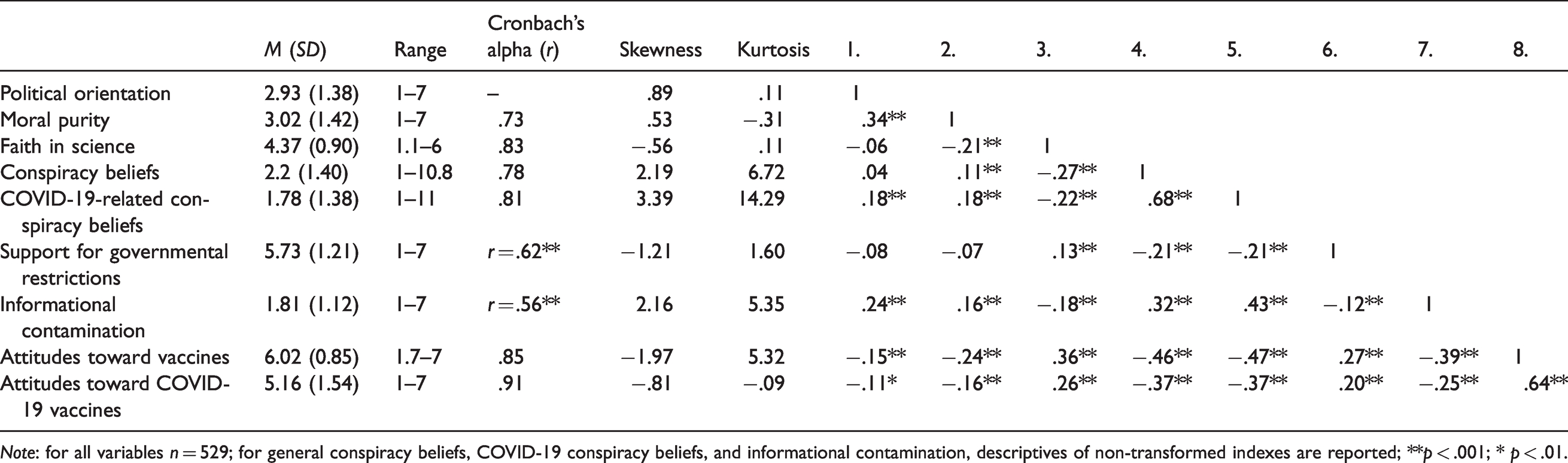
Note: for all variables n = 529; for general conspiracy beliefs, COVID-19 conspiracy beliefs, and informational contamination, descriptives of non-transformed indexes are reported; **p < .001; * p < .01.
Structural equation modelling
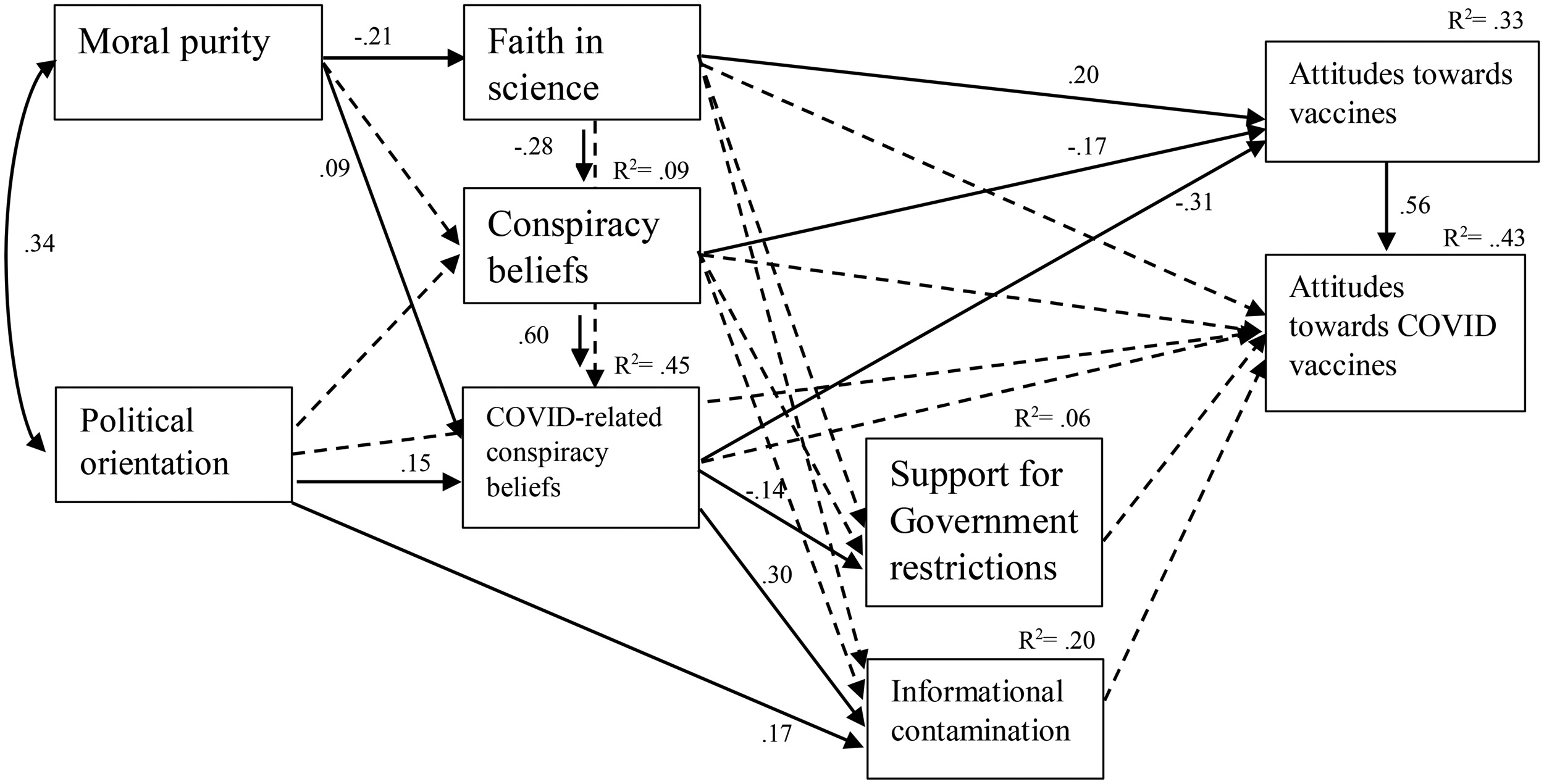
The hypothesized serial mediational model specified in Figure 1 provided an acceptable fit to the data (S‐Bχ2 (7) = 49.873, p = .000, R-CFI = 0.942; R-RMSEA = 0.108; R‐AIC = 35.874). However, the Lagrange Multiplier Test indicated that the model fit could be significantly improved by adding one path from political orientation to informational contamination (S‐Bχ2 (6) = 35.119, p = .000, R-CFI = 0.961; R-RMSEA = 0.096; R‐AIC = 23.119). Subsequently, paths (a) from political orientation to faith in science, (b) from political orientation to attitudes toward vaccines, and (c) from moral purity to attitudes toward COVID-19 vaccines were fixed to 0 (not supporting H4a, H4d, and H5e) based on a Wald test, even if path (a) and (c) were significant in Pivetti et al. (2021). The final model was improved accordingly (S‐Bχ2 (9) = 36.334, p = .000, R-CFI = 0.963; R-RMSEA = 0.076; R‐AIC = 18.335) and accounted for a significant amount of variance in COVID-19 conspiracy beliefs (R2 = .45), in attitudes toward COVID-19 vaccines (R2 = .43), in attitudes toward vaccines (R2 = .33), and in informational contamination (R2 = .20; see Figure 3).
Direct, indirect, and total effects for the final model are reported in Table 2, from which the following results are explained in detail. Conspiracy beliefs strongly predicted COVID-19 conspiracy beliefs (β = .60), and those participants endorsing more conspiracy beliefs in general were also more willing to endorse specific COVID-19 conspiracy beliefs (in line with H1e). As predicted (see H1a), conspiracy beliefs negatively predicted general attitudes toward vaccines both directly (β = −.17) and indirectly via COVID-19 conspiracy beliefs (β = −.19), with those participants endorsing conspiracy beliefs endorsing more COVID-19 conspiracy beliefs and, consequently, being less in favor of vaccinations in general. In addition, conspiracy beliefs were related to attitudes toward COVID-19 vaccines (total β = −.33), mainly indirectly via attitudes toward vaccines (β = −.10) as well as via the serial mediation of COVID-19 conspiracy beliefs and attitudes toward vaccines (β = −.11; total indirect β = −.24). Those participants endorsing conspiracy beliefs also endorsed COVID-19 conspiracy beliefs and had more negative attitudes toward vaccinations in general, which in turn predicted being specifically less in favor of COVID-19 vaccinations (supporting H1b). Finally, consistent with the hypotheses (H1c and H1d) of this study, general conspiracy beliefs were negatively related to support for governmental restrictions (total β = −.16) and positively related to informational contamination (total β = .25), mainly through the mediation of COVID-19 conspiracy beliefs (βs = −.08 and .18, respectively). Those participants endorsing more conspiracy beliefs also endorsed more COVID-19-related conspiracy beliefs, which in turn predicted less support for governmental restrictions and perception of the media information as more contaminated.
Significant direct, indirect, and total effects in the final model.

Note: Values reported refer to standardized effects significant at p < .05. D = direct effects, I = indirect effects, T = total effects.
Along the same line, COVID-19 conspiracy beliefs directly predicted general attitudes toward vaccines (β = −.31; supporting H2a), with those participants endorsing conspiracy beliefs related to the COVID-19 pandemic being less in favor of vaccinations. COVID-19 conspiracy beliefs were linked to attitudes toward COVID-19 vaccines (total β = −.25), mainly through the mediation of attitudes toward vaccines (β = −.16), with those endorsing conspiracy beliefs related to the COVID-19 pandemic being less in favor of vaccinations in general and of COVID-19 vaccinations specifically (supporting H2b). Additionally, COVID-19 conspiracy beliefs were negatively and directly related to support for governmental restrictions (β = −.14), with those participants endorsing such beliefs also being less supportive of strong governmental restrictions to control the pandemic (supporting H2c). Similarly, those beliefs were also directly related to the perception of informational contamination (β = .30), with those participants endorsing COVID-19 conspiracy beliefs also being more willing to perceive that the information received is not transparent or complete (supporting H2d). Neither support for governmental restrictions nor informational contamination predicted attitudes toward COVID-19 vaccines (supporting neither H7 nor H8).
Attitudes toward vaccines strongly and positively predicted attitudes toward COVID-19 vaccines (β = .56), with those supporting vaccination also generally being more supportive of COVID-19 vaccines in particular (in line with H3).
As for the antecedents of conspiracy beliefs, political orientation was found to directly predict COVID-19 conspiracy beliefs (β = .15) and to indirectly predict attitudes toward vaccines via COVID-19 conspiracy beliefs (β = −.06), with more right-wing participants also endorsing more COVID-19 conspiracy beliefs and more negative attitudes toward vaccines (in line with H4c and with H4d). However, political orientation did not predict faith in science, general conspiracy beliefs or attitudes toward COVID-19 vaccines (not supporting H4a, H4b, or H4e). Nevertheless, political orientation predicted informational contamination both directly (β = .17) and indirectly via COVID-19 conspiracy beliefs (β = .05), with those participants who are more right wing also being more willing to perceive that the information received in times of crisis is not accurate.
Regarding moral purity, this factor negatively predicted faith in science (β = −.21), with those endorsing more purity having less trust in science (supporting H5a). Moral purity positively predicted COVID-19 conspiracy beliefs (total β = .16), mainly directly (β = .09), with those endorsing more purity also endorsing more COVID-19 conspiracy beliefs (supporting H5c). Moreover, moral purity predicted attitudes toward vaccines both directly (β = −.12) and indirectly (β = −.11), mainly via faith in science (β = .04). In addition, moral purity predicted attitudes toward COVID-19 vaccines, only indirectly (β = −.15), mainly via attitudes toward vaccines in general (β = .07). In general, participants who endorsed more moral purity values were less in favor of vaccines and, consequently, of COVID-19 vaccines in particular (supporting H5d and H5e). However, moral purity was overall unrelated to general conspiracy beliefs (not supporting H5b).
Finally, faith in science positively predicted attitudes toward the vaccine, both directly (β = .20) and indirectly (β = .12), mainly via conspiracy beliefs (β = .05) and the serial mediation of conspiracy beliefs and COVID-19 conspiracy beliefs (β = .05). Faith in science also positively and indirectly predicted attitudes toward COVID-19 vaccines (β = .22), mainly via attitudes toward vaccines (β = .11). Therefore, those participants with greater trust in science also had a more positive attitude toward vaccines in general and COVID-19 vaccines in particular (in line with H6a and H6b). Faith in science also negatively predicted conspiracy beliefs (β = −.28) and COVID-19 conspiracy beliefs (total β = −.22), mainly indirectly via conspiracy beliefs (β = −.17), with those trusting science being less inclined to endorse general and, consequently, COVID-19 conspiracy beliefs (in line with H6c and H6d). Additionally, faith in science predicted support for governmental restrictions (total β = .13) as well as informational contamination (total β = −.17), mainly indirectly (βs = .05 and −.09, respectively) via the serial mediation of general and COVID-19 conspiracy beliefs. Those trusting science endorsed less general and COVID-19 conspiracy beliefs, which in turn was related to being more supportive of governmental restrictions and perceiving media information as less contaminated (supporting H6e and H6f).
Discussion
The present study provided a conceptual replication of findings by Pivetti et al. (2021) to examine antecedents and consequences of conspiracy beliefs on attitudes toward the COVID-19 vaccination. As the availability of COVID-19 vaccines does not imply that people will be willing to receive the vaccination, this study has shed some light on the role played by COVID-19 conspiracy beliefs and their antecedents, such as political orientation and the endorsement of purity moral foundations, in one’s willingness to receive a COVID-19 vaccine.
Concurrent with original findings and with a broad body of research, this study of a sample of Finnish people showed that endorsing non-health-related conspiracy beliefs negatively predicted attitudes toward vaccines. Previous studies suggested that anti-vaccination beliefs are part of a psychological propensity to believe in conspiracies (e.g., Goldberg & Richey, 2020). Additionally, conspiracy beliefs strongly predicted COVID-19 conspiracy beliefs, pointing to the existence of a broader conspiracy tendency encompassing health- and non-health-related domains. As expected, conspiracy beliefs were inversely related to trust in science, which was also consistent with the relevant literature (e.g., Rutjens et al., 2018). When combined, these results suggest that conspiracy beliefs may present a substantial public health risk, as they were found to be inversely related to reduced compliance with public health guidance with regard to COVID-19, such as staying at home, social distancing of two meters, and prolonged hand-washing (Allington & Dhavan, 2020; Douglas, 2021).
Moreover, general conspiracy beliefs have negatively and indirectly predicted attitudes toward COVID-19 vaccines via the mediation of COVID-19 conspiracy beliefs and via the serial mediation of COVID-19 conspiracy beliefs and attitudes toward vaccines. In addition, this result points to the importance of specific COVID-19 conspiracy beliefs in predicting attitudes toward COVID-19 vaccines. Furthermore, COVID-19 conspiracy beliefs also negatively predicted attitudes toward the COVID-19 vaccines with the mediation of general attitudes toward vaccines. This is in line with the results of Pivetti et al.’s study (2021) and with similar results found by Sallam et al. (2021) in Jordan and Kuwait. COVID-19 conspiracy beliefs did not directly predict attitudes toward COVID-19 vaccines in Finland either, or in Italy, which could be due to the strong correlation between the two measures: attitudes toward vaccines and attitudes toward the COVID-19 vaccine. At the time of data collection during the first wave of the coronavirus pandemic (i.e., in spring 2020), there was almost no media information on the development of the COVID-19 vaccine and no vaccine was available at the time. Therefore, the general public, who were not directly involved in the preparation of the vaccines, did not have the possibility of developing a firm attitude toward the COVID-19 vaccine. As attitudes toward COVID-19 vaccines were most strongly predicted by the general attitude toward vaccines, this study hypothesized the existence of a broader attitude toward vaccinations, of which the attitude toward the COVID-19 vaccination was just one specific case (Reno et al., 2021; Sherman et al., 2021).
As for the antecedents of beliefs in conspiracy theories, political orientation and moral purity directly predicted COVID-19 beliefs in conspiracy theories (but not general conspiracy beliefs) in the Finnish context, whereas in the Italian study, political orientation predicted both types of conspiracy beliefs. Moreover, faith in science negatively predicted general conspiracy beliefs, consistently with the relevant literature (e.g., Rutjens et al., 2018), which in turn predicted COVID-19 conspiracy beliefs. These results suggest the need for a more in-depth investigation of the relationship between health- and non-health-related conspiracy beliefs.
Regarding the consequences of conspiracy beliefs, COVID-19 conspiracy beliefs directly predicted support for governmental restrictions (negatively) and the perception of informational contamination (positively), showing the impact of those conspiracy beliefs on reducing public support for the central government and increasing distrust in the transparency of COVID-19 information circulating in the media. In addition, this result replicated the findings for the Italian sample.
COVID-19 conspiracy beliefs also mediated the relationship between general conspiracy beliefs and support for government restrictions and informational contamination, underlining the role of specific COVID-19 conspiracy beliefs in support for the governmental response to the pandemic. As trust in the government was found to predict intentional behaviors such as hand-washing and social distancing in a multi-country study (Pagliaro et al., 2021), this study draws attention to the importance of studying trust in shaping positive behaviors that are crucial to limiting the spread of the virus.
When it comes to attitudes toward COVID-19 vaccines, the second strongest predictor after attitudes toward vaccines was conspiracy beliefs. In this sense, the results of this study parallel the findings of Neumann‑Böhme and colleagues (2020), who explored the reasons as to whether or not people were willing to be vaccinated against COVID-19. Additionally, those participants with less faith in science were also less willing to get vaccinated against COVID-19, in line with the results of Palamenghi and colleagues (2020), showing that willingness to vaccinate against COVID-19 was correlated with trust in research and in vaccines.
Study limitations
In spite of the valuable findings gained from this study, there are a number of limitations that could be addressed in future research. First of all, the cross-sectional nature of the study poses constraints on the ability to draw causal inferences. Future studies can address this by testing the effects through longitudinal design.
Second, it should be noted that the data were not based on a representative sample of Finns, as there was a tendency toward younger generations and medium-to-highly educated people and students in the data. Using a convenience sampling strategy in the data collection makes it challenging to evaluate why certain groups of people decided to answer the questionnaire, but it is likely to be more difficult to reach people with more negative attitudes toward science or strong conspiracy beliefs, for example. As Väliverronen, Sivelä, and Nohynek (2019) stated, more research and more versatile methods are required to better understand different factors behind vaccination attitudes. On the other hand, the unique value of the present data was to provide insight into vaccination attitudes during an exceptional situation in which, for example, individual freedom of movement was restricted. It is also worth bearing in mind that, during the data collection, no vaccine was available, and the vaccine development schedule and vaccine efficacy were still unclear.
Additionally, as data were collected via online questionnaires, it is possible that the participants were self-selected because older citizens and/or those less familiar with social media did not complete the questionnaire. However, to overcome this problem, the link to the questionnaire was also sent via WhatsApp and instant messaging to both close friends and distant acquaintances, in an effort to also reach those less reachable participants.
In addition, as data were collected during the first wave (i.e., in spring 2020), the results were highly time-specific. It is likely that during 2020 and 2021 the perceptions of COVID-19 vaccines may have evolved (e.g., Hammer et al., 2021). However, addressing the question of changing perceptions would require a longitudinal approach which goes beyond the scope of the present study.
Conclusions
While some studies explored public compliance with health-related guidance during the COVID-19 pandemic (e.g., Allington & Dhavan, 2020), or the relationship between conspiracy beliefs and support for COVID-19 vaccines (e.g., Bertin et al., 2020), this study provided a conceptual replication of the study by Pivetti et al. (2021) in a novel context, in Finland, in an effort to expand current knowledge on COVID-19 vaccine hesitancy across countries and cultures.
Having greater knowledge of psychosocial determinants of COVID-19 vaccine hesitancy can help government agencies, healthcare workers, and other authorities to mitigate the impact of vaccine skepticism. In order to do this, such bodies and individuals may need to address the issue of conspiracism and develop public information campaigns designed to reduce vaccine avoidance by increasing confidence in the effectiveness and safety of vaccines (Thunström et al., 2020; Karlsson et al., 2021).
Footnotes
Data availability statement

Acknowledgement
We are grateful to Lucia Mongelli for her assistance with setting up the questionnaire.
Declaration of conflicting interests
The authors declared no potential conflicts of interest withnrespect to the research, authorship, and/or publication of this article.
Funding
The authors received no financial support for the research, authorship, and/or publication of this article.