




Abstract
The efforts of peace-building and reconciliation between historical enemies are faced with many structural and psychological obstacles. Scholars have identified mechanisms that can induce improvements in psychological aspects of intergroup relations, such as intergroup contact. However, establishing direct contact with everyone is impossible. Therefore, the mass media represents an important source through which groups learn about each other. Numerous studies have shown that stereotypical and often negative portrayals of specific social groups through the media produce or reinforce negative intergroup outcomes. In this research, the authors report results from an experimental study conducted in a post-conflict society of Bosnia and Herzegovina (N = 119). It examined the effects of stereotypical and counter-stereotypical representations of former enemy groups (Bosniaks) through the media on intergroup behavior (reported by Bosnian Serbs). More specifically, in this research the authors explored the effects of representing out-group individuals as immoral (the stereotypical condition) and moral (the counter-stereotypical condition) on specific behavioral tendencies toward the historical enemy group. The results indicate that exposure to primarily moral information about the out-group target facilitated important positive intergroup outcomes. This study extends the literature and research on moral exemplars by demonstrating the effects on relevant intergroup outcomes whilst utilizing current (vs. historical) moral exemplar stories.
Introduction
Research in the social sciences has identified processes and developed interventions that can improve intergroup relations. An often distinguished and applied approach is intergroup contact (Paluck et al., 2019; Pettigrew & Tropp, 2006). Research shows that members from different social groups who report to have good-quality contact with each other are more likely to report and engage in prosocial-oriented ways. Such positive effects of intergroup contact have also been reported in the most challenging intergroup situations, such as conflict, indicating positive associations between contact and readiness to forgive former enemy groups (Čehajić et al., 2008). However, establishing direct contact with everyone is impossible. Moreover, often members of one group do not have opportunities to meet, socialize, and thus directly learn about the members of another group. Even if the opportunity for direct contact exists, as Witkowska et al. (2019) explain, groups in post-conflict societies tend to avoid encounters with each other. Negative intergroup attitudes such as prejudices, different emotions, and lack of trust impede openness to contact (Witkowska et al., 2019). That void of no direct experience is often filled by the mass media. Thus, the mass media can, and often does, act as a relevant source of information about the world and others. As a result, the media represents an important source through which groups are represented. Such representations become a basis for forming judgments about others and shaping behavior toward social groups. Atwell Seate and Mastro (2015) describe this function of the media as a socializing force in the process of learning about one’s own and other groups. In this study, we opted to represent relevant out-groups in a counter-stereotypical way using the media and investigated the effects of such representations on intergroup reconciliation processes in a real post-conflict setting.
Biased Representations of Social Groups Through the Media
The research on the media and stereotype processes indicates that the media often plays a negative role in intergroup relations, displaying unfavorable images of out-groups. Atwell Seate (2017) classifies these studies into two categories: (a) content analysis research that examines the quantity and quality of stereotypical portrayals of social groups and (b) survey and experimental research. The first type of study looks at prevalent overrepresentations of out-groups (particularly those that can be categorized as minority or nondominant groups in a given society) in a negative media context (the stereotypical portrayal) and underrepresentations of the same groups in positive media contexts (the counter-stereotypical portrayal). These studies have demonstrated the tendency of the media to portray some social groups more negatively, irrespective of the actual reality. As an example, Dixon and Linz (2000) identified that Latinos and Blacks are more likely than Whites to be portrayed as perpetrators of crimes, misrepresenting actual crime rates and perpetrators of crimes in the USA. More recently, research by Dixon and Williams (2015) showed that such frequent portrayals of Blacks as criminals have changed in media networks and cable news; however, they identified prevalent portrayals of Muslims as terrorists and Latinos as undocumented immigrants. Consumption of such biased and often negative media content has the potential to produce negative intergroup outcomes. Thus, the second type of study on the media and stereotype processes examines the endorsement of stereotypes (survey research) and the impact of stereotypical content on intergroup judgments (experimental research). The findings of these studies will be discussed below.
The impacts of consuming a media message on the psychological (or social) responses of individuals or groups are termed media effects (Valkenburg et al., 2016). As media technologies have advanced and diversified, especially in the past couple of decades, research interest has been continuously growing. Many scholars have been interested in analyzing the effect of the media on the emotions, attitudes, and behaviors of people. Consequently, different theories have been developed, and empirical evidence supporting these theories has been obtained. Research that specifically examined the impact of television as one of the telecommunication mediums discovered the significant influence that television has on its audience (Gerbner et al., 2002). The results of this study were developed into cultivation theory. The theory explains that heavy users—individuals who watch television frequently—are more prone to align social reality with television content portrayals. Although the consumption of media content can have both positive and negative effects, due to the prevalent portrayals of out-groups in an unfavorable, stereotypical manner (as explained above), there is a greater likelihood that this will result in negative intergroup outcomes. One line of research that explored this particular impact and relationship was conducted by Peffley et al. (1996). Their research found that exposure to such media messages led to the endorsement of negative racial stereotypes. In accordance with the priming effect, repeated and frequent exposure to such media messages results in the creation of stereotypical memory traces. Additional danger lies in subsequent exposure to media content that can reactivate these traces and impact people’s thinking and behavior (Arendt, 2013). Similarly, Eyssel et al. (2015) conducted a study where they discovered that consumption of media sources (privately owned television channels in Germany) that often report biased news about Islam was related to Islamophobia. Moreover, verbal violence in the form of hate speech in media content could damage intergroup relations. Soral et al. (2017) show that recurrent exposure to hate speech increases out-group prejudices. As a result of these and many other studies which have identified the negative effects of the consumption of biased, stereotypical media content, scholars often point out the damaging role of the media in intergroup relations (Seate & Mastro, 2017). As much as the media can be, and indeed is, used to instigate negative social implications, it can also be utilized to induce positive effects whereby people’s tendency to question or counterargue is reduced by being carried away by a story (Green & Brock, 2000). In fact, scholars have analyzed media messages using positive stories about social out-groups and their impact on intergroup judgments and behaviors toward these groups. For instance, Power et al. (1996) analyzed the impact of priming both negative stereotypic and positive counter-stereotypic information on interpreting subsequent real media events. They found that exposure to one stereotypical but also counter-stereotypical media portrayal of an out-group member (an autobiographical essay featured in a newsletter) could shape people’s judgments on what appeared unrelated to this content, shaping their perceptions about the entire out-group. On the other hand, McKinley et al. (2014) tested the impact of exposure to positive media portrayals and found that such exposure only led to favorable evaluations of the entire group among in-group but not out-group members. Thus, they did not identify positive effects of counter-stereotypical media content exposure on out-group members.
Although these and similar studies analyzed the capacity of the media to prompt more positive intergroup outcomes, our understanding of what specific forms of counter-stereotypical representations of social groups in the media can be effective for instigating prosocial intergroup outcomes is still very limited. In addition, research that has examined this particular question has produced mixed results, pointing to no consistent conclusions or identification of clear counter-stereotypical content and processes that underline the potentially positive effects of describing out-group targets in counter-stereotypical (Johnson et al., 2013) or positive meta-stereotypical ways (Vezzali, 2017). In this article, we examine the effects of a specific form of counter-stereotypical representation of out-groups using the media on intergroup reconciliation correlates. In this regard, we focus on morality as a fundamental dimension for the evaluation of social groups (Brambilla et al., 2013; Leach et al., 2015).
Evaluation of Social Groups on Different Dimensions and the Role of Morality
Social psychological research has mainly focused on competence and warmth as two important dimensions for the evaluation of others and stereotype formation (Fiske et al., 2002). Most of the existing research on mass-media effects on intergroup outcomes has been guided by this understanding (Behm-Morawitz & Ortiz, 2013). However, and more recently, empirical evidence has pointed to the importance of the morality dimension (Brambilla et al., 2011, 2013). Initially, the morality factor was attributed to two main evaluative dimensions (competence and warmth) but, subsequently, it has been identified as a distinctive element of the warmth dimension and a decisive factor in the process of creating impressions about others. Brambilla et al. (2013) conducted a study that provided empirical evidence for these claims. In their research, they identified two distinct dimensions of warmth: sociability and morality. In Study 1, they measured the impact of the morality (high/low: honesty, sincerity, and trustworthiness) of the targets (in-group and out-group) on behavioral intentions toward them. The morality information was manipulated by exposing some groups of participants to a high morality condition and others to a low morality condition. In Study 2, they included information on competence in the manipulation, while in Study 3 they incorporated information on sociability. The results show that when forming judgments about in-group and out-group members, people relied more on information about their morality in comparison to both sociability and competence. When this information was made available, it had a stronger effect on the overall impression of the targets. In addition, such impressions shaped the intention to interact with those targets.
The methods of Brambilla et al.’s (2013) research included manipulating morality, sociability, and competence by describing the characteristics of particular targets (in-group and out-group members). The participants’ behavioral responses toward these particular targets were measured. This prompts the question of whether morality information affects behavioral intentions toward not only specific targets in a group but also the group as a whole. This is the key question when studying changes in intergroup judgments and behavior. Also, Brambilla et al.’s (2011) research was conducted in Italy and the participants were Italians. The studies analyzed their relations with Indians, a large population group living in Italy. The Italians were treated as in-groups and the Indians as out-groups. This raises the question of whether these effects could be produced between not only distinct social groups but also those with a history of conflict. In this study, we examine the effects of portraying conflict-relevant out-group individuals as moral on relevant intergroup reconciliation outcomes in a post-conflict environment.
Perceptions of Morality and Intergroup Relations
Brambilla et al. (2013) demonstrated that morality (in comparison to other dimensions such as warmth and competence) is fundamental for evaluations of individuals and social groups. Furthermore, in intergroup conflict environments, people tend to perceive out-groups (in relation to their own group) as inherently immoral and evil (Leach et al., 2015), further contributing to the deterioration of intergroup relations. Building on this research pointing to the importance of morality judgments for the evaluation of social groups, Čehajić-Clancy and Bilewicz (in press) have developed a new intervention aimed at conflict resolution and intergroup reconciliation: the moral exemplar intervention. Moral exemplars are individuals who, during a conflict, save the lives of members of other social groups, often at the risk of their own life. Čehajić-Clancy and Bilewicz (in press) propose that by exposing participants to stories about moral exemplars and thus bringing attention to the moral variability of the out-group, more prosocial intergroup processes will be induced, such as intergroup reconciliation and forgiveness. A specific advantage of learning about out-group moral exemplars lies in the potential to induce a positive emotional response (Čehajić-Clancy & Bilewicz, in press), reminiscent of moral awe (Haidt, 2000), and in that way reduce the likelihood of tension and negative reactions produced by counter-stereotypical information.
Indeed, and as suggested by empirical evidence, Čehajić-Clancy and Bilewicz (2017) showed that learning about out-group moral exemplars increased willingness to forgive the out-group and the belief that reconciliation between their in-group and the relevant out-group was possible (Study 1). In addition to replicating these results, Study 2 showed that exposure to moral exemplar stories decreased intergroup anxiety and increased contact intentions and belief in humanity.
The research described above (Čehajić-Clancy & Bilewicz, 2017) employed stories about past (historical) moral exemplars as an enhancer of contact-based interventions—that is, the participants established contact with out-group members while learning about the moral exemplar stories in order to increase the effectiveness of the contact and eliminate the potential negative effects of it. Since contact between members of groups with a history of violence rarely occurs, limiting the realistic potential of this intervention, Witkowska et al. (2019) sought to examine whether presenting stories about historical out-group moral exemplars would result in positive intergroup outcomes in the absence of such contact. Indeed, their research showed that even without contact exposure, moral exemplar stories led to a decrease in prejudice and an increase in openness to contact. Likewise, Beneda et al. (2018) demonstrated that learning about historical moral exemplars in the absence of contact increased the willingness to forgive.
The studies presented above implemented an intervention that included exposing the participants to stories about historical conflict-related moral exemplars. They asked the participants to read texts from a nonspecific source about these people. The question of whether positive effects on intergroup relations could be produced by implementing current non-conflict-related stories of moral exemplars has not yet been tested. In this study, we focus on the effects of learning about current (present) out-group moral exemplars through the media on important correlates of intergroup reconciliation, such as approach- and cooperation-oriented behavioral tendencies (Čehajić et al., 2008).
Furthermore, the consequences of conflict include a range of negative emotions which impede attempts to improve relations between the relevant social groups (Halperin, 2014). Thus, emotions have been recognized as an important psychological process relevant for the improvement of intergroup relations in societies affected by conflict. Decades of research on intergroup reconciliation have indeed led to the conclusion that reconciliation between social groups ought to be conceptualized also as an emotion-regulation process (Čehajić-Clancy et al., 2016). Related to this, Čehajić-Clancy and Bilewicz (2020), in their review of moral exemplar stories, identified positive out-group emotions as an important predictor of prosocial intergroup behavior. However, it remains to be examined, empirically, whether exposure to moral representations of out-groups, through moral exemplar stories, is indeed related to positive emotions, and how these might shape behavioral intentions. The present study addresses this issue as well.
The Current Study
Our study was conducted in Bosnia and Herzegovina. The armed conflict in Bosnia and Herzegovina was part of the breakup of Yugoslavia and took place between 1992 and 1995. During the war, grave breaches of international humanitarian law occurred. The war atrocities were stopped and the conflict ended with the signing of the Dayton Peace Agreement (General Framework Agreement for Peace in Bosnia and Herzegovina). The current organization of the state is the outcome of the conflict management mechanisms of the international community. Bosnia and Herzegovina is home to three constituent peoples (three groups who are explicitly mentioned and recognized in the constitution) who were formerly adversary groups: the Croats, the Bosniaks, and the Serbs.
As noted above, the media tends to portray out-group members in a negative light. This becomes particularly relevant in post-conflict societies such as Bosnia and Herzegovina. Besides the political elites, the mass media has been identified as an important partaker in the radicalization of the public discourse. The frequent use of inflammatory and ethnically dividing messages by most of the media has been recognized as a serious threat to the established peace (Sanctis, 2014). Thus, the media should be regarded as an influential provider of information about the out-group. The lack of opportunities or avoidance of contact in post-conflict societies makes portrayals of social groups through the media even more important. Therefore, we aimed to (re)confirm empirically that continuous exposure to negative (that is, stereotypical) messages about the out-group possibly leads to the deterioration of intergroup relations on an individual level, particularly in this context.
Moreover, since the research on positive media effects on intergroup outcomes has not obtained consistent findings, identifying distinct mechanisms that have the potential to produce such an effect, the study tackled this issue as well. Čehajić-Clancy and Bilewicz (2017) demonstrated that learning about moral exemplars can act as a powerful tool. In addition, Witkowska et al. (2019) and Beneda et al. (2018) showed that, even in the absence of direct contact, such intervention produces positive effects. Thus, we explored the effectiveness of counter-stereotypical (vs. stereotypical) representations of the former enemy group on peace and reconciliation processes by adopting the moral exemplar paradigm. While the mentioned research implemented manipulation in the form of text from an unknown source, this study applied it in the form of specific media content. In addition, all of the studies that have analyzed the impact of morality information on intergroup relations in post-conflict settings exposed the participants to information on historical (past) moral exemplars—that is, the participants learned about the moral behavior of the out-group members that occurred during the conflict in the past. Our research was thus focused on exploring the relevance of morality information in current societal settings and implemented a non-conflict-related intervention.
Therefore, this research aimed to test the effects of learning about current/present moral exemplars on as yet unexamined but relevant intergroup outcomes: approach-oriented behavioral tendencies (Čehajić et al., 2008) and out-group emotions as important indicators of intergroup reconciliation (Čehajić-Clancy et al., 2016; Halperin, 2014). Furthermore, this research examined a particular importance and utility of the media for intergroup relations and its relevance in post-conflict societies. It highlighted two roles the media can take in these processes. In spite of the prevailing negative role it plays, by providing counter-stereotypical messages implementing the morality paradigm, the media can potentially foster positive intergroup outcomes, challenging everyday exposure to stereotypical messages about the out-group. Thus, while some react to negative messages by adopting (or reinforcing) unfavorable attitudes toward out-groups, others may react to positive media messages by adopting favorable intergroup attitudes, fostering reconciliation and strengthening the established peace.
Method
Participants
A total of 119 participants took part in the study (48 males and 71 females). The participants were aged between 16 and 21 (M = 18.36, SD = 1.33). All of the participants were either high school or university students. A total of 111 (93.27%) identified themselves as Serbs. Out of the remaining 8 participants, 6 (5.04%) stated their religious affiliation (Orthodox) rather than ethnicity, and 2 (1.68%) opted not to answer.
Research Design and Procedure
In this study, we used an experimental research design with two experimental conditions. In one condition, the out-group was presented as immoral (a stereotypical representation). In the other condition, the out-group was presented as moral (a counter-stereotypical representation). The out-group that was used in this study was Bosniaks (Bosnian Muslims), as a former enemy group, and the participants were Serbs. The participants were randomly assigned to one of these two conditions. In the immorality condition, the participants received a media article depicting the out-group as immoral. In the morality condition, the participants received a media article depicting the out-group as moral. An important advantage of such a design was the comparison of the same story set in the same context whilst only manipulating the response (behavior) of the out-group target. However, an important limitation of our design was the lack of a more neutral (control) condition which could be contrasted against both experimental conditions. Across both conditions and after reading the story, all of the participants filled out the same survey. The data was collected at the School of Economics in Pale, the University of East Sarajevo, and a high school, “27. januar,” in Rogatica. Participation was voluntary and the participants were informed that they could withdraw at any point without consequences. At the end of the data collection process, all of the participants were debriefed.
Materials
The media articles were inspired by a real event but adapted for the purpose of the two experimental conditions: the (counter-stereotypical) morality condition and the (stereotypical) immorality condition. Both of the media articles were fictional but created to look as genuine as possible. The story was inspired by a real intergroup incident. Players from a water polo club, Red Star (Crvena Zvezda) Belgrade (Serbia), were attacked by a group of people in Split (Croatia). The attack was ethnically motivated. There were several partakers/actors in the event: the attackers, their accomplices, those who ignored or refused to offer help, and those who provided help. The regional media reported heavily on the incident but the majority of these reports left out stories about those individuals who provided help. Based on this real event, we created two made-up stories. The first story included information on the immorality of the out-group targets. It reported an ethnically motivated verbal assault in Sarajevo (a majority Bosniak population) on volleyball players from East Sarajevo (a majority Serb population). In this story, some of the witnesses observed passively while others got involved in the harassment. The second story included information on the moral behavior of the out-group targets. It reported the ethnically motivated verbal assault in Sarajevo on volleyball players from East Sarajevo. However, in this story, witnesses stood up to the attacker, managed to defend the players, and immediately called the police. The stories were created and designed as two real media articles published by Katera (https://katera.news). Katera is an online news website; its primary audience is citizens in the East Sarajevo region. The first media article (see Supplementary Appendices 1 and 3) was titled “The volleyball players from the VBC Slavija assaulted in Sarajevo” and reported the first story described above. The second media article (see Supplementary Appendices 2 and 4) was titled “The citizens of Sarajevo defended the volleyball players from the VBC Slavija from the attacker” and reported the second story described above. In this story, the volleyball players expressed their gratitude to the citizens of Sarajevo through the media article. The third instrument was a survey, which was the same for both conditions (see Appendix 5).
Measures
After reading one of the two media articles, the participants filled out the survey. The survey measured the participants’ perception of the appropriateness of the behavior of the targets (individuals whose behavior was covered and reported by the media article) and the participants’ perception of out-group morality. The perception of out-group morality was measured with two items: “I think the members of the Bosniak nation are moral human beings” and “In general, I think the members of the Bosniak nation are good people.” These two items formed a reliable scale with Cronbach’s α = .81. These measures were designed to assess the intended effectiveness of manipulation. The questions were in the form of a Likert scale with 5 points measuring the level of (dis)agreement with the stated items.
In addition, the survey measured behavioral intentions (Brambilla et al., 2013) toward the out-group using the 5-point-scale questions, assessing the level of (dis)agreement with particular statements, where 1 = strongly disagree and 5 = strongly agree. The statements were as follows: “I am trying to avoid any kind of interaction with people of Bosniak ethnicity”; “I am willing to initiate interaction with the members of Bosniak nationality”; “I am willing to work in an organization where members of the Bosniak ethnic group are also employed”; “I am willing to have members of the Bosniak ethnic group as friends”; and “I am willing to have members of Bosniak ethnicity as neighbors.” These five items formed a reliable scale with Cronbach’s α = .83.
Moreover, the first of the measurements of intention to cooperate was based on a single-answer multiple-choice question, asking the participants to identify the greatest problem in society (unemployment, a low standard of living, corruption, criminality, the brain drain (the emigration of youth from the country), inappropriate governance, low salaries/pensions, or other). Then, we measured participants' view on the extent to which societal problems are shared among citizens with the following statement: “All people living in Bosnia are faced with this problem” (from 1 to 5) and finally, we assessed participants' willingness to cooperate with other groups (including the relevant out-group) in solving existing problems (“I am willing to work with people from other ethnic groups on the process of solving this problem”; “I am willing to work with people from other ethnic groups on the process of solving other common problems”). These items formed a reliable scale with Cronbach’s α = .77.
We also measured the participants’ emotions toward the out-group with the same Likert scale, ranging from 1 = no, not at all to 5 = yes, completely, estimating the participants’ level of emotions (fear, anger, warmheartedness, warmth, closeness, or trust) toward the out-group.
Results and Discussion
Manipulation Checks
The participants were asked to rate the level of appropriateness of the behavior of the out-group target (as depicted in the article). Additionally, perception of out-group morality was measured with the following items: “I think the members of the Bosniak nation are moral human beings” and “In general, I think the members of the Bosniak nation are good people.” T tests were run to determine whether there was a significant difference between the two experimental conditions. As expected, the participants in the morality condition assessed the behavior of the out-group target as more appropriate, M = 4.33, SD = 1.12, than the participants in the immorality condition, M = 1.49, SD = 0.88, t(117) = 14.93, p = .001, d = 2.82. Likewise, there was a significant difference in perception of the morality of the entire out-group (computed variable) between the participants in the morality condition, M = 3.41, SD = 0.87, and the participants in the immorality condition, M = 2.43, SD = 1.04, t(93.80) = 5.37, p = .001, d = 0.96. Thus, the manipulation was successful. The results show that exposure to a counter-stereotypical media portrayal (depicting the moral behavior of the out-group targets) and exposure to a stereotypical media portrayal (depicting the immoral behavior of the out-group targets) affected peoples’ morality perception of the entire out-group. Presenting the participants with moral (vs. immoral) representations of individual out-group members led to an increased and generalized perception of out-group morality.
Behavioral Intentions
By comparing the mean values of the responses on behavioral intentions toward the out-group between the two experimental conditions, the tendency of a positive behavioral response in the morality condition in comparison to the immorality condition was identified. Therefore, variables measuring avoidance of interaction (reverse-coded), initiation of interaction, and coworkers’, friends’, and neighbors’ relationships were computed. To assess the significance of the differences in the responses between the two groups, a t test for the independent samples was conducted. The test revealed a statistically significant difference between the participants who were exposed to the morality media message, M = 3.21, SD = 0.89, and the participants who were exposed to immorality media message, M = 2.58, SD = 0.89, t(116) = 3, 78, p = .0002, d = 0.70. In conclusion, representation of out-group targets as moral versus immoral significantly predicted the participants’ behavioral intentions toward the out-group as a whole (for the mean values, standard deviations, and effect sizes of each item, see Table 1; for the values of the computed variable, see Table 2).
Mean Values and Standard Deviations of Specific Behavioral Intentions Between Experimental Conditions.
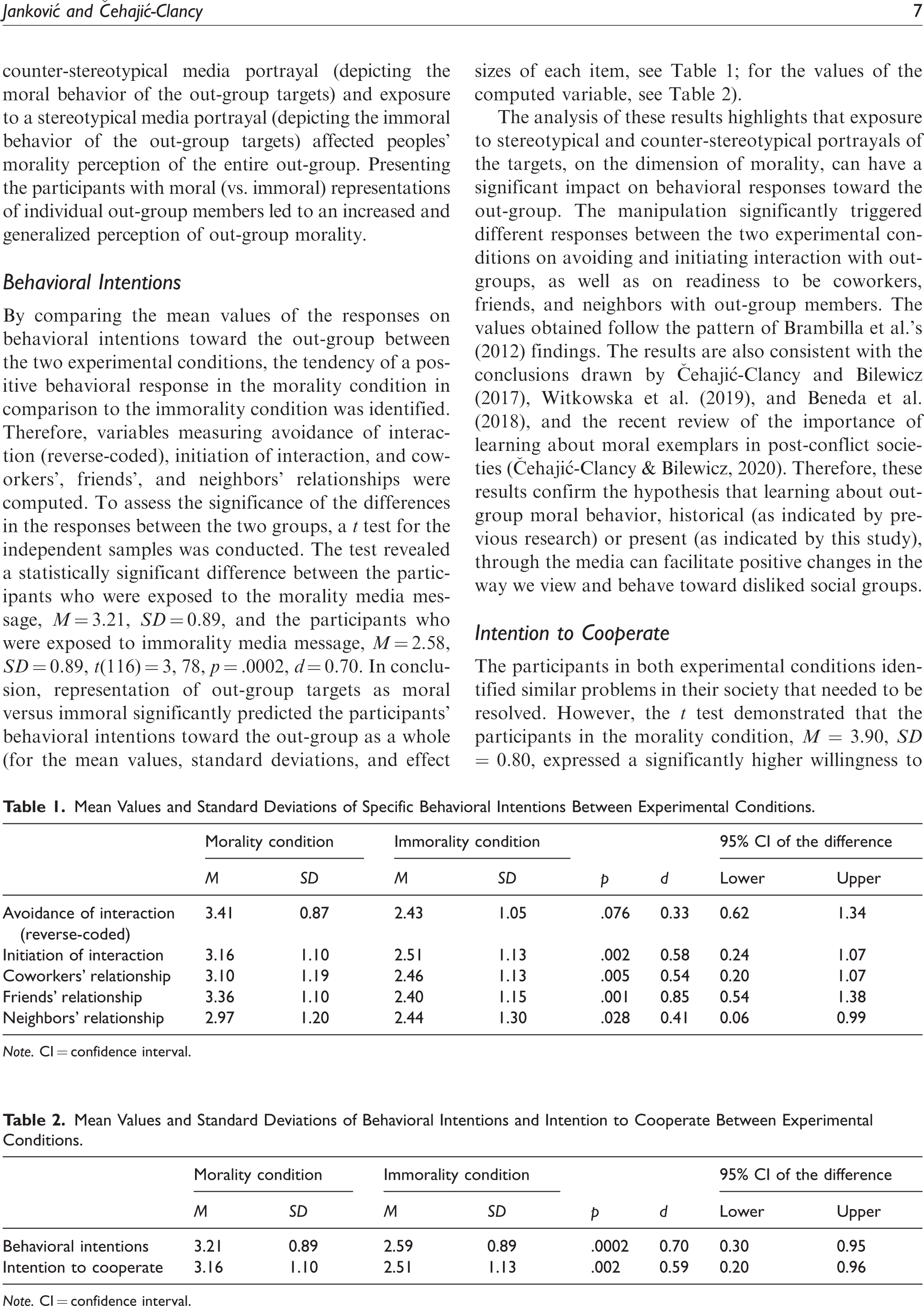
Note. CI = confidence interval.
Mean Values and Standard Deviations of Behavioral Intentions and Intention to Cooperate Between Experimental Conditions.

Note. CI = confidence interval.
The analysis of these results highlights that exposure to stereotypical and counter-stereotypical portrayals of the targets, on the dimension of morality, can have a significant impact on behavioral responses toward the out-group. The manipulation significantly triggered different responses between the two experimental conditions on avoiding and initiating interaction with out-groups, as well as on readiness to be coworkers, friends, and neighbors with out-group members. The values obtained follow the pattern of Brambilla et al.’s (2012) findings. The results are also consistent with the conclusions drawn by Čehajić-Clancy and Bilewicz (2017), Witkowska et al. (2019), and Beneda et al. (2018), and the recent review of the importance of learning about moral exemplars in post-conflict societies (Čehajić-Clancy & Bilewicz, 2020). Therefore, these results confirm the hypothesis that learning about out-group moral behavior, historical (as indicated by previous research) or present (as indicated by this study), through the media can facilitate positive changes in the way we view and behave toward disliked social groups.
Intention to Cooperate
The participants in both experimental conditions identified similar problems in their society that needed to be resolved. However, the t test demonstrated that the participants in the morality condition, M = 3.90, SD = 0.80, expressed a significantly higher willingness to cooperate with other groups in finding a solution to the identified societal problems (computed variable = identified problem + other problems) than the participants in the immorality condition, M = 3.33, SD = 1.14, t(83.80) = 3.06, p = .003, d = 0.59 (see Table 2). In conclusion, these results indicate that manipulating how out-groups are represented in the media can also impact people’s intention toward social and political intergroup cooperation.
Emotions
An analysis of the out-group emotions reported by the participants across the experimental conditions was performed by running a t test for independent samples. The test did not reveal a significant difference in the reported emotion of fear between the participants in the morality condition, M = 2.07, SD = 1.23, and the immorality condition, M = 2.32, SD = 1.42, t(116) = −1.00, p = .318, d = 0.18. Likewise, no significant difference was discovered in the feeling of anger between the participants exposed to the morality condition, M = 3.01, SD = 1.40, and the immorality condition, M = 3.48, SD = 1.48, t(115) = −1.72, p = .087, d = 0.32.
Even though no significant differences in negative out-group emotions were observed, the analyses showed significant differences across more positive out-group emotions. The participants in the morality condition reported stronger feelings of warmheartedness, M = 2.76, SD = 1.18, than the participants in the immorality condition, M = 1.78, SD = 1.04, t(112) = 4.54, p = .001, d = 0.87. The participants in the morality condition also reported higher feelings of warmth, M = 2.44, SD = 1.19, in comparison to the participants in the immorality condition, M = 1.55, SD = 0.93, t(113.43) = 4.52, p = .001, d = 0.83. Similarly, the t test for the independent samples identified a significant difference in the emotion of closeness, t(113.99) = 4.02, p = .001, d = 0.74, where the morality group, M = 2.34, SD = 1.26, expressed stronger feelings of closeness toward the out-group in comparison to participants in the immorality experimental condition, M = 1.53, SD = 0.91. Lastly, trusting the out-group, M = 2.19, SD = 1.19, reached higher levels in the morality condition than in the immorality condition, M = 1.60, SD = 0.84, t(112.98) = 3.10, p = .002, d = 0.57. The results are presented in Table 3. Overall, there was no significant difference in feelings of negative out-group emotions (anger, fear) between the groups, while positive emotions felt toward the out-group increased significantly in the morality condition. Therefore, the analyses of these results indicate that those exposed to moral portrayals of out-group individuals through the media article reported significantly higher levels of warmth, closeness, trust, and warmheartedness toward the out-group than those exposed to the immoral media portrayal of out-group individuals. In contrast, there was no such meaningful difference in more negative emotions such as fear or anger.
Mean Values and Standard Deviations of Self-Reported Emotions Between Experimental Conditions.
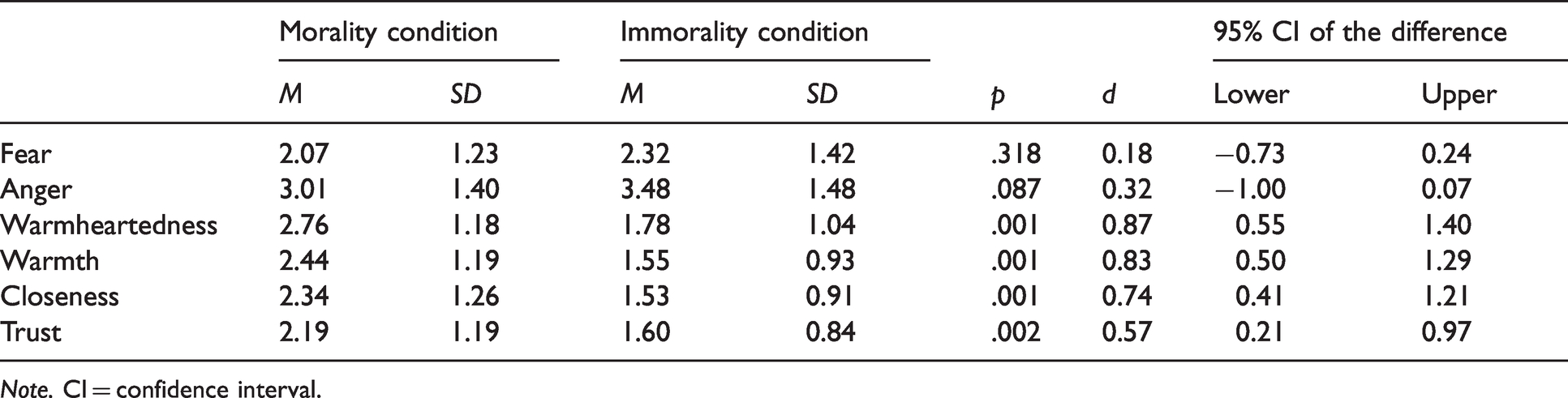
Note. CI = confidence interval.
General Discussion and Conclusion
The perceptions and judgments we hold about social groups matter, as they form the basis of our behavior. Unfortunately, our social perceptions are not only categorical but often biased (Hewstone et al., 2002). We tend to perceive and believe that our group (the in-group) is better and more moral than other social groups (out-groups). Translating these beliefs into behavior, we tend to favor our own and discriminate against other social groups. All of this becomes even more pronounced in contexts ridden by intergroup conflict. Added to this, the media becomes an important player in intergroup processes. It acts as an important and added source of how we view and judge others (Atwell Seate, 2017). Unfortunately, the media tends to engage in biased representations of social groups (Mastro, 2009). Such biased media representations resemble our individual and social perceptions—favoring our own whilst demonizing others.
In our research, we aimed to examine the question of how the media could be utilized to induce a more positive impact on intergroup behavior. More specifically, we examined different portrayals of relevant social groups in specific intergroup processes. Building on research on moral exemplars (Beneda et al., 2018; Čehajić-Clancy & Bilewicz, 2020; Witkowska et al., 2019), we compared moral representations of a specific and relevant out-group with representations of the same out-group as immoral. By utilizing an experimental design in the real post-conflict setting of Bosnia and Herzegovina, our data indicates that moral representations of relevant social groups matter for reconciliation processes in post-conflict societies.
More specifically, our data shows that representing former enemy group members as acting morally (in present times) facilitated more positive emotional and behavioral responses toward the entire out-group in comparison to more immoral representations of the same out-group individuals. These results are in line with the recent review by Čehajić-Clancy and Bilewicz (2020) of the impact of learning about moral exemplars. They claim that learning about historical moral behavior as performed by out-group members can shape our beliefs and behavior toward the social group associated with moral exemplars. These results are also in line with recent theorizing on the evaluation dimensions of social groups, indicating the importance of morality (Brambilla et al., 2011, 2013) and people’s tendency to preserve and reserve such perceptions for the in-group. Exposing people to stories of others’ (out-group members’) moral behavior through the media is important as it might shift those perceptions and consequently affect our behavior for the better. An important limitation that ought to be acknowledged here is the lack of a control condition. This study contrasted stereotypical (immoral) and counter-stereotypical (moral) representations of out-group targets without including a neutral representation and/or other positive (non-moral) representations of out-group targets. This constitutes not only a limitation of this work but also further research into learning about out-groups’ morality and its effects on intergroup processes. Future research should address this limitation.
Despite this limitation, this research is important for several reasons and contributes to the literature in the following ways. First, it provides further evidence for the moral exemplar paradigm, indicating the importance of learning about out-groups’ moral behavior and how such processes could facilitate positive intergroup responses. Second, it demonstrates an alternative and positive way for how the media can be utilized to promote such positive and current representations of social out-groups, and consequently recreate intergroup realities for the better. And third, it adds to the theory and research on intergroup reconciliation by demonstrating the importance of emotion-regulation processes in post-conflict environments. Whilst previous studies utilizing the moral exemplar intervention have demonstrated that learning about out-groups’ moral exemplars improved intergroup relations through creating a more generic positive effect, this study demonstrated the same effect for more specific (vs. general) positive emotions such as closeness, warmth, and trust. In addition, and in line with the existing literature, this evidence points to the null effect of moral exemplars on negative emotions. We have no evidence to explain why reading about out-group moral exemplars did not produce changes in negative out-group emotions, but we speculate that the negative emotions (fear and anger) might not have been as relevant—and hence potentially affected by our manipulation—as the positive emotions measured in this study. In line with this idea, Čehajić-Clancy and Bilewicz (in press) have argued that reading and learning about out-group moral exemplars emphasizes a more positive emotional response, and it could be argued that positive emotions are more likely to receive attention, and consequently be enhanced (as demonstrated in this study), in comparison to less (momentarily) salient negative emotions. This, however, remains to be empirically investigated. In conclusion, this study suggests that learning about relevant out-groups’ moral exemplars tends to promote more positive sentiments toward out-groups without directly influencing the levels of negative out-group emotions.
Supplemental Material
sj-pdf-1-pac-10.1177_18344909211002561 - Supplemental material for The Power of the Media on Peace and Reconciliation Processes: Representing Former Enemy Groups as Moral versus Immoral Matters
Supplemental material, sj-pdf-1-pac-10.1177_18344909211002561 for The Power of the Media on Peace and Reconciliation Processes: Representing Former Enemy Groups as Moral versus Immoral Matters by Ana Janković and Sabina Čehajić-Clancy in Journal of Pacific Rim Psychology
Supplemental Material
sj-pdf-2-pac-10.1177_18344909211002561 - Supplemental material for The Power of the Media on Peace and Reconciliation Processes: Representing Former Enemy Groups as Moral versus Immoral Matters
Supplemental material, sj-pdf-2-pac-10.1177_18344909211002561 for The Power of the Media on Peace and Reconciliation Processes: Representing Former Enemy Groups as Moral versus Immoral Matters by Ana Janković and Sabina Čehajić-Clancy in Journal of Pacific Rim Psychology
Supplemental Material
sj-pdf-3-pac-10.1177_18344909211002561 - Supplemental material for The Power of the Media on Peace and Reconciliation Processes: Representing Former Enemy Groups as Moral versus Immoral Matters
Supplemental material, sj-pdf-3-pac-10.1177_18344909211002561 for The Power of the Media on Peace and Reconciliation Processes: Representing Former Enemy Groups as Moral versus Immoral Matters by Ana Janković and Sabina Čehajić-Clancy in Journal of Pacific Rim Psychology
Supplemental Material
sj-pdf-4-pac-10.1177_18344909211002561 - Supplemental material for The Power of the Media on Peace and Reconciliation Processes: Representing Former Enemy Groups as Moral versus Immoral Matters
Supplemental material, sj-pdf-4-pac-10.1177_18344909211002561 for The Power of the Media on Peace and Reconciliation Processes: Representing Former Enemy Groups as Moral versus Immoral Matters by Ana Janković and Sabina Čehajić-Clancy in Journal of Pacific Rim Psychology
Footnotes
Declaration of Conflicting Interests
The authors declared no potential conflicts of interest with respect to the research, authorship, and/or publication of this article.
Funding
The author(s) disclosed receipt of the following financial support for the research, authorship and/or publication of this article: Production of this article was supported by the Pro-Futura Fellowship by Riksbankens Jubileumsfond (Grant Number: RIK 19-1296:3) awarded to Sabina Čehajić-Clancy.
Supplemental material
Supplemental material for this article is available online.
References
Supplementary Material
Please find the following supplemental material available below.
For Open Access articles published under a Creative Commons License, all supplemental material carries the same license as the article it is associated with.
For non-Open Access articles published, all supplemental material carries a non-exclusive license, and permission requests for re-use of supplemental material or any part of supplemental material shall be sent directly to the copyright owner as specified in the copyright notice associated with the article.
