




Abstract
Learning about outgroup individuals who risked their lives to save members of one’s ingroup can improve intergroup relations. However, previous studies have primarily focused on historical conflicts with clear intergroup boundaries, relied solely on self-report measures, and lacked assessments of durable effects. A preregistered preliminary experiment and a preregistered main experiment tested whether exposure to moral exemplars would improve the attitudes of Jewish citizens of Israel toward Arab citizens of Israel (their outgroup) following the October 7 attacks. Jewish Israeli participants who read true stories of outgroup (vs. ingroup) heroic acts showed more positive outgroup evaluation and reduced ingroup favoritism. In the main experiment, these effects persisted 1 week later and were accompanied by an effect on an indirect measure (Single-Target IAT) of outgroup morality immediately following the intervention. The results support the effectiveness and durability of the moral exemplar approach in improving outgroup evaluations.
A growing body of research has shown that learning about outgroup moral exemplars can shift beliefs and emotions, thereby improving intergroup relations, primarily in post-war conflict contexts (e.g., Beneda et al., 2018; Čehajić-Clancy & Bilewicz, 2017; Janković & Čehajić-Clancy, 2021; Witkowska et al., 2019, 2023) For example, in the context of the Nazi occupation of Poland during World War II, exposure to true stories of Germans who saved Polish citizens (vs. Germans participating in Nazi crimes) led Polish participants to report greater trust and more positive feelings toward Germans (Witkowska et al., 2019). The moral exemplar approach also effectively improves attitudes toward immigrants in non-conflict contexts (Alonso-Arbiol et al., 2024; Bojerud et al., 2023) and has recently shown effectiveness in an ongoing conflict (Sunni and Shia Muslims in Pakistan; Čehajić-Clancy et al., 2026, Experiment 3). The present research tested the moral exemplar approach in the context of active tension between subgroups in Israel.
Our research advances the moral exemplar approach in several ways. First, to our knowledge, the effectiveness of a moral exemplar intervention has not yet been tested within the context of the active intergroup tension among groups within Israel. This context allows us to extend prior work by examining an intergroup conflict in which the group that is exposed to the intervention is not entirely alienated from the outgroup but instead shares a common (Israeli) identity with it. Second, this research is the first to explore whether the effects of exposure to moral exemplars persist beyond immediate measurement. Third, to address the limitations of self-report measures (e.g., social desirability and motivational reasoning), we incorporated an indirect measure (the Single-Target IAT; Bluemke & Friese, 2008) that is less susceptible to these limitations (e.g., De Houwer, 2018).
To apply the moral exemplar approach, we drew upon documented events surrounding the Hamas-led attack on southern Israel on October 7, 2023, which resulted in substantial loss of life and the taking of hostages. This event intensified existing tensions between two key groups within Israel’s citizenry: Jews and Arabs (the largest non-Jewish minority group; Peleg & Waxman, 2011). In particular, the attack led to a marked decline in tolerance among many Jewish Israelis toward Arab Israelis (e.g., Bazak-Hilger & Face, 2024). Within this context, the present research examined changes in perceptions and judgments among Jewish citizens of Israel (JCI) following exposure to moral actions of Arab citizens of Israel (ACI) during the October 7 attack.
Groups Within Israel
The largest fraction of non-Jewish residents of Israel (21.1% of Israel’s population; Khalaily et al., 2023) identify ethnically as Arab and religiously as Muslim, Christian, or Druze (Cooperman et al., 2016). By and large, they are the descendants of those who remained within the borders declared by Israel after the 1948 Arab–Israeli war and hold Israeli citizenship 1 with the same legal rights as Jewish citizens (Robinson, 2023). However, indicators of integration into Israeli society present a mixed picture (Knesset Research and Information Center [KRIC], 2020): ACI are increasingly visible in key sectors (e.g., comprising 30% of nurses and 25% of doctors nationwide), yet striking disparities persist (e.g., only 9% of members of the Israeli parliament are Arab, and there are currently no Arabs in ministerial positions).
Importantly, in addition to their diverse religious identities, ACI hold multiple potential civil-national identities—including Arab, Palestinian, and Israeli (Cooperman et al., 2016). Accordingly, several terms are used to describe this population. The term “Palestinian citizens of Israel (PCI)” (e.g., Witte & Taha, 2021) is increasingly used by Muslims and Christians who wish to emphasize their Palestinian national identity (Peleg & Waxman, 2011), but is not used by other groups (e.g., Druze serving in the Israeli Defense Force; Amara & Schnell, 2004; Halabi, 2024). The term PCI has also been adopted by academics studying this population’s identity. In contrast, the Israeli government and mainstream media typically use “Israeli Arabs” to highlight the shared Arab ethno-cultural identity of Muslims, Christians, and Druze, and to distinguish these citizens from Palestinians living in the West Bank and Gaza (e.g., Amara, 2016).
The choice of terminology is therefore sensitive and politically charged and should be made carefully depending on the question investigated. Here, we investigate judgments made by JCI toward the population known to them as “Israeli Arabs.” For JCI, this overarching term encompasses various segments of Arabic-speaking citizens, some of whom identify as Palestinian and some of whom do not. We therefore adopt the term “Arab citizens of Israel”. Studies focusing on the self-definition of this population should consider using different labels, depending on the segment of the population under investigation.
For many years, JCI attitudes toward ACI have been marked by deep mistrust, rooted in security concerns and conflicting identities—particularly the perception that many ACI primarily identify with the Palestinian cause and the broader Arab world rather than with the Israeli state (Smooha, 2001; Waxman, 2011). JCI often view ACI as potential traitors (Waxman, 2019), and surveys consistently show that JCI consider ACI to be a threat to the country’s national security (Hermann et al., 2025). Although relations have remained largely nonviolent (Smooha, 2022), these tensions manifest strongly in attitudes and perceptions. Accordingly, researchers have investigated ways to effectively reduce negative evaluation and stereotyping by JCI (mainly children and adolescents) toward ACI through various interventions (e.g., Berger et al., 2018; Ditlmann & Samii, 2016; Influs et al., 2019; Masri et al., 2024; Shani & Boehnke, 2017; Weiss et al., 2023). Notable examples include a 24-week mindfulness- and compassion-based program (Berger et al., 2018), a month-long diversity-education program delivered through a children’s television show (Weiss et al., 2023), an 8-week dialogue-group intervention (Influs et al., 2019), and intergroup-contact-based courses (Gilad et al., 2021).
Heightened Tension Following the October 7 Attack
The October 7 attack heightened the tension felt by JCI toward ACI. A survey conducted shortly after the attack revealed that 63% of JCI reported not trusting their Arab compatriots, and 39% were unwilling to maintain friendly relationships with ACI (Givat Haviva, 2024). In a separate survey of JCI high school students, 40% indicated hatred toward ACI to a great or very great extent, and 19% indicated moderate hatred (Bazak-Hilger & Face, 2024).
The widespread mistrust among JCI stands in contrast to attitudes expressed by ACI. A survey conducted several weeks after the attack showed that 66% of ACI reported feeling part of the Israeli state—an unprecedented figure (Hermann et al., 2025). Media coverage around the same time further underscored this complexity by highlighting the assistance provided by ACI during and after the attack, including police officers and volunteers who rescued JCI from attacked areas, provided emergency medical care, donated blood, and supported JCI evacuees through initiatives in Jewish-Arab mixed cities (e.g., Pacchiani, 2023; Sudilovsky, 2024). We used true stories of these acts to test whether exposure to moral exemplars could reduce the negative attitudes that JCI hold toward ACI.
The Current Research
We conducted two experiments to test whether exposure to true stories of ACI moral exemplars during the October 7 attack could improve the attitudes of JCI toward ACI. In the outgroup exemplar condition, the heroic acts were performed by ACI; in the ingroup exemplar condition, similar heroic acts were performed by JCI. We used the ingroup exemplar condition as a comparison because narratives of ingroup heroism dominated Israeli media coverage following the attack and thus reflected participants’ natural exposure to heroic acts. 2 We predicted that participants who were exposed to outgroup moral exemplars would show more positive attitudes toward the outgroup—across both direct and indirect measures—and less ingroup favoritism than participants exposed to ingroup moral exemplars. In a preliminary experiment (N = 197), presenting JCI with heroic acts by either ACI or JCI and assessing immediate outgroup attitudes using self-report measures and the IAT (Greenwald et al., 1998), we found the predicted effect on self-reports but not on the IAT (see full report in the supplemental online material; SOM). Here, we present the more powered main experiment, which assessed the durability of the effect, replaced the IAT with a more nuanced indirect measure, and explored the potential effect of highlighting shared victimhood (see below).
Method
Transparency and Openness
We report how we determined our sample size, all data exclusions, all manipulations, and all measures used in the study. We preregistered our materials, sampling plans, exclusion criteria, and analysis plan (https://osf.io/4h95e/). We made several deviations from the preregistered analysis plan. 3 First, we report the results of three self-report measures of outgroup evaluation (outgroup morality, outgroup trust, and behavioral intentions) as a single measure of outgroup evaluation, rather than reporting them separately as planned. These measures lack theoretically meaningful differentiation (they all reflect outgroup evaluation), and their internal consistency was very high (α = .96 at both sessions). The results for the combined measure were identical to those for each measure separately (see the SOM for the full report). Second, our preregistered plan was to report the results separately for each measurement time point, including all participants who completed each specific session. Instead, we included the measurement time as a factor in an analysis including only participants who completed both sessions (the preregistered analysis produced similar results and is reported in full in the SOM). Full experimental procedures are available in the SOM. Data and materials (original and translations) for all experiments are available online (https://osf.io/ufp5v/). This research was approved by the ethics committee of the Open University of Israel (no. 3580).
Participants and Procedure
Based on the results of power analyses conducted using G*Power (Faul et al., 2009; see preregistration for details), we recruited 406 JCI participants through the online Midgam Panel (www.midgampanel.com). Data collection took place between November 12 and 13, 2024. Participants completed a 10-min experiment for a payment of 10 NIS (approximately US$3). As preregistered, we excluded five participants who had more than 10% of trials with response times under 300 ms (Greenwald et al., 2003) on the Single-Target IAT (ST-IAT), as well as one participant who made two or more mistakes identifying the social group of the heroes, resulting in 400 valid participants. Of these valid participants, 326 (82%) participated in a follow-up session—a 4-min experiment conducted 1 week later, for a payment of 6.5 NIS (approximately US$2). Data collection for this follow-up was conducted between November 19 and 20, 2024. After excluding an additional four participants who had more than 10% fast trials on the ST-IAT, the final sample included 322 participants (Mage = 41.95, SD = 12.98, 50% women; see Tables S1–S2 in the SOM for additional demographic information). This final sample size provided 88% power to detect a small-to-medium effect (η2 p = .03) in a mixed analysis of variance (ANOVA) with two measurement times (immediate post-intervention vs. 1-week follow-up; within-participants), in which participants were randomly assigned to one of four experimental conditions resulting from a 2 × 2 experimental design (see details below).
Participants first answered two demographic questions (gender and religiosity). Additional demographic questions were collected at the end of the experiment (see Table S1 in the SOM for the full set). They were then presented with an introductory text describing the events of October 7, 2023, and informed that they would read short descriptions of actions performed by Israeli citizens on that day. Participants were randomly assigned to read four genuine stories—previously published in Israeli media—depicting either outgroup members or ingroup members who performed heroic actions on October 7. To explore whether adding stories about victims might enhance the effect by highlighting a shared victim identity (assuming that such a framing could encourage recategorization of the ingroup and outgroup as members of the same broader group; e.g., Sharvit & Kremer-Sharon, 2023), half of the participants in both the outgroup and ingroup exemplar conditions read two additional stories about group members who were victims of the October 7 attack.
We selected ingroup-member stories that closely matched the available outgroup-member stories in both content and tone (see Table 1 for an example of one heroic act from each condition; full descriptions are available in Table S4 in the SOM). Each story included a photograph of the real-life hero (or victim), obtained from Google Images. After each description, participants answered two comprehension questions designed to ensure engagement with the story and understanding of the protagonist’s identity and actions. The first question was uniform across stories and concerned the name and ethnicity of the protagonist. The second question varied depending on the specific story and focused on the actions described (see Table S4 for the full set of comprehension questions). In total, 80% of participants answered all comprehension questions about the four main stories correctly.
Example Stories From Each of the Two Exemplar Group Conditions
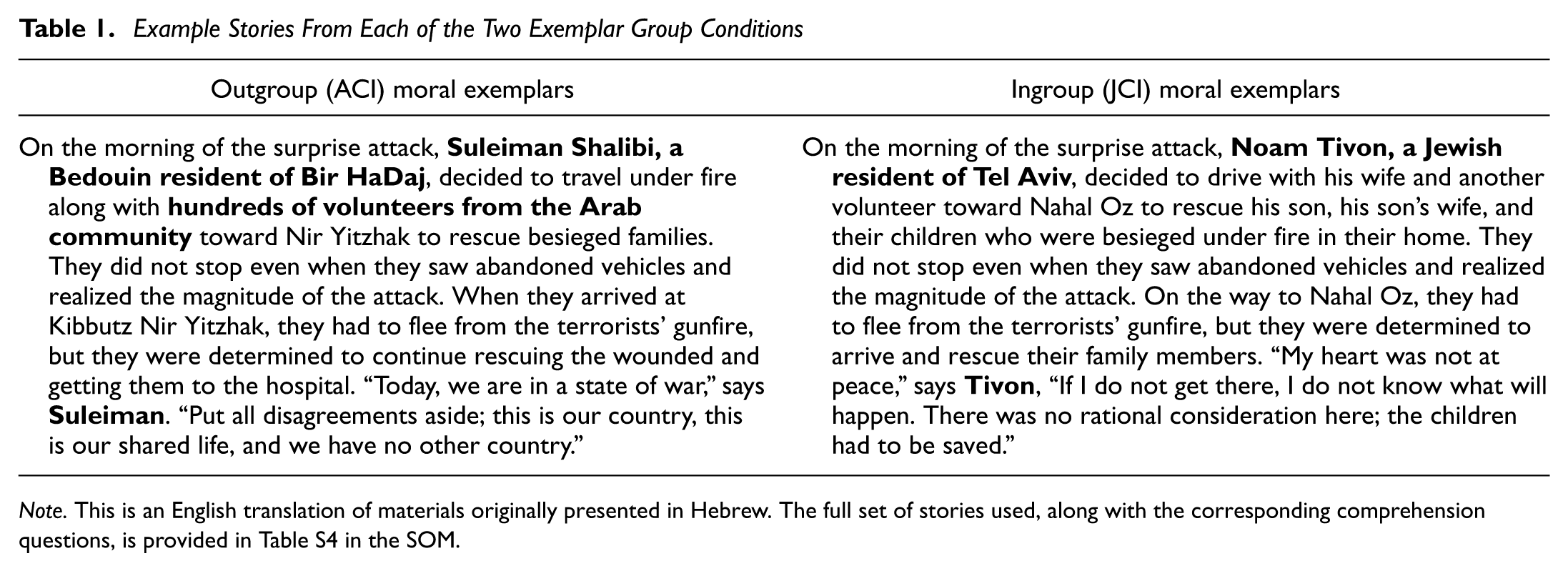
After reading the stories and answering the comprehension questions, participants completed the dependent measures. Specifically, they completed a set of self-report measures assessing outgroup morality, outgroup trust, behavioral intentions, and ingroup favoritism (measured using a feeling thermometer), presented in random order. In addition to these self-report measures, we included an indirect measure of outgroup morality: the Single-Target IAT (ST-IAT; Bluemke & Friese, 2008). The completion order of the self-report measures and the ST-IAT was randomized.
Materials
Direct (Self-Report) Measures
Table 2 provides details on the self-report measures of outgroup morality, outgroup trust, and behavioral intentions (which were combined into a single measure of outgroup evaluation), as well as the measure of ingroup favoritism.
Self-Report Measures
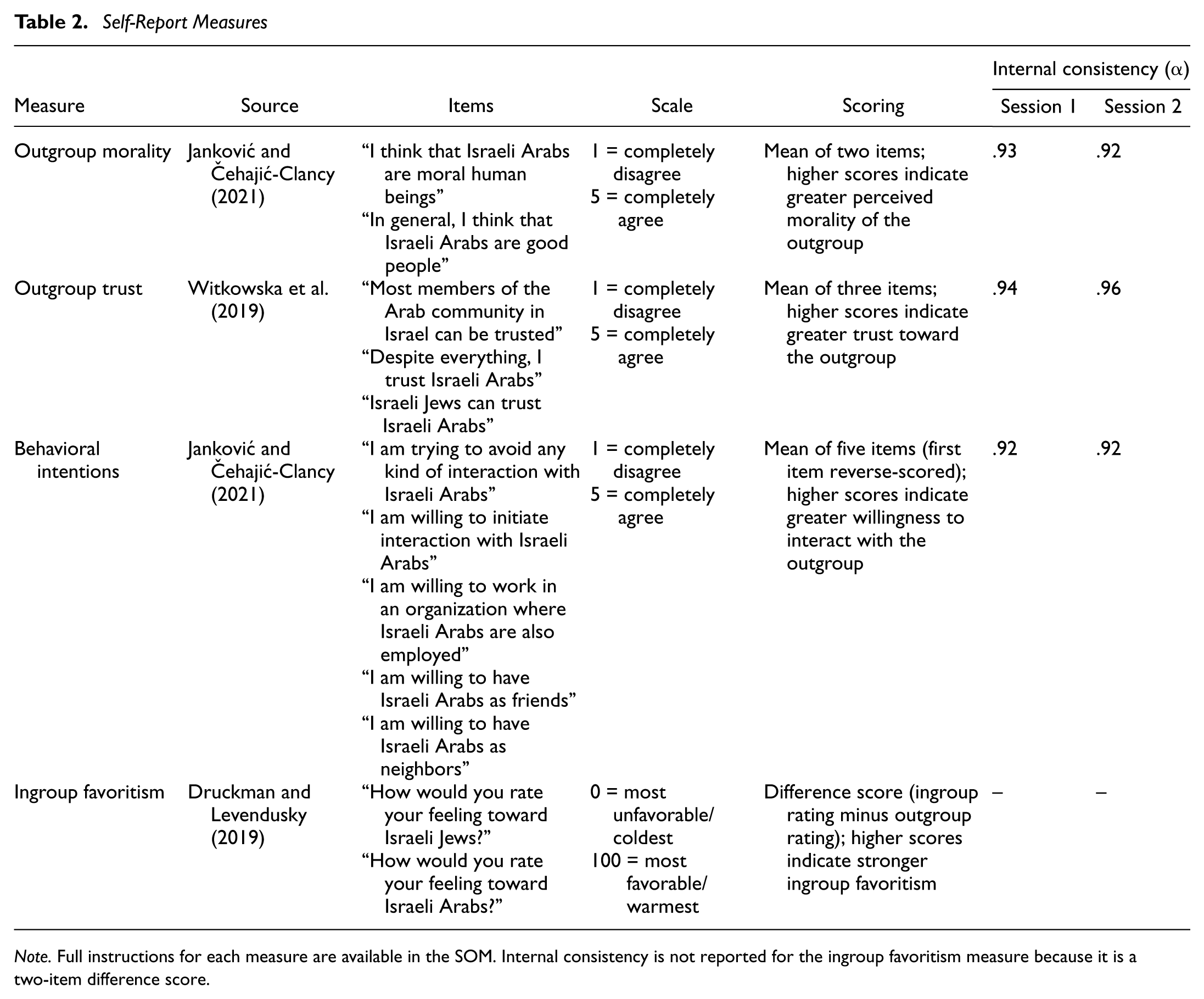
Note. Full instructions for each measure are available in the SOM. Internal consistency is not reported for the ingroup favoritism measure because it is a two-item difference score.
Indirect Measure of Outgroup Morality: The Single-Target IAT (ST-IAT)
In the ST-IAT, participants categorized stimuli into their corresponding categories using two computer keys. The ST-IAT includes three categories: “Israeli Arabs,”“Moral,” and “Immoral” (see Table 3 for the category items). In one critical block, participants responded with the left key to stimuli from two categories (“Israeli Arabs” and “Moral”) and with the right key to stimuli from the remaining category (“Immoral”). In the other critical block, participants responded with the right key to stimuli from two categories (“Israeli Arabs” and “Immoral”) and with the left key to stimuli from the remaining category (“Moral”). The order of these blocks was random. We computed ST-IAT scores (Cronbach’s α = .69 in the first session and .55 in the follow-up session), with more positive scores reflecting a stronger link between the outgroup and morality and more negative scores reflecting a stronger link between the outgroup and immorality. 4
Items Used in the ST-IAT
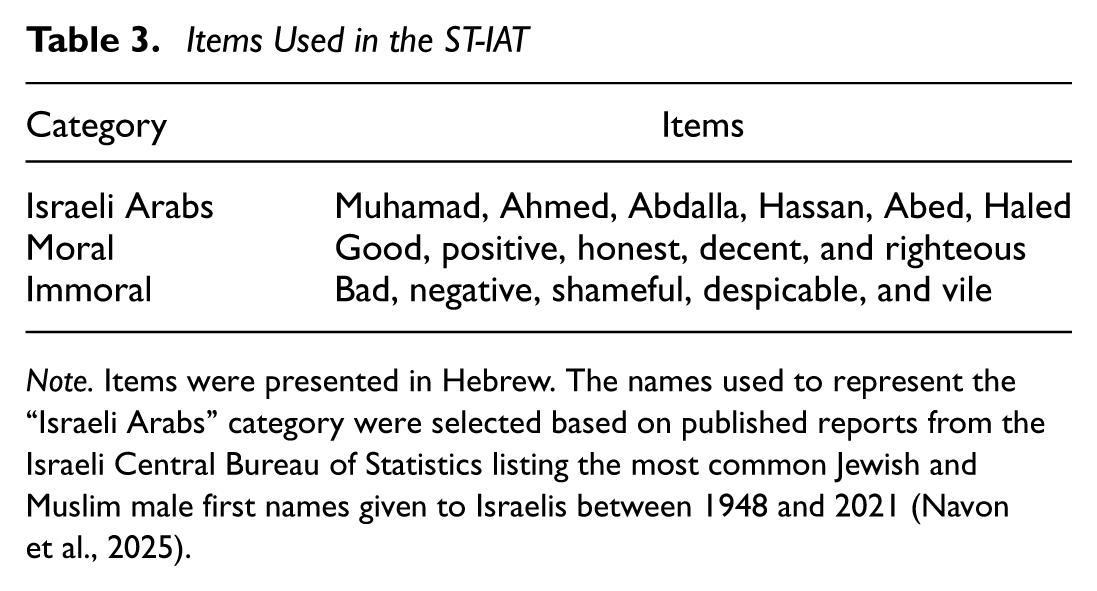
Note. Items were presented in Hebrew. The names used to represent the “Israeli Arabs” category were selected based on published reports from the Israeli Central Bureau of Statistics listing the most common Jewish and Muslim male first names given to Israelis between 1948 and 2021 (Navon et al., 2025).
Results
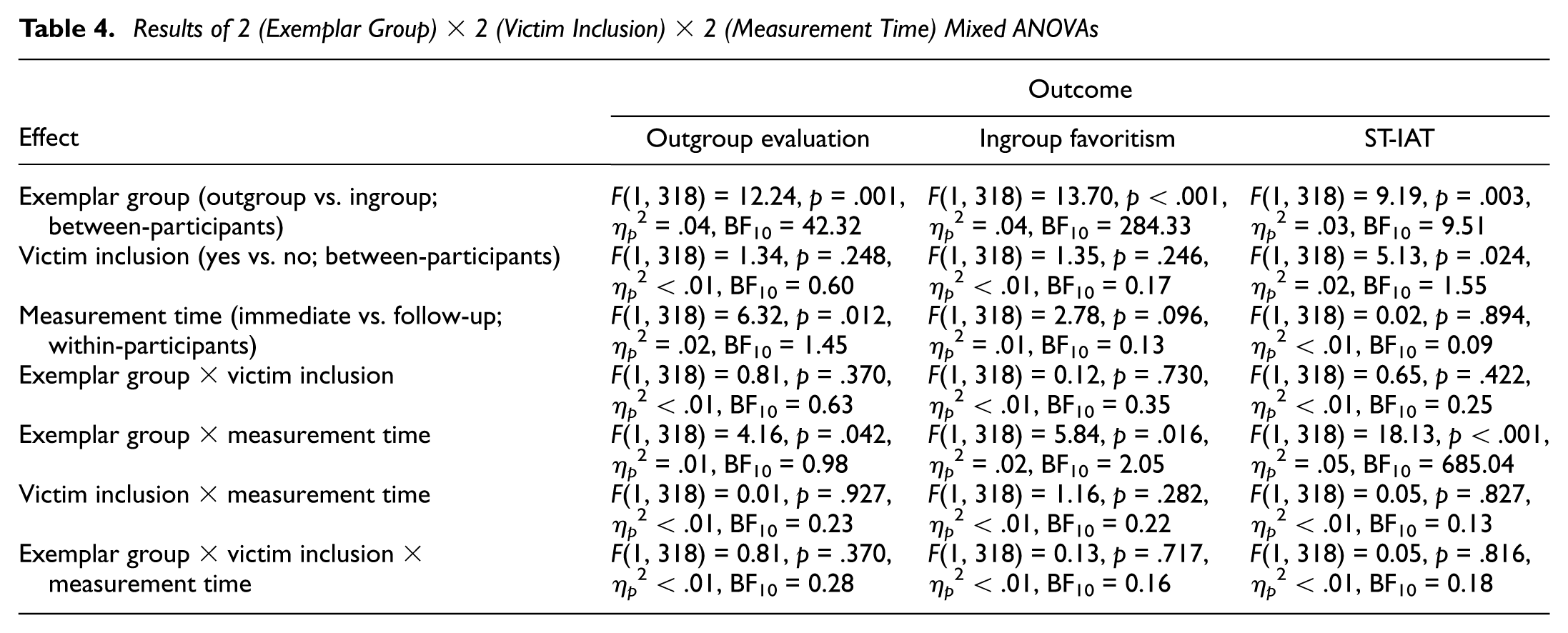
For each of the three dependent measures—outgroup evaluation (combined), ingroup favoritism, and the ST-IAT—we report the results of 2 × 2 × 2 mixed ANOVAs (one per dependent measure), with exemplar group (outgroup vs. ingroup; between-participants), inclusion of victims (yes vs. no; between-participants), and measurement time (immediate post-intervention vs. 1-week follow-up; within-participants) as factors. These analyses include the 322 valid participants who completed both sessions. Full results are shown in Table 4. Because the effects of victim inclusion were mainly non-significant (except for one main effect on the ST-IAT), and the main effect of exemplar group and its interaction with measurement time were consistently significant, Figure 1 presents the means by exemplar group and measurement time collapsed across the victim inclusion factor. The full means table is reported in the SOM (Table S11). 5 The most relevant preregistered hypothesis was a more positive evaluation of the outgroup, which should be visible in a main effect of the exemplar group (i.e., heroic outgroup vs. ingroup members). Participants in the outgroup exemplar condition should show a more positive outgroup evaluation, a more positive ST-IAT score, and reduced ingroup favoritism. The exemplar group-by-measurement-time interaction tests the stability of the effect over time.
Results of 2 (Exemplar Group) × 2 (Victim Inclusion) × 2 (Measurement Time) Mixed ANOVAs
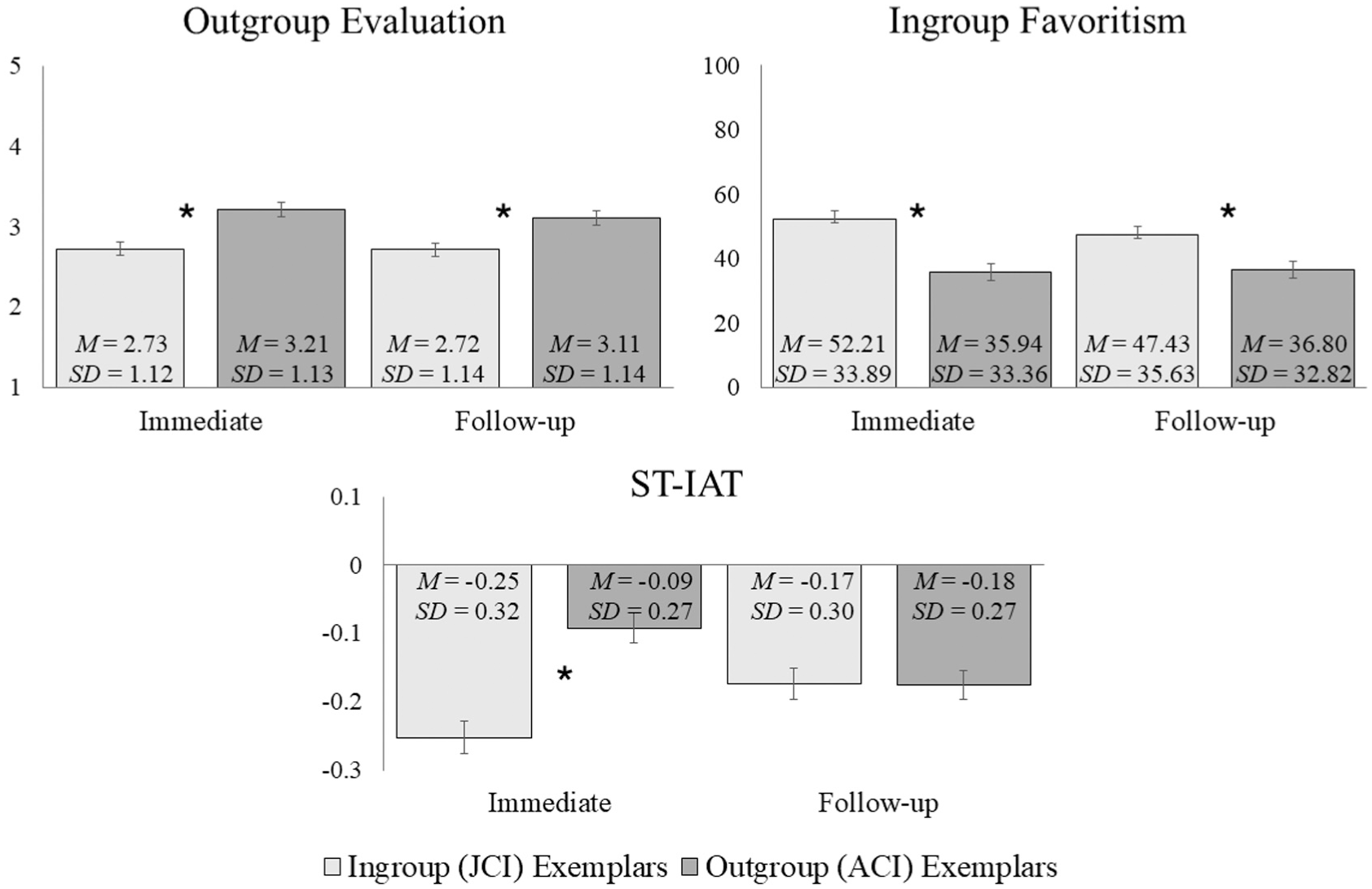
Outcome Measures as a Function of Exemplar Group and Measurement Time
Outgroup Evaluation
The mixed ANOVA revealed the hypothesized main effect of exemplar group, F(1, 318) = 12.24, p = .001, η p 2 = .04, 90% confidence interval (CI) (.01, .08), BF10 = 42.32, indicating more positive outgroup evaluation in the outgroup exemplar condition (M = 3.16, SD = 1.12) than in the ingroup exemplar condition (M = 2.72, SD = 1.11). In addition, a main effect of measurement time (with anecdotal evidence for an effect) emerged, F(1, 318) = 6.32, p = .012, η p 2 = .02, 90% CI (.002, .05), BF10 = 1.45, indicating somewhat lower positivity in the 1-week follow-up (M = 2.90, SD = 1.15) relative to the immediate measurement (M = 2.96, SD = 1.15). The interaction between exemplar group and measurement time was also significant (with anecdotal evidence for a lack of effect), F(1, 318) = 4.16, p = .042, η p 2 = .01, 90% CI (.0002, .04), BF10 = 0.98, indicating a somewhat larger effect of exemplar group in the immediate measurement, t(316.19) = 3.86, p < .001, d = 0.43, 90% CI (.24, .62), BF10 = 137.51, compared with the 1-week follow-up, t(316.57) = 3.07, p = .002, d = 0.34, 90% CI (.16, .53), BF10 = 10.78. All other effects were not significant (ps > .248, η p 2s < .01; see Table 4).
Ingroup Favoritism
The mixed ANOVA showed the expected main effect of exemplar group, F(1, 318) = 13.70, p < .001, η p 2 = .04, 90% CI (.01, .08), BF10 = 284.33, indicating less ingroup favoritism in the outgroup exemplar condition (M = 36.37, SD = 31.88) than in the ingroup exemplar condition (M = 49.82, SD = 32.79). The interaction between exemplar group and measurement time was also significant (with anecdotal evidence for an effect), F(1, 318) = 5.84, p = .016, η p 2 = .02, 90% CI (.002, .05), BF10 = 2.05, indicating a somewhat larger effect of exemplar group in the immediate measurement, t(317.75) = 4.34, p < .001, d = 0.48, 90% CI (.30, .67), BF10 = 818.04, compared with the 1-week follow-up, t(319.9) = 2.79, p = .006, d = 0.31, 90% CI (.13, .50), BF10 = 4.76. 6 All other effects were not significant (ps > .096, η p 2s < .011; see Table 4).
Single-Target IAT
The mixed ANOVA revealed the expected main effect of exemplar group, F(1, 318) = 9.19, p < .003, η p 2 = .03, 90% CI (.006, .06), BF10 = 9.51, indicating a weaker link between the outgroup and immorality in the outgroup exemplar condition (M = –0.13, SD = 0.21) than in the ingroup exemplar condition (M = –0.21, SD = 0.25). The main effect of inclusion of victims was also significant (with anecdotal evidence), F(1, 318) = 5.13, p = .024, η p 2 = .02, 90% CI (.001, .05), BF10 = 1.55, indicating a weaker link between the outgroup and immorality when no stories of victims were presented (M = –0.15, SD = 0.25) than when participants were also exposed to stories of victims (M = –0.21, SD = 0.22). The interaction between exemplar group and measurement time was significant, F(1, 318) = 18.13, p < .001, η p 2 = .05, 90% CI (.02, .10), BF10 = 685.04, indicating a significant effect of exemplar group in the immediate measurement only, t(318.92) = 4.91, p < .001, d = 0.54, 90% CI (.36, .73), BF10 > 1,000, but not in the 1-week follow-up, t(319.96) = –0.05, p = .959, d = –0.005, 90% CI (–.19, .18), BF10 = 0.12. All other effects were not significant (ps > .422, η p 2s < .01; Table 4).
Discussion
The present research extends the moral exemplar approach (Čehajić-Clancy & Bilewicz, 2021) to the ongoing, acute tension within groups in Israel. The results provide evidence for the effectiveness of this approach in shaping JCI attitudes toward ACI—demonstrating not only immediate effects on both direct and indirect attitude measures but also durable improvements on direct measures, albeit with weaker effects over time. Interestingly, the inclusion of victim stories did not moderate the intervention’s effects, suggesting that the initial expectation that highlighting shared victimhood would enhance the intervention’s impact was not supported. 7 Importantly, this research provides the first evidence that exposure to moral exemplars can yield changes that persist beyond the immediate moment. Whereas most studies on prejudice reduction have been limited to immediate outcomes (e.g., Paluck et al., 2021), our research contributes to the growing emphasis on understanding the durability of intervention effects (Čehajić-Clancy & Halperin, 2024). Future studies could explore whether these effects endure over longer periods, as has been observed with other types of interventions (e.g., Berger et al., 2018).
We focused on a particularly complex intergroup context in which the target group—the group toward which we sought to improve attitudes—is perceived by the attitude holders as having multiple social identities: some that are perceived as contradictory to theirs (e.g., Arab/Palestinian) and others that are shared (e.g., Israeli). Research on moral exemplars has traditionally examined conflicts where group boundaries are more clearly defined and a shared identity is either absent—as in the case of Poles and Germans (Witkowska et al., 2019)—or actively rejected, as among Bosnians and Serbs in the former Yugoslavia (Čehajić-Clancy & Bilewicz, 2017). In contrast, at the time of data collection, substantial proportions of both JCI (86%) and ACI (66%) reported feeling part of the state and its challenges (Hermann et al., 2025), highlighting the relevance of a shared superordinate identity for both groups. Presenting ACI exemplars may therefore have activated not only the outgroup identity but also the shared superordinate identity—potentially encouraging JCI participants to consider ACI as part of their broader national group and increasing positivity toward them. This would suggest that the moral exemplar approach may be especially effective in contexts where a shared superordinate identity exists. Future research could examine this possibility directly and join concurrent work on the role of a perceived shared superordinate identity in other domains, such as political partisanship in the United States (e.g., Amit et al., 2024).
Our research is the first to demonstrate effects of a moral exemplar intervention on an indirect attitude measure—a type of measure that is less controllable and therefore less susceptible to social desirability and motivated reasoning (e.g., De Houwer, 2018). The results thus suggest that the intervention impacted not only participants’ reflective attitudes but also their less controllable responses. However, unlike the effects observed on the self-report measures, the impact on the ST-IAT did not persist 1 week after the intervention. One interpretation is that the durable effects on self-report measures partly reflect social desirability or demand characteristics (Corneille & Lush, 2023). Alternatively, these findings may indicate that while a single exposure to moral exemplars is sufficient to produce stable changes in more deliberate, controllable judgments, repeated or more prolonged exposure may be necessary to achieve lasting changes in less controllable responses (e.g., Forscher et al., 2017). Finally, the measure’s low reliability, combined with a decline over time, may result in a null effect.
Prior research offers several mechanisms that may explain why moral exemplar interventions, such as ours are effective. Scholars have argued that morality plays a central role in outgroup evaluation and overall impression formation (Amit & Venzhik, 2025; Brambilla et al., 2013; Goodwin et al., 2014; Leach et al., 2007; Venzhik et al., 2025), and that moral behavior can signal shared values between groups (e.g., Haidt et al., 1993; Moran & Walther, 2026). Thus, exposure to outgroup (vs. ingroup) moral exemplars in our study may have led JCI to perceive more shared values with ACI, thereby improving outgroup evaluations. A second mechanism, proposed by Čehajić-Clancy et al. (2026), is that exposure to moral actions elicits feelings of moral elevation—such as inspiration and awe—which can, in turn, foster more positive attitudes toward the outgroup. However, previous studies examining moral elevation have compared exposure with moral exemplars with neutral stories (Čehajić-Clancy et al., 2026), whereas in our study, both conditions featured moral actions. Thus, a moral elevation explanation would require the additional assumption that moral elevation is stronger, or more strongly associated with improved attitudes, when the outgroup performs moral acts than when the ingroup performs them. Finally, as noted earlier, the intervention may have also activated a shared superordinate identity, leading participants to perceive ACI as part of a broader national ingroup. Future research could directly test which of these mechanisms best explains the observed changes in the current context, particularly with regard to the durability of the effects, and explore whether different mechanisms operate in different intergroup contexts.
Building on prior work with migrant moral exemplars (Alonso-Arbiol et al., 2024; Čehajić-Clancy et al., 2026, Experiment 4) and ethnic minority exemplars (e.g., Shia Muslims in Pakistan and Albanians in Serbia; Čehajić-Clancy et al., 2026, Experiments 2–3), our research examined changes in attitudes held by members of a dominant group (JCI) toward a minority group (ACI). Accordingly, our theoretical framing and materials were constructed from the perspective of the dominant group. To our knowledge, no studies have investigated the reverse pattern—presenting moral exemplars from the majority group to foster trust among minority group members. Future studies could explore whether group status serves as a boundary condition in moral exemplar interventions. It may also be valuable to investigate whether priming ACI with their Israeli identity (shared with JCI) enhances the effect of exposure to JCI moral exemplars relative to priming their Palestinian identity, which stands in greater tension with JCI identity.
In our research, we relied on real-life media stories to present moral exemplars from either the ingroup or outgroup. Building on work showing the impact of media content on moral intuitions (e.g., Prabhu et al., 2020), our results suggest that media initiatives or campaigns could highlight the moral dimensions of heroic acts by ACI to challenge prevailing negative attitudes and stereotypes. More broadly, the very act of reporting moral exemplar stories underscores the role of media not only in documenting events but also in shaping public perceptions, social norms, and intergroup relations (Eden et al., 2021; Prabhu et al., 2020). The reliance on real-life media stories made it plausible that some participants were already familiar with these materials before the experiment. However, because we did not measure familiarity, we cannot assess how it influenced the intervention’s effect. Future studies could directly examine the role of previous exposure in the success of the moral exemplar approach.
Given that our materials were adapted from stories already circulating in the media, scaling such interventions for real-world implementation may be relatively simple. Still, consistent with the call by IJzerman et al. (2020) to exercise caution when translating scientific findings into real-world applications, we note that additional research is needed to enhance the evidence readiness level (ERL)—the quality of evidence before translation to application—of moral exemplar interventions. Future work could include large-scale experiments that measure behavioral outcomes during periods of active crisis. Although the effects observed on self-report measures were small, they are comparable with effect sizes reported in meta-analyses of interventions targeting existing evaluations and behaviors (e.g., Beelmann & Heinemann, 2014; Moran et al., 2025). This is promising given the simplicity of the intervention and accumulating evidence that even small effects can meaningfully shape real-world outcomes (Götz et al., 2022).
In conclusion, the current findings offer cautious optimism amid an ongoing and emotionally charged conflict. Even within this tense and unresolved context, brief exposure to a small number of moral exemplars produced consistent and, in some cases, lasting improvements in attitudes. The effectiveness of such a minimal intervention, akin to reading a few news headlines, highlights the potential power of the moral exemplar approach in reducing intergroup bias and fostering trust.
Supplemental Material
sj-docx-1-spp-10.1177_19485506261428949 – Supplemental material for The Enduring Effect of Exposure to Moral Exemplars During Active Intergroup Tensions: Evidence From Groups Within Israel
Supplemental material, sj-docx-1-spp-10.1177_19485506261428949 for The Enduring Effect of Exposure to Moral Exemplars During Active Intergroup Tensions: Evidence From Groups Within Israel by Tal Moran, Adi Amit and Dror Butbul in Social Psychological and Personality Science
Footnotes
Handling Editor: Christian Unkelbach

Funding
The authors disclosed receipt of the following financial support for the research, authorship, and/or publication of this article: This research was supported by an Israel Science Foundation grant #870-23 and the Open University of Israel’s research grant #41454 to Tal Moran and by a grant by an Israel Science Foundation grant #604-20 to Adi Amit.
Declaration of Conflicting Interests
The authors declared no potential conflicts of interest with respect to the research, authorship, and/or publication of this article.
Supplemental Material
The supplemental material is available in the online version of the article.
Notes
Author Biographies
References
Supplementary Material
Please find the following supplemental material available below.
For Open Access articles published under a Creative Commons License, all supplemental material carries the same license as the article it is associated with.
For non-Open Access articles published, all supplemental material carries a non-exclusive license, and permission requests for re-use of supplemental material or any part of supplemental material shall be sent directly to the copyright owner as specified in the copyright notice associated with the article.
