




Abstract
Australia has a long history of privately owned utility price regulation, one that is little known. This price control was designed to restrain the market power of several utilities (gas, rail, tramways, electricity, and water). The purpose of this paper, therefore, is to establish what types of price control that were used in Australia in the utilities sector before the First World War and to determine the degree to which this price control influenced efficiency. As price levels in this era were set in legislation, the lack of flexibility led to less-than-optimal outcomes, and eventually and led to new approaches were developed after 1912 to the utilities that remained in private ownership, and in some cases influenced the movement in Australia towards government control.
Keywords
Introduction
In Australia, during both the 19th and 20th centuries, state and federal governments have periodically used direct regulatory controls to restrain private businesses from raising prices. These measures have taken place in a range of different contexts and have attracted varying degrees of attention from historians (Blainey, 1966; Butlin, 1959; McLean, 2013; Sinclair, 1976). Generally, the measures undertaken to combat inflationary pressures during the two world wars and during the 1970s and 1980s have attracted the most attention, whereas the measures undertaken to restrain the pricing behaviour of monopoly utilities have attracted less scrutiny. This is mainly because throughout most of the 19th and 20th centuries, Australian monopoly utilities were owned and operated by the state (most rail, seaports, water supply, and electricity) and federal (airports, post, telecommunications) governments (Abbott & Cohen, 2021). Because of the predominance of government ownership of the utilities in Australia up until the 1990s, it has generally been assumed that utility price regulation of private utilities, which was common in places such as Britain, Canada, and the United States, was largely absent from Australia (Armstrong & Nelles, 1985, 1986; Butlin et al., 1982; Ergas & Pincus, 2014).
In the Australian case of government-owned utilities, prices were set by the agencies carrying out these functions in conjunction with some sort of ministerial oversight (Bland, 1929; Brigden, 1927; Butlin et al., 1982; Eggleston, 1932). Although much of the utilities sector was government owned, there have been some examples of price regulation of privately owned utilities companies in Australia. This came initially in the form of statute regulation, with regulatory clauses on pricing placed into legislation that enabled the laying of privately owned rail and tram tracks, gas pipelines, and the stringing up of electricity lines. Later, more flexible pricing arrangements were imposed on privately owned gas supply companies from 1912 onwards and persisted in use until the present day (Abbott, 2013; Abbott & Ma, 2017). With the privatization of many Australian government utilities from the 1990s, this formal price control became more common across non-gas utilities as well and was embodied in the National Competition Policy from 1995 onwards (King & Maddock, 1996).
This means that Australia has in fact a long history of privately owned utility price regulation, one that is little known, even by the various government agencies today that are involved in the economic regulation of utilities.
The economic regulation of utilities internationally has a long history, is generally said to be motivated by the asserted existence of ‘natural monpoloy’ characteristics (Pindyck & Rubinfeld, 2001, p. 50). These characteristics make it economical for a single firm to supply services in the relevant market rather than by two or more competing firms. This in turn can lead to losses in economic efficiency and other social costs from excessive pricing. Regulation of this pricing is designed to set prices at a level of long run average costs that would enhance efficiency. Regulation, however, is imperfect and can lead to costly and unanticipated responses to incentives created by regulatory rules and procedures (Joskow, 2007; Spulber, 1989).
The purpose of this paper, therefore, is to examine the types of price control that were used in Australia in the utilities sector before the First World War. This price control was designed to restrain the market power of several utilities (rail, gas, tramways, electricity). On doing so two research questions are addressed. These are: • Firstly, to establish what form of regulatory control was predominately used in Australia in the 19th century; and • Secondly, and more importantly, to determine the degree to which economic regulation was effective at enhancing efficiency, or if there were any unanticipated consequences that undermined efficiency.
In undertaking this study will be possible to gain a greater understanding of the problems associated with establishing economically efficient and political acceptable forms of economic regulation of public utilities.
In the first section, a description is provided on the nature of the market power of utilities and their regulation internationally. In the following section, the various utilities regulated are examined, and in the final section, some conclusions are drawn.
Public utilities, market power, and phases of regulation
First, if the effectiveness of regulation is to be determined, it is important to understand why utilities have attracted price regulation in the first place. The term utilities refers to the set of services provided by those organizations consumed by the public that make use of public property, are thought to be essential in nature, and typically include things such as railways, electricity and gas supply, telecommunications, and water and sewerage. Sometimes airports, seaports and postal services are also considered to be public utilities. The organizations created to supply these services were created by public law, use public property, deliver public services, and so became ‘public’ utilities. Public utilities are generally natural monopolies because the network infrastructure required to deliver a product such as electricity or water (the wires or pipes) is expensive to build, to maintain and to duplicate. Not only are utilities capital intensive, but they also need to maintain substantial sales volumes, which has encouraged them to be heavily involved in expanding the use of the product.
In recent years, developments in technology have eroded some of the monopoly aspects of traditional public utilities, but the network infrastructure used to distribute most utility products and services has remained largely monopolistic (often the natural monopoly elements are identified as being the distribution networks in electricity and gas and of the local loop in telecommunications: Economides, 1996).
The development of public utilities is strongly related to the development of urban centres. Urban life depends upon a complex of interconnections and technological-based systems. Communications, light, power, and mobility are the fundamental attributes of urban life in the modern era. Public utilities, by improving transport, communications, and public sanitation, make it possible to create more expanded urban centres, which in turn convert the negative externalities associated with urban congestion into positive externalities. Greater urban densities mean that economic gains could be made from the external benefits associated with concentrations of industry as well as the economies of scale from larger units of production.
The use of price controls in Australia has been influenced by the manner in which they have been used internationally, especially in the United States and the United Kingdom. Price controls have been used in various guises since at least the time of the Roman Empire and were commonly used in the 19th century in the United Kingdom in the gas supply, railways, and water industries (Hassan, 1985). This mostly came in the form of rate of return regulation, which survived until the late 1940s when these industries were nationalized. In Britain, the gas supply industry has been regulated since 1812, with these measures being common in some European countries (Millward, 1991a, 1991b, 2005, 2011; Chatterton, 1972; Falkus, 1967, 1977, 1982; Foreman-Peck, 1989; Matthews, 1985; Millward & Ward, 1993; Rowlinson, 1984). In the gas supply industry in Britain, the sliding scale approach became commonly used and was first used in Sheffield in 1866. It was the main form of price regulation in the British gas industry by 1914 (Foster, 1992). With this approach, if a company raised prices above the set standard price without justification, it had to lower its dividends. This could happen if costs rose faster than the price increase. Conversely, if costs fell at a greater rate than prices, dividend payments would be allowed to rise. This was often achieved given the considerable technological change that occurred in the industry. Economists have depicted this approach to regulation as a form of early ‘incentive-regulation’ where the utility is encouraged to maximize its profits by achieving cost reducing efficiencies (the CPI-X format is the most common form of this in recent times) (Foster, 1992).
Price regulation also became common in the utilities sector in the United States in the 19th century (and in Canada). Regulation in the gas, electricity and water industries in the United States, for instance, evolved in four distinct phases: the first phase (ca. 1850–1899) was a period of weak municipal control, often referred to as franchise regulation; the second phase (ca. 1900–1909) was a period of aggressive municipal control, commonly referred to as municipal regulation; the third phase (ca. 1907–1977) was a period of state regulation, and the fourth phase (ca. 1978 to present) has been characterized by limited state and municipal control and the introduction of competition. In the first phase, companies were regulated by municipal franchises. Franchises gave utilities the power to dig up streets and operate in particular cities and, in return for these rights, imposed obligations on the utility in question (i.e., price ceilings and minimum service thresholds). Nominal price ceilings, however, worked poorly because the general price level fell steadily over the 19th century and because the technology of producing gas and electricity improved rapidly (Armstrong & Nelles, 1985, 1986; Schap, 1986; Troesken 1996). During the second phase, many states (in Canada, the provinces) began to pass laws authorizing municipal governments to directly regulate the rates charged by gas and electric companies, as well as other utilities. State regulation, the third phase in the regulation of gas and electricity, began in earnest approximately 1910. In the case of the water supply industry in the United States from the second phase onwards, many private water companies governed by municipal franchises were replaced by municipally owned enterprises (Joskow, 1987).
The use of regulation of pricing in Australia in the 19th century was more heavily influenced by the way it was undertaken in the United Kingdom than in the United States. The Australian experience was, however, similar to the American case in that in the early years in both countries, rates were set in a fairly rigid fashion, in the American case, by long-term franchise agreements. In the Australian case, the setting of rates was embodied in enabling legislation that established the utilities companies. In the early 20th century, however, in both Australia and the United States, this led to problems emerging, which eventually led to more flexible price control regimes being experimented with, or of the industries themselves to be taken over entirely by the government.
The nineteenth century
Despite the prevailing perception that Australia’s utilities in the 19th century were government controlled, it was at this time common for private businesses to attempt the construction and operation of many of the initial network utilities. Even if most were subsequently taken over by the colonial and later state governments, a number were to survive into the 20th century in private ownership. Prominent amongst these were the land grant, Midlands Railway Company in Western Australia, electricity companies in Brisbane and Adelaide and gas supply companies such as AGL in Sydney, the South Australian Gas Company, and the Brisbane Gas Company.
Although initial private initiatives were common, in the case of network-based infrastructure industries such as rail, gas supply, electricity supply, water and sewerage, and tramways, government intervention was necessary for these industries to be established. Each made use of infrastructure that required the acquisition of land or the breaking up of streets to lay pipes or rails or permission to string up wires along streets. To enable this to occur, legislation was required and subsequently passed through the various colonial parliaments in the 19th century. As local government was relatively underdeveloped in Australia during the 19th century, it was the colonial parliaments that passed the legislation that enabled these firms to operate rather than occurring through local government regulations. In addition, in the earliest years, legislation had to be passed to incorporate the companies, as general laws and statutes that enabled the creation of limited liability were only passed in the Australian colonies from the 1860s onwards (e.g., Companies Statute 1864 VIV; Companies Act 1874 NSW). This sort of company formation was necessary, as considerable sums of money had to be raised from investors to finance the capital-intensive infrastructure.
19th Australian utility price regulation (gas supply industry).
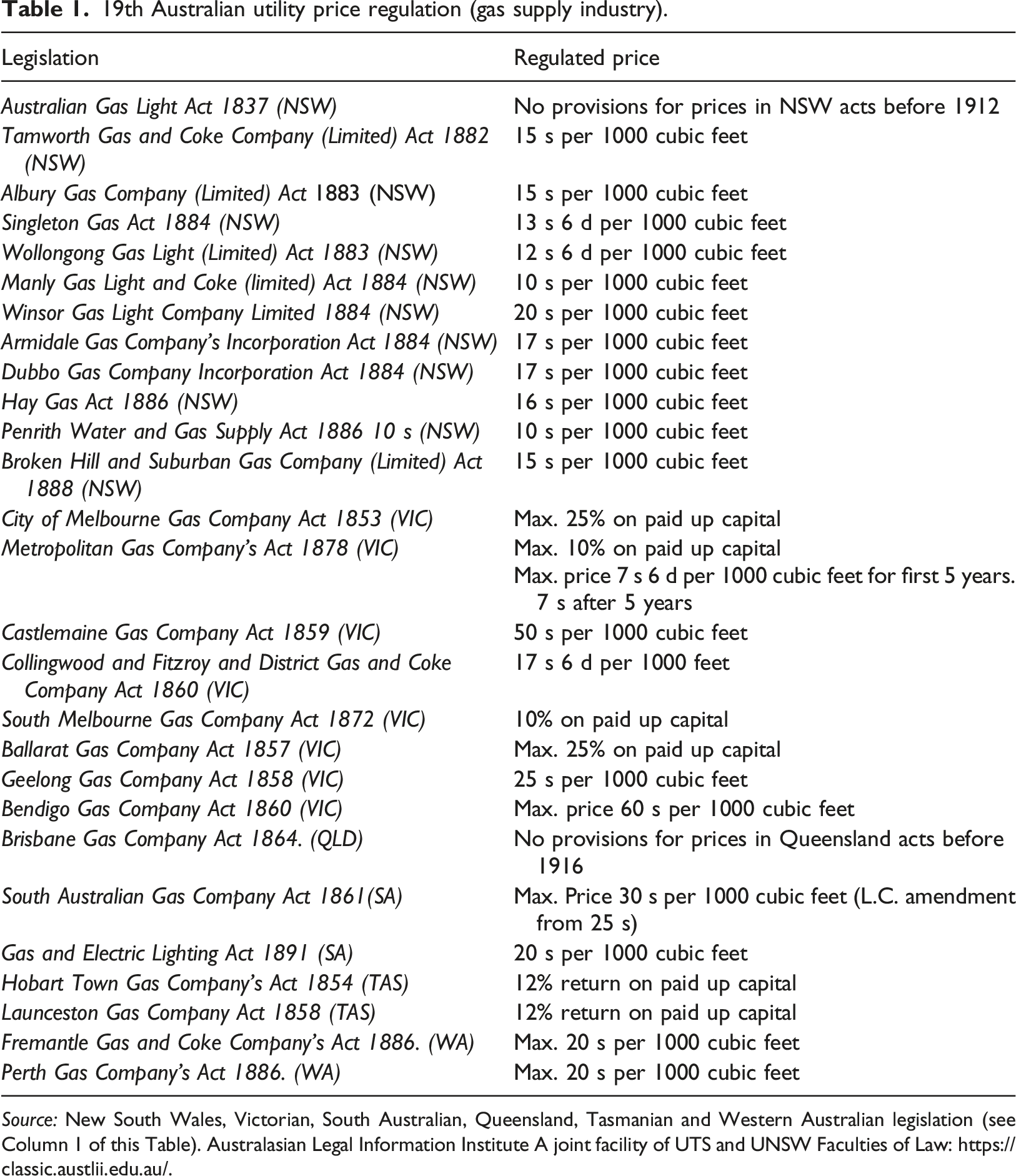
Source: New South Wales, Victorian, South Australian, Queensland, Tasmanian and Western Australian legislation (see Column 1 of this Table). Australasian Legal Information Institute A joint facility of UTS and UNSW Faculties of Law: https://classic.austlii.edu.au/.
19th Australian utility price regulation (tramways and railways).
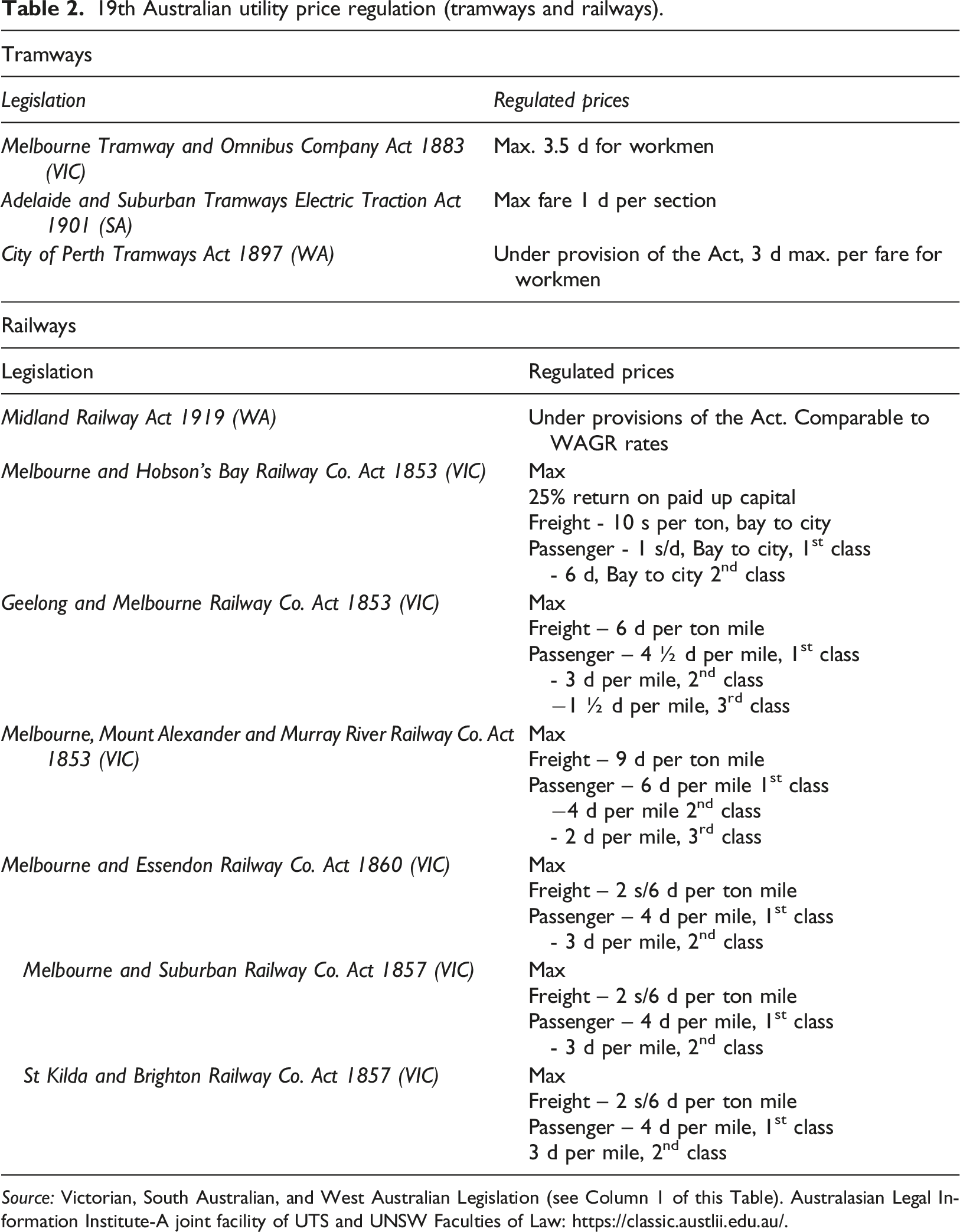
Source: Victorian, South Australian, and West Australian Legislation (see Column 1 of this Table). Australasian Legal Information Institute-A joint facility of UTS and UNSW Faculties of Law: https://classic.austlii.edu.au/.
19th Australian utility price regulation (water and electricity).
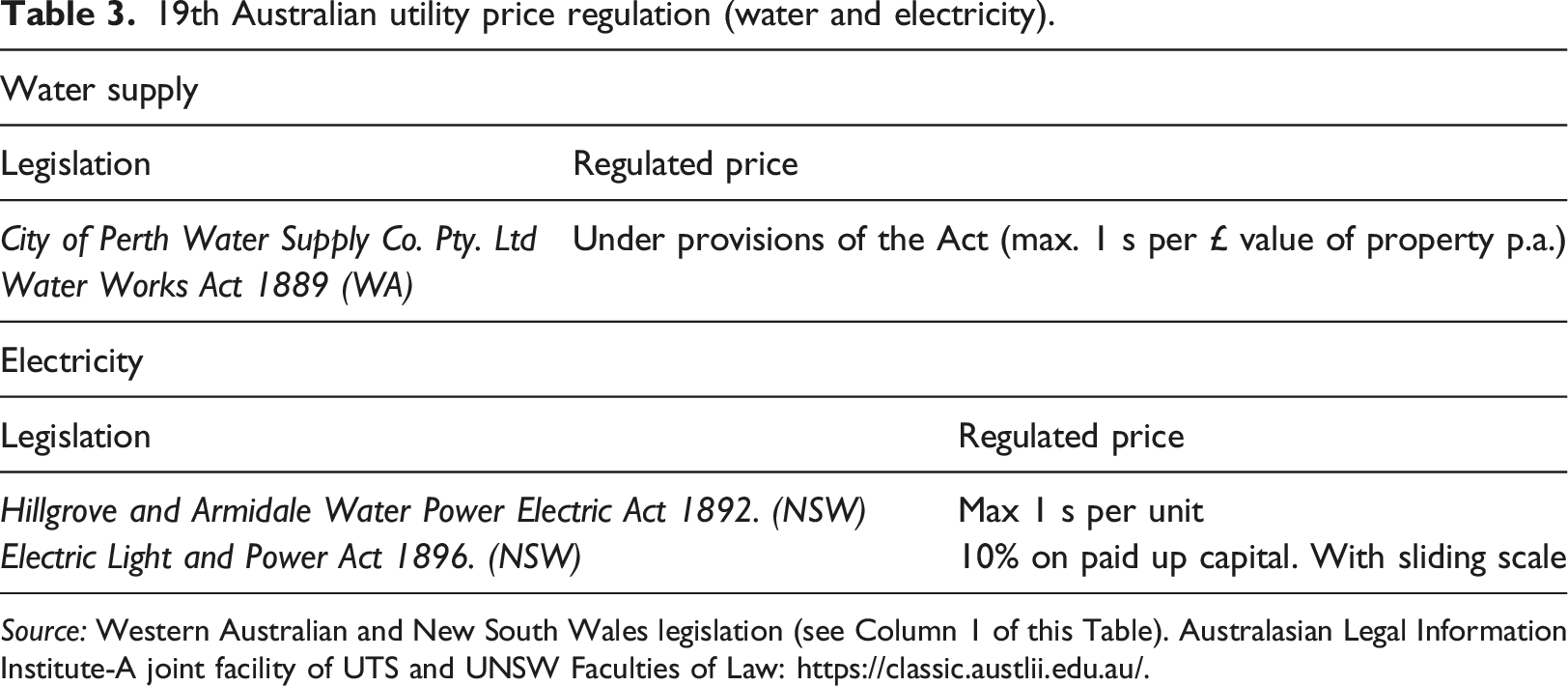
Source: Western Australian and New South Wales legislation (see Column 1 of this Table). Australasian Legal Information Institute-A joint facility of UTS and UNSW Faculties of Law: https://classic.austlii.edu.au/.
Gas supply
The main utility industry that was the subject of legislated statute regulation with fixed prices was the gas supply industry. Throughout Australia’s history, the gas supply industry has mainly been conducted by privately owned companies. The oldest of these is the Sydney-based Australian Gas Light Company (AGL). On 7 September 1837, “An Act for lighting with Gas the Town of Sydney, in the Colony of New South Wales” was passed by the New South Wales Legislative Council, which established the AGL (Broomham, 1987). AGL began supplying gas to consumers in July 1841. AGL operated as a monopoly provider of gas to Sydney right throughout the 19th century. Over this period, the company was not the subject of price control; however, in 1912, an Act was passed through the New South Wales Parliament that regulated its prices, controlled dividends and share issues (also that of other gas supply companies in Sydney) (Abbott, 2012, 2013). This was designed on a sliding scale of a fixed standard price, and a judgement was required over the determination of the costs of production. Despite the lack of regulation in the 19th century, what evidence there is does seem to suggest that gas prices decreased substantially. In Sydney, the rate at which AGL charged for streetlamps, for instance, fell from £10 per lamp per annum in 1848 to £6 by 1885 (Abbott, 2012). Because of falling material and capital costs, as well as improvements in reducing gas wastage, the costs and prices of gas tended to fall in many jurisdictions in the second half of the 19th century (Matthews, 1986).
Despite the Sydney-based company being free of price controls throughout the 19th century, this was not the case for many other gas supply companies. In Tasmania, for instance, a bill was passed through the Tasmanian Parliament in October 1854 that incorporated the Hobart Town Gas Company. The first street lighting began operating on 9 March 1857 (Keating, 1974). The Hobart Gas Company continued supplying gas to urban consumers as a privately owned enterprise until the 1970s. This company, along with a company based in Launceston, was the subject of a rate of return control, which allowed a rate of return of 12.5% annually on paid-up capital (see Table 1). In Melbourne, the City of Melbourne Gas Company was formed through legislation in 1853. This legislation contained rate-of-return controls (25% annually on paid-up capital). When the firm was merged with others in Melbourne in 1878 (South Melbourne Gas Company, Collingwood and Fitzroy and District Gas and Coke Company), the enabling legislation continued using price controls, although it introduced a greater level of prescription (Keating, 1974; Proudley, 1987). In South Australia, supporting legislation was passed for the incorporation of the South Australian Gas Company in November 1861. An additional company – the Provincial Gas Company – was established in 1868 to supply regional towns in South Australia, and the two companies were merged in 1877 (Donovan & Kirkman, 1986). This company was the subject of price regulation in legislation passed in 1861. In Brisbane, the Brisbane Gas Company was established in 1864. Another company – the South Brisbane Gas and Light Company Ltd. - was formed in June 1885 to supply gas to consumers south of the Brisbane River. After competing over territory to begin with, the two companies settled to share the Brisbane market between them in an agreement in September 1889. In Perth, gas companies were established in Fremantle and Perth in the 1880s. The Perth City Council took over the supply of gas to that centre in 1912 and in turn sold it to the State Electricity Commission of Western Australia in 1948. The Fremantle gasworks, in contrast, stayed in private ownership until the 1980s (Boylen & McIIwraith, 1994). As seen from the information provided in Table 1, the Tasmanian, South Australian and Victorian companies were the subject of price controls imbedded in the legislation that created them. Several regional New South Wales companies were also price regulated (see Table 1). The Brisbane and Sydney companies were the main ones exempt from this sort of control during the 19th century (see Table 2).
Gas price regulation.
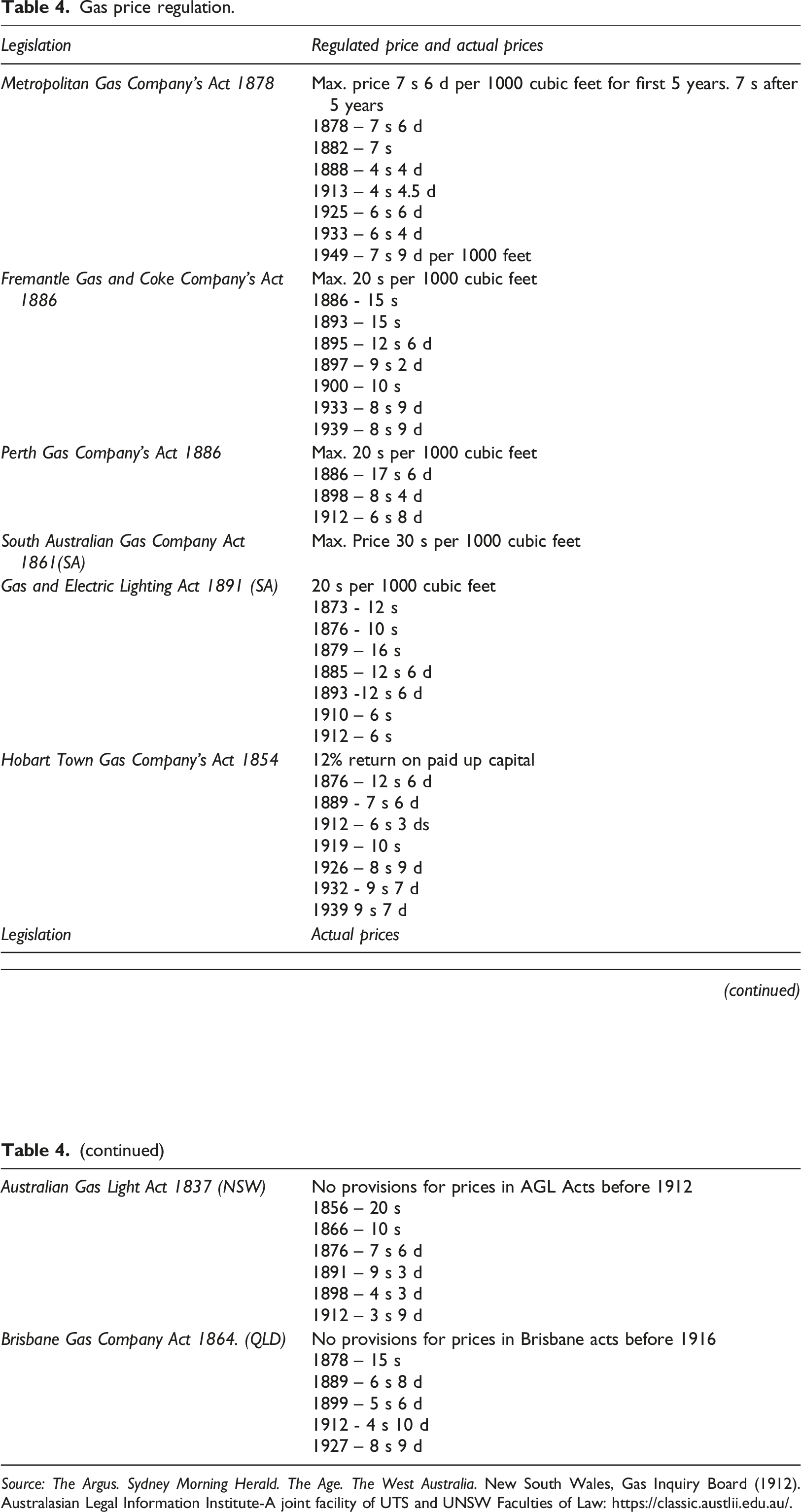
Source: The Argus. Sydney Morning Herald. The Age. The West Australia. New South Wales, Gas Inquiry Board (1912). Australasian Legal Information Institute-A joint facility of UTS and UNSW Faculties of Law: https://classic.austlii.edu.au/.
In the case of the Melbourne-based Metropolitan Gas Company, this company was formed in 1878 by the merger of three Melbourne-based companies (City of Melbourne, South Melbourne, and Collingwood and Fitzroy and District). Each of these companies had separate regulated prices imposed on them from previously passed legislation. The price of gas in each of these areas had, however, had fallen and was set at 7 s 6 d by the time the legislation was passed (Victoria, Legislative Assembly, 1877, p. 804). The Premier at the time the legislation was passed, Graham Berry, supported the legislation but felt that ‘some machinery’ should be put into the Act should the costs of production in the industry decline (Victoria, Legislative Assembly, 1877, p. 800). This machinery was to come in the form of the sliding scale approach, which was introduced on the recommendation of a Select Committee of Parliament appointed to investigate this matter, amongst a number of issues (Victoria, Legislative Assembly, 1877, p. 1269). The use of this approach to pricing was inspired not so much as to encourage the gas company to raise its level of efficiency (the incentive affect) but instead was a recognition that the technology used in the industry was improving and at least some of the gains from this should be passed onto consumers.
In the Act as it was passed, the Metropolitan Gas Company Act was allowed a 10% return on paid-up capital but could increase this by 5 s of dividend for each reduction of 1 ¼ d in the price of gas (the sliding scale approach). By reducing its costs through the introduction of new technologies, the company could increase its return, which it was able to do. In 1878, its dividend was 8%, in 1879, it was 9%, and by 1885, it was 15%. It subsequently rose to reach 21 ½ percent in 1890 (selling price dropped to 4 s 7d per 1000 cubic feet), fell to 17 ½ percent in 1892, 10% in 1894, then fell to 8% in the late 1890s. From the mid-1900s to 1911, it was at 10% (Victoria, Board of Inquiry, 1912, p. xiv). The company, therefore, made a good rate of return during the boom years of the 1880s, and even though in the 1890s it made less, it was still profitable a solid achievement given the depressed economic conditions at the time. A Board of Inquiry appointed by the Victorian Government in 1912 found that while the price of gas in Melbourne was below the legislated required level, it was higher in that city than in most British ones of similar size, as well as in Sydney, Brisbane, and Auckland (but not Adelaide, Hobart. and Perth). For this reason, it declared that ‘The present price charged by the Company for lighting and heating is unreasonable’ (Victoria, Gas Inquiry Board, Report, 1912; xvii, xxiv). It appears then that the technological change that had been envisaged by those debating the passing of the legislation was far more substantial that those proposing the legislation in had anticipated. For this reason, the price regulation was in practice ineffective.
In the case of the two Western Australian companies listed in Table 4, the initial regulated price was set at very high levels, over twice that of the Melbourne-based company, a reflection of the smaller size of the Perth market and scales of production as well as the higher price of coal in this centre. Despite this, the high price in Perth and Fremantle very soon became redundant. The prices imposed in legislation were soon unrelated to the actual prices charged (regulated prices of 20 s per cubic foot of gas compared to around an actual price of 10 s or less: Table 4). In these two cases, the sliding scale approach was not used, so consumers received no advantage from the use of this approach. That said, given the scale of the cost and price reductions brought about, it is unlikely that any sliding scale would have had any impact on prices.
In 1912, the Perth City Council took over the Perth-based gas works, in order to itself taking advantage of the very healthy profits of the works, and so the legislation no longer applied to the Perth gas works. Fremantle legislation continued to apply to Fremantle gas works until legislation was passed in 1947 to create a more flexible regime of price control (Gas Undertakings Act 1947). By this time, wartime inflation had pushed the price of gas up to the legislated amount, and under the new legislation, gas prices were set by the State Electricity Commission on the basis of expenses, including the cost of capital.
Unlike in the case of other utilities, the gas companies were less inclined to sell to governments, although is some cases local councils sought ownership to take advantage of their profitability. Once established, they had relatively good business, with stable returns and a narrower clientele than other utilities. The capital required to establish gas distribution networks was cheaper than that of water. The technological changes that occurred reduced costs and allowed gas prices to decline. Competition from electricity helped to keep up the pressure to reduce prices. Therefore, most of the 19th century gas price regulations in Australia fell into disuse. By the end of the 19th century, the statutes in the various legislation had little effect on prices, and most consumers would have been unaware that such things even existed. As technology improved, scale economies became larger and coal prices fell, and the maximum prices lodged in legislation became redundant. Gas supplies responding to the introduction and use of other sources of fuel and light, such as kerosene, coal and later electricity, lowered their prices while retaining healthy profits. In Sydney, the country’s largest gas company, AGL, operated without any price regulation and headed off any move to do so by lowering prices over time (see Table 4).
A number of factors negated the impact that price regulation had on the way in which the industry functioned. In most cases, the prices were set too high in the legislation to have much impact on the industry, and as they were embodied in legislation rather than delegated to regulatory authorities, they were difficult to change. As technological change was steady in the industry, costs declined and made the regulated rates largely redundant. In 1910, however, a Labor Party government was elected in New South Wales with an aim to nationalize the industry in that state. This meant that when the issue of gas price regulation was revisited in 1912 in New South Wales, a means for changing rates using Royal Commissions and Boards of Inquiry was instigated (Gas Act 1912) (Abbott, 2013). In some of the other states, the legislated gas rates were eventually replaced by more flexible schemes similar to the 1912 New South Wales scheme. This includes the states of Queensland (Gas Act 1916: price set by Minister on advice of the gas referee) and South Australia (Gas Act 1924; price set by the Industrial Court). In Tasmania and Victoria, gas prices remained under 19th century legislation except when they were superseded by war time price controls, although as previously mentioned, this in effect meant that they were not regulated at all.
What the Australian gas examples shows is that changing supply conditions (technological changes, but also materials costs and economies of scale), and quickly make a rigid from of regulation redundant. Its unlikely that the economic regulation imposed on the gas industry did little more than help to smooth the passing of the initial legislation. Gas works were generally very profitability right up until the outbreak of the First World War and in many cases incorporated monopoly profits.
Tramways and railways
In addition to the gas supply industry, there were several railway and tramway companies that were subject to price controls for short periods of time. Although in all the colonies the railways were either established by the colonial governments or soon taken over from private companies, there were a number of private companies, primarily in Victoria, that created privately owned rail lines and services. These were the subject of price controls imbedded in the enabling legislation that established them. In addition to the railways, privately owned tramway systems were established in Melbourne, Perth, and Adelaide, which were each the subject of pricing controls.
Details of the rail and tramway pricing controls are listed in Table 2. The rates set tended to be those set on fares to directly protect consumers. In the case of tramways, rates were set for workmen’s tickets, commuter traffic that made up the bulk of travellers. As the rail companies did not survive in private ownership for very long periods, it is difficult to know just what their impact was. It is possible, however, that they were set too low and helped to prevent private companies from surviving commercially, and therefore helped to push them towards government ownership. The same might also have been true of tramway companies, which generally stayed in private ownership a little longer than railways before being taken over by the government.
The literature on railways in Australia says little about the impact of the rates being set on private railways, but one way in which they may have attempted to survive commercially would have been to raise rates. The legislation creating them, however, precluded this from happening. No attempts were made to amend legislation to allow increases to rates, governments deciding to take over the railways instead when they failed commercially. Changing the rates through amendments to legislation was always going to be politically difficult. Once supplied by tramway or railway services, consumers inevitably compared prices and service levels with those in other places. With trams, consumers wanted an extensive and frequent service, with comfort and cheap fares. Amending legislation to raise fares precluded this.
One exception to the government takeover of private railways in the 19th century was that of the land-grant, Midland Railways Company, which was established in the early 1890s in Western Australia. This survived as a privately owned railway company until the early 1960s. Instead of being the subject of set rates as was the case with the private railways in Victoria, it was simply obliged to charge rates comparable to the Western Australian Government Railways, which did give its rate setting some degree of flexibility compared to the practice of simply legislating fixed rates. Its unlikely that the setting of legislated rates in the railways in Australia did anything to enhance levels of efficiency in the industry. Instead, unlike the gas case where rates were set at levels to be ineffective, in the rail industry they were set at levels that made it difficult for the private companies to operate commercially.
Water and electricity
In addition to the gas supply industry, railways, and tramways, there were some other isolated examples of price regulation in the water and electricity industries in Australia. In the case of water, the industry was dominated by government-owned utilities. One exception to this was the case of the privately owned City of Perth Water Supply Company established in 1889 (see Table 3). This company failed commercially in the mid-1890s and was taken over by the government, but in its short life, it was limited on how much it could charge for supplying water (Gaynor, 2020; Hunt & Bolton, 1978). The company faced several problems before being taken over by the government in terms of water contamination and pressure brought to bear on it to extend its supply network. Solutions to these problems might have been undertaken by raising prices and using the additional revenue to improve water quality and extend its pipe network. Public opinion was opposed to these price increases, and a government takeover was used instead. The results of this episode, therefore, seem similar to that of the rail industry, with legislated rates inhibiting the ability of the company to operate commercially and achieving higher levels of efficiency.
One ironic result of regulation in the city of Perth was that the too low setting of rates with the water supply company helped to led to the commercial failure of the company and its being taken over by the state Government, while the too high setting of prices in the case of the Perth Gas Company led to the local council seeking to take it over because of the potential to use it as a revenue raising vehicle.
In the case of electricity before the Frist World War, there were several private companies supplying electricity. Two of them, based in Adelaide and Brisbane, were to survive in private ownership until the Second World War. Many of the pre-war companies, however, were owned either by government railway departments or municipal governments and were not the subject of price regulation. Likewise, the Brisbane and Adelaide companies avoided price regulation. In New South Wales, private companies were brought under a form of regulation in legislation from the 1890s onwards (see Table 3). Later in the inter-war period, this was brought into line with the gas price regulation that was instigated in 1912. These legislated prices in New South Wales had little impact, especially as the largest owners of power plant in Sydney before the Second World War were the New South Wales Government Railways and the Sydney City Council. Price regulation of electricity, therefore, had little impact on the development of the industry and levels of efficiency achieved.
Conclusion
Price regulation of utilities in Australia in the period up until the First World War was rare (outside of the gas supply industry) but did exist. In the case of the gas supply industry, it was common and tended to follow the approaches that had been used in Britain in the 19th century. It also existed in the case of the private railway companies, although for shorter periods, as these were quickly taken over by the colonial governments. To establish these companies, land had to be acquired, and roads broke up to lay pipes or track, so it seemed natural to incorporate price regulations into this legislation in order to smooth its passage through the colonial parliaments. In terms of regulatory structures, price regulation followed the main patterns in Britain and the United States in the 19th century, in that price regulation was embedded in the legislation that was required to be passed to establish the gas and rail companies, and took either set prices or an allowed rate of return.
In terms of the second research question, the price regulation was not especially effective at boosting efficiency levels and there were unanticipated responses to the incentives created by regulation that actually undermined efficiency. Placing price regulation in the legislation that established the companies created the same problems that were encountered in the United Kingdom and the United States. If the prices were set too high and/or if technological change reduced costs over time, then companies were able to use their market power to exploit consumers. This occurred in the case of the gas supply companies in a few centres. There was, however, a danger that the opposite might occur. If prices were set too low such that the companies could not make an adequate return, then companies might struggle to survive commercially. In these cases, governments generally stepped in to take over the running of the railways or tramways (and water in the case of Perth) rather than let the companies substantially increase prices. In these cases, therefore, it could be said that price regulation made more of a contribution to the government takeover of the companies rather than the enhancement of their efficient operation.
By the time of the First World War, it was only truly the gas supply industry that had much in the way of regulated, privately owned monopolies. From 1912 onwards, a more flexible approach to regulation was instigated, starting in New South Wales, with scope for rate changes after inquiries were undertaken. In some ways, this mirrored the transformation of utilities regulation in Canada and the United States from legislated prices to rate of return regulation set by commissions.
Footnotes
Declaration of conflicting interests
The author(s) declared no potential conflicts of interest with respect to the research, authorship, and/or publication of this article.
Funding
The author(s) received no financial support for the research, authorship, and/or publication of this article.
