



Abstract
Think tanks linked to political parties, known as political party think tanks (PPTTs), exist in various EU member states and play particular roles in their respective political systems. This article provides the first comprehensive overview of these PPTTs, focusing on their party affiliation. Based on data collected from PPTT websites and exploratory contacts with PPTTs, we categorise the EU member states into two groups: those with PPTTs in sensu stricto, that is, where the PPTTs have recognised party affiliations, and those where the PPTTs have hidden party-political affiliations. Understanding PPTTs is essential for comprehending their roles at both the national and the EU level.
Keywords
Introduction
Political party think tanks (PPTTs) play a crucial role in modern democracies (Vande Walle and de Lange 2024). At the level of the EU, PPTTs exist as European political foundations (EPFs), which are networks of national foundations and think tanks (Gagatek and Van Hecke 2014, 96). Although going by different labels in different countries (e.g. ‘scientific institutes’ in the Netherlands, ‘party study centres’ in Belgium, ‘political academies’ in Austria and ‘political foundations’ in Germany), these institutions all fall under the category of PPTTs.
While the EPFs have been compared with each other (Gagatek and Van Hecke 2014) and there have been several case studies on national PPTTs in EU member states, 1 an overview of the PPTTs on the European continent, including in the regions beyond Western Europe (e.g. Day 2000), is still lacking.
The literature on political parties is extensive and provides valuable insights and empirical data that underpin the study of party organisations (see, e.g. Poguntke et al. 2016). However, similar comprehensive studies for the affiliated PPTTs are lacking. Thus, a crucial first step for comparative research is to map the existing PPTTs. Descriptive research is essential for understanding phenomena that are not yet well documented, making it intrinsically valuable to the study of PPTTs.
The aim of this article is therefore to provide an answer to the descriptive question of what the PPTT landscape in Europe looks like and what characterises these organisations. We will look at the defining feature that distinguishes PPTTs from other think tanks: party affiliation (Miragliotta 2021, 241; Pattyn et al. 2017a, 258; Weaver and McGann 2006, 7). Based on exploratory contacts with PPTTs and an analysis of the EPF members’ websites in 2022, we present two groups of PPTTs in EU member states: those with recognised party affiliations and those with hidden party affiliations.
What defines PPTTs?
To study PPTTs in Europe, a crucial first step is to define what constitutes a PPTT and how it differs from other entities, particularly think tanks. The scholarly discourse on defining think tanks underscores the inherent complexity of this task (Kelstrup 2021, 33). When defining PPTTs, the focus is on delineating their distinguishing features vis-à-vis think tanks.
PPTTs exhibit functional similarities to think tanks insofar as they fulfil essential roles within the political process, such as analysing societal issues and formulating policy recommendations (Mendizabal 2021, 26). However, their defining characteristic lies in their exclusive and formal alignment with a specific political party (Miragliotta 2021, 241; Pattyn et al. 2017a, 258; Weaver and McGann 2006, 7). The defining characteristic of PPTTs is thus their party affiliation.
This leads to two types of party-affiliated think tanks (Figure 1): PPTTs in sensu stricto, and hidden party-affiliated think tanks. The first category consists of think tanks with a recognised and exclusive alignment with a specific political party. This alignment is often evident through organisational, legal and financial ties, and can either be regulated or merely acknowledged. While regulated PPTTs receive direct government funding, those that are simply recognised owe their existence to the party, and their funding depends on the party’s support (Miragliotta 2021, 241; Pattyn et al. 2017a, 258).
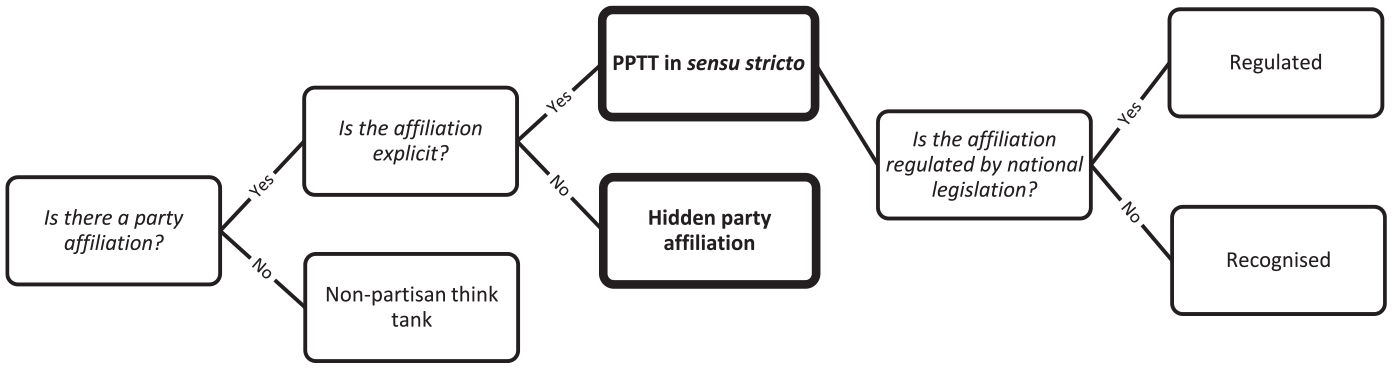
Types of party affiliations.
The second type of PPTT, comprising those that have a hidden affiliation, is less clearly defined. These organisations exist separately from any party and describe themselves as non-partisan. However, they maintain ties to political parties by having party-affiliated members on their boards of directors or being founded by key party figures. Despite their formal independence, they share ideological affinities and informal links with political parties (Miragliotta 2018, 234). This contrasts starkly with the position of non-partisan think tanks, which maintain no formal or informal connections with political parties and explicitly advocate political neutrality (Abelson 2009, 9).
Studying the party affiliations of think tanks
The analysis of the party affiliations of PPTTs required three stages of investigation. In the first stage, we identified PPTTs across the EU member states by compiling a list of the members of the EPFs. Just as national parties are represented in the European parties and groups, national PPTTs are represented in the EPFs, which serve as networks (Gagatek and Van Hecke 2014, 96). Therefore, to identify these often overlooked national PPTTs, we analysed the members of the EPFs. However, not all members of EPFs are PPTTs, and not all PPTTs are EPF members.
In the second stage, we made exploratory contact with 37 party-affiliated organisations by reaching out to 138 EPF members via email, receiving responses from 27% of them. We sought information on their party affiliations and perceptions of party affiliation. Additionally, we enquired about their funding mechanisms, asking for their sources of funding and the estimated share provided by each source (i.e. direct government subsidy, private donations, member contributions, political party funding and indirect government subsidy via political party).
In the third stage, we expanded and cross-checked the information obtained during our exploratory contacts by conducting a content analysis of the official websites of the PPTTs, which is presented in the analysis section of this article. This analysis focused on categorising the PPTTs based on their party affiliation. Specifically, we analysed whether the PPTT explicitly acknowledges a party affiliation. If it does, we labelled the organisation a ‘PPTT in sensu stricto’. If they did not acknowledge an affiliation or claimed to be non-partisan or independent, we checked for party representation on their board of directors. If such representation was found, we labelled the organisation a ‘hidden party-affiliated think tank’.
Descriptive analysis
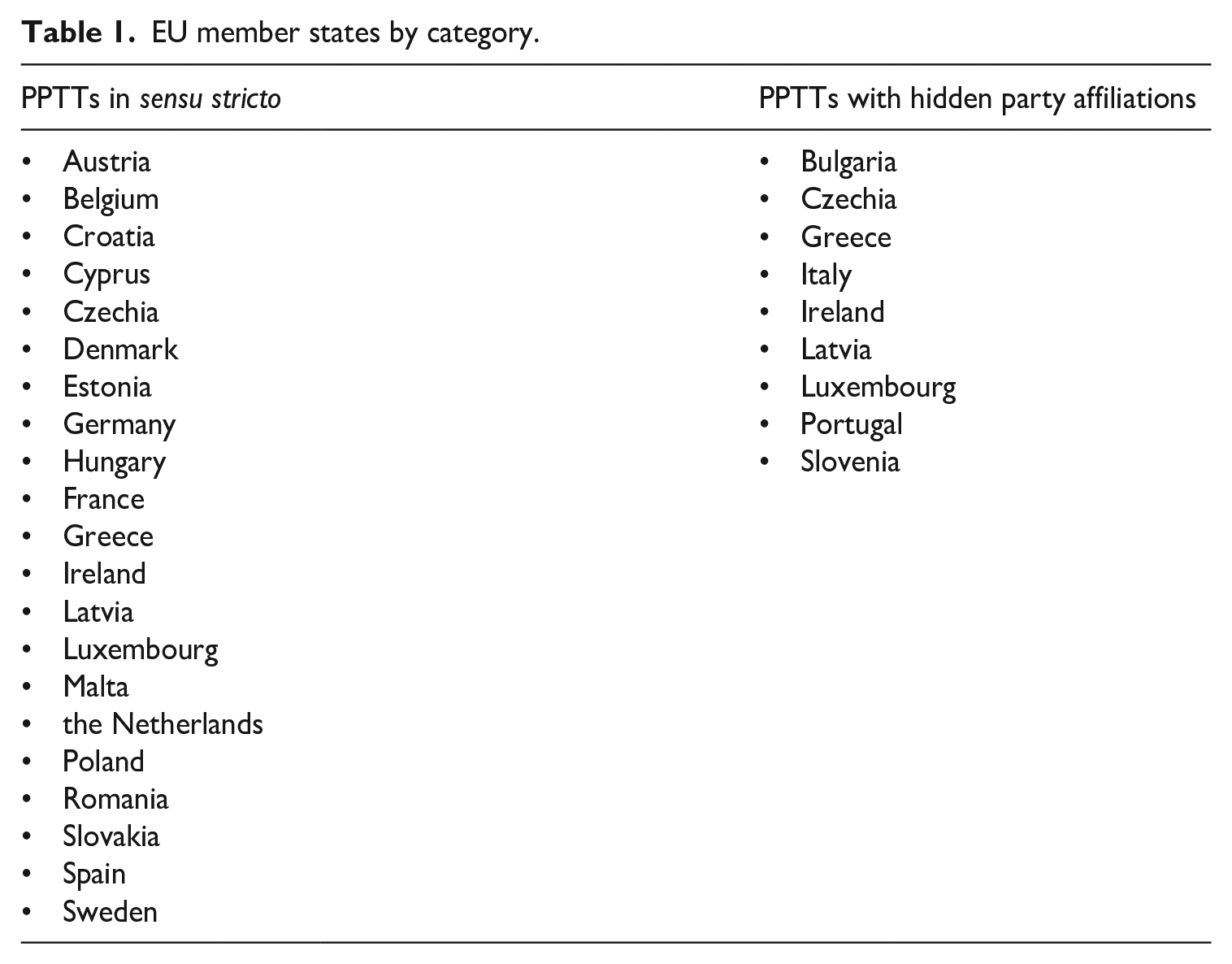
The purpose of this description is not to provide an exhaustive overview of all party-affiliated think tanks, but to offer an overview of the types of party affiliations and the countries in which PPTTs exist. It serves as an introductory tool for understanding the under-studied subject of PPTTs in EU member states. We categorise the EU member states according to the type of party affiliation found among their PPTTs (Table 1). This categorisation is not exclusive, as a country can have both think tanks that acknowledge party affiliations and those that hide their party affiliation.
EU member states by category.
PPTTs in sensu stricto
PPTTs in sensu stricto are think tanks with a recognised and exclusive alignment to a specific political party. This alignment is often evident through organisational, legal and financial ties and can either be regulated or merely acknowledged. Regulated PPTTs (e.g. those in Austria and Germany) receive direct government funding, whereas purely recognised PPTTs (e.g. those in Poland) owe their existence to the party, often relying on the party’s support for funding (see Figure 2).
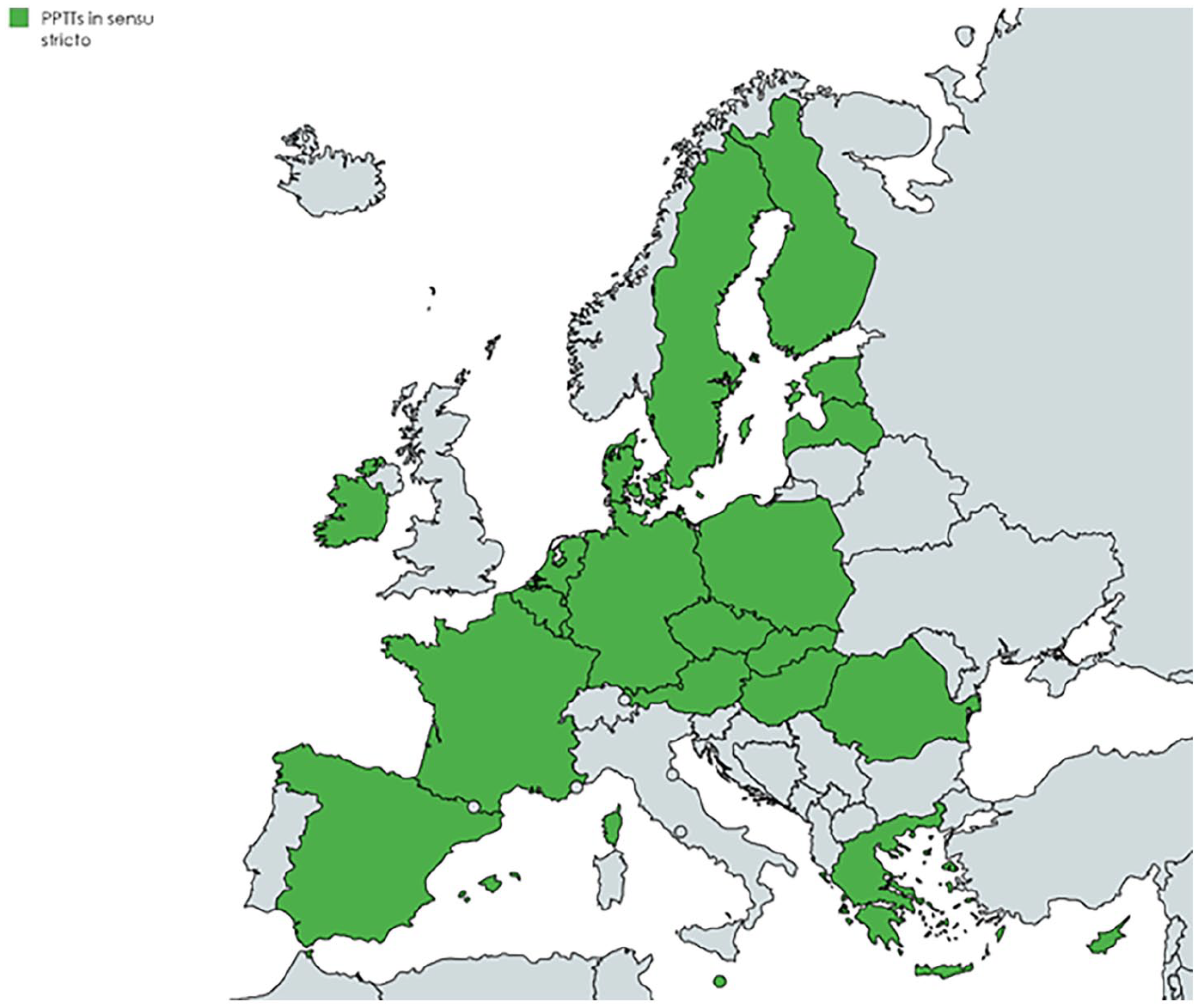
EU member states with PPTTs in sensu stricto.
A clear example of a member state where PPTTs in sensu stricto are present is Austria. In Austria, PPTTs are closely affiliated with their respective parties and receive direct government funding based on the electoral success of the affiliated party. Austrian PPTTs include the Karl Renner Institute, affiliated to the Social Democratic Party of Austria (Sozialdemokratische Partei Österreichs); the Green Educational Workshop (Die Grüne Bildungswerkstatt), affiliated to the Greens; NEOS Lab, affiliated to the New Austria and Liberal Forum (Das Neue Österreich und Liberales Forum); the Political Academy of the Austrian People’s Party (Österreichische Volkspartei), affiliated to the conservative party of the same name; and the Liberal Educational Institute (Freiheitliches Bildungsinstitut), affiliated to the Freedom Party of Austria (Freiheitliche Partei Österreich), which is not a member of an EPF. This type of regulated PPTT is also known to be present in Germany, Hungary, Finland and the Netherlands.
Another example from Western Europe is provided by the German party foundations. These are among the most well-known and well-developed PPTTs. For example, the Christian Democratic Konrad Adenauer Foundation, linked to the Christian Democratic Union of Germany (Christlich Demokratische Union Deutschlands), employs over 600 staff members in Germany and more than 1,000 people across 100 international offices. The Friedrich Ebert Foundation, linked to the Social Democratic Party of Germany (Sozialdemokratische Partei Deutschlands) and founded in 1925, and the Konrad Adenauer Foundation and the liberal Friedrich Naumann Foundation (linked to the Free Democratic Party (Freie Demokratische Partei)), both established in the late 1950s, all focus on civic education and international development. Other notable German foundations include the Desiderius Erasmus Foundation, linked to the Alternative for Germany (Alternative für Deutschland); the Hanns Seidel Foundation, linked to the Christian Social Union (Christlich-Soziale Union); the Heinrich Böll Foundation, linked to Alliance 90/The Greens (Bündnis 90/Die Grünen); and the Rosa Luxemburg Foundation, linked to The Left (Die Linke).
When there is no national regulatory framework providing direct funding for PPTTs, their funding often depends on the willingness of the party to fund them. Alternatively, they can receive funding from various sources, including corporate donations or from limited public funds for specific activities. A clear example of an EU member state with PPTTs funded in this way is Poland. In Poland, the parties are responsible for establishing PPTTs and often decide on their activities and funding. Generally, these PPTTs focus on research, policy analyses and political education. As noted by a respondent to our enquiries from a Polish PPTT, ‘The lack of a law on political foundations severely hinders the activities of PPTTs, as only the party can [provide] support’. An example of such a PPTT is the Social Democratic Ignacy Daszyński Centre, which explicitly aligns with the Social Democratic New Left (Nowa Lewica).
Other EU member states also have PPTTs in sensu stricto. In Western and Northern Europe, Belgium’s Emile Vandervelde Institute is linked to the Walloon Socialist Party (Parti Socialiste) and Luxembourg’s Green Foundation (Gréng Stëftung) is affiliated with the Greens. In the Netherlands, all PPTTs are explicitly affiliated to one specific political party and receive direct funding based on the parliamentary seat allocation of the parent party. The Social Democratic Wiardi Beckman Foundation, connected to the Labour Party (Partij van de Arbeid), is a Dutch example. Finnish PPTTs also acknowledge their affiliation with a political party and receive direct government funding from the Ministry of Education and Culture based on the election results of that party. Examples of Finnish PPTTs include the Kalevi Sorsa Foundation which is closely linked to the Social Democratic Party of Finland (Suomen sosialidemokraattinen puolue), while Thought Workshop Toivo (Ajatuspaja Toivo) aligns with the National Coalition Party (Kansallinen Kokoomus). In France, the Jean-Jaurès Foundation acknowledges its affiliation with the Socialist Party (Parti Socialiste), which is represented on the board, and organises the socialist archives. In Ireland, the Collins Institute is a Family of the Irish (Fine Gael) initiative supported by the party. In Denmark, the Danish Liberal Democracy Programme formally connects with the Left (Venstre), and in Sweden, the Jarl Hjalmarson Foundation explicitly aligns with the Moderate Party (Moderata samlingspartiet). Estonia’s Academy of Liberalism is strongly affiliated with the Reform Party (Eesti Reformierakond), while Latvia’s Forum for Latvia’s Future supports its parent party, For the Development of Latvia (Latvijas Attīstībai).
In Central, Eastern and Southern Europe, 2 Czechia’s Masaryk’s Democratic Academy (Masarykova Demokraticka Akademie) maintains a strong connection with the Czech Social Democratic Party (Česká strana sociálně demokratická), while in Slovakia, the Anton Tunega Foundation serves as the official think tank of the Christian Democratic Movement (Kresťanskodemokratické Hnutie). Hungarian PPTTs are closely tied to their parent parties, which receive budget subsidies for their foundations if they have parliamentary representation. For example, the Barankovics István Foundation is fully integrated with the Christian Democratic People’s Party (Kereszténydemokrata Néppárt) and the Táncsics Mihály Foundation develops the policy thinking of the Hungarian Socialist Party (Magyar Szocialista Párt). Other notable PPTTs with strong party connections include the Foundation for Civil Hungary (Polgári Magyarországért Alapítvány), associated with Fidesz, and the Oikopolis Foundation, associated with the Greens (LMP– Magyarország Zöld Pártja). In Romania, the Institute of Popular Studies (Institutul de Studii Populare) strengthens the political identity of the National Liberal Party (Partidul National Liberal). Croatia’s Foundation of the Croatian Statehood (Zaklada hrvatskog državnog zavjeta) acknowledges its affiliation with the Croatian Democratic Union (Hrvatska demokratska zajednica). Greece’s Nicos Poulantzas Institute is linked to Syriza, while Cyprus’s conservative Glafkos Clerides Institute was established by the Democratic Rally (Dimokratikós Sinagermós). In Malta, the Ceratonia Foundation is affiliated with the green Democratic Alternative (Alternattiva Demokratika). In Spain, the Concord and Freedom Foundation (Fundación Concordia y Libertad) openly acknowledges its affiliation with the Christian Democratic People’s Party (Partido Popular).
PPTTs with hidden party affiliations 3
Some EU member states do not have PPTTs in sensu stricto, but do have think tanks that have less explicit connections to political parties. These organisations may lean towards a particular political ideology, and their boards often include former or current representatives of political parties. These think tanks do not have explicit party ties but possess political ideologies that align with broader political thought groups. Although they do not make their connections explicit, they have implicit links via party representation on their boards (see Figure 3).
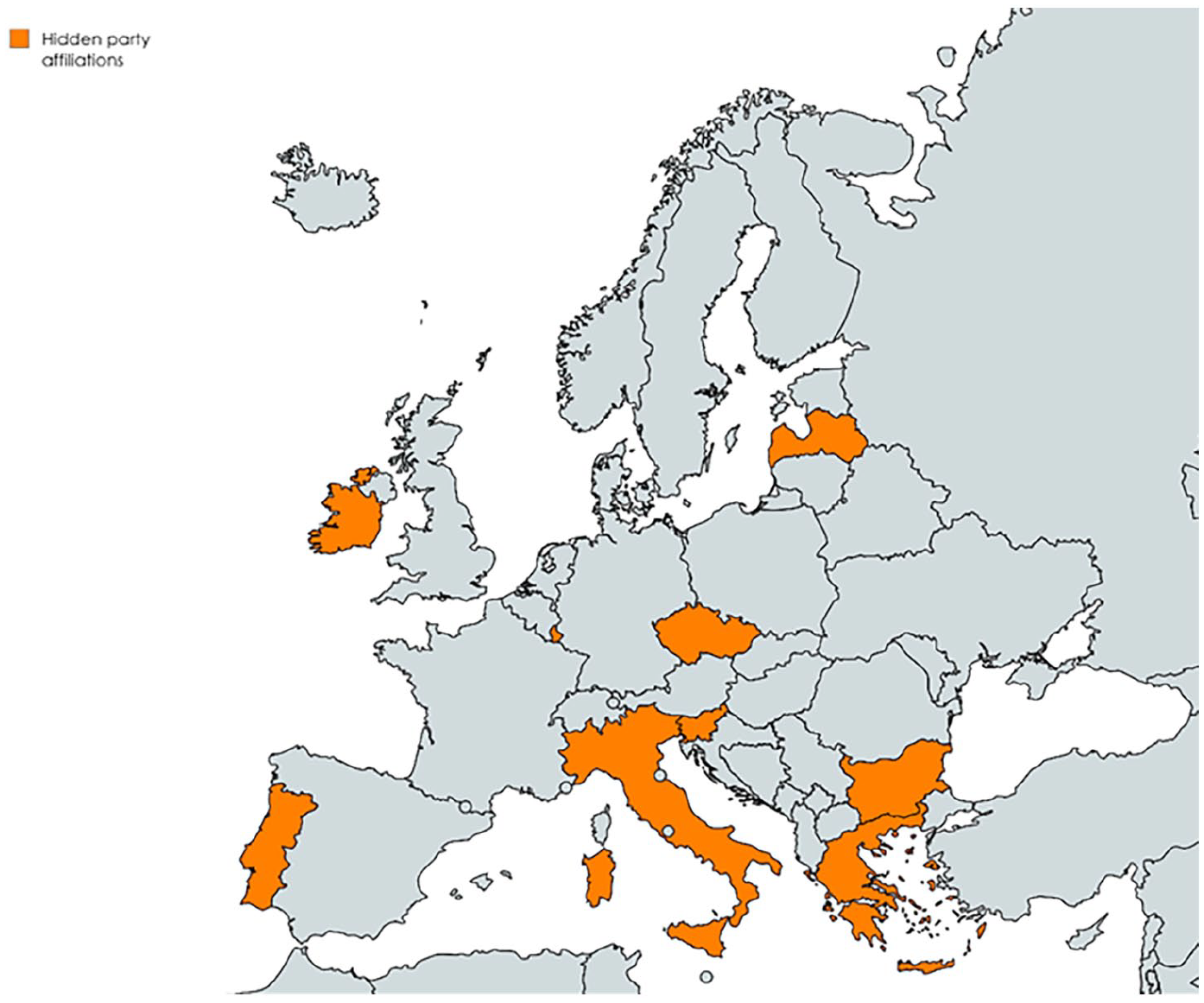
EU member states with hidden party-affiliated think tanks.
A clear example of an EU member state that has hidden party-affiliated think tanks is Portugal. In Portugal, think tanks are not explicit about their party affiliations but do have party representation on their boards. For example, the Amaro da Costa Institute describes itself as independent, yet a People’s Party (Partido Popular) representative is a member of its board. The institute focuses on research, political thought, public policy, education and public debate. Other examples include the ResPublica Foundation, which has a representative of the Socialist Party (Partido Socialista) on its board, and the Francisco Sá Carneiro Institute, the board of which includes members of the Social Democratic Party (Partido Social Democrata).
In Western and Northern Europe, Luxembourg’s Robert Krieps Foundation includes board members from the Luxembourg Socialist Workers’ Party (Lëtzebuerger Sozialistesch Aarbechterpartei), but does not explicitly acknowledge its affiliation with the party. In Ireland, the Think-Tank for Action on Social Change, while asserting its independence, includes members of the Irish Labour Party on its board. In Latvia, the website of the Freedom and Solidarity Foundation (Brīvības un solidaritātes fonds) does not make an explicit party reference but has Social Democrats represented on its board of directors. In Slovenia, the Jože Pučnik Institute includes board members from the Slovenian Democratic Party (Slovenska demokratska strankaù).
In Central, Eastern and Southern Europe, Bulgaria’s Institute for Social Integration (Institutǎt za socialna integracija) does not explicitly emphasise its link to a specific party, but the Bulgarian Socialist Party (Balgarska sotsialisticheska partiya) is represented on its board. In Czechia, the Institute for Politics and Society (Institut pro politiku a společnost) asserts its independence while having an affiliation with Yes (ANO) through its board. In Greece, the Konstantinos Karamanlis Institute for Democracy includes members of New Democracy (Néa Dimokratía) on its board without acknowledging a direct affiliation. An example from Italy, a country with a wide variety of political foundations (see Allegri et al. 2018 for an overview), is the Gramsci Foundation, which has a board member from the centre–left Democratic Party (Partito Democratico).
Conclusion
This article provides an initial overview of the various party-affiliated think tanks in the EU member states. We classified the members of the EPFs into two categories, based on their type of affiliation with a political party, as it is this affiliation that differentiates the PPTTs from other think tanks. An analysis then allowed us to categorise the member states in terms of the types of PPTTs present therein. The first category includes EU member states that have PPTTs in sensu stricto; either regulated funding is provided to these PPTTs direct from the government or there is a clear recognition of party affiliation, even if a regulatory framework is lacking. The second category comprises EU member states where the think tanks claim to be non-partisan and independent but have party representation on their boards. Furthermore, the research uncovers substantial differences in the establishment and regulation of PPTTs across the EU member states.
This article lays the foundational groundwork for understanding the distribution and characteristics of PPTTs across the EU member states. This foundational analysis is crucial for further research and policy discussions regarding the influence and operation of PPTTs within European political systems. We have lifted the veil on the often-mysterious PPTTs and emphasised the diversity of these political actors. It can now be seen how difficult it must be for EPFs to have such a variety of members or partner organisations across all the EU member states and to actively engage with all of them as members of the same political family.
Footnotes
Funding
Funding for this research was provided by Fonds Wetenschappelijk Onderzoek (Grant Number: 11J2423N). Ethics approval for this research was obtained from the University of Leuven Social and Societal Ethics Committee, application number G-2020-2595-R2.
Notes
Author biographies