




Abstract
Political parties are increasingly caught in the fast-paced rhythm of modern politics, where short-term messaging and rapid response dominate long-term thinking. This article examines whether and how Political Party Think Tanks help parties transcend these pressures by supporting long-term, policy-focused work. Drawing on case knowledge of 22 Political Party Think Tanks in the Netherlands and Flanders, it uses qualitative comparative analysis to explain why some Political Party Think Tanks focus more on policy development while others prioritise short-term political goals. The analysis shows that Political Party Think Tanks with direct public funding and greater autonomy from the party are better positioned to support long-term thinking. In highlighting how public funding, organisational autonomy, party type and leadership shape these roles, this article contributes to broader debates about public funding for political organisations and how political parties and their auxiliary organisations can be better equipped to strengthen democratic governance.
Keywords
Introduction
In contemporary democracies, political parties are under increasing pressure to respond rapidly to the demands of 24-hour news cycles, social media dynamics and shifting voter sentiment. Their core objectives to win elections, shape impactful policies and govern responsibly remain constant (Müller and Strøm, 1999). However, these forces often push parties to prioritise short-term electoral goals, raising concerns about their capacity to plan for and deliver long-term responsible governance (Caramani, 2017). But how do parties generate the ideas, expertise and policy advice needed to look beyond the next election?
One answer lies in the institutions that support parties behind the scenes. In order to govern responsibly and develop impactful policies, political parties rely upon the knowledge of different organisations such as academic institutions, civil society organisations, business organisations and think tanks (e.g. Abelson and Rastrick, 2021; Rich, 2004; Weaver and McGann, 2006). As traditional links between parties and interest organisations have weakened (Allern and Bale, 2017; Kirchheimer, 1966), and political parties have increasingly professionalised (Kirchheimer, 1966; Panebianco, 1988), the demand for in-house expertise has grown (Aula and Koskimaa, 2023).
Political Party Think Tanks (PPTTs) therefore occupy a unique position as formally and exclusively affiliated experts for their political parties. These organisations are prevalent in diverse countries, including Germany, Austria, the Scandinavian countries, and the Netherlands, Australia, Brazil and Japan (Miragliotta, 2021; Pattyn et al., 2017a). 1 This formal and exclusive affiliation makes PPTTs fundamentally different from other think tanks (e.g. Kelstrup, 2017; Ruser, 2018). Often referred to as the ‘brains’ behind political parties (De Winter and Dumont, 2006: 965), PPTTs play pivotal roles in the political landscape by, for example, promoting party ideas to a wider audience in order to maximise votes or offering research and policy advice to support the party in governing responsibly. Their democratic importance is reflected in the public funding that PPTTs receive in many countries (Pattyn et al., 2017a; van Biezen, 2004).
Previous research has categorised the functions of PPTTs as either political party functions (e.g. preparing debate sheets and election manifestos) or think tank functions (e.g. research and policy advice) (Pattyn et al., 2017b; Vande Walle and de Lange, 2024). PPTTs that conduct think tank functions offer a counterbalance to parties’ short-term priorities (Miragliotta, 2018) by contributing to the long-term vision and responsible governance. Although the literature suggests that PPTT roles differ between (Pattyn et al., 2017a) and within countries (Vande Walle and de Lange, 2024), little is known about the specific conditions that determine whether a PPTT focuses on party or think tank functions.
This article addresses this gap by examining the conditions under which PPTTs adopt these roles using Qualitative Comparative Analysis (QCA), a method that is well suited to explain variation in comparative research with a medium number of cases (Ragin, 1987) and enables me to identify the pathways leading PPTTs to adopt specific roles. QCA departs from the assumption of conjunctural causation which implies that a causal condition is only explanatory in combination with other conditions. In light of this assumption, I analyse the impact of both system-level (national legislation and public funding) and organisational-level characteristics (organisational autonomy, mainstream or non-mainstream party type, and the PPTT leader’s profile), expecting that the system-level conditions are necessary but not sufficient for understanding PPTTs’ functions. I also anticipate that (combinations of) PPTT and party-level conditions play a substantial role, in explaining the variation observed within countries. Thus, the research question is: Under which conditions do PPTTs take up think tank or party functions?
The analysis draws on in-depth interviews with PPTT leaders, statutes, legislation and existing literature. Specifically, 22 PPTTs in the Netherlands and Flanders, 2 selected for their similar political landscapes but differing legal PPTT frameworks, are studied in detail. In the Netherlands, PPTTs have a degree of autonomy ensured by legislation, whereas in Flanders, they are directly integrated within the party. Thus, the research design contrasts two specific regulatory PPTT frameworks and identifies how these two frameworks combine with organisational-level characteristics to lead PPTTs to adopt either party or think tank functions. Given the variety of legal frameworks that regulate PPTTs around the globe (Pattyn et al., 2017a), the generalisability of the findings of this study are limited to those with similar regulatory frameworks as Flanders and the Netherlands.
By identifying the necessary and sufficient conditions shaping PPTT functions, this study contributes to the literature on political parties and their auxiliary organisations. It underscores the critical role of public funding in ensuring autonomy and defining the PPTTs’ tasks. Specifically, the findings show that to perform think tank functions and transcend day-to-day political pressures, PPTTs require a degree of autonomy ensured through direct public funding. This provides valuable insights for debates on the impact of public funding on political organisations.
In addition, this study contributes to the political party literature by finding that party type not only shapes party choices, behaviour and strategies but also impacts the behaviour of their affiliated PPTTs. Furthermore, it shows that the presence of a party in its PPTT affects the organisation’s functions. Finally, by finding that the profile of the PPTT leader is reflected in the work of the organisation, this study shows that the findings on leadership in other organisations travel to PPTTs. These findings advance our understanding of the diverse roles PPTTs play in modern democracies and their contributions to responsible governance with well-founded policy by transcending the daily political pressures.
This article is structured as follows. The first section establishes a theoretical framework for analysing PPTTs’ functions. The second section outlines the research design, including case selection and the rationale for using QCA. The third section presents the QCA results, identifying causal pathways that explain the diverse functions of PPTTs and illustrating these findings with interview material. The final section closes with conclusions and offers recommendations for future research.
Theoretical Framework
Conceptualising PPTTs’ Functions
PPTTs exist in a variety of countries, have a variety of names and perform a variety of functions (Pattyn et al., 2017a). The most well-known examples are the German ‘party foundations’ or Stiftungen (such as the social democratic Friedrich-Ebert-Stiftung) that focus on political education and research and are involved in international political projects (Pinto-Duschinsky, 1991). Another example is the variety of Dutch scientific bureaus with for example the green left Scientific Bureau GroenLinks delivering research and policy advice to support the party on the (mid)long term, and the far right Renaissance Instituut of Forum voor Democratie that promotes the party’s ideas to a wider audience (Vande Walle and de Lange, 2024).
To grasp this variety of functions, a theoretical conceptualisation that takes the uniqueness of PPTTs into account is needed. PPTTs are a distinct type of organisation in the sense that they differ from think tanks which are formally independent from political parties (Kelstrup, 2017; Miragliotta, 2018; Ruser, 2018). Unlike think tanks PPTTs have formal and exclusive ties to one specific political party. Moreover, they differ from political staffers (e.g. Karlsen and Saglie, 2017; Webb and Kolodny, 2006). Unlike political staffers, PPTTs are often not directly integrated in the party in central or public office but rather maintain a more autonomous position outside the party structure and are not always included on the payroll of the party because they often receive direct public funding.
However, despite these organisational differences, PPTTs display functional similarities with both think tanks and political parties. The functional characteristics shared with think tanks are their focus on research and policy advice (e.g. Mendizabal, 2021; Weaver and McGann, 2006). Besides, PPTTs can contribute to party functions by either directly fulfilling these party functions such as parties’ programmatic function (e.g. Kitschelt, 1989; Meguid, 2008), their recruitment and selection function (e.g. Cross, 2008; Gallagher and Marsh, 1988) and their representation and socialisation function (e.g. Kitschelt, 1989; Panebianco, 1988) or by supporting the party in fulfilling these functions.
Therefore, the conceptualisation of PPTTs’ functions demands a framework that captures PPTTs as organisations that show functional characteristics of both political parties and think tanks as developed by Vande Walle and de Lange (2024). This conceptualisation includes four types of PPTTs: (1) ‘Party Assistants’, who assist the party in its daily operations and primary functions by performing party functions, (2) ‘Party Supporters’, engaged in think tank work aimed at supporting the party, (3) ‘Party Promoters’, responsible for disseminating party ideas to a broader audience and (4) ‘Party Intellectuals’, performing ideologically driven intellectual work intended for a wider public. These four types are the result of two distinctions presented in a 2×2 table (see Table 1 in Appendix A). The first distinction captures the functions performed by PPTTs, which can vary between political party functions and think tank functions. The second distinction identifies the target audience, distinguishing between an internal party audience (party members, party president, members of parliament) and an external wider social and political audience.
Since this research focuses on the conditions under which PPTTs contribute to responsible governance or prioritise the party’s electoral goals, the distinction between their functions is more relevant than their target audience. PPTTs can advance electoral priorities either internally, such as preparing the election manifesto as a Party Assistant, or externally, by disseminating party ideas as a Party Promoter. Similarly, they can support responsible governance by offering policy advice as a Party Supporter or by publishing reflective policy notes as a Party Intellectual. Hence, this analysis concentrates on functions, as PPTTs can serve both governance and electoral priorities through internal and external engagement.
System-Level Conditions
Understanding the diverse functions of PPTTs requires careful consideration of system-level conditions to capture the across country differences between PPTTs (Miragliotta, 2018; Pattyn et al., 2017a). On a system level, the autonomy of PPTTs is defined by the legal framework and public financing system that provides parties with the possibility to install a PPTT as a separate legal entity (Pattyn et al., 2017a). Autonomy is an extensively studied concept that is decisive for the performance of organisations. Especially in studying the role of think tanks, organisations that face the ‘independence paradox’ 3 (Jezierska and Sörbom, 2021: 396), it is a crucial concept that encompasses financial, legal and organisational dimensions (Pattyn et al., 2017a; Verhoest et al., 2004). Financial and legal autonomy are subject to national party and PPTT legislation that specifies public financing systems. These two dimensions of autonomy go hand in hand (because often a legal entity is required for government funding) and both express system-level autonomy. PPTTs may receive public funding, and the national party/PPTT legislation can specify whether a PPTT is mandated to have its own legal identity, among other considerations for funding eligibility (Pattyn et al., 2017a).
Political organisations operate within various systems of autonomy shaped by legal and financial frameworks (Pattyn et al., 2017a). These systems range from high-autonomy models reliant on private donations, as seen in the United States (e.g. Medvetz, 2012), to regulatory approaches where organisations receive direct public funding, such as in the Netherlands (Timmermans et al., 2015) or Germany (Mohr, 2010). In contrast, some systems, like Flanders, prohibit private donations and direct public funding, making these organisations entirely dependent on their affiliated political parties (Pattyn et al., 2017b). Despite variations in system-level autonomy, PPTTs are defined by their formal and exclusive ties to affiliated parties, ensuring they can never be fully independent, even though they may possess some degree of autonomy. This distinguishes them from other think tanks (Miragliotta, 2021; Pattyn et al., 2017a).
The rise of the cartel party model illustrates how state subsidies and regulations increasingly shape how political organisations operate (Katz and Mair, 1995; van Biezen, 2004). Research on the impact of government funding on political organisations presents contrasting findings. While some studies suggest that such funding encourages political activity (e.g. Chaves et al., 2004), others argue it may lead to depoliticisation by discouraging engagement in political activities (e.g. Giugni and Grasso, 2024). Based on these insights, I propose that system-level autonomy is a necessary condition for the performance of think tank functions. System-level autonomy implies that PPTTs have a legal framework and financial resources to operate independently. Consequently, this distance from the party creates space to perform their own activities which include research and policy advice. However, due to within-country variations (Timmermans et al., 2015; Vande Walle and de Lange, 2024), I assume that system-level autonomy is not sufficient to explain the performance of think tank functions. Therefore, system-level autonomy will have to be combined with organisational-level conditions as discussed in the following section.
Organisational-Level Conditions
There are different conditions on the level of the PPTT and of the affiliated party that are expected to contribute to the functioning of the PPTT. One key factor is the level of organisational autonomy, defined as the ‘degree of closeness’ between the party and its affiliated organisations (Allern and Bale, 2017; Duverger, 1954; Verhoest et al., 2004). Organisational autonomy reflects whether the PPTT can set its own agenda or whether its daily functioning is dominated by the party. Formally, this means that the PPTT or party statutes stipulate that the board of the PPTT is occupied with party officials (Pattyn et al., 2017a; Timmermans et al., 2015). Like system-level autonomy, I propose that the presence of organisational autonomy will contribute to the performance of think tank functions. 4 Another condition that can possibly contribute to the understanding of PPTT functions is the type of party they are affiliated to. The party literature shows that party type is relevant for the understanding of party choices, behaviour and strategies (e.g. De Vries and Hobolt, 2020; Wagner, 2012). Party types are categorised as mainstream or dominant and as niche or challenger (e.g. Adams et al., 2006; De Vries and Hobolt 2020; Meguid, 2005; Wagner, 2012). Both ‘mainstream’ and ‘dominant’ are employed to describe established parties with government experience, that are loyal to the political system and are contrasted to those that are anti-establishment and have no office-holding experience (Akkerman et al., 2016; De Vries and Hobolt, 2020). Moreover, this party type often refers to centre left and centre right parties that are conventional (Kitschelt, 1989), attribute importance to socioeconomic issues and have broad issue profiles (Adams et al., 2006; Meguid, 2005) and are opposed to niche parties (e.g. green parties, regionalist parties and far-right parties) (Akkerman et al., 2016). While dominant established parties are expected to focus predominantly on governing and implementing policies, challenger parties have smaller issue profiles and are not expected to focus on governing but rather on shaking up the status quo by promoting the party positions (De Vries and Hobolt, 2020).
I propose that the party type might have an impact on the PPTTs’ functions because PPTTs can address these party goals and strategies in different manners. For challenger parties that prioritise shaking up the status quo, PPTTs can fulfil party functions by for example contributing to the development of the party manifesto or promote the party ideas. For mainstream parties, PPTTs can fulfil think tank functions by for example preparing well-founded policy reports on a wide variety of issues.
Another condition to take into account when studying the functions of PPTTs is the profile of the principal leader of the PPTT. 5 Similar to the importance of a party leader within a political party (e.g. Cross and Blais, 2012; Poguntke and Webb, 2005), the director of a PPTT occupies a crucial role by coordinating the day-to-day affairs and functions as the key intermediary with the parent political party (Miragliotta, 2021; Timmermans et al., 2015). Literature shows that biographical characteristics such as education, work experience and political experience of leaders impact their performance and achievements (Andrews and Boyne, 2010; Lee, 2022) and that the traits, values and motives of a leader are reflected in the work of the organisation (Oreg and Berson, 2018).
Taking into account these insights and the diversity of the backgrounds of PPTT leaders, for example, certain PPTT leaders possess an academic background (Timmermans et al., 2015), while others have political experience or hail from different sectors, including business, finance and civil society (Pattyn et al., 2014, 2017b); I propose that the profile of the PPTT leader will be reflected in the work of the PPTT. More specific, PPTT leaders with an academic background will contribute to the performance of think tank functions because of the research focus of the PPTT leader.
Based on these theoretical insights, I assume that there is a causal complexity in explaining which (combinations of) conditions lead to a specific type of PPTT function. The assumptions underlying this causal complexity are threefold and inherent to QCA (Berg-Schlosser et al., 2009; Oana et al., 2021). The first assumption is conjunctural causation, which implies that the causal condition is only explanatory in combination with others. The theoretical section reveals the expectation that system-level autonomy is a necessary condition to capture the role of PPTTs across countries. However, it is expected that this condition, while necessary, remains insufficient to explain the variation in PPTTs’ function within countries. Therefore, the combination of system-level autonomy with conditions on the level of the organisation holds the potential to explain the within-country variation. The analysis will need to uncover the precise relationships between factors. The second assumption is equifinality, which means that different causal paths can lead to the same outcome. I assume that the performance of think tank functions will not be explained by system-level autonomy and one specific (combination) of organisational condition(s) only, rather more than one combination will be possible. The third assumption is the one of causal asymmetry, meaning that if the presence of the outcome is explained by the presence of one causal condition, the absence of the latter does not automatically explain the absence of the outcome. If the performance of think tank functions is explained by the necessity of system-level autonomy, this does not automatically imply that the absence of system-level autonomy is necessary for the performance of party functions.
Methodological Framework
Case Selection
To study the diversity in PPTTs’ functions, I selected all 22 PPTTs affiliated with parties represented in parliament in the Netherlands and Flanders (see Table 1). 6 The variation in terms of roles and system- and organisational characteristics of these PPTTs helps to identify the causal paths that lead to PPTTs that perform think tank or party functions.
Overview of Cases.

The rationale underlying the choice of Dutch and Flemish PPTTs rests upon a fourfold justification. First, both these regions share similar political systems wherein political parties occupy a prominent role (De Winter and Dumont, 2006). Second, Dutch and Flemish political parties (and by extension their PPTTs) face similar challenges: mainstream social democratic, liberal and Christian democratic parties who have been in power for decades are challenged by niche parties of the radical left and/or right (Pellikaan et al., 2018). Moreover, both party systems are highly fragmented (Andeweg and Irwin, 2009; De Winter, 2005), which maximises the variation in PPTTs’ roles and connected parties. Third, Dutch and Flemish parties have similar historical origins because the Netherlands and Flanders share a history of pillarisation 7 (Hellemans, 2020), which implies that the dominant established parties have similar historical origins.
Fourth, while the Dutch and Flemish party systems and histories are similar, they differ notably when it comes to the founding of PPTTs and its consequences. In the Netherlands, the depillarisation resulted in government funding of the so-called scientific institutes of the parties (Timmermans et al., 2015: 189), while in Belgium the study centres were, and still are, fully depending on the mother party for their funding and existence (Pattyn et al., 2017b). This results in a fundamental difference between Dutch and Flemish PPTTs when it comes to the legal framework and formal position of PPTTs. In the Netherlands, Article 2 and 8 of the Law on Financing of Political Parties regulates PPTTs. This law states that the direct government funding is based on the number of seats of the party in parliament and that PPTTs are required to have a legal entity that is separate from the party in order to receive the funding (Timmermans et al., 2015). While in Flanders, PPTTs are fully incorporated in the political party (Pattyn et al., 2017a, 2017b); and are recognised as a component of the party in Article 1 of the Law on the Limitation and Control of Electoral Expenditure, the Financing and the Open Accounting of Political Parties. They are considered as a department, much like a communication or HR department, within the parent political party. In addition, they are financially fully dependent on the host party because they do not receive direct public funding. In sum, the analysis of Dutch and Flemish PPTTs offers an interesting comparative case study, as these entities exhibit notable variations despite sharing similar party systems.
The case selection deliberately covers two regulatory systems for PPTTs with fundamentally different characteristics. In the Netherlands, PPTTs receive direct public funding based on the parliamentary results of their affiliated party. In contrast, Flemish PPTTs do not receive direct public funding and are prohibited from accepting private donations, relying instead on support from their affiliated parties (Pattyn et al., 2017b). Given the global diversity of regulatory systems (Pattyn et al., 2017a), the findings of this study may not travel to other contexts. In particular, the findings may not apply to regulatory systems with features that are not characteristic of the ones present in the Netherlands and Flanders, such as PPTTs relying heavily on private donations, as is the case in the United States. The generalisability of the findings is thus bounded by a specific institutional scope condition (Gauquelin, 2021): PPTTs are either directly funded by the state based on the electoral results of the affiliated party or lack both public and private funding, depending instead on affiliated party support. As such, the findings may not travel to all multiparty systems where political parties play a prominent role and where PPTTs with explicit ties exist.
Qualitative Comparative Analysis
To analyse the causal paths that lead the 22 PPTTs to adopt different functions, QCA is applied. QCA is well suited for comparative research in political science with a medium number of cases and in which the researcher has in-depth case knowledge (e.g. Luypaert and Legein, 2022; Reutter, 2017). While in quantitative research 22 cases is considered small, it is a rather high number of cases for qualitative research (Berg-Schlosser et al., 2009). QCA inherently acknowledges the causal complexity in social phenomena, wherein complex combinations of causal conditions contribute to a specific outcome. As discussed in the theoretical section, conjunctural causation, equifinality and causal asymmetry are the three assumptions underlying this causal complexity (Berg-Schlosser et al., 2009; Oana et al., 2021).
QCA differentiates between necessary and sufficient conditions (Oana et al., 2021; Schneider and Wagemann, 2012). This analytical approach focuses on assessing individual conditions, as well as their combinations. Employing truth tables, which present configurations (combinations of conditions associated with an outcome) corresponding to cases (Rihoux and De Meur, 2009; Schneider and Wagemann, 2012). The aim is to identify the causal pathways (combinations of different conditions) leading PPTTs to perform think tank functions or party functions.
I employ crisp set QCA (csQCA), a form of QCA in which characteristics are either fully present (1) or absent (0) in a set. Crisp sets are a special case of fuzzy sets, where cases are members of sets to different degrees, with no empirical values in between 0 and 1 (Oana et al., 2021). In the context of this study, this means that each of the 22 PPTTs are calibrated as either members (1) or non-members (0) of a well-defined set along a condition (Oana et al., 2021; Rihoux and De Meur, 2009). The choice for crisp rather than fuzzy set is based on the theoretical and substantive knowledge and relevance of the dichotomisation of the outcome and the conditions (see section below). This study focuses on the difference in kind that separates the members from non-members, as there is no meaningful variation in degree concerning the outcome and conditions (Oana et al., 2021).
What follows is based on the steps to conduct a csQCA as put forward by Oana et al. (2021). Prior to the analysis, I define, operationalise and calibrate the conditions. Subsequently, I analyse the necessity, followed by an analysis of sufficiency and the minimisation of the truth tables that will unveil the causal pathways that lead to the outcome.
Operationalisation and Calibration of Conditions and Outcomes
Data was collected by means of semi-structured elite interviews with leading representatives of 22 PPTTs (see Table 2 in Appendix A) between June 2021 and September 2022. Elite interviews are particularly useful for exploring under-researched and hard-to-access topics like PPTTs (Beamer, 2002). The semi-structured format ensured flexibility for exploration, while covering all key topics (Galletta, 2013). 8 The interviews, recorded and transcribed, yielded over 200,000 words of rich qualitative data. This material was triangulated with a review of PPTT and party websites, statutes and national party/PPTT legislation. This interview material is used to illustrate the QCA findings.
The selection of the conditions and outcome followed an abductive approach, alternating theory and original empirical research in an iterative process (Timmermans and Tavory, 2012). More specifically, the initial selection of the outcome, the system-level conditions and organisational-level conditions are derived from the theory. Subsequently, the specific detection of which organisational conditions are relevant to explain PPTT functions is derived from the empirical research. Since the selection process was abductive, some conditions are inherently tied to the case selection, while other conditions may be more relevant in different contexts. For instance, financial resources and staff size could play a notable role in cases like the German foundations, which are known for their extensive funding and large teams but fall outside the scope of this study.
Table 2 summarises the outcomes and conditions included in the csQCA. The Think Tank Functions and Political Party Functions outcomes were dichotomised based on the typology of Vande Walle and de Lange (2024) which states that PPTTs either perform think tank functions or political party functions. Based on this typology, this study considers political party functions as the inverse of think tank functions, which implies that cases that do not perform think tank functions (~TTF) are cases that perform party functions. The decision to focus on think tank functions is primarily based on the fact that this article tries to understand which conditions contribute to the functions of PPTTs that might contribute to governing responsibly. More specific, the outcome was operationalised as follows: value 1 was given to PPTTs of which the activities are predominantly those of a think tank (conducting research and preparing policy reports). A function was considered as a think tank function (1) when the dominant response on interview questions about activities during the interview were research and policy functions. The dominance of functions is determined by the value interviewees place on them, such as the time allocated to each function and the priority assigned to them. 9 Moreover, the output and activities of the PPTT was checked on their websites and in their yearly reports. The value 0 was given to PPTTs that did not perform think tank functions and thus performed party functions (0) (see Table 3 in Appendix A for examples of coding decisions).
Definition, Operationalisation and Skewness of the Outcomes and Causal Conditions.

The System-Level Autonomy condition was operationalised as follows. Value 1 was given to PPTTs that operate in a system that has a legal framework that foresees legal and financial autonomy for PPTTs towards their mother party. More specific, when the PPTT/party legislation indicates that PPTTs received direct government funding and when they have their own legal entity, they were considered to have system-level autonomy. Since these two requirements go hand in hand, they are both present in cases with system-level autonomy. This is the case for the PPTTs in the Netherlands, as regulated by Article 2 and 8 of the Law on Financing of Political Parties. Value 0 was given to cases that do not have system-level autonomy, they are depending on the party for their financial means or are incorporated in the party as a department because they do not have a legal entity. This means that PPTTs that have their own legal entity but that do not receive direct government funding and financially fully depending on the party are not considered as having system-level autonomy. This is the case for the PPTTs in Flanders.
Organisational Autonomy was operationalised in the following manner. Value 1 was assigned to PPTTs that have organisational autonomy which means that the party is not present in the PPTT’s Board or that they experience freedom in determining their day-to-day tasks. Information on the latter was collected during in-depth interviews with leading representatives of PPTTs. The formal involvement of the party in the PPTT’s Board is stipulated in the PPTT or party statutes and websites. Value 0 was assigned to PPTTs in which party officials are present in the Board or to PPTTs that indicate that their day-to-day tasks are dominated by the party.
I dichotomised the condition Party Type as either mainstream (1) or non-mainstream (0). Although there is a discussion in the literature on the exact definitions of mainstream, dominant, niche and challenger parties (Adams et al., 2006; Akkerman et al., 2016; De Vries and Hobolt, 2020; Meguid, 2005; Wagner, 2012), I defined parties as mainstream according to the most common definition. This means that mainstream parties are conventional, have government experience, have a centrist position on the classic-left-right scale, belong to traditional party families and attribute importance to a wide set of socioeconomic issues. 10 This implies that Christian democratic, liberal and social democratic parties were operationalised as dominant (1) and the other parties, that are non-mainstream and therefore lean towards niche or challenger parties, were given value (0).
The Background of Director condition was operationalised as follows. Value 1 was given to cases where the PPTT leader has an academic background which was operationalised by the possession of a doctoral degree, and value 0 was given to cases where the PPTT leader has no academic background and so does not have a doctoral degree. This information was obtained during the interviews and triangulated by the biographies of the leaders on the PPTTs’ websites (see Table 4 in Appendix A for an overview of the calibration of the outcome and conditions). 11
Analysis: csQCA
Analysis of Necessity
The first part of the QCA consists in assessing whether one of the conditions is necessary for the outcome (see Appendix B for methodological explanation on how to interpret necessity). 12 As presented in Table 3, the analysis of necessity for think tank functions underscores that system-level autonomy is a necessary condition for the performance of think tank functions (Cons.Nes > 0.9). This necessity relation complies with the theoretical expectation and is therefore conceptually meaningful (Schneider, 2018). To elaborate, PPTTs must operate within a system that dictates PPTTs to possess their own legal identity and secure direct funding. This grants PPTTs a degree of autonomy from the mother party, enabling them to engage in think tank functions instead of being confined to the role of a party department and exclusively performing party functions.
Analysis of Necessary Conditions for Think Tank Functions and Party Functions.

~ indicates the absence of a condition. An overview of the labels can be found in Table 2.
As illustrated in Plot 1, 12 out of 13 cases conducting think tank functions exhibit system-level autonomy. Specifically, these 12 cases refer to Dutch PPTTs engaged in think tank functions: Scientific Bureau of the SP, Clemencia-Redmond Foundation, Statera, Scientific Bureau GroenLinks, Wiardi Beckman Foundation, Mr Hans van Mierlo Foundation, TeldersFoundation, Scientific Institute Volt, Scientific Institute 50 PLUS, Scientific Institute ChristenUnie, Scientific Institute for the CDA and Guido de Brès Foundation. These PPTTs operate within a system that grants them funding through Articles 2 and 8 of the Law on Financing of Political Parties. This law provides direct government funding based on the number of parliamentary seats held by the party and requires them to maintain legal entities separate from their affiliated parties.

Necessity Plot System-Level Autonomy (TTF).
The interview material reveals that these PPTT all operate think tank functions (Int 18;16;7;14;4;6;9;20;5;22;8;15). For instance, the leading representative of the TeldersFoundation describes that ‘What we do is, we publish political reports on specific policy domains such as higher education, or digitalisation, (. . .) or for example a report on inequality across several domains’ (Int 9). Similarly, the leading representative from the far left socialist PPTT explained: ‘We conduct research, not like academic research. (. . .) We provide the party with research based on socio-economic data on for example inequality, wealth disparity, dividend payments, profit trends, and investments’ (Int18).
There is one deviant consistency in kind case displayed in the upper left cell: Study Centre N-VA (Plot 1). This case performs think tank functions without system-level autonomy. This PPTT is located in Flanders, which explains the absence of system-level autonomy. The interview material and the electoral results, reveal that the Flemish Nationalists N-VA is organised differently than other Flemish parties. Their PPTT is entirely segregated from the parliamentary support and from the day-to-day assistance provided to the party leader. This separation is a deliberate choice driven by the financial capacity of N-VA, the largest party in Flanders. This financial capacity gives them the opportunity to independently institute parliamentary staff, party leader staff and the PPTT (Int13). This contrasts with other Flemish parties facing electoral setbacks, who pool their staff due to financial constraints (Int1;2;3;10;11;12). 13
The analysis of necessary conditions for party functions shows that the absence of system-level autonomy is not necessary for the performance of party functions. This complies with the assumption of causal asymmetry which entails that while the presence of think tank functions is explained by system-level autonomy, the absence of system-level autonomy does not automatically explain the absence of think tank functions. In other words, party functions can also be present when there is system-level autonomy which means that when there is autonomy there is freedom to choose the functions of preference. Specifically, three Dutch cases with system-level autonomy perform political party functions, primarily aimed at promoting party ideas to a broader audience. These include the far-right Renaissance Institute and the PPTT of JA21, and the Nicolaas G Pierson Foundation of the party for the animals (Int17;19;21). The Nicolaas G Pierson Foundation, for instance, makes documentaries on key party issues, such as ‘a climate film about the consequences of greenhouse gas emissions from livestock farming (. . .) showing that the emissions from livestock production exceed those of all traffic and transport combined’ (Int 21). Another example is the far-right Renaissance Institute, which focuses on organising lectures and events to discuss and disseminate party ideas (Int17).
Furthermore, the analysis of necessity for party functions reveals a notably high Cons.Nec score associated with the absence of organisational autonomy. This high score suggests a potential necessity for the absence of organisational autonomy in facilitating the performance of party functions. However, it is crucial to approach this result with scepticism given the lower-than-expected relevance of necessity score (RoN < 0.5). This scepticism arises from the skewed distribution of absence of organisational autonomy, present in 17 out of 22 cases (see Table 1). As displayed in Plot 2, there are nine cases that have no organisational autonomy and perform party functions: Study Centre PVDA-PTB, Study Centre Groen, Study Centre Vooruit, Study Centre Open Vld, Study Centre CD&V, Knowledge Centre Vlaams Belang, Nicolaas G. Pierson Foundation, Scientific Institute JA 21 and Renaissance Institute. Simultaneously, eight cases that have no organisational autonomy, perform think tank functions: Study Centre N-VA, Scientific Bureau for the SP, Wiardi Beckman Foundation, Mr Hans van Mierlo Foundation, TeldersFoundation, Scientific Institute Volt, Scientific Institute for the CDA and de Guido de Brès Foundation. The examination of skewness and Plot 2 indicate that this necessity outcome is trivial (Oana et al., 2021). Consequently, the statement that the absence of organisational autonomy is a necessary condition for political party functions lacks a solid foundation.

Necessity Plot No Organisational Autonomy (PPF).
Analysis of Sufficiency
Truth Tables
The second analysis in QCA is the analysis of sufficiency. A first step in order to identify the sufficient conditions is to construct the truth table as presented in Tables 3 and 4 (Oana et al., 2021). The rows of the truth tables show all logically possible combinations of conditions specified in Table 2. There are four conditions which can be either present or absent, which leads to a total of 24 or 16 possible combinations. These truth tables reflect the empirical diversity that PPTT functions cover. The next step is to logically minimise the truth table which results in the combinations that are sufficient for the outcome.
Truth Table Think Tank Functions.

The truth table for think tank functions (Table 4) displays five sufficient combinations of conditions for the outcome, presented in row 10, 11, 12, 13 and 14. The truth table for party functions (Table 5) displays three combinations of conditions as presented in row 1, 3 and 4 that are sufficient for the outcome. This means that we find equifinality and conjunctural causation.
Truth Table Political Party Functions.
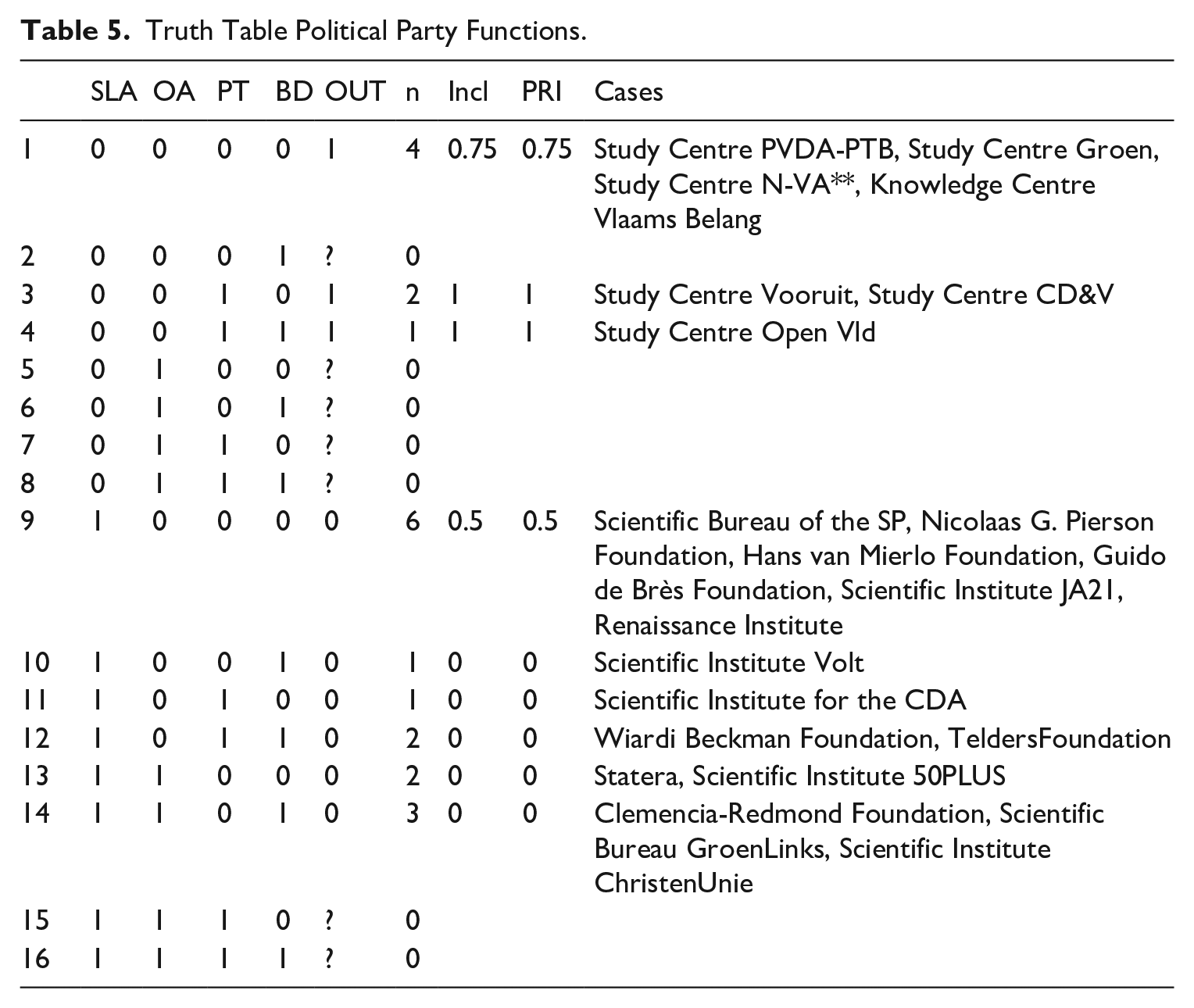
Row 1 in both Tables 4 and 5 shows that Study Centre PVDA-PTB, Study Centre Groen, Study Centre N-VA and Knowledge Centre Vlaams Belang are not identical in the outcome. This can be explained by the fact that, while all these cases share certain characteristics, including not operating within a system or organisation with autonomy, lacking a leader with an academic background and being connected to non-mainstream parties, they still differ in their outcomes. The deviant case here is Study Centre N-VA, the only Flemish case that performs think tank functions, while operating in a system without autonomy, as explained in the analysis of necessity (section ‘Analysis of Necessity’).
Row 9 in Tables 4 and 5 shows conflicting results as well, while all six cases show the same combination of conditions (system-level autonomy, no organisational autonomy, non-mainstream parties and no academic background of the director), their outcome differs. The Nicolaas G. Pierson Foundation, Scientific Institute JA21 and Renaissance Institute perform party functions, which is rather exceptional in the Netherlands, as discussed in section ‘Analysis of Necessity’, while the Hans van Mierlo Foundation and the Scientific Bureaus of the SP and the SGP perform think tank functions.
Solutions of Sufficiency
In a second step of the analysis of sufficiency, the causal pathways that lead to think tank functions and party functions are identified. This is achieved through the process of logical minimisation and the Enhanced Standard Analysis, leading to the intermediate solution. 14 Three possible solutions arise from this logical minimisation process, each with complementary strengths: the conservative solution, the most parsimonious solution and the intermediate solution. These solutions vary in their level of complexity. Among them, the intermediate solution is regarded as the preferred option for causal analysis because it is the only relevant solution within the framework of the Enhanced Standard Analysis. It guarantees that the counterfactual claims are good and tenable (Dușa, 2019a; Haesebrouck, 2022; Schneider and Wagemann, 2012).
The intermediate solution for think tank functions (Table 6) shows three causal pathways (equifinality) and supports the theoretical expectations. 15 As shown by the analysis of necessity, system-level autonomy is a necessary condition and therefore present in all pathways. However, it is not a sufficient condition because it has to be combined with an organisational-level condition (conjunctural causation). More specific, for a PPTT to perform think tank functions, it is sufficient to operate in a system that foresees autonomy and (1) to have organisational autonomy, or (2) to be connected to a mainstream party, or (3) to have a director with an academic background. The analysis shows that 9 out of 13 cases that perform think tank functions are covered by these pathways (upper right cell Plot 3). These cases are the Clemencia Redmond Foundation Statera, Scientific Bureau GroenLinks, Wiardi Beckman Foundation, TeldersFoundation, Scientific Institute Volt, Scientific Institute 50PLUS, Scientific Institute ChristenUnie and Scientific Institute for the CDA. All these cases are situated in the Netherlands, a system characterised by system-level autonomy.
Intermediate Solution Think Tank Functions.
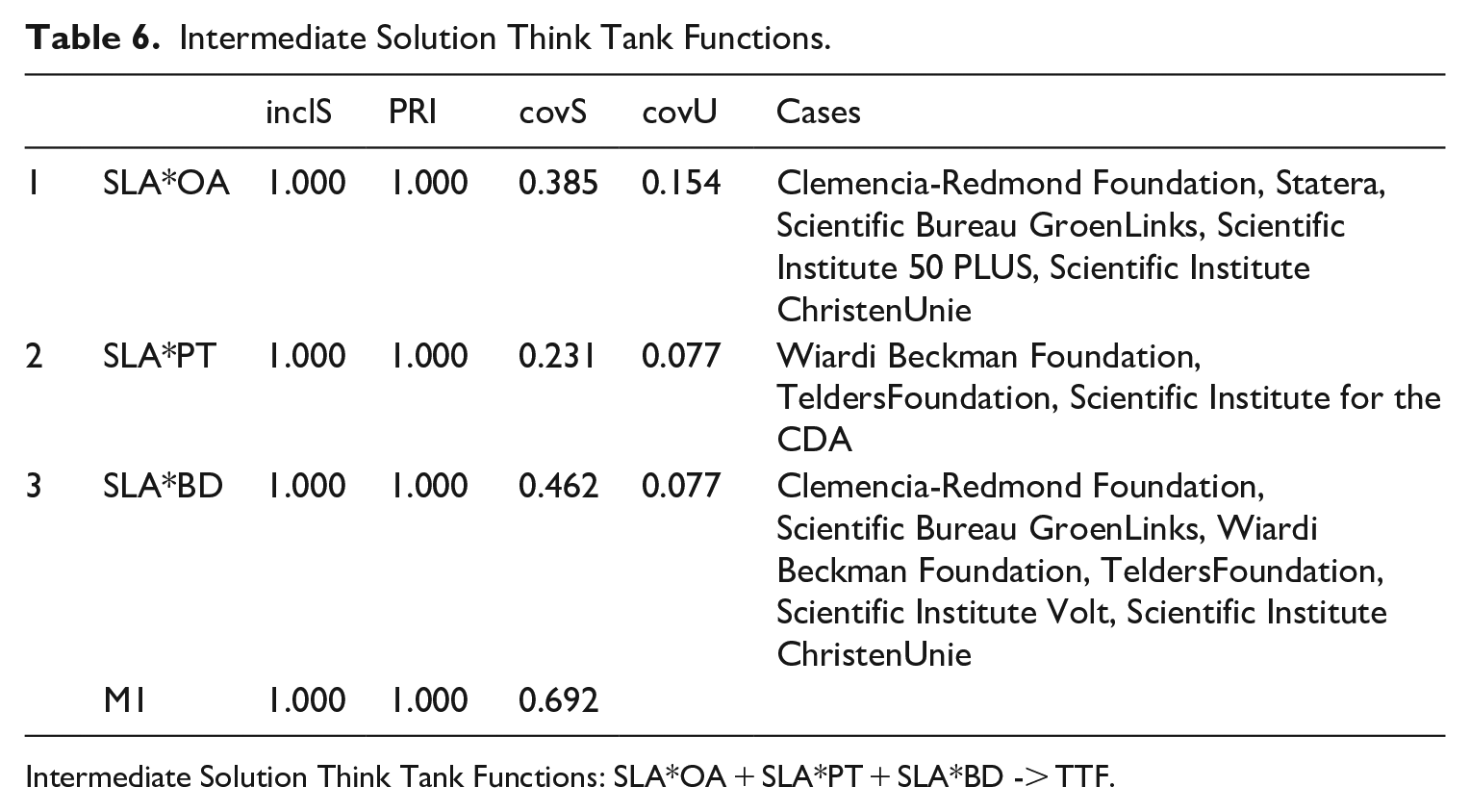
Intermediate Solution Think Tank Functions: SLA*OA + SLA*PT + SLA*BD -> TTF.

Sufficiency Plot Intermediate Solution Think Tank Functions.
The impact of organisational autonomy is particularly evident in five Dutch PPTTs: the Clemencia Redmond Foundation (Int16), Statera (Int7), Scientific Bureau GroenLinks (Int14), Scientific Institute 50PLUS (Int5) and Scientific Institute ChristenUnie (Int22). A leading representative of the PPTT of 50PLUS, the party for elderly rights, emphasised the importance of this autonomy: ‘There is of course a link with the party, but independence is of paramount importance to us (. . .) We are independent. We can decide for ourselves which studies and projects we conduct; the party cannot influence this’ (Int 5). Similarly, an interviewee from the Clemencia Redmound Foundation, the PPTT of BIJ1, a party advocating for minority rights, highlighted that officials from the party are not included in the PPTT. They explained this choice as striving for ‘A separation of powers, an important degree of autonomy towards the party in order to also be critical’ (Int16).
The type of party also plays a role. All three mainstream PPTTs, Wiardi Beckman Foundation, TeldersFoundation and Scientific Institute for the CDA, indicated that they perform think tank functions (Int4;9;8).
Finally, the analysis confirms the assumption that PPTT leaders with an academic background focus on research. This is evidenced by directors of the TeldersFoundation, the PPTT of Volt, the Wiardi Beckman Foundation, the Clemencia Redmond Foundation, the PPTTs of GroenLinks and the ChristenUnie, all of whom have academic backgrounds and prioritise research (Int9;20;4;16;14;22). One example comes from the PPTT leader of the ChristenUnie:
I worked in academia before as a PhD researcher, as a postdoc and as an assistant professor. In that sense, I really feel like a scientist. (. . .) In my current function you have a bit of politics, you are also allowed to think and look critically as a researcher, independently, and some of your deepest convictions as a Christian party are also included (Int 22).
Plot 3 reveals that there are four cases (presented in the upper left cell) that perform think tank functions but are not included in the solution formula. These cases are Study Centre N-VA, Scientific Bureau of the SP, Hans van Mierlo Foundation, Guido de Brès Foundation (SGP). The nine cases in the lower left cell are the cases that do not perform think tank functions and are discussed in the analysis of sufficiency for party functions.
Although the intermediate solution is the preferred solution for causal analysis, it is relevant to discuss all three solutions in the analysis of sufficiency for party functions because there are no untenable or logically contradictory assumptions that have to be taken into account. The conservative solution (Table 7) displays two causal pathways that lead to political party functions. In both causal pathways, the lack of system and organisational autonomy is present. This complies with our theoretical expectation that the lack of autonomy is sufficient to contribute to the performance of party functions. In one pathway, the absence of system and organisational autonomy is combined with dominant parties, in the other solution this is combined with a non-academic background. Taking into account the high overlap of cases in both solutions, the intermediate solution is a good summary of the analysis. The intermediate solution (Table 8) shows that the absence of system-level and organisational autonomy is sufficient and that no other variables have a considerable contribution. The most parsimonious solution (Table 9) shows that the absence of system-level autonomy is sufficient for party functions. The cases that are covered by the solutions are all cases in Flanders, a system without system-level autonomy.
Conservative Solution Political Party Functions.
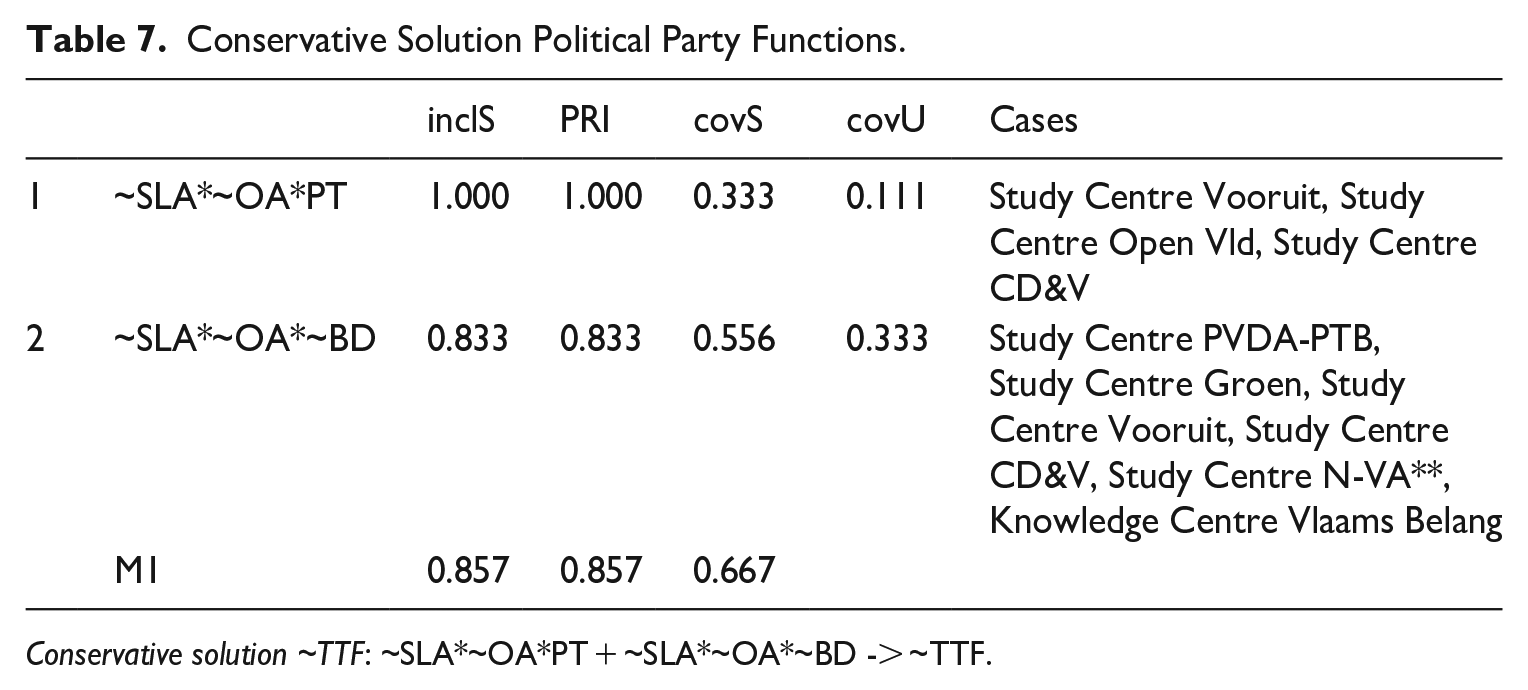
Conservative solution ~TTF: ~SLA*~OA*PT + ~SLA*~OA*~BD -> ~TTF.
Intermediate Solution Political Party Functions.

Intermediate solution ~TTF: ~SLA*~OA -> ~TTF.
Most Parsimonious Solution Political Party Functions.

Most parsimonious solution ~TTF: ~SLA -> ~TTF.
The solutions display that the Flemish PPTTs, formally integrated into their respective parties, lack both system-level and organisational autonomy. This means they do not experience freedom in their daily operations. Instead, they are heavily focused on assisting the party in its day-to-day immediate needs and tasks. Although they differ in party type, and the background of their directors, these conditions do not impact the outcome (Int1;2;3;10;11;12).
This focus on assisting the party was illustrated by the interviewee of the PPTT of the Flemish social democrats Vooruit:
Our main focus is determining the party positions. We have to take a position on policy formulation and something that is up for vote or discussion in parliament, or if something is in the newspaper and our party leader is asked ‘what do you think about it?’. So, defining party positions every day (Int 1).
Moreover, the lack of organisational autonomy was illustrated by this interviewee: ‘We are part of the party, we are not separate from or affiliated with, we are part of the party’. However, when asked about the comparison with Dutch PPTTs, the interviewee responds that: ‘We can only dream about such system, we don’t have that. We don’t operate as a think tank, we don’t have the time for that’ (Int1), also indicating a normative component.
Plotting the solutions of sufficiency (Plot 4) displays that there is one case that displays the solution but does not display the outcome. This case is the study centre N-VA, which has been discussed in section ‘Analysis of Necessity’, and is marked with ** in Tables 5 and 7–9. This suggests that for PPTTs without direct guaranteed funding there is another factor may be at play: the financial strength of the party.

Sufficiency Plot Political Party Functions. 16
Conclusion
Political parties face increasing pressure to prioritise short-term electoral gains and daily operations, often at the expense of long-term policymaking. In this context, PPTTs stand out as unique entities that can either assist parties with their daily operations or help them transcend these pressures to focus on more long-term governance.
As the ‘brains’ of political parties (De Winter and Dumont, 2006: 965), PPTTs play pivotal roles in the political landscape. Although organisationally different from think tanks and parties, they show functional similarities with both types of organisations. Their functions have been conceptualised as either those of political parties or think tanks, based on the fact that PPTTs can either contribute to the goal of parties to win elections (party functions) or offer a counterbalance to these electoral priorities by conducting research in order to develop well-founded policy advice (think tank functions). This raises the question of what conditions cause PPTTs to prioritise either party or think tank functions.
The aim of this study was to shed light on the brains behind political parties and to establish what combination of sufficient and necessary conditions determine the functional focus of PPTTs. The conditions were detected following an abductive approach. The analysis deployed a QCA, leveraging case knowledge of 22 PPTTs in the Netherlands and Flanders, obtained through in-depth interviews with PPTT officials, and the analysis of primary sources from these PPTTs. Dutch and Flemish PPTTs operate within different frameworks. In the Netherlands, PPTTs are subject to a legal framework and receive direct public funding in proportion to the electoral performance of their associated party. These give them what is described as system-level autonomy. In Flanders, PPTTs do not enjoy these conditions. This careful case selection covers two regulatory systems for PPTTs, one which is marked by direct funding and one which is marked by lack of funding. Future research is needed to assess whether the role played by organisational characteristics is similar in countries with other regulatory systems. Particularly valuable would be an examination of within-country variation in Belgium. This would include a comparison between Wallonia, where PPTTs receive a form of direct funding for organising certain activities such as permanent education but lack other funding, and Flanders, where such funding is absent. An additional avenue for research lies in investigating countries with different regulatory systems.
This study is innovative and unique because it takes into account both between and within-country variation in the functional focus of PPTTs. QCA enabled to unravel the complex dynamics of system- and organisational-level conditions that determine whether PPTTs perform think tank or party functions. The study complied with the three assumptions (conjunctural causation, equifinality and causal asymmetry) underlying the causal complexity that is inherent to QCA. In particular, the analysis establishes four key findings.
The first key finding, supporting the theoretical assumption, is that system-level autonomy defined by a legal framework and direct funding is a necessary condition for PPTTs to perform think tank functions. This implies that national legislation that enshrines system-level autonomy and secures direct government funding for PPTTs, matters for the roles PPTTs assume enabling them to operate relatively autonomous and are not entirely depending on the party for their income. In such systems, PPTTs have the space to perform think tank functions that both support the party and stimulate the public debate with research and policy advice. This think tank behaviour contributes to a healthy and informed democratic process.
This finding adds to the literature public funding for political organisations demonstrating that this public funding makes them less dependent on the party and therefore tames their political party functions and lets them set their own agenda and rise above party activities. This finding has important implications for both PPTTs and the systems in which they operate. Given that direct government funding can influence their roles, policymakers may consider introducing public funding to support organisations that transcend the day-to-day political activities of parties, allowing them to focus more on think tank functions.
Besides, this finding raises the question if PPTTs that operate in systems, other than the Netherlands, that foresee system-level autonomy with a legal framework and direct funding, perform think tank functions. An avenue for future research is to map these legislative frameworks governing PPTTs in other jurisdictions and study the impact of these diverse legal frameworks on the functions of the PPTTs. Moreover, the analysis of necessity identifies four deviant cases, highlighting within-country variation. Future within-case research would be valuable to investigate the mechanisms underlying the deviant positions of these cases in greater depth.
A second key finding is that there are no necessary conditions for party functions. While system-level autonomy is a necessary condition for think tank functions, it does not mean that party functions can only be performed without system autonomy. Rather, the analysis shows that there are no necessary conditions for the performance of party functions. Although, the absence of system-level autonomy proofs sufficient for the performance of party functions. Besides, future research is necessary to further uncover other factors at play, as for example the financial strength of the affiliated party might play a role as well.
The third key finding is that party type is relevant for the understanding of PPTT functions. The results show that PPTTs affiliated with mainstream parties that operate in a system that provides autonomy, perform think tank functions. This finding adds to the literature on party types that the understanding of party types is relevant not only for the understanding of party choices, behaviour and strategies but is also associated with the behaviour of parties’ affiliated PPTTs. To know whether this finding travels to other party systems, this result should be tested on a larger scale.
The fourth key finding is that the presence of the party within the PPTT matters for the functions that PPTTs perform. When PPTTs operate with system-level autonomy, the absence of the party in the PPTT is sufficient for the performance of think tank functions. And, for PPTTs that operate without system-level autonomy, and where the party is present in the PPTT determining the day-to-day operations, this is sufficient for the performance of party functions. This suggests that the dominance and incorporation of the party within the PPTT, is sufficient for the performance of party functions and that other conditions do not matter in such cases. This finding on the ‘degree of closeness’ between the party and its affiliated organisation contributes to the literature on party organisations, demonstrating that the presence of the party in a PPTT matters. It opens an avenue for future research on whether the presence of the party in other auxiliary party organisations such as youth wings, also impacts their role.
The final key finding implies that for PPTTs operating with system-level autonomy, the background of the leader is reflected in the work of the PPTT, more specific PPTT leaders with an academic background reflect their research background in the work of the PPTT by focusing on think tank functions. This finding adds to our understanding of the role of leadership in political organisations suggesting that the profile of the PPTT leader matters and that the importance of leadership in other organisations travels to PPTTs An avenue for future research is to do an extensive mapping of the biographical characteristics of PPTT leaders and to establish whether other biographical characteristics impact the functions of PPTTs both in the systems this study focuses on, and in other countries. This implies that the careful selection of a PPTT leader matters for their activities.
A key limitation of this study is its focus on this limited set of conditions–system-level autonomy, party type, organisational autonomy and leader profile. This study opens the door to further research, highlighting the need to explore additional influencing factors and enhance generalisability. In sum, understanding the different ways in which PPTTs are employed and the conditions that shape their functions is crucial for grasping the dynamics of today’s political landscapes and the challenges political parties face. Specifically, this study highlights whether PPTTs primarily support parties day-to-day political activities and their goals of winning elections, or whether they transcend these pressures to contribute to responsible governance through well-founded policy. Furthermore, this study has revealed how PPTTs can rise above daily political pressures, paving the way for future research into the critical roles these unique political organisations play.
Supplemental Material
sj-docx-1-psx-10.1177_00323217251344075 – Supplemental material for Transcending Fast-Paced Politics? The Functions of Political Party Think Tanks
Supplemental material, sj-docx-1-psx-10.1177_00323217251344075 for Transcending Fast-Paced Politics? The Functions of Political Party Think Tanks by Britt Vande Walle in Political Studies
Footnotes
Acknowledgements
Previous versions of this article were presented at the Annual Political Science Workshop of the Low Countries at KU Leuven in June 2023, at the American Political Science Association Annual Meeting in Los Angeles, CA, in September 2023 and at the Annual International QCA Paper Development Workshop in Antwerp in December 2023. I would like to thank all discussants and colleagues at these occasions for their valuable feedback. Special thanks go out to Prof. Dr Sarah de Lange for her continuous support and insightful comments.
Declaration of Conflicting Interests
The author(s) declared no potential conflicts of interest with respect to the research, authorship and/or publication of this article.
Funding
The author(s) disclosed receipt of the following financial support for the research, authorship and/or publication of this article: Funding for this research was provided by Fonds Wetenschappelijk Onderzoek (Grant Number: 11J2423N).
Ethics Statement
Ethics approval for this research was obtained from the KU Leuven Social and Societal Ethics Committee (SMEC) under the number G-2020-2595-R2.

Supplementary Information
Additional Supplementary Information may be found with the online version of this article.
Content
Appendix A. Tables. Appendix B. Methodological information QCA. Appendix C. Solution Types. Appendix D. Robustness Checks.
Notes
Author Biography
References
Supplementary Material
Please find the following supplemental material available below.
For Open Access articles published under a Creative Commons License, all supplemental material carries the same license as the article it is associated with.
For non-Open Access articles published, all supplemental material carries a non-exclusive license, and permission requests for re-use of supplemental material or any part of supplemental material shall be sent directly to the copyright owner as specified in the copyright notice associated with the article.
