




Abstract
Demographic issues are becoming key to the debate on the future of Europe, and of Italy in particular, which has the lowest birth rate in Europe but is among the top-ranked countries for demographic ageing. The general improvement of living conditions and the ageing of large cohorts cannot be supported by the economic activity of the younger generations, which calls into question the security of certain aspects of the social pact, such as the provision of pensions and health care.
While encouraging an awareness among Italians of the trends and problems they will have to deal with, all national actors must cooperate to ensure the recovery of the birth rate, and to harness the economic benefits of incoming migrants and the experiences of older people. It is equally necessary to meet the needs of young people and enhance their social role. Only through such cooperation will it be possible to create a favourable climate for actions that will allow us to control and direct these demographic phenomena and not to suffer from them.
Introduction
Over the last four or five decades, the Italian population has undergone extraordinary changes in terms of both the events that affect the total number of inhabitants (births, deaths, immigrations and emigrations) and its main structural characteristics: sex, age, educational level, occupation and citizenship.
For more than a century Italy managed to compensate for its increasingly high emigratory flows to every part of the world by maintaining a positive natural balance (more births than deaths). However, the data since 1993 show that this balance is no longer positive (with the sole exception of 2006). Furthermore, the deficit in births has recently increased, resulting in a cumulative effect over the last 30 years of a surplus of approximately 2.5 million deaths.
When even the recent positive migratory balance could no longer compensate for the negative natural balance, the total number of residents started to decline, resulting in the population shrinking by 1,349,000 people between 1 January 2014 and 1 January 2023. To find a similar decline in Italian demography, we have to go back more than a century, to 1916–18, when the population fell by 971,000. However, in 1918 Italy experienced the highest mortality rate it has ever recorded, due to the combination of the effects of the Great Influenza pandemic—the so-called Spanish influenza—and the persistent effects of the First World War.
While less disruptive than the Spanish influenza, the Covid-19 pandemic, which exploded at the beginning of 2020 with immediate and intense effects, still left its traces on the demography of the country, having a significant impact on deaths but also on the frequency of births, marriages and migrations. The pandemic experience, when combined with the pre-existing demographic phenomena, has definitively placed the Italian population in a long regressive phase—a ‘demographic winter’. This is indicated by the 14 years of continuous decline in the total number of births (2009–22) and the 9 years of progressive reduction in the number of residents (2014–22). These trends have recently shown signs of further accentuation.
Between 2020 and 2022 over 700,000 deaths per year were recorded—among the highest annual figure ever, and substantially similar to the numbers recorded in the middle of the Second World War (1942–4). During this same period the number of births continued to decline, setting new negative records, as had happened year after year from 2013 onwards The data currently available for the first 11 months of 2023 indicate that the number of births was lower than for the same period in the preceding year (-3.3%). Thus, it is very likely that the low figure of 393,000 births in 2022 will have further contracted in 2023 once the final figures are known. Therefore, the presence of a negative natural balance appears to be something that we will have to live with in the years to come.
Balance of the Italian resident population, 2010–22, annual averages in thousands.
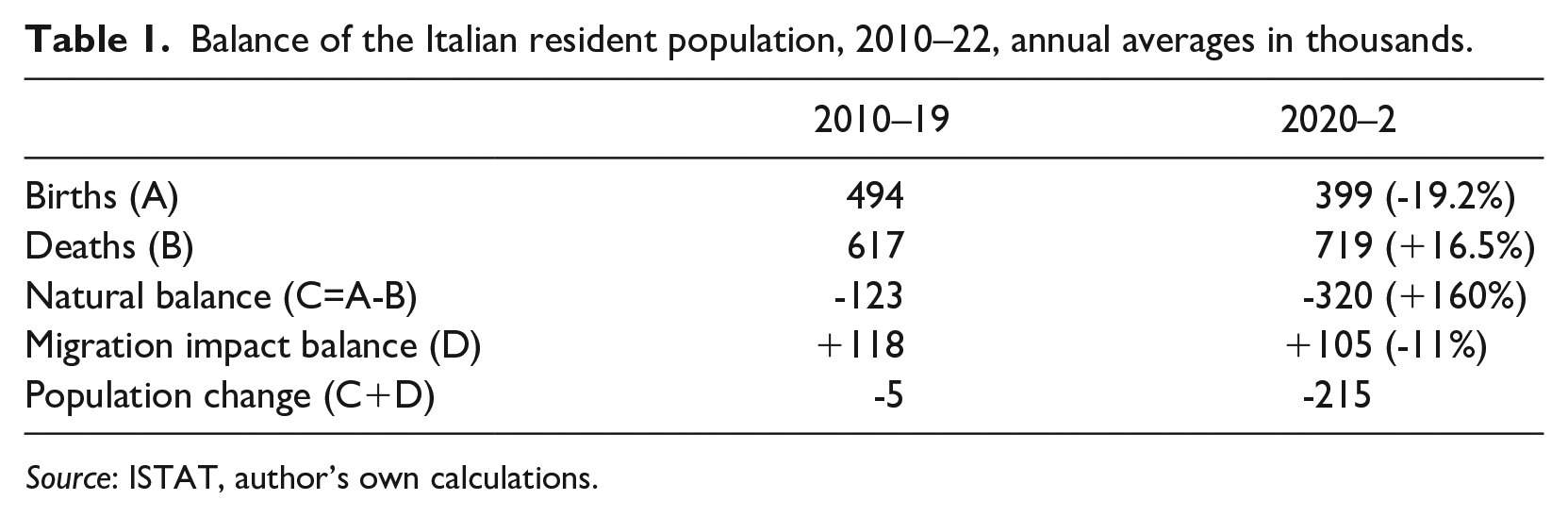
Source: ISTAT, author’s own calculations.
In addition to these regressive dynamics that have triggered changes in the population’s size, important transformations are also taking place in its age structure, with a progressive increase in the number of older people. Conventionally identified as people over 65, the older person component of the population totalled 23.8% in 2023, having grown from 18.7% at the beginning of the century (2002) and just 13.2% 20 years earlier (1982).
This ‘demographic ageing’ began at the end of the last century and will persist and increase over the next three to four decades. Three factors underly it. The first is the rapid and dramatic decline in the birth rate, which is depriving the country of an adequate inflow of young people. The second and third factors interact with one another and must be understood in combination. The first of these is the—certainly welcome—increase in the capacity to survive to old age. The second is linked to the high birth rates in the past, which are now producing a very substantial contingent of ‘mature’ people who are likely to survive and become part of the older population.
A path from the past
The demographic changes we are experiencing, both in terms of negative growth and ageing structure, do not represent a sudden novelty of our time. It is well known that demographic phenomena—excluding exceptional circumstances (conflicts, natural disasters, or serious health or economic crises)—follow the inertia principle: today incorporates the manifestations of yesterday and creates the conditions for building tomorrow.
The decline of the Italian population, as well as its progressive ageing can, in fact, be largely explained by the volatile dynamics of the birth rate over the last 70 years. After the post-war recovery (beginning in 1946) and its exhaustion between 1947 and 1951, an ‘economic miracle’ led to a baby boom in the mid-1960s. A gradual return to more ordinary numbers of births occurred in the following years, until 1974, when a downturn in the birth rate heralded the start of a 20-year period of drastic decline. From 886,000 in 1974, the number of births per year dropped dramatically to just 628,000 seven years later (1981). It then continued to fall, bottoming out at 526,000 in 1995. This low number was then surpassed in 2013—as noted above—and, in a downward spiral, the number of births consistently shrunk in each of the subsequent nine years (2014–22).
At the beginning of the new century the contribution of the incoming foreign population, along with the related mechanism of family reunification, gave the illusion of a weak recovery, albeit one that was short-lived when faced with the economic crisis of 2008. With fewer and fewer people in the fertile age range, the number of potential parents grew smaller, while the economic difficulties for families increased. It is no surprise that the conjunction of these two factors caused a new and rapid collapse in the birth rate, which has since continued uninterrupted.
In 2020 Covid-19 burst onto the scene, having not only dramatic health consequences but a revolutionary impact on societal and family organisation. The changes it caused have strongly affected people’s emotional well-being and reproductive attitudes, with consequences that are not yet fully understood.
Birth phases in Italy since the Second World War.
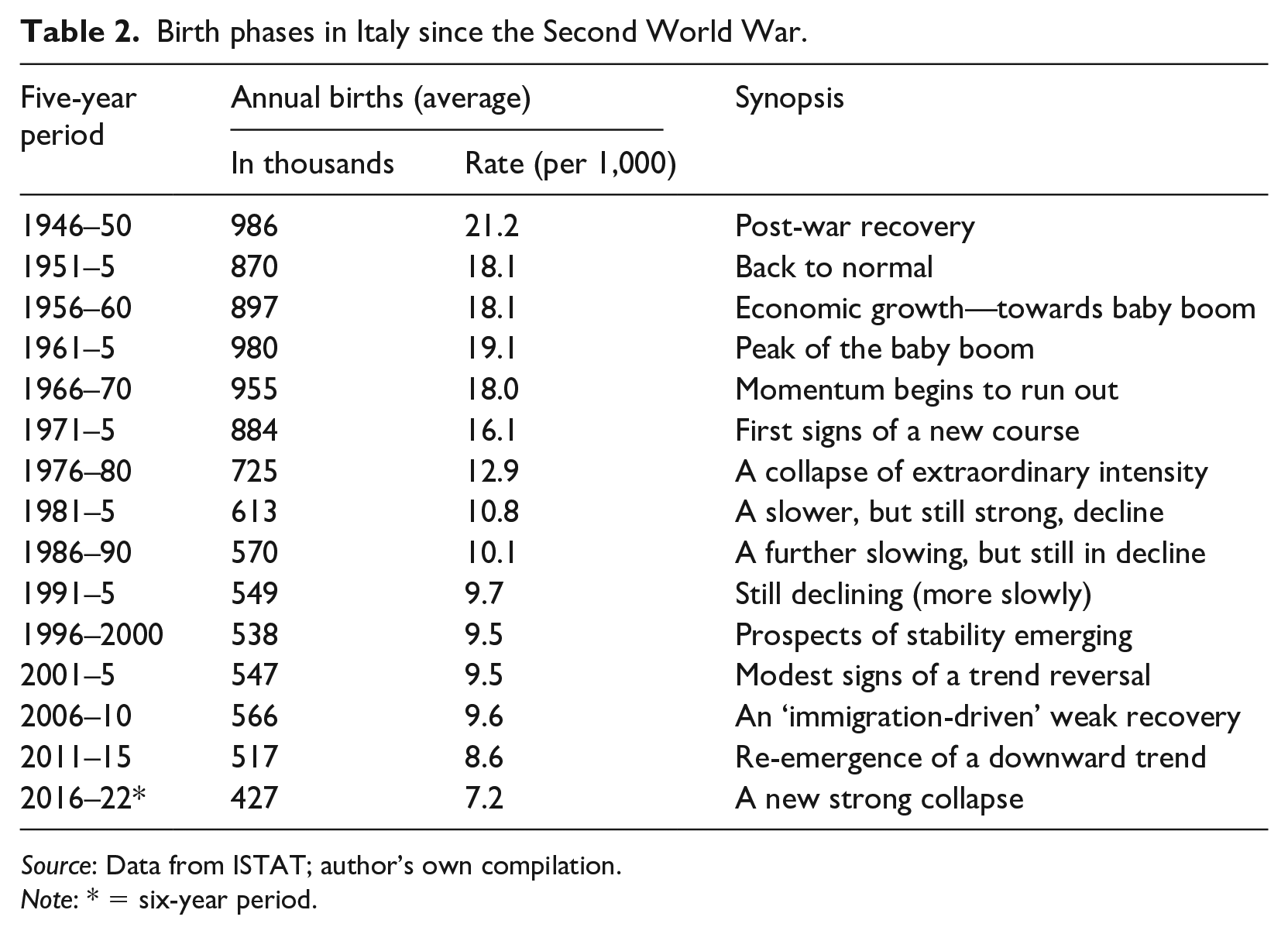
Source: Data from ISTAT; author’s own compilation.
Note: * = six-year period.
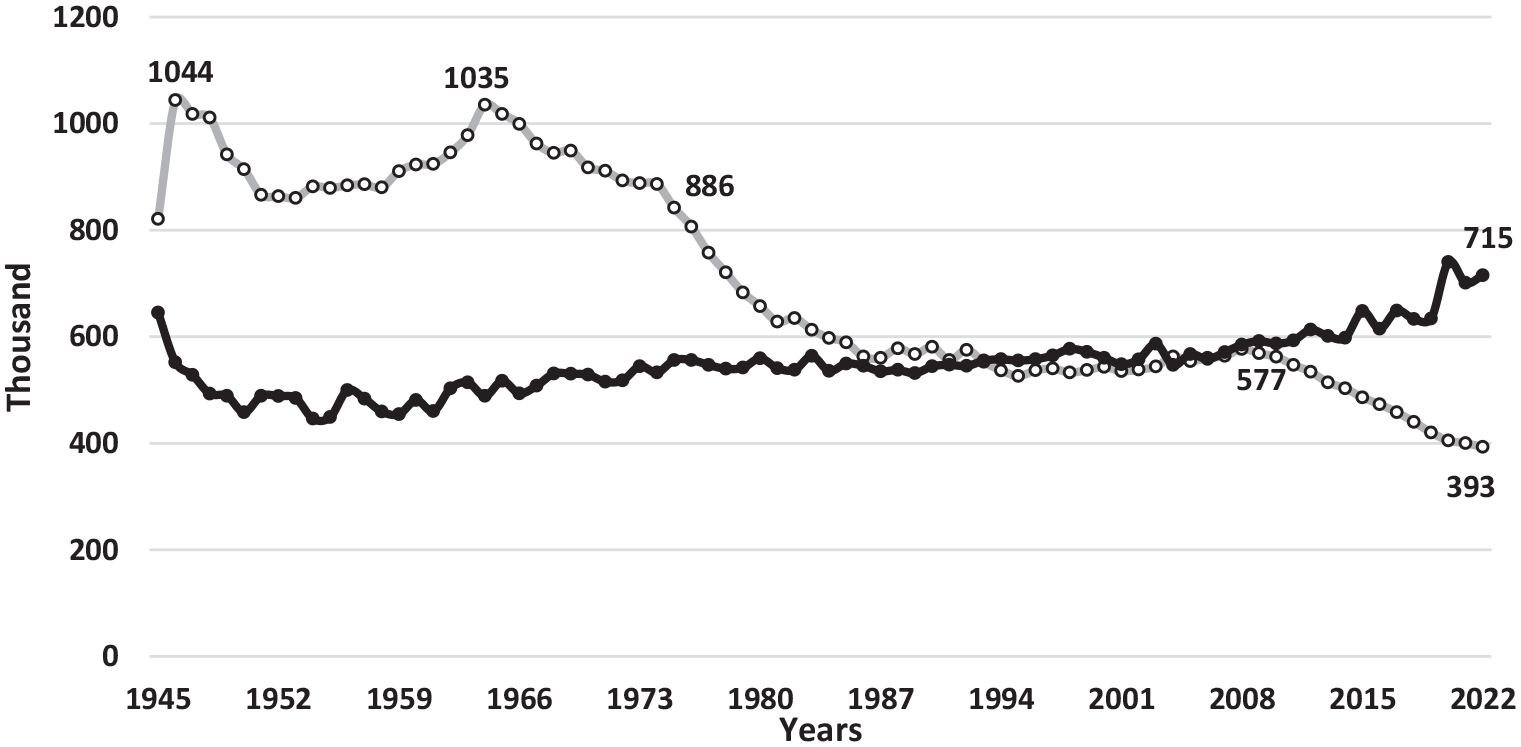
Births and deaths (black line) in Italy since the Second World War.
As a result, the demographic regression we are experiencing is expected not only to continue but to speed up. The latest forecasts from the Italian National Institute of Statistics (ISTAT 2022b) predict—in the most likely scenario (the ‘median variant’)—a decline of 3 million in the number of residents in the next 20 years, and then a further decline over the following 20 years, to bring the population, now 59 million people, to under 50 million. Simultaneously, it is estimated that in 2043 not only will those over the age of 65 total a third of the residents, but that the number of elderly people (aged 90 and over) will be in the order of 1.3 million. Furthermore, the population’s economically active component (conventionally 15–64 years old) will fall by more than 6 million in the next 20 years and then by a further 4 million in the following two decades.
Consequences and problems
Knowledge of how these great structural and dimensional changes to the population will impact the country brings us to reflect on the resources we can rely on in the years to come. In this regard, a simple simulation exercise may be useful. Below we isolate and assess the effects on GDP of the expected population decline and the reduction in the share of working-age residents, as forecast by the National Statistical Institute.
The exercise shows how GDP, totalling €1,946 billion in 2022, may shrink to €1,625 billion by 2042 if—other conditions (activity rate, employment rate, average productivity per employee) being equal—the expected demographic changes to the population and its working-age component were to materialise. The decline compared to 2022 would be equal to 16.5% of GDP over 20 years (-12.2% at per capita level), rising to 25.7% over a 40-year horizon (-13% per capita).
Thus, the simulation shows how, at the national level, if no adequate support is provided through favourable changes to the three economic factors of reference (activity, employment and productivity), in 2062 there will be a loss of resources totalling approximately €500 billion due purely to demographic changes. This will happen precisely when, due to the ageing population, many more resources are likely to be needed. The collective expectation that the country is capable of guaranteeing good levels of quality of life, especially in terms of assistance and care, will simply not be realistic. This will be the result of both fewer economic resources being available and the fact that intra-family support is becoming increasingly fragile due to the progressive weakening of familial ties and the growth in the number of single elderly people.
Furthermore, with respect to the dynamics of consumption, these demographic shifts are also destined to bring about important changes to the Italian economy. The OECD assigns a consumption ‘score’ for each family unit based on a score of 1 for the first adult (the head of the family), 0.5 for each additional family member over 15 years old and 0.3 for those aged 0–14 years. If we apply these parameters to the population and the number of families expected in the 20-year period 2022–42 (ISTAT 2022a), consumption units are expected to shrink from 40.7 million to 39.9 million. This will likely affect aggregate demand, the production system and employment. These changes will have a fairly limited negative impact at the national level (-1.84%), but will cause a more significant decline in southern Italy (-8.42%).
From awareness to action
There can be no doubt that reversing the headlong demographic decline in Italy requires effective and timely interventions on multiple fronts. Although the effects will inevitably take time to filter through, the first line of action should involve addressing the birth rate and removing all obstacles that affect the reproductive choices of families, such as the cost of raising children, childcare problems, and difficulties in reconciling the respective spheres of parenthood and work. To seriously address the problem of the declining birth rate, we should combine the tools of politics and culture with a new and different approach that has a positive impact on the conditions that actually induce people to have a child (or an additional one). All of this should be done quickly, without any illusion of external help or magical solutions such as the important (but insufficient) contribution of foreigners, among whom the birth rate has halved over the last 20 years—from 23.5 per thousand in 2004 to 10.4 per thousand in 2022.
A second area of action must be in the field of international mobility. This should not only open up new routes for well-governed immigration, adequately accompanied by valid paths to full integration, but also act to contain emigration. The latter is a popular choice among younger cohorts that have excellent education levels, often at the graduate and post-graduate levels, but have limited (or even zero) opportunities to achieve success within the national borders.
Finally, to address (or simply attenuate) the problematic effects of demographic change, a further area for intervention is among the living conditions of ‘older people’—or the ‘differently young’—that is, those not yet belonging to the universe of the ‘elderly’. We are referring, in particular, to those who are still capable of being productive and for whom the boundaries of the seasons of life should not be defined on the basis of rigid age thresholds, but rather should be modulated over time according to progress in terms of life expectancy and physical and mental fitness. In this sense, for example, if we select from all those over 65 those expected to have (at the current life expectancy) ‘still more than 20% of their total life to be lived’, we can see that today nearly 3 million such residents, who are ‘differently young’, could potentially be economically and socially activated, with allowances made for personal choice and convenience. This number will grow to 5 million in the next 10 years.
Numbers of ‘older’ Italian residents according to different definitions, 1982–2062.
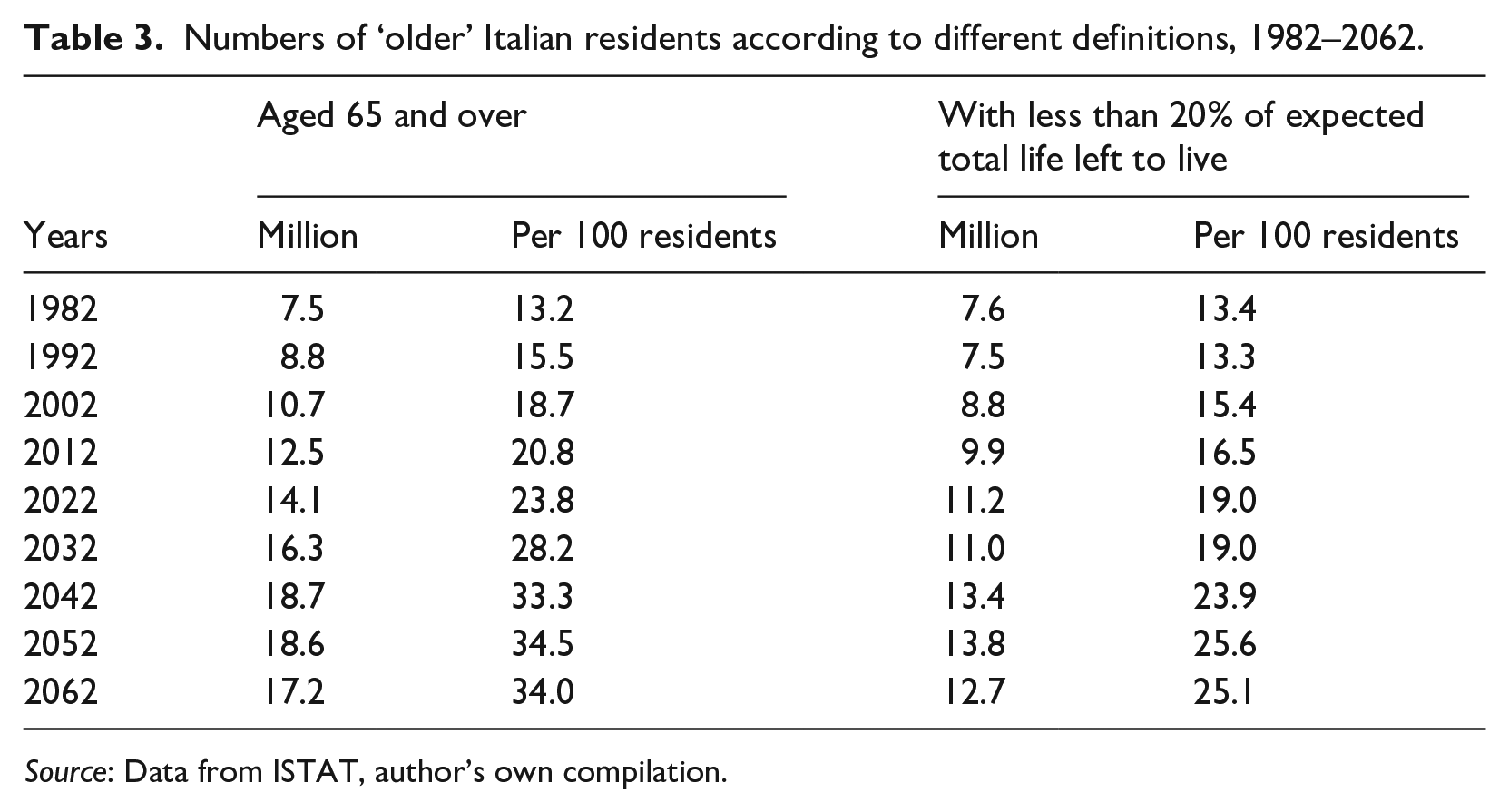
Source: Data from ISTAT, author’s own compilation.
In any case, if we utilise the logic of mobile boundaries—that is to say, old people are not those who have lived for x years, but those who have less than x% of their expected total life left to live—this weakens the phenomenon of demographic ageing. By adopting the measure of ‘20% of expected total life’ as the flexible threshold for changing status, the percentage of the Italian population who are to be counted as old would drop from the current 23.8% (if all over-65s are considered old) to 19%. Furthermore, rather than forming two-thirds of the total number of residents in 20 years’ time, their share would be reduced to less than a quarter.
Conclusion: guidelines for sustainable demography
Looking at the present with one eye on the future, the demographic data convey a pressing need for the renewal of the population, both in a quantitative and a qualitative sense.
It is necessary to act on the availability of human capital, encouraging both its production, by removing any obstacle (economic, regulatory or cultural) that may hinder fertility, and its acquisition, with appropriate initiatives to govern international mobility flows. At the same time we must seize the opportunity to appreciate the component of the population that, despite its maturity, still has the energy and skills to be part of the economy and social system.
To seriously address the problem of insufficient generational turnover, it is necessary to combine the tools of politics and culture with a different approach in which resources, capacity and imagination help to introduce new solutions. This being said, we must not forget to utilise and enhance the valuable tools already at our disposal, including those outlined in the 2012 National Plan for the Family (Italy, Presidency of the Council of Ministers, Department for Family Policies 2012).
Additionally, it is important to start recognising young people as social subjects whose needs must be met if they are expected to play an active role in society. It is time for the country to embrace the European youth policies which promote the meaningful participation of young people in decisions and activities, both on a local and a national level. These policies must be considered a strong departure point for building a more democratic, more supportive and more prosperous society. Local authorities can play a leading role in promoting youth policies, guiding new generations in their education, training, autonomy and independence. For this reason it is necessary to create a cultural environment that respects young people and encourages their energies and aspirations for change, combining this with the needs of the regions, which must be made attractive and viewed as sources of opportunity. Only in this way will it be possible to think positively about the future and limit the demographic consequences of ageing and depopulation, which are already affecting quality of life in many significant areas of the country.
Finally, we must consider that passing through the various stages of life affects and will increasingly also condition the transition to the elderly state. Being young, adult or elderly no longer only relates to biological and demographic factors. In fact, there is a growing distance between chronological age, its social representation and the perception that individuals have of it. The points in time and ways in which one passes from youth to adulthood and then into old age are partially a result of the economic conditions, lifestyles and, more generally, the human capital of individuals. But they also reflect the institutional and social context in which members of each generation interpret their life paths.
Ultimately, to ensure and preserve the presence of an active and involved older population, a comprehensive view of the entire life course needs to be developed. This overview would help to ensure that reforms and investments are made that promote the awareness and adoption of a healthy lifestyle from a young age. The ambition must be to encourage social and cultural participation through all stages of life in order to postpone the moment when we are overtaken by the effects of ageing, with their inevitable consequences for health and autonomy.
Footnotes
Author biography