




Abstract
Europe is currently under pressure from both the economy and demography. Six years after the onset of the global financial crisis, there are still no signs of a strong recovery. Moreover, demographic shifts have affected the size and structure of the European population, which is the fastest ageing in the world. These trends are inexorable and will be very hard to break unless major changes take place in the mentality of both policymakers and society at large. This article explains how the mixture of these adverse economic and demographic prospects puts the whole continent at high risk and will undermine its economic and political influence in the years to come.
Introduction
Despite the somewhat more optimistic reports recently released about the current economic climate, most European countries are still suffering from the ramifications of the latest and particularly severe financial recession. The economic crisis has not been evenly experienced across the continent, yet hardly any country has been sheltered from its consequences. Moreover, most macroeconomic indicators suggest that the recovery is going to be prolonged and thorny: GDP growth is sluggish, unemployment remains discouragingly high and alarming volumes of national debt prevail in almost all EU member states. Even for well-performing countries, the medium-term economic prospects are unsatisfactory.
The current economic recession risks being deeper and longer lasting than previous ones. This is far from a surprise, as the prospects for economic recovery are threatened by the non-economic parameter that lies behind the forthcoming challenges. Demographics, the factor whose importance has been downplayed since the onset of the crisis, is the game changer in our recovery process.
At global level there is an ongoing debate about the relationship between the economy and population dynamics. It has been shown that the transition from a high mortality-high fertility to low mortality-low fertility status is beneficial to economic development. In all the more developed regions the ‘demographic dividend’ (Bloom and Canning 2004) initiated by the above demographic shift has created a favourable population age structure that has facilitated rapid economic growth with little or no budgetary stress. This favourable population structure has been the key to the ‘economic miracles’ that have occurred in many regions at different times. However, today, as fertility rates remain low and life expectancy keeps increasing, Europe, as well as most of the industrialised world, is facing the aftermath of demographic transition. The disproportionately high number of older people relying on shrinking younger generations undermines the tools traditionally used to drag economies out of stagnation. Once again the complex nexus between economy and population dynamics is brought to the fore.
This article highlights the magnitude of demographic dynamics in the global economy. It starts by contextualising shifts in the population age structure and presents their consequences. It claims that, although overlooked, population ageing is the most serious and complicated of all European concerns, with major implications for some fundamental European values.
From a growing to a greying population
The last century has been an era of major demographic developments. Within the twentieth century, and especially during its second half, the global population experienced an amazing increase in volume and registered historically unprecedented high growth rates. From roughly 1.6 billion in the early 1900s, the world's population rose to 3 billion in 1959, before further accelerating to exceed 6 billion just 40 years later, in 1999. At times, the annual population growth rate was above 2 %, and in the 1970s the population doubling time 1 became less than 33 years. This rapid population growth gave rise to concerns about population dynamics and fears about resource sustainability. In the early 1980s, newly emerging notions of a ‘population bomb’ or ‘population explosion’ implied that demographic development was putting socioeconomic progress in peril and was responsible for environmental degradation.
Population doubling time corresponds to the number of years required for the total population to double in size if the annual rate of population change is kept constant.
Since the beginning of the twenty-first century, concerns about the global population have been moderated as growth rates have been steadily declining (UN 2013). Fertility transition has been gaining momentum, and the long-term decline of fertility rates towards the replacement level 2 has become a virtually universal process (Wilson and Pison 2004). Long-term population projections have been repeatedly revised downwards and humanity seems to have escaped the nightmare of overpopulation, at least for the time being. During the first decades of the new century, the major demographic concern has shifted from population growth to population age composition (Lutz et al. 2004).
Replacement fertility is the minimum average number of children per woman required to ensure that a generation replaces itself in size. This number is conditioned by mortality rates (especially at young ages) as well as the sex ratio at birth. Currently, at a global level, a total fertility rate of 2.1 children per woman is used as a rough approximation of replacement fertility.
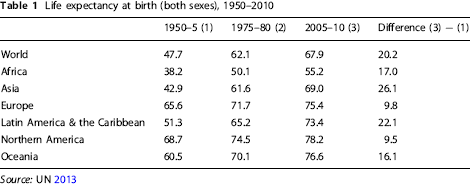
The decline in mortality rates for all ages–-the primordial factor behind population dynamics–-is a major achievement. The increase in life expectancy is a great success story for humanity: the twentieth century witnessed significant and sustained progress in reducing mortality rates all over the globe (Table 1). Today, the average newborn baby is expected to live for 68 years, more than 20 years longer than average global life expectancy at birth in 1950. Even though global averages always mask considerable variations across large regions or countries, this spectacular upward trend concerns all human beings, regardless of their place of birth.
Life expectancy at birth (both sexes), 1950–2010
Source: UN 2013
It is, however, common knowledge that for every benefit there is always a price to pay; the greater the benefit, the higher the price. Increased longevity followed by falling fertility rates 3 reshapes population pyramids and shifts volumes towards older age groups: the median age increases (Fig. 1) and so does the share of those above 65 years old, to the detriment of the younger age groups (Fig. 2). This demographic process is widely known as population or demographic ageing.
Things might be even worse if this was not the case. Declining mortality coupled with steadily high fertility would have led to uncontrollable population growth rates.
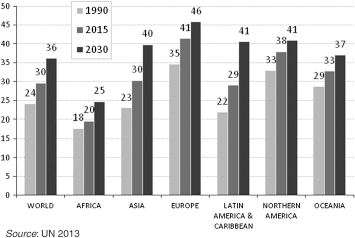
Median age by great areas: 1990–2015–2030
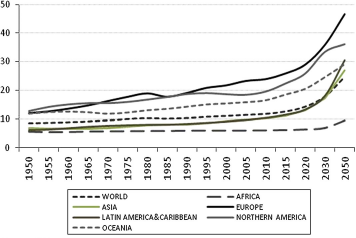
Old age dependency ratio, 1950–2050
Population ageing is a global phenomenon that is more pronounced in industrially advanced countries where the process started earlier; it is growing at a much faster pace in developing regions. All over the world people are living longer, growing older and having smaller families. Nevertheless, Europe is by far the oldest part of the world. The European population enjoys especially high levels of life expectancy and records particularly low fertility rates (Lutz et al. 2003; van de Kaa 1987). With the exception of just a few countries (Denmark, France and Ireland), fertility rates are well below replacement levels. For certain countries in Central (Austria and Germany), Mediterranean (Greece, Italy and Spain) and Eastern Europe (Bulgaria, Romania and Hungary), fertility rates have reached the lowest levels ever registered globally, below 1.5 children per woman. Due to the above-mentioned long-lasting combination of increasing longevity and low fertility rates, half of the European population is already above 41 years of age. This is twice as high as the African median age and almost 40 % higher than the global median age.
Population ageing: as much a challenge as an achievement
Not unlike biological ageing, demographic ageing does not come in isolation. Skills, capacities and potentials vary with age, for both individuals and societies. Compared to a population with a young age structure, an aged population is by default more experienced and mature, but less innovative and creative; more conservative and less adaptable to change; more risk averse and less open-minded. Far from simply enjoying a longer and healthier life, members of an ageing society have to face the critical implications of that progress. Population ageing has a direct effect on all aspects of everyday life through its economic, social, health, budgetary and political consequences (Burniaux et al. 2004).
Economic prosperity is directly linked with the size and capacity of the labour force; both decrease when a population ages. Investments, tax revenues and asset prices fall as well, as older people do not create wealth but mainly rely on their savings; purchasing power falls and consumption patterns change. The operation and financial sustainability of pension and health care schemes are jeopardised by escalating old-age dependency ratios (Börsch-Supan and Ludwig 2011). Whether based on a pay-as-you-go system or privately funded, future pensions are equally exposed to demographic developments: the former is threatened by the rapid deterioration of the ‘beneficiaries to contributors’ ratio, while the latter is vulnerable to lowering return rates. Research and innovation is an additional crucial area where aged societies lag behind their younger counterparts. Moreover, public and private services and infrastructure age with a population when the number of users or beneficiaries shrinks below the minimum level required to economically justify the maintenance and/or provision of a particular service. 4
This mostly applies to areas of low population density where demand for transportation, medical care, emergency services and leisure activities will be hard to justify under strictly financial criteria.
Demographic shifts happen slowly, and this is both a blessing and a curse. There is usually enough time to see things coming, but it takes a long time for changes in demographic behaviour to materialise. Changes are gradual but difficult to turn around. Therefore, current population trends are irreversible for the next couple of decades, even if fertility rates rebound. Yet, as repeatedly mentioned in relevant studies (see, among others, Burniaux et al. 2004; Zaidi 2008; Börsch-Supan and Ludwig 2011), no matter how inexorable or unprecedented this challenge may be, it is definitely not insurmountable. This is very true: an aged world is a different world; not worse, just different.
Policy options and limitations
Since the early 1990s, adaptability has been considered the key tool in dealing with the forthcoming changes (Eberstadt and Groth 2007). The decreasing labour force could be partly offset by increasing female participation and/or by active ageing (Bagavos and Tragaki 2011); a well-measured mixture of private and publicly funded pension systems could provide a solution that guarantees the schemes’ future financial integrity. European governments have agreed that adaptability needs to mobilise all societal and economic forces to invent and implement viable solutions to the new demographic status quo. And that is exactly where the current problem lies. Adaptability is at stake as reforms became harder and more onerous to implement under the present austere budgetary policies.
In the currently adverse economic environment the above-mentioned options are not easy to implement and alternative solutions for how a shrinking and ageing workforce can escape the ‘high debt-low productivity-high unemployment’ trap are hard to find. It can hardly be argued that the recent economic recession has not been a considerable setback to the absolutely necessary adaptation effort. Budgetary instability and high unemployment rates put additional pressure on social security systems and do not allow for increasing productivity. To make things worse, as economic indicators have become the main preoccupation, interest in demographic trends and their implications has lessened and the issue has been downgraded on the European agenda. However, Europe's main problem is at least as much demographic as it is financial.
The demographic profile of a region is determined by the interplay of just three factors: fertility, mortality and migration. Manipulation of mortality rates is not only undesirable but also ethically unacceptable. Interventions aimed at increasing fertility levels would only bring results in at least 20 years’ time, when the first ‘new baby-boomers’ would start to enter the workforce (Bermingham 2001); meanwhile the growing volume of both young and inactive populations would put additional pressure on the total dependency ratio. Nor could massive migratory flows offer a realistic solution to Europe's shrinking workforce (Alonso 2009). The number of immigrants necessary to stabilise the European working-age population in the years to come is huge, estimated at 3.2 million entrants per year. The number of immigrants needed to keep the old-age dependency ratio at sustainable levels is even bigger: it would require nothing less than 27 million immigrants every year for the next 45 years (UN 2001). It is clear that, despite the African and Asian youth bulge, such levels of net migration would be extremely hard to reach and maintain for such a long period. Additionally, so massive a population inflow could hardly be described as desirable, taking into consideration the ethnic lines on which all European nations have been established. Instead of alleviating disadvantageous demographics, such an option risks inciting serious social turmoil and political instability.
Nevertheless, even if in the long run immigration is not sufficient to fully replace the anticipated vacuums in population pyramids, controlled 5 migratory inflows are undeniably an answer to labour force shortages. This option should be decided and designed at a European level and all EU member states should shoulder the costs and enjoy the benefits. A common, well-planned and centrally financed integration policy is the prerequisite to successfully addressing such a complicated and thorny issue without compromising European objectives such as security, justice, social cohesion and a unified labour market.
Current experience shows that in times of political and social tension, such as that currently being experienced by countries in North Africa and the Middle East, ‘controlled’ or ‘selected’ migration is more wishful thinking than an actual policy option. It goes without saying that additional measures, along with all the necessary resources, should be taken to address the highly acute issue of illegal border crossings.
Conclusion
Europe is simultaneously facing two major issues: economy and demography. Population ageing is a historically unprecedented demographic event, the major implications of which are still to be fully gauged in size. Our currently available tools rely on the full use of all economic (and social) forces to surmount near-future population challenges. Ironic though it may seem, experience from previous recessions shows that demographic dynamics is one of the horses that can pull the economy out of its misery. It is as difficult to drive economic growth within an ageing demographic environment as it is to cope with demographic ramifications when budgetary constraints are strict.
There is a huge challenge ahead and European policymakers must take decisive actions to alleviate demographic and economic problems. European values such as solidarity, human rights and well-being risk being questioned in the near future. Achievements such as social welfare and equity are in peril if insufficient measures are taken. Moreover, due to the combination of a recession with migration pressures the unified labour market is currently more divided than ever. The freedom of movement for workers–-one of the main aspects of the acquis communautaire–-may jeopardise regional cohesion within the EU, as highly qualified southern Europeans move to the northern and better-performing economies.
Against the backdrop of a shrinking workforce, new sources need to be tapped to increase productivity 6 and specific population groups 7 need to be mobilised to achieve higher participation rates. In other words, investing in people is the only way out. Some of our best options for the future are supplementary public and private spending on education and skills formation, investing in health and quality of life, and making the best use of migration and the diversity of the population. What the creation of relevant policies needs more than financial resources is a radical change in mentality. New tools and approaches need to be applied to solve these adverse and unprecedented conditions. Both policymakers and European citizens should acknowledge that tomorrow is definitely going to be different from today: to ensure that it is not going to be worse, demographic challenges should be managed in an innovative, efficient and coordinated way. We simply cannot afford to treat demography as a peripheral issue any longer.
This goal could be attained through improvement of the link between education and the labour market, the development of a knowledge-based society, and/or life-long training.
Mostly by increasing participation rates among inactive women and younger retirees, as well as those who are unemployed.
Footnotes