




Abstract
Just six decades ago, the world was experiencing remarkably high population growth rates, which led to the coining of the term ‘demographic bomb’ to describe concerns associated with population size. At the time, the global population was three billion. Since then, an extra billion people have been added every 12 years. However, the pre-eminent demographic challenge of the twenty-first century is population ageing, a global, irreversible and unprecedented trend. The number of people aged 65 and over has almost doubled since the turn of the century and currently accounts for 10% of the global population. An extra billion people are expected to age into the older category within the next 35 years. In Europe, half of the population is above 45 years of age, and the number of those above 65 years old is greater than the number of children under 15. Commonly referred to as the ‘silver tsunami’, it is feared that the increasing number of older people will have a destructive impact on economies and social systems. Never before have our lives been longer, our families smaller and our societies more multigenerational. The new reality of longevity requires a shift in how we approach ageing. This article explores ways to cope with the challenges of the silver era we are heading towards.
Introduction
‘Demography is destiny’: this well-known maxim, commonly ascribed to French philosopher Auguste Comte, remains as relevant and controversial today as it was in the early nineteenth century when it was formulated, and when the impressive growth in the global population began. Demographics have a fundamental impact on the economy, the society and the environment, as well as politics. Moreover, the current demographic trends have been dictated by previous developments and not only define the everyday lives of our generation, but also those of the generations who come after us.
Throughout human history, population size and dynamics have been directly and positively associated with prosperity, stability and security (Livi-Bacci 2001, 1). According to conventional wisdom, all other things being equal, a large population is supposed to be capable of defending its rights more efficiently, forwarding its claims more powerfully and laying down its conditions on the international stage more decisively than a small one. Paradoxically, an equally widespread conviction blames high population growth rates for poverty, resource scarcity and political instability. Evidently, demographic considerations vary significantly across regions and time periods; however, the importance of population issues remains undeniable (Tragaki 2011, 436).
In 1900, the global population counted 1.6 billion people; by 1999 its volume had quadrupled. Eleven years later the world’s population hit 7 billion people and another 11 years later it had reached the 8 billion milestone. It is astonishing how quickly the time needed to increase the population by an extra billion people is shrinking. However, while the global population is expected to keep growing, this will be at a reduced pace: according to UN estimations, the population may peak at 12 billion, at some point before the end of this century (UN, Department of Economic and Social Affairs, Population Division 2022). This would be a level well below the numbers feared a couple of decades ago, but still high enough from an environmental point of view.
The population bomb
During 99% of the period of human presence on the planet, population growth rates were almost zero. Despite being high, fertility rates were offset by correspondingly high mortality. Persistently high mortality rates—due to wars, famines, poor living conditions, poor nutrition, epidemics and natural disasters—kept global population levels low. Then the Industrial Revolution arrived, which triggered the demographic transition.
The demographic transition describes the shift from a population of high mortality and high birth rates to low mortality and low birth rates. This transition occurs as populations pass through four discrete and successive stages, directly linked to their economic and social development. The low population level mentioned above represents Stage I. Then mortality rates decline (Stage II), followed by falling birth rates (Stage III). As mortality falls, more people survive childhood, become adults, and enter the reproductive and working ages of life. During this period the number of births largely outpaces the number of deaths. These are the years of high population growth rates. Birth rates then gradually follow a downward path due to economic development and urbanisation, which reduce infant mortality as well as causing a shift in gender roles that affects the desire to have a large family (Figure 1).
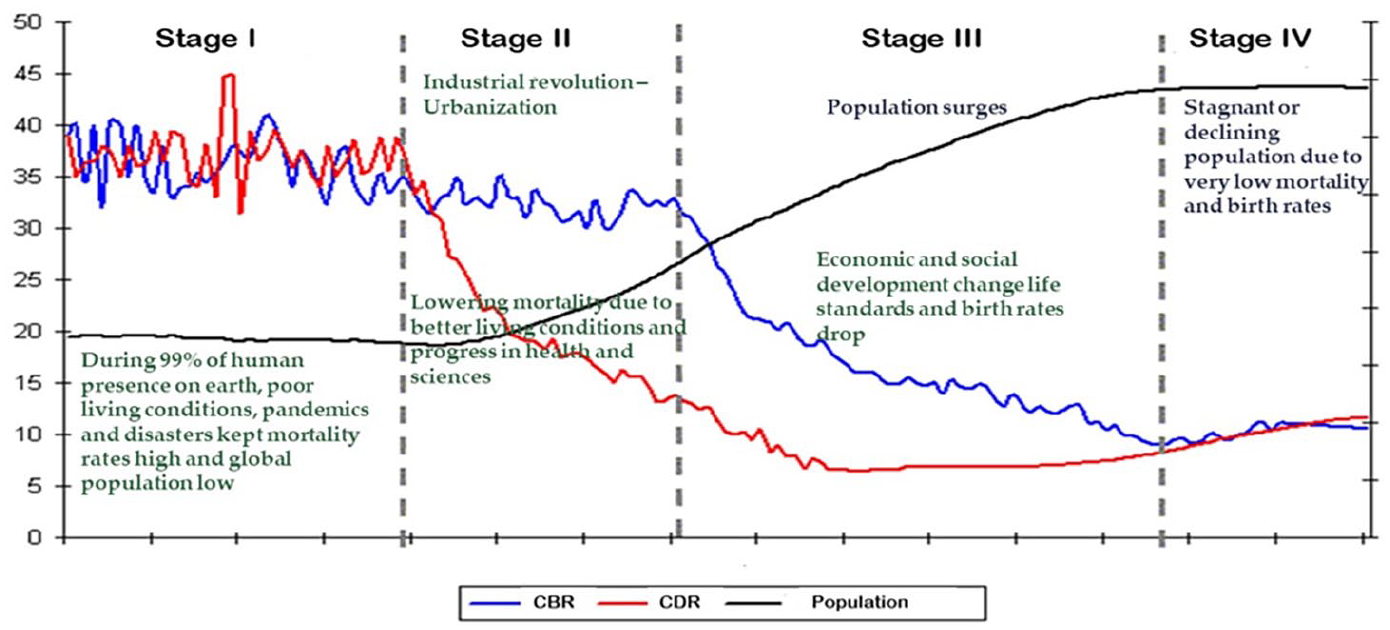
The demographic transition model.
During Stage III, the dependency ratio (defined as the ratio of active persons to those who are dependent) is favourable. If accompanied by effective governance, decreasing dependency ratios have the potential to translate into significant GDP growth. This phenomenon was notably observed in the majority of developed nations during the third quartile of the twentieth century, and was the catalyst for the economic upsurge in South-East Asia during the final quarter of the century. This is the ‘demographic dividend’, which can only be reaped if, at this crucial moment when the demographics are favourable, a country invests in human capital and makes structural reforms, such as those that will ensure inclusive access to financial services, encourage foreign direct investment, liberalise trade and set up a sustainable pension system. This demographic window of opportunity only lasts for a couple of decades before the last stage of demographic transition is reached, when both mortality and birth rates are low, offsetting each other and thus stabilising the population (Stage IV).
Evidently, different countries follow different timelines, with different starting points and varying durations spent in each stage. One common element shared by all countries in this transition process is the sequence of the stages. Declines in mortality come first, followed by declining birth rates. This sequence gives time for the population to grow. Currently, the so-designated more developed regions have concluded their demographic transition, with their population growth rates having slowed, while the least developed regions are still growing. This disparity highlights the geographical heterogeneity of population dynamics.
The global population will keep growing until all regions have completed the demographic transition. This is expected to happen sometime before the end of this century, when population growth is expected to come to an end. If projections are correct, another four billion people (mainly in Africa) will have been added by the time the global population reaches its peak.
Shifting population concerns
The population explosion that marked the twentieth century raised serious concerns about its effects on development and the environment. Economists have long argued about the interaction between population growth and economic development. It remains an open and unresolved subject of debate between those who regard population growth as a brake on economic development and those more optimistic about human adaptability, who claim that history has never confirmed Thomas Malthus’s theory. 1 In fact, the population has kept growing, but so has per capita income; famines have occurred, but there has never been an absolute shortage of food. Actually, food production has grown faster than the population, and the global numbers of those living in poverty have declined. So, it appears that ‘we have survived the population bomb’ (Lam 2023, 14).
Currently, the major concerns have shifted from food shortages to food insecurity and the climate crisis, from population growth rates to the demographic and economic imbalances responsible for the huge migratory waves, and from the ‘youth bulge’ to a major shift that will profoundly affect the economic and social status quo: population ageing (Bongaarts 2023).
Population ageing reflects the increasing share of people above 65 years of age in the aftermath of the demographic transition. Falling mortality at all ages means longer lifespans for more people, not just for the lucky ones. The increase in life expectancy is, without exaggeration, one of humanity’s most revolutionary achievements. A newborn baby today is estimated to live an average of about 72 years, at least 25 years longer than the average lifespan in 1950. Despite the persistent geographical and racial variations hidden by these averages, the overall progress is impressive. The population ageing process was initially caused by the spectacular increases in longevity and then accelerated by declining fertility rates. The increase in life expectancy allows a greater number of people to survive to older ages, while the declining birth rate is shrinking the size of younger cohorts. Thus, the relative weight of the over-65 cohort in the total population is increasing.
This increase has been even more spectacular than that of the total population, as shown in Figure 2. The recent falls in life expectancy, largely due to the Covid-19 pandemic, have not really influenced this trend (Schöley et al. 2022; Heuveline 2022).
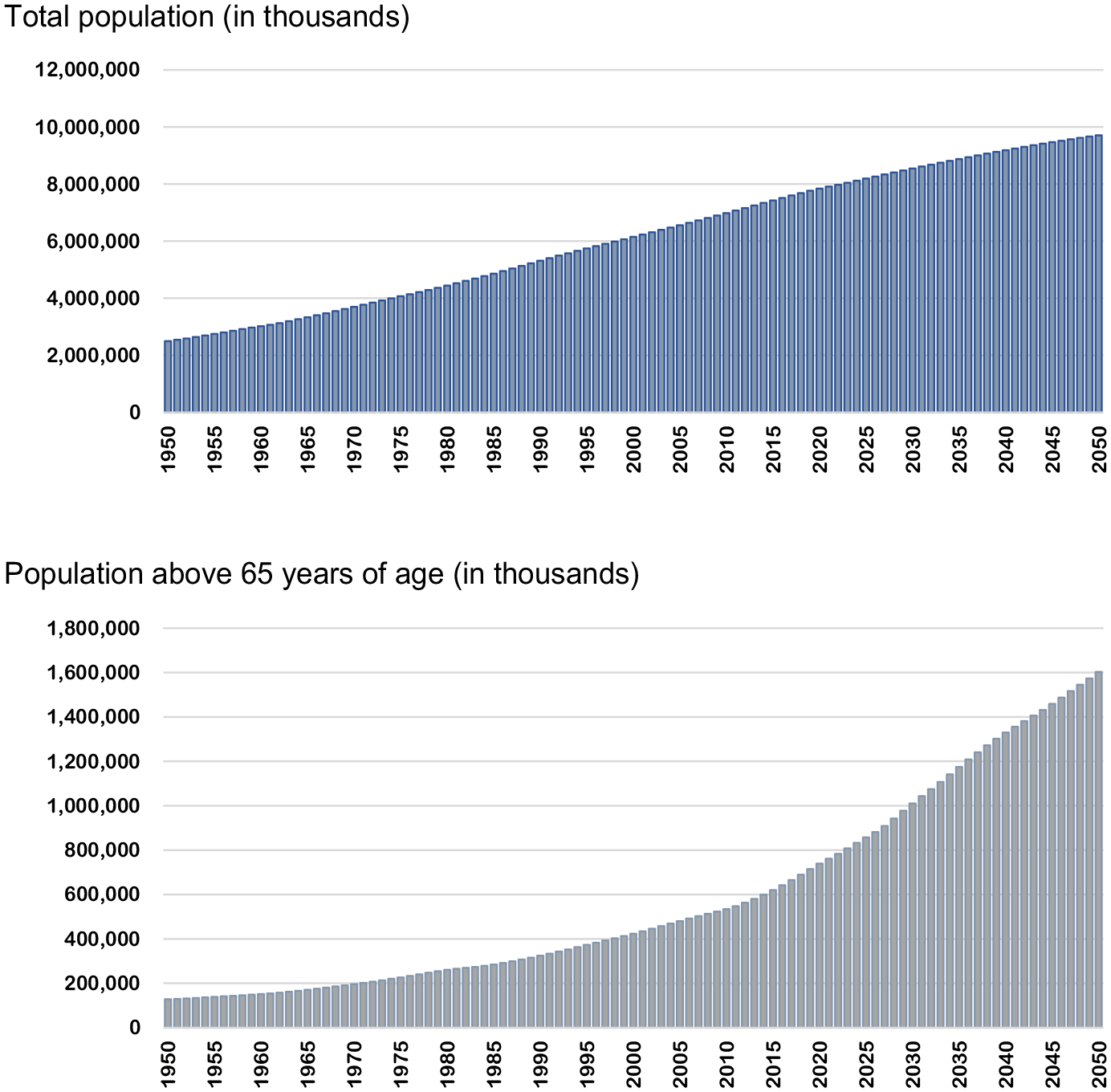
Population increase, 1950–2020.
Longer lifespans are a blessing at the individual level. There is, however, a pitfall: as we live longer, we get older. As massive numbers of people grow old and large cohorts reach the top of the population pyramid at the expense of the younger cohorts, the economic and social structures become endangered. The numerical explosion of older people is often described as a ‘silver tsunami’, an alarming term that warns of the massive destruction that is about to hit many nations. The growing share of elderly and older people in the population puts pressure on and affects practically all spheres of life (Goodhart and Pradhan 2020, 1).
The financial sustainability of the pension system and the surge in health care costs are among the first issues to cause anxiety. The pensions of an increasing number of retirees are covered by the contributions and taxes paid by a decreasing number of workers. Whether based on a pay-as-you-go or a funded system, pension schemes are equally vulnerable to demographic developments. The sustainability of the pay-as-you-go system is affected by the unfavourable change in the proportions of beneficiaries (pensioners) and contributors (employees) in the population, while the funded system is particularly vulnerable to low returns due to demographic ageing. Equally, as a population ages, the demand for health care increases, with impacts in terms of both costs and the human resources needed: the more numerous the elderly, the higher the prevalence and incidence of age-related chronic diseases. Potential labour and skills shortages in this sector could jeopardise our living standards.
The working-age population will grow much less rapidly than it used to. In most developed countries it will soon be in decline, and in some, such as Japan, Italy and Greece, the labour force has already started to shrink. This is particularly alarming, not only because of the unsustainable pension commitments, but also in terms of output growth, tax revenues and future wage levels, and their impact on inflation and interest rates. Moreover, demographic ageing leads, in some cases, to a reduction in the number of users and beneficiaries of certain public goods or services. Thus, there is a serious risk that certain infrastructure (e.g. buildings, transport, roads) will become obsolete or that certain services (e.g. education) will cease to exist in regions where the number of users falls below the level necessary to make their maintenance economically viable. This is already the case in several rural European regions menaced by depopulation.
Population ageing is the pre-eminent demographic trend all over the world. However, Europe is the most aged of all the major regions, and the historic crossover has already happened here, with those over 65 years of age already more numerous than children under 15 years old.
In the decades to come the numbers of elderly and older people will continue to grow rapidly, while total population growth rates will slow down. In 2020, there were 727 million people aged 65 or older. This number is expected to more than double by 2050.
Is there a way out?
Most of the people that will be alive in 2050 have already been born, and all of those who will be over 65 are already here. Also already here are all the potential parents for the years to come, so their procreation is highly predictable. Population ageing is much more than the main demographic trend of the current century; it is the ‘inescapable demographic future’ of humanity (Chamie 2022), for it cannot be slowed down nor solved (Coleman 2008; Potancokov et al. 2021). To make things even more complicated, population ageing is an unprecedented phenomenon, with no previous experience nor good practices to rely on. Ageing is here to stay, and whether we like it or not there is no other option but to cope with it . . . and cope with it successfully!
Living not just longer but also healthier lives is so crucial a parameter that the UN has declared the years 2020–30 the Decade of Healthy Ageing. Instead of just making old age longer, the real benefit of longevity will come from spreading middle age. This has already been partly achieved. The definition of ‘old’ has intensively evolved over recent years: 50 is already the new 35. The next goal is to make 80 the new 60. Formulated in demographic terms, the key to this is the so-called longevity dividend: the gains that can be realised if higher life expectancy is matched by health improvements, changes in individual behaviours and shifts in social norms so as to achieve healthy, long, purposeful and productive lives. To that end, individual and social preparation are required so as to age in physically and emotionally healthy ways without putting economic sustainability and social cohesion in peril.
Ageing is an issue to be discussed within different contexts so as to increase awareness across all ages. Ageing is not only about old people; it concerns us all, no matter what stage of life we are at. Living longer demands that we redesign our lives—so as to virtually remake every stage of life. The model of education–work–retirement, dictated by age segregation, is simply no longer viable. The importance of lifelong learning is widely recognised, with activity and social involvement after retirement promoted and small career breaks used to help redefine one’s professional path. The different stages of life need to be less age-driven than they used to be, and intergenerational collaboration greater than ever before.
Population ageing has reshaped the structure and composition of modern societies: never before have our lives been longer, never before have our families been smaller and never before have so many age cohorts coexisted. Since the turn of the millennium, major demographic shifts have unfolded, affecting the social, economic and physical environment. Europe has recognised that the well-being of future generations is subject to how rapidly and efficiently the transformations necessary to cope with these shifts are carried out.
The relevant discussions, though, remain rather superficial and fragmentary. The public is largely unaware, even ignorant, of the demographic challenge and its implications, while policymakers are failing to detect the substantial inequalities within the population, instead coming up with ‘one-size-fits-all’ solutions.
Despite being universal, the gains in life expectancy have highlighted social and regional inequalities. We age differently: different cohorts age differently, people of different social milieux and economic backgrounds age differently. 2 Moreover, different regions age differently: economic performance, social cohesion and environmental conditions, but also (surprisingly) common beliefs and social stereotypes influence both the length and the quality of our lifespan (Levy 2022). Coping with ageing demands a completely new mental framework: we need to rethink, both individually and as societies, the way in which we approach life and ageing, so as to stay healthy, active, updated and involved—in other words, to age successfully (Cavendish 2019).
Moreover a new economy, the Silver Economy, will emerge. The Silver Economy will grow in importance and profitability in various areas, both public and private. Health, finance, employment, tourism, leisure and well-being, education, and the use of digital tools make up a non-exhaustive list of areas with great potential for growth.
Conclusion
Ageing is taking place in a very specific context along with two more drivers of global change: the climate crisis and the development of artificial intelligence (AI). With regard to the first, the climate crisis is not age-neutral (Cooper 2022; Haq 2023): it is well-documented that older people are more likely to have health conditions that make them more sensitive to climate hazards, such as extreme heat. Moreover, the elderly are more vulnerable to natural disasters due to their physical limitations, slower reactions and even their unwillingness to abandon their homes in time. With regard to the second driver of change, AI could, subject to certain conditions, ease some of the negative effects of labour shortages in specific sectors; alleviate the pressure of health care costs, especially for long-term care; and help improve the everyday lives of those in need. Safe, smart and affordable houses; remote health care; reliable transportation; and wearable devices are expected to make ageing at home feasible for a growing number of people. Care-delivering robots are already being successfully used in nursing homes in Japan (Wright 2023). The use of generative AI in social care is one of the most promising developments: the early detection of health issues, the creation of personalised health care plans, and the provision of chatbots for mental health support and robotics for companionship may radically change the way we live and age in the years to come.
Population ageing is the great game changer. It demands the mobilisation of all economic and social agents. The magnitude of its impacts cannot be fully grasped; nor can the scale of the opportunities that stem from it. Longevity was the great human achievement of the twentieth century. The proper management of it, for the benefit of present and future generations, needs to be the accomplishment of the twenty-first century.
Footnotes
Notes
Author biography