




Abstract
In 2022 the EU made remarkable progress in drastically reducing its energy dependence on Russia. However, serious challenges remain. Europe still buys a significant amount of liquified natural gas (LNG) from Russia. Furthermore, most of the alternatives to Russian LNG come from authoritarian countries. The EU’s planned green energy transition is challenged by its dependence on supplies of critical raw materials from China, Russia and other autocracies. This article suggests practical ways to minimise the EU’s energy dependence on authoritarian countries. These range from boosting the production of indigenous offshore natural gas to supporting projects in democratically inclined countries outside Europe, with the aim of increasing the production of LNG and the critical minerals required for the green energy transition.
Introduction
Since the commencement of Vladimir Putin’s barbaric aggression against Ukraine in February 2022, the EU has made remarkable progress in drastically reducing its energy dependence on Russia. However, serious challenges remain. While the EU has managed to stop buying Russian pipeline gas (with a few exceptions), it has increased purchases of Russian liquified natural gas (LNG), and LNG supplies overall are dominated by imports from authoritarian countries. Natural gas will remain important as a ‘bridging fuel’ for Europe until the continent completes its ongoing green energy transition.
There is another challenge associated with the green energy transition: Europe and the rest of the world are heavily dependent on certain critical raw materials that are mainly produced in dictatorships, primarily China and Russia. Therefore, the question that needs to be asked is, how can these problems be addressed in a way that makes Europe less dependent on critical supplies of energy-related materials from China, Russia and other authoritarian regimes?
This article proposes practical ways to minimise the EU’s energy dependence on authoritarian countries. These range from boosting indigenous offshore natural gas production to supporting projects in non-European, democratically inclined countries, with the aim of increasing the production of LNG and the critical minerals required for the green energy transition. It argues that the EU should focus on enhancing its resilience by prioritising sourcing energy and raw material supplies from democratic states—as this approach presents much less risk of future energy disruptions due to geopolitical tensions. The rest of the article is divided into three sections. The first suggests how the EU could reduce its energy dependency on authoritarian countries, while the second explains how the Union could enhance its resilience in the area of critical raw materials supply. The third and final section concludes the article.
Reducing Europe’s energy dependency on authoritarian countries
To begin with, the dramatic reduction in purchases of Russian pipeline gas by the EU in 2022 should not create the illusion that Europe has been completely decoupled from Russian gas. While piped gas flows shrank, Europe has greatly increased purchases of Russian LNG: imports grew by nearly 38% year on year in 2022, to over 15 million tonnes, or 16% of the EU’s total LNG imports. Over 50% of Europe’s LNG imports come from authoritarian countries—either Russia or dictatorships in the Middle East and Africa. Just 41% of the LNG imported in 2022 came from the US (Elijah 2023).
How can Europe reduce its dependence on LNG supplies from authoritarian countries? First, the Union needs to look more closely at its offshore natural gas development potential, which offers the opportunity to increase the EU’s indigenous natural gas production by tens of billions of cubic metres per year (for details, see Milov 2022). Offshore gas drilling has been snubbed by many countries due to climate concerns, but the current crisis leaves Europe with little choice but to reconsider that approach. Some of the countries which have proceeded with offshore drilling—that is, Romania and Turkey—have achieved considerable progress on the road to energy independence. Offshore natural gas production has a certain synergy with the green energy transition—gas platforms at smaller fields can be transformed into offshore wind platforms at the end of their lifespan. Such an approach has been taken in Croatia, where oil and gas company INA is planning to install offshore wind farms in the northern part of the Adriatic Sea after closing its natural gas platforms in 2025 (Durakovic 2022).
Second, the EU needs to assist with the implementation of LNG production projects in countries which are either stable or relative democracies. Many increases in LNG production capacity are planned among the EU’s like-minded partners—the US, Canada, Australia and so on—in the coming years. However, other countries with significant potential for the expansion of LNG exports—Indonesia, Senegal, Peru, Trinidad and Tobago, and Papua New Guinea—could also be considered vital partners that could present a serious alternative to dependence on LNG imports from Russia or the authoritarian states of the Middle East and North Africa.
Learning from the painful Russia lesson, the EU should focus on building its energy relations by prioritising supplies from democratic states—this approach presents much less risk of future energy disruptions due to geopolitical tensions. One of the recent examples of problems arising beyond Russia is the crisis in relations with Qatar following the European Parliament corruption scandal (Cooper and Zimmerman 2022). In 2022 Qatar supplied over 14% of the LNG imported by Europe (Elijah 2023). The EU could do a lot to assist democracies to bring specific new LNG production projects on stream, thus boosting energy security as LNG will continue to play a vital role as a bridging fuel while the energy transition is in progress.
The critical raw materials challenge
It would also be wise to prioritise building supply chains with providers of raw materials critical to the green energy transition, again prioritising democratic countries. Much has been said about the world’s significant dependence on authoritarian powers, including China and Russia, for supplies of mineral resources such as lithium or nickel, which are crucial to battery performance, longevity and energy density, or rare earth elements, which are essential to the permanent magnets used in wind turbines and electric vehicle motors. However, according to US Geological Survey data, the share held by China and Russia in the global reserves of critical raw materials is lower—often considerably—than their current share in the global supply of these materials (US Geological Survey 2022) (Table 1).
Shares of Russia and China in the production and global reserves of critical raw materials.
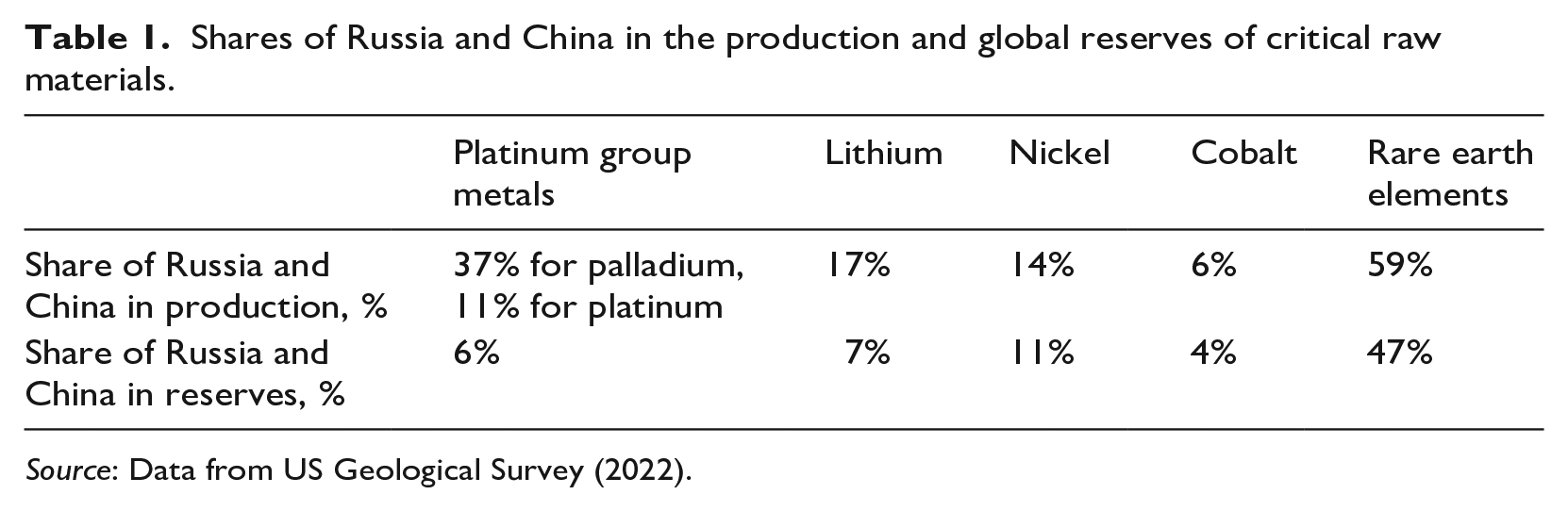
Source: Data from US Geological Survey (2022).
In other words, countries other than Russia and China could achieve a greater market share in the supply of critical raw materials for the green energy transition, if they were assisted to do so.
Many of the untapped reserves of critical raw materials are located in countries which are either fully or partly free according to the Freedom House index (US Geological Survey 2022). Some of these countries include South Africa (rich in platinum group metals), Chile (lithium), Indonesia (cobalt, nickel), India (rare earth elements), Philippines (cobalt, nickel), Papua New Guinea (cobalt), Brazil (rare earth elements, nickel, lithium), Argentina (lithium), Bolivia (lithium), Mexico (lithium) and Greenland (rare earth elements).
With its proposed Critical Raw Materials Act (European Commission 2022), the EU is currently pushing for a systemic policy approach aimed at building a more resilient critical raw materials supply chain. Some of the proposals include empowering the European Commission to list strategic projects within the EU member states—which would be labelled as being of European interest—based on proposals from member states.
It is worth considering also listing projects in democratically inclined countries beyond the EU which are rich in the relevant critical resources. Countries involved in the development of these new supply chains of critical materials—independent of Russia, China and other authoritarian powers—might then be able to count on various forms of European support, development aid, and market and sustainable finance access in return for their role in building sustainable global markets for critical resources.
The recent debate on Europe’s energy independence has been significantly focused on a much narrower range of ‘like-minded countries’, primarily meaning developed democracies such as the US, Canada and Australia. However, a broader focus on building sustainable supply relations with countries which have achieved considerable progress in building a functioning democracy, or are leaning towards being democratic, would both provide incentives for democratic development and shield critical global supply chains from dependence on authoritarian states.
As a matter of fact, the proactive policies of authoritarian powers such as China have in the past done exactly the opposite: converted many countries into authoritarian allies through reliance on development assistance. China has been very active in self-promotion through initiatives such as the Belt and Road, has overtaken the US as South America’s largest trading partner and has been Africa’s largest trading partner for 12 consecutive years. Europe, so far, has missed the opportunity to become a major economic partner to the countries of Asia, Africa and Latin America. If this should change, it might help to reconfigure the global energy markets away from dependence on various autocracies.
Another benefit of such an approach is that it will help to boost democracy in the world. In its 2022 Freedom in the World report, Freedom House documented 16 consecutive years of decline in global freedom (Repucci et al. 2022). Much of this has to do with the proactive economic expansion of China and other authoritarian powers.
The energy transition offers Europe the perfect opportunity to regain its influence and promote the causes of democracy and human rights through economic means. The EU should prioritise imports of energy-related materials—both LNG and the raw materials needed for the green energy transition—from democratically inclined countries, and support projects that boost ties with democratic states around the world. This would also benefit these countries economically, and help to defend and expand the global territory of freedom, which, according to Freedom House, has been steadily shrinking for almost two decades.
Conclusion
To sum up, several key approaches will help to significantly reduce Europe’s dependence on supplies of energy and energy-related materials from authoritarian countries:
boosting its own indigenous natural gas production capacity through intensifying offshore natural gas drilling;
supporting projects in non-European democratic countries—beyond the ‘usual suspects’ of like-minded developed democracies—related to LNG production and the mining of the critical raw materials needed for the green energy transition (rare earth elements, nickel, cobalt, lithium, platinum-group metals, etc.);
prioritising democratic and democratically inclined countries as its partners in building LNG and raw materials supply chains; and
expanding the list of strategic projects under the proposed Critical Raw Materials Act to include projects in democratically inclined non-European countries; and developing a set of incentives aimed at both implementing such projects and assisting the economic development of the relevant countries (through development aid, and assistance with infrastructure and access to markets and sustainable finance).
Europe also needs to find sustainable solutions which will help it to realise its own potential to produce critical raw materials, while minimising the environmental damage caused by mining activities. Regarding lithium, some of the EU member states—Portugal, Germany, Spain, Czechia, Austria and Finland—possess both sizeable reserves and potential resources. However, the development of these would create tensions with local communities, which fear that mining could damage their environment and livelihoods—as in Portugal after lithium exploration was approved by the Portuguese government (Kijewski 2022). The concerns of the local communities must be properly addressed—in the same way that concerns regarding offshore natural gas exploration are currently being dealt with. However, the development of the EU’s own critical minerals production is absolutely necessary to avoid paying the far greater price that arises from being dependent on dictatorships such as China and Russia for the supply of important resources. The perils of such dependency have been made amply clear by the experience of 2022.
Footnotes
Author biography