



Abstract
There is increasing recognition of the impact that wildlife trade has on globally threatened and geographically restricted species. For only a few species do we have long-term datasets on their presence in domestic trade. The Asian Songbird Trade Crisis has highlighted the detrimental role that the cage bird trade has on populations of wild birds (songbirds and others) throughout Asia. Starting in 1994, I have visited bird markets in Java and Bali, Indonesia, recording the presence of chestnut-bellied hill partridges Arborophila javanica (endemic to most of Java apart from the easternmost part) and white-faced hill partridges A. orientalis (endemic to easternmost Java). The data thus collected allowed me to test hypotheses related to rarity, price, and purported population trends. No change in the number of hill partridges in trade was observed over this period. The more widespread chestnut-bellied hill partridge was recorded in higher numbers (mean of 1.7 birds survey−1) than white-faced hill partridges (mean of 0.4 birds survey−1). I monitored their online trade on four bird selling platforms and two dedicated hill partridge Facebook pages. Like the trade in the bird markets, the chestnut-bellied hill partridge was recorded in higher numbers than white-faced hill partridges (106 vs 44 birds). Both species were for sale both within and outside their native ranges (17 cities for chestnut-bellied and 10 cities for white-face hill partridges) suggesting extensive trade networks with birds being transported hundreds of kilometres. Average asking prices were similar for both species (US$31) and were not related to the minimum monthly wage of the cities in which the birds were offered for sale. I estimate that annually 3500 chestnut-bellied hill partridges and 700 white-faced hill partridges are sold in the bird markets on Java and Bali. Despite the absence of a harvest quota, the presence of both species over a 27-year period in numerous bird markets, and over the last decade online, indicated the absence of commitment and political and societal pressures to curb the illegal trade in birds in Indonesia.
Introduction
While it has been evident that throughout Asia many species of birds have been exploited unsustainably for decades, 1 there is a need for long-term data to identify those species that are being overexploited. As argued by Harris et al., 2 the seriousness of the threat from this bird trade necessitates an evaluation based on incomplete available data, comparable to analyses of sustainability for data-poor fisheries. 3 Indonesia is the centre of what is now recognised as the Asian Songbird Trade Crisis 4 and numerous bird species (songbirds and others) are imperilled due to the insatiable demand for cage birds. 5 Hitherto, most of these assessments and evaluations on the sustainability of the trade are based on counts of all birds during one-off visits to bird markets (e.g. Chng et al. 6 ), monitoring of birds offered for sale in markets in one city, either over the course of several months 2 or several years, 7 or monitoring of single species for sale in bird markets over a larger geographical area over several years. 8 Declines of wild bird populations due to overharvesting may be noticeable in the trade (smaller numbers, fewer markets, higher prices, etc.) after decades rather than years. 9 Only recently have researchers started to report aggregated trade statistics for birds over multiple decades.2,9
There are many challenges in using disparate bird trade datasets that need to be overcome including: approaches for data collation may have changed over time; methods may differ between researchers; bird taxonomy may have changed over time; and large gaps, both temporal and spatial, may remain in the dataset. As a result, it is rare to have data from a group of birds in trade that have been collected consistently, by the same person(s), visiting the same bird markets, at regular intervals over several decades. Here, I report on such a dataset, using two species of hill partridges that occur on Java, chestnut-bellied hill partridges and white-faced hill partridges, as case studies. I developed an interest in Javan hill partridges early in my studies on Javan wildlife through observations in the wild and in bird markets, 10 which I have maintained, and thus I have access to a rare long-term dataset.
Excluding my own report from the 1990s and early 2000s,10,11 I only found a few records of either species in trade in the literature. In 1997 a single chestnut-bellied hill partridge was recorded during 12 monthly surveys of three bird markets in Medan and a further two during 12 monthly surveys in 1998.12,13 Medan is the capital of the province of North Sumatra and this is 1500 km from the nearest forest area where chestnut-bellied hill partridges are found. Haryoko 14 recorded 20 chestnut-bellied hill partridges during a single visit to Sukahaji market in Bandung in 2008; Iskander et al. 15 observed three in the same market in 2018. Chng et al. 6 recorded only one chestnut-bellied hill partridge among the 19,036 birds they recorded in three bird markets in Jakarta. I only found one record of two white-faced hill partridges for sale, in Bali in 2018. 16 Pricing data for these species are even more rare – the only asking price I found recorded in the literature was US$11–22 for chestnut-bellied hill partridges in a bird market in Yogyakarta collected in 2019 or 2020. 17 As such, it is understandable that trade is not seen as a major impediment to the conservation of either species, although BirdLife International, 18 referring to Resit Sozer, an expert on Indonesian bird trade, noted that chestnut-bellied hill partridges were commonly, and white-faced partridges occasionally, seen in Javan bird markets. It was furthermore noted that this trade may have some local impact. 18
Hypotheses and associated predictions and data related to the trade in chestnut-bellied hill partridges Arborophila javanica and white-faced hill partridges A. orientalis in Java and Bali, Indonesia.

Methods
Study species and their conservation status
From 2004 onwards the chestnut-bellied hill partridge has been classified by BirdLife International as of ‘Least Concern’, and prior to that, between 1988 and 2000, it was of ‘Lower Risk/Least Concern’. 20 In the first years of surveying the white-face hill partridge was considered a subspecies of the Sumatran hill partridge A. sumatrana but I recognised the east Javan form as distinct. In 2001 it was given its own entry on the IUCN Red List (listed as ‘Vulnerable’) in part based on information I had collected in eastern Java. 18 This was also the first time it was given an English name, viz. white-faced hill partridge. Its recognition as a separate species triggered an interest in the species from birders (visiting Mt Ijen to observe them 23 ), traders, and bird keepers. Chestnut-bellied hill partridges have been consistently referred to as puyuh gonggong (‘barking partridge’), puyuh gonggong biasa (‘common’/‘usual barking partridge’) or puyuh gonggong jawa (‘Javan barking partridge’) whereas in trade white-face hill partridges were referred to as puyuh gonggong jatim (‘east Javan barking partridge’, Jatim is the abbreviation for Jawa Timur, the province of East Java) and after its IUCN Red Listing additionally as puyuh gonggong muka putih (‘white face barking partridge’).
Being confined to forests on mountains of 1700 m asl and taller, 11 with some of these mountains standing isolated in the lowlands, the chestnut-bellied hill partridge occurs in numerous equally isolated populations. As a result, there is a significant amount of morphological variation in, especially, the head patterns and the amounts of brown, yellow, and white that birds from different areas display (these various forms are illustrated by van Balen 24 ). While this had led to the description of two subspecies that are confined to single mountains (A. j. bartelsi on Mt Ciremai near the border of west and central Java and A. j. lawuana on Mt Lawu on the border of central and east Java; the nominate is confined to the more contiguous mountains of westernmost Java), many morphological types exist, intermediate between the described taxa. The white-faced hill partridge has a much more restricted range, and no morphological variation is apparent.
Data collection
There are at least 53 bird markets on Java and Bali, most of them operating on a daily basis, 25 with more markets open on weekends only or during specific days of the Javan 5-day calendar (e.g. Pon, Wage). I have visited 33 of these markets on at least one occasion since 1994. The approach to data collection remained roughly similar over the course of the study in that the market was visited: by slowly walking through the market, birds (and other animals such as small mammals) that were of interest (including certain endemics, protected species, globally threatened species) were counted. After leaving the market these observations were recorded in a notebook. The trade is open and there is no need to resort to undercover techniques. Several of the shop owners in the animal markets have operated their shops for as long as I have visited the markets and they recognise me from earlier visits and from previous interactions we have had; this allowed me to re-establish rapport relatively effortlessly. In most years I collected data from multiple markets over a 27-year period, but no data were collected in 2004, 2005, 2006, 2008, 2010, 2011, 2020, and 2021. I did visit and work in other parts of Indonesia during most of these years, other than in 2020 and 2021 when COVID-19 restricted travel (both internationally and to the bird markets). Pricing data of birds were collected from 2013 to 2021 (this included pricing data from markets and from the online trade, thus covering the COVID-19 period).
At the start of the study there was no online (bird) trade; the first Internet café on Java opened in 1996. In 2004 ∼6% of the people on Java had access to the Internet and this had risen to ∼37% in 2013 and to ∼56% in 2020. 26 From the mid-2000s onwards an increasingly large number of bird species are offered for sale online. Now a substantial, but unquantified, part of the bird trade is taking place over the Internet. 27 In May, August, and October 2021 I searched for Javan partridges for sale (‘puyuh gonggong’ and jual) on four of the main bird selling online platforms and recorded the number of birds that were available (verified by photographs of captive birds) and asking prices. I searched two specialist Facebook groups (one situated in western Java, one on the island of Madura, off the coast of East Java), for posts offering one or both species for sale. I only included posts in which birds were specifically offered for sale (rather than owners showing their birds) and where the identity of the birds could be verified by photographs or videos. Prices were rarely mentioned and normally had to be obtained by direct messaging the seller through WhatsApp (something I did not do). The Facebook page referred to some of the bird selling platforms – in this case only the advert of the latter was included (as this included pricing data).
All prices were corrected for inflation to 2021 by using the online FX Top inflation calculator (https://fxtop.com/en/inflation-calculator). These inflation-corrected prices were then converted to US dollars for October 2021 (one US dollar equalled 14,300 Indonesian rupiah).
Analysis
I divided the study into three 9-year periods, that is, 1994–2002, 2003–2012, 2013–2021. These periods, and especially their starting points, coincided broadly with distinct projects with which I was involved. In the first period my main partners were BirdLife Indonesia Programme (Bogor), the Indonesian Institute of Sciences (Bogor, Cibinong) and Pusat Informasi Lingkungan Indonesia (Bogor). At the start of the second period, I started working with TRAFFIC (Petaling Jaya, Jakarta) and other partners were the Ministry of Forestry (Jakarta) and WWF (Jakarta). The start of the third period was marked by working with the Little Fireface Project (Cipaganti), the Indonesian Institute of Sciences (Cibinong) and Universitas Gajah Mada (Yogyakarta).
Many bird markets were visited, some of them frequently, but not always over the entire duration of the study, and this was often linked to the specific priorities of the organisations with which I worked. For analysis I included those bird markets that were surveyed at least twice during each of the three 9-year periods, including markets that had moved location within this period. For example, in 2010 the Ngasem market in Yogyakarta was relocated from Jalan Polowijan to Jalan Bantul ∼2 km south of Ngasem and was renamed Pasar Satwa dan Tanaman Hias Yogyakarta, PASTY. One market in Jakarta (Pramuka) was surveyed 15 times, those in Bogor (Empang, Anyar, Merdeka) 22 times, Sukabumi (Pasundan) nine times, Yogyakarta (Ngawi, PASTY) eight times, Surabaya (Bratang) seven times, and Denpasar (Satria) was surveyed eight times. In addition, to explore the relationships between the size of the market (number of stalls or shops) and the mean and maximum number of birds that were observed per survey for 10 bird markets where three or more times hill partridges were observed.
I assumed that individual birds were not moved between markets between surveys and that birds were not returned to markets. Based on weekly or fortnightly observations at Kerkhof bird market in Garut, in line with other similarly priced birds,28,29 chestnut-bellied hill partridges typically sell within 2 weeks of arrival in the market (A. Ardiansyah and A. Langgeng, pers. comm.). I used this 2-week turnover period for both species to approximate the number of hill partridges that are sold annually. The online survey did not overlap with the bird market surveys precluding double counting; I have no data on turnover of hill partridges in the online market.
I compared the encounter rates (the mean number of partridges observed during a visit to a particular market) in the six markets and between periods of visits with a Friedman test for repeated measures. This was done for both species separately. The relationship between the size of a bird market (number of shops, log-transformed) and the mean number of birds encountered in these markets (log10-transformed) was examined using a Pearson product-moment correlation coefficient. I used SPSS v25 for analysis. All tests were two-tailed, and the alpha threshold was 0.05.
Results
Bird market data
Observations of chestnut-bellied hill partridges Arborophila javanica and white-faced hill partridges A. orientalis in bird markets on Java and Bali, Indonesia. Presented are mean number of birds observed (number of surveys), and the total number of birds observed [range]. Cities are listed from west to east.

Mostly single birds or groups of two or three birds were observed (Figure 1). The two markets with the largest number of hill partridges, that is, Pramuka (overall mean of 3.5 birds survey−1) and Bratang (4.1 birds survey−1) were also the two largest bird markets in Indonesia. There was a positive correlation between the size of the market and the mean number of birds that were observed per survey (Pearson’s R = 0.82, N = 10, p = 0.004) and maximum number of birds that were observed during the surveys (Pearson’s R = 0.66, N = 10, p = 0.04). The mean number of chestnut-bellied hill partridges observed in the six consistently surveyed markets increased slightly over time from 1.2 birds survey−1 in 1994–2002 to 1.5 birds survey−1 in 2003–2012 to 2.7 birds survey−1 in 2013–2021. Giving equal weight to the six bird markets there was no statistically significant change in numbers encountered over time (Friedman test for repeated measures, chestnut-bellied hill partridge: χ2r = 3.25, p = 0.20; white-faced hill partridge: χ2r = 1.08, p = 0.58). Frequency distribution and cumulative numbers of chestnut-bellied hill partridges Arborophila javanica (red) and white-faced hill partridges A. orientalis (blue) recorded in 16 bird markets on Java and Bali (1994–2019) showing that during most surveys, single birds, or small groups of up to three birds were observed.
With an overall mean of 1.7 chestnut-bellied hill partridges survey−1, assuming the partridges were sold within a 2-week period, over the course of the study over 7000 chestnut-bellied hill partridges were sold in these six bird markets. The equivalent number for the white-faced hill partridge was close to 1000. Assuming the six bird markets were representative of the others 47 bird markets that are present on Java and Bali, 25 the number of chestnut-bellied hill partridges for sale in recent years amounts to ∼3500 per year and for the white-faced hill partridge ∼700 per year.
Online trade and price data
I found 16 adverts for chestnut-bellied hill partridges offering a total of 63 birds for sale, with nine of the sellers based in Jakarta (18 birds), three in Bandung (16 birds), two in Bogor (two birds), one in Tasikmalaya (five birds) and one in Ngawi (22 birds). In addition, on the specialist hill partridge Facebook groups birds were offered for sale, with postings from sellers in Jakarta (three birds verified), Depok (eight birds), Bogor (six birds), Bandung (17 birds), Tasikmalaysa (four birds), Pekalongan (one bird) and Jepara (four birds). I found two online sellers offering white-faced hill partridges (Jakarta eight birds; Kediri two birds), and six more on Facebook, viz. Depok (seven birds), Surakarta (one bird), Surabaya (three birds), Malang (15 birds) and Jember (eight birds). The earliest online offers for sale I was able to trace date back to April 2011, and the earliest online advert to October 2013 indicating that hill partridges have been offered for sale over the Internet for an extended period of time (Figure 2). Left: Chestnut-bellied hill partridge Arborophila javanica offered for sale online in October 2013 by a seller based in Bandung, with an asking price of US$33.45. Right: White-faced hill partridges A. orientalis for sale online in June 2021 by a seller based in west Jakarta, with an asking price of US$47.22.
Considering the online and bird market data, birds were observed throughout Java and Bali. For chestnut-bellied hill partridges this included 16 cities within the species’ natural geographic range, and one outside. For white-faced hill partridges there were two cities within its range and eight outside where the species was offered for sale (Figure 3). Map of Java and Bali, Indonesia, showing cities where hill partridges were offered for sale. In green are the names of cities where both species were recorded for sale, in blue are cities where only chestnut-bellied hill partridges Arborophila javanica were offered for sale, and in white are cities where only white-faced hill partridges A. orientalis were recorded for sale. The red line separates both species with chestnut-bellied hill partridge occurring to the west and white-faced hill partridge occurring to the east (neither species occurs on Bali). Names of mountains and forest areas mentioned in the text are indicated in Italics.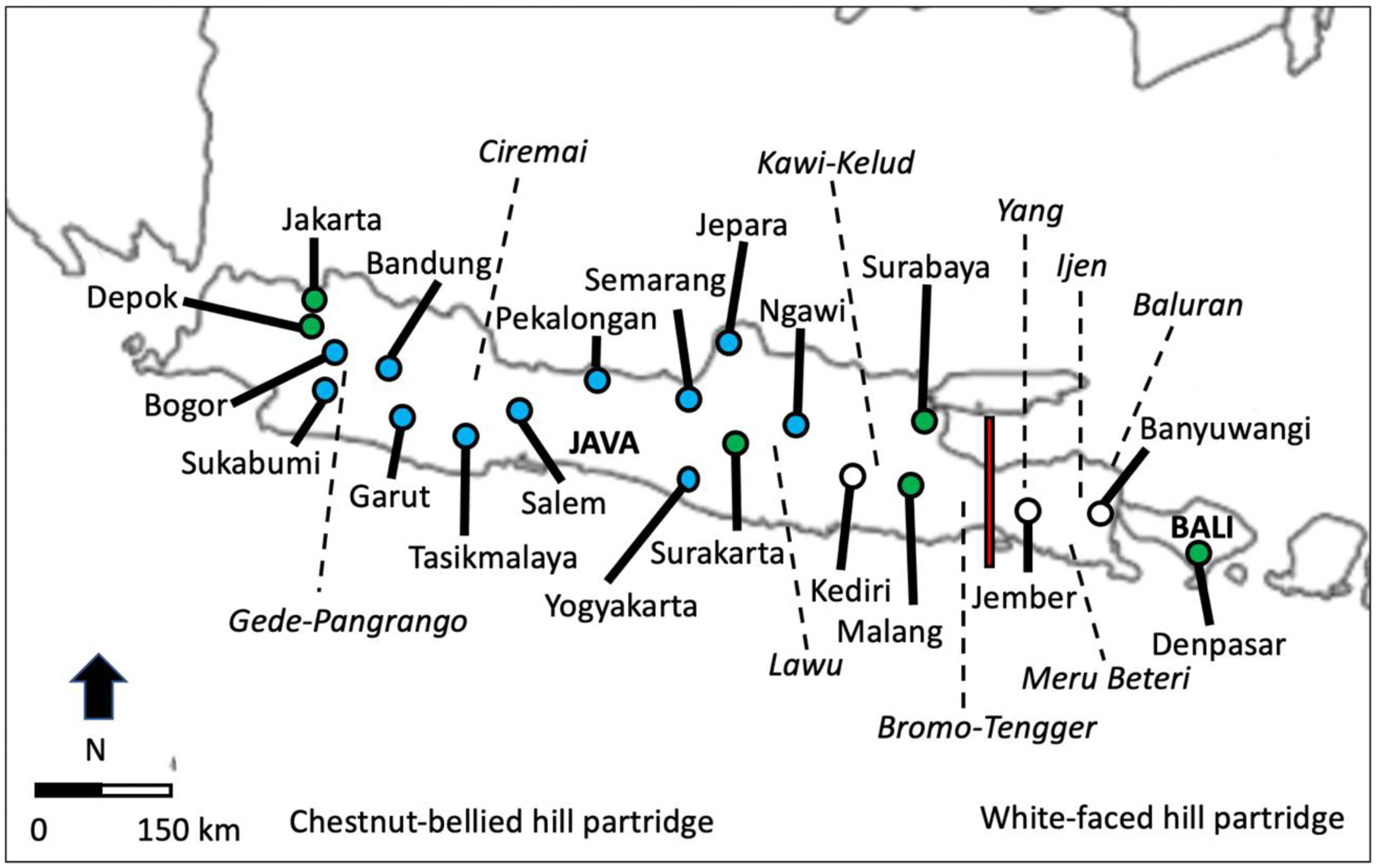
Asking prices for chestnut-bellied hill partridges quoted between 2013 and 2021, when corrected for inflation, were US$33.61 ± 21.48 based on 11 independent quotes. Prices of four white-faced hill partridges were similar to that of chestnut-bellied hill partridges, that is, US$31.61 ± 15.91. Each city and region in Indonesia has a different government-recommended minimum monthly wage (upah minimum), and while prices for hill partridges differed between cities, there was no clear relationship with local minimum wage (Figure 4). Most traders specified that payments would only be accepted via RekBer (an abbreviation for Rekening Bersama, that is, the bank account of a trusted third party
30
), thus making it challenging to connect buyers to sellers if any enforcement was to be taken. Trade in hill partridges on Java and Bali, Indonesia. Asking prices (mean±SD, in US$, corrected for inflation to May 2021) for chestnut-bellied hill partridges Arborophila javanica (red) and white-faced hill partridges A. orientalis (blue) relative to the 2021 recommended minimum monthly wage for the city in which the seller was based.
In the online trade, chestnut-bellied hill partridges were occasionally advertised as being ‘different’ or ‘special’ because they were sourced from specific geographic regions (e.g. a particular mountain or regency). Reading the comments, questions, and answers on the online platforms and dedicated Facebook pages, it is evident that collectors are interested in specific, rare, forms (e.g. less, or more, white in the face; darker neck) and that some of these forms represent the various subspecies that have been described. 24
Discussion
Based on observations in bird markets in Java and Bali starting in 1994 I demonstrate that two species of hill partridge, despite there not being a quota for their harvest, are consistently offered for sale. Conversations with traders, and the observation that hill partridges in trade are very skittish, suggests that these birds were all sourced from the wild. Going back at least to 2013 chestnut-bellied hill partridges, and to a lesser degree also white-faced hill partridges, are offered for sale on online platforms, and, perhaps more recently, Facebook. My dataset is a rare example of one associated with the long-term bird trade and offers insights into the Indonesian bird trade over decades rather than months or years. Furthermore, these data also allowed for the testing of hypotheses related to rarity, price, and population trends.
The estimates of the total number of hill partridges that are traded annually are based on a single turnover estimate from one market (i.e. all birds sold within 2 weeks), and this was generalised to all markets on Java. Lowering the turnover estimate to 10-days or increasing it to 20-days changes the estimate of the number of chestnut-bellied hill partridge sold per year in the bird markets from ∼3500 to between 2500 and 5000 individuals. The equivalent numbers for white-faced hill partridge are 500 to 1000 birds. Most studies that monitor the bird trade in Indonesia survey at intervals of 1 month or more, and as indicated by Shepherd et al., 13 to obtain a more accurate measure of turnover, markets need to be monitored weekly or even daily. Nash 1 in estimating the number of birds sold at Pramuka bird market used a generalised 2-week turnover, but it is unlikely that this is accurate for all species. Also based on data from Pramuka bird market, turnover is strongly positively related to the number of birds that are sold every month, and, in addition, it is negatively correlated with asking prices. 31 A trader can afford to retain over longer periods some of the most expensive songbirds but for the trade to be profitable turnover of cheap birds must be high. Turnover of black-winged myna Acridotheres melanopterus (a bird that is three times as expensive as the hill partridges) in two bird markets in west Java was calculated at 47–62% sold after 1 week and 71–86% sold after 2 weeks. 25 Turnover of Javan crocias Laniellus albonotatus (similar in price to the hill partridges) in three bird markets in west Java was estimated at 50% of the birds sold within 8 days and 75% of them sold within 10 days. 29 It is unlikely that the turnover of hill partridges is equal throughout the year or in all bird markets – it is expected to be higher in the larger bird markets where many more potential customers visit and where running costs of vendors are higher than in, for instance, small roadside or mobile bird markets. Further research is required to improve estimates of turnover of birds in trade in Indonesia and indeed elsewhere.
The rarer and geographically more restricted white-faced hill partridge was recorded less often, and in fewer markets, than the more common and wider-ranging chestnut-bellied hill partridge (totals of 273 and 46 birds, respectively), providing support for my first hypothesis (Table 1). Asking prices, however, did not differ between the two species, thus not lending support to the second hypothesis. Currently, insufficient information is available if any of the advertised less-common morphological forms of the chestnut-bellied hill partridge command higher prices, but it is clear that at least some buyers and sellers attach different aesthetic values to these birds. As predicted, given that there has not been any evidence to suggest a change in the perceived abundance or level of threat over the last 27 years, I did not find a significant change in the numbers of hill partridges in the bird markets (hypothesis 3). What has changed over this period, however, is that in addition to the birds being traded in these markets they are additionally offered for sale online. 27
The asking prices were similar in the different parts of Java despite there being clear differences in the cost of living (hypothesis 4). For instance, asking prices for hill partridges are similar across the whole study area, but in Yogyakarta the government’s recommended minimum monthly wage is less than half of that in Jakarta (Figure 4). For other species that are traded throughout Java, and especially those that are captured in the same region where they are offered for sale, asking prices reflect the purchasing power of the region. 29 The observation that prices seemed roughly constant throughout Java and Bali suggests that traders of hill partridges sell their birds over large geographic distances, and indeed both species were for sale both within and outside their native ranges (16 cities for chestnut-bellied and 10 cites for white-faced hill partridges). The shortest overland distance from the easternmost part of the range of the chestnut-bellied hill partridge to Denpasar on Bali is 450 km (including one ferry crossing). Conversely, the shortest overland distance from the westernmost part of the range of the white-faced hill partridge to Jakarta is 850 km.
Asking prices of both species of hill partridge of ∼US$31 make them affordable to a large proportion of Indonesia’s society. Prior to the COVID-19 pandemic, the World Bank graduated Indonesia to the list of upper middle-income countries; between 2002 and 2016 the middle class tripled as a percentage of the population, with two-thirds of them living on Java. 32 This suggests that, based on 2016 survey data, close to 75 million people (55% of Java’s population) are middle class, with a per capita consumption of US$275–1350 month−1.
Neither species of hill partridge is included on Indonesia’s protected species list. 33 However, capture of non-protected birds for commercial trade is subject to an annual harvest quota set by the Ministry of Forestry. At least since 2008 this quota has been set at zero, and to the best of my knowledge and as far as I can recollect, as early as in 1994 when I started my surveys, no harvest quotas were allocated. As such, the trade in both species of hill partridge, as observed in the bird markets over 27 years and online since at least the mid-2000s, has been illegal. According to Facebook’s terms and policies, listings may not promote the buying or selling of animals or animal products, and this includes live animals, livestock, and pets. This policy dates to at least 2017 but it is evident that in the case of Java’s hill partridges this policy is not adhered to. Similarly, three of the four online platforms where hill partridges were found to be offered for sale explicitly forbid their sale (no pets; no animals are allowed to be sold; no animals and wildlife products, including without limitations wild animals). The fourth platform allows the sale and purchasing of animals, provided it is in accordance with government regulation 92 of 2018, which theoretically would allow for the sale of captive-bred hill partridges from registered captive-breeding facilities. Non-compliance of social media sites to violations of their own terms and conditions have been noted in research on online drug sales, 34 e-cigarettes, 35 tobacco, 36 and wildlife, 37 and it seems that, for the moment, enforcement of this is completely in the hands of the social media companies themselves. It has been noted that specifically for Indonesia, online wildlife trade is difficult to regulate and even more difficult to enforce as the possession of illegal products is deemed insufficient evidence to bring charges. 38 The online trade means sellers do not have to meet buyers in person, payments can be processed online, and birds are shipped directly to the buyer’s address. The use of third-party bank accounts, 30 and how this plays into the hands of illegal wildlife traders, is something that needs to be addressed as a matter of urgency.
There are many uncertainties about some of the most basic distributional and occurrence data for these two hill partridges. For instance, BirdLife International, as part of their ‘Data Zone species factsheets’ and as part of their role as the assessor for the IUCN Red List,20,21 include numerous internal inconsistencies and errors in their descriptions and mapping of the two species’ distribution ranges (these were taken over in a recent conservation assessment 39 ). For chestnut-bellied hill partridges they list the following Important Bird Areas: Dataran Tinggi Hyang (Yang Highlands), Gunung (Mt) Ijen, Meru Beteri, and Gunung (Mt) Baluran. There is no evidence of hill partridges on Gunung Baluran, and the three other areas are part of the native range of the white-faced hill partridge. In mapping the range of the chestnut-bellied hill partridge BirdLife International inadvertently excluded the area between Mt Kawi-Kelud and Mt Bromo-Tengger, probably as they mapped this area within the range of the white-faced hill partridge. Boakes et al. 40 calculated extirpation dates for galliformes outside protected areas and included both chestnut-bellied and white-faced hill partridges in their analysis. They listed what they considered to be the last records of these species outside protected areas, which were 1916 and 1917 for white-faced hill partridges and 1986, 1994, 2010 and 2013 for chestnut-bellied hill partridges. While this may be correct in terms of written records they were able to locate, 40 there is no reason to assume that either species has been extirpated in any of the forest areas where they have been (historically) recorded. My own most recent records from protected areas are 2016 for chestnut-bellied hill partridge in Gunung Gede-Pangrango National Park and 2013 for white-faced hill partridge in Gunung Ijen strict nature reserve but this just reflects my most recent visits to these areas. With much of the little remaining forest on Java included in the protected area network, no evidence of long-term captive-breeding, and the presence of wild-caught hill partridges in bird markets throughout Java, their local extinctions seem unlikely.
Indraswari et al. 41 obtained data from 321 bird seizures by the Indonesian authorities from throughout Indonesia between 2010 and 2019, with 48,916 birds seized on Java and Bali alone. From this it is evident that not a single hill partridge has been seized over this period. Tackling the illegal trade in non-protected and less charismatic animals such as Java’s hill partridges is never going to be easy.1,2,5–9 With substantial monetary gains to be made from the illegal wildlife trade, generally low risks of detection and prosecution, and with enforcement efforts spread out over vast geographic areas, this is a daunting task. The many postings of hill partridges on three of the four online platforms as well as on Facebook are in clear violation of their terms and policies. The two Facebook groups I monitored were both public groups, set up 11 and 22 months prior to the last monitoring session, and had a combined total of almost 3000 members; the trade that occurs on these groups is open for all to see. Recent research on the online wildlife trade, including of high-profile species such as orangutans Pongo spp., sun bears Helarctos malayanus, and otters Lutrinae,37,38,42,43 demonstrates that Facebook continues to be a platform for the sale of imperilled wildlife. The weight of legal instruments to control the illegal wildlife trade is undermined when local harvesters realise that little action is being taken against known traders. Low rates of prosecution, low penalties, and imposition of low fines all act to limit effective enforcement. When it comes to either of the hill partridges it is evident that their trade, both in the bird markets and online, has been allowed to continue with impunity.
I have shown that certain species are found consistently in specific markets. Wildlife passes through a limited number of trade hubs, and these pathways and nexuses provide ample opportunities to maximise the effects of regulatory efforts. The bird markets I and others1,2,6,7,9,12–15 have monitored are prime examples of these trade hubs, and only through targeted and well-informed actions will authorities be able to reduce markedly the illegal trade in birds in Indonesia. This, however, does require genuine and effective commitment and political and societal support, which appears to be lacking at present.
Footnotes
Acknowledgements
A large number of people facilitated my work in Indonesia, and I benefitted from discussions with those involved in avian conservation and aviculture including Resit Sozer who introduced me to the world of Galliform keeping, and Bas van Balen, Dewi M Prawiradilaga, Iwan Setiawan, Ria Saryanti, Andi Prima Setiadi, Chris Shepherd, Wirdateti, Anna Nekaris, Ahmad Ardiansyah, Abdullah Langgeng, and Mohammad Ali Imron. I thank the reviewer and the editor for constructive feedback and suggestions for improvement.
Declaration of conflicting interests
The author(s) declared no potential conflicts of interest with respect to the research, authorship, and/or publication of this article.
Funding
The author(s) disclosed receipt of the following financial support for the research, authorship, and/or publication of this article: Funding was received from the Netherlands Foundation for International Nature Protection, Society for the Advancement of Research in the Tropics, M. de Beukelaar Foundation, J.C. van der Hucht Fund, P.A. Hens Memorial Fund, Zoological Museum Amsterdam, and Cleveland Metroparks Zoo & Zoological Society.
