




Abstract
School takeover has become an increasingly popular policy strategy to improve schools despite a lack of evidence that points toward its success in increasing student academic achievement. This case study focuses on the takeover of a rural school district in the Southeastern United States and utilizes the work of Paulo Freire to examine if the state’s actions are dialogic or antidialogic action. This qualitative explanatory case study leverages data from State press releases, policy documents, community meetings, and interviews with parent participants to conceptualize takeover as dialogic or antidialogic action. The findings of this study are organized around the domains of the theoretical framework: cooperation or conquest, divide and rule or unity for liberation, manipulation or organization, and cultural invasion or cultural synthesis.
Introduction
Education reform has become a common practice in the United States. The recent trend in the United States has been for policy actors to portray public schools often as failing and in need of an overhaul (Black, 2020). Reform in the United States has taken many different approaches to varying degrees of success, though often under the guise of improving the outcomes for students and communities—one such approach has been school takeover. School takeover first appeared in the United States in 1989 when the state of New Jersey assumed control of the Jersey City Public Schools. Since then, this policy has proliferated and many states have adopted school takeover policies (Morel, 2018). School control in the United States is primarily at the local level—school districts have elected school boards that govern the finances and policies (Mitra, 2018). Districts then are held accountable primarily by a state level department of education. When districts struggle academically or financially the state may utilize several various reform approaches to improve the academic achievement or fiscal solvency of the school district.
School takeover is one such approach that states may use to reform a school district. While the intent is to increase the academic and financial health of the school district there is no evidence that school takeover has successfully increased academic achievement among students in the district (Schueler and Bleiberg, 2022; Wong and Shen, 2003). School takeover is a reform policy that targets schools that are experiencing financial crisis or persistently low scores on state based academic accountability. Takeover leads to the district being placed under the control of the state or municipality (Morel, 2018). School takeover is often implemented in school districts serving high populations of Black students (Morel, 2018; Oluwole and Green, 2009; Schueler and Bleiberg, 2022).
This qualitative explanatory case study took place in a district in the Southern United States and was part of a larger dissertation study. Recently in this state the use of school takeover has increased threefold. Prior to 2017 only one school district in the state had been taken over in 1999. Between 2017 and 2018, however, three more school districts were placed under state control, and in 2022 the state’s legislation put into place a revised takeover policy that provide the state policy actors the ability to disband the local school board and appoint members to an interim governing body. The theories of antidialogic and dialogic action (Freire, 1970/2018) were utilized as the framework to understand the relationship between how parents experience school takeover and how the state conceptualize takeover. This study specifically focuses on parents as they have not been heavily focused on in current school takeover literature. This study was guided by the following questions: (1) How does antidialogic and dialogic action explain the experiences of parents during state takeover in a rural district in the Southern United States? (2) How do parents’ experiences converge or diverge with how the state espouses school takeover?
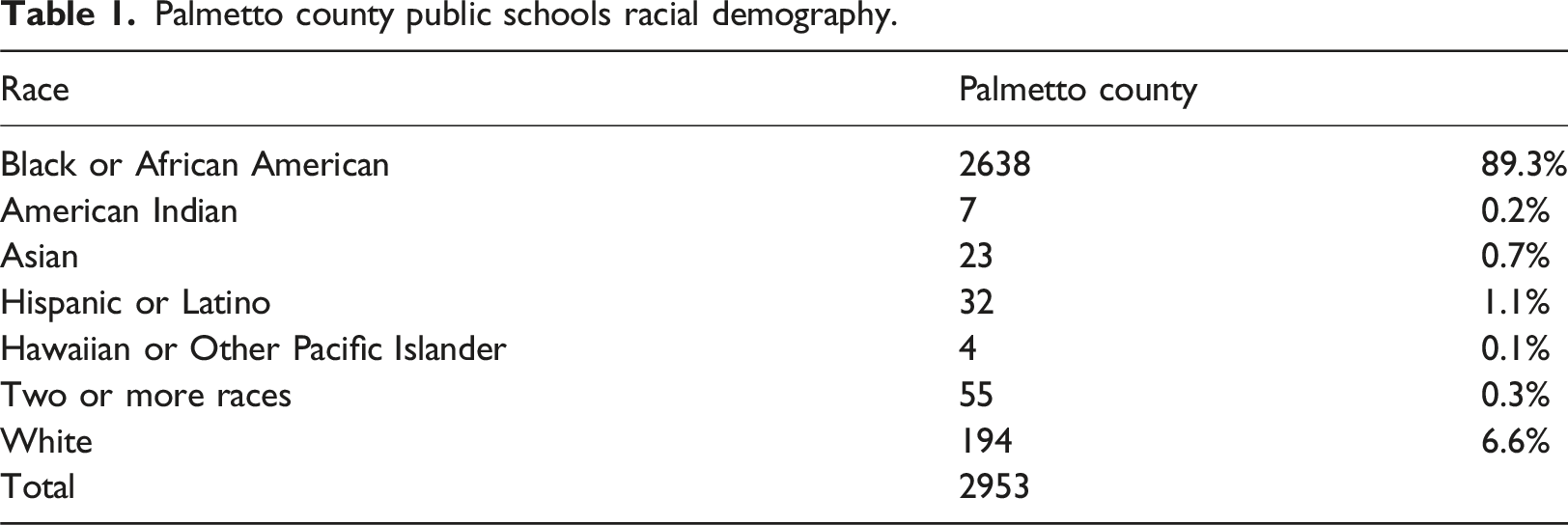
Palmetto county public schools racial demography.
Palmetto county schools in poverty.

Literature review
Racialization of takeover policy
School takeover as a reform strategy is utilized more frequently in communities of color (Morel, 2018; Oluwole and Green, 2009; Schueler and Bleiberg, 2022). Wright et al. (2020) find that when districts have similar academic and financial conditions majority white districts escape a takeover while majority Black districts are placed into state control. Schueler and Bleiberg (2022) express that race is one of the most salient factors in determining the likelihood of takeover. in districts serving fewer Black students, academic performance is more predictive of takeover than it is in districts serving large populations of Black children. This suggests that race is playing an important role in the process of selection for takeover, above and beyond the academic performance of a given district, with majority-Black communities at greater risk of being taken over. (Schueler and Bleiberg, 2022: 172-173)
The overrepresentation of districts serving predominantly non-white students being takeover is alarming. The presence of a takeover policy has been correlated to the proportion of non-white students in a state (McDermott, 2003). In Philadelphia, for instance, the schools serve a majority of students of color and were taken over in 2001 despite no evidence of academic or financial crises (Royal and Gibson, 2017). Wright et al. (2020) express that the key difference between Detroit and other Michigan cities that experienced takeover was their racial makeup, specifically that they served mostly Black students. Racial discourse has been central to takeover policy, for instance, in Georgia racist imagery was used in political commercials in favor of the policy (Welsh et al., 2019). Clement and Chen (2024) find that in the takeover of Little Rock school district politicians “ignored, or disregarded, facts about the racist impact of takeover and other reform strategies” (12). Nelson et al. (2022) suggest that takeover has deleterious effects on Black girls including increased disparities in discipline and increased rates of push out—push out is a reconceptualization of the term “drop out” to center the systemic structures that often contribute to students, especially those of color, choosing to leave school.
Disinvestment through takeover
School takeovers are often accompanied with market-based reforms such as education management organizations or conversion of traditional public schools to charter schools (Osworth, 2022). Charter schools, like public schools, are free to attend; however, they have increased flexibility and are not overseen by local school districts. Some charter schools are part of large national networks such as KIPP or Uncommon Schools; these charter management organizations control the school rather than local school boards. These school closures and increased charter schools have had an impact on the demography of educators. For instance, in Philadelphia the takeover resulted in the removal of long-time Black educators from leadership positions and often being replaced by educators who had no ties to the community (Royal and Gibson, 2017). The takeover in New Orleans decimated the Black teaching force reducing it by about 71% (Cook, 2010). Additionally, this takeover resulted in the termination of long-time partnerships with Historically Black Colleges and Universities obfuscating the pipeline of Black teacher preparation for the city (Akbar and Sims, 2008). Hunter (2009) expresses that when takeover targets low-income or Black communities they may not have the economic or political power to resist the repressive policies and privatization that accompany the state’s involvement.
Political disempowerment
School takeover is often accompanied with alienating communities of color from their elected officials (Rogers, 2012). Takeover often removes elected officials (Morel, 2018) and is accompanied with financial austerity (Lipman, 2013). Morel (2016) explains that takeover can disrupt existing community involvement in the schools ultimately reducing the possibilities for schools to collaborate with the families they serve. Takeover can be understood as disinvestment in Black communities, often resulting in the closure of schools that serve integral roles for the community (Lipman, 2013). Takeover creates political instability and makes sustained school improvement challenging (Mason and Reckhow, 2017). The racial implementation of takeover has been shown to reduce the amount of Black representation on school boards during and following the takeover (Morel, 2016). School boards provide an important pathway for aspiring Black politicians to city council or mayoral positions (Morel, 2018).
Appointed boards often replace the existing elected boards following the initiation of a state takeover (Morel, 2018). Rogers (2012) notes that in St Louis “appointed boards were more stable than elected board and stability was more important than participatory democracy. Order was more important than debate and plurality of voices” (297). Appointed boards reduce both the symbolic and substantive power of the school board (Morel, 2018). The ability for state level policy actors to determine appointed boards that govern at the local level reduce the local representation in schooling. Burg (2006) explains that it is concerning that a governor is able to supersede local control of schools without being held to the same transparency standards that a traditional school board is held to. Takeover proceedings often exclude parental voice and reduce their participatory power in determining the direction of schools in their district (Bulkley, 2007; Hunter and Donahoo, 2003; Osworth, 2024; Useem, 2009).
Alternatives to takeover
There are examples of collaboration between the state and the community helping to avoid the need for a state to takeover the school district. One such example was Union City, NJ where a comprehensive partnership helped to drive an increase in academic performance for the district (Morel, 2021). However, the impetus of this partnership was the identification of a strong Latinx population of conservative voters in Union City, NJ that conservative politicians did not want to ostracize. Conversely, the current takeover of Houston schools allowed Republican politicians to disrupt a center of liberal political power in Texas (Lovell, 2022). Takeover has the possibility to influence politics of a city or a county in addition to impact the schools that are under state control.
Theoretical framework
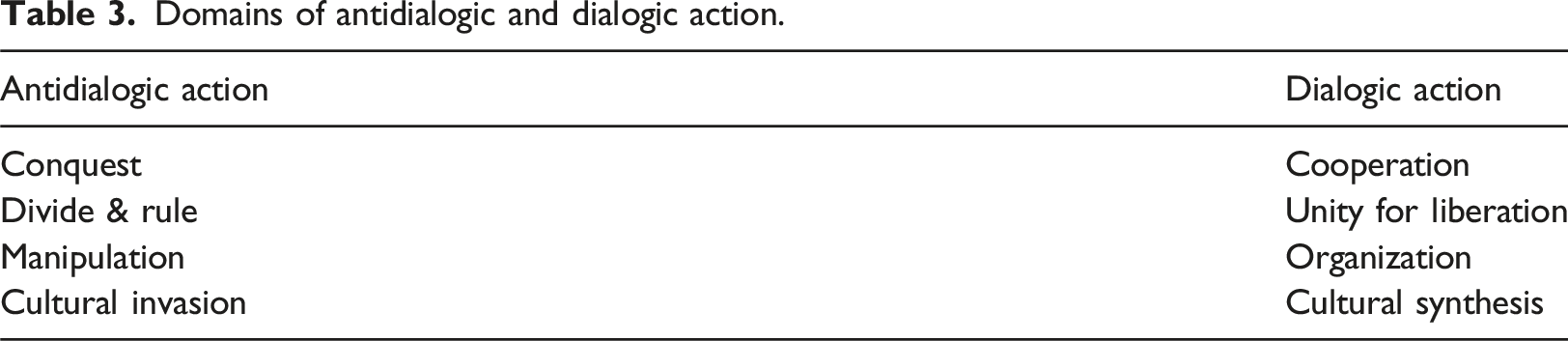
Domains of antidialogic and dialogic action.
Methods
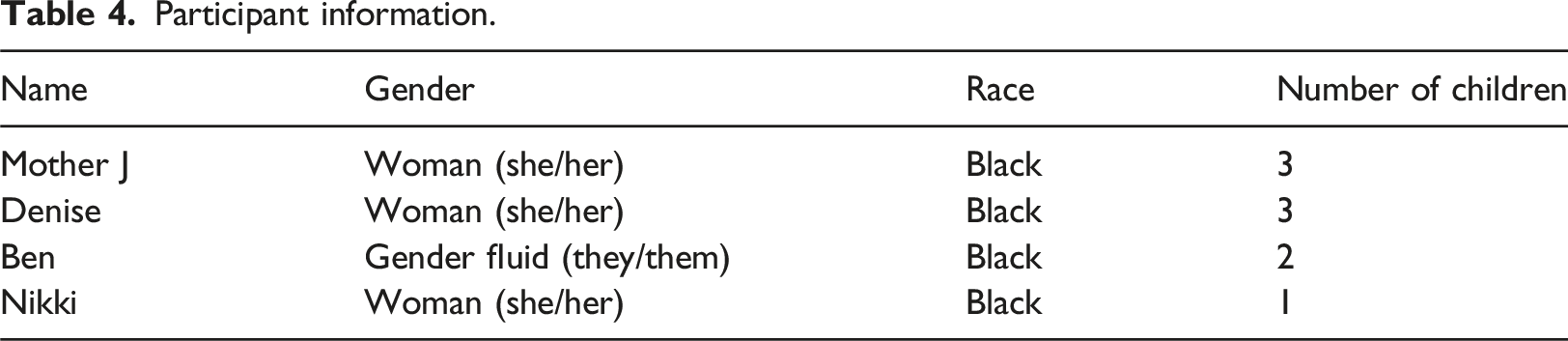
Participant information.
I deductively analyzed the data sources using Friere’s (1970/2018) theory of dialogic and antidialogic action. First cycle analysis utilized in vivo coding across the data source (Saldaña, 2016). In vivo coding was specifically used to foreground the experiences of parents and focus on the specific rhetoric of the State Department of Education. While there are other inductive approaches that can be used to analyze data, such as concept, descriptive, or process coding, in vivo was chosen because of the use of verbatim participant language to drive the analysis (Saldaña, 2016). This helped to both center participant language as the foundation of the analysis process. I generated over 500 codes during the initial inductive process. I used versus coding for the second cycle of analysis (Saldaña, 2016) due to the dichotomous nature of dialogic and antidialogic action. For instance, this looked like manipulation vs. organization. As I am particularly interested in understanding the presence of antidialogic and dialogic action the second cycle of analysis was theoretically driven. There are other coding approaches that are leveraged when engaging in deductive analysis; one that is frequently leveraged is process coding which is often used when there is a coding structure that the field of scholarship generally agrees upon (Saldaña, 2016). This study’s focus on a theory that there is not an established process coding scheme, I utilized versus coding specifically to pay attention to the inherent tension in the pairs of theoretical concepts (Saldaña, 2016). Both the in vivo and versus coding occurred across all data sources to work toward triangulation (Yin, 2018). Ultimately, I triangulated the data sources with the four hallmarks within antidialogic and dialogic action and they are presented below.
Findings
The analysis of the DOE press releases, the state’s policy, community meeting recording, and interviews with parents revealed the tensions between Freire’s (1970/2018) concept of antidialogic and dialogic action. The following themes were created from the versus coding: conquest vs. cooperation; divide and rule vs. unity for liberation; manipulation vs. organization; and cultural invasion vs. cultural synthesis. They center around each characteristic in Freire’s work. The findings below center around the theoretical concepts to attend to the first research question and the focus of the case study as an explanatory design (Yin, 2018). Within each of these finding I explore the tension between parent experience and state rhetoric to answer the second research questions. This tension is important as it demonstrates how parent experiences diverge from the taken-for-granted story that the state presents through documents and community meetings.
Conquest or cooperation
Both conquest and cooperation are the first characteristic of their respective theories that Freire (1970/2018) discusses. Conquest limits the humanity of the community through imposing the conquerors objectives onto those they are conquering (Freire, 1970/2018). Cooperation, on the other hand, is about collaborative processes which bring together the community in coalition. When looking at this case of state takeover I was looking for cooperation in the form of collaborative relationships between the state and the community. Whereas conquest would look like ignoring community feedback or not soliciting it all.
I found what I would argue is a façade of cooperation present in how the state discussed the takeover. State documents signaled the importance of working in tandem with the community. For example, a letter from the State Superintendent from the department of education (DOE) stated, “over the coming day and weeks [the interim district leader] and I will be meeting with school and district employees, parents and community leaders in order to move the district in the right direction.” The sentiment from the DOE suggests that the process will be collaborative, and that they will work with various stakeholders in making decisions. There was also in the same DOE document statements that centered the individual decisions of the State Superintendent as the impetus for the takeover. The letter stated, “I have determined that this declaration is in the best interests of the students, parents, and taxpayers of [the] county.” The paternalistic nature in which the DOE operates is similar to a history of conquest. The state superintendent’s words point toward the way that they know what is best for the community, with or without any input from the community.
While DOE communication placed a heavy emphasis on community meetings, the collaborative nature of such meetings was not present in the experiences of participants in this study. Mother J, for instance, expressed that these meetings oftentimes were not allowing for questions and were simply opportunities to hear the message. Mother J shared her experiences with these community meetings: You know, when your parents tell you no and say, “don’t ask me why just do what I say?” That’s what it was, because you weren’t allowed to ask any questions. This is what’s going on, we’ve already decided. And that’s because they removed the school board, so it was one person making the decisions.
Nikki similarly mentioned that community meetings dwindled after the initial meetings. Nikki expressed that she hoped the DOE was still planning to meet with the community, but Nikki had “not heard of any formal meetings for the community to get back together like they did originally.”
While meetings occurred throughout the takeover process they oftentimes happened after major decisions had been made. Two notable decisions were the closure of a charter elementary school in the district and a traditional public high school. In both instances the community was unhappy about the closures, but as Denise, Mother J, and Nikki all expressed that you would hear about these decisions as a rumor prior to any community facing meeting being held. Denise said with the takeover and with other decision she felt as though decisions had been made prior to community meetings. Denise said, “we figured that when she said, ‘I haven’t made up my mind yet’ the rest of us were like, ‘she made up her mind.’ We were like, ‘it’s going to happen.’” Similarly, Ben expressed, “I don’t feel like parent’s feedback were effectively used,” and they also explained that the DOE communicated that they, “expected full cooperation from the parents.” While parent feedback may have been solicited it was not utilized to shift the decisions that the DOE had already made. Ben’s experience of being told to cooperate while the state was engaging in what Freire (1970/2018) might describe as acts of conquest points toward the way rhetoric was used to create a false sense of community collaboration.
Divide and rule or unity for liberation
Divide and rule occurs in antidialogic action to create discordance among communities. Freire (1970/2018) argues this act creates tension and makes it difficult for these communities to come together to resist oppression. Dialogic action would strive to develop unity for liberation. Freire (1970/2018) writes that “in the dialogical theory the leaders must dedicate themselves to an untiring effort for unity among the oppressed—and unity of the leaders with the oppressed—in order to achieve liberation” (172). Dialogic leadership constantly centers creating coalition and unity that works toward the liberation of the community.
In my analysis I found that the DOE documents often focused on the taxpayer and used language surrounding the failure of the school board and the school district. For example, in a DOE press release announcing the takeover released in April 2018 the State Superintendent said, “the district and state must remain accountable to the taxpayers and it is clear that the district has failed to use these dollars efficiently and effectively.” In a letter to the district, also from April 2018, the State Superintendent continues to focus on the failure of the district, they wrote, “[the districts] continuous financial and programmatic issues in key federal program areas has resulted in the district’s designation as high risk.” The language used by the DOE casts aspersions on the locally elected school board members and the career educators in the district. In the community meeting the state superintendent suggested that the district’s failure to meet federal standards would put the entire state at risk of losing their federal funding.
The ways in which state policy actors employed divide and rule tactics in press releases and community meetings manifested in how participants experienced the takeover, too. Ben described their experience during the first community meeting. Ben noted that the meeting “focused on the failures of the systems, the failures of the school system.” Ben expressed that they, “criticized a lot about the system.” During the same community meeting Nikki also expressed a lack of trust in the district during the meeting; she said, “It made me think, is the leadership incompetent?” Nikki said, “But after leaving that meeting, I was like, okay my child cannot go here.” The way in which information was framed led parents placing blame on individuals rather than on systemic issues that may be at play leading to the academic and fiscal difficulties in the district Denise explained that, “a lot of people need to stop playing the blame game.” The takeover led to a lot of people in the community blaming each other. By centering on the individuals and placing blame it obfuscates the ways toward unity among the community to address the systemic oppression at play in low-income rural schools.
Offering a qualitatively different perspective, Mother J expressed that she felt the DOE took too long to intervene with the district. Mother J shared, “I blame the state because you turned a blind eye to things that was made public… So [the academic performance] was public knowledge and it went on for years, and you didn’t step in.” Mother J felt as though the DOE did not intervene and let the state of the district become so bad. Similarly, Denise felt that the DOE did not act quickly enough. It was sort of like watching a Jenga puzzle fall, and then you wait until everything is on the floor to try to pick it up. It was days late, millions of dollars short. It should have been happening. I really want to say early 2000s it should have happened. But why it took so long? I don’t understand.
Participant questions about why the state took so long to intervene raise some important concerns, specifically about the purpose of takeover. Takeover as a reform has yet to demonstrate success in increasing student academic achievement (Schueler and Bleiberg, 2022; Wong and Shen, 2003). Lovell (2022) noted, “a policy window for a takeover materialized for Texas executive officials to capitalize on the political goals of the state’s Republican Party to gain control of a major local entity in a highly Democratic area” (56). Lovell’s (2022) work demonstrates how the impetus of takeover may not be the best interests of the community but rather a move to disempower and control communities.
Manipulation or organization
Manipulation is the way in which antidialogic action “attempts to anesthetize the people so they will not think” (Freire, 1970/2018: 149). Leaders that engage in antidialogic action will attempt to lull communities with promises of success or progress when they are not substantive or are an illusion. The diametric characteristic is organization; this is a process where the leader works together with the community and through dialogue come together in a “highly educational process” (Freire, 1970/2018: 178).
Mother J explained that there was a sense of relief when the takeover was initially announced. Mother J expressed that the community would be lulled into a sense of security until a change was announced that would create a stir among parents. Mother J explained: [The State Superintendent] came to town and once they got comfortable, the numbers started declining again. [The community] trusted that they got it. And when they did that, that’s when [the State Superintendent] threw another spade hand and she hit the table with a high spade and she said, “Bam we’re closing this school.” And then [the parents] got up again. You know, it took events for them to stay on point, but by that time it was too late. It was already done.
The community would get comfortable, and the DOE would provide data to encourage the community trust them. But the manipulation comes in the form of the “spade” that Mother J described. The DOE is able to stack the deck and always have more power throughout the process. The DOE maneuvered to close schools especially once the community had begun to trust. As Mother J explains after a certain point it was too late to resist the school closures because the DOE had the high card the whole time.
During the community meeting DOE representatives provide information about how this was the path forward which I theorize helped to anesthetize the community and encourage them to trust the process of the takeover. The State Superintendent promised the takeover was about, “our students and providing them the opportunities that they deserve to grow and become the best of what they want to be, whatever their passion is.” Additionally, communication from the DOE would often position the takeover as the way in which the district will be able to move forward. These press releases centered this as the ultimate way to move forward and do what was in the best interests of the students. Lipman (2013) explains that the community disinvestment that accompanies school takeover, such as school closures, remove central fixtures within the community.
At the time of writing this the district was in its fifth year of state takeover. Nikki mentioned that now the takeover is not as present in conversations. Nikki shared, When my friends and I talk about school, it really doesn’t affect us because they’re still going through the day-to-day…I don’t think it really matters, but we know it matters in the big scheme of things, but we don’t have the discussion.
Nikki’s experience points to how normalized the takeover has become that it is not as present in her conversations as it was when the takeover first happened. Denise shared that rumors helped to inform the community prior to official communication. She said, “We already know before. Even if they’re open and honest about it, half the time we already know before it happens.” This false transparency created by rumors allows Denise to “hope for the best, but prepare for the worst.” Denise, however, felt a sense of defeat and that there was not a lot that could be done to alter the decisions. Denise wondered “what can be done?… How can we voice our opinions?” The manipulation of the DOE halted organization as defined by Freire (1970/2018). Specifically, it was very difficult for parents to envision ways that they could affect change when the decisions felt final before they were even communicated. As the takeover continued over time it became just another part of daily process and not one that was frequently questioned.
Mother J shares that as the community becomes accustomed to the takeover, she is concerned that the DOE will take advantage of them and break policies that protect children. Mother J shared, But remember, we are supposed to be in a town where people aren’t educated and don’t supposed to know. So are you really going to break those laws just because you think you’re dealing with a bunch of people that isn’t aware? Are you going to take advantage of that?
The absence of transparency allowed the DOE to manipulate the residents and parents of the district. The DOE created a false sense of trust among parents. Mother J worried that the trust will allow the state to take advantage of the community. Nikki similarly expressed concern about the length of the takeover. Nikki asked the rhetorical question, “So are you doing it to prove a point or are you doing it because it’s the best interest of the community?” As the community is lured into a false sense of security decisions of the state get met with less resistance further reifying the oppressive power that they wield through the takeover of the district.
Cultural invasion or cultural synthesis
Cultural invasion is the final domain of antidialogic action and Freire (1970/2018) notes that it is both an instrument and result of domination. Cultural invasion is where the views of an oppressor are imposed on the communities that they oppress; cultural invasion alienates and seeks to strip the oppressed of their identity and replace it with the myths perpetuated by those with power. Cultural synthesis, however, is the way in which culture is interrogated to understand the systems of perpetuate and preserve oppression (Freire, 1970/2018). The previous domains were more present in the data than this final domain. While participants did not express internalize deficit views, I present the ways in which the DOE attempted to engage in cultural invasion.
The DOE engages in cultural invasion through the use of deficit ideology in their communications about district. DOE artifacts framed the children in the community as “at-risk” or “high risk.” Pica-Smith and Veloria (2012) explain that “at-risk” classification create a false equivalency between “at-risk” and racially minoritized; this can reinforce deficit logics surround race or class. Deficit logics were used during the community meeting as well. State policy actors expressed surprise that parents were willing to come to the meeting. One state policy actor stated, “when I came in from [the capital] I was worried about what I would see.” This state policy actor went on to explain that they were expecting a low turnout of parents. This frames the community from a deficit perspective that suggests that parents in this community are not invested in the education of their children.
Another aspect of cultural invasion as the result of domination is the erasure of nuance of a communities culture to be more monolithic (Freire, 1970/2018). Through the takeover the state closed two schools in the district. There was a sense of loss among the community surrounding the closure of a high school in the district. Nikki explained that the community that attended the school was very proud of themselves and there was a sense of history and success within that school. Nikki explained that, I know there was a lot of pride in the members of [that community] … I think it was more of the historical, the pride in that school and the citizens of that community banding together to make sure that school was successful. I think that part has been lost.
Denise similarly expressed the concerns of alumni of the school being closed. Lipman (2013) writes that takeover is a form of governmental disinvestment in communities of color, the subsequent closure of schools does not only impact the students but leads to an eroded sense of identity for the community. Takeover of schools in New Orleans similarly removed the cultural identity of schools by repurposing them as charter schools and removing the majority Black teaching force creating an immense upheaval of community culture (Akbar and Sims, 2008; Míron, 2008). This disruption and disinvestment help to constitute the end stages of antidialogic action, specifically cultural invasion by attempting to erase the nuances of a community to fit a monolithic depiction that aligns with the narratives of the oppressor (Freire, 1970/2018).
Discussion
Freire (1985) explains that to impose freedom on others in the name of salvation is inherently antidialogic action; thus, even with the intent of liberation the result is just further domination. This case study illustrates the ways in which while the intent may be to collaborate and create better schooling for the students in the district the takeover often fell short of these espoused goals. What may have been intended as a dialogic approach that claims to center the community is realistically an antidialogic education policy.
While the takeover is still occurring parents in the study remained hopeful that the state’s involvement would lead to long term positives. Mother J’s concerns about the manipulation of the state and her analysis that political leaders see them as “a town where people aren’t educated” demonstrates the deep mistrust she feels for the state policy actors. Rogers (2012) expressed the general concern that takeover often prioritized the needs of state level actors while excluding the voices of the communities. Nikki echoes this sentiment when calling out what the purpose of the takeover is, was it in the best interest of the community or was it to prove a point.
It is hard to imagine that takeover as a reform was in the best interest of the community. Wong and Shen (2003) were unable to identify statistically significant evidence that pointed toward takeover increasing the academic achievement of students. Nearly two decades later Schueler and Bleiberg (2022) similarly were unable to find evidence that takeover provides a positive increase to academic achievement. Persistent academic achievement concerns were part of the reason that the state took over the district, yet the reform strategy they chose does not have evidence that it is successful. We have recently been in an era of education reform that obsesses over data informed approaches, this data often being derived from accountability measures such as standardized tests (Mitra, 2018). It is curious, then, why educational leaders seem to pick and choose when “data informed” is salient and when it is not.
Takeover has been linked to governmental disinvestment in Black communities (Lipman, 2013). Takeover is operationalized along racial lines (Oluwole and Green, 2009; Schueler and Bleiberg, 2022). Therefore, is takeover more about exercising power or about what is best for the community? Lovell (2022) highlights how political power plays an important role in determining takeover and how it may be seen as a tool to obtain greater control over communities that support a different political party than the one currently in power. Morel (2021) expresses how preserving trust with conservative voters helped the Union City, NJ schools avoid a state takeover. Using interest convergence to theorize takeover when there is no political incentive present to stave off a takeover the result is a non-collaborative approach that does not center community input and voice (Osworth, 2024).
Implications for future research
Previous scholarship on takeover has focused primarily on urban districts and utilized case study as a method (e.g., Bulkley, 2007; Mason and Reckhow, 2017; Mìron, 2008; Morel, 2016, 2021; Rogers, 2012). This case study however leveraged a critical and liberatory theoretical framework from Freire’s (1970/2018) seminal work to examine the experiences of parents as they related to the espoused approach to takeover from the state. Continued study of takeover through case study, specifically explanatory case study, provides a promising look into the interactions between the community, school, and state policy actors. Future research should consider utilizing critical and liberatory theories to study school takeover, especially because it is often used in low-income, and Black and Brown communities. Furthermore, future scholarship should expand on this work by using antidialogic and dialogic action to examine the experiences of school and district staff during takeover. Furthermore, this study suggests that using theories to interrogate power in educational policy research can be a fruitful way to understand how state policy actors reify white supremacy and oppression, often under the guise of beneficence. While I found a strong connection between three of the four domains of antidialogic and dialogic action the area of cultural invasion or cultural synthesis was a weaker connection to this case. Future directions for research should examine how takeover may engage in cultural invasion, specifically how deficit logic may be internalized or how communities resist the myths of the oppressive political regimes.
Implications for policy
This study has several implications for policy actors. Primarily policy actors should critically reflect on whether the espoused values and practices of a policy are being implemented. While state policy actors presented a collaborative process that was focused on the wellbeing of students this did not align with the experiences of parents’ interview in this study. Policy actors should also consider moving away from takeover as a reform practice; this study suggests that as a practice it did not follow a collaborative or dialogic approach. Additionally, other scholarship has been unable to find statistically significant evidence that it increases academic achievement (Schueler and Bleiberg, 2022; Wong and Shen, 2003). Policy actors should explore collaborative options that engage with the community and do not decimate schools as community centers.
Conclusion
This study examined the experiences of four parents in a rural school district in the Southeastern United States that experienced state takeover. Through an explanatory case study design leveraging Freire’s (1970/2018) antidailogic and dialogic action parents’ experiences were compared to the rhetoric of the State Department of Education. The findings suggest that the takeover of the district aligned more closely with antidialogic action even though state policy actors often presenting the process as dialogic. Freire (1970/2018) reminds us that, “What distinguishes revolutionary leaders from the dominant elite is not only their objectives, but their procedures. If they act in the same way, the objectives become identical” (167). While state policy actors may believe their objectives to be socially just or in the best interest of the children and community, how they go about achieving those objectives matters just as much. Freire’s words remind us that in creating a liberated world through education we cannot fall back on the old adage of “the ends justify the means.” Therefore, this study and Freire’s work call us to focus not only on the what but the how. As educators, and scholars, think about how to improve schools for the betterment of children we should examine our “procedures” with criticality in order to avoid recreating the conditions that we are trying desperately to improve.
Footnotes
Declaration of Conflicting Interests
The author(s) declared no potential conflicts of interest with respect to the research, authorship, and/or publication of this article.
Funding
The author(s) received no financial support for the research, authorship, and/or publication of this article.

Data Availability Statement
The data for this study is not publicly available.