




Abstract
This ethnographic study attempts to find, reveal, and understand the quality of life in a College English classroom for non-English majors in China, where a task-based language learning and teaching practice is conducted under the guide of the principles of Exploratory Practice, aiming at exploring the viability of the practice in this specific instructional context. It takes the perspective of a practitioner’s and researcher’s, and that of an anthropologist’s, to conduct qualitatively the study of the task process. By inspiring students to free themselves from the rationality of instrumental curriculum, and encouraging them to exercise their agency and creativity, through the joint four-stage activities of the task, the study witnesses a harmonious classroom life, in which the students, in the direction of their teacher, engage actively in the activities, creating not only language learning opportunities, but also social and cultural ones, and critical thinking chances. The study confirms the positive effect of this context-sensitive instructional practice which prioritizes quality of life in the task-based language learning and teaching classroom.
Introduction
Second/foreign language acquisition (SLA/FLA) theory divides language learning into four skills: listening, speaking, reading, and writing. The learning method of each skill is different, so separate course is set for each skill, and teaching and learning entails transmitting for teachers and mastering for students these separate skills. While this scientific approach to SLA/FLA is prevalent, an alternative approach is practiced in the field: the integrated approach, which integrates these skills together in instructional practice (e.g. Zheng, 2009; Akram and Malik. 2010; Tuncay, 2014; Hinkel, 2018). In Chinese college English course for non-English majors, reading and writing (RW) are integrated into a course, and listening and speaking (LS), another one. This is a partial integration. Traditionally in the RW class, teachers are supposed to make students achieve the reading, writing, and translating skills required by the national College English Requirement, and in the LS class, the listening and speaking skills. The prevalent instructional model employed is teacher-centered though students’ presentation is occasionally combined. While this instructional practice can help learners learn the skills, it may not motivate learners sometimes because students are mostly in the passive state to listen to their instructors or peers to transmit knowledge and skills. This kind of learning is somewhat boring and even frustrating to learners. This is especially the case when internet resources are widely access to learners. In such context, a student-centered model appears necessary, which can make students have more learning-by-doing chances. Hence, the exploration of a whole integrated approach of English as a foreign language (EFL) learning and teaching in my classroom as an exploratory instructional practice that integrates the four skills together.
Exploratory practice
The framework of Exploratory Practice (EP) is originally proposed by Dick Allwright and colleagues in the world on the basis of the traditional classroom action research (Allwright, 2003). It is premised on a philosophy that is stated in three fundamental tenets (Allwright, 2003, p.114): (a) quality of life in the language classroom should be the priority over instructional efficiency, (b) understanding quality of classroom life is far more essential than developing ever “improved” teaching techniques, and (c) understanding such a quality of life is a social, not an asocial matter, that is, practitioners must “be concerned with the effect of a situation of ‘co-presence’ on classroom language learning and teaching behavior” (Allwright, 1995: p.6). From these fundamental tenets, Allwright derives seven broad principles of language teaching: “(a) put quality of life first, (b) work primarily to understand language classroom life, (c) involve everybody, (d) work to bring people together, (e) work also for mutual development, (f) integrate the work for understanding into classroom practice, and (g) make the work a continuous enterprise” (Allwright, 2003: p.128–130, 2005a, p.360).
As “an approach to practitioner research that is devoted to understanding the quality of language classroom life” (Allwright 2005a: p.353) under the guide of the above seven principles, the core of EP is to understand the “quality of life” in the language classroom through interpretation in “a socially constituted, dialogic activity” (Van Lier, 1994: p.331), or ecologically interactive activity (Van Lier, 2010: p.4).
The concept of “quality of life” in EP framework is in contrast to “quality of work”. Both terms are meant to describe the classroom teaching and learning activity, but “quality of work” is product-oriented, while ‘quality of life’ is process-oriented. The former is used to describe the general characteristics of the classroom instructional work, for the establishment of general theory, the “global understanding” (2003, p. 115) or “upward understanding” (Alwright, 2005a, p. 358) in Alwright’s terms, in order to gain an abstract knowledge and technically make it a universal model of classroom operation as a way of increasing efficiency of work, usually in response to an outward requirement of teaching quality improvement. The latter is used to describe the ongoing classroom instructional activity for the understanding of the idiosyncrasy and complexity of the specific classroom life (Alwright, 2006; Alwright and Hanks, 2009), a kind of local understanding (Alwright, 2003) or“downward understanding” (Alwright, 2005a, p. 359), for the purpose of gaining a practical way to perform the specific classroom activity on the practitioner’s part, and an insight into or implication of the work for the practitioners, with the possible outcome of internally driven, spontaneously initiated reform of the instructional work by the practitioners themselves. In this sense, it is “the integration of pedagogy with locally relevant, small scale research activity” (Hanks, 2015: p.1).
In addition, “quality of life” also means being concerned with the “socialness” (Zheng, 2019: p.589) of classroom interaction, not just the technical or instrumental dimension. In other words, when interpreting students’ classroom interactive or learning actions, social factors as well as technical ones should be considered because students are people that have “intentions, agency, affect, and above all histories” (Pavlenko and Lantolf, 2000: p. 155) which will influence the “co-production of the lesson” (Alwright, 2006, p. 12). Therefore, for instructors, understanding quality of life in their language classroom is of priory importance to the success of their instruction and the development of students as whole-persons. Here the term “understanding” tells practitioners how to do research into their classroom learning and teaching, which, according to Alwright (2003), is to “use the normal pedagogic procedures (standard monitoring, teaching and learning activities) as investigative tools” (p. 118). In this sense, EP naturally integrates research with pedagogy, which “positions practitioners as legitimate researchers” (Hanks, 2017: p38). Such research, in Zheng’s term (2012), is in essence an ethnographically qualitative investigation on “what’s going on” (Gieve and Miller, 2006: p.20) in the language classroom. In Nassaji’s (2020) term, it is a pure qualitative research, wherein “data are both collected and analysed qualitatively” (P. 427).
In addition, in a broad sense, the term “classroom” refers to any space associated with learning and teaching. That is, it includes both the traditionally in-class and out-of-class learning activities. It is in the direction of this theory that I would like to use it to have my classroom research in an ethnographic, narrative, as well as empirical way on a ‘task-based instructional practice’ (Alwright, 2005b) which integrates reading, writing, listening, and speaking skills for college non-English majors who study EFL in an average college of China.
The research background
This study originated from my puzzle about the test-oriented instruction in College English class for non-English majors. During the 2-year college English education stage, the first year’s course of College English for non-English majors includes two sub-courses of LS and RW. The main purpose of the RW class is to enable students to learn language knowledge (new words, expressions, structures, etc.), and skills (reading and writing) required by the national College English Requirement. And the main purpose of Listening and speaking, its corresponding skills. Each sub-course is allocated to a one-and-half-credit-hour per week during a semester of 16 weeks. All the students adopt the same textbooks, and will share the end-of-the-semester examination. In my university the RW textbook is composed of a set of two books, each book for one semester, so does the LS textbook. In the former case, each book comprises eight units, with each unit consisting of two texts, Test A for intensive reading and Text B for extensive reading. After each text are exercises for vocabulary, structure, translation, reading comprehension and structured or theme writing practice. In the latter, each book also has eight units, with each unit comprised by listening, viewing, and speaking tasks. In the RW class, because the class hours are limited and the texts tend to be long with large numbers of new words and expressions, teachers mainly focus on the explanation of language points and the analysis of passage structures in order to help students to understand the texts and master the new words and expressions, a teaching practice focusing on “language points” in Allwright term (2005b). And, after the analysis of the passage structure and the content of the whole text, students are assigned as homework to write a short essay around 120 or 150 words, corresponding to the requirement of College English Test Band‐4 or Band‐6, by using the similar passage structure or theme. Then after about 1 week they submit their essay for evaluation. As far as I investigate, such evaluation is nowadays mostly carried out by editing software rather than teachers because the student population is too large for teachers to fulfil in their daily teaching life. Even if some teachers do evaluate occasionally, they usually give only a mark. In such a context, what students concern about their writing is what mark they can get, rather than what their problems of writing are and how they can overcome them to improve their writing, let alone about how effective their written communication is.
In the LS class, the focus is mainly on the input activities of listening and viewing rather than the output activities of speaking, for only a few students can speak English spontaneously. As foreign language learners, they have few chances to use English out of classroom. But globalization and test requirement do provide a driving force to push them to learn EFL. And some students are eager to improve their English proficiency, especially the spoken proficiency. But they do not know how. They are contradictory in that they regard the national college English Test Band-4 and Band-6 as a standard of English proficiency and want to pass them, on the one hand. On the other, they get tired of the test-oriented learning and teaching model, which they have experienced so long before their college life when they were learning for the national entrance examination (Chinese Gaokao). They do hope college can make a difference of their study life while facilitating them to achieve their goal of test.
The above-mentioned situation pushed me to the endless reflection on teaching and learning. And enlightened by the spirit and the principles of EP, I figured out that education in China is deeply rooted in test-oriented practice, and we teachers are accustomed to teacher-dominant classroom model with what Kumaravadivelu (2006, p.61) called a three “P” sequence — presentation-practice-production. This is even the case in the so-called flip classroom, where the deliverer is a small group of students in place of their teacher. In other words, Chinese teachers are too deeply influenced by the rationality of instrumental curriculum, ignoring that students are, first of all, people before they are students, and English as a discipline is first of humanist nature rather than instrumental one. In this sense, the education in our college English classroom is supposed to concern about the students’ interest, not just linguistic knowledge and skills. That is, concern about their development as people or “whole person” in Lave and Wenger’s term (1991).
This understanding has prompted me to have an innovative teaching and research in my classroom. I intend to make the instructional model more student-centered, so that students’ needs and desires can be considered and quality of life can be prioritized. Hence, a more student-centered, task-based learning activity is designed, where students can be more actively involved, where cooperative instead of competitive learning can be promoted, and where students’ listening, speaking, reading, and writing skills can all be practiced by carrying out the task. I meant to investigate the viability of such a teaching practice, and I am especially interested in figuring out the understanding of the following areas:
1. What was the quality of life in such classroom?
2. What did the learners gain, if any, from such a classroom process?
Design of the research
The participants
This research took place in the second term of the college English class for my students majoring in electrical engineering and automation in an average university in China. I worked as a teacher researcher and my 40 students as co-participants in the class, embodying EP principle of collegiality. These students’ ages range from 18 to 20. Among them, 24 were males and 16 were females. They all had at least received 8 years English education before attending college, but their English proficiency was generally still low, especially in their listening, speaking, and writing. Some of them even never had listening class before college. They had experienced a test-oriented education in their middle school for the national college entrance examination, and had little chances to use English in their daily life.
The task
Given the students’ low language proficiency, the task should have students receive enough linguistic input in order to improve their English skills, but it should interest, involve, and engage them and should be less controlled by their teacher so that they can learn by doing, and walk out of the test-oriented learning mode into application-oriented one. Namely, the designed activities of the task “need to be good exercise machines for the target skills” (Claxton, 2017: p46), and they need to be appropriate for the students’ current level of expertise in order to drive deep learning. I tried to negotiate with my students. One of them proposed playing a drama, which I echoed immediately and then others accepted the proposal. Then I suggested the drama should base on their own adaptation of stories so that the process of fulfilling the task would entail chances for them to comprehensively practice reading, writing, listening, and speaking, and chances of cooperative learning. And we divided the task into four stages and set its schedule and requirement.
Stage 1: Summary writing based on the reading of a short story. That is, students read a short story Lamb To The Slaughter written by Roald Dahl (1916–1990) as a supplementary reading material provided by their teacher and then write a summary of it. After they had finished their reading, each student was required to write together with a partner the main idea of the story in the genre of a summary or a letter telling a friend the main plot. The purpose of this pair work was to make them have chances to discuss problems and share knowledge and skills, meanwhile I, their teacher, could see whether they had globally understood the story. After that, they submitted their writings to me for grade. I graded them mainly based on the content. If there was any problem in the global understanding of the story, then I would discuss it with the students till they understand. This stage lasted about 2 weeks, the students’ reading and writing, and the teacher’s grading and explanation of the story covering 1 week respectively.
This short story was chosen in this task-based learning activity because its plot was appealing and its language, full of dialog, not too difficult for students so far as their English level was concerned. Therefore, it was suitable to be adapted into a play. In addition, it may also help students broaden their horizon, getting to know the complication of people and society to help them develop as people. And, writing in the form of adaptation based on story-reading, aim to guarantee the accuracy of their output language while playing. The choice of this learning material and the design of the task entailed a global thinking advocated by EP (Alwight, 2003) and was enlightened by the research implication that boosting learner enjoyment could facilitate students’ learning (Dewaele et al., 2018).
Stage 2: Adaptation of the short story into a play, which lasted 4 weeks, with teacher’s instruction through demonstration, students’ adaptation, teacher’s feedback, students’ revision covering 1 week respectively. First, I taught the students in the class the skills of adapting the story into a play with an example. Then the students were asked to adapt it into a play in a cooperative way in a four-member group, which was organized based on their own choice. This activity was required to complete within a week. After completion, each group submitted the draft to their teacher for feedback. After a week, the teacher returned the draft with feedback written in Chinese to each group. Then every two groups were combined into one based on their own choice, with each group now having eight members, for the preparation of the third stage—playing stage. The class had finally five groups all together. And, the combined two groups tried to compare their adapted drafts to decide which would be adopted to be the script for play. Upon their decision, the eight students of the group revised together the chosen draft in light of the teacher’s feedback. After their completion they submitted the second draft to their teacher and went on to the third stage
Stage 3: Preparation for playing and the real classroom performance. First, students assigned their roles and began to prepare for the performance: recite the lines, rehearse the play, find the background music and pictures to make PPT as setting for their performance. Then, they performed the play in the classroom. This stage lasted 2 weeks.
Stage 4: Reflection on the previous activities. students were required to reflect their learning throughout the process of the task. And then each group was required to submit a journal of their collective reflection within a week after their performance.
Each group on each stage had a head responsible for the management of the activity. At the end of the performance, the teacher would give them a mark as part of the final score of the task. In the whole process of “the task-based learning and teaching” (Alwright, 2005b) whose task is from the sociocultural perspective in Elis’ term (2000, p.208), I also communicated with them my experience of learning English so that it may help and facilitate their fulfillment of the task devised as an exploratory teaching program, a representation of teaching as “revealing being through words embraced by understanding” (Wu, 2006: p. 333); and learning, conversely, as “experiencing what a teacher reveals” (ibid), as was informed by EP.
Data collection
Data mainly comes from the students’ writing drafts related to this task, the observation of the in-class play performing process, and the group reflections in the form of written journal. There were 20 drafts of summaries of the story collected when each dyadic group submitted their writing homework on the first stage, 10 drafts of the adapted play from the ten four-member-groups, and 5 drafts of the revised drafts as scripts and five written reflections from the five eight-member-groups. The five PPTs each group made serving as the setting of their play performance. In the classroom play performance, two groups spontaneously video-recording their own group’s performance, which also served as the data in this study. These ways of data collection embody EP’s advocated method of using “the normal pedagogic procedures as investigative tools” (Alwright, 2003, p. 118), which elicits the following result of data analysis in the form of understanding the classroom quality of life.
Quality of life in the language classroom
The first stage activity: reading as a process of enjoyment and writing as a communication of global understanding of the story
This stage is somewhat similar to the traditional reading and writing activity, where students read the story provided by their teacher and wrote the summary of it in the genre they liked. From the 20 drafts submitted, I found 15 pairs of students had understood the story and 5 pairs had some misunderstanding of it. There were great numbers of linguistic errors in their writing, which students could not correct by themselves. But these errors did not prevent my understanding of their writing. And through my help, the five pairs of students with misunderstanding finally got their understanding of the story. Hence, the practitioners—both the students and their teacher, fulfilled the first-stage activity. In addition, of the 20 drafts, 16 were written in the genre of a letter. In these letters the word “interesting” is commonly used to describe the story, which indicated the reading material attracted them and they enjoyed the reading process.
The second stage activity: writing in the form of adaptation as a channel for the teacher to find and meet the students’ learning needs, and feedback as an authentic communication between the teacher and the students
On this stage, the four group members composed their draft of the play based on the sample given by the teacher. Of the 10 drafts, while a few of them did demonstrate some creativity—not only adapted the dialogues of the original story, but also some of its narrations into the stage lines of a play, most of them displayed problems. A common problem was that these drafts were only the products of a shallow adaptation of the story. That is, students only rendered those dialogs of the story into the stage lines of a play, leaving the other parts as background or aside. Specifically speaking, their first draft exposed three main problems.
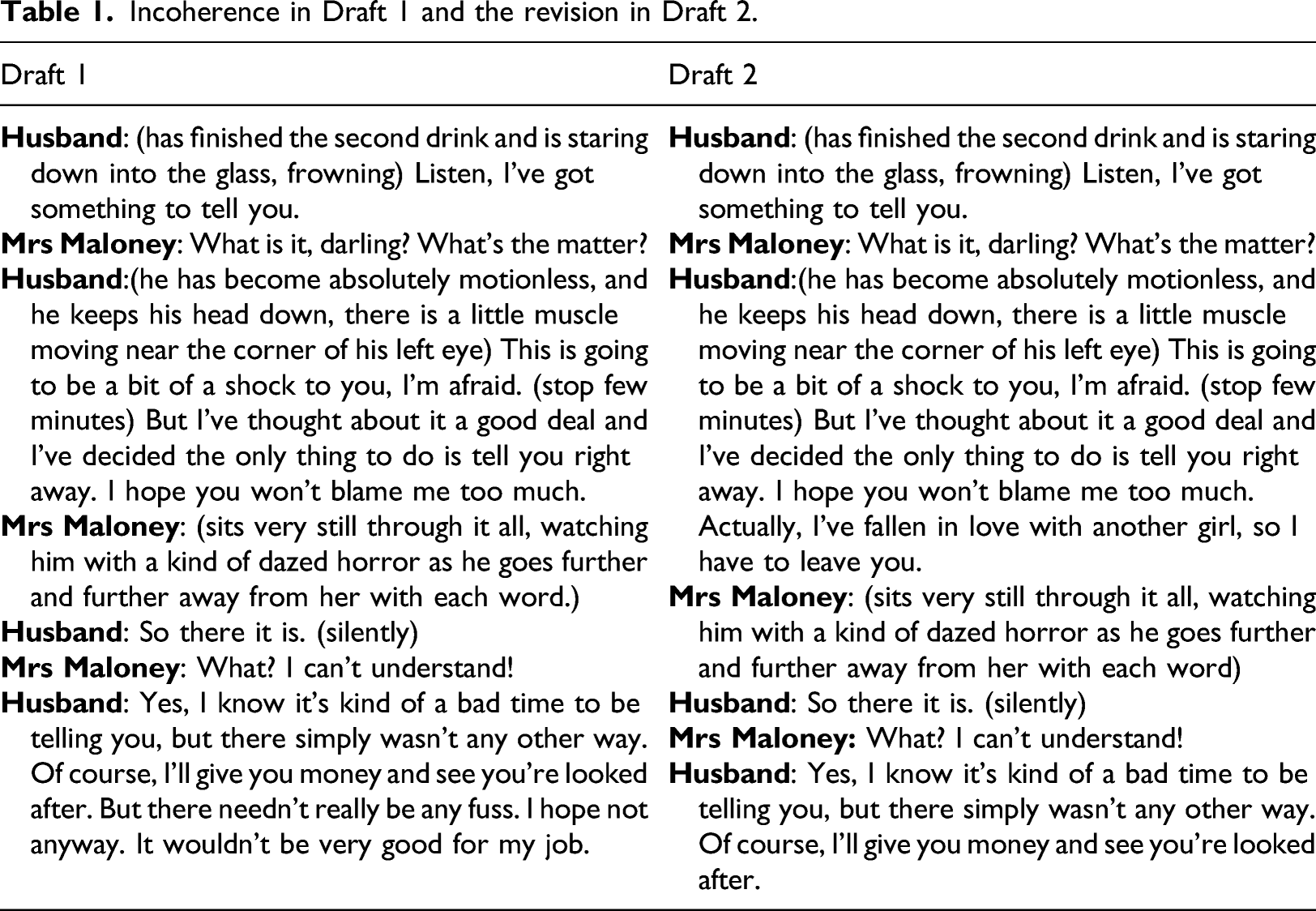
Incoherence in Draft 1 and the revision in Draft 2.
Example 1
While this simplistic adaptation did make their writing look like the genre of a play, it read incoherent in content. What indeed did the husband, Patrick Maloney, say to his wife, Mary Moloney? The original story leaves a suspension through a simple narration “And he told her,” which is acceptable because it is a common practice of story creation. But when adapted into a play, it is supposed to be expressed clearly through the lines of the persona. Otherwise, the content of the play lacks coherence. In the above example, the group simply deleted this narrative sentence, which proved they were aware of this generic difference but failed to make due adaptation. In some other groups’ drafts, even this four-word- narrative sentence was kept, illustrating that these groups of students were not clear of the generic difference between a story and a play.
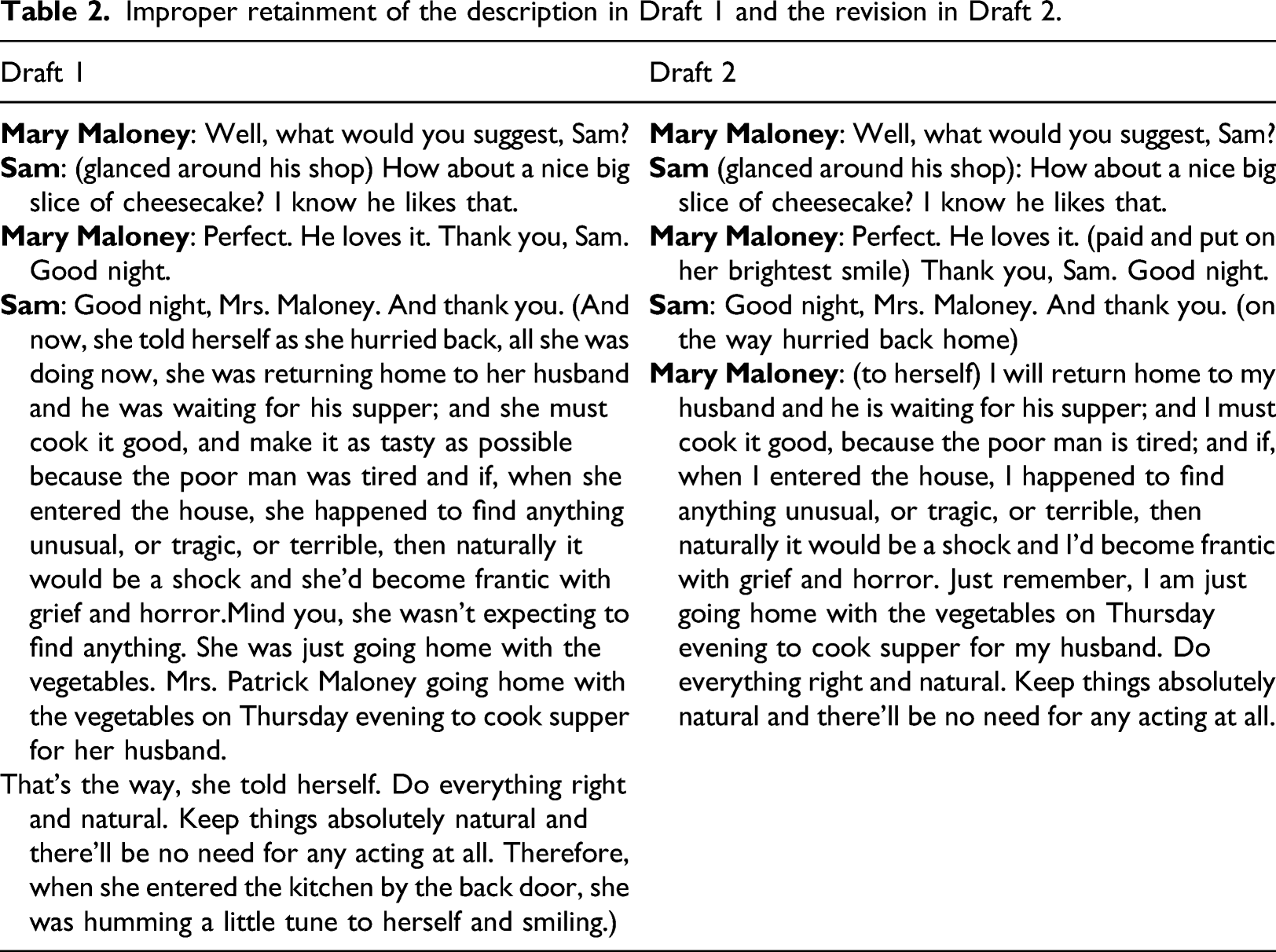
Improper retainment of the description in Draft 1 and the revision in Draft 2.
Example 2
In this example, the description words of the heroine’s inner thinking were copied into the text of their adapted play, making it a lengthy part of aside. This phenomenon revealed the group’s poor awareness of the genre difference between a story and a play.
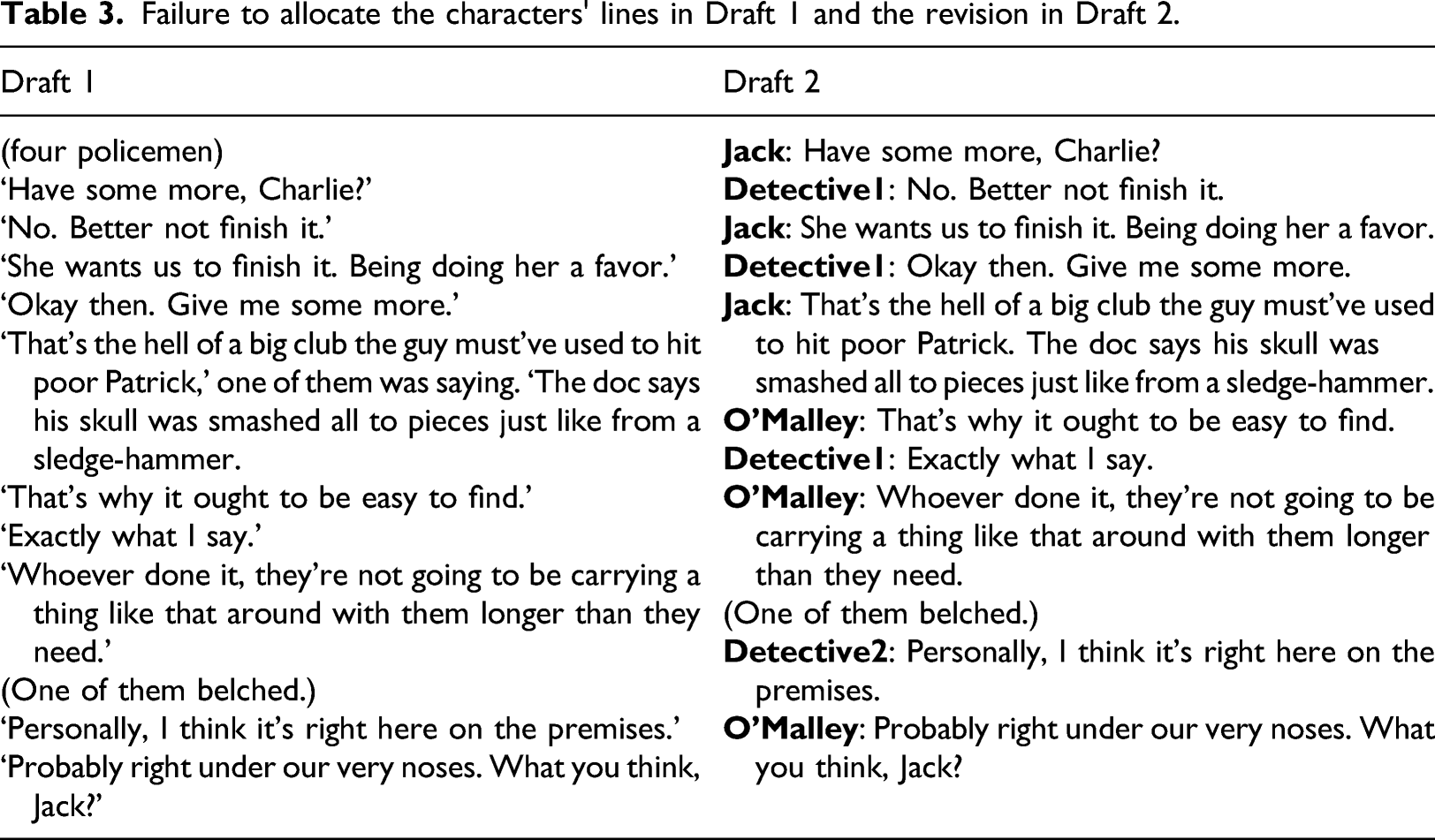
Failure to allocate the characters' lines in Draft 1 and the revision in Draft 2.
Example 3
In the example, students did not allocate the lines to the four policemen because they could not figure out who said what. They just deleted the narrative sentences and left the dialogs between characters in the play, but did not allocate these turns of conversation to due characters. The story did not definitely relate that, but readers can figure out that the four policemen are Jack Noonan, O’Malley, and two detectives. Of the two detectives, one of them is Charlie, with the other’s name unknown.
These common problems, as well as the other individual ones, provided opportunities for their teacher to understand their difficulties and provide corresponding feedback as scaffolding. These feedbacks proved a help to their writing in that the second drafts witnessed their improvement of these places, motivating their creative adapting work.
For the first problem, the teacher gave the following feedback:
“What did the husband say here? In the original story, the writer kept a suspension, but as a play writer, you are supposed to write it clearly, otherwise it is not coherent in content”.
As a response to this feedback, students reread the story, discussed it, and recreated the play, from which I found most students’ interpretation was that the husband loved another woman and wanted to leave his wife. This interpretation was embodied in their second drafts, as could be seen in the revised draft of the first example (see the right column of Table 1), where the added words demonstrates students’ creation in the revision of their first draft related to the first problem mentioned above.
For the second problem, the teacher’s feedback was as follows:
“You may as well adapt the paragraphs that describe the persona’s inner mind into stage lines the heroine says to herself”.
And students revised as their teacher’s advice, which can be seen in their second drafts, as is the case of example 2 (see the right column of Table 2), where the revised part showed how students changed the narration of the heroine’s inner thinking activity in the original story into the stage lines in their adapted draft of a play.
For the third problem, the teacher’s feedback was as follows:
“This is not the genre of a play, but that of a story. There are two policemen and two detectives here in the story. Who said what? You are supposed to arrange the roles in your draft of the play”.
With the guide of this feedback, it was not difficult for the students to allocate the role of the four men engaging in conversation, since the story did not definitely relate the configuration of those conversations between the four policemen but the clue of the names of the three of them. The above exemplified group’s revised draft (see the right column of Table 3) represented one of the configurations, in which, lines were assigned to the different characters. Here the two detectives were differentiated by Detective 1 and Detective 2. And readers could infer that Detective 1 was Charlie, and Detective 2’s name kept unknown in this revised draft.
The third stage activity: learning as an experience of acting in the play and as mutual engagement in a student-centered classroom life
In this stage, students negotiated the roles they would play in the classroom performance. Usually the students whose pronunciation was best, or whose language proficiency was highest, would play the leading role—the one with the most lines in the play. And students who were lower in speaking proficiency played the minor role. This role distribution, embodying the nature of legitimate peripheral participation (Lave and Wenger, 1991), embarrassed none of the group members, and in fact satisfied all of them. Then they recited and rehearsed the lines, searched pictures and auditory materials from internet to make PPT as background for their oral performance.
When the day came for their actual performance, I observed this classroom life different from the previous one where the classroom activities were firmly controlled by the teacher; where students were imposed to speak by answering questions or expressing their ideas; where students felt nervous when they were unsure about the question, where students stood to say nothing but sorry in response to the imposition, as is the case of Zheng’s study (2009, p. 86). Now, the English class was dominated by students themselves, occupied by the students’ voice. The class unfolded in a way, through which students involved themselves in the roles of the play, turning others including the teacher as audience. Besides, I, as the teacher, also worked as a facilitator who helped each group to cooperate well in their performance, and an assessor who marked the playing of each group. Students were witnessed to engage and invest actively in the performance of the play, displaying interest in, and attention to this classroom life. And one of the students even spontaneously video-recorded the playing of his classmates while watching their performance. Though his recording was not complete, it recorded the students’ authentic being (Wu, 2006: p. 333) in the classroom life.
In short, in the classroom oral performance, students’ life, their authentic being was represented, which they showed interested in, and helped motivate them to engage in the performing task in collaboration with the members of their learning group. And in this kind of classroom, I, as their teacher, withdrew from the dominant position to the position of an anthropological observer, researcher, facilitator, assessor, etc.
The fourth stage activity: reflection as a way to engage in critical thinking
In the reflection, students recalled their experiences of participating in the collective creation and performance of the play. Some groups talked about the gains they obtained from the activities of the task and the shortcoming they found in the process of carrying out the task. The following reflection is a typical case. The performance of Lamb To The Slaughter witnesses our twice English play performance contest, ending up with our cheerful course although we have some passivity in the performance, not natural enough. Although Lamb To The Slaughter is brilliantly revised and acted by my team, we are neither the best actors nor the best thrillers because we did not organize well to perform. Lamb To The Slaughter contains a number of great scenes, but our team suffered from a split personality. Our team may not have been the one of the best outstanding teams, but it was the most concerned team, and there’s no denying that the most celebrated aspect of the performance could have been accomplished with our members’ greater cooperation. To sum up, not only can the English play broaden our view of the world culture, but it also can excite our potential of the performance of campus play.
Students in this group recognized that participating in the activities of the task enabled them to broaden their vision of the English culture, and to excite their potential of learning by doing. Meanwhile, they admitted their shortcoming as “passivity”— not playing naturally enough and poor organization, which resulted from their different opinions. In the words of Aubrey et al. (2020), the social cohesion of the group was not good enough, which affected their performance of the task.
Others focused on the contrast between this new classroom life and the traditional one, confirming its meaningfulness. The following is one of the reflective cases: In English class, we have acted a play called Lamb To The Slaughter by ourselves, when we were on the stage, we all did our best to act our roles, and our teacher gave us a praise after we had finished the play, that feeling was very good really. And we learned a lot from the preparation of the play. We finished the drama with three weeks. When we wrote the first draft, we translated it into Chinese. After all, we should know the play as soon as possible. Then, we revised it. We did it together. Through working together, we had a common knowing about the play, which helped us play more easily. After that, we played it for a try with a paper which we wrote lines on. Then, we try to play without the paper, and used some props. First time, it was hard, but it wasn’t a problem finally. We practiced whenever we had time. During that time, we had a great time. You know, we were laughing, crying, hitting, talking. That is very happy. I first time feel that learning English can also be that funny. My job is to make a PPT which used as a background. I should put music, words, pictures in it. If I want to do it well, I should know every role and their feelings. I should also know the atmosphere during different parts, I need to choose the right music, pictures, etc. It’s hard, but it’s also fun. By the way, I also played a role in the drama – a policeman. We had a good job, and now I don’t think that English learning is boring. I feel that this style of learning is pretty good, students can learn a lot, not just English.
This reflection reveals that the task was somewhat challenging to the students, so they must work hard to fulfill it. In the process, some traditional skills such as memorizing, reciting were still used, but students did not feel boring this time because they were memorizing their own creative work, which they would play in the classroom. This inner motivation drove them to engage in the activities of the task, reaping a fruitful feeling of their cooperative participation.
Discussions
1. What was the quality of life in such classroom?
The concern of “quality of life” in my class witnesses the students’ interest in this approach, and as the consequence of that, the arousal of their creativity (which can be drawn from the process of their writing), the activation of the classroom atmosphere (which can be seen from the classroom oral performance), and the changing of their learning role (which can be seen from the classroom oral performance.). However, it does not mean that the change in my classroom is caused by the improvement of teaching method or techniques, but rather by the concern with quality of life, the students’ “authenticity of being” in Wu’s sense (2004, p.309; 2006, p. 333) in the language classroom, where “prioritizing quality of life” in the EFL classroom means that students’ opinions are considered when choosing a task, that students have access to learning opportunities to gain alignments, that students have chances to participate in classroom activities actively instead of passively accepting what the teacher infused or imposed on them, that students have chances to engage with each other to negotiate meaning and their own ways of activity organization and participation, that students are inspired to engage in their critical thinking, that students have chances to know people, society, culture etc. as well as English language itself. In other words, “quality of life” in this EFL classroom entails potentials for students’ comprehensive development as people (Lantolf and Appel, 1994, p. 9).
In such classroom, students’ learning lives are not constantly manipulated by the teacher’s powerful discourses, by the scholar standards, by the instrumental assessment, though there are still technical requirement, so that writing in English, to students, is no longer “a process of sighing, pencil-chewing, foot-shuffling agony” (Hedge, 1988, p.5, cited in Zheng 2009: p. 87), and speaking English is no longer an experience of face-threatening torture, but a meaningful learning process to use English to communicate or practice by playing, through which students’ language proficiency, the ability of critical thinking and subjective self are given an access to develop holistically. Such a classroom life revealed the empowerment nature, which, according to Cote (1999, p. 3), is exactly what quality of life aimed at.
Such a quality of life is different from the traditional classroom practice, typically in the form of “the three P” mode — presentation, practice, and production (Kumaravadivelu, 2006: p.61). In the traditional teacher-centered classroom, what students learn is just objectified, discrete and explicit knowledge produced by others. And teachers, as powerful carriers and transmitters of that kind of knowledge, strictly control the linguistic practice and production of their students by giving various feedbacks, including error feedbacks. The relationship between students and their teachers is strictly hierarchical, and classroom interaction, mostly in the form of knowledge transmission, is unidirectional, emphasizing the “vertical accountability” (Wenger, 2010: p191) of the practitioners. That is, classroom instructional practice puts emphasis on teachers’ responsibility of transmission of the above-mentioned objective, discrete and explicit knowledge, and students’ duty is learning and consumption of that kind of knowledge.
While the above teacher-centered instructional practice based on the rationality of technical or instrumental curriculum is prevalent in the field of ESL/EFL education, it ignores the fact that English course is, first of all, a humanist course, and students are people rather than just knowledge containers or consumers, which means they have agency and will produce personal practical knowledge and tacit knowledge in their classroom social practice. These implicit knowledge constitute a very important part of the “regime of competence” (ibid, p.180) of practice — a whole set of criteria and expectations of linguistic practice. And the acquisition of these implicit knowledges requires practitioners take “horizontal accountability” (ibid, p.191) in a two-way interactional environment, or ecological environment in Van Lier’s term (2010). Taking this horizontal accountability means students’ engagement with each other in joint activities, negotiation of meaning, and commitment in collective learning, which is what we have seen in the classroom group activities of the task-based learning.
2. What did the learners gain, if any, from such a classroom process?
Language learning is not just “a cognitive process residing in the mind-brain of an individual learner” (Long & Doughty 2003; cited in Young and Miller, 2004: p. 519), it is also a social process in lived experience or in an interactional learning environment where students could engage with each other and involve themselves in activities actively, where legitimate peripheral participation is emergent, where learning opportunities are created by teachers and learners in their interaction. The cooperation between students as well as teacher in my classroom while we were carrying out the task makes a scene of the harmonious classroom life, where the teacher gained an access to understand the students—their ability and difficulty, and provided corresponding aids—feedback, to them. And the students could find and feel their need of learning from the teacher’s feedback. The process of their reading the story and writing the summary provided the opportunity for students to understand the story plot, characters’ complexity and thus the society’s complexity, as well as English language knowledge and skills. And the process of play creation based on the story and its revision based on the teacher’s feedback provided the opportunity for students to think and write in a creative way besides the opportunity of studying and using English in their writing practice. The fulfilling of these two learning activities involved mainly the cognitive aspect—vocabulary, grammar, sentence structure, genre of story and play, knowledge of personas or characters, it also touched on the social aspect such as the organization of group writing. Compared with the first two stages’ activities, the third stage activities—the role distribution of the play performance, the rehearsing and actual classroom performance involved more of the social aspect: negotiation, direction, coordination etc. in organization, though cognitive aspect was also critical in that students must memorize their lines to play.
Of these activities, a distinct character is the construction of the expert-novice learning mode. Writing based on the teacher’s feedback shaped a model of expert-to-novice interaction, where student groups obtained an alignment with their teacher by fulfilling their task in accord with their teacher’s feedback. And the group oral performance of the play was witnessed to be of the nature of expert-to-novice mode in both technical and social dimensions. From the linguistic dimension, their mode is expert-to-novice in that the students with relatively higher level played the major roles, whereas those with lower level, the minor roles in the play, a case of legitimate peripheral participation. And from the social dimension, the student who organized and directed the group oral performance tended not to be the student who played the main role in the play. In other words, students who were less competent in organization had chances to learn from those who were more competent in organization. According to Storch (2002), and Zheng (2009, 2012), language learning is more likely to occur in groups that are collaborating or that interact in an expert/novice relationship. In this sense, the task-based learning and teaching life in my classroom was believed to be of quality, where students not only had access to linguistic resources, but also sociocultural ones. Besides, they were also witnessed to have developed their understanding of the quality of life of this task-based classroom learning process, as is demonstrated in their group reflections.
In short, the students were seen to gain the learning opportunities for what Lave and Wenger termed “the whole person development” (1991) rather than just explicit linguistic knowledge and skills.
Conclusion and implication
Under the guidance of the EP tenets and principles, this study involved both the teacher and her students as practitioners in the inquiry into a task-based EFL learning and teaching life through the normal pedagogical activities, achieving a kind of collegiality between the teacher and the students. By encouraging the practitioners (both the teacher and students) to free themselves from the rationality of instrumental curriculum and put quality of life first in the college EFL classroom, this study witnessed a student-centered classroom mode whereby students as learning agents had an access to develop as people, as is the case reported by Machin (2020). By considering the students’ need and negotiating the task and requirements, through the process of group writing and play performing activities, the study witnessed a harmonious classroom life where the students realized their role transition from the traditional passive knowledge consumer to the active classroom participant. In the activity of cooperative group writing of the drama based on the short story reading, and the activity of their classroom oral performance of their adapted play, an expert-to-novice learning and teaching mode was produced, enabling students to find, feel and satisfy their learning need. Thus, we can say that it is viable and desirable to put quality of life first in the EFL classroom.
In the process of this task-based instruction, the teacher’s traditional role as a dominant knowledge presenter is withdrawn, rather, teaching is mostly based on the discovery of students’ problems they exposed in their fulfilling process of the task. In this sense, teaching means providing contingent helps that meet students’ need, what Alwright and Hanks (2009) termed as idiosyncrasy need. This gives an implication for EFL instruction that teaching is not imbuing knowledge, but creating a context, in which students’ learning problems and needs are emergent and identified in their everyday classroom life, and contingent instruction is provided in their experience of practices. In Wu’s term (2006), a representation of teaching as “revealing being through words embraced by understanding” (p.333); and learning, conversely, as “experiencing what a teacher reveals” (ibid), as was informed by EP.
Since this was a case study on the local practice, further study and understanding on it in different instructional context is necessary to achieve the richness of understanding or to find out its commonality, for EP understanding is a continuous and sustainable work.
Footnotes
Acknowledgements
The author would like to give thanks to the two anonymous reviewers for their revision suggestions, and to the students and teachers who participated in this instructional practice.
Declaration of conflicting interests
The author(s) declared no potential conflicts of interest with respect to the research, authorship, and/or publication of this article.
Funding
The author(s) received no financial support for the research, authorship, and/or publication of this article.
