



Abstract
The present study investigates language learners’ perceptions of what types of language learning activities they carry out in the Spanish second language (L2) classroom and what activities are the most common ones. A further aim is to investigate how the activities align with a model based on task-based language teaching. The group studied are Swedish learners of Spanish as L2 in a Swedish setting, where out of class exposure to first language (L1) Spanish is generally limited. The activities carried out in class are therefore expected to have a high impact on learners’ L2 acquisition in Spanish. The participants were tested after finishing secondary school. The reported learning activities, which in the long run should lead to goal attainment according to the national curriculum, were ranked and classified. The activity types were then graded along the scale explicit/analytic – implicit/experiential, according to a model based on task-based language teaching, an approach that is closely related to the action-oriented view of language, central to the Common European Framework of Reference for Languages and the Swedish syllabus. Ninety-nine learners were included in the study, which is based on quantitative data consisting in self-report questionnaires in which participants estimate what activities they have typically been involved in. Results show a dominance of activity types based on a structural view of language with focus-on-form rather than on meaningful communication, and a dominance of writing-based activities. The study also has direct implications for the classroom, where it points to the importance of including more communicative oral activities without the support from writing in the teaching.
Keywords
I Introduction
The study investigates the types of learning activities that Swedish students report having carried out during secondary school in the subject Spanish as a second language (henceforth L21) and is a follow up of results from Aronsson (2020) and Brito Engman and Aronsson (2022). Aronsson (2020) evaluated test results in oral and written production for a group of 90 fifteen- to sixteen-year-old Swedish learners of Spanish as an L2 in an instructional setting. The results showed that a majority of the learners studied (48%) were better at writing than speaking. Only a small proportion, 12%, performed better in speaking. When the results were related to the scales of the Common European Framework of References for Languages (CEFR), level A2, it was found that an overwhelming majority of the learners in the study did not reach the expected target level after year 9, and that this proportion was larger in oral language skills (88.9%) than in writing skills (74.4%). This result is in agreement with results from the European Survey of Language Competences (ESLC) (European Commission: Education and Training, 2012), where Swedish results for English as an L2 were found at the top of all the participating countries, while results for Spanish as an L2 were found at the bottom. Only writing-based skills were tested in the ESLC (2012) (European Commission: Education and Training, 2012), where 84% of the Swedish learners of Spanish as L2 did not reach the target level A2.
Brito Engman and Aronsson (2022) studied the distribution of 1,672 learning activities involving productive and receptive skills in four popular teaching materials of Spanish as an L2. The activity types were related to a task-based language teaching (TBLT) framework, using the communicative continuum proposed by Littlewood (2018). The TBLT framework forms the basis of the functional/action-oriented view of language that has been guiding both the Swedish curriculum and the CEFR (see, for example, Little, 2012) and was therefore chosen as the guiding model when the learning activities of the course books were evaluated in relation to the functional, action-oriented approach found in the curriculum and the CEFR. The results showed that the books were largely dominated by structured exercises with a focus on form-training, and activities directly or indirectly based on writing, even in oral skill training.
The imbalance identified by Aronsson (2020) between students’ oral and written language skills and the difficulties for a large proportion of learners to achieve the communicative goals set for the CEFR level A2 could have a possible connection to the form-focused orientation of the teaching materials and the dominance of activities based on writing or reading (Brito Engman & Aronsson, 2022). However, it cannot be assumed that the teaching materials alone provide the basis for the learning activities carried out. An investigation of what activity types the learners themselves perceive to form the basis for their learning, and to what extent these connect to the content of course books and an action-oriented language view, would add important information to the previous results. The participants in Aronsson (2020) also participated in the present study, which enables a discussion about possible relationships between classroom practices and L2 achievement. The results of the present study, together with results from previous studies (Aronsson, 2020; Brito Engman & Aronsson, 2022), are expected to provide a useful platform for pedagogical improvements.
By relating the results of this study to those of Brito Engman and Aronsson (2022), any connection between the content of the teaching materials and learning activities reported by the learners can be established. Despite the fact that the descriptors of the Swedish curriculum are explicitly connected to the CEFR levels and the action-oriented functional view of language teaching (see, for example, Erickson & Pakula, 2017), there are currently no studies on the extent to which the action-oriented approach of the CEFR affects L2 learning activities in the Swedish setting. This lack of research is not limited to the Swedish context. As pointed out by Little (2022), the proficiency levels of the CEFR are widely used by national education systems, but little attention has been paid to the CEFR’s wider implications (Little, 2022, p. 72). A deeper discussion of the pedagogical implications of what the ‘action-oriented approach’ means for teachers’ practice is needed. Much research in ISLA (instructed second language acquisition) is based on general assumptions about what teaching is, without describing in detail what kind of teaching and learning behaviour a particular framework implies. The action-oriented view of the CEFR has been identified as being clearly task-based (see, for example, Little, 2006, 2011, 2012), which motivates the use of a task-based language teaching (TBLT) framework as a tool for the analysis in the present study. An excessive focus on linguistic forms rather than on meaningful communication would make it difficult for learners to achieve the learning outcomes based on the action-oriented view of language that prevails in both the Common European Framework of Reference for Languages (CEFR) and the Swedish curriculum. A TBLT framework has the potential to reveal how the learning activities relate to the language view expressed by these guiding documents.
Another aspect that will be studied more closely, is the balance between writing and speaking activities, and the influence from writing on speaking activities. We are not always aware that when we practise oral skills through the reading of a dialogue or answer content questions in writing after listening, these activity types are only quasi-oral, since they also involve reading and/or writing skills. If true oral activity types, with no written support, turn out to be underrepresented, the learners cannot be expected to manage oral situations without support from writing. If writing activities turn out to be dominant in learners’ language practice, this could be a contributing explanation for the fact that the majority of the learner profiles analysed by Aronsson (2020) are more skilled in writing than in speaking.
II Research questions
Research question 1: Which of the skills reading, writing, speaking and listening do learners experience that they practice in the classroom most and least often?
Research question 2a: What types of learning activities are most frequent within each of the skills listed in research question 1; form-training or communicative activities?
Research question 2b: To what extent is there influence from writing in the most frequent activity types within the receptive and productive skills involved in oral language, listening and speaking?
Research question 3: How do the types of learning activities found in RQ2a relate to a TBLT framework, and thus to a functional, action-oriented approach to language teaching?
III Theoretical background
Spoken language is primary in the learning of the first language but not necessarily in the learning of second languages in a formal educational setting. The Western tradition of teaching only what can be found in writing (Harris, 2001) implies that we may be unaware of the bias from written language that often permeates our way of thinking about and reflecting on language, not least as teaching and learning activities are concerned. Oral tests in L2 testing were introduced much later than written ones, and oral language skills have been consistently excluded in European comparisons of school languages (Bonnet, 1998, 2004; European Commission: Education and Training, 2012), despite the highlighting of the importance of oral skills in the CEFR.
If we consider the fact that writing has formed the basis of European education (Harris, 2001; Saenger, 1997), it comes as no surprise that the teaching materials in foreign languages often include elements of writing and reading also when oral receptive and productive skills are practised (Brito Engman & Aronsson, 2022; Brown & Yule, 1983; Tarone, 2005; Tarone et al., 2009). This is true also of teaching materials in Spanish as L2 in general (Cantero, 1994; Rigol, 2005; Santamaría Busto, 2010) and of materials produced for the Swedish setting (Aronsson, 2014, 2016; Brito Engman & Aronsson, 2022). Course books generally have a strong position in schools, as they are perceived to have a legitimizing function (Skolverket, 2006), especially in foreign language teaching (Englund, 2011).
The original form of language is indisputably the spoken form, and it is well known in L2 research that the degree of oral exposure to the language outside the classroom is related to the development of oral skills (see, for example, Flege and Bohn 2021; Muñoz, 2012). In this respect we find an important difference between Spanish and English as an L2 in the Swedish setting. While a large part of the exposure to spoken language in English takes place outside the classroom, exposure to Spanish is generally limited to the oral input and output provided by the classroom context (see, for example, Bardel et al., 2019; Erickson & Pakula, 2017; Skolverket, 2013). The classroom activities, then, will have a greater impact on the outcome (language level achieved) than in, for example, the learning of English.
If we assume that textbooks highly influence teachers’ practice, one of the explanations for the lower levels achieved in oral production than in writing found in Aronsson (2020) could be that the learners, in addition to the fact that they probably have low extramural exposure to spoken Spanish, are exposed to more writing-based activities than activities based on speaking. These possible conditions will be investigated more closely in research question 1 and research question 2b, which study learners’ perceptions of what learning activities are actually carried out, and whether their basis is written or spoken. While research question 2a ranks the most and least common activity types within each skill, research question 3 connects the reported learning activities to a TBLT framework (Littlewood, 2018). Research question 3, then, studies the prevailing balance with regard to the relationship between teaching methods based on behavioral models and a structural language view, for example grammar translation (a method based on text reading followed by a glossary to be learnt on the side) or the audiolingual method (the listen and repeat order), and teaching methods such as TBLT, rooted in the more recent communicative framework based on the seminal works by Hymes (1972), Canale and Swain (1980) and Canale (1983). The theoretical approach is described in more detail below.
Even though the Council of Europe (2001) does not subscribe to, or prescribe, any specific methods, this does not mean that it ‘licenses any and every approach to language teaching/learning’ (Little, 2012, p. 6). The CEFR adopts an action-based approach which, in turn, is not methodologically neutral. Little, member of several Council of Europe expert groups, points out that the CEFR and its use of can-do descriptors has its theoretical basis in the sub-category of the communicative language teaching (CLT) research field, labelled task-based language teaching (TBLT) (see, for example, Little, 2006, 2011, 2012). TBLT thus has an established connection to the action-oriented view of language advocated by the CEFR and thereby also to the Swedish curriculum (see Erickson & Pakula, 2017). In the present study, the TBLT framework will be used for the classification of the learning activities, where TBLT is equated with an action-oriented approach to language teaching. The results will be discussed in relation to the TBLT branch of the communicative framework of language teaching. Since both the CEFR and the Swedish curriculum are based on this orientation, the results are expected to provide information on the extent to which the overall distribution of learning activities reported by learners can be classified as adapted to an action-oriented view of language.
IV Implications of TBLT for classroom practice
It is important to note that neither the action-oriented view of language nor TBLT should be understood as a specific language teaching method. Rather, these are broad educational frameworks, based upon the assumption that successful language learning takes place in authentic speech situations. What the balance should be between structural form-focused exercises and activities with a communicative focus for the teaching to be classified as TBLT has been a controversial issue among researchers. While some have long had a stricter interpretation of what can be classified as a task (see, for example, Bygate et al., 2001; M. Long, 1991; M. H. Long, 2015; Skehan, 2003), others (for example Ellis, 2005; Littlewood, 2018) have opted for a more generous interpretation of the term.
In the stricter interpretation, only tasks based on real-world everyday activities can be classified as real tasks. These rely on a core definition of the concept: ‘A task is an activity which requires learners to use language, with emphasis on meaning, to attain an objective’ (Bygate et al., 2001, p. 11). Ellis (2005) and Littlewood (2018), on the other hand, believe that also form-focused activities can shed light on various aspects of the communicative ability. Grammatical structures and lexical units can be practised with the aim to prepare the learner for the implementation of a communicative activity that meets the core criteria for being a task. However, a balance should be found where activities focusing on linguistic form do not occupy too much space; the predominant element/goal should be practice of communicative, real-life situations, not form-focused training. Littlewood’s (2018) classification was used for the analysis of learning activities of teaching materials in Brito Engman and Aronsson (2022) and will also guide the classification of the learning activities reported by learners in the present study. Littlewood (2018, p. 1227) proposes a so-called ‘communicative continuum’, i.e. a continuous grading of teaching activities based on the degree to which the activity supports the students in the development of the communicative skill (Table 1). Communicative ability is defined as the ability to express oneself and communicate with others in real life (Littlewood, 2018, p. 1227). The application of the framework in this study is described in Section V.1.
The communicative continuum.
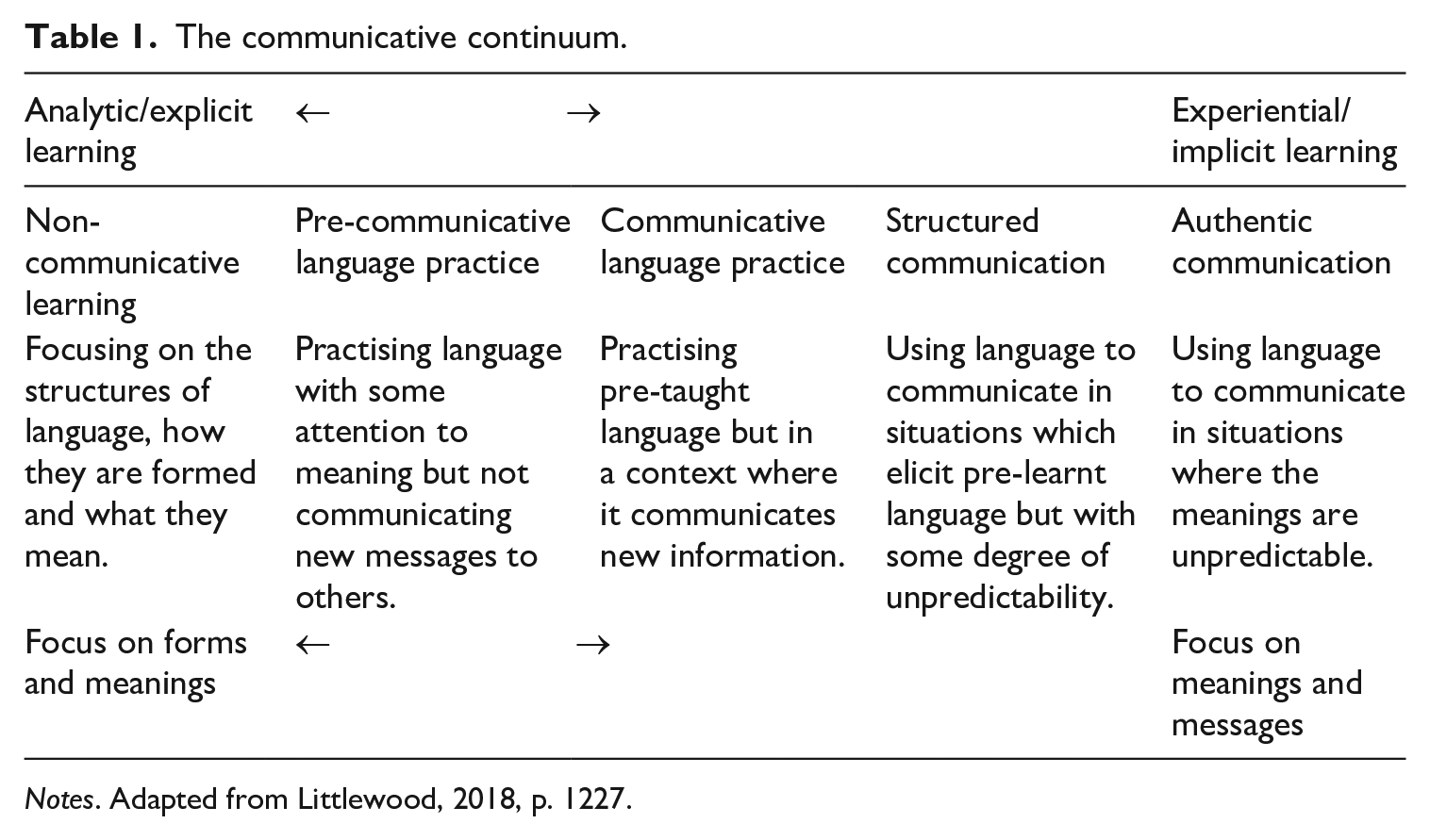
Notes. Adapted from Littlewood, 2018, p. 1227.
V Study design and method
1 Study design
In order to answer research questions 1 and 2, the types of learning activities that learners report having carried out most and least often in the classroom will be investigated. Research question 1 addresses the distribution of reading, writing, speaking and listening activities, and research question 2a ranks the most and least frequent activities carried out within each skill. Research question 2b seeks to discuss possible interference from written language in oral language practice, for example the reading of dialogues for practising oral language. Such activities are only quasi-oral since they also involve a focus on the written word. Research question 3 classifies the learning activities within the four skills into the continuous grading of teaching activities presented in Littlewood’s (2018) TBLT framework, described below.
The grading is based on the dichotomy of explicit and implicit teaching, which by Littlewood (2018) is labelled analytic vs. experiential activities. The activities are classified into five categories: Non-communicative learning, Precommunicative language practice, Communicative language practice, Structured communication, and Authentic communication (Littlewood, 2018, p. 1227).
The further to the right an activity is located, the more communicative it is considered to be. Analytical activities that focus on forms and structures are called Non-communicative or Pre-communicative learning (Table 1, columns 1–2). Experiential (experience-based) activities focus on the communicative message and stimulate implicit learning (these are labelled Structured and Authentic communication (Table 1, column 4–5). In the middle there is an activity type with a shared focus on both forms and meaningful communication: Communicative language practice (Table 1, column 3). Littlewood (2018) warns that teaching often places too much emphasis on the left-hand columns (form-focused teaching), but admits that a certain focus on linguistic forms is motivated, as long as that focus is balanced with activities of authentic communication.
2 Data collection
The procedure for data collection follows the Law on Ethical Review and Good Research Practice recommended by the Swedish Centre for Research Ethics (Vetenskapsrådet, 2017). The participants’ informed agreement was obtained prior to testing, with all participants signing a consent form. The participants were informed about the overall research plan, the aim of the research, the methods to be used, the fact that participation was voluntary and anonymous and that they had the right to cease participation at any time.
The tested group had studied Spanish for four years between the age of 12 to 15 years, which in Sweden implies around 320 instructional hours (in the general case around 2–3 classes a week). The expected level then equals an A2 according to the CEFR scale. In total 99 students participated in the study, which is based on survey data collected on one single occasion and carried out during the same period as the data collection for Aronsson (2020). An established method in the field of second language acquisition for the investigation of language use is questionnaires, where participants subsequently state the amount, type and context of language use. Some researchers have criticized this kind of data collection for carrying a risk of negatively affecting the validity of the data, as participants are often asked to estimate their language usage over a longer period, after it has finished. Alternative proposals include mobile survey applications where participants self-report assessments at repeated, sometimes randomized, intervals. It has been argued that this kind of direct reporting might gather more reliable data (see, for example, Arndt et al., 2021. However, there are also considerable inconveniences, for example the extensive commitment required of participants and the impact that the participation might have on participants’ everyday lives. In the present study, it was considered a prioritized goal to gather data from as many participants as possible in order to obtain a corpus that would be representative of a variety of study backgrounds and teacher experiences. Since the age group studied is generally a very busy group, there was a risk of high drop-out rates if the participants had perceived the data collection method as too time-consuming. If possible, it was also considered of interest to include the same the participants as in the study by Aronsson (2020) in order to enable a discussion regarding possible connections between learners’ speaking and writing performance and their self-reported learning activities. This aim was achieved, since 90 of the 99 participants of the present study had also participated fully in the study by Aronsson (2020). Ideally, the learners’ language use should have been followed longitudinally over the whole study period (four years of Spanish studies in secondary school), but this was not possible for practical reasons. Data collection was carried out only after the full study period and is to be considered a rough estimation of the most frequent activities carried out during this period, as perceived by the learners.
The data was collected at the beginning of the first semester of upper secondary school, while the students could still be expected to have a clear idea of which learning activities in Spanish they mainly engaged in during secondary school. The purpose of the survey is thus not to study details of the complexity of the learning activities, but to get an overview of the types of activities that learners perceived as being the most and least frequently used ones in the classroom. Learners from 20 different schools (rural as well as urban schools in northern Sweden) were included. The number of participants was estimated to be sufficient to compensate for any difference attributable to individual teachers’ way of teaching, the teaching books or learners’ study backgrounds.
3 Procedure
The online survey was designed to include several steps:
A survey proposal of commonly occurring activity types in reading, writing, speaking and listening in the Spanish L2 classroom was developed together with an experienced teacher (more than 25 years of teaching experience).
The proposal was then reviewed by a group of four qualified 2 teachers. These were given the opportunity to provide feedback and suggest modifications, so that the elective alternatives in the survey corresponded to activities they identified as occurring in the classroom, and also to assure that the text was formulated in such a way that young people would understand what was meant. In all, five teachers were thus involved in the survey design.
In order to further make the survey as representative as possible, empty text fields were added with space for the students to add their own comments in connection with each question. The survey also included a question where the participants were asked to evaluate the representativeness of the activity types, in order to increase the validity of the activities tested.
Prior to carrying out the survey, the different activity types were explained in dialogue with the participants, in order to ensure a coherent and identical interpretation of the alternatives. The survey thus consists of ranking questions where regular learning activities in the classroom were listed, followed by open-ended, free-text questions where the student could add a comment if they felt something was missing. The survey, translated into English, is presented in Appendix 1.
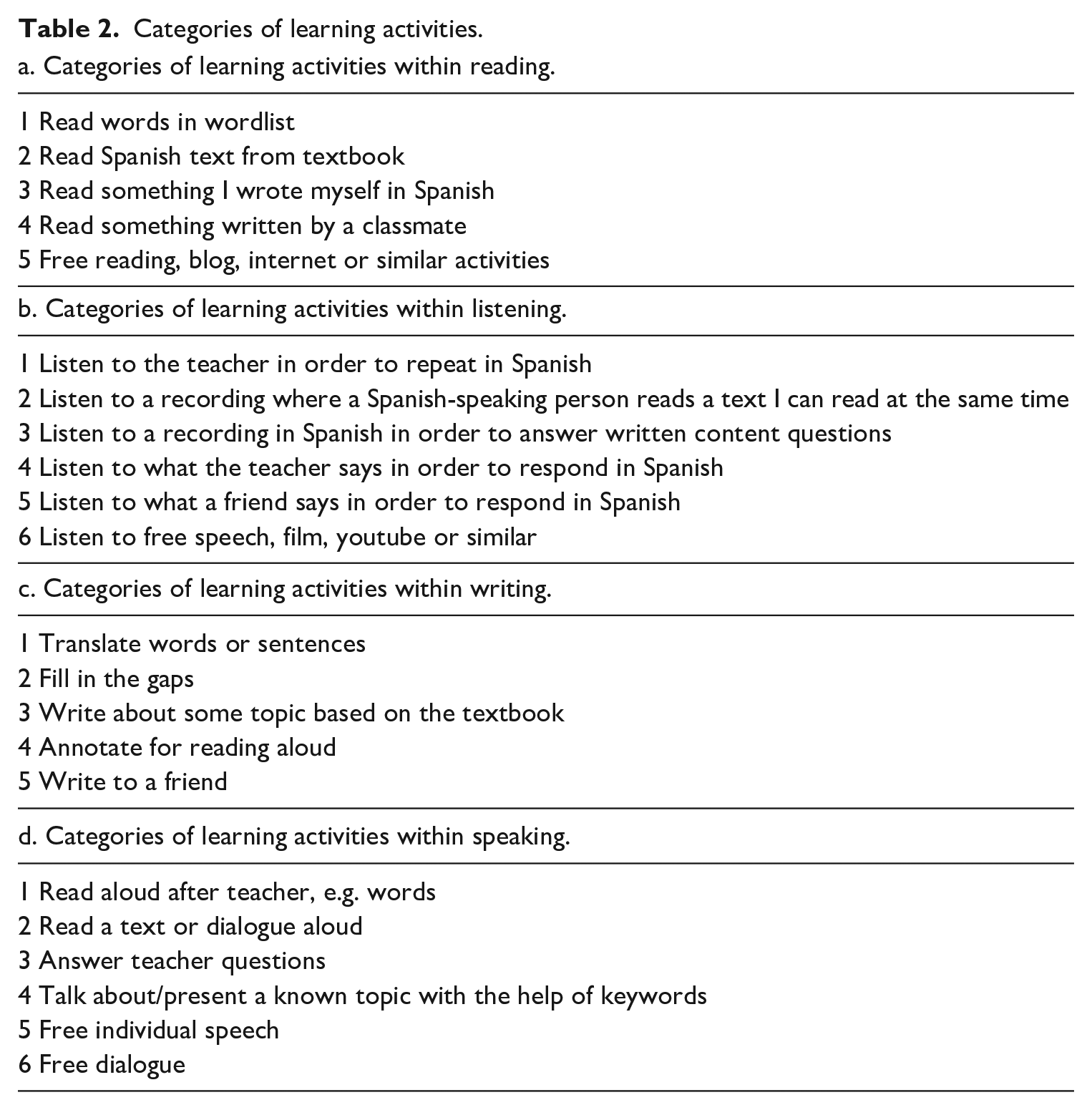
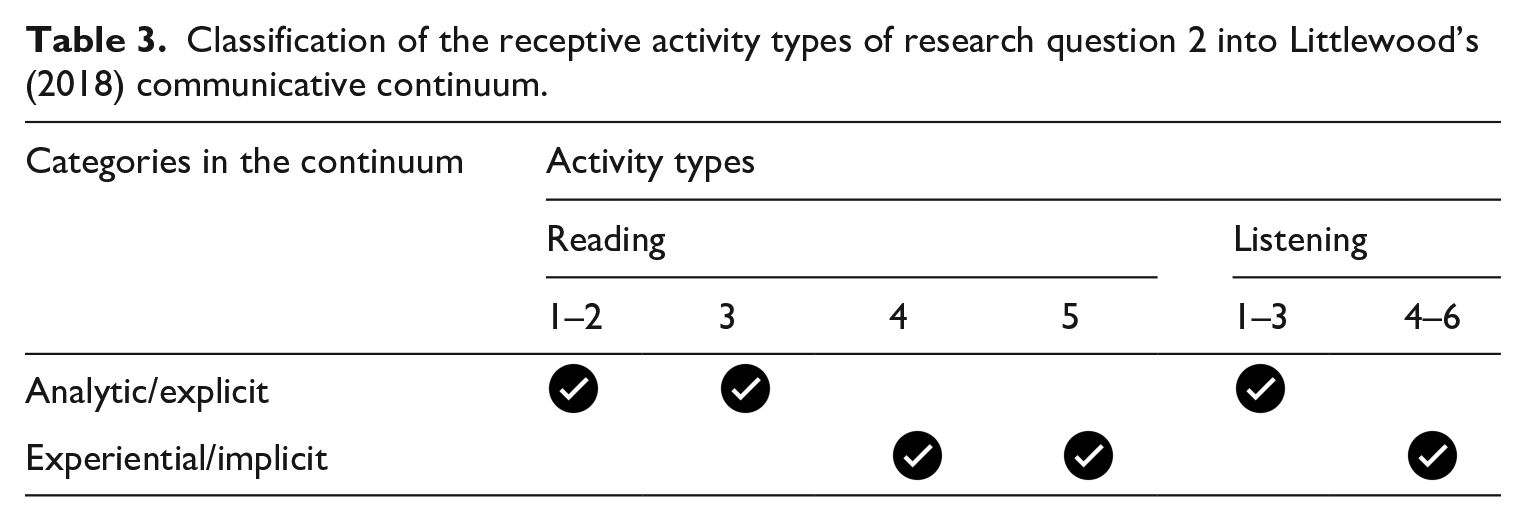
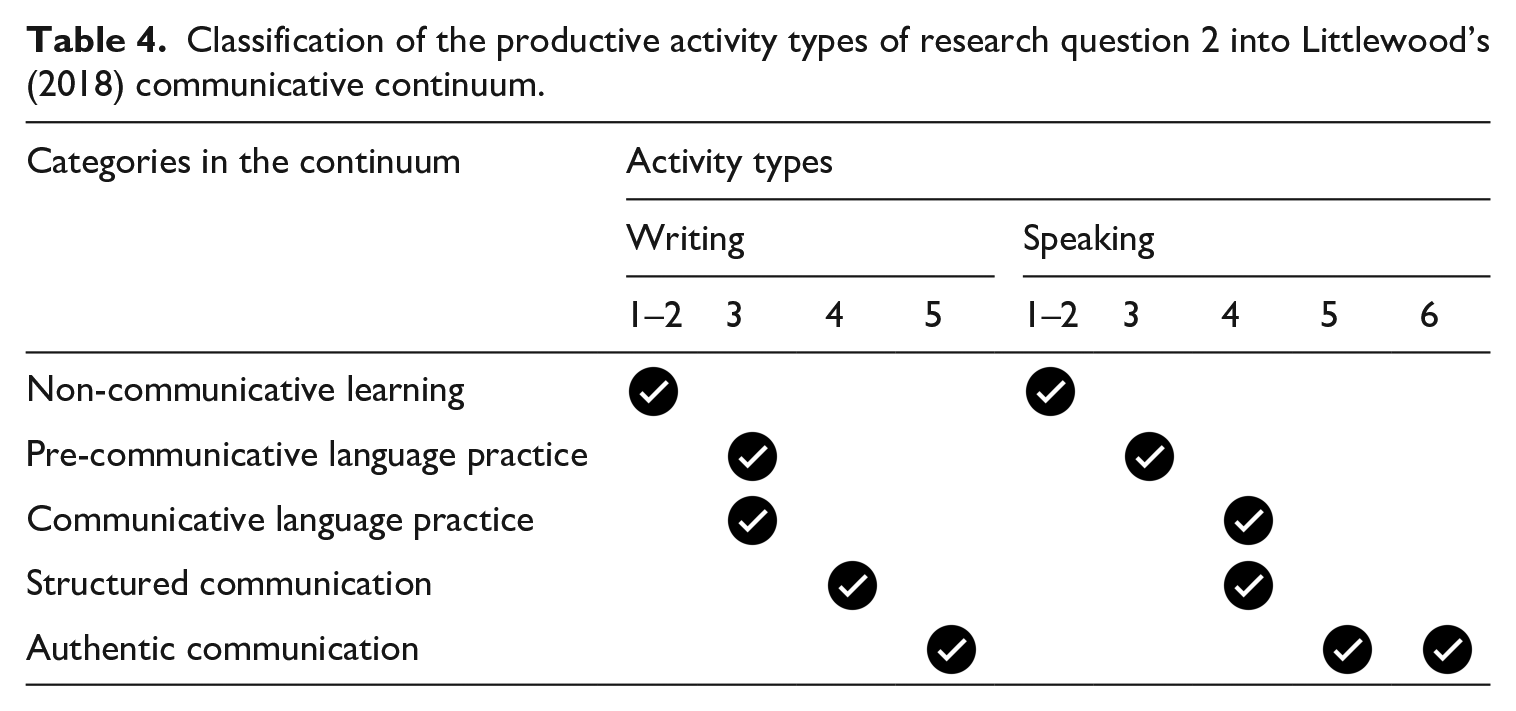
The learning activities reported were first mapped according to skills and then ranked within each skill (research questions 1 and 2a). The most frequent speaking and listening activities were checked for influence from writing (research question 2b). The activities within each skill were finally classified into Littlewood’s communicative continuum (research question 3). The five subcategories under the overarching division into analytic/explicit and experiential/implicit activities (Table 1) refer to production, not reception, and were therefore used for the classification of the productive skills. Receptive skills, on the other hand, were only classified into the two main categories of the continuum; analytic/explicit when receptive activities were focused on forms and conceptual meanings, or experiential/implicit when they had a focus on situated meanings or messages (Table 1). The same procedure was used by Brito Engman and Aronsson (2022) for the learning activities found in textbooks. Descriptions of the survey’s learning activity types are given in Table 2a–d below, grouped under Reading, Listening, Writing and Speaking. Tables 3 and 4 show how the receptive and productive activities ranked in the survey are related to Littlewood’s (2018) continuum. The rationale underlying the classification of learning activities into Littlewood’s (2018) continuum is explained below.
Categories of learning activities.
Classification of the receptive activity types of research question 2 into Littlewood’s (2018) communicative continuum.
Classification of the productive activity types of research question 2 into Littlewood’s (2018) communicative continuum.
a Rationale for the classification of reading activities into Littlewood’s (2018) continuum
Activity 1 (Read words in wordlist), Table 3, was classified as analytic/explicit since this type is based on form-training. Activity 2, (Read Spanish text from textbook), was also classified into this category, since textbook reading is usually closely connected to form-training and is not a free-choice for the learners. Activity 3 (Read something I wrote myself in Spanish) was explained to the participants prior to the survey as a type where the learners are supposed to provide corrective feedback to themselves (react to form rather than content), and thereby this type, too, is Analytic rather than Experiential. Activity 4 (Read something written by a classmate) and 5 (Free reading, blog, internet or similar) are more experiential activities which involve a focus on meaning rather than on form, where number 4 could be seen as mirroring option 5 in the writing activities. Activity 5 represents a completely free reading activity. Both were classified as Experiential.
b Rationale for the classification of listening activities into Littlewood’s (2018) continuum
Activity 1 (Listen to the teacher in order to repeat in Spanish), Table 3, is based on the behavioristic Listen and repeat formula, and Activity 2 (Listen to a recording where a Spanish-speaking person reads a text I can read at the same time) and Activitiy 3 (Listen to a recording in Spanish in order to answer written content questions) possibly involve a focus on both form and meaning but in the linguistic sense. The goal is to understand content rather than react to content. All three were therefore classified as Analytic/Explicit. Activities 4 and 5 (Listen to what the teacher says in order to respond in Spanish, Listen to what a friend says in order to respond in Spanish), and 6 (Listen to free speech, film, youtube or similar) were all classified as experiential activities, since, from the point of view of the receiver, they do not have a form-focus and may involve either pre-learnt language with some degree of unpredictability or completely unpredictable speech.
c Rationale for the classification of writing activities into Littlewood’s (2018) continuum
Activities labelled 1–2 in Table 4 (Translate words or sentences and Fill in the gaps) are clearly structurally based and were therefore classified as Non-communicative learning according to Littlewood’s definition. Activity 3 (Write about something that is based on the textbook) was explained to the participants prior to the survey as an activity involving the use of a text in the textbook as a model for a writing activity where it would be possible to personalize the text by replacing words or phrases in order to adapt it to a personal environment or context. This type can be used in many different contexts, both for writing short sequences or dialogues, or for writing longer and more coherent texts. The reason why this option was classified as both Pre-communicative language practice and Communicative language practice in writing is that the interpretation of this activity may include different degrees of independence from the model text. Activity 4 (Annotate for reading aloud) was classified as Structured communication according to Littlewood’s definition (Using language to communicate in situations which elicit pre-learnt language). This type can be seen as a combined writing-speaking activity and will also be addressed under speaking activities. Activity 5 (Write to a friend) was classified as Authentic communication since the activity was explained to the participants as a free writing activity without access to scaffolding from the teacher, textbooks or other sources. The outcome is assumed to be unpredictable and the task is comparable to an authentic communicative situation.
d Rationale for the classification of speaking activities into Littlewood’s (2018) continuum
Activity 1 (Read aloud after teacher, e.g. words) together with Activity 2 (Read a text or dialogue aloud) in Table 4 were both classified as structurally based, non-communicative learning. The activity type that Littlewood (2018, p. 1227) labels the ‘question-and-answer’-practice corresponds in our survey to Activity 3, Answer teacher questions, in which the teacher asks questions to which everyone knows the answer. This type is exemplified by Littlewood (2018) as a pre-communicative language practice (p. 1227), since it involves practice of the language with some attention to meaning, although with high predictability and without communicating new information. It was deemed unlikely that this category would be interpreted as having a free conversation with the teacher (category 6), since it was explained to the participants as an activity where the teacher asks control questions on a previously known context. Activity 4 (Talk about/present a known topic with the help of keywords) was classified as both Communicative language practice and Structured communication, since it could involve different degrees of freedom. Activity 5 and 6, Free individual speech (present something without support from keywords) and Free dialogue, were both classified as authentic communication where new messages and unpredictable speech were assumed to be involved. Finally, it should be observed that Activities 1, 2 and 4 involve a bias from written language, whereas Activities 3, 5 and 6 are assumed to be carried out without support from writing.
VI Results and analysis of the results
All but two of the 99 participants (98%) confirmed that the activities listed as options in the survey were representative of activities carried out in the classroom, which indicates a high level of representativeness. The bars of Figures 1 to 5 show the most frequent activity to the left and the least frequent to the right. The results only indicate the ranking of the frequency of these activities and do not provide information on how much time has been dedicated to each activity. The personal comments, however, do add some information regarding this matter. These comments will be discussed in Section VI.4.
1 General distribution of learning activities (research question 1)
As shown in Figure 1, writing and reading were by far the most common activities, ranked as number 1 (the most frequent) by 40% and 37% respectively. Listening was chosen as number 1 by only 13%, and even fewer, 9%, chose speaking as the most frequent activity. The second most frequent activity follows the same trend: writing-based activities are most frequent. Speaking was chosen as the least common activity (number 4 = the least frequent) by a majority, 42%. Thus, according to the results, writing is the most practised skill, closely followed by reading, while speaking is clearly the least practised one, preceded by listening.
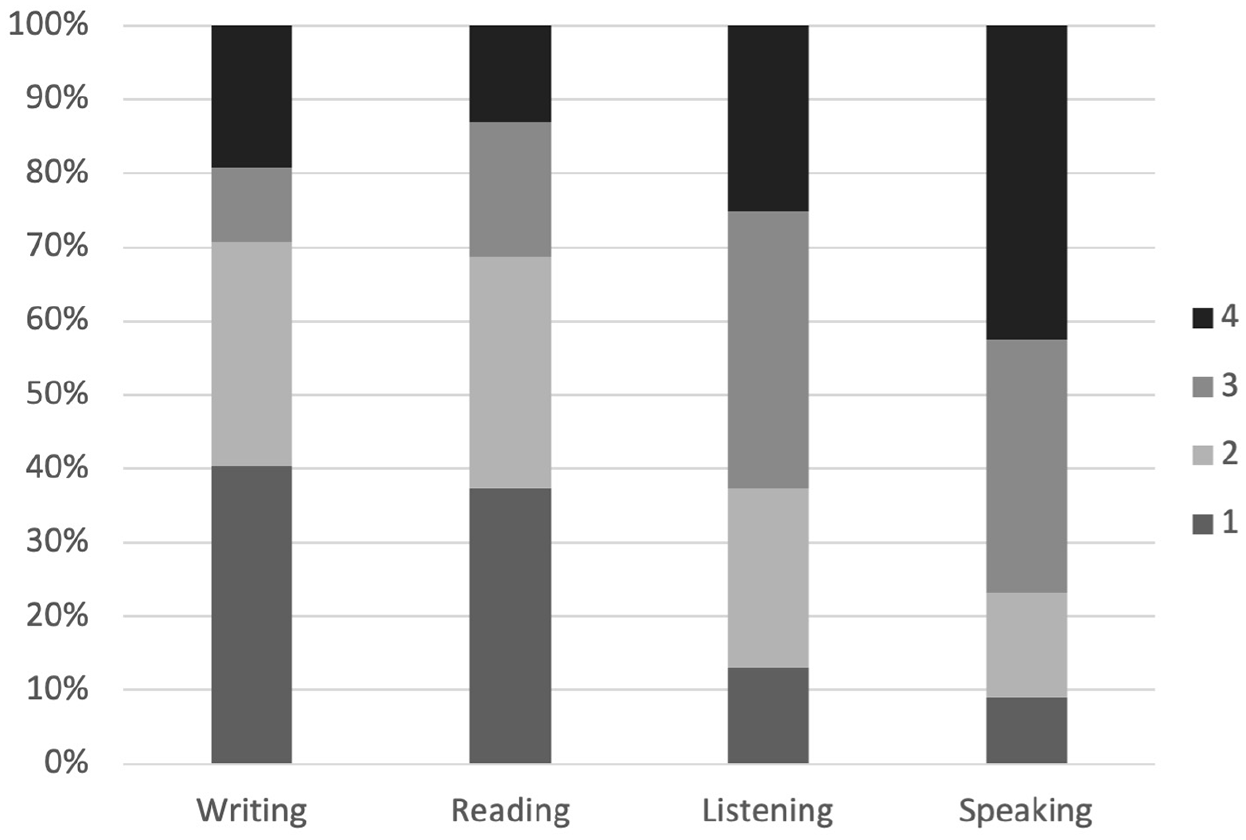
Distribution of receptive and productive skills reported by participants, where 1 = the most frequent and 4 = the least frequent activity.
2 Distribution of learning activities (research question 2a)
Below the types of learning activities that were most frequent within each of the skills listed in research question 1 are presented.
As regards reading, texts in textbooks and wordlist reading are the most frequent activities. As shown in Figure 2, Text book reading was chosen as number 1, the most frequent (49%), or the second most frequent (28%) activity by altogether 77% of the participants. Wordlist-reading comes second, with 35% and 40%, respectively, who choose this activity as the most or second most common one. Peer reading and Free reading, on the other hand, seem to be activities that are less frequent. Free reading was chosen as number 1 by 10% and Peer reading as number 1 by only 1%. Accordingly, the distribution shows a clear dominance of more controlled types, while more experiential types are reported as being less commonly occurring ones.
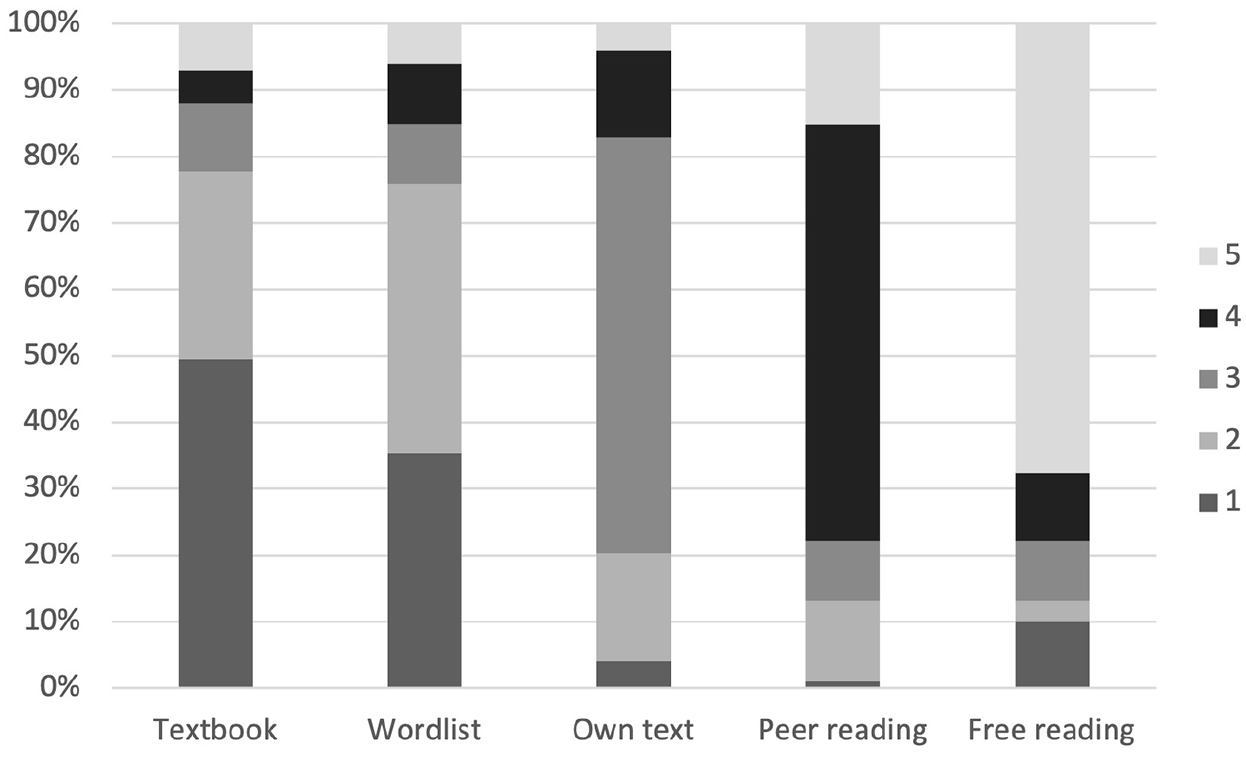
Distribution of receptive activities: reading, where 1 = the most frequent and 5 = the least frequent activity.
The most frequent listening activity (Figure 3) is Listen to the teacher and repeat, chosen by 33% as number 1 (the most frequent). Listen and read text, where oral skills are mixed with reading competence, is the second most frequent activity, chosen as number 1 by 21%. Listen to recording and answer questions was chosen as number 1 by 17%, and Listen to teacher and answer questions by 13%. The more experiential activities Listen to a friend and Watch film or youtube lag far behind, chosen as number 1 by only 8% and 7%, respectively. It should also be noted that the freest activity, Watch film or youtube, which could also be an out-of-class activity, was chosen as number 6 (the least frequent) by 57%. Added comments, like [have not done, never did, we never listened freely] (my translation) indicate that this activity type appears to be rare.
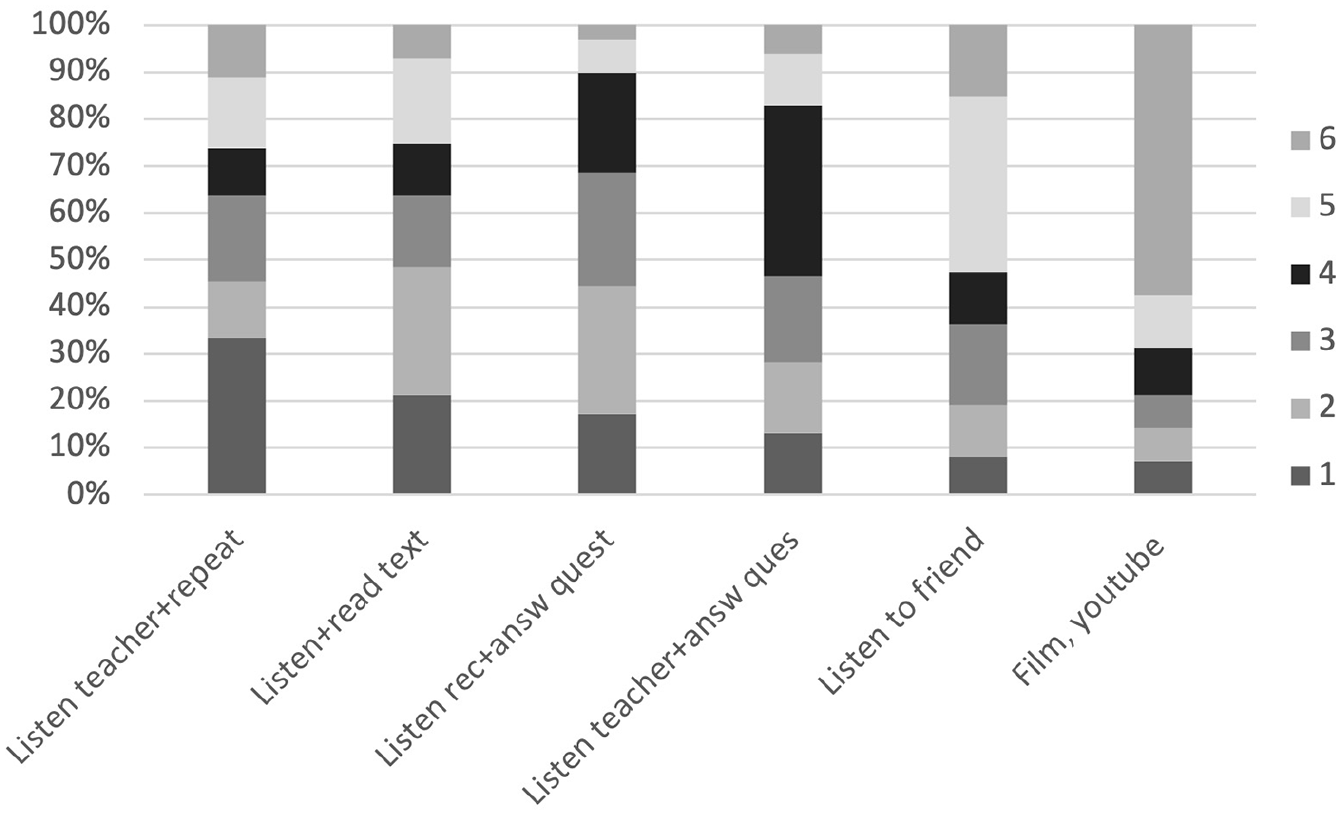
Distribution of receptive activities: Listening, where 1 = the most frequent and 6 = the least frequent activity.
Figure 4 shows that the most frequent writing activity by far is Translate words and sentences, chosen as 1 (the most frequent) by 49% and as the second most frequent by 23%. This means that translation has been chosen as the first or second most common activity by altogether 72%. This result is interesting since it shows that writing activities still seem to be dominated by types based on the grammar translation method (see Section III). The second most common activity type reported is fill-in exercises of the type Fill in the gaps, chosen by 20% as 1 (the most frequent). The tendency for structured activity types to be the most frequent is in line with the results for reading and listening. However, the dominance of the more structured types is greater for reading and writing than for listening. The least frequent types are clearly the freer types – Annotate for reading aloud and Write to a friend – chosen as number one by only 4% and 12%, respectively. In sum, writing seems to be mainly a solitary activity with no immediate receiver of the message.
The distribution of speaking activities follows the same pattern as the other skills: structured types, such as Read text aloud or Read aloud after teacher, are found at the top. The types Read text aloud, chosen by 41% as number 1 (the most frequent) and by 30% as the second most frequent, and Read after teacher, chosen by 25% as the most frequent and by 23% as the second most frequent, display a distribution roughly similar to that of the listening activities Listen and repeat after teacher and Listen and read text. Speak from notes and Answer teacher questions clearly have a lower frequency than the first-mentioned activities, while freer activities are the least frequent. The dominance of reading text aloud over the other speaking skills is salient. Freer activities like Talk about/present a known topic without support from notes (labelled Free individual speech in Figure 5) and Talk freely with someone about a familiar topic (labelled Free dialogue in Figure 5) were reported as by far the least commonly occurring ones, chosen as number 1 by only 3% and 7%, respectively.
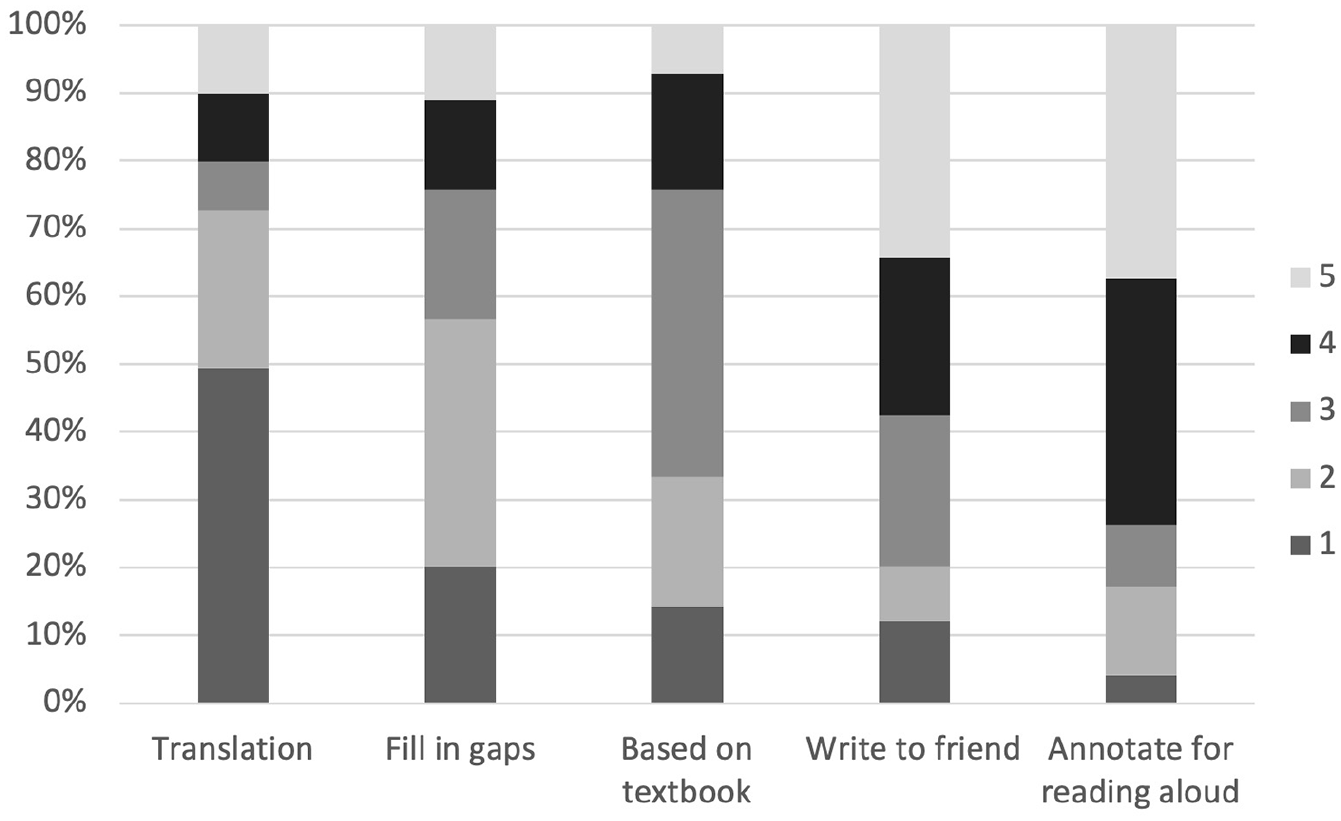
Distribution of productive activities: Writing, where 1 = the most frequent and 5 = the least frequent activity.
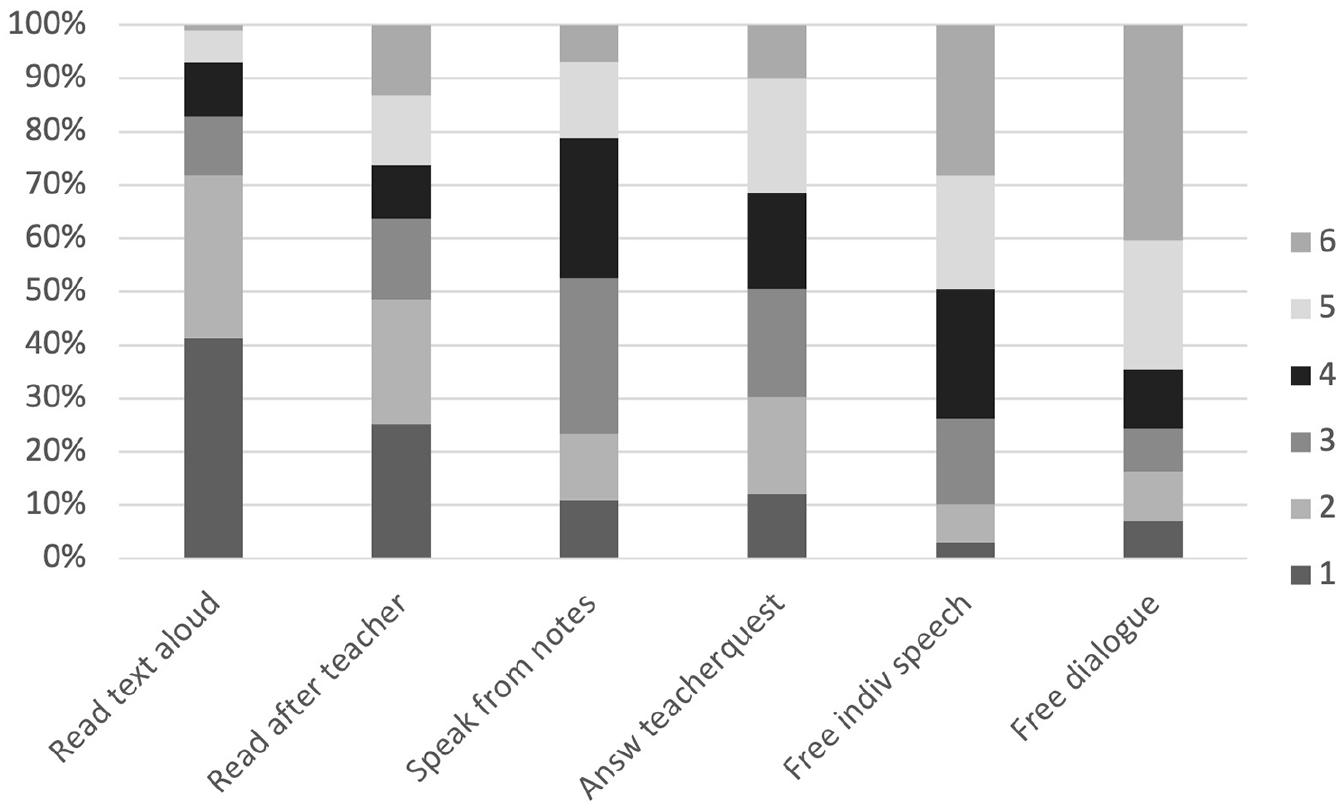
Distribution of productive activities: Speaking, where 1 = the most frequent and 6 = the least frequent activity.
3 Distribution of quasi-oral and oral learning activities within listening and speaking (research question 2b)
Research question 2b studies the influence from writing in the most frequent activity types within the receptive and productive skills involved in oral language, listening and speaking. Activities with influence from writing have been labelled quasi-oral. In order to answer research question 2b, the activities chosen as number 1 (the most frequent) within listening (Figure 3) and speaking (Figure 5) were classified into quasi-oral and oral types (Figures 6 and 7). The definition of quasi-oral or oral is based on the presence or absence of the words read or write in the survey options (Appendix 1).
As regards speaking, the activities Read text aloud, Read aloud after teacher and Speak from notes were classified as quasi-oral, since they all include writing based skills. The remaining three, Answer teacher questions, Talk about/present a known topic without support from notes and Talk freely with someone about a familiar topic were classified as oral. The distribution is shown in Figure 6, where the quasi-oral activities constitute 78%. Thus, the dominance of activities that include influence from writing is overwhelming.
The activities Listen and read text (Activity 2) and Listen in order to answer written questions (Activity 3), classified as quasi-oral as they explicitly involve influence from writing, constitute 38% of the activities chosen as number 1. The other activities classified as oral, thus constitute 62% of the total number of the most frequent activities. Even if influence from writing is considerable also in the practice of listening skills, the oral listening activities reported by learners seem to have less influence from writing than the speaking activities. It is important to bear in mind, though, that the most frequent of the oral listening activities is Listen and repeat after teacher, reported as 1 by 33%. It cannot be excluded that this type also involves reading (for example the repetition of words in a list), even if this is not explicitly stated in the survey.
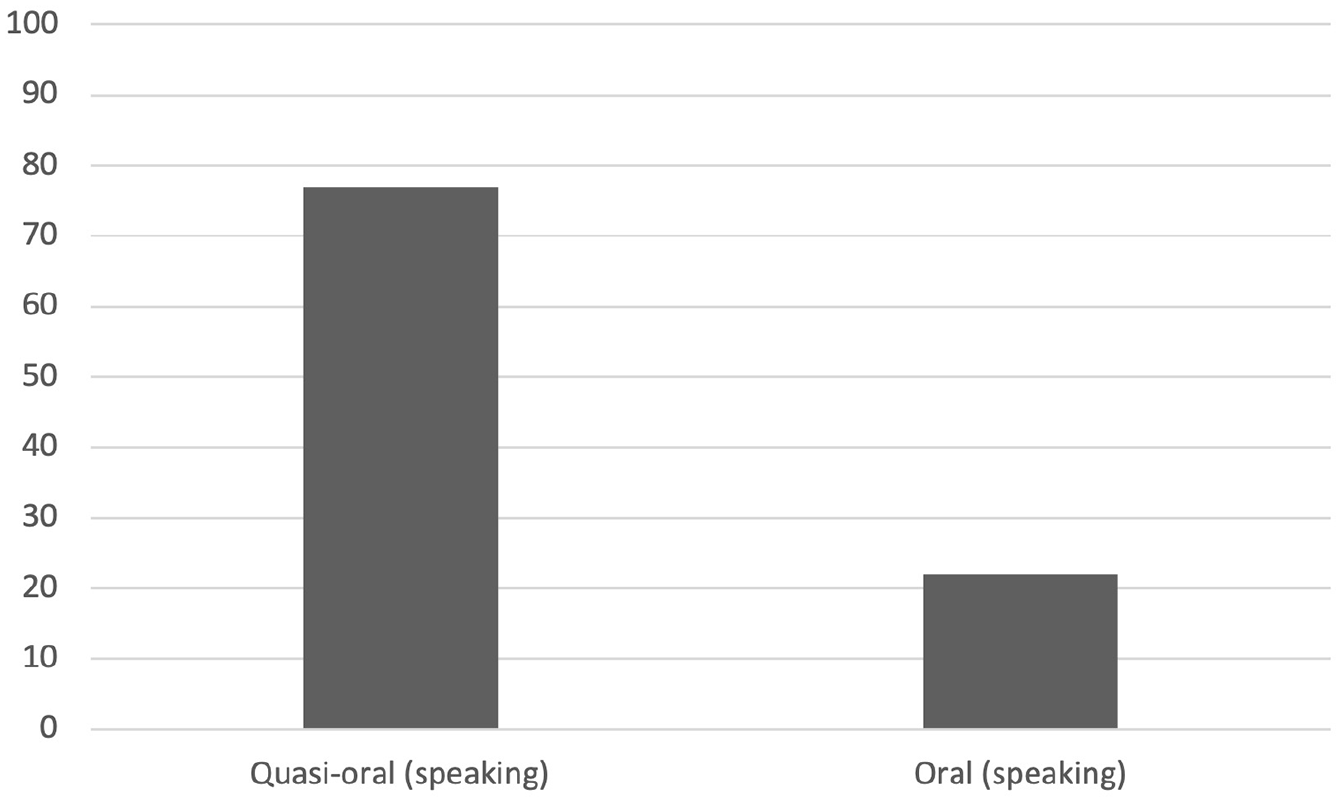
Percentage of quasi-oral and oral activities chosen as 1 (the most frequent) within speaking.
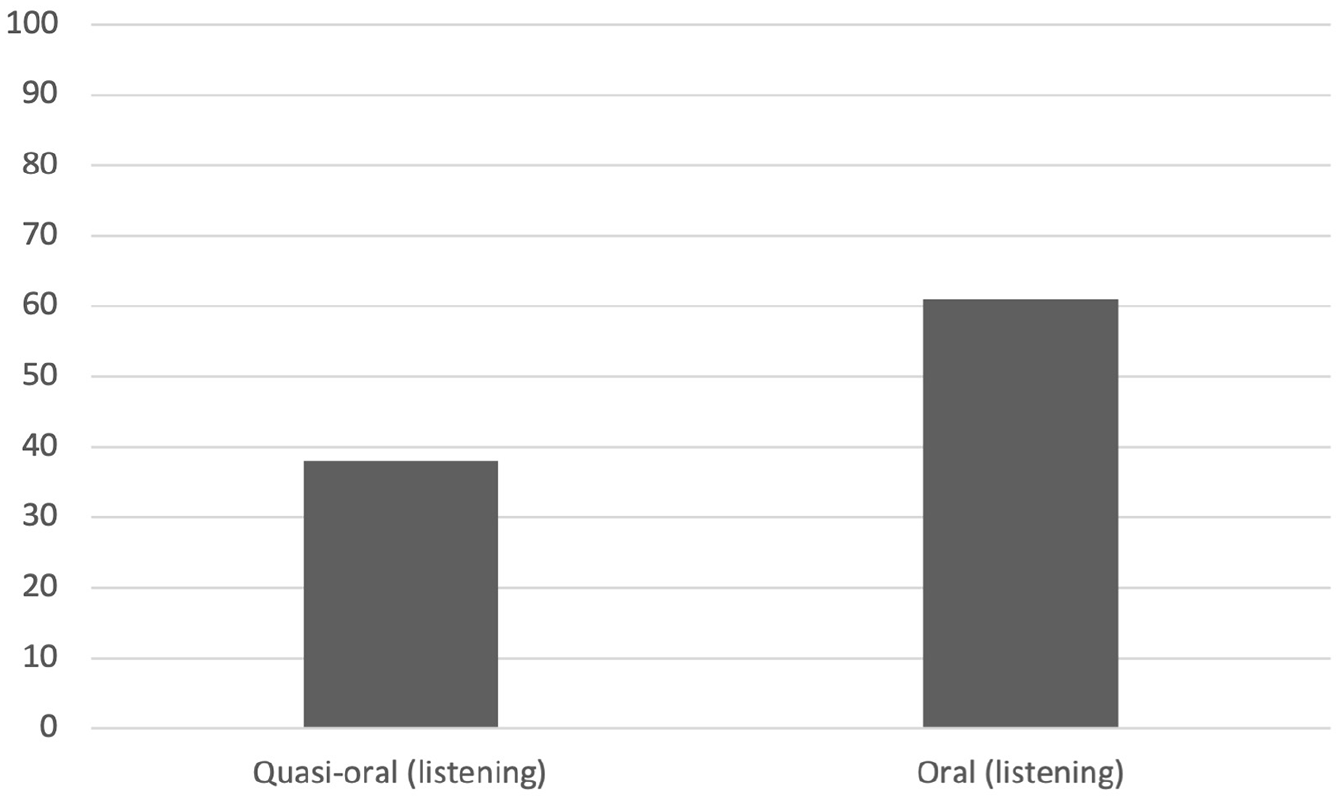
Percentage of quasi-oral and oral activities chosen as 1 (the most frequent) within listening.
4 Comments from participants
Some of the participants added personal (optional) comments after they ranked the different skills and activities (see Appendix 1). Some examples have been added below. Comments 1–6 below belong to the first question (1), the ranking of the frequency of the four skills, while 6–12 were comments added to the final question (6), where the participants were asked to comment on the representativity of the activities (98% found the activities to be representative and some added a personal comment).
The comments have been translated literally into English.
We mostly wrote, listened and read in about the same amounts, but talked very little.
We mostly wrote, because we used to write down every lesson what the teacher wrote on the board or write our own texts, etc.
We have mostly done reading and writing.
Read and write almost in equal amounts and talk and listen very seldom.
Have not listened or talked very much at all.
One thing we did was to read aloud to each other in the textbook.
Have not spoken Spanish at home or outside school.
Not done much at home as we have barely had homework at all.
We hardly ever had homework so we did almost everything in the classroom.
Almost only wordlist reading at home.
Only read words in wordlist at home.
Have not had homework.
Comments 1–6 support the results of the ranking questions: both the personal comments and the ranking of skills practised point to the dominance of writing-based activities. Comments 6–12 support the assumption that practice of Spanish mainly takes place in class, not out of class. It also seems that when the language is practised out of school, wordlist reading is mentioned as the activity carried out. The pedagogical implications of a probably low exposure out of class have been discussed in the Conclusions.
5 Distribution of the types of learning activities found in research question 2 in relation to a TBLT framework (research question 3)
Below, the most frequent activities in the classroom (Figures 2–5) are related to a TBLT framework, and thereby to a functional, action-oriented approach to language teaching. Figures 8 to 11 show the learning activities chosen as number 1 (the most frequent), in the survey, i.e. activities that learners reported to be the most common ones, classified into Littlewood’s (2018) framework. The rationale for the classification has been explained in Section V.3. The percentages shown in the graphs were counted as follows: For example, the analytic activities within reading were chosen as number one (the most frequent activity) by totally 88 out of 99 participants: Textbook reading (49), Wordlist reading (35), or Read own text (4); see Figure 2. The classification of these activities as analytic has been motivated in Section V.3. Eighty-eight out of 99 represent 89% of the total. Then 89% of the participants chose an analytic activity as number 1 (the most frequent).
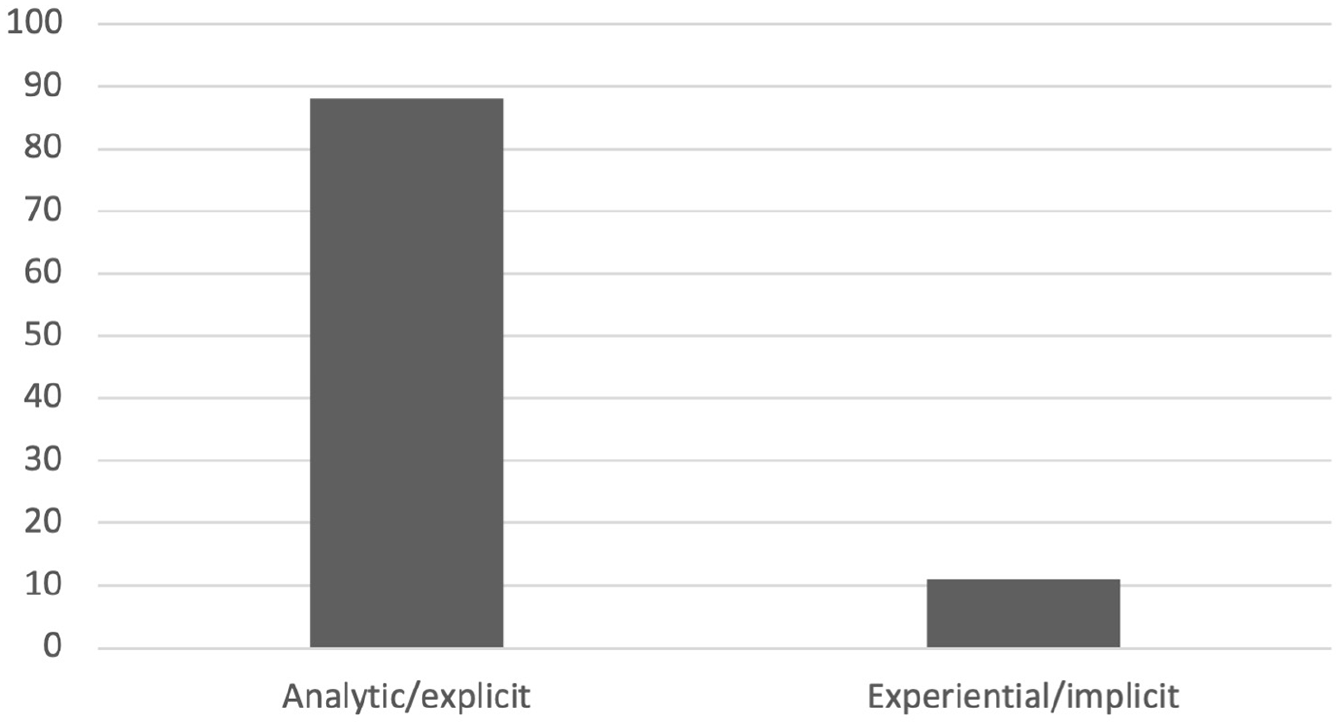
Distribution of reading activities along Littlewood’s (2018) communicative continuum.
Options 1–3 (Wordlist reading, Textbook reading and Read own text) were all categorized as analytic rather than experiential (focusing on form and meaning). Options 4 and 5 (peer-reading and free reading) were both classified as experiential (focused on meanings and messages). The results show that 89% of the activity types chosen as number 1 (the most frequent) are activities classified into the analytic/explicit category, whereas only 11% of the participants’ first choice activities are experiential types according to our classification criteria (see Section V.3).
Options 1–3 of Table 1: Listen to teacher and repeat, Listen to a recording of a text in order to read at the same time and Listen in order to answer content questions (Figure 3) were classified as Focus on forms and meanings rather than Focus on meanings and messages (see Table 1) and thus they are analytic/explicit rather than experiential. Options 4, 5 and 6 (Listen to what the teacher says in order to respond, Listen to what a friend says in order to respond, and Listen to free speech in a film, youtube or similar) were all classified as experiential activities, since the focus is on the message rather than the form. As shown in Figure 9, there is a dominance of analytic/explicit types chosen as number 1 (the most frequent activity) (71%), while experiential listening activities were selected as the most frequent activities by only 29%.
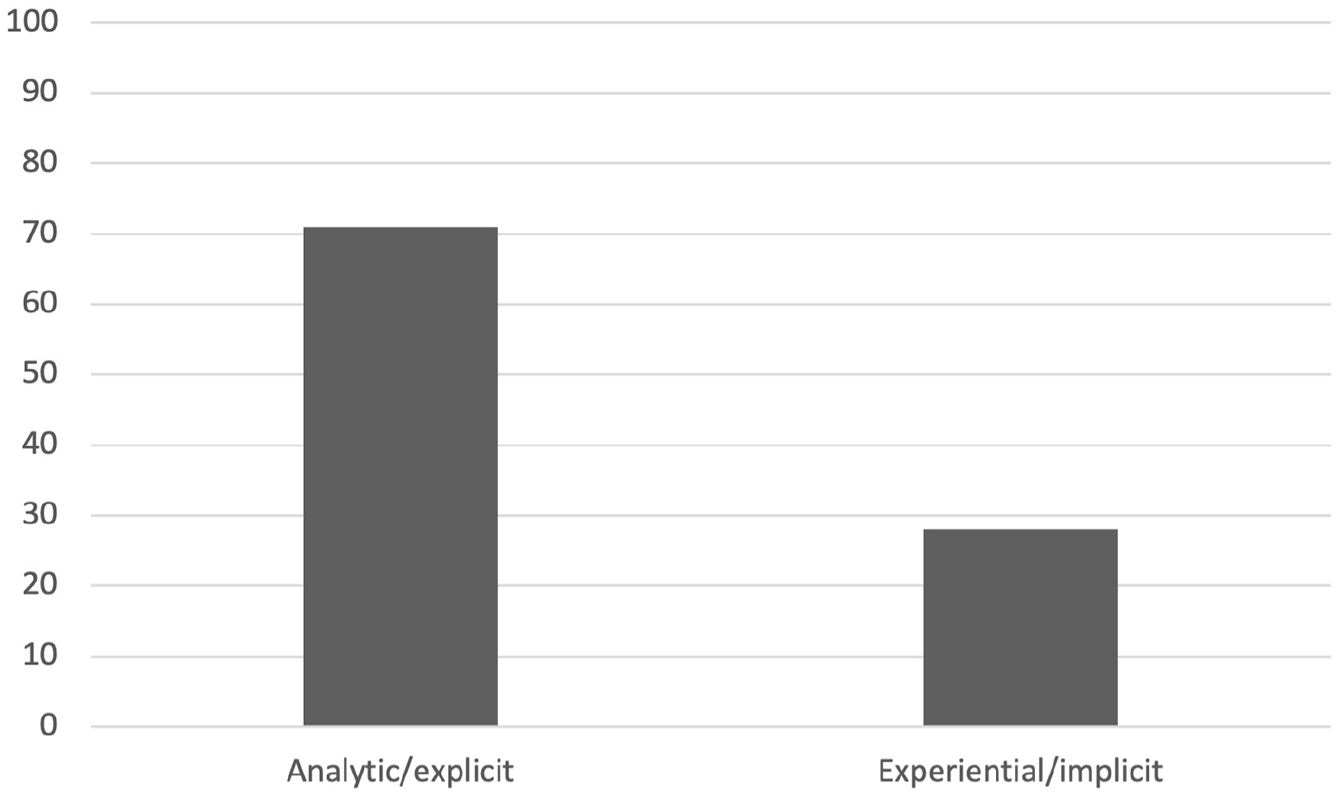
Distribution of listening activities along Littlewood’s (2018) communicative continuum.
The activities Translate vocabulary and Fill in the gaps (Figure 4), classified as Non-communicative learning according to Littlewood’s definition (see Section V.3.c), were chosen as number 1 (the most frequent activity) by 69%. Only 12% chose the more communicative writing activities in the category Authentic communication as number 1. Activities within the categories Pre-communicative language practice and Communicative language practice of the framework were chosen as the most frequent activities by 14% while Structured communication is by far the least frequent type (4%). The dominance of non-communicative activity types is massive.
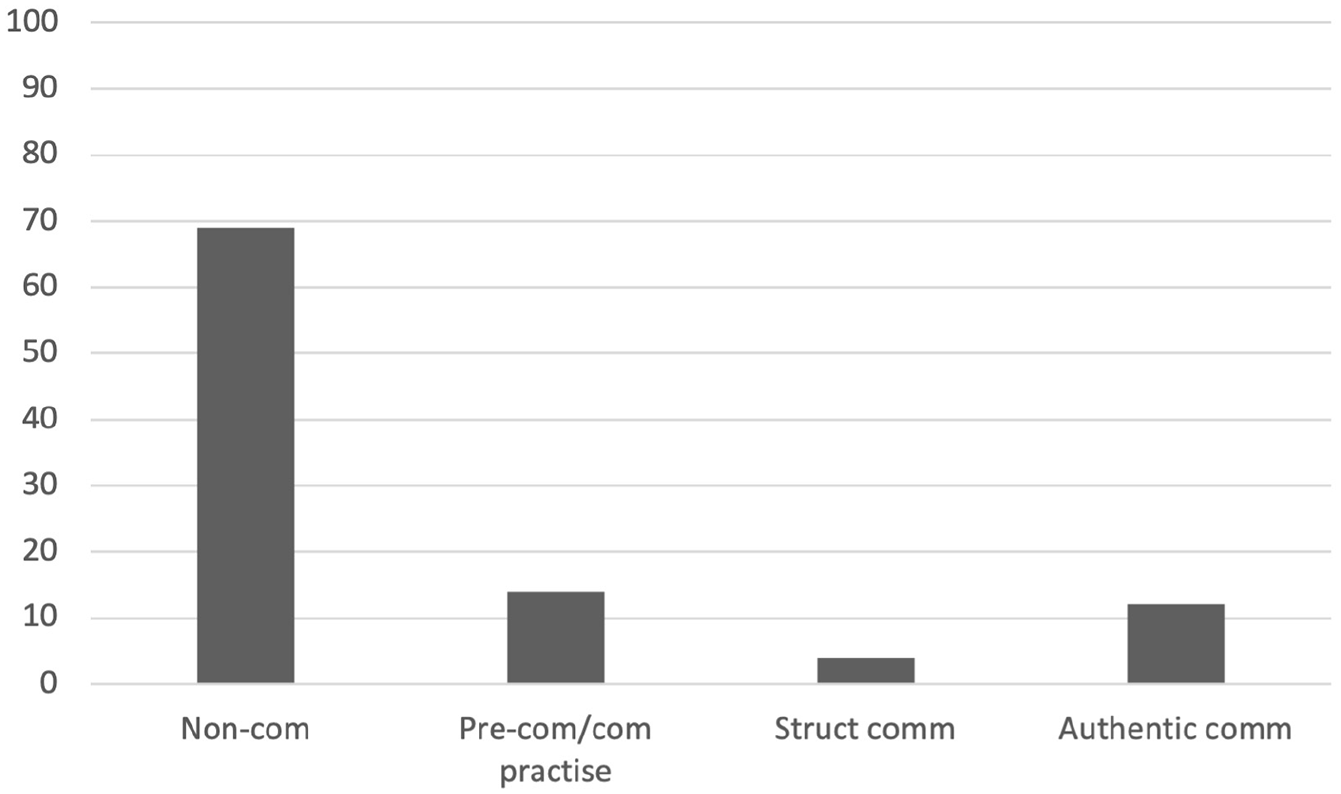
Distribution of writing activities along Littlewood’s (2018) communicative continuum.
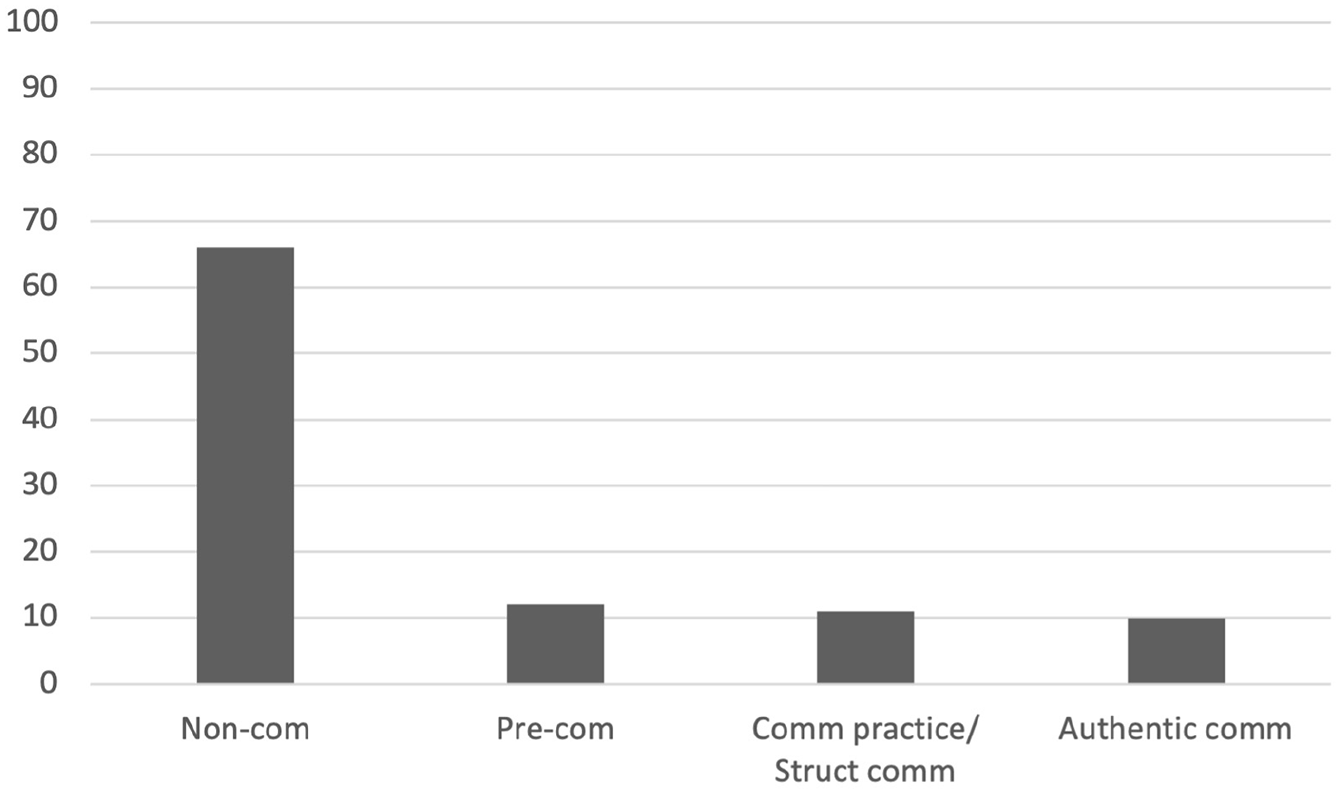
Distribution of speaking activities along Littlewood’s (2018) communicative continuum.
The same trend, a dominance of non-communicative activity types, is observed for speaking (Figure 11). The activities Read aloud after teacher and Read aloud a text or dialogue, both classified as non-communicative learning (see Section V.3.d), were chosen as number 1 (the most frequent activity) by 66% of the participants. The rest of the activities chosen as number 1, in all 34%, were distributed among Pre-communicative language practice, Communicative language practice / structured communication, and the freer types found within Authentic communication. The activity types in the category Authentic communication were chosen as number 1 by only 10%.
VII Conclusions
The activity types investigated were perceived as representative by 98% of the participants, which indicates a high validity of the tested types. As regards research question 1, i.e. which of the skills reading, writing, speaking, and listening participants reported as being most vs. least often practised in the classroom, writing and reading were by far the most common activities, chosen as the most frequent by 40% and 37%, respectively, while only 13% (listening) and 9% (speaking) chose oral receptive and productive activities as the most common ones. The results for the ranking of the most and least common activity types within each skill (research question 2a) show a clear dominance of more controlled types, while the more communicative or experiential types are reported as less commonly occurring ones. The distribution of the most frequent productive activity types along Littlewood’s (2018) continuum (research question 3) shows that the non-communicative activities in the left-hand column are overrepresented. The same tendency is observed for the receptive activities listening and reading, which are dominated by explicit/analytic types. The spontaneous comments from participants addressed in Section VI.4 support the results: form-training and non-communicative activities seem to be dominant in all skills. The results are in line with results from Brito Engman and Aronsson (2022) regarding course books. Altogether, the learners’ ranking of the classroom activities do not coincide with the intentions of the action oriented framework proposed by the Council of Europe (2001) and by the Swedish policy documents, since the great majority of the most common activities are not centred around real-life communicative situations where speakers act as ‘social agents’ (Council of Europe, 2001, p. 9).
The results for research question 2a indicate that most common listening and reading activities are based on the listen-and-repeat formula, wordlist and textbook reading. Writing appears to be a mainly solitary activity with no immediate receiver of the message, since this skill tends to be practised by means of form-training exercises, typically translation of words and sentences, rather than as a medium of interactional communication. A similar tendency can be seen in the speaking activities, which, like the writing activities, are dominated by form-training. Structural activity types based on a combination of reading-and-speaking or writing-and-speaking, in this study labelled quasi-oral types, constitute an overwhelming majority, 78% (research question 2b). Even the listening activities show a considerable influence from writing. The dominance of the written language found in both the learning activities reported in the present study and in textbooks (Brito Engman & Aronsson, 2022) is suggested as a contributing explanation for the poor results found for speaking abilities as compared to writing abilities in Aronsson (2020).
The dominance of structurally based, non-communicative activity types found in both the learning activities analysed in the present study (research question 3) as well as in the textbooks (Brito Engman & Aronsson, 2022) is suggested as a factor that may play a part in the low results reported for Spanish as L2, as compared to English in the ESLC (2012). The limited extramural exposure to Spanish in comparison to English, earlier proposed as a contributing explanation for the differences found in language development (see, for example, Bardel et al., 2019; Erickson & Pakula, 2017), increases the impact of the design of in-class activities for the learning process, since these constitute a major part of the learning opportunities. Comments from participants of the present study indicate that out-of-class language practice is low, and in case it takes place, it mainly consists of form-training, wordlist reading and the reading of texts in text books. This evidence, however anecdotal it may seem, together with results from earlier studies, supports the assumption expressed in Section III: the activity types carried out in the classroom are probably highly influential in the learning process, since they constitute the main part of all language practice. However, the learners’ out-of-class engagement with the language (or lack thereof) would still need to be investigated more in detail. To sum up, it seems like even though the communicative paradigm of language teaching has been prevailing in policy documents for several decades, the influence from structural models still appears to be considerable in classroom practice, both in learning materials and classroom activities.
A strength of the study is that it included the same participants as in Aronsson (2020), which enabled a discussion about explanatory factors for the results of the former study. It should also be mentioned that the activity types tested in the present study turned out to be very similar to those found in textbooks by Brito Engman and Aronsson (2022). The agreement with the results from Brito Engman and Aronsson (2022) supports the idea that textbooks seem to guide teachers’ practice. On the other hand, it could be considered a weakness of the present study that it is based on the learners’ subjective perceptions of how they have practised the language. As always when a self-report instrument is used for data collection, the accuracy of the collected data runs the risk of suffering from recall errors. Additional studies are therefore suggested to complement the current one, for example classroom observation studies.
As Littlewood (2018, p. 1228) points out, the extreme left of the diagram (Table 1) is where most teachers concentrate their activities. These categories have the strongest focus on the linguistic form. He proposes that the model could be used by teachers in order to organize classroom activities in a more balanced way along the continuum. It is suggested that the results of this study might act as a wake-up call for both teachers and teacher students to include more communicative types of activities in their teaching and make them aware of the invisible bias from written language in oral activities. If both teachers and learners used form-training with the explicit goal to provide tools for the authentic communicative situation later on, having in mind ‘how do we apply the knowledge of the linguistic form in the authentic communicative situation?’, then authentic communicative practise would naturally occupy a greater role and as a consequence more space in the right-hand columns of Littlewood’s (2018) continuum. It is also important to bear in mind that oral reception and production are skills in their own right and deserve to be recognized as such.
