




Abstract
The education of newly arrived students is a debated global policy issue. Less attention has been paid to the sub-group of students with limited experience of schooling, referred to here as ‘newly arrived students with limited schooling’ (NALS). This article explores Swedish policy frameworks that inform the education of newly arrived students, comparing policy approaches from two time periods (1983–1996 and 2013–2016) during which the numbers of NALS were said to be increasing in Swedish compulsory schools. Framed within a poststructural approach to policy analysis and Foucault’s theorisation of heterotopian spaces, the analysis explores policies’ representation of separate teaching groups for newly arrived students, with a particular focus on what these spaces have to offer NALS. The findings indicate a shift between the two periods: from a focus on knowledge acquisition in policies of the 1980s and 1990s towards an emphasis on integration in those of the 2010s. This shift is particularly evident in relation to NALS, whose educational needs are discussed only to a limited extent in relation to subject knowledge in the 2010s policies. It is argued that this serves to homogenise the educational needs of the category newly arrived, thereby potentially obscuring the conception of NALS.
Introduction
The question of how compulsory education systems should address newly arrived students has attracted increased attention in recent decades. This is evident in the introduction of new labels, categories and policy approaches with the aim of identifying and serving the educational needs of this diverse student group (King and Bigelow, 2018). Still, even though most school systems assume not only proficiency in the dominant language but also that adolescent students ‘have been involved in continuous, print‐based textual engagement with school subjects across the compulsory years of schooling’ (Woods, 2009: 87), specific measures for newly arrived students continue to be predominantly directed towards language acquisition (Brown et al., 2006; Woods, 2009). This is argued to leave a particular group of newly arrived students largely overlooked, namely those with limited experience of formal schooling. This study explores how this group, hereafter referred to as ‘newly arrived students with limited schooling’ (NALS), is established and dealt with in Swedish education policy.
The education of newly arrived students constitutes a contentious area, in which assumptions on the interrelation between citizenship, nationality and knowledge are brought to the fore. Critical inquiries of education policy have demonstrated how discourses of ‘trauma’ and racialised discourses of cognitive or cultural inferiority tend to homogenise migrant students and potentially distract schools from viewing them as knowledgeable subjects (Buchardt, 2018; Fylkesnes, 2019; Gruber, 2002; Rodriguez, 2015). Similarly, findings from studies at the school level suggest that specific educational measures concerning migrant students, in addition to a need for language acquisition, are often motivated by students’ presumed need for socialisation into the culture of the new country (Fridlund, 2011; Hilt, 2017). Considerably less academic attention has been paid to the more delimited group of NALS (Young-Scholten, 2015). However, ethnographic inquires suggest that these students are particularly at risk of being positioned within racialised or psychological discourses. Thus, cultural or cognitive factors, rather than their limited school experience, tend to serve as explanations for school failure within this group (Brännström et al., 2019; Roy and Roxas, 2011).
Against this background, it is interesting to explore how NALS are positioned within the policy frameworks of a country with a relatively great deal of experience of receiving newly arrived students. The case of Sweden also entails some further characteristics of interest. First, in 2016, Sweden adopted a new and extensive set of legislative changes addressing the education of newly arrived students. This policy was introduced in a period during which the country was also witnessing a steep rise in NALS (Swedish Government Official Report (SGO), 2017) and could therefore be assumed to, at least to some extent, address the schooling of this sub-category. Second, despite NALS currently being regarded as a relatively ‘new’ phenomenon in Western schools (e.g. Tarone, 2010), this group was addressed by Swedish educational policy as early as the 1980s. The Swedish context is thus able to provide policy materials from different periods, making it possible to compare conceptualisations of this particular issue across time. Not only does such an approach have the potential to challenge the tendency of school systems in the West to perceive the increase in (different ‘populations’ of) migrant students as new and temporary ‘crises’ that will soon pass (cf. Mohan et al., 2013); it also constitutes a particularly effective way of highlighting the contingency in policies production of objects, subjects and issues as ‘particular kinds’ (Bacchi and Goodwin, 2016: 22–23).
Hence, drawing on a poststructural approach to policy analysis (Bacchi and Goodwin, 2016) and Foucault’s concept of ‘heterotopia’ (Foucault, 1998), this article explores discursive patterns across time in Swedish policy approaches to newly arrived students in general and NALS in particular. The overarching aim of this inquiry is to explore if, and how, NALS are framed as ‘particular kinds’ of subjects, with particular kinds of educational needs.
The policy context
In 2016, the category newly arrived was implemented in Swedish legislation, defined as a student who arrived in Sweden from another country after the age of seven and who has been enrolled in a Swedish school for less than five years (SNAE, 2016). NALS constitute a subset of this category that neither holds legal status nor is officially defined. Nevertheless, as I will demonstrate, this subset has been targeted by different policy measures, but to a lesser extent than the newly arrived ‘in general’.
In the 1980s, Sweden adopted a generous refugee policy, whereby compulsory schools now to a higher degree encountered children whose life trajectories had entailed limited access to schooling (Swedish Government Official Report (SGO), 1983). Since these students’ educational needs were not deemed to be satisfied within the measures that up to then had been organised for newly immigrated students, special classes particularly addressing NALS – base classes – were introduced in regional policies (e.g. Garefelt and Hedberg-Granath, 1987). Whilst it seems as if teaching groups reserved for NALS are occasionally organised in Swedish compulsory schools even in recent times (SGO, 2017), there is no established term for, or regulation of, such practices. This reflects the contemporary situation in Sweden, in which NALS are rarely distinguished as a separate group, in either research or policy (SGO, 2017). Therefore, to be able to trace current policy responses to this particular group, one must turn to the restrictions that address the student category newly arrived. As previously mentioned, a new set of policy measures specifically designed to cater for this student group was implemented in 2016. These involved the legal formalisation of the preparatory class. This is a commonly adopted separate teaching practice for compulsory school, in which newly arrived students are prepared for entering the mainstream teaching (Nilsson and Bunar, 2016). The legislation of this practice entailed restrictions on the amount of time that a newly arrived student is allowed to be educated in a preparatory class, and schools were thereby prohibited from placing a newly arrived student in a preparatory class full-time and for longer than two years. The purpose of this was to avoid the reported occurrence of students being ‘stuck’ in preparatory classes for extended periods of time, and often experiencing them as spaces for ‘othering’ and social marginalisation (e.g. Nilsson Folke, 2017; Skowronski, 2013). This legislation was hence ‘guided by a desire to avoid social segregation between newly arrived students and the rest of schools’ (Crul et al., 2019: 7). Even so, there is much to indicate that NALS are often placed in preparatory classes for considerably longer periods than other newly arrived students (Korp et al., 2019; SGO, 2017). Thus, insofar as specific measures involving NALS can be traced from the 1980s to now, these are predominantly linked to ‘special’ classes, separated from the mainstream teaching. This leads me to take a closer look at the classes reserved for newly arrived students and/or NALS and inquire into what these practices, as presented in policy, have to offer their students.
Theory and methodology: Analysing educational spaces
Teaching practices that specifically address newly arrived students, i.e. base classes and preparatory classes, can be considered ‘exceptions’ in a school system that normally presupposes Swedish proficiency as well as many years of formal schooling in regard to adolescent students. As such, I will explore them as heterotopias, a term used by Foucault to describe ‘different spaces’ (Foucault, 1998: 179; see also Cenzatti, 2008). Broadly, heterotopias can be described as spaces that in some sense are different from – or outside – the wider society of which they are a part, often reserved for specific individuals or groups. Yet, they form spaces in which all other sites that form a culture or society are ‘simultaneously represented, contested, and reversed’ (Foucault, 1998: 178). Here, I suggest that preparatory classes and base classes can be regarded as such ‘different’ sites, located both within and outside the ‘society’ that makes up the regular or mainstream school and that they, as such, also say something about the normality from which they differ.
Foucault gives examples of a wide range of different kinds of heterotopias but argues that ‘they can be classified into two major types’: crisis heterotopias and heterotopias of deviation (1998: 179). The crisis heterotopia is reserved for individuals who are considered to be in-between – and therefore outside – accepted social identities. Hence, the crisis ‘consists of the temporary absence of a recognized social identity’ (Cenzatti, 2008: 3), which can also be referred to as a state of liminality (Van Gennep, 1960). When a person has transgressed from one social position to another, it is time to leave the crisis heterotopia, which means that this is a space in which visitors are constantly replaced (cf. Cenzatti, 2008). In contrast, heterotopias of deviation may be more permanent solutions for individuals or groups considered unfit for modern society due to their ascribed deviation ‘with respect to the mean or the required norm’ (Foucault, 1998: 179).
Heterotopias are, moreover, characterised by ‘temporal discontinuities’ (Foucault, 1998: 182), which could be explained as cracks in – or the abolishment of – time as it is normally perceived. In analogy to the concept of heterotopia, Foucault uses the term heterochronia to describe these ‘other’ temporalities. Hence, the concept of heterotopia has provided me with a tool for inquiring into separate classes for newly arrived students as possible solutions to a kind of ‘deviation’ or ‘crisis’ in an educational context (cf. Barden, 2016), and moreover, as spaces where the normal temporality and pace of compulsory school are, in different ways, challenged, inverted or disturbed.
The analysis in this article is further guided by the Foucault-inspired methodological approach ‘What’s the problem represented to be?’ as described by Bacchi and Goodwin (2016). Central to this methodology is the study of solutions proposed in policy through which more or less implied problems can be identified. For this study, this entails an interrogation as to what kinds of problems base and preparatory classes are set out as solutions to. In line with this methodology, policies are regarded as producing problems rather than merely reflecting problems that are ‘out there’ to be found. Problem representations are not seen as either neutral or static, and attention is hence brought to the ways in which thoughts and subjectivities are shaped by them.
Material
The analysis draws on policy documents that regulate and/or provide guidance in relation to the schooling of newly arrived students at the compulsory school level in Sweden. The material was strategically selected, primarily based on an ambition to draw conclusions about policy responses concerning NALS over time. I have therefore chosen to focus the analysis on two time periods (1983–1996 and 2013–2016), both during which: (1) Numbers of NALS were said to be significantly increasing in Swedish compulsory schools and (2) NALS were framed as a new challenge to the Swedish school system, which, in turn, was constituted as particularly ill-equipped to meet the needs of this student group (SGO, 1983, 2017).
Due to the limited selection of policies that specifically address the education of NALS, there are some limitations to this article’s comparative approach. First, the analysed documents from 1983 to 1996 on the one hand and from 2013 to 2016 on the other partly operate on different levels of governing. Second, they do not address the exact same student population: whereas the 1983–1996 policies address the more delimited population of NALS, the 2013–2016 policies address newly arrived students in general. Whilst the latter policy hence addresses a broader group, I explore it with particular attention to what it means for NALS. This can also be considered symptomatic of the shift I am tracing in this article, whereby contemporary policy to a lesser extent explicitly sorts out and addresses this student group. So, whilst this could be regarded as a methodological weakness, it nevertheless reflects an actual – and in my view, interesting – difference between the two policy contexts.
Table 1 provides a list of the analysed material. From the first period (1983–1996), two policies are selected that offer guidance in the teaching and organisation of base classes. These policies, introduced in Sweden’s two largest municipalities, constitute two of the most comprehensive policies addressing NALS in Swedish educational policy history. The third analysed document is a Government Official Report that addresses immigrant and minority students but also includes a particular section on NALS. Although this section does not entail guidance on base classes, it is included in the analysis to provide a broader, national context for the period during which the two regional policies were introduced.
Analysed documents.
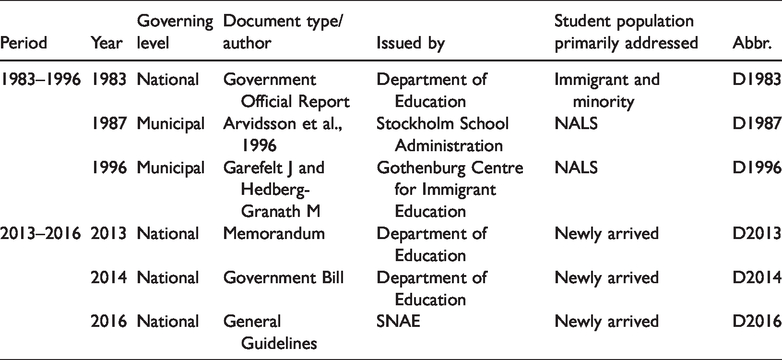
To my knowledge, there is no current or more recent Swedish policy that offers methodological and/or organisational guidance in the teaching of NALS in a way similar to the above-described reports. Instead, the policies introduced between 2013 and 2016 address the broader category of newly arrived students. These documents constitute a ‘policy chain’ (Fylkesnes, 2019) representing texts from different levels within the legislative process of redefining education for newly arrived students. The Memorandum (D2013) contains recommendations for how the reception and teaching of newly arrived pupils should be regulated. Based on these recommendations, the Government Bill (D2014), in turn, contains proposals for amendments to the Education Act. Finally, the General Guidelines (D2016) for the education of newly arrived students include recommendations for how municipalities and school staff should act to meet the requirements of the legislation implemented in 2016. 1
Data analysis
The policy texts were analysed with a focus on patterns and shifts in solutions proposed and advice given in relation to teaching for newly arrived students in general and NALS in particular. More specifically, in the policies from both periods (1983–1996 and 2013–2016), I searched for the ways in which NALS needs were articulated, and how they were conceived in relation to other students. In the policy texts that also addressed other or broader student populations, this meant paying particular attention to passages explicitly referring to NALS. For this purpose, a word search (including Swedish terms such as ‘skolbakgrund’ [Eng: previous schooling]) was applied. This initial scan of the documents led to an analytical focus on the preparatory and the base class, since the vast majority of the recommendations involving NALS were carried out in relation to these practices. By ‘working backwards’ from the dominant patterns of proposals, the policies’ core problem representations in relation to these practices were then identified (Bacchi and Goodwin, 2016: 17). This analytical process formed the basis for an analysis of the preparatory and base class as heterotopias: different spaces installed as solutions to ‘crises’ or ‘deviations’.
The aforementioned differences regarding the addressed student populations meant that the analytical process differed on some points between the policies from 1983 to 1996 on the one hand and the policies from 2013 to 2016 on the other. Hence, in the analysis of the 2010s policies, also recommendations on the preparatory class that did not specifically address NALS were analysed. Moreover, attention was, in the analysis of the 2010s policies, directed towards the tensions and contradictions that appeared between the advice regarding ‘all’ newly arrived and that directed primarily at NALS. Finally, whilst attention was predominantly given to the advice offered in relation to base and preparatory classes, in the case of D1983, more general advice on the teaching of NALS was also taken into account.
Findings
NALS: In need of ‘different spaces’
A point of consistency between the policies from 1983 to 1996 and 2013 to 2016 is the view that NALS are particularly in need of being placed outside the ordinary educational context. In the policies from 1987 and 1996, the base class is suggested as a space in which NALS can receive ‘the particular kind of education’ they are thought to require (D1987: 21).
2
This differs from the 2010s policies, in which there is no recognition of base classes or other teaching practices that are strictly reserved for NALS. But even if the preparatory class in the 2010s policies is framed as a response to a wider group of newly arrived students, NALS are singled out as being in greater need of this space, or, put differently: as particularly unfit for mainstream education (D2014: 47). This is illustrated in the first quote below, while the second provides an example of the framing of the base class in the 1983–1996 policies: One idea behind setting up preparatory classes is that students should be able to be included in the mainstream teaching in a good way. For example, students who have no or limited school background will not benefit from attending a mainstream class if they cannot follow the instruction, e.g. because the pace is too fast (D2013: 42). In order to give [NALS] students good conditions for learning, the teaching needs to take place in a stable group where the goal is not that the student should transfer to a mainstream class, but that he/she should gain knowledge and skills that other students of the same age usually have, which takes time (D1996: 12).
The base class: A heterotopia of (knowledge) deviation
In the analysis of the policies from 1983 to 1996, two predominant patterns emerged: first, a consistent focus on school subject knowledge and second, the positioning of NALS as significantly different from other students – ‘Swedish’ as well as other ‘immigrant’ students. Through these logics, the base class is constituted as a response to a knowledge deviation, deriving from an interruption in the expected school trajectories of adolescent students. As suggested by Cenzatti (2008: 4), ‘heterotopias of deviance are fixed spaces with fixed populations’. In line with this description, the base class is proposed as a – if not permanent, at least long-term – solution: ‘It is important not to interrupt the time in the base class too soon, before the students have acquired the necessary basic knowledge’ (D1987: 23. cf. D1996: 12). Thus, although the base class is represented as potentially ‘isolating’ on a few occasions (e.g. D1996: 21), it is proposed that placement in the base class should last as long as students’ level of knowledge is still considered to make them unfit for the regular school setting.
Until then, the base class should provide students with knowledge and skills, and more specifically, ‘the knowledge and skills that other students of the same age usually have’ (D1996: 12. Cf. D1987: 4). NALS are ‘different’ in the sense that they did not have a childhood in which they regularly, and from a young age, attended formal education and thereby acquired a specific set of knowledge and skills (cf. D1983: 123; D1987: 2; D1996: 11, 50). Within the framework of compulsory schooling, where age, grade placement and knowledge content are tightly linked, this becomes problematic. Not only do the later grades presuppose certain ‘prior knowledge necessary to be able to understand the subject content’ (D1996: 23); there is also a lack of teaching material at a beginner level that addresses adolescent students. This is illustrated in the quote below: Since [the base class] carries out teaching at the beginner level, the students often have to start from the same level as the students in Grade 1. Such books are, however, clearly designed for younger students (D1996: 43).
The preparatory class: A crisis heterotopia
The preparatory class can be chosen in order to give newly arrived students the knowledge they need to be able to participate in the mainstream teaching (D2016: 8).
Shifting the focus to the 2010s policies and the constitution of the preparatory class, the knowledge focus described above is not as manifest. Admittedly, the preparatory class, too, is in some instances produced as an answer to students’ insufficient knowledge. This is the case, for example, in the definition of the preparatory class above, in which it is produced as an alternative for providing newly arrived students with the knowledge they need, and implicitly lack. However, there are few specifications as to what kind of knowledge this might be. In the section ‘Teaching in the preparatory class’ (D2016: 30–31), for example, it is only in the closing sentence that explicit guidance is provided regarding the teaching in the preparatory class. There, it is stated that: In all teaching, in the preparatory class as well as in the mainstream class, the teachers need to emphasise the students’ strengths and challenge them instead of addressing deficiencies (D16, 31). One reason […] may be that the student is assessed to be in need of much more knowledge in Swedish, e.g. because the student started their education very late and due to deficient or total absence of previous schooling has not acquired a written language (D2014: 47). The preparatory class usually gives the newly arrived student a calm start and the opportunity to be gradually introduced into the Swedish language and the Swedish school culture, which is central from an integration perspective (D2013: 42–43).
Crises with different durations: Temporal dimensions of the preparatory class
One way of understanding the above-described silence – or ambiguity – around the knowledge content tied to the preparatory class is against the background of an increased and one-sided focus on newly arrived students’ participation in the mainstream teaching (e.g. D2016: 8, 28; D2013: 7, 78; D2014: 29, 62). This means that advice is primarily directed towards the transfer from the preparatory class rather than on the activities in the preparatory class itself. For example, the vast majority of the recommendations in the previously mentioned section, ‘Teaching in the preparatory class’, deal with (organisational) measures that are thought to enable a rapid transition to the mainstream class: Cooperation between teachers is said to ‘accelerate the student’s transition’ (D2016: 31), and study guidance in the mother tongue is said to enable transition ‘at an earlier stage than otherwise’ (D2016: 31), while physical placement far from other teaching is said to limit the student’s opportunities to ‘participate more and more in the mainstream teaching’ (D2016: 31). Overall, the preparatory class is in similar ways constituted as a ‘time-limited teaching form’ (D2013: 78) that students should leave ‘as soon as possible’ (D2016: 8, 30).
In this way, the preparatory class is imagined as a form of heterochronia linked ‘to time in its most futile, most transitory and precarious aspect’ (Foucault, 1998: 182). Instead of a space of absolute separation, it is thus produced as a place reserved for individuals only during their strictly time-limited liminal condition (cf. Cenzatti, 2008). Due to the transitory nature of their stay, the inhabitants of the preparatory class – indeed a ‘different space’ after all – are thought to be slightly less marked by this difference (e.g. D2013: 51), which, in turn, reduces the risk of ‘differentiation and segregation’ (D2013: 78) and ‘permanent categorisations of students’ (D2014: 46).
As indicated in the preceding section, there are, however, passages that link the preparatory class to a significantly different temporal constitution. In the previously discussed passage on the benefits of the preparatory class for NALS, expressions such as a calm start and to be gradually introduced (D2013: 42–43) suggest that the advice more commonly offered in relation to the preparatory class (accelerate the student’s transition) does not apply to NALS. Nonetheless, it is largely through its temporal constitution that the preparatory class is constituted as a different space: either as a heterochronia marked by transition or, when proposed for NALS, as a heterochronia marked by stability, slow progression and pace.
In both instances, the explicit desired outcome –‘integration and inclusion’ (D13: 70) – remains the same. This is illustrated in statements such as ‘The preparatory class usually gives the newly arrived student a calm start […] which is central from an integration perspective’ (D2013: 43). Whether or not a rapid transition to mainstream teaching is promoted, ‘integration’ is produced as an overarching goal, which can be achieved by both ‘an extended separation from’ and ‘a rapid participation in’ the mainstream teaching. The potential conflict – with exclusion presented as a core problem at the same time as NALS are constituted as difficult to include – is thus made invisible through a ‘temporal relocation of the problem’ whereby inclusion for some students is thought to be achieved over time (Hilt, 2015: 179). Thus, even though the patterns of advice offered in relation to newly arrived in general and to NALS in particular thus seem to contradict each other, they are still permeated by the same logic, in which temporal aspects of integration, rather than knowledge aspects, dominate the policy discourse.
Discussion
This article has sought to analyse policy recommendations in relation to teaching practices that target newly arrived students in general, and NALS in particular, drawing on policy documents from two time periods. The analysis suggests that a shift has taken place over the course of the analysed periods: from a focus on knowledge acquisition in the policies from the 1980s and 1990s to a focus on inclusion and integration in those from the 2010s. This is manifested in the constitution of base and preparatory classes as two rather divergent ‘different spaces’; whereas the base class is represented in the 1983–1996 policies as a heterotopia of (knowledge) deviation, in the 2010s policies, the preparatory class is instead produced as a response to a relatively loosely defined and transient crisis, linked to the transition from one national context to another. The suggestions connected to the preparatory class are, further, primarily answers to the problem of exclusion or segregation, which means that this practice is ‘emptied’ as a space for learning and knowledge acquisition.
I would hence suggest that both the base class and the preparatory class can be understood as spaces of ‘compensation’ (Foucault, 1998: 184) that, on the one hand, protect NALS from educational spaces that are seen as poorly arranged in relation to their needs. On the other hand, they – particularly, the base class – protect the order of the mainstream teaching that can thereby carry on, undisrupted. However, whilst the base class also seems to have something to offer the students (knowledge acquisition), the preparatory class appears more as a ‘negative’ offer for NALS, i.e. primarily as an offer not to be exposed to something (the mainstream teaching). This since the primary offer of the 2010s policies – that of rapid inclusion into the mainstream – does not apply to them.
In this closing section, the focus will be primarily directed at the 2010s policies, whose dominant patterns will be traced in relation to overarching tendencies in the Swedish educational policy landscape during this period. First, however, I want to address some potential objections to the claim that the findings indicate a shift away from a focus on knowledge. Admittedly, there are several possible explanations for the comparatively vague character of the knowledge recommendations found in the 2010s policies. For example, during the time span included in the analysis, the governance of Swedish schools has shifted from detailed methodology guidelines into a logic of management by objectives (Lundahl, 2005). Moreover, in comparison to the 1983–1996 policies, those from the 2010s address a more heterogenous student population, which could be assumed to obstruct detailed specifications. However, the fact remains that with regard to the regulation of temporal aspects of the preparatory class, the 2010s policies are indeed both detailed and precise, and also differentiate between subsets of the student category. This suggests that possible explanations for this finding should also be sought elsewhere.
This is especially true when seen in the light of dominant trends on the Swedish educational policy landscape during the twenty-first century. Between the mid-2000s and 2014, extensive education reforms were implemented in Sweden, primarily in response to an alleged ‘knowledge crisis’ in Swedish schools (Magnússon et al., 2019). Accordingly, students’ knowledge acquisition was at the heart of these reforms, which makes the silence around knowledge in the 2010s policies all the more noteworthy. Moreover, scholars in the field of special education connect the reforms of the mid-2000s to 2014 to a growing scepticism towards inclusive education observed during the same period (Isaksson and Lindqvist, 2015; Magnússon et al., 2019). It thus appears as if an overarching tendency to prioritise ‘knowledge’ and ‘results’ has affected the discourse on special education towards increased support for separate teaching practices, whereas the discourse on education for newly arrived students has simultaneously moved in the opposite direction. This indicates that ‘inclusion’ (and ‘knowledge’) is constituted differently in relation to newly arrived students than to other students, and perhaps that newly arrived students’ need for inclusion/integration is regarded as more acute. This is hinted at in the following quote from D2013, which stipulates that the preparation class, unlike special teaching groups, should be regulated based on students’ need for integration: The regulation of the preparatory class will, with this proposition, be regulated based on the needs of newly arrived students both in terms of teaching and in terms of opportunity for integration. This means that […] the regulation proposed for the preparatory class will differ from the regulation on special teaching groups, i.e. the form of special support that can be provided outside the classroom to students with special educational needs (D2013: 79–80. My emphasis).
In conclusion, I suggest that this shift in policy serves to homogenise the category newly arrived in ways that risk obscuring the educational needs of NALS. Whilst the silence around knowledge perhaps partly derives from a well-meant ambition to avoid differentiation or the negative labelling of students, it actually risks positioning NALS – whose educational needs are largely framed as ‘more of the same’, at a slower pace – as merely a lesser version of the ‘ideal’ newly arrived student.
Footnotes
Declaration of Conflicting Interests
The author declared no potential conflicts of interest with respect to the research, authorship, and/or publication of this article.
Funding
The author received no financial support for the research, authorship, and/or publication of this article.
