




Abstract
Across European and OECD countries, the number of migrant students is rising. In the Netherlands, reception classes offer intensive programs to newly arrived migrant students who cannot yet use the Dutch language sufficiently to follow mainstream secondary education. In reception classes, an important role is attributed to language scaffolding, which supports learners to engage with content in a language they only partially know. Through an exploratory descriptive design this study investigated language scaffolding strategies reported by nine teachers across nine interviews and observed in a combined total of 21 lessons. The results show that language scaffolds on the word, sentence, and text-levels were applied to support students in meeting both receptive and productive demands. In total 23 different language scaffolding strategies were identified across the three levels and two types of demands. Language scaffolding occurred most often on the word-level and teachers scaffolded the word-level in 13 different ways. Language scaffolding on the word-level should thus neither be regarded as a monolith, nor should the 10 different strategies that occurred on the sentence and text-level be disregarded. These findings can offer teachers approaches to supporting multilingual learners, inform their professional development, and guide policymakers’ decisions about curriculum requirements.
Keywords
Introduction
Educators in many parts of Europe are developing approaches to provide quality education to newly arrived migrant students (NAMS). Across European and OECD countries, the number of migrant students is rising (European Commission/EACEA/Eurydice, 2019; Forghani-Arani et al., 2019; Organisation for Economic Cooperation and Development (OECD), 2022). PISA data show a consistent performance gap between NAMS and native-born students (OECD, 2016, 2019, 2023). Even though all 193 UN member states have committed to providing quality education to these young people (United Nations, 2016), NAMS do not always have access to quality education (Emery et al., 2023). Moreover, teacher practices in NAMS contexts are a relatively recent area of investigation (Burner and Carlsen, 2022) and studies that investigate teacher practices that contribute to quality education are limited (Murphy, 2021). When this relatively limited number of studies in an emerging field is tied to the performance gap mentioned above and the lack of access to quality education, it becomes clear that the ways in which NAMS education can be implemented effectively require further investigation.
Reception classes are a common way to organize initial education for NAMS in Europe and the United States (Alvarez et al., 2023; European Commission/EACEA/Eurydice, 2019). In this model, NAMS are placed in separate classes once they are enrolled in the education system of the country of arrival. Students are provided with intensive language teaching and classes in a number of other subjects, with the aim of helping them transition to mainstream education, usually after 1 or 2 years (European Commission/EACEA/Eurydice, 2019). The subjects taught in reception classes often include citizenship-related courses such as “civics,” “citizenship education,” and “social studies.”
By offering language support, subject teachers play an important role in multilingual secondary education models such as the reception classes that offer education to NAMS (Hajer, 2018; Repo, 2023). Studies indicate that the language-focused subject teaching that happens in reception classes supports language development as well as subject-specific knowledge and skills (Gibbons, 2002; Smit et al., 2016; Van Drie et al., 2015). Within these multilingual education contexts, “scaffolding” is used to describe the support that allows students to engage with content in a language they cannot yet fully access (Hajer, 2018; Lyster, 2019). In her review, Mahan (2023) shows that teachers in multilingual environments need to address both content and language with their scaffolding strategies. In doing so, the dual goals of content and language learning that are a characteristic of reception classes are supported (Lo and Lin, 2019; Mahan, 2022). Although several studies have highlighted that a focus on language is not always an integral part of subject teachers’ teaching in various multilingual environments (Hüttner et al., 2013; Oattes et al., 2018), very few studies have focused on the kinds of language scaffolding supports that teachers do provide to NAMS. Where Cammarata and Tedick, indicated that subject teachers in other multilingual environments focus mostly on content, Villabona and Cenoz (2022) showed that teachers understand and implement content and language integration in a variety of different ways. The current study tries to provide insight in these kinds of supports by investigating the language scaffolding strategies that are used by teachers of citizenship-related subjects teaching in Dutch reception classes. Mahan (2023) has shown that teachers of these subjects in multilingual environments tend to focus more helping students to comprehend material and provide few supports to help students to solve tasks. However, this image has been nuanced by Ertuğruloğlu et al. (2025), who showed that teachers are also able to provide a variety of ways to produce language.
Conceptual foundations
This section provides the conceptual foundation for our study by establishing the key concepts that inform our analysis. We first examine language scaffolding in the context of education, then discuss language levels, before ending with receptive and productive demands.
Language scaffolding
Although the metaphor and general idea of scaffolding is quite popular, the concept itself is not always clearly defined (Hamidi and Bagherzadeh, 2018; Shvarts and Bakker, 2019; Wischgoll et al., 2015). More specifically, across research on language scaffolding in multilingual secondary education contexts, language scaffolding is described in different ways (Ertugruloglu et al., 2023). The current study uses a description of scaffolding that includes the aspects of diagnosis, responsiveness, and a handover to independence, as defined by van de Pol et al. (2010) and further elaborated by Smit et al. (2013). Scaffolding is thus defined as follows:
Diagnostic and, by extension, scaffolding strategies appear to be rare in research on teaching practice (Bliss et al., 1996; Dominguez and Svihla, 2023; Li et al., 2024; Mahan, 2023; Van de Pol et al., 2011). Since the current study sets out to find the broadest range of language scaffolding practices, the authors opt for Smit et al.’s (2013) conceptualization of whole-class scaffolding. This conceptualization expands scaffolding beyond one-on-one interactions between a teacher and a student to whole classes of students. Adopting the whole-class scaffolding approach allows for including both one-to-one and whole-class interactions as scaffolding events. As Smit et al. explain, “there is a need for a conceptualization of whole class scaffolding that keeps as close as possible to the spirit of the origin of the scaffolding concept, but that leaves room for features not salient in one-to-one interaction” (Smit et al., 2013: 818).
Language levels
Since scaffolding as a general educational strategy refers to the adaptive support that helps students complete tasks they would not be able to complete by themselves, scaffolding can serve many different purposes, such as supporting metacognitive as well as cognitive activities, and regulating emotions (van de Pol et al., 2010; Wood et al., 1976;). In this study, the idea of language levels are used in to identify specific language scaffolding practices. Lo and Lin (2014) created a framework to investigate the cognitive and linguistic demands of assessment tasks. Their framework differentiates between word, sentence and text levels. Here, the “word,” “sentence” and “text” levels correspond to Lo et al. (2019)’s “lexico-grammar,” “sentence,” and “text” levels respectively. These three levels correspond with the different features of academic language (Crandall, 1998; Dale et al., 2018; Schleppegrell, 2004; Snow et al., 1989) and thus provide a way to connect scaffolding to language, making it possible to categorize particular instances of language scaffolding.
Receptive and productive demands
Lo and Lin (2014) use a further distinction between receptive and productive linguistic demands. In this distinction, skills related to reading and listening are labeled as receptive, and skills related to speaking and writing are labeled as productive demands. Lo and Fung (2020) build on the work of Lo and Lin (2014), explaining that a question or a prompt “contains receptive linguistic information” that needs decoding and that can “be different from the productive language requirement” (Lo and Fung, 2020: 1197). For instance, a student might need support to understand a particular word in a question, but the question itself might ask a student to produce a poem. Whereas the first need implies a receptive demand, writing a poem implies a productive demand.
In summary, within the context of this paper, a “language scaffold” combines diagnosis, responsive support and a handover to independence to focus on a particular linguistic element in order to help a student to understand or produce language as a communicative tool. Importantly, this study examines scaffolding of language itself, such as vocabulary, grammar, and discourse structures, rather than scaffolding of subject-matter content. For instance, when a teacher explains the meaning of a word or helps a student construct a grammatically correct sentence, this constitutes language scaffolding. Our framework categorizes such scaffolds according to the linguistic level (word, sentence, or text), which can be achieved through verbal, written and non-verbal means such as hand gestures.
Research in different multilingual contexts suggests that when subject teachers focus on language in their scaffolding, they mostly focus on specific terms (An et al., 2019; Baecher et al., 2014; Dalton-Puffer, 2013; Lo et al., 2023; Tan, 2011; Walker, 2011), that is, on the word level. Less clear from these findings are the different ways teachers focus on these terms. On the one hand, Pawan (2008) indicates that teachers mostly help students with language to for productive demands. On the other hand, Mahan (2022) shows that teachers mostly scaffold students to meet receptive demands.
The current study
In this research the term “language scaffolding strategy” is used for a type of interaction between a teacher and (a) student(s) in which the teacher engages in the three aspects of scaffolding, on one of the three language levels to support either receptive or productive demands. Mapping the language scaffolding strategies of teachers in reception classes could help teachers to face the challenge of offering quality education to NAMS. By providing insight into language scaffolding strategies, it becomes clearer how teachers of citizenship-related subjects teach in reception classes. This insight also allows researchers to further investigate teaching practices in NAMS education. Showing the language scaffolding strategies that are part of current teachers’ teaching practice can provide both current and future teachers with a point of departure for their own teaching practices. Consequently, the research question of the current study is as follows: What types of language scaffolding strategies emerge from classroom observations and teacher self-reports within the context of citizenship-related subjects in Dutch reception classes?
Methodology
This observation study uses interview data, video lesson observations and stimulated-recall interviews (SRI) to map the different language scaffolding strategies used in Dutch reception classes. It does so through an exploratory descriptive approach that describes the different language scaffolding strategies that were used and/or reported by nine participating teachers of citizenship-related subjects (e.g. “Humans and Society” and “World Orientation”) in secondary education reception classes in the Netherlands. The study combines qualitative and quantitative approaches. Where the former is used to categorize the types of language scaffolds that are employed by teachers, the latter is used to record how many times each type of scaffold is used. By combining the two approaches, an overview can be provided of the types of language scaffolds that are used more and less often by the teachers who participated in this study. Teachers were recruited between the Fall of 2021 and the Spring of 2022. In the Fall of 2021, the first author emailed the principals of all 104 schools listed on the website of Landelijke Onderwijs Werkgroup Asielzoekers Nederland (National Education Workgroup Asylum Seekers Netherlands, LOWAN), the national network organization for education to NAMS. This led to the recruitment of two participants. In the Spring of 2022, the principals who had not responded to the first email were emailed again. This led to the recruitment of an additional seven participants.
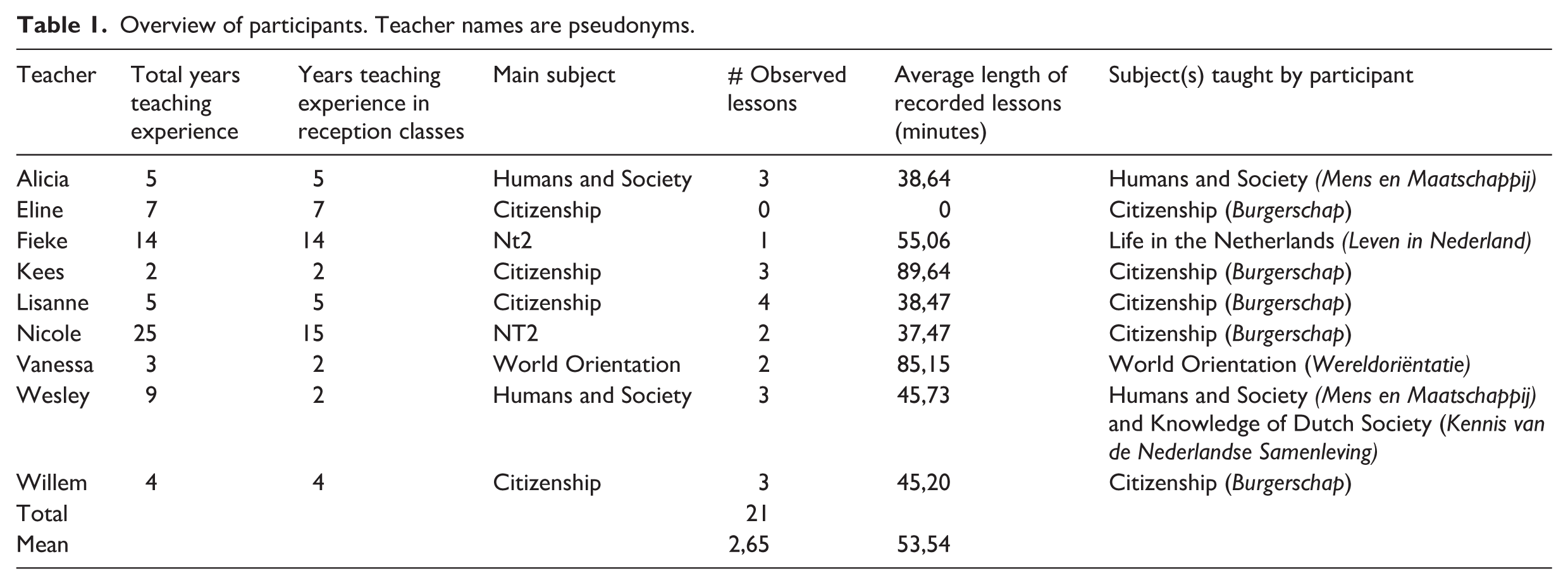
The teachers’ teaching experience in this particular context ranged from 2 to 15 years. Two teachers were trained in and mainly taught Dutch as a Second Language, but they were also responsible for teaching citizenship-related subjects in their school. The age-range of the students involved in the observed classes was 12–18 years old. All teachers conducted their lessons in Dutch. The information about the participants is summarized in Table 1.
Overview of participants. Teacher names are pseudonyms.
The details of scaffolding practices were obtained using three different sources: interviews exploring self-reported practices, lesson observations aimed at identifying enacted scaffolding strategies, and SRIs. During the SRIs teachers were asked to reflect on their reasons for using the scaffolding strategies from the observed lessons. This helped to clarify elements on scaffolding strategies as well as the language levels and demands that were targeted by the teachers.
Individual semi-structured interviews were conducted to find out which language scaffolding strategies teachers reported using in their classes. Interviews lasted between 40 and 74 minutes, and were audio recorded and subsequently transcribed.
The interview started by asking teachers what they would like to discuss before the interview turned to language scaffolds. The teaching-learning cycle was used to identify four phases of the lesson in which teachers could provide language scaffolds (Martin and Rothery, 1986; Rose and Martin, 2012; Rothery and Stenglin, 1994). These four phases are: (1) setting the context and providing new information to students; (2) providing students with instructions for a task; (3) students and teacher are jointly creating answers and/or doing a task; and (4) students complete a task independently. The teachers were encouraged to provide accounts of practices that they considered language scaffolds. To this end, they were provided with the definition of scaffolding that is used in this research. The interviews yielded 36 self-reported scaffolding strategies.
The teachers were asked to select two or preferably three lessons to be observed, and to teach those lessons as they usually would. The first author recorded these lessons with a video camera. The lessons were subsequently transcribed. Each teacher’s lessons took place on two different days and were observed and filmed by the first author. The first author also took notes during the observation, so as to facilitate identification of scaffolding events and selection of events for the stimulated recall interviews. Twenty one lesson observations were completed, with lessons ranging from 32 to 90 minutes. The lessons yielded a total of 185 language scaffolding strategies. One teacher opted out of the lesson observations.
The SRIs took place within 3 days after the teacher’s final lesson observation. The SRIs were audio recorded and transcribed. They were used to clarify elements of the scaffolding strategies, as well as the language levels and demands that were targeted by the teachers. SRIs were conducted with eight teachers and lasted between 43 and 67 minutes.
During the SRIs, teachers were first asked to identify language scaffolding events that they wanted to discuss. After discussing these events, the interview would turn to three to four events selected by the first author, based on notes taken during the lesson observation. Each of these language scaffolding events was transcribed and lasted between 2 and 8 minutes. The SRIs were audio recorded and subsequently transcribed.
Our conceptual approach centers on teacher practices rather than student experiences or outcomes. This focus, which aligns with van de Pol et al.’s (2010) framework for analyzing scaffolding behaviors, allows us to systematically document the strategies teachers employ but does not illuminate how students interpret, utilize, or benefit from these supports. While student perspectives would provide complementary insights into scaffolding effectiveness, this study’s contribution lies in describing the pedagogical repertoire teachers draw upon in multilingual reception classes, which is a context where such documentation is currently lacking.
Data analysis
The interviews, lesson observations and SRIs were analyzed through an iterative deductive-inductive process, beginning with a three-step process for the identification and classification of language scaffolding events.
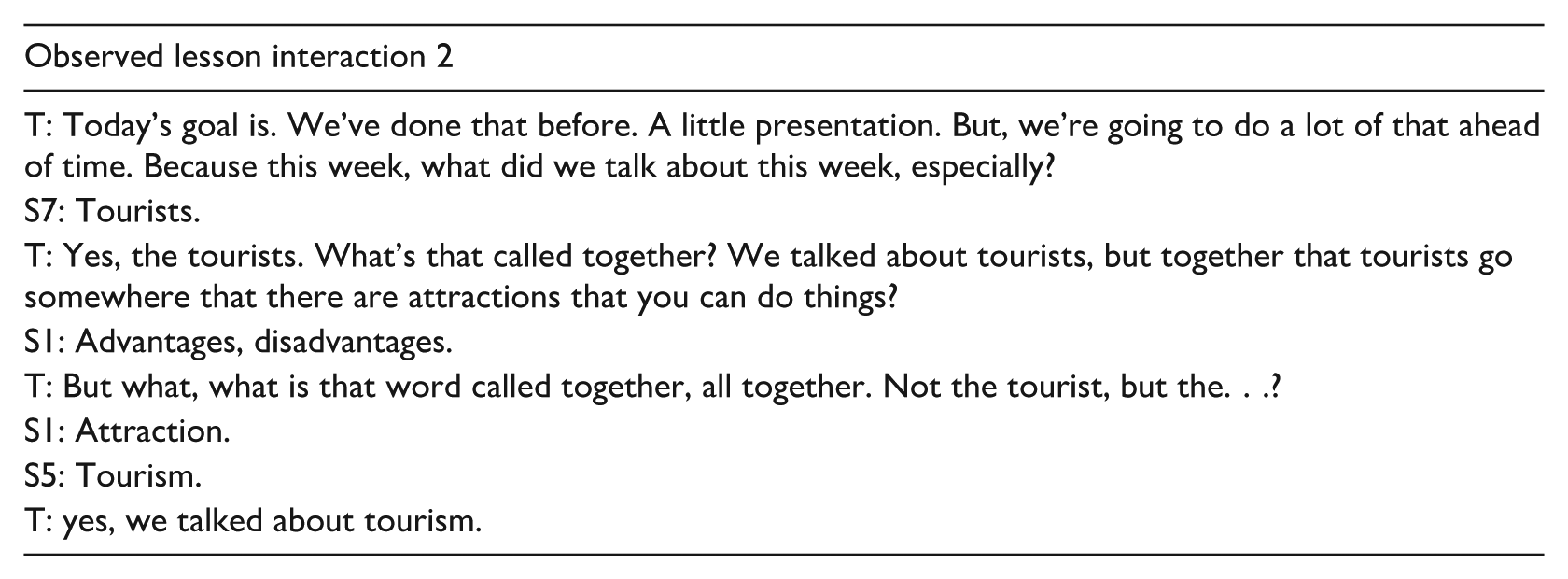
In the first step, event sampling was used to identify scaffolding events in the interviews, lesson observations and SRIs (Mackey and Gass, 2011; Smit et al., 2017; Wright, 1967). Following work by Van de Pol et al. (2011) and Smit et al. (2013), an event was identified as a scaffolding event if the aspects of diagnosis, responsiveness, and handover to independence could be identified in a series of teacher-student interactions. Diagnosis is where a teacher judges that a student is in need of their support (Van de Pol et al., 2011). A teacher action was identified as diagnosis if it included asking questions, checking answers, requests for explanations as well as offering explicit space for questions. Responsiveness occurs when a teacher uses the judgment to adjust the way they teach (Smit et al., 2013). Handover to independence happens when the support is withdrawn, and students continue a task by themselves. The events identified as scaffolding events either included a handover to independence or included responsive support that students needed to continue a task later or after the lesson. For instance, the event in observed lesson interaction 2 supported students to create a presentation. The support in observed lesson interaction 4 helped students to correctly pronounce “European Union” in a speaking task. Interview passage 2 linked up with a homework task that the students were assigned at the end of the class.
Participants self-reported on language scaffolding strategies in the interviews, and enacted these strategies in the lesson observations. Coding was conducted in Atlas.ti. The coding scheme was designed to capture verbal, written, and non-verbal scaffolding strategies such as body-language and visual aids with the analysis focusing on the type of language being supported. Reported or observed events were coded as a language scaffolding event when they matched the indicators of scaffolding as well as one of three language levels as defined by Lo and Lin (2014) and Lo et al. (2019).
Finally, language scaffolds were categorized as supporting either receptive or productive demands. Although the distinction between receptive and productive demands is by no means new in the field of language acquisition (cf. Swain and Lapkin, 1982; Ulijn and Kempen, 1976), Lo and Lin (2014), and Lo and Fung (2020) supplied the descriptions for the difference between receptive and productive demands in the context of different language levels. Supports related to reading and listening were labeled as “receptive,” and requirements related to speaking and writing were labeled as “productive.”
When a scaffolding event was labeled with a language level and a receptive or productive demand, it became a language scaffolding strategy. A language scaffolding strategy thus focuses on an aspect of a particular language level and is geared toward reading, listening, speaking, or writing. For instance, “description” on the word-level for receptive purposes refers to an interaction where a teacher helps students to understand a particular word, whereas “spelling” on the word-level for productive purposes refers to an interaction where a teacher helps students to spell a word so that they can write it down correctly.
Some language scaffolding strategies were identified through the SRIs, as a result of additional information that was not visible in the video recording. For instance, Lisanne provided information on a homework task that students needed to complete after lesson D. This led to the identification of an additional language scaffolding strategy, as it had only been coded with diagnosis and response support. With the information about the homework assignment, “handover to independence” could now be coded as well, which identified an additional language scaffolding strategy in lesson D as taught by Lisanne.
Quality of the coding
A dual-coding procedure was employed to ensure the reliability of the coding. The first author identified the language scaffolding strategies in the interviews, lesson observations and SRIs. The second author then checked the strategies that had been identified for one teacher. They did this by checking whether they agreed on the identification of events as scaffolding events, as well as the ways in which the language levels and the receptive and productive demands were applied to the scaffolding event. The second author did not identify additional language scaffolding events to those that had been identified by the first author. Both authors agreed on the inclusion of the events that had been identified by the first author, as well as the application of the language levels and demands. The discussion after the check led to the clarification of three coding rules. The first clarification was that a scaffolding event was bounded by the occurrence of diagnosis and a handover to independence. An occurrence of diagnosis meant that a new scaffolding event could start. The second clarification was that “responsiveness” was only applied to help that was provided after the teacher engaged in diagnosis. The third clarification pertained to possible rhetorical questions. Questions were only coded as diagnosis or responsiveness when the teacher engaged the students in answering their question. The first author used these clarifications to check the way the language scaffolds from the other participants had been identified. The clarification of the coding rules did not lead to the identification of new language scaffolding strategies. It did lead to the elimination of one language scaffolding event.
Research ethics
Before the start of the project, a detailed research proposal was submitted to the Ethics Committee of Leiden University’s Graduate School of Teaching. Potential participants were contacted by the first author once permission was granted. The participating teachers were provided with all the details of the research and provided their informed consent to participate. Participating students were provided with all the details of the research and provided their informed consent to participate. Teachers provided additional explanations of the research and the possibility to withdraw consent to supplement students’ understanding of the purpose of the research and the ways in which they could decide (not) to be involved in it Since the research included classrooms of students from the ages of 11–18, parental consent was provided for students under 16 through the schools. Students were provided the opportunity to withdraw from the research both during and after the observation. The camera was positioned in the front of the class and was pointed at the teacher to minimize the effects of the presence of the observer.
Results
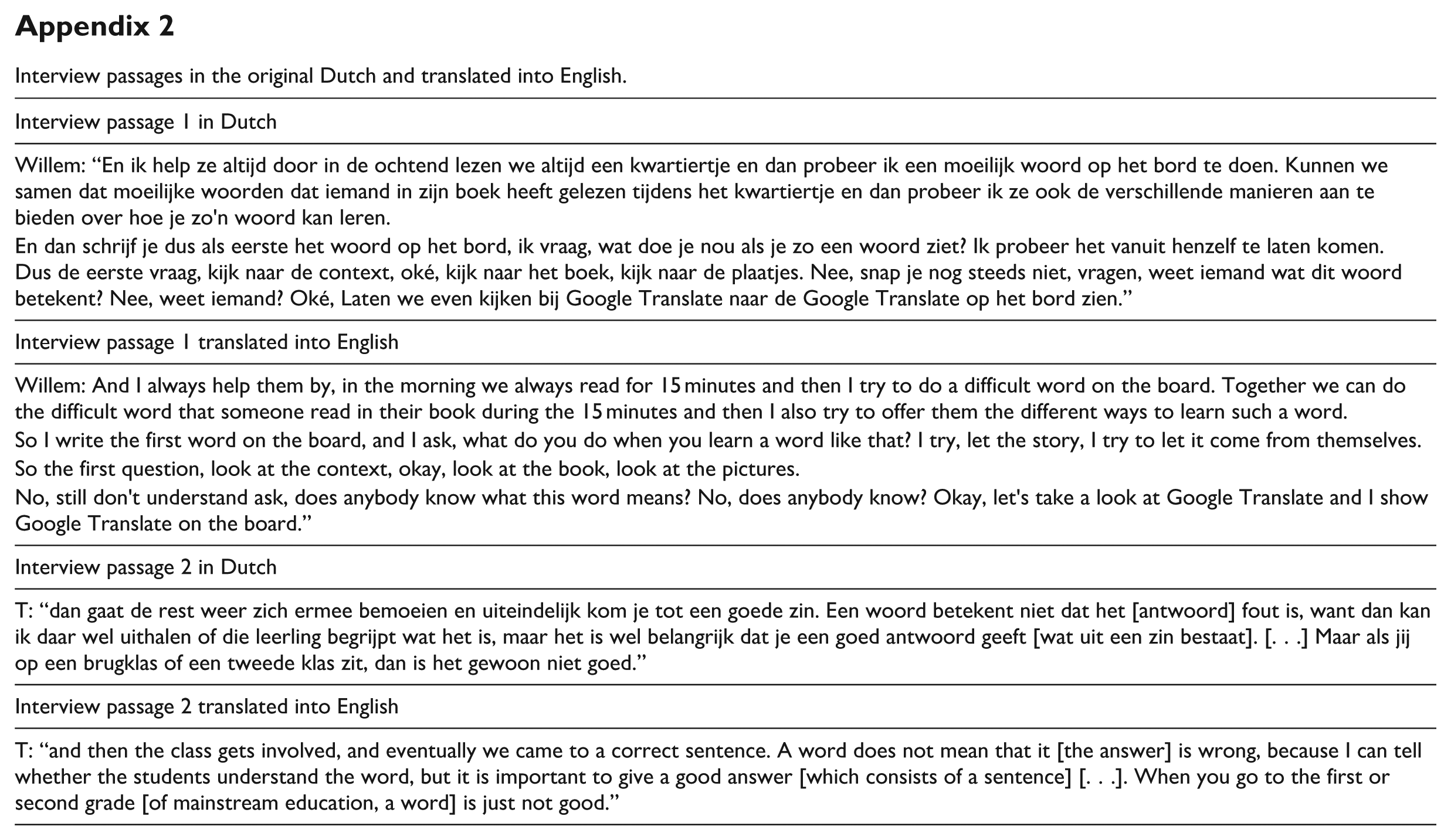
The findings below are organized by language level (word, sentence, text) and by demands (receptive, productive). The Results section is organized according to linguistic level and type of language demand. Each language level begins with strategies that support receptive demands, followed by strategies that address productive demands. Table 2 displays the frequency of each language scaffolding strategy. Appendices 1 and 2 respectively contain the observed lesson interactions and interview passages in the original Dutch, with the English translations.
Overview of identified language scaffolding strategies.
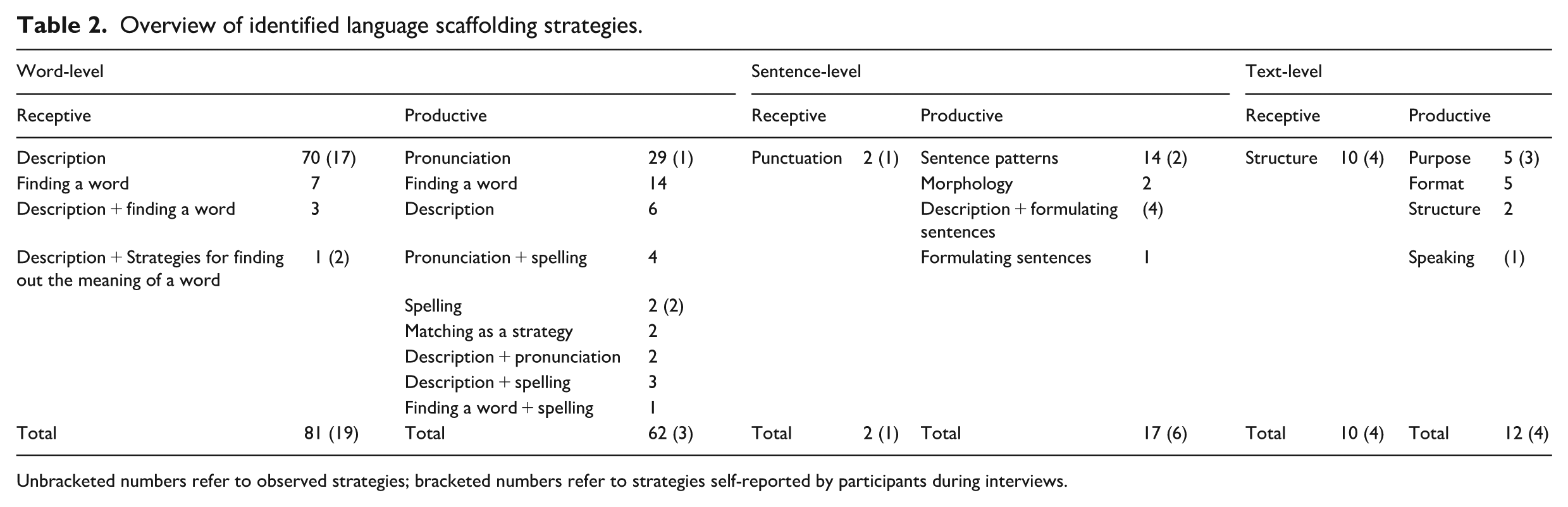
Unbracketed numbers refer to observed strategies; bracketed numbers refer to strategies self-reported by participants during interviews.
Language scaffolding strategies on the word-level
Language scaffolding strategies on the word-level for receptive demands
Concerning the receptive demands on the word-level, 81 instances of strategies for receptive demands were observed and teachers reported a further 18 instances, coming to a total of 100 instances in this category.
The focus of the support on the word-level for receptive demands was mainly geared toward helping students understand the meaning of words they needed in order to grasp what a task demanded of them.
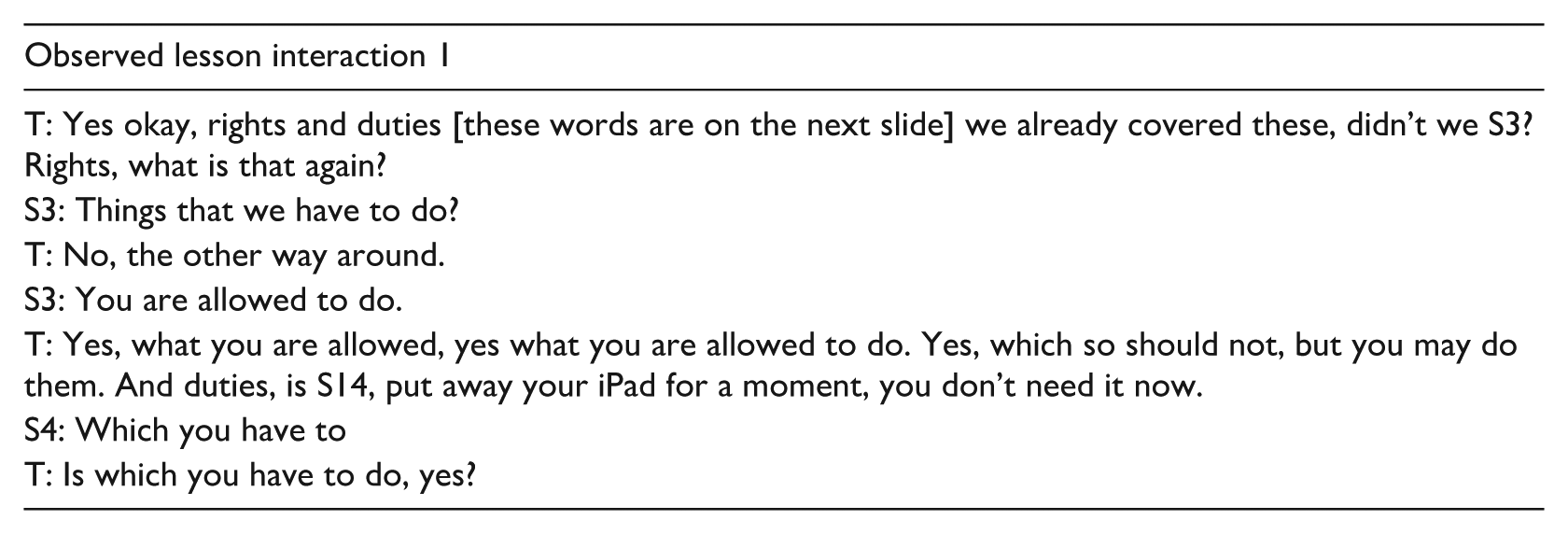
Out of the 100 observed and reported instances, 87 focused on helping students to describe a word. This strategy occurred when a teacher diagnosed that a student had trouble understanding a particular word. The teacher responded by helping the student grasp the meaning of this word, by either providing a description of the word themselves or asking other students to describe the word, as in observed lesson interaction 1.
The second strategy identified on this level is finding a word. This strategy was observed seven times and consists of helping students understand key terms that they need in order to grasp the meaning of a task. In observed lesson interaction 2 Fieke helped students to understand the key word in a presentation they were going to prepare:
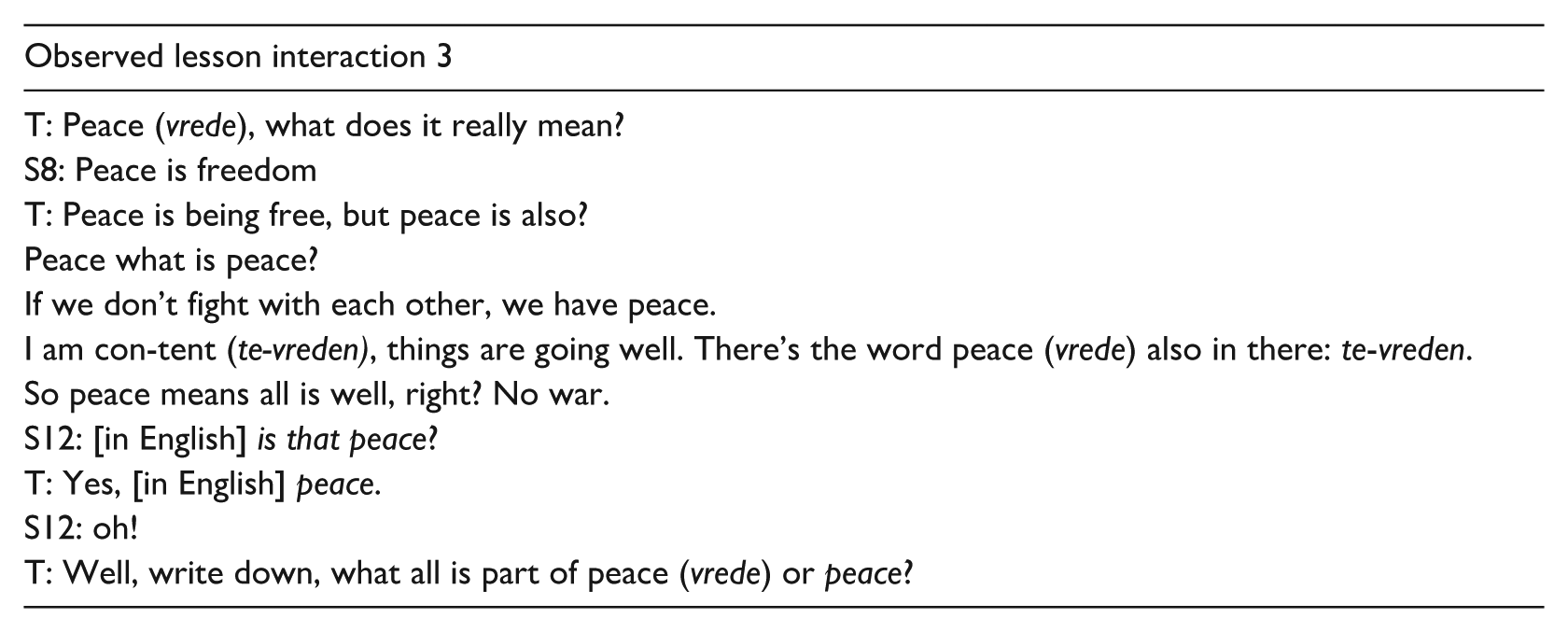
On three occasions, teachers helped students to understand a word by providing a word that students did understand. In observed lesson interaction 3, Kees showed how the word “vrede” (“peace”) is used in a different context, and also referred to the English translation of the word, to help the student understand the word’s meaning.
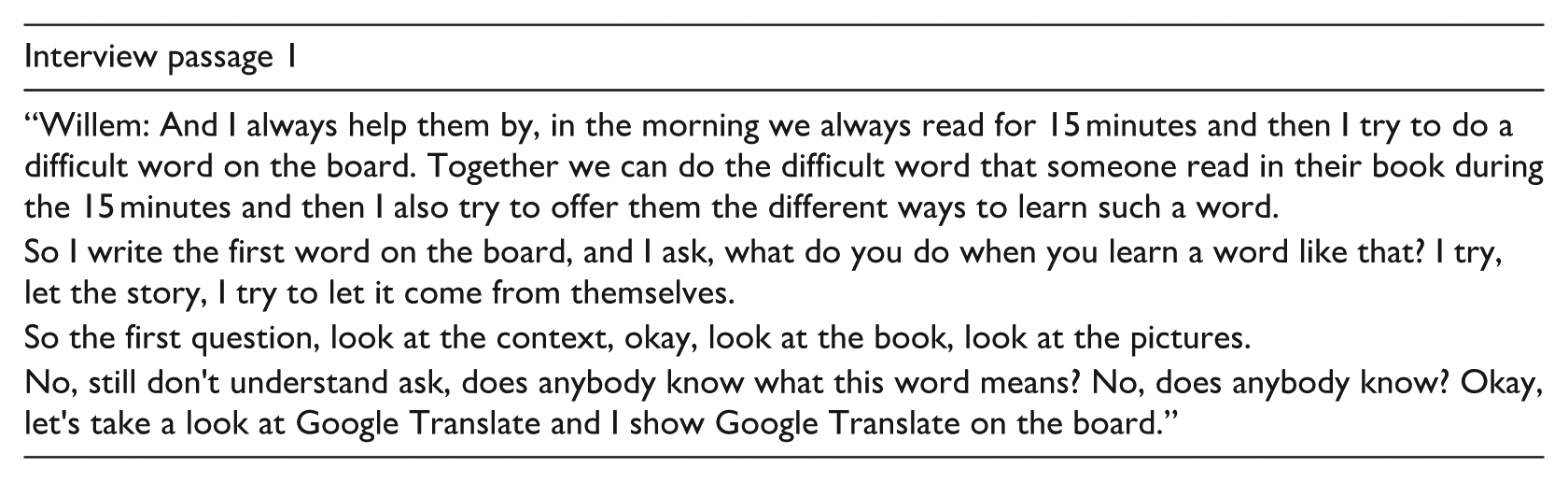
One teacher both reported and enacted a strategy in which he helped students develop a strategy to find the meaning of words themselves:
Language scaffolding strategies on the word-level for productive demands
A total of 62 instances of language scaffolding on the word-level for productive demands were observed. Teachers reported on a further three scaffolding practices.
The focus of word-level scaffolding strategies for productive demands was on both the meaning and the form of words. The strategies on this level helped students understand the meaning of words that they needed in order to complete a task, as well as the conventional way of writing or pronouncing the word. These strategies are classified as productive scaffolds because they are geared primarily toward the completion of a speaking or writing task, rather than to a listening or reading task.
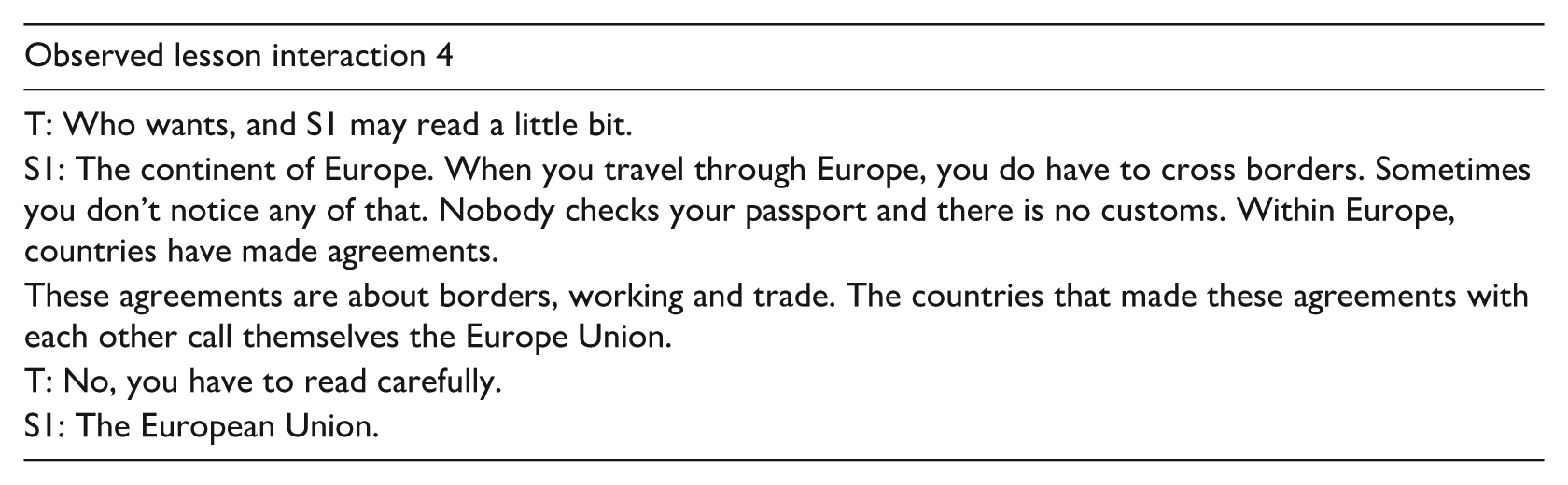
The results show that 30 of the 65 observed and reported instances of language scaffolding focused on helping students to pronounce a word. In most cases, the teacher responded to a student’s utterance of a word by either asking the student to pronounce the word again, or by providing an alternative pronunciation. For example, in an introductory lesson on Europe, Alicia identified that the student read “Europa Unie,” instead of “Europese Unie” (European Union). By telling the student that they need to “read carefully” she offers the student another opportunity to read the words themselves and independently pronounce them as intended: “Europese Unie” (European Union). This can be seen in observed lesson interaction 4. The activity after the interaction required the students to talk with each other about the European Union and use the correct pronunciation.
Finding a word occurred 14 times to support productive demands. In the same lesson as the previous strategy, Alicia wanted students to find a synonym for the Dutch word “continent,” namely “werelddeel” (both meaning “continent”). The students needed to use this word in a follow-up assignment. The students do not just need to understand the word, but should also be able to use it independently, which is why it was classed under productive demands.
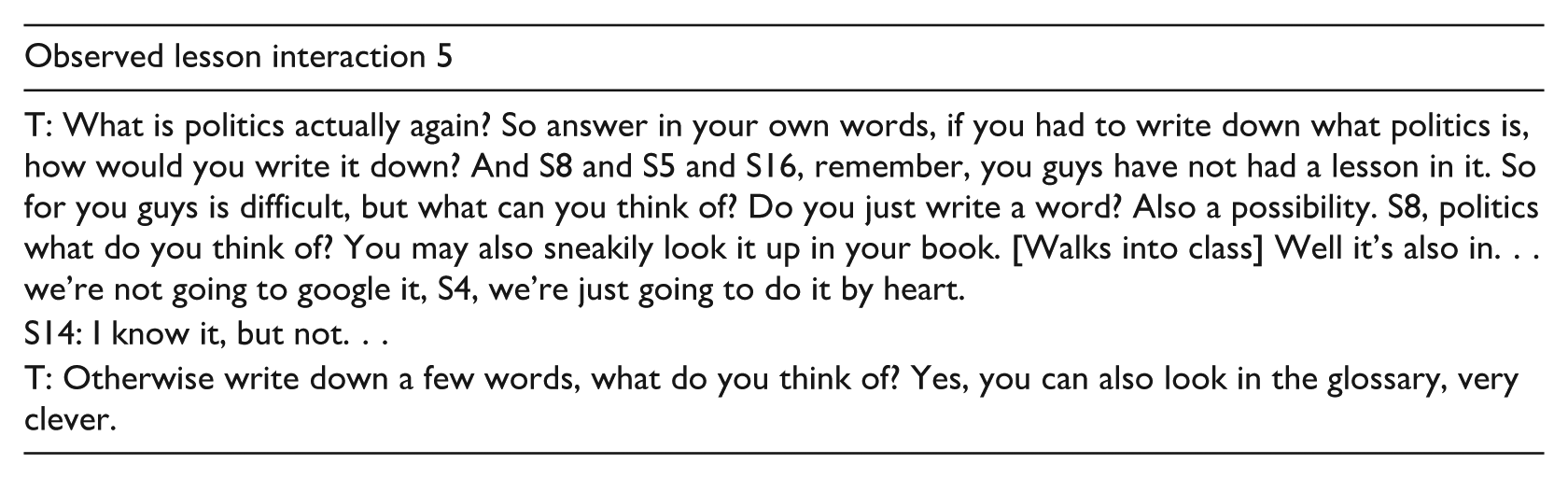
Description was observed six times in the context of productive demands. Lisanne worked with her class on the word “politics” which they needed to be able to use. She focused on students’ abilities to express the meaning of the word in writing. As observed lesson interaction 5 shows, she provided adaptive support as she saw students engaging in more or less helpful ways to approach the assignment:
For the productive demands, four language scaffolding strategies were labeled as a combination of pronunciation and spelling. In another example from the lesson on continents, Alicia asked students to match colors with the correct continents. In the debrief the exchange in observed lesson interaction 6 unfolded:
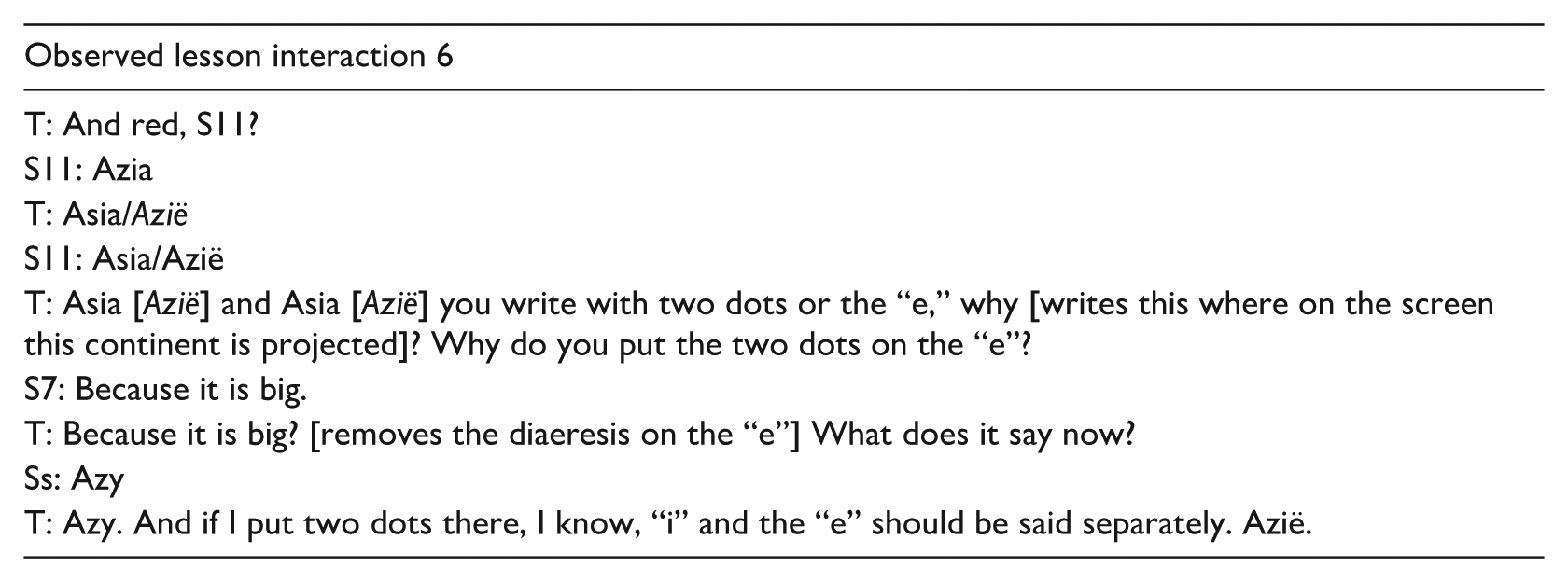
The focus in observed lesson interaction 6 was not only on the correct pronunciation of the Dutch word for Asia, but also on its spelling. The spelling was used to explain why the word should be pronounced the way it is pronounced.
Spelling as a standalone focus was observed twice and reported twice. As students were writing down answers to a question that was posed by the teacher, the teacher offered advice on how to spell words, as is shown in observed lesson 7 interaction from Lisanne’s lesson.

Matching as a strategy was observed twice. Willem used a matching strategy to help students find the characteristics that belonged to the historical periods as defined in the Dutch exam curriculum.
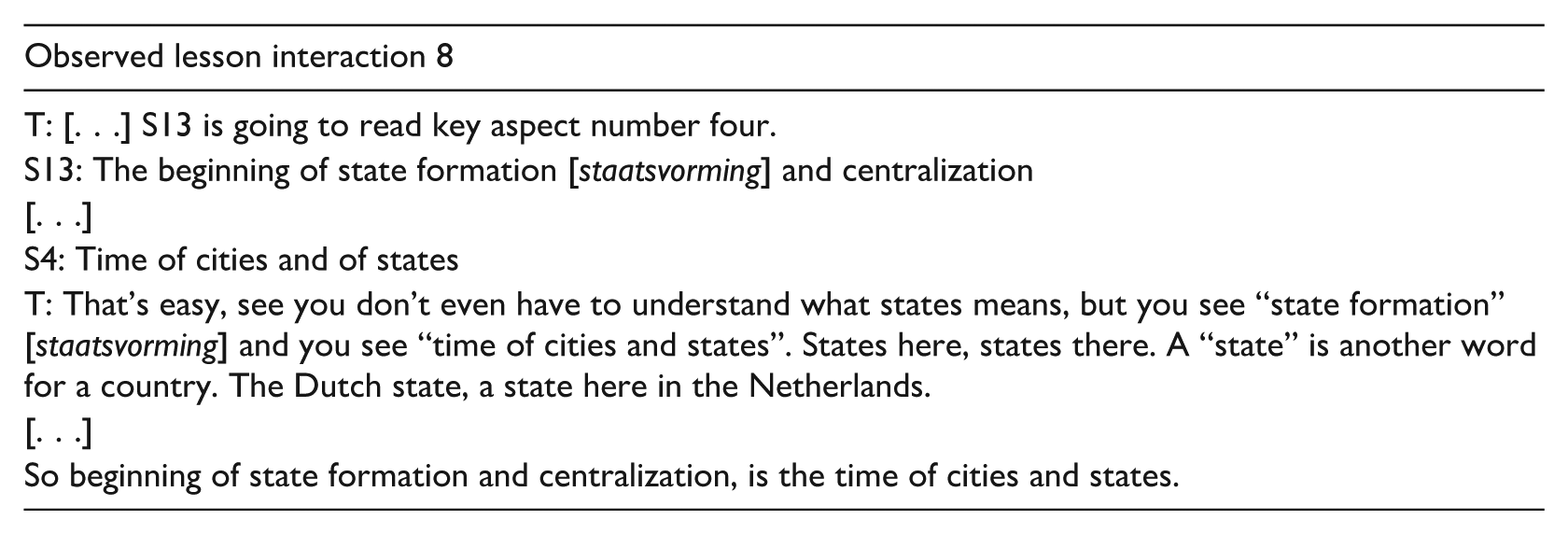
By offering this matching strategy, Willem helped students to use the form of the word “
Willem and Vanessa each focused once on pronunciation and description to help students understand a word as they were working on writing and speaking assignments.
The combination of description and spelling occurred three times. Vanessa combined these two elements to enable students to look up buildings that characterized the country on which the students were going to present. She provided examples of local buildings and referred to the Eiffel Tower to help the students understand the word “building.” She then asked a student to do a Google Image search on the word “building” (gebouw), to which end she helped the student to correctly spell the word.
Finally, Kees ran an activity in which students had to write down words that they associated with “war.” In observed lesson interaction 9 Kees helped a student to find the correct word and helped her to spell it.

Language scaffolding strategies on the sentence-level
Language scaffolding strategies on the sentence-level for receptive demands
On the sentence-level there was one teacher, Wesley, who enacted supports for receptive demands on two occasions. He reported on the same strategy in the interview. This support helped students to understand what punctuation does to the way a sentence should be understood.
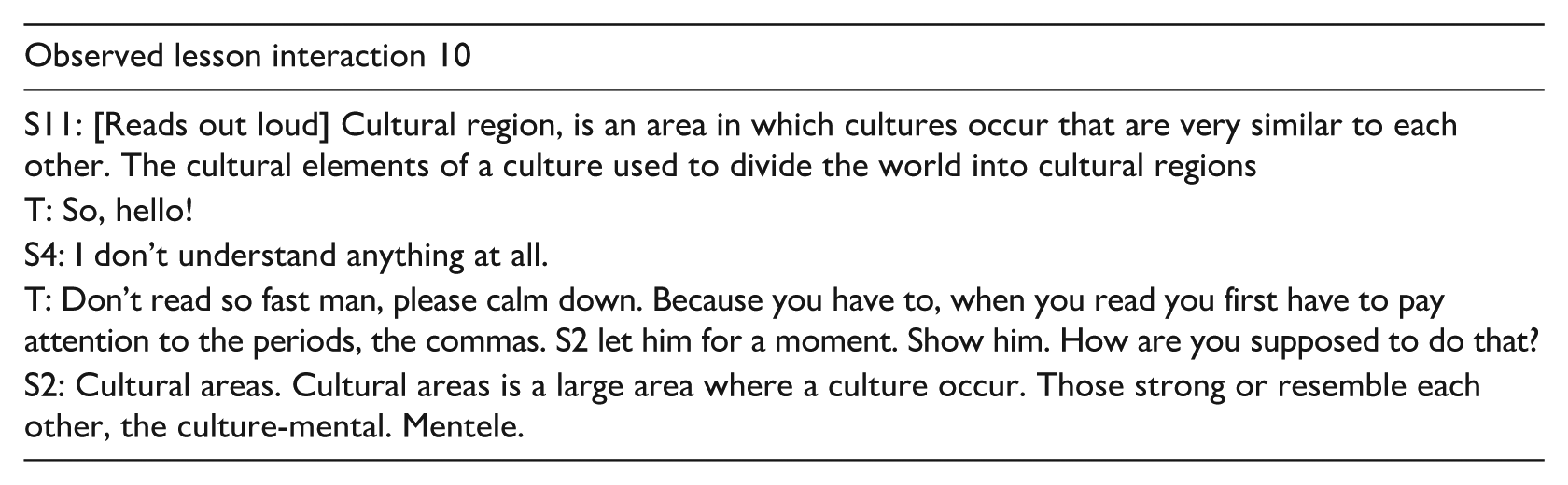
Even though the student read out loud, the focus was not on the pronunciation of the words or the text, but on punctuation: “when you read, you have to pay attention to the periods, the commas.” The focus was on understanding sentences when students read a text for themselves. As Wesley puts it himself in the stimulated recall interview: “Yes, this is [. . .] about technical reading, because if he read this quick, he will not understand it himself, and the others can’t understand it either.”
Language scaffolding strategies on the sentence-level for productive demands
Language scaffolding strategies for productive demands comprise of four different strategies. In all, 17 instances of language scaffolding for productive demands on the sentence-level were observed and teachers reported on an additional six language scaffolds. The 23 coded occurrences focus on both forms and meaning.
Sentence patterns was coded 16 times. Fieke was one of the teachers who enacted this strategy. Her lesson focused on formulating opinions about tourism. A significant portion of the lesson was dedicated to helping students come up with sentences that expressed those opinions. She wanted students to be able to use two words to provide reasons for an opinion. In Dutch, at least two words can be used to connect a statement to a reason: want and omdat. Both words would translate as “because,” but using one or the other has implications for the structure of the sentence, as observed lesson interaction 11 shows:
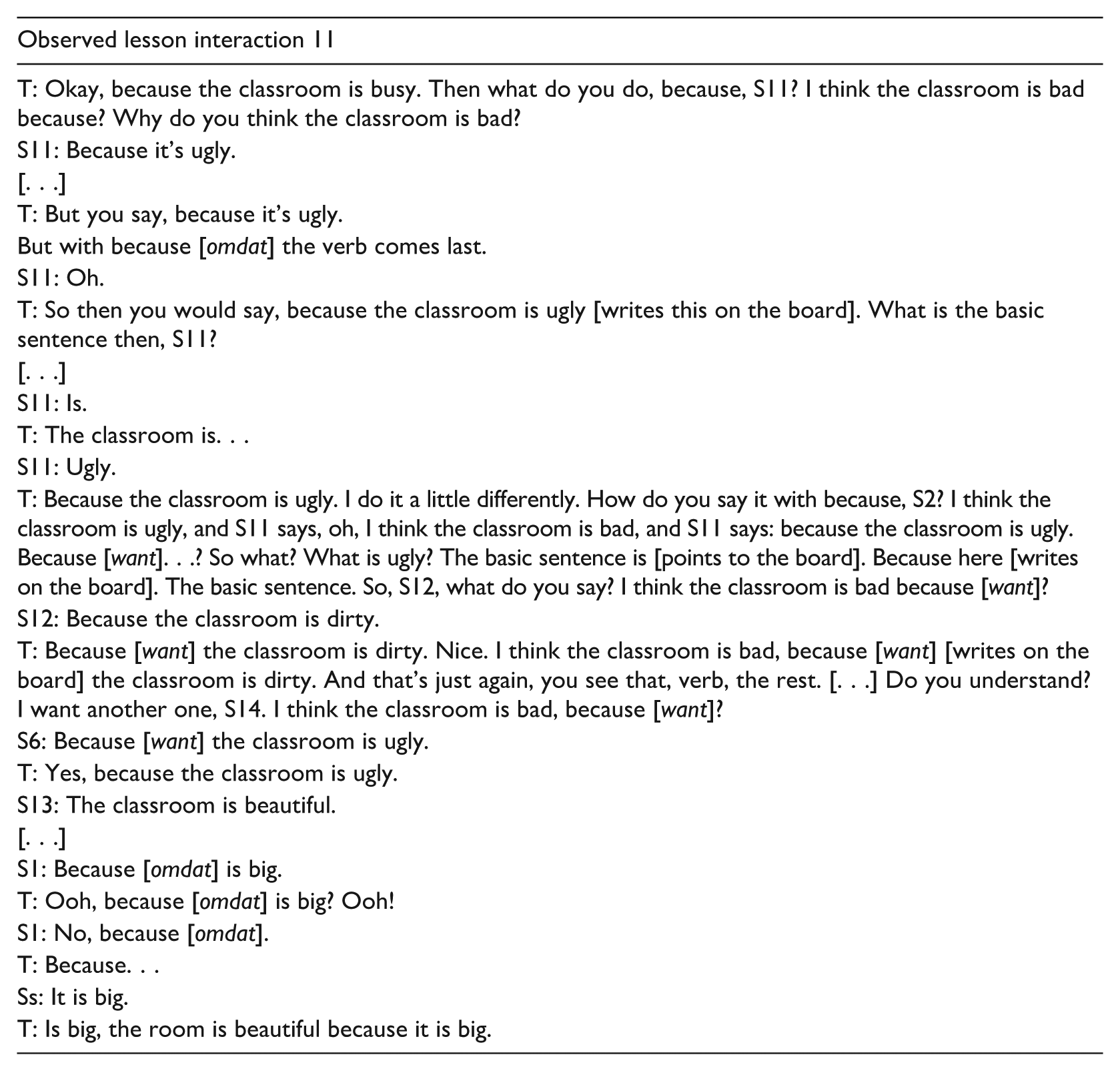
By focusing on the sentence patterns, Fieke scaffolded students in their meaning-making process of what they made of the classroom as well as their use of sentences to express thoughts.
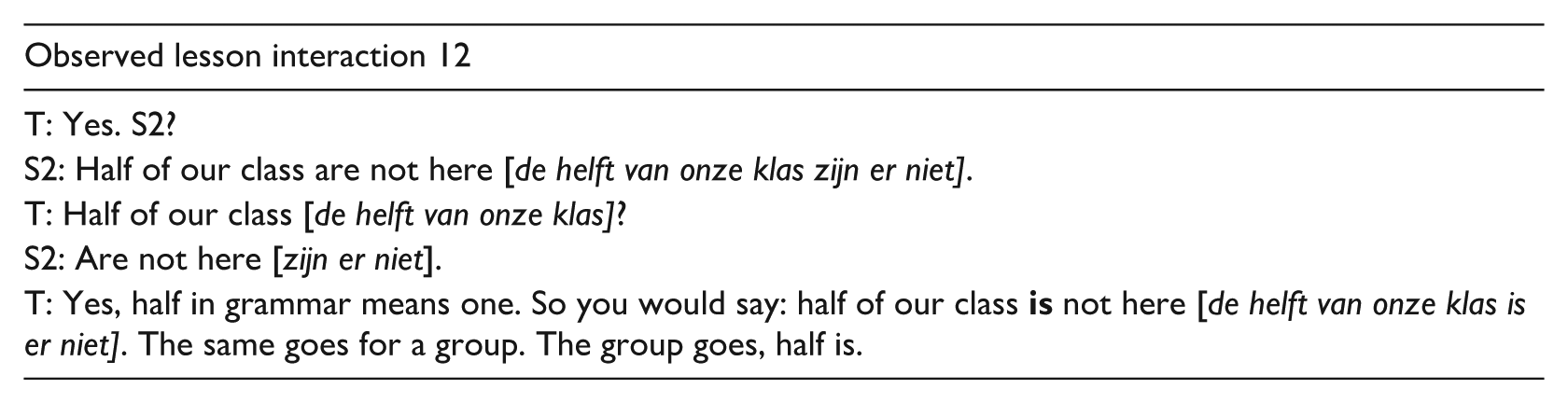
A scaffolding event was coded with “morphology” if the support was about how the form of words change in different grammatical context. This strategy was observed twice. Observed lesson interaction 12 from Nicole’s lesson illustrates how this works.
Description + formulating sentences was reported four times. Alicia reported on instances where she helped students to understand a word by having them make sentences that describe the meaning of these words. In these interactions she asks students to describe the meaning of a word. When the students respond with a synonym, she pressed the class to jointly construct a sentence that describes the word:

Formulating sentences was observed once in isolation. Nicole prompted a student to turn a one-word answer given by another student into a full sentence.
Language scaffolding strategies on the text-level
Language scaffolding strategies on the text-level for receptive demands
Language scaffolding strategies on the text-level for receptive demands comprises of one strategy. The researchers observed 10 instances of language scaffolding for receptive demands on the text-level and teachers reported on an additional four instances. The 14 coded strategies related to the structure of a text.
Observed lesson interaction 13 from Kees’ lesson shows how focusing on the structure of a poem allows students to understand the assignment. By understanding the structure of a poem and what it means to rhyme, the student could get to producing a rhyme, which is what they would have to do later in the lesson. However, helping the student to understand what a rhyme is, is part of the receptive demand of understanding what the task asks the student to do.
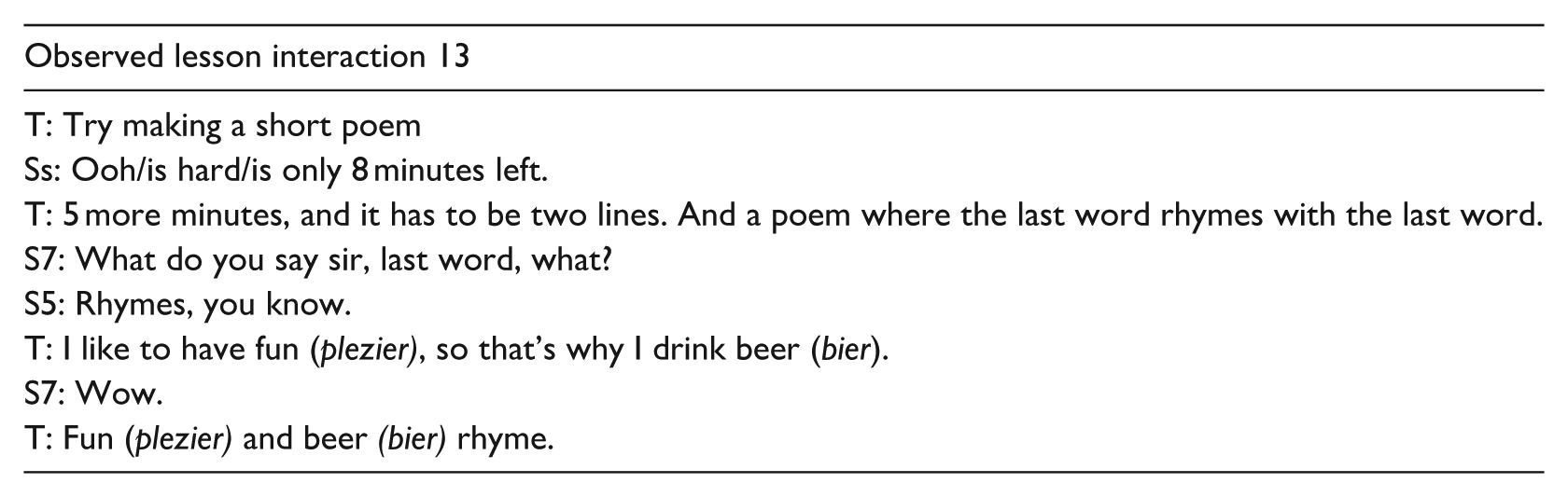
Kees responded to the reaction of the students who state that making a poem is difficult or that it cannot be done in 5 minutes. He then showed what a rhyme is. Rather than just explaining what a poem is he explained that poems rhyme and what a rhyme looks like. In doing so he went beyond the word-level to help students understand the kind or text that they are to produce.
Language scaffolding strategies on the text-level for productive demands
Language scaffolding strategies on the text-level for productive demands comprises of four different strategies. A total of 12 instances of language scaffolding were observed in this category, and teachers reported on an additional four. The 16 coded scaffolding practices focus on the purpose, format and structure of a text as well as on speaking.
Language scaffolding on the text-level for purpose was observed five times and reported on three different occasions. For example, Vanessa helped students to understand that the text that they needed to create would show that they could present information in their own words. When asked how she supports students who are creating presentations, she responds as follows: “Then I say, I see that you copied it and I get it, but I do prefer that you do it in your own words and so that's exactly how I explain it, like I just said. I'd rather you do it your own words, but that it's maybe some [. . .] smaller piece or that it's not quite complete than that you copied it, but actually you don't know what you're talking about.” By making it clear to the student that a piece of text should be written in their own words, Vanessa focused on what the text needs to achieve, namely that it should convey how the student’s understanding of a particular idea in Dutch.
Supports to help students choose a format for a presentation were observed five times. As Vanessa’s students were working on a poster that gave information about a country of the student’s choice, she gave advice on how to present the information. For instance, she provided students with the option to create a PowerPoint presentation or a hand-drawn poster on A3 format. In doing so she helped students by focusing on the various forms that their output could take and the requirements of those formats.
Emphasis on structure was observed twice as a scaffold for productive demands. As students were working on a presentation in Vanessa’s lesson, observed lesson interaction 14 shows how a student walked up to her desk and asked:
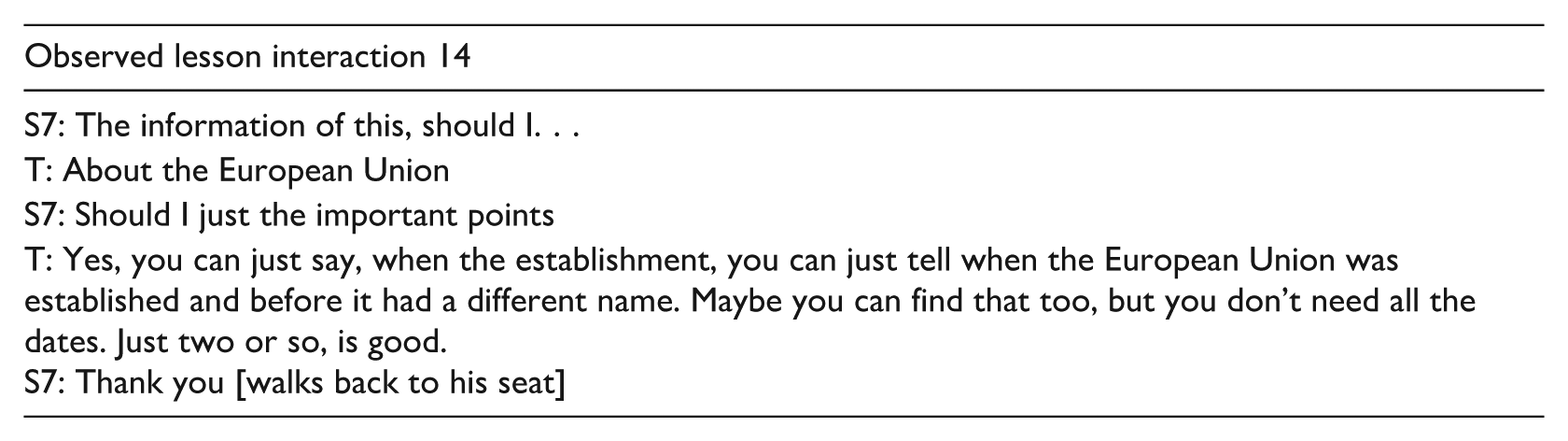
By providing these instructions Vanessa helped the student to understand which pieces of information they should include in their presentation.
Finally, one teacher reported that they would stimulate students to speak Dutch in class if she noticed them speaking another language with each other. Vanessa explained that one of the goals of the reception class is to learn how to speak the language of instruction. One of the tasks that students thus need to complete by themselves is speaking this target language in order to support their acquisition. When she notices students using another language to communicate, she would ask them to try to speak Dutch with each other to practice their skills.
Discussion
Analysis of the interviews and lesson observations on the basis of scaffolding, language levels, and receptive and productive demands, indicates that teachers of citizenship-related subjects in reception classes use a variety of strategies to engage in language scaffolding. Language scaffolding strategies were observed and reported for both receptive and productive demands as well as across all three language levels, resulting in a total of 23 different language scaffolding strategies. The word-level accounts for most of the instances of scaffolding. However, within the word-level, scaffolding happens in 13 different ways. This shows that even when scaffolding happens on the word-level there are different ways in which this can happen. Below, we discuss these key findings in more detail, before reflecting on implications for future research.
Language scaffolding across levels and demands
The current results suggest that statements about which demands are addressed by scaffolding might need to take language levels into account. Language scaffolding strategies occurred for both receptive and productive demands and on all language levels. Where Pawan (2008) indicated that teachers mostly help students with language to complete tasks, Mahan (2022)’s results show that teachers scaffold students mostly to comprehend material. Findings from the current investigation reveal a more complex picture, namely that teachers used more receptive strategies on the word-level, and more strategies for scaffolding productive demands on the sentence-level. On the text-level we recorded about similar numbers of language scaffolding strategies for productive and receptive demands. Thus, rather than supporting the prevalence of either demand in language scaffolding strategies, the outcomes show that consideration of language scaffolding strategies in terms of multiple dimensions might provide a clearer view of what teachers do to help their students understand and produce language.
A wealth of language scaffolding strategies
Teachers in multilingual settings need to address both content and language with their scaffolding strategies (Mahan, 2023) Studies in other multilingual education settings have indicated that subject teachers find it hard to balance content and language, and indeed mostly focus on content (Cammarata and Tedick, 2012; Oattes et al., 2018).The findings of the current study, however, are better aligned with those of Villabona and Cenoz (2022), which showed that teachers understand and implement content and language integration in a variety of different ways. The strategies that were found were not enacted or reported by all of the participants of the current study. Instead, the participants contributed to the identification of different strategies. However, the occurrence of 23 different language scaffolding strategies does imply that teachers engage in language scaffolding in various ways. This does not necessarily mean that they do not find it hard to balance focus and content, nor does it mean that lessons do not mostly focus on content. It does indicate their capacity to deal with language in 23 different ways.
More than words
The above point regarding the variety of language scaffolding strategies employed by teachers in this study extends in particular to the range of strategies encountered on the word-level. While the prevalence of language scaffolding events on the word-level in this study is in line with results from studies in other multilingual education contexts (Baecher et al., 2014; Lo et al., 2019, 2023; Tan, 2011; Walker, 2011), our findings provide a less one-dimensional picture of word-level scaffolding. Of the 23 scaffolding strategies identified, 13 were varieties of word-level scaffolding, which also aligns with An et al. (2019) who found that the greatest variety of language scaffolding strategies occur on the word-level. In other words, when teachers in this study pay attention to language, they are indeed most likely to focus on subject-specific terminology. Striking is that they do so in 13 different ways. This word-level focus can take the form of more meaning-focused support where students are equipped to understand the meaning of a word, or it can help to them grasp the formal aspects of language such as spelling and pronunciation. Language scaffolding on the word-level can therefore not be seen as a monolith. In addition to the observation that word-level scaffolding may be richer than teachers are often given credit for, we also note that 10 of the 23 identified strategies occurred on the sentence or text-level, which shows that although most of the scaffolding happens on the word-level, scaffolding did occur on the other levels as well. Thus, language scaffolding focuses on more than just words.
Limitations and future research
The exploratory study design implies that the value of these results is not that it provides a definitive answer to the question of which language scaffolding strategies teachers of citizen-related subjects in Dutch reception classes use. Rather, it provides a frame of reference from which language scaffolding strategies in the context of reception classes can be further examined. The relatively limited number of participants in this study allowed us to collect and analyze data from three different sources and to engage in triangulation. There is a possibility that future research that uses the strategies identified in the current study as a point of departure with higher numbers of participants might provide a more detailed map of language scaffolding strategies.
Even though diagnosis could be identified through teachers’ reported practices, their elaboration on the observed lessons and the observed lessons, there is a possibility that the authors missed instances of diagnoses. A research design that focuses on rewatching the entire lesson observations with the teachers could unearth those instances of diagnoses that remain unobservable with the methods that were employed in the current design.
Future research could also investigate the relationship between language and conceptualizations such as emotional scaffolding (Song and Park, 2021), virtual scaffolding (Mansouri and Mashhadi Heidar, 2019), and gestural support (Kim and Cho, 2017). However, there is also a need for conceptual clarity to ensure a coherence in the research on scaffolding in multilingual educational contexts (Ertugruloglu et al., 2023; Mahan, 2023).
One alternative focus for forthcoming inquiries would be to investigate the motivations for teachers to enact certain language scaffolding strategies. The current study unearthed 23 different language scaffolding strategies and these strategies might be enacted for different reasons. Mapping these motivations and teachers’ own reasoning might provide more insight into the teaching of teachers so that other teachers as well as teacher educators might benefit from them. Finally, this study involved teaching learners with varied levels of proficiency and its findings could also be relevant to other contexts, across different proficiency levels.
The current study focuses on teacher scaffolding, and engages neither with learners’ understanding of language scaffolding nor with the role of students’ first languages. Thus, another avenue for future research could be to explore learner perceptions of effective scaffolding and how this relates to learner differences, first languages, and L1 proficiency.
Conclusions
This study set out to identify language scaffolding strategies employed by teachers teaching citizenship-related subjects in reception classes for newly arrived migrant students (NAMS). The paper investigated language scaffolding strategies employed and reported by nine teachers across nine interviews, a combined total of 21 lessons, and eight stimulated recall interviews. Language scaffolding strategies were identified by combining the concept of whole class scaffolding with receptive and productive demands on the word, sentence and text-levels.
The inquiry found that language scaffolds on the word, sentence and text-levels were applied to support students in meeting both receptive and productive demands. Analysis identified 23 different language scaffolding strategies across the three levels and two types of demands. Strategies occurred most often on the word-level, which was also the level that accounted for the largest variation in scaffolding strategies. That said, teachers also employed a variety of strategies to scaffold language on the other levels. These findings suggest that language scaffolding on the word-level should not be understood as monolith but regarded as something that can be done in different ways.
Reception classes play a vital role in equipping young people with a new language for a new future. While language scaffolding strategies hold considerable promise for supporting this process, their effective implementation depends on teachers having adequate training, resources, and institutional support. By investigating how teachers currently employ scaffolding in practice, this research aims to bridge the gap between pedagogical theory and classroom reality. The findings can inform targeted improvements in teacher preparation programs, guide the development of practical classroom resources, and provide insights for policy decisions affecting multilingual education. For practicing teachers, the findings offer concrete examples in which receptive and productive demands can be supported on the word, sentence, and text-level to support multilingual learners. These examples are not meant to be copied but can rather function as a point of departure for teachers to identify their own language scaffolding tendencies, and to develop the supports that they are less likely to provide. Teacher educators can use these findings to shape pre-service and in-service training. For policymakers, they can inform decisions about resource allocation to teacher professional development and curriculum requirements.
Footnotes
Appendix
Interview passages in the original Dutch and translated into English.
| Interview passage 1 in Dutch |
|---|
| Willem: “En ik help ze altijd door in de ochtend lezen we altijd een kwartiertje en dan probeer ik een moeilijk woord op het bord te doen. Kunnen we samen dat moeilijke woorden dat iemand in zijn boek heeft gelezen tijdens het kwartiertje en dan probeer ik ze ook de verschillende manieren aan te bieden over hoe je zo'n woord kan leren. |
| En dan schrijf je dus als eerste het woord op het bord, ik vraag, wat doe je nou als je zo een woord ziet? Ik probeer het vanuit henzelf te laten komen. Dus de eerste vraag, kijk naar de context, oké, kijk naar het boek, kijk naar de plaatjes. Nee, snap je nog steeds niet, vragen, weet iemand wat dit woord betekent? Nee, weet iemand? Oké, Laten we even kijken bij Google Translate naar de Google Translate op het bord zien.” |
| Interview passage 1 translated into English |
| Willem: And I always help them by, in the morning we always read for 15 minutes and then I try to do a difficult word on the board. Together we can do the difficult word that someone read in their book during the 15 minutes and then I also try to offer them the different ways to learn such a word. |
| So I write the first word on the board, and I ask, what do you do when you learn a word like that? I try, let the story, I try to let it come from themselves. |
| So the first question, look at the context, okay, look at the book, look at the pictures. |
| No, still don't understand ask, does anybody know what this word means? No, does anybody know? Okay, let's take a look at Google Translate and I show Google Translate on the board.” |
| Interview passage 2 in Dutch |
| T: “dan gaat de rest weer zich ermee bemoeien en uiteindelijk kom je tot een goede zin. Een woord betekent niet dat het [antwoord] fout is, want dan kan ik daar wel uithalen of die leerling begrijpt wat het is, maar het is wel belangrijk dat je een goed antwoord geeft [wat uit een zin bestaat]. [. . .] Maar als jij op een brugklas of een tweede klas zit, dan is het gewoon niet goed.” |
| Interview passage 2 translated into English |
| T: “and then the class gets involved, and eventually we came to a correct sentence. A word does not mean that it [the answer] is wrong, because I can tell whether the students understand the word, but it is important to give a good answer [which consists of a sentence] [. . .]. When you go to the first or second grade [of mainstream education, a word] is just not good.” |
Acknowledgements
We would like to thank the participants who so generously shared their views and classrooms with us. We would also like to thank the reviewers for their time, attention and constructive suggestions.
Data
Data will be made available upon request.
Declaration of conflicting interests
The authors declared no potential conflicts of interest with respect to the research, authorship, and/or publication of this article.
Funding
The authors disclosed receipt of the following financial support for the research, authorship, and/or publication of this article: This work was supported by Nederlandse Organisatie voor Wetenschappelijk Onderzoek, The Hague [grant number 023.013.002].
Research ethics
Before the start of the project, a detailed research proposal was submitted to the Ethics Committee of Leiden University’s Graduate School of Teaching.
