




Abstract
Newly arrived migrant students in German schools are currently the centre of attention. In 2015 and 2016 the incoming number of migrant children and adolescents of school-age has risen. Schools, the education administration as well as politics need to take action with regard to this. In the on-going debate on new immigrant students in school, German media and the public focus have been predominantly on asylum seekers from conflict zones such as Syria or Afghanistan. For schools, the increasing number of newcomers with no or little proficiency of German currently poses a challenge, even though new immigrant students at school are not a new phenomenon, but rather a permanent one. From a theoretical point of view, social participation can be discussed within the division of inclusion and exclusion. In this article we examine the potential of a theoretical framework of social inclusion and exclusion in the case of new immigrant students and establish a connection between the organisation of schooling and practices in class. The analysis of a scene of multilingual classroom interaction, held in a separate class for newcomers only, shows how a complex interplay of including and excluding effects structure the situation of newly arrived migrant students.
Keywords
Introduction
Newly arrived migrant students in German schools are currently the centre of attention. In the last two years the incoming number of migrant children and adolescents of school-age has risen. Schools, the education administration as well as politics need to take action with regard to this. In the on-going debate on new immigrant students in schools, German media and the public focus have been predominantly on asylum seekers from conflict zones such as Syria or Afghanistan. However, there is also a large group of European Union (EU) immigrants from Southern and Eastern European countries as well as migration from other countries around the world. Despite statistical evidence that refugees form only one part of the new immigrant students in German schools, they seem to be the group generating the most interest in the media and the public sphere. For schools, the growing number of newly arrived immigrant students with no or little proficiency of German currently poses a challenge. Given the structure of Germany, federal states or even schools respond to this situation with a variety of principles of schooling. Even though new immigrant students at school are not a new phenomenon, but rather a permanent one, the actual situation in Germany shows some particular features of interest: first, the number of immigrant students that have arrived in the short period of time since 2014 until now has been relatively high. Second, public discussion about the rising number of refugees in Europe and particularly in Germany between the fear of how to handle the ‘refugee crisis’ on the one hand and a ‘Culture of Welcome’ (German: Willkommenskultur) on the other.
School plays an important role in the process of including new migrant students in their new surroundings. Learning a new language is a central, but not the only contribution of schooling. It includes the experience of social participation as a whole from the time of arrival. In this article we will discuss the participation of newly arrived migrant students in school within the division of inclusion and exclusion. Within this theoretical framework, we are going to present results from a research project concerning the concepts and attitudes of teachers as well as their (didactical) practices, particularly concerning the use of language(s) in classrooms with newly arrived migrant children in Cologne, Germany. Linking it to the institutional dimension of schooling, we micro-analyse one specific scene taking place within a separate class for newcomers only. By focussing on the interwoven including and excluding effects of institutional structures and practices, we will provide insight into the current situation of the schooling of young newly arrived students in Germany. We argue that a differentiated analysis of the schooling of newly arrived children in its complexity is not possible without including both institutional structures as well as every day practices in class. The understanding of this complexity may offer a base for further research as well as for decision making in a school that takes in newcomer students for the first time.
Theoretical framework
Looking at social participation in terms of exclusion and inclusion has been a long tradition in social theory. Even more so, the question of opportunities of social participation seems to be one of the central aspects in analysing society. In recent debates though, the terms and their relation to each other are not defined homogeneously (e.g. Farzin, 2006: 7; Seifert, 2013). Inclusion and exclusion can be characterised as a ‘multifaceted conceptual instrument’ (Stichweh, 2005: 7), or, as Schäffter (2013: 53) points out, the terms are either set into a correlative relation, used as a mutually exclusive conceptual pair or focus on the regulatory impact of social structures. References to exclusion and inclusion are used for analytical, political and/or socio-critical purposes (Gertenbach, 2008: 309) and diverse theoretical foundations are available. The following three perspectives are often quoted, and provide a good insight into the debate on exclusion and inclusion in social sciences.
Niklas Luhmann offers a system-theoretical perspective by dividing between a social system and its environment. Each system (e.g. politics, education, health, law) is autopoietic; therefore they are mutually exclusive and communicative coupling is the only way to connect them. As a result, social systems are only inclusive in their own logic (e.g. a prisoner included in the system of law), which can be connected to exclusion in other social systems (e.g. possibly excluded as a voter in the system of politics). From this perspective, a functional differentiated society offers mechanisms of inclusion in each social system, but does not address the ‘whole person’. Thereby the connection between different forms of inclusion can be focused (Bommes and Tacke, 2001: 63). Furthermore inclusion and exclusion are connected to communicative rather than spatial structures (Farzin, 2006: 24). Exclusion is therefore not mainly seen as a spatial separation but a lack of social attention so that no communicative connection is given (Luhmann, 1997: 620). In contrast, inclusion is seen as a chance for social connections of person. In Luhmann’s reference to his visits to the favelas of Rio de Janeiro, exclusion becomes a central aspect in terms of a problematic social exclusion (Luhmann, 1997: 227). By referring to Parsons’ social theory, Luhmann defines inclusion and exclusion as opportunities in which members of society are able to attend social contexts and therefore participate within them (Farzin, 2006, 2011: 80–81; Luhmann, 1995; Stichweh, 2005). Hence, social exclusion and inclusion are correlated, since the existence of inclusion inherently contains the option of exclusion (Luhmann, 1997: 620–621).
Looking at the effects of exclusion, the work of Michel Foucault offers a further perspective on social interaction and institutionalised contexts. Even though Foucault’s work is no theory of exclusion, he submits an analysis of exclusion by taking a differentiated look at social demarcations as well as exclusion as a regulatory tool within society (Farzin, 2011: 94; Gertenbach, 2008: 313). However, his analysis of exclusion is without question no appreciation of social inclusion: his work can be characterised by the ambivalence between his critique concerning social exclusion and discursive demarcation as well as the problematic impact on social mechanism of intrusive inclusion (Gertenbach, 2008: 314). Gertenbach defines three historically situated types of exclusion within Foucault’s analysis (Gertenbach, 2008: 315–323): first, exclusion as the pre-modern practice of banishment; second, total including exclusion by discipline; and third, forms of exclusion as part of the crisis of the traditionally inclusive institutions. The first type represents a form of radical exclusion concerning the social existence in total and can be located in former society where power is run by sovereign authority (e.g. Foucault, 1994: 255, 324). The following type defines exclusion within a total social inclusion aiming at improvement and standardisation in modern disciplinary society (e.g. Foucault, 2003: 67–69). The third type is part of present society focusing on its self-regulation within social spaces located between mobility and security (Foucault, 2004a, 2004b). Looking at these forms of exclusion, Foucault offers a perspective on social inclusion and exclusion, which can only be understood in the context of time and space. His critical analysis is often used in terms of thinking about possibilities of resistance concerning official or common ways of normalisation as a by-product of inclusion and exclusion. In this interpretation, the focus is set on the demarcation between excluding and including effects of institutionalisation.
Another well-known point of reference regarding the question of social inclusion and exclusion is the work of Pierre Bourdieu. Within his concept of habitus as well as his work on different forms of capital, he draws out the idea of social processes within social situations, groups and institutions by acting in a proper or an inadequate way. Even though Bourdieu also does not offer a theory of exclusion, his analysis and critique of social inequalities can be connected to questions of exclusive and inclusive structures and practices. In his famous work about the banlieues of Paris, Bourdieu et al. define the so called ‘internally excluded ones’ (Bourdieu et al., 1997: 527) as members of society who have little opportunity to participate in terms of influencing the contexts they are living in. Bourdieu et al. (1997) show that formal inclusion in the education system does not automatically lead to inclusion in terms of social equality and justice of participation.
Among others, the three designated theoretical perspectives play a great role in work on exclusion and inclusion in social sciences. Many attempts have been made to combine these theoretical approaches, trying to find overlapping aspects. However, the theoretical definitions of social exclusion and inclusion differ between the different approaches and are not exactly compatible (Seifert, 2013). Analysing the field of education, both terms are used as a comprehensive description of the selectivity of the education system and its impact on social inclusion and exclusion. Despite the many differences between various theoretical positions: inclusion and exclusion is seen as a linked pair.
In this context it is remarkable that the current political debate on a more inclusive educational system in Germany focuses on inclusion only. Based on the United Nations (UN) Conventions on the Rights of the Child and the Anti-discrimination Law, the majority of people promoting inclusion emphasise the idea of not only integrating a small number of persons into the existing system but the multiple differences between all according to the slogan: all different – all equal. In this case inclusion is often used as a normative term. Described as an emphatical discourse on individualisation (Dammer, 2015: 21) some discussions about inclusive school reforms in Germany indeed seem somewhat like inclusive propaganda, and, as the German Educational Research Association (GERA) points out in its position paper about inclusion, ‘no objection’ seems possible (DGFE, 2015: 2). Thus, quite often there is no (differentiated) reference to exclusion as its counterpart, and the education system seems to play a major role when demanding the inclusion of everyone into society, without any constraint. However, such restricted ideas on inclusion have been discussed and criticised.
Concerning the schooling of newly arrived students the decision on how to organise classes for these students is often connected to the question of including and excluding effects of different types of concepts. Due to the federal system there is not one standardised or consistent concept or principle applied all over Germany. Instead, there are many. In some regions, e.g. in Hesse or Hamburg, there are stronger regulations about how to include children arriving with little or no German in school than in others. Plus, how schools themselves on a local level adapt these models to their particular situation may vary further. In North Rhine Westphalia, the biggest federal state of Germany in terms of population, the regulations allow the implementation of different principles. Hence, concepts vary widely among schools, as do personal and financial resources. The graph (Massumi et al., 2015: 45) in Figure 1 gives an overview of the principles of schooling in Germany. 1
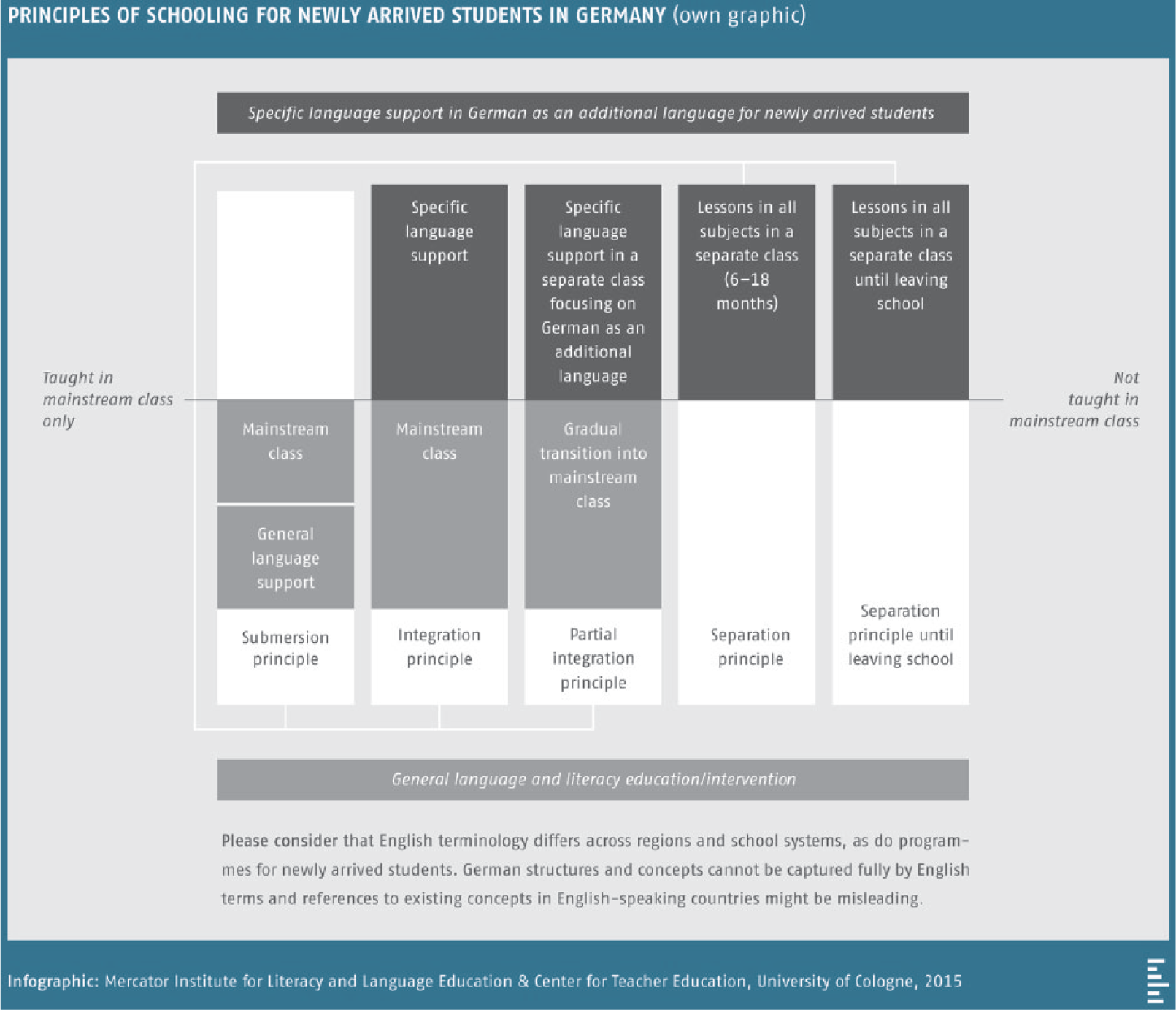
Principles of schooling for newly arrived migrant students in Germany.
Broadly speaking there is a continuum of different principles that linger between two extremes (Massumi et al., 2015: 45) 2 : at one end of the spectrum, we find newcomers taught in mainstream class only, right from the beginning with no additional support in German (submersion). At the other end, we find the concept of installing separate classes exclusively for newly arrived migrant students with no previous knowledge of German. They are parallel to other classes at school and continue until graduation (segregation until leaving school). In the vast majority of federal states this type of programme applies to vocational schools only.
In general, both ends of the range may not be the most common approaches: often a combination of mainstream class and separate class is chosen. The integration principle puts newcomer students straight into mainstream classes and includes some form of additional support in German as an additional language. In contrast, the principle of partial integration as well as the principle of separation are based on parallel classes for the newly arrived. These parallel classes are generally temporary, usually have a maximum stay of two years and aim for mainstream as soon as possible. Choosing the principle of partial integration of students from a parallel to mainstream class, they start in a separate class, but increase the amount of time and number of subjects in the mainstream class step by step. This results in a combination of separate and mainstream classes with students switching between both according to their individual timetable for a certain amount of time. Using the separation principle, a certain point in time is fixed, usually the beginning of a new school year for transition from a parallel to a mainstream class. Within these guidelines the period of time in a separate class may depend on the student’s proficiency with German, given that the concept of separate classes for newcomer students is based on the idea of their special needs regarding the German language.
Central to the principle of integrating newly arrived migrant students into mainstream classes is support in German as an additional language. Using the principle of submersion without any further support could be linked to the concept of ‘negative equality’ stating ‘that all people are equal and therefore should be treated identically’ (Thompson, 2013: 1251). However, negative equality – realised in the submersive principle of schooling – is inappropriate as it neglects the situation and needs of students with no proficiency in German in a mainly German-speaking classroom. Piller characterises the resulting situation of submersion as ‘obviously unfair’ (2015: 104). Language majority students need to focus on content only, while the language learners ‘who are learning language and content at the same time, will always be playing catch-up’ (Piller, 2015: 104). Sufficient knowledge of German determines the threshold of visiting a mainstream class or not 3 and thus the categorisation of a student as newcomer or ‘lateral entrant’ (German: Seiteneinsteiger). As long as she or he is taught outside mainstream class the attribute applies. Transition into mainstream class may end the affiliation to this category theoretically. However, as discussed earlier, effects of social inclusion and exclusion are tightly connected. Applying this idea to institutional structures, the transition from an excluding structure (separate class) to a presumably including one (mainstream class) does not necessarily lead to enhanced participation. In contrast, being the only one or one of a few ‘former newcomer students’ in a classroom may even enhance excluding effects, especially if no support is given by the teacher.
In the following we are going to use the theoretical heuristic of inclusion and exclusion to analyse an interaction in a separate class for newcomers only. This way, we are aiming for a better understanding of the complexity of the related exclusive and inclusive effects on a structural and practical level (i.e. principles of schooling and class interaction respectively).
Method
In our research project, which took place in 2014–2015 with 20 graduate students at the University of Cologne, 4 we examined the schooling of newly arrived students in ten schools in the city of Cologne, Germany. Within the ten participating schools, different principles of schooling, different stages (primary and secondary) and accordingly age groups of students were represented. The sample of schools was not chosen by selective criteria other than the requirement of having taken newly arrived students in. Yet, we tried to represent different types of schools, from primary to vocational level, in order to explore a range of schooling. All schools participated voluntarily with no further obligations.
For the purpose of this article, we are focussing on one of the research interests of the project by looking at how teachers deal with teaching newly arrived immigrant students: which (didactical) practices do they use in order to include the students’ diverse (language) skills and how are these practices framed by concepts and attitudes towards teaching new migrant students? 5
Based on this rather explorative research interest, we triangulated different data in order to explore the practices of teaching and interaction with newcomer students: first, we conducted expert interviews (Meuser and Nagel, 2009) with teachers of newly arrived migrant students, mostly teaching in separate classes or in groups for German as an additional language. Second, two researchers observed one class at the same time, each using a different research method: one wrote partly structured observation protocols focussing on the didactical methods used by the teacher and gathered a corpus of all written material used in class. The other researcher wrote ethnographic classroom observation protocols, establishing her or his own focus within the course of the observations. These observations were compressed and at the same time expanded into thick descriptions (Geertz, 1973). The interviews as well as the observation protocols were analysed using a qualitative content analysis approach (Mayring, 2015; Schreier, 2012), whereas the written material was used for a corpus-based product analysis (see Petersen, 2014). For the analysis of the thick descriptions we made use of the categorisation procedure of Grounded Theory.
Later we will examine closely one thick description of a scene in a lesson within a separate class for newcomer students at a secondary school in Germany. As the methodological approach of Grounded Theory aims for the construction of theory (Glaser and Strauss, 2008; Friebertshäuser et al., 2012), conceptual categories were developed by analysing the empirical data in an inductive and comparative way. The process of coding data can be described as a ‘microanalytic study’ (Mey and Mruck, 2009). In this process, we divided the scene into sequences first, which were then connected to codings. Second, we compared and theorised these codings. This procedure reveals the paradoxical relationship between the teacher’s outspoken symbolic attitude regarding the students’ multilingualism (supplemented by interview statements) and her tacit assumptions towards it; as well as implicit barriers constructed through the methodical frame of the lesson.
Analysis
The following scene took place in a separate class for newly arrived migrant children at a secondary school (German: Gesamtschule) in Cologne, North Rhine Westphalia, Germany. The all-day school has chosen the principle of partial integration: in the morning lessons are mostly given in a separate class for newcomers only and the class teacher is often accompanied by a special education teacher. In the afternoon the students partly attend lessons of mainstream classes (e.g. arts or physical education) or extra-curricular activities, such as craft or soccer clubs.
The separate class consists of 16 students, attending grades five to seven. While nationality has not been elicited, students’ first languages are Kurdish (four students), Hungarian (three students), Arabic (two students), Greek (two students), Polish, Dutch, Romanian, Spanish and Portuguese (one student each). The teacher speaks German as a first language and Ancient Greek, Latin, English and French as second languages.
We have chosen this particular scene for analysis because it demonstrates the teacher’s struggle in trying to make use of the highly multilingual setting and, thus, illustrates very well the complex interplay between including and excluding effects. Within the given structure of a separate class for newcomers only, the class teacher wants to include the existing languages by applying a new method:
Thick description ‘Could I borrow your … ?’
The teacher asks the students: ‘Do you still speak your mother tongue? That’s what we will look at today…so that you won’t forget your mother tongue’. The children show now clear reaction at first sight. It seems as if they were surprised, because so far their class focussed on German language learning only. Supposedly, they are not able to anticipate the task to come. The teacher tells them to ask one another if they could borrow something using sentences like ‘Could I borrow your pencil, please?’. They should do this using their first languages, intentionally addressing those classmates who do not understand their language. The addressed student then should answer in German ‘Pardon me?’. Now, the student should repeat his or her question in German, so that the addressee may answer the question in German. The first student, Constantinos, hesitates before speaking Greek and asks insecurely: ‘Hmm, but … I don’t know the Greek word for pencil…’ Afterwards other students ask similar questions or hesitate before using their first languages, too. In general, students speak strikingly fast and in very low voices. Additionally, some of them struggle to find the right words in their first languages. The teacher tries to encourage the students, and reacts surprised: ‘But at home you speak nothing but your languages! You know them! Don’t be shy using them here, too!’ Still, when the students speak their first languages, they seem embarrassed within this apparently uncommon situation. Some students seem to be amused by their classmates’ languages. Having finished the task, the teacher comments on how low and quick they spoke their languages. She encourages them to be more self-confident next time and to value their multilingualism: ‘Why do you speak your mother tongue so fast and lowly? You may well speak up. I really appreciate the many languages you speak. Not everyone can do so, it’s really something special and great!’
Formally, a question introduces the scene: the teacher asks whether the students still speak their first languages (mother tongues). Instead of waiting for a reply, she rather formulates the objective of not forgetting them (line 2) and explains the assignment: a role-play consisting of short dialogues in which one student tries to borrow something from another – in two languages. The first attempt has to be carried out in the student’s first language, but will not be understood by the addressee who does not know that language. Therefore they switch to German (lines 5–10) repeating the request that now can be answered easily. However, students do not perform the assignment in the way intended by the teacher. Instead, they show insecurities regarding the situation as well as the vocabulary needed. Thus, the ‘examination of their first language proficiency’ (lines 1–2) the teacher announces, does produce at least mixed results. As a reaction she expresses surprise (lines 16–17: But at home you speak nothing but your languages! You know them!) and tries to encourage them. At this point it becomes clear that her introduction of the assignment was rhetorical as she answers her initial question (line 1) herself (You know them!). Additionally, she gives a reason for it, namely the language usage at home (line 16). Her encouraging intervention still does not resolve the situation and the students’ performance does not change or improve visibly. The teacher then ends the unit by encouraging the students once more to be proud of their languages, telling them that she very much appreciates their competences (lines 20–24). However, she does not explicitly evaluate their performance, or give linguistic support, e.g. by providing a word list, further exercises, etc. Considering the make-up of the separate class for newcomer students only, there are several languages apart from German spoken by more than one student as his or her first, or maybe second language. Yet, the teacher excludes the option of using one of these common languages explicitly. In consequence, the students’ first languages are used merely for translation, not to complete the intended action of the role-play. Given that she does not talk about linguistic structures and forms etc., it does not seem very likely that the teacher planned her assignment with a form-focused linguistic objective in mind, like to practice translating or comparing requests across languages. She neither evaluates the performance with regard to the linguistic demands and performance, nor does she apply any sort of sanctions for not having performed well.
Instead, she defines the situation by classifying the students’ reactions as being shy (line 17). This is what she reacts to. Therefore, a connection between the teacher’s introduction, her intervention and her closure can be established, while the actual completion of the assignment by the students appears to be detached. Regarding the students’ performance, the teacher chooses an explanation by herself and acts accordingly – on a symbolic level of meta-communication, expressing appreciation and encouragement.
Symbolic appreciation of the students’ languages
The teacher’s awareness of her students’ first languages becomes apparent when she chooses a multilingual assignment. Starting with the – rather rhetorical – question if they still know their first languages and animating the students to use their languages, she demonstrates her will to include different languages in class. In this spirit the teacher praises bi- or multilingualism explicitly at the end of the scene (lines 22–24: I really appreciate … something special and great). This general regard points towards a positive attitude to the students’ bilingualism. In addition, she shows an affirmative attitude towards her students’ first languages during the interview: by pointing to a global map on the wall she elaborates: (…) there you’ll see from which / where about from all over the world my children come from. I don’t have a set (!) of ten something, but they come from all over the world. And if they want to talk to each other they have to revert to German. As a centre. So. Of course, I don’t ban them (!) [first languages], just the opposite. We use short dialogues (…) (Interview School IX, p. 12 (151).
In the interview she uses the spatial metaphor of a centre in order to illustrate the status of the German language whereas the other languages of the students are also ‘inside’, i.e. not banned as she highlights. But in this picture they are located at the margins. Foucault connects the dualism between centre vs. margins to the concept of normalisation. Marginalisation can be seen as a societal strategy to sustain a system of norms. These norms are not only a description of what is common, but also a specification of how to act, think and feel. Thus, these disciplinary effects are not only brought in to us from the outside, but also work from within in a self-disciplining way (Foucault, 1994: 238). The perspective of different languages each being more or less central, coincides with learning German as the overall target of the class functioning as temporary and transitional arrangement, separating newcomer students from others. Despite this ‘marginal’ position of the students’ languages in relation to German the teacher explicitly mentions their inclusion into class, even quoting short dialogues as one of the methods she is using for this purpose. However, the students’ reaction to the method in the analysed scene indicates something different, namely that it is not common for them to use languages other than German officially in class, i.e. as part of an assignment. This suggests that the teacher – even if involving various languages from time to time – has not established a routine in using multilingual methods. Her appreciation appears to remain on a symbolic level and then conflicts with the actual interaction in class.
Tacit assumptions and implicitly constructed barriers
In addition to the analysis of what the teacher phrases explicitly in the interview and the scene, there are certain instances in the arrangement of the scene that refer to underlying assumptions of the teacher regarding languages and language acquisition. Unlike the symbolic praise, they remain tacit and may not even be clear to the teacher herself. Yet, they do have consequences within class, and they allow a different reading of the teacher’s phrasing.
We could distinguish two perspectives on the assignment, focusing on the linguistic task or action. Linguistically, the students have to perform a translation, uttering the same sentence, i.e. a request, in their first language and German. However, in this case the objective of the assignment remains fairly vague and does not correspond convincingly with the teacher’s introduction. The addressed student’s task is easy from a linguistic point of view, as he or she only has to answer with ‘Pardon?’ or ‘yes’ respectively. On the other hand, the performed action of borrowing something from somebody is completed once the request has been complied with (or refused). One necessary condition for this to happen is that the speaker and hearer do understand each other by speaking the same language. This is not given in the setting, even though there are students who speak the same languages.
One of these assumptions could be the idea that (first) languages are acquired ‘in a natural way’ with no effort, resulting in a proficient native speaker. This concept is compatible with certain approaches to language acquisition, particularly Generative Grammar (see Cook and Newson, 2007; Pinker, 1994). In the present case, it becomes visible through the initial rhetorical questions and its late answer (lines 1–2, 16), but also leads to the idea that the students should be able to express everything in their first language, resulting in surprise when this is not the case (lines 16–17). The teacher is not aware of the consequences that the usage of a certain language in a certain context implies, like vocabulary of the different semantic domains as well as varieties according to the domain. Otherwise she might have planned the multilingual assignment differently, not using a translation in a setting otherwise not focusing on form, or avoiding the semantic domain of ‘items used in the classroom’. Instead, she seems to expect the students to resemble monolingual speakers in one person. This position was more common earlier, but has been proven wrong (Grosjean, 1982, 1989). Furthermore, it might imply that she is not aware of the specific requirements of academic language differing from general communicative needs in daily interaction. Cummins (1979, 2008) has coined the terms BICS (basic interpersonal communicative skills) and CALP (cognitive academic language proficiency) in order make clear it is two different issues; BICS being sufficient for daily, mostly oral communication, but CALP as a requirement for participation in class.
This assumption of students as competent, or even ‘flawless’, speakers of their native languages is related to another idea regarding the language of bilinguals: the teacher assumes that there is a clear boundary between German and the respective additional language (But at home you speak nothing but your languages!), conceptualising languages as static and clearly separable units tied firmly to certain places. She implicitly states that the students do not speak German – or any other language other than their mother tongue – at home, and does not consider the option of code-switching or mixing (Terhart and von Dewitz, 2017). Or, if she does, maybe it does not form part of her concept of ‘speaking a language’. Against the background of the analysis above, the teacher’s connection of ‘first language’ or rather mother tongue and ‘home’ appears to construct a demarcation line. She establishes an antithesis of ‘at home’ as the place of the families and their languages on one hand and ‘at school’ termed as here (line 17) on the other. The term mother tongue intensifies this effect as well as the phrase
Results
The thick description of a scene in a separate class for recently arrived migrant students in a secondary school in Germany is only a small glimpse of the practice of one teacher. Yet it opens up a view on the complexity concerning the question of exclusive and inclusive effects on a structural (principle of schooling) and practical (class interaction) level in school. In order to work on the morally convincing idea of inclusive education in a realistic way, the idea of inclusion and exclusion as a couple needs to be taken into account. In doing so, pedagogical practices cannot be completely inclusive as they are always accompanied by exclusive effects. Likewise, formally exclusive institutional structures may also provide the opportunity of inclusive actions. With this in mind, inclusion and exclusion are not mutual alternatives; they exist in a comprising relation. In terms of the scene, learning a new language in school always implies that language is not only the medium but also the subject of learning (e.g. Khakpour, 2015: 227). Against the background of a monolingual school targeting German proficiency only, the teacher may still have different reasons for installing multilingual settings (Dirim, 2015): one could be the aim of raising language awareness and promoting metalinguistic competence. From this perspective, first language competence can be used or even transferred to the second language and thus facilitate learning. This approach is very often connected to Cummins’ interdependence hypothesis (Cummins, 1991), but might partly lead to a simplified notion of transfer and the use of resources. As analysed above the teacher of the observed class does not focus on language very much. The idea that multilingual competence is a value in itself is undermined by the monolingual requirements of the school (Cummins, 1991). This explains how the teacher unconsciously creates a situation of conflicting implicit and explicit messages for the students. In this scene, the announcement of including the first languages of the students in the separate class for newly arrived migrant students does not result in including multilingual practices, as one might assume. Instead, including the first languages of the students in a certain didactical situation leads to a rather excluding effect. By dividing the scene into its sequences, two interwoven and paradoxical dimensions were reconstructed: the symbolic appreciation of multilingualism by the teacher and the implicit construction of barriers through the tacit underlying assumptions.
By matching these two dimensions which structure the scene in class, two interpretations seem likely: possibly the teacher has not reflected her position on multilingualism ‘as a resource’ but rather uncritically adopted a positive idea of multilingualism. Critical opinions towards multilingualism in school may not go down well within the professional context of this teacher. The claim of multilingual resources that should be included in class might have developed a normative character that makes it hard to allow honest articulation of insecurity, doubts or critical attitudes towards the multilingual situation. In this interpretation, the global affirmative attitude towards multilingualism becomes a barrier in itself, inhibiting sensitivity in acknowledging the language situation of the students in its variety. Instead all students are presumed to use exclusively their first languages with their families at home.
A second interpretation focuses on a change towards a negative attitude to multilingualism over time. The students might well react even more reluctantly the next time they are asked to use their languages, whereas the teacher may expect them to overcome their insecurities. This may result in frustration for the teacher who may even develop the idea of the students as ‘not proficient speakers’, or bilingualism as enhancing semi-lingualism (see Wiese, 2012 for a critical view). Her positive attitude might change to a critical one, using her students’ performance as evidence without starting a process of reflection, or entering a discussion with other professionals, such as colleagues or even the students themselves. While she does talk to the students there is no such discussion in this scene; it rather resembles a monologue and even though she knows the class, it seems as if no communication about the language situation of the children has taken place. In this scene no requirement analysis or negotiation between the students and the teacher concerning the spoken languages is done.
Furthermore, the idea of including various languages in class is complex: multilingual resources are not ‘just there’ in the classroom but the usage of language(s) in class has to be negotiated between all members of this class. Including the students’ perspectives could be a starting point to reduce the tension between the educational pretence of integrating various languages while inhibiting their communicative function in practice at the same time. When analysing this scene, the overall school programme as well as the principle of schooling for newcomer students has to be taken into account: the setting of a separate class may have influenced the teacher’s attempt to include multilingualism. The structural segregation within the school may also have led to a hidden curriculum of placing languages and their speakers into a hierarchy with German at the top.
In comparison to data from other schools, the expressed global affirmative relation towards multilingualism and the first languages of the students seems common. In the interviews the teachers show a general positive attitude towards multilingualism. However, when talking about the practical task of including the first languages of the students, doubts seem to arise. To point out the complexity or even impossibility of including all languages, one teacher refers to a student from Nigeria who speaks any kind of dialect no one knows which he is unable to use in class (school VIII, p. 6 (126)). Too many different or too uncommon languages in a class are seen as barriers, whereas languages spoken by the teachers are preferred.
Discussion
The way of organising education for newcomer students influences the options about what can or cannot be negotiated within a classroom. At the same time, practices bring formal decisions to life. Both are framed by the social functions of the educational system and the way it deals with newly arrived migrant students and their families. Formal education provides central instruments and mechanisms to control options for social participation. Looking at the different principles of schooling for newly arrived immigrant students in Germany in terms of social exclusion and inclusion, at first glance, an inclusive approach integrating incoming students straight into mainstream class seems to suggest itself. It is the least segregating principle with all students in one class. This way, newcomers are directly part of the school community and student body, not being separated into special classes or defined as a specific group. Instead they are treated like other children who change schools within Germany or migrate from German-speaking countries. Their presence in class may also have a stronger impact on all students: they are participating in a multi-heterogeneous setting. Whether such a setting has a positive impact on their interaction or results in segregating practices amongst students, again may depend on a wide range of factors, mostly beyond organisational structures. Nevertheless the school as a whole may include its increasing diversity, developing the school programme or revising the concept of language education and promotion at an institutional level. Furthermore, the language(s) and competences of language learners are often not elicited or valued, so that this may result in difficulties with making use of them in class (Dirim, 2015; Leichsering, 2003: 231). Positive equality means ‘that all people are moral equals but that differential treatment is what equality demands, is the conception of equality invoked in a seminal case involving language minority students’ (Thompson, 2013: 1251). However, with regard to newly arrived migrant students this does not necessarily result in parallel classes for them only. Applying an integrative principle usually implies scheduling additional lessons, either in the afternoon when classes are over or parallel to mainstream class as pull-out lessons. They provide additional support by ‘treating them differently’. Yet, in comparison to a parallel class for newcomers only, there are usually fewer hours per week.
Concerning inclusive and exclusive effects at the institutional level, parallel classes for newcomer students are generally transitional in the sense that they aim at integration into mainstream class. Separate classes install a spatial division between newcomer and other students, segregating them into different classrooms, sometimes even in different buildings. The excluding structure from this point of view seems obvious. Very often these classes focus on German language, so that other subjects may be taught to a reduced extent. But, as for structural conditions of time, number of students, etc., also the amount of German language classes in comparison to other subjects may depend on state-specific guidelines. Being in a separate class involves the risk that students with no proficiency in German can appear to be some sort of other or different group. As schooling is obligatory in Germany, all children and adolescents of the respective age have to be included into school. Classes for newly arrived students only could therefore be classified as a separating form of inclusion (Stichweh, 2013). Hence, special classes for newcomers may lead to social marginalisation within the school. At the same time they may function as a protective space for students – especially in the very beginning.
Hence, the relationship regarding excluding and including effects of schooling for newly arrived students is more complex than the automatic division between the schooling in mainstream class as being inclusive and the schooling in parallel class being exclusive – both can provide a lack of social attention. If the principles of schooling are considered to be a continuum, they interrelate closely but never totally. Including and excluding institutional structures entail each other, as practices do, too. Therefore, we observe a dynamic system that includes coinciding but also diverging structures and practices of inclusion and exclusion. Certain structures like the way of organising the schooling for newcomers can contravene the actual practices taking place in social interaction within these structures. As the analysis of the scene showed, despite the principle used, the teacher’s beliefs and practices have a deep impact on the situation. Regardless of the chosen principle of schooling, it is fundamental to offer social situations of contact and joint tasks within the school for all students. In this respect, newcomer students, particularly refugees, may need further professional support beyond language learning, regarding their former and current experience of insecurities.
Their future opportunities or disadvantages are affected by the complex interplay of including and excluding effects in school examined earlier. Relying on this conceptual pair as a heuristic, the empirical analysis illustrates the multidimensional connection of these terms with the organisational framework of one school and its concrete social practices within class. Like a fourfold table, exclusion and inclusion at the level of institutional structures as well as at the level of practice can be related to one another and characterise the schooling of recently arrived students: inclusive practices can take place in formally excluding structures of classes for newcomers only just as separation can happen within integrative settings. Moreover, the effects of including exclusion and excluding inclusion take place within pedagogical settings as areas of tension. The shaping of these areas should involve all participants. This includes the students’ perspective.
Footnotes
Declaration of Conflicting Interest
The author(s) declared no potential conflicts of interest with respect to the research, authorship, and/or publication of this article.
Funding
The author(s) received no financial support for the research, authorship, and/or publication of this article.