




Abstract
In this article, the authors interpret affirmative actions with reference to structural violence, which is accompanied by legitimizing discourses that tend to make discrimination appear natural and unquestionable. They illustrate the extension of structural violence in Brazilian society with particular reference to access to higher education. It has been common to talk about some groups of students as having special needs. However, the authors see groups of students suffering structural violence as being groups with special rights, and explore affirmative actions through the notion of special rights. The authors find that special-rights terminology establishes the discussion of affirmative actions in higher education in a broader and, at the same time, more profound conceptual framework related to interpretations of social justice. Simultaneously, special-rights terminology brings an educational specificity to the discussion of affirmative actions. Thus, the authors see affirmative actions as being both a general sociopolitical and specific educational challenge.
Keywords
Introduction
In 2012, the Organisation for Economic Co-operation and Development published a report pointing out that university degrees provide a route to economic and individual success, as well as national development. The report claims that, in the end, people with higher education get economic advantages compared to other people. In Brazil, the income of people with higher education is 157% higher than the income of people without, while in member countries of the Organisation for Economic Co-operation and Development (2013) this difference is, on average, 57%. 1 Researches have also shown that having a higher education gives advantages beyond the economic (Baum et al., 2013). For instance, a study by the Institute of Education at the University of London states that students with higher education have shown a greater tendency to be happy, healthy and democratically tolerant (Jackson et al., 2005). Other research, conducted in the USA by the Washington Higher Education Coordinating Board, entitled Key Facts about Higher Education in Washington , claims that families with parents who do not have a college degree are three times more likely to live below the poverty line and require government-subsidized services (Washington Higher Education Coordinating Board, 2009–2010). The study concludes that a higher level of education, in addition to financial independence, is also related to individuals who are healthier and less likely to engage in criminal activities, and have a greater level of participation in elections and voluntary work.
Race and ethnicity influence the opportunities for many groups of people to have access to higher education. In Latin America, black and indigenous students have traditionally been under-represented in higher education (Cicalo, 2012; Linhares, 2010; Sverdlick et al., 2005). Similar under-representation has occurred in other parts of the world, as in the USA, for instance, with reference to black, Latino American, South-east Asian and Native American students (Harper, 2012; Howard, 2014; Palmer et al., 2014; Strayhorn, 2010). Several struggles and social movements have confronted this situation. Social pressure has led some governments to act against such discrimination and improve the access of marginalized groups to higher education (Bowen et al., 2006; Burke, 2012; Gomes, 2003; Harper et al., 2009; Park, 2013; Sowell, 2004). These policies, referred to as affirmative actions, are associated with the elaboration of principles opposing discrimination. The ultimate goal has been to foster equality between peoples, regardless of their ethnicity, race, socio-economic status, gender, sexuality or first-language background.
The notion of affirmative action originated in the early 1960s in the USA through a programme implemented by President JF Kennedy promoting public and private policies that countered social and racial discrimination. Before that, in the mid 1940s, there were discussions that sought to create legal mechanisms to prevent the existence of racial discrimination in public service recruitment. One of the first cases involving lawsuits related to the issue of access to higher education, discussed in the US Supreme Court, occurred during that period. In 1945, a black candidate, Heman Sweatt, was rejected during the admission process of the University of Texas Law School. The university had been founded on a law of the state which asserted that only white people were qualified to attend university programmes in the state. The Supreme Court ruled that Sweatt’s rights had been violated, since, according to the Fourteenth Amendment to the US constitution, no state could deny a person equal protection under its laws (Dworkin, 2013). In 1965, President Lyndon Johnson strengthened affirmative action policies and demanded that companies with federally affiliated contracts use non-discriminatory hiring practices and actions to combat the effects of the discrimination that had occurred in previous decades. Shortly thereafter, the category of gender began to be integrated into affirmative action policies and, in 1972, similar requirements began to be introduced in educational institutions (Archibong and Sharps, 2013; Bowen and Bok, 1998; Oliven, 2007; Sowell, 2004).
In much of our research, we have addressed mathematics education from the perspective of critical mathematics education (see, for example, Skovsmose, 2011, 2014, 2016; Silva, 2016b). However, in this article, we will concentrate on a more general educational issue and only briefly illustrate it with references to mathematics. We are going to address affirmative actions in higher education. First, we present some figures from Brazil, which reveal a profound social bias with respect to access to higher education. We then introduce the notion of structural violence and interpret the Brazilian figures as an expression of such violence. This brings us to the notion of students with special rights, which we find to be a more adequate term than the notion of students with special needs. We find that groups of students who suffer forms of structural violence get special rights, and we interpret affirmative actions as an expression of such rights.
Figures from Brazil
Brazil has followed the global tendency regarding enrolment in higher education, and there has been a significant increase in enrolment in just one decade. In 2002, there were approximately 3.5 million students enrolled, while 12 years later the number was 8 million (Instituto Brasileiro de Geografia e Estatística, 2015). This situation could indicate that Brazil has undergone radical changes with respect to education; unfortunately, however, racial and social inequalities continue to exist in its educational system (Ristoff, 2014).
Brazil has approximately 200 million inhabitants. Its demographic census asks Brazilians about their ethnicity, and people have to choose between five categories: white, preto, pardo, yellow or indigenous. Black people are composed of preto and pardo. While preto literally means ‘black’ in Portuguese, pardo refers to people with mixed-race ancestors and mixed skin colours. In the last demographic census, approximately 53% of Brazilians self-declared as black (Instituto Brasileiro de Geografia e Estatística, 2015). Illiteracy among black people is almost 13%, while it is 6.5% among white people. A black person has an average of 6.7 years of schooling, whereas a white person has an average of 8.5 years (Instituto Brasileiro de Geografia e Estatística, 2013). The distribution of employment and income is also not uniform. Most black people take jobs that do not require schooling, such as a domestic servant or farmworker (Departamento Intersindical de Estatística e Estudos Socioeconômicos, 2012). The difference between adult blacks and whites with a university degree is shown in Table 1.
Percentage of people aged 25 or over with a university degree.

Source: The authors, based on Instituto Brasileiro de Geografia e Estatística (2013), United Nations Development Programme (2005), and the Instituto Nacional de Pesquisas Educacionais Anísio Teixeira (2014).
The University of São Paulo is one of the major universities in Latin America. In 2013, the racial inequality between freshman students was appalling. Approximately 80% of these students were white, while 13% were black. The percentage of indigenous students was 0.2%. The remaining students – around 7% – were Asian, who were classified as ‘yellow’ according to the Brazilian census categories. These differences are further evidenced when we consider the percentage of black freshman students on the more selective courses at this university (see Table 2). There were no preto students enrolled on the medical course at the University of São Paulo, and just 7% were pardo.
Enrolment in the 10 most selective courses at the University of São Paulo in 2013.
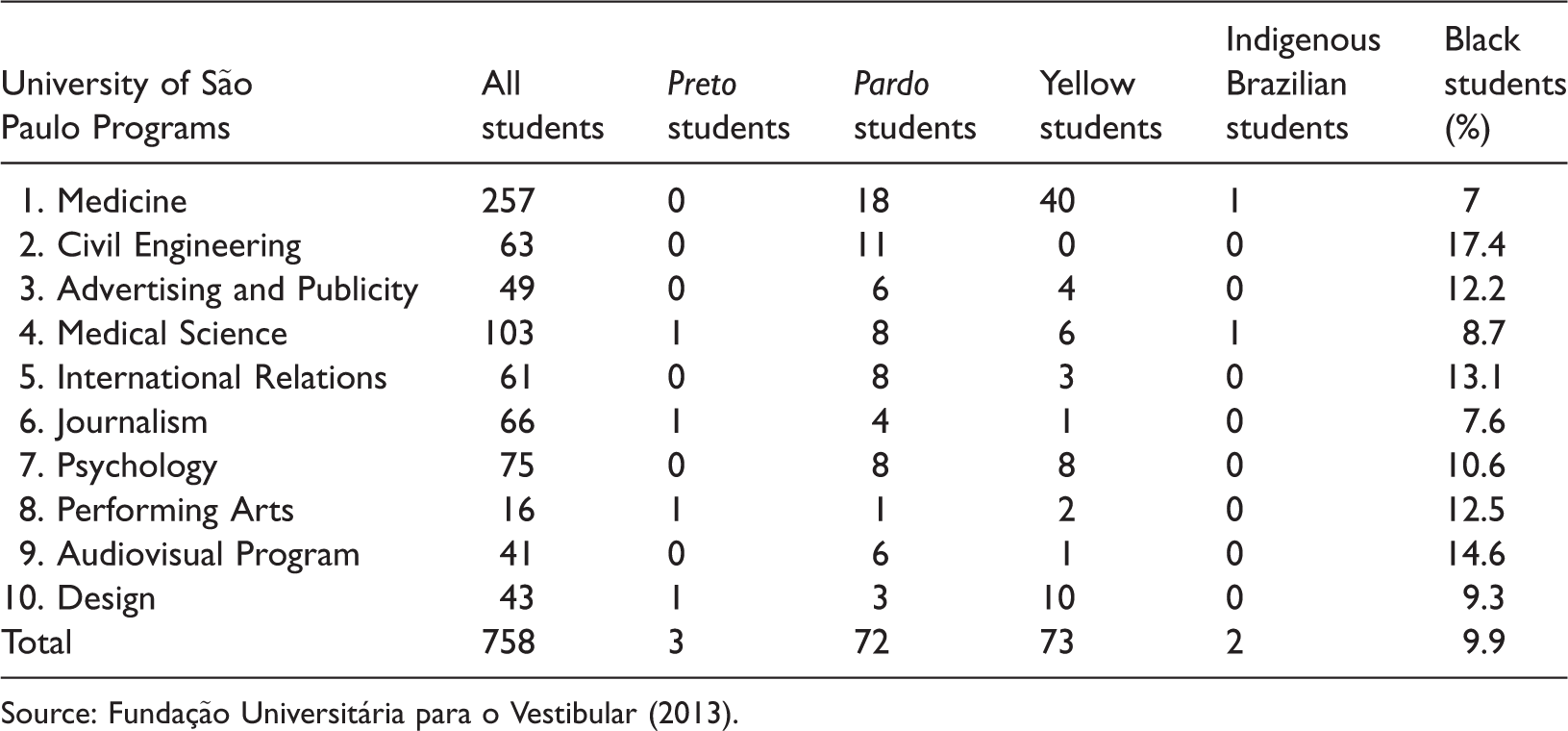
Within the less popular courses at the University of São Paulo, the percentage of black freshmen was relatively greater than in the top-10 courses. Table 3 shows the 10 least selective courses in the 2013 admission examination. The average proportion of black freshman students on these courses was approximately 26%, against 9.9% on the top-10 more selective courses.
Enrolment in the 10 least selective courses at the University of São Paulo in 2013.
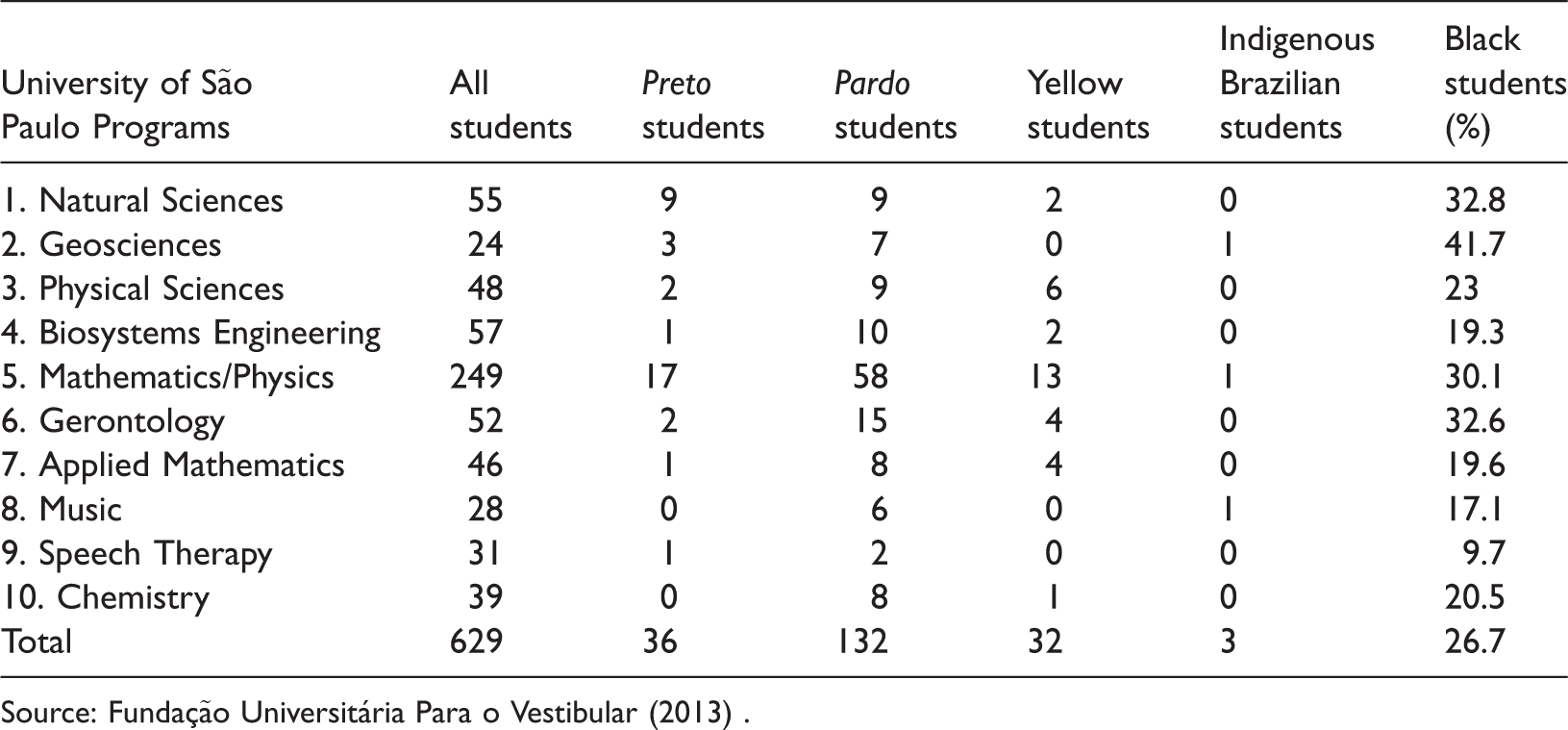
Source: Fundação Universitária Para o Vestibular (2013) .
At the University of São Paulo, as in most Brazilian universities, the admission examination comprises just one test, which includes content from all disciplines. Students from the upper social class, who have attended more expensive schools, have an in-built advantage. In 2011, students from the 20% higher-income group occupied 47.1% of all places at Brazilian universities, while those from the 20% low-income group occupied only 4.2% of places (Instituto Brasileiro de Geografia e Estatística, 2015).
Structural violence
Violence can take many forms. For instance, the extension and brutality of colonial violence seems almost to be without limits, including genocide as one possible extreme. In Postcolonialism, Young (2016) points out that colonial violence becomes extended deep into post-colonial times, although in new formats. In Identity and Violence, Sen (2006) discusses how violence may be cultivated, how it can be related to religious positions, how it can relate to sexism, and how it can form identities. Such discussions as those by Young and Sen certainly refer to the existence of overt physical violence, but they also conceptualize the existence of a different, implicit, acted-out form of violence. In the following, we refer to this as ‘structural violence’.
In his book Violence, Žižek (2008) presents the notion of systemic violence as being different from open physical violence. He points out that contrary to physical violence, systemic violence is invisible and causes no physical injury to its victims. Žižek integrates the notion of systemic violence into his general, highly elaborated philosophical and political outlook. Although we are inspired by Žižek’s distinction between physical and systemic violence, and want to acknowledge this, we are not ready to assume his whole theoretical outlook. As a consequence, we prefer to talk about structural violence. 2
Galtung (1969) may have been the first explicitly to use the notion of structural violence. However, the idea that violence need not be explicit and physical, but could be implicit and structural, was formulated earlier – for instance, by Fanon (2004, 2008), who published during the 1950s and early 1960s. Farmer (2004) also refers to structural violence and highlights that this is an indirect violence practised by everyone who pertains to a certain social order. Farmer (2004: 307) states that ‘the concept of structural violence is intended to inform the study of the social machinery of oppression’. Farmer relates structural violence to conceptual and ideological structures, and we agree with this – structural violence can be exercised through a variety of oppressing discourses.
We find resonance between Farmer’s presentation of the notion and the way we see it. However, Farmer (2004: 307) also highlights the following: ‘Just as everyone seems to have his or her own definition of “structure” and “violence”, so too does the term “structural violence” cause epistemological jitters in our ranks’. Commenting on Farmer’s article , Wacquant makes the following observation: ‘structural violence may be strategically useful as a rhetorical tool, but it appears conceptually limited and limiting, even crippling’ (Wacquant, cited in Farmer, 2004: 322). We do not agree with Wacquant, but bearing these observations by Farmer and Wacquant in mind, we do not try to extract from the literature any unifying meaning of ‘structural violence’. Rather, we prefer to clarify our use of the notion and to illustrate it with reference to the figures from Brazil.
We consider structural violence as embedded in sociopolitical and economic structures working as a machinery of oppression. A husband may be physically violent to his wife, but violence in a family can also operate through well-established customs and traditions. Over the course of history and in different cultural contexts, the role of the father has been different from the role of the mother. Such differences could be violent to the extent that they establish advantages for some and disadvantages for others. In this way, sexism could be acted out as structural violence.
Racism has assumed the most explicit forms of physical violence – one only needs to recollect the history of slavery. However, even though colonialism and slavery belong to the past, their accompanying ideological and discursive structures may continue to operate. They may cause profound differences with respect to life conditions and, for instance, capture large groups of people in extreme poverty – a further example of structural violence.
The entire logic of capitalist production can be seen as an example of systemic violence, where the conditions of workers become formed through a sophisticated network of economic and political parameters. Sometimes, these conditions might have been maintained through physical violence; at other times, the format of capitalist production might appear to be broadly agreed on, yet still exercises as structural violence. Žižek (2008) has paid particular attention to the violence associated with capitalism, and we indeed acknowledge that structural violence operates through the logic of capitalism. 3
Let us now try to outline the brief characteristics of structural violence:
Structural violence is acted out through a fabric of powers and need not have any specific agent. Such violence is not exercised by a particular person or any defined institution. This applies when we consider the violence caused by the sexist formation of the roles in the family, when we consider how racism continues to operate even after colonialism has come to an end, and when we consider the patterns of production that dominate global capitalism. Structural violence is exercised through forms of discrimination and exclusion. Discrimination may involve, for instance, access to food, health care and welfare in general. Naturally, one can think of access as defined by walls and barriers; however, the point is that access and non-access can be established through a range of formalities and acted-out procedures. Discrimination can be related to political rights. A classic example is the right to vote. Women over the age of 21 gained the right to vote in England in 1928, in France in 1944 and in Switzerland in 1971, while, in South Africa, black people gained the right to vote in (Attridge and Jolly, 1998; Chandler, 2001; Duchen, 1994). Discrimination is exercised through a range of barriers and walls, ensuring that some become included and others are excluded. Structural violence is accompanied by legitimizing discourses. The function of such discourses is to make discrimination and exclusion appear natural and unquestionable. For instance, colonial systems have sought legitimation through discourses emphasizing the supremacy of the ‘white’ man. As a consequence, it turned into an obligation for the ‘white’ to take care of the ‘coloured’ (see, for example, Said, 1979). Today, one rarely finds explicit repetitions of such discourses, but post-colonialism is accompanied by a range of other discourses that tend to legitimize new forms of exploitation and make cases of structural violence appear ‘natural’.
The Brazilian figures as an expression of structural violence
We are now going to interpret the Brazilian figures as a manifestation of such structural violence. Although we concentrate on structural violence, we do not ignore that physical violence simultaneously adopts dramatic proportions. The report Mapa da violência (Map of violence; Waiselfsz, 2012) shows that, in 2012, considering all homicides among Brazilian people aged under 25, 75% were black. Physical violence is a devastating social fact that affects young black people more than young white people, and the difference is increasing. However, black people not only suffer from physical violence; they also suffer from structural violence. The Brazilian figures illustrate what this could mean, and we are going to indicate how these figures can be related to the characteristics of structural violence outlined above.
Structural violence is acted out through a fabric of powers
Table 1 shows a clear difference in terms of those who, aged 25 or over, have a university degree. In 1997, 2.2% of black people held such a degree, while 9.6% of white people held one. Table 1 also shows that the numbers have changed over time. In 2012, 13.3% of black people and 23.3% of white people had a degree. Thus, we have witnessed a substantial change with respect to people gaining a degree. Still, the figures reveal a significant difference between black and white people.
We read these figures as a manifestation of structural violence. Thus, the figures are not produced by any person, government or institution. No well-defined acting subject lies behind the figures. Nobody can be identified as being responsible. Instead, these figures emerge as an expression of a fabric of powers that are difficult to identify and enumerate. We have to consider the genealogy of such a fabric as being composed of political, economic, cultural and discursive features. Therefore, we have to be careful when we try to identify the possible sources of structural violence. However, in order to provide a reason for some of the changes in the figures, we can be more specific in pointing to forms of possible political and economic intervention.
Structural violence is exercised through forms of discrimination and exclusion
In Brazil, blacks have the highest illiteracy rates, constitute the largest group of people killed in the country, and overcrowd Brazilian prisons (Monteiro and Cardoso, 2013). At the other end of the scale, we find that the approximately 250 places on the medicine course at the University of São Paulo were taken by no preto and 18 pardo students.
In Brazil, such forms of discrimination have long historical roots. One can think of the genocide of Indians, slavery, landlordism and the Land Law of 1850, stating that people without large amounts of money had no access to land. Discrimination, however, continues to operate. For example, in some cases, migrants from north-eastern Brazil have been labelled as inferior or causing problems when they get to the São Paulo area. Similar situations occur in other countries. Fredrickson (2002: 149) points out that, ‘[a]lthough most Muslim immigrants to Europe are not potential terrorists and do not seek to impose their beliefs on others, Christians and secularists alike make them targets of suspicion and discrimination’.
Discrimination can take explicit forms – some become included, others excluded. Thus, discrimination can be acted out through explicit physical violence. However, discrimination can also be rooted in discourses that operate with simplifications, stereotypes and preconceptions. Discrimination may occur in nebulous ways, as, for instance, manifested in the form of microaggressions. This notion has been developed with reference to verbal and non-verbal abuse practices more or less subtly applied against individuals based on race, gender, ethnicity, social class, dialect or religion. Microaggressions might be exercised automatically or unconsciously by the offender; still, they can have a profound negative impact on the lives of those abused. Being followed by security guards inside a store, having suspicious looks cast at them with regard to their professional position or academic knowledge, or even being the target of racial jokes are situations that have been experienced by black people in the university environment (Silva, 2016b; Silva and Powell, 2016; Solórzano et al., 2000). These forms of discrimination are present in all spheres of Brazilian society, and they show what structural violence might include.
Structural violence is accompanied by legitimizing discourses
A classic legitimation of discrimination of blacks is rooted in what one ironically can refer to as ‘scientific racism’. By this we refer to studies that have been conducted at universities with the aim of identifying different human races. Phrenology, which refers to the detailed study of the shape and size of the cranium, played an important role in such studies. The stipulated biological differences were accompanied by a ranking, claiming that some human races were more developed than others. From the beginning of the 19th century, ‘scientific racism’ was developed with dedication in German universities, but was also established as a recognized scientific discipline in many countries. At the beginning of the 20th century, research centres in Brazil were responsible for the production and dissemination of racial ideology. The Medicine University of Salvador, for example, tried to identify links between criminal behaviour and being a black person. Also in this period, research at the Salvador University sought to document a connection between racial crossing and madness (United Nations Development Programme, 2005). It is not common today to meet with such ‘science-based’ justifications of discrimination. However, we still find a range of popular discourses through which discrimination becomes portrayed as natural.
Legitimizing discourses make up part of the formation of experiences of inferiority, as well as superiority, and form an integral part of structural violence. According to the United Nations Development Programme (2005), already in elementary school in Brazil, certain stereotypes are reinforced, which end up creating a stigma about black children. Among a rich variety of data, the report produced by the United Nations Development Programme presents a survey of 7- and 18-year-old students in public schools in Rio de Janeiro. The survey shows that while white people are associated with attributes such as beauty (95%) and intelligence (81.4%), and with professions such as engineering (85.4%) and medicine (92.2%), blacks are associated with the characteristics of ugly (90.3%) and stupid (82.3%), and with jobs such as janitor (84.4%) and cook (84.4%) . Such kinds of stereotypes operate as a way of legitimating discrimination towards black people.
Students with special rights
Inclusive education is one overall form of reacting to discrimination and, in the following section, we will consider affirmative actions in higher education as an example. First, however, we are going to suggest a change in terminology. Instead of talking about students with ‘special needs’, we will talk about students with ‘special rights’.
Special-needs terminology has been developed with reference to blind and deaf students, for instance. Hiring specialized staff as interpreters, for example, or transcribing material into Braille could be actions which are undertaken in order to compensate for the difficulties these students face. The term ‘special needs’ has also been applied to students with a so-called ‘lack of cultural capital’. 4
When students with ‘special needs’ enter higher education, they are claimed to enter with a lack of what is referred to as adequate content knowledge (Rosa, 2014). This lack needs to be compensated for and, accordingly, it becomes the students themselves who are described as having special needs. Special-needs terminology also makes up part of the discourse of affirmative actions, giving rise to different ideas about what one can do in order to organize ‘compensatory’ courses for those ‘in need’.
We find that special-needs terminology makes space for questionable discourses. Instead, we suggest that we talk about students with ‘special rights’. Thus, we agree with Runswick-Cole and Hodge (2009) when they, with respect to students with disabilities, suggest a change of terminology from students with ‘special educational needs’ to students with ‘special educational rights’. They point out that, over the years, the former notion has been integrated into discriminatory discourses. In fact, several institutions have applied special-rights terminology – for instance, UNESCO.
Gervasoni and Lidenskov (2011) have talked about students with ‘special rights’ with respect to mathematics education. They refer to students who ‘underperform in mathematics due to their exclusion from quality mathematics learning and teaching environments’ (307). They refer as well to visually or hearing-impaired students and to students with Down’s syndrome. Thus, they consider a variety of groups of students as having special rights. We agree completely concerning the broad relevance of special-rights terminology. While special-needs terminology tends to individualize the problem, special-rights terminology helps to highlight the structural and violent format of the problem.
The very idea of some people having special rights is broadly accepted, at least when it comes to certain situations. When an elderly person or a pregnant woman gets on a bus, a younger passenger might well give up their seat. When a person is involved in a traffic accident and needs urgently to get to hospital, people will make space for the ambulance to pass through. The same sort of special rights would apply to a person who has been knocked down in the street and needs urgent assistance. In such situations, people who have suffered an explicit form of physical violence get special rights. Our point, however, is that not only people who have suffered physical violence, but also people who have suffered structural violence, can be ascribed special rights. We find that special-rights terminology can be applied to any group of students who have suffered a form of structural violence.
Many groups of students in today’s societies suffer from structural violence; it could be through economic exclusion, poverty, racism, sexism or post-colonial suppression. It could be a form of structural violence as documented by the Brazilian figures presented above. Special-rights terminology has a broad range of applications. In the following, we exemplify this with respect to affirmative actions.
Affirmative actions in higher education as a human right
Special-needs terminology provides a certain perspective on affirmative actions in higher education, which we relate to features of what we refer to as a ‘charity discourse’. If we move back in time, we meet a portrayal of charity organizations as being formed by nice people doing something for people in need. These nice people could, out of their own pocket, give money, collect clothes for distribution and help in many different ways. Charity provides compensation for the misery some people have ended up in. Usually, charity has not been accompanied by a discourse that interprets misery as caused by social and economic structures. Charity discourses have also been applied with respect to affirmative actions, which means that such actions become seen as donations to people in need (Bacchi, 2004; Morley et al., 2006). In this way, students who have entered college through affirmative actions are seen as ‘needy’ students, who should be grateful for the opportunity they have received.
However, we view affirmative actions very differently. We do not think that any charity discourse should be applied to affirmative actions. We read the Brazilian figures as an expression of structural violence; we find that structural violence brings special rights to those groups of people who have suffered such violence; and we interpret affirmative actions as the acknowledgement of such rights.
This observation has many implications, and here we wish to point out two. First, we find that special-rights terminology establishes the discussion of affirmative actions in a broader and, at the same time, more profound conceptual framework. Second, we find that special-rights terminology helps to make the point that affirmative actions need to be elaborated in all their educational specificities.
Recognizing conceptual profoundness
The notion of special rights brings us directly to the notion of social justice and, as a consequence, to controversies of a philosophical, ethical and political nature. We find that the discussion of affirmative actions has to be located within such conceptual complexity. Naturally, this does not bring about any straightforward conclusive arguments for or against such actions. However, we come to recognize that apparently straightforward for-and-against arguments can be nothing but superficial.
As an illustration of the conceptual profoundness that special-rights terminology points towards, we refer to Rawls’ (2001) conceptions of fairness and justice, and to the way he addresses inequalities. According to Rawls’ conception, social and economic inequalities can be allowed only if they benefit the least advantaged members of society. Rawls points out that each person ‘has the same indefeasible claim to a fully adequate scheme of equal basic liberties’ (42). However, this does not imply that inequalities should be prevented. In fact, according to Rawls, one can imagine inequalities being introduced as part of an effort to establish fairness and justice. In this situation, he insists on what is referred to as the ‘difference principle’: social and economic inequalities have to be to ‘the greatest benefit of the least-advantaged members of society’ (43). The introduction of social and economic inequalities should benefit the most disadvantaged and help to provide an equality of opportunities.
Affirmative actions can be interpreted as an expression of the difference principle. This means, for instance, that if one wants to challenge the legitimacy of affirmative actions, one needs to challenge the principle of difference. As a consequence, a discussion of affirmative actions that primarily focuses on pragmatic and practical issues appears limited. We find that the discussion of affirmative actions needs to be related to philosophical, ethical and political controversies.
Elaborating educational specificity
The discussion of special rights leads directly to the need to clarify the specificity of such rights. Elderly people, pregnant women and injured persons all have special rights, and they are rights with a high degree of specificity. This also applies when special rights become expressed in terms of affirmative actions. Such actions do not simply consist of opening the door of universities to new groups of students. It also concerns how these groups of students are received at universities, and how they become engaged in their study activities. We refer to such issues as ‘educational specificities’.
Such specificities concern the particular university studies in question. Here, we will make reference to mathematics, keeping in mind that educational specificities need to be elaborated with respect to any discipline, be it history, biology or medicine, for example. 5 The implementation of affirmative actions will have to consider, for instance, what these educational specificities mean for the organization of introductory subjects to mathematics before students attend disciplines such as Differential and Integral Calculus. In some Brazilian universities, it has been common to offer such introductory courses. Generally, this is motivated by the academic difficulties that freshman students have experienced, both those benefiting and not benefiting from affirmative actions. Other universities around the world have also organized such introductory courses.
However, just offering introductory courses might not be enough. For instance, from 2003 to 2005 at the University of Michigan in the USA, of the 67 students who took Calculus I and II in the first year and were majoring in science, technology, engineering and mathematics (STEM) programmes, only four were from ethnic minorities (Mesa and Megginson, 2011). After a year-long study of historical data regarding students’ enrolment patterns in mathematics courses, the University of Michigan implemented the Douglass Houghton Scholars Program. The aim of this programme was to contribute to the access of non-traditional students to STEM programmes. Through workshops related to calculus, these students were encouraged to excel in calculus. For this, the classes were organized around problem-based learning. In addition, these students listened to STEM scientists talking about the mathematics that is required for work. Furthermore, they were invited to participate in social events. After one year, the Douglass Houghton Scholars Program showed some results, and one was that more minority students manifested an interest in STEM programmes (Mesa and Megginson, 2011). This illustrates our point that the implementation of affirmative actions has to address the educational organization and content of courses.
Considering mathematics, one could ask: What types of problems can arise that relate to mathematical notions and theories? What roles are the mathematical proofs playing in the exposition of mathematics? How is the distribution between lectures and group work organized? To what extent are the courses problem-based? The answers to such questions have implications for how affirmative actions become acted out within a mathematical study programme.
In addition, one needs to consider the knowledge that students bring to the university. In the Brazilian case, Silva (2016a) has pointed out that the characteristics and particularities of different groups of students are rarely discussed in mathematics departments or particular courses. However, one exception was identified in Silva (2016a), which occurred at a Brazilian federal university through a project organized by three professors from the mathematics department. Here, Brazilian indigenous students, who had accessed engineering programmes through affirmative actions, worked with academic mathematics to address the use of hand tools in agriculture. This project provided a space for relating students’ pre-knowledge to formal mathematics. Establishing such relationships constitutes part of the required educational specificity of affirmative actions.
Affirmative actions also have to address the social and academic integration of students. Studies show that this integration is an important factor for the progress of students from minority groups, particularly in STEM programmes (Foltz et al., 2014; Hurtado et al., 2010; Silva, 2016b ). In other words, affirmative actions need to be addressed as an educational task, including all kinds of specific interventions.
Concluding observations
What is, in fact, the status of affirmative actions in Brazil? Such actions are relatively recent, introduced after the World Conference against Racism, Racial Discrimination, Xenophobia and Related Intolerance in Durban, South Africa, in 2001. Before this conference, there was no discussion of affirmative actions in higher education in Brazil, even given the situation presented by the Brazilian statistics. This recent discussion has also taken place in other Latin American countries such as Chile, Colombia and Mexico (Linhares, 2010; Sverdlick et al., 2005). In 2003, a few Brazilian public universities, such as the State University of Rio de Janeiro, started programmes of affirmative action. Since then, a heated discussion has emerged (see, for example, Carvalho, 2003; Francis and Tannuri-Pianto, 2012; Seiffert and Hage, 2008), and the issue has begun to be broadly highlighted by the Brazilian media, influencing the general opinion. For instance, Campos et al. (2013) analysed one of the newspapers with the largest circulation in the country. According to them, in the years following 2004, articles explicitly opposed to affirmative actions published by the newspaper outweighed those that were in favour. In addition, Campos et al. point out that, between 2001 and 2008, more than 90% of the editorials that addressed the theme were against affirmative policies, especially those of a racial nature. This priority has become reflected in the general opinion of the population.
In the Brazilian context, affirmative action is a controversial issue, no matter where the discussion takes place. For example, a recent survey of undergraduate students from a prestigious federal university in the north-eastern region of Brazil showed that 84% of the students interviewed were against affirmative action based on race. The main justification was that ‘all’ students were equal and that, in terms of intellectual capacity, ‘all’ should be able to compete equally for places, regardless of race (Camino et al., 2014). With such a justification, all the past racial segregation suffered by black people in Brazil would become annulled. In 2012, the Brazilian Supreme Court judged affirmative actions to be constitutionally legal. Shortly thereafter, the government issued a law proclaiming that 50% of all places in federal Brazilian universities had to be reserved for students from public high schools, and that half of these places had to be for black students (Brasil, 2012).
Affirmative action policies have changed the profile of undergraduate students in Brazil. For instance, Ristoff (2014) used data from three complete cycles of the Brazilian National Student Performance Exam and presented important results regarding the change in students’ socio-economic profile. According to Ristoff, even slow affirmative actions create opportunities for social mobility for students who previously were excluded from the university, such as working students from low-income families, black students, indigenous students and students from families with no schooling. This has significantly broadened the nation’s creative energies. However, Ristoff also shows that, even though there has been a decrease in the percentage of white students and an increase in the percentage of black students, Brazilian universities continue to be mostly white and made up of students from higher-income families. This shows that there is still a long way to go.
Such observations have implications for our understanding of the difficulties facing affirmative action policies – one being that the permanence and academic progress of affirmative action students should be better investigated (see, for example, Bergamaschi et al., 2018; Cordeiro, 2010; Estácio and Almeida, 2016; Silva, 2016b, 2017) and another that the prejudices which these students face in their daily life at university need to be paid careful attention (Silva and Powell, 2016). Such studies have pointed out the need for universities to understand affirmative policies in their total complexity. Many students enter a university but do not get the necessary support to remain at the university, in terms of neither material nor academic support. Although these students develop strategies for facing this situation (Santos, 2009; Silva, 2016b), their entrance to university ends up taking place through a revolving door.
Special rights have been legitimated in federal universities and some state universities. 6 However, there is much opposition related to this development. For instance, it has been asked if it is fair that the established universities should pay for errors of the past. We think of affirmative actions in terms of special rights which go beyond a simple correction of the mistakes of the past. The general implementation of affirmative actions has to be accompanied by philosophical, ethical and political discussions of the nature of possible justifications, as well as by elaborated subject-matter specificity. We see affirmative actions as one feature of struggling with structural violence, which is deeply rooted in our society.
Footnotes
Acknowledgements
This article is based on work supported by the São Paulo Research Foundation and CAPES Foundation under grant number 2014/05584-3. We wish to thank Peter Gates, Ana Carolina Faustino, Denival Biotto Filho, Renato Marcone, Raquel Milani, Amanda Moura and João Luiz Muzinatti for their many helpful comments and suggestions.
Declaration of Conflicting Interests
The authors declared no potential conflicts of interest with respect to the research, authorship, and/ or publication of this article.
Funding
The authors disclosed receipt of the following financial support for the research, authorship, and/orpublication of this article: This work was supported by São Paulo Research Foundation (FAPESP) and CAPES Foundation under grant number 2014/05584-3.